MAGNETIC LEVITATION
[MAGLEV]
BY
Sathish & sai charan
LEVITATION MEANS TO RISE
OR HOVER IN THE AIR
Levitation as shown in magic shows and
movies [not possible without tricks]
TRICKS AND ILLUSIONS USED SPECIAL EFFECTS USED
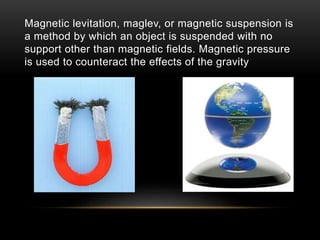
Magnetic levitation, maglev, or magnetic suspension is
a method by which an object is suspended with no
support other than magnetic fields. Magnetic pressure
is used to counteract the effects of the gravity
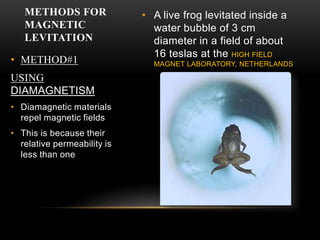
• A live frog levitated inside a
water bubble of 3 cm
diameter in a field of about
16 teslas at the HIGH FIELD
MAGNET LABORATORY, NETHERLANDS
METHODS FOR
MAGNETIC
LEVITATION
• METHOD#1
USING
DIAMAGNETISM
• Diamagnetic materials
repel magnetic fields
• This is because their
relative permeability is
less than one
.
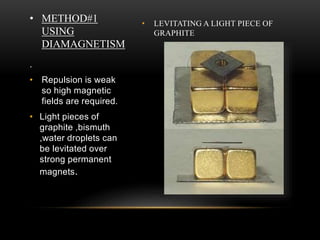
• Repulsion is weak
so high magnetic
fields are required.
• Light pieces of
graphite ,bismuth
,water droplets can
be levitated over
strong permanent
magnets.
• METHOD#1
USING
DIAMAGNETISM
• LEVITATING A LIGHT PIECE OF
GRAPHITE
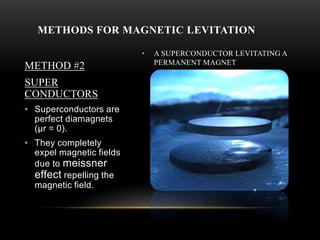
• A SUPERCONDUCTOR LEVITATING A
PERMANENT MAGNET
METHODS FOR MAGNETIC LEVITATION
METHOD #2
SUPER
CONDUCTORS
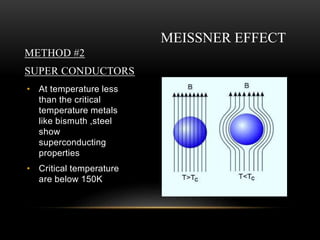
• Superconductors are
perfect diamagnets
(μr = 0).
• They completely
expel magnetic fields
due to meissner
effect repelling the
magnetic field.
• At temperature less
than the critical
temperature metals
like bismuth ,steel
show
superconducting
properties
• Critical temperature
are below 150K
MEISSNER EFFECT
METHOD #2
SUPER CONDUCTORS
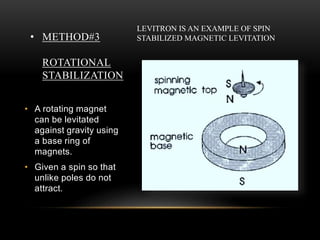
• METHOD#3
ROTATIONAL
STABILIZATION
• A rotating magnet
can be levitated
against gravity using
a base ring of
magnets.
• Given a spin so that
unlike poles do not
attract.
LEVITRON IS AN EXAMPLE OF SPIN
STABILIZED MAGNETIC LEVITATION
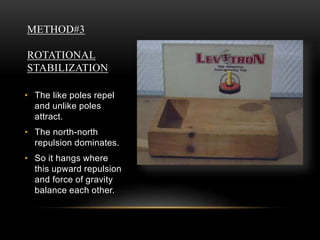
METHOD#3
ROTATIONAL
STABILIZATION
• The like poles repel
and unlike poles
attract.
• The north-north
repulsion dominates.
• So it hangs where
this upward repulsion
and force of gravity
balance each other.
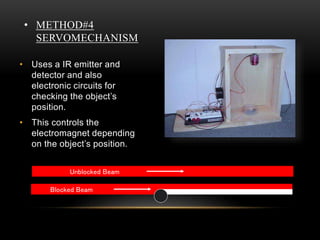
• Uses a IR emitter and
detector and also
electronic circuits for
checking the object’s
position.
• This controls the
electromagnet depending
on the object’s position.
• METHOD#4
SERVOMECHANISM
Blocked Beam
Unblocked Beam
METHOD#4
SERVOMECHANISM
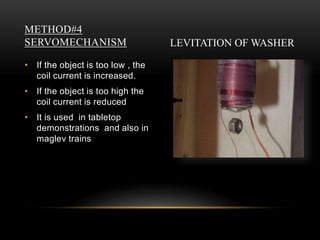
• If the object is too low , the
coil current is increased.
• If the object is too high the
coil current is reduced
• It is used in tabletop
demonstrations and also in
maglev trains
LEVITATION OF WASHER
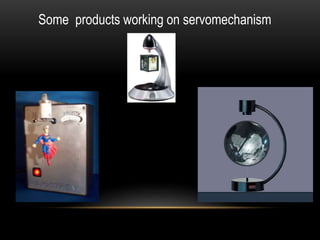
Some products working on servomechanism
MAGLEV TRAINS
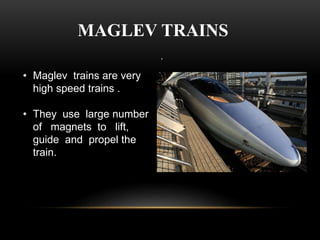
• Maglev trains are very
high speed trains .
• They use large number
of magnets to lift,
guide and propel the
train.
,
MAGLEV
TRAINS
• Two types of maglev
trains have been
developed.
1. EMS MAGLEV
TRAIN developed in
GERMANY
[TRANSRAPID]
2. EDS MAGLEV
TRAIN developed in
JAPAN.[JR MAGLEV
shown in picture ]
The highest recorded speed of the
JR MAGLEV train is 581 kilometres per
hour (361 mph),
ELECTROMAGNETIC
SUSPENSION[EMS]
• Electromagnets
controlled by
computers are used.
• They are present on
the sides and the
underside of the train.
• Attraction between the
steel track and
magnet on the
underside levitates
the train.
How does the train rise?
ELECTRO MAGNETIC
SUSPENSION[EMS]
GUIDING MAGNETS
• Magnetic forces may
not be constant on
the two sides.
• So ,electromagnets
are controlled by
computers to keep
the train in the
center.
front view of guiding magnets
side view
• Picture showing aluminium
windings
ELECTRO MAGNETIC
SUSPENSION[EMS]
PROPULSION
• Aluminium three
phase windings are
present in the track.
• When a current is
supplied to the
windings, it creates a
traveling alternating
current that propels
the train forward by
pushing and pulling.
ELECTRO MAGNETIC
SUSPENSION[EMS]
BRAKING
• When the alternating
current is reversed, the
train brakes.
• Different speeds are
achieved by varying the
intensity of the current.
• Only the section of track
where the train is
traveling is electrified.
ELECTRO DYNAMIC
SUSPENSION [EDS]
LEVITATION
• In electrodynamic
suspension (EDS), a
repulsive magnetic
field between the train
and the track levitates
the train.
• . Superconductors
cooled by liquid
helium or liquid
nitrogen are used in
the train and the track.
The JR-Maglev
ELECTRO DYNAMIC
SUSPENSION [EDS]
PROPULSION
• The train is naturally
stable.
• An alternating
current runs throw
the track.
• For braking it moves
in the reverse
direction.
THE
INDUCTRACK
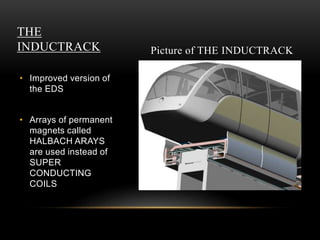
• Improved version of
the EDS
• Arrays of permanent
magnets called
HALBACH ARAYS
are used instead of
SUPER
CONDUCTING
COILS
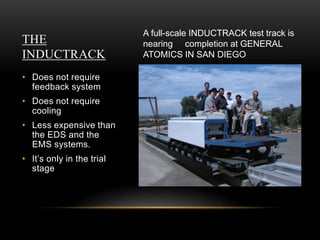
Picture of THE INDUCTRACK
THE
INDUCTRACK
• Does not require
feedback system
• Does not require
cooling
• Less expensive than
the EDS and the
EMS systems.
• It’s only in the trial
stage
A full-scale INDUCTRACK test track is
nearing completion at GENERAL
ATOMICS IN SAN DIEGO
ADVANTAGES OF MAGLEV TRAINS
• An average speed of
300mph is achieved.
• Time taken to reach
destination is as
good as an airplane
[including check in
and check out time ].
• Safer as there is no
risk of derailing.
ADVANTAGES OF MAGLEV TRAINS
• As there is no
mechanical friction ,
lesser maintenance
is required.
• No energy is wasted
as only the part of
the track that is to be
used is electrified.
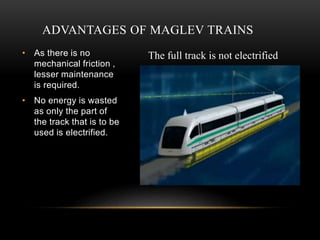
The full track is not electrified
DISADVANTAGES
OF MAGLEV TRAINS
• High initial cost
• The EDS MAGLEV
requires magnetic
shielding.
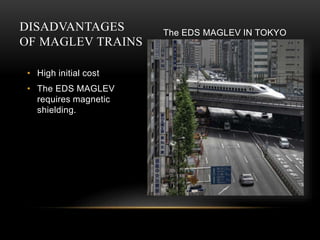
The EDS MAGLEV IN TOKYO
Start Quiz
A:
C:
B:
D:
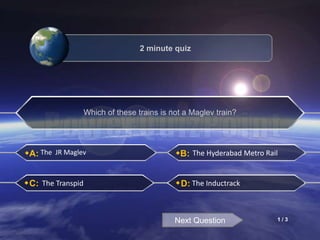
The JR Maglev The Hyderabad Metro Rail
The Transpid The Inductrack
Next Question
2 minute quiz
Which of these trains is not a Maglev train?
1 / 3
Next Question
You are correct
The HYDERABAD METRO RAIL is a wheeled mass
transit system. It's speed is 80km/hr
Try Again Next Question
You are wrong
You are wrong
A:
C:
B:
D:
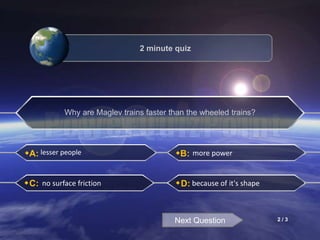
lesser people more power
no surface friction because of it's shape
Next Question
2 minute quiz
Why are Maglev trains faster than the wheeled trains?
2 / 3
There is only air friction in Maglev trains.
Even this friction can be eliminated if the
train is run in vacuum tunnels
Next Question
You are correct
Try Again Next Question
You are wrong
You are wrong
A:
C:
B:
D:
Professor Eric Laithwaite Rafael Nadal
Adam Gilchrist Morris Mano
2 minute quiz
The person who developed the first full-size working model of
linear induction motor, also developed the working Maglev
system. Identify the person.
3 / 3
You are correct
In the late 1940s, Professor Eric Laitwaite of Imperial
College ,London developed the first full-size working
model of the linear induction motor. In the early 1970s,
Laithwaite developed the maglev system.
REFERENCES
• http://www.howstuffworks.com/electromagnet.htm
• http://en.wikipedia.org/wiki/Magnet
• http://en.wikipedia.org/wiki/Electromagnet
• http://en.wikipedia.org/wiki/Magnetic_levitation
• http://en.wikipedia.org/wiki/Maglev_transport

Magnetic lev

  • 1.
  • 2.
    LEVITATION MEANS TORISE OR HOVER IN THE AIR Levitation as shown in magic shows and movies [not possible without tricks] TRICKS AND ILLUSIONS USED SPECIAL EFFECTS USED
  • 3.
    Magnetic levitation, maglev,or magnetic suspension is a method by which an object is suspended with no support other than magnetic fields. Magnetic pressure is used to counteract the effects of the gravity
  • 4.
    • A livefrog levitated inside a water bubble of 3 cm diameter in a field of about 16 teslas at the HIGH FIELD MAGNET LABORATORY, NETHERLANDS METHODS FOR MAGNETIC LEVITATION • METHOD#1 USING DIAMAGNETISM • Diamagnetic materials repel magnetic fields • This is because their relative permeability is less than one
  • 5.
    . • Repulsion isweak so high magnetic fields are required. • Light pieces of graphite ,bismuth ,water droplets can be levitated over strong permanent magnets. • METHOD#1 USING DIAMAGNETISM • LEVITATING A LIGHT PIECE OF GRAPHITE
  • 6.
    • A SUPERCONDUCTORLEVITATING A PERMANENT MAGNET METHODS FOR MAGNETIC LEVITATION METHOD #2 SUPER CONDUCTORS • Superconductors are perfect diamagnets (μr = 0). • They completely expel magnetic fields due to meissner effect repelling the magnetic field.
  • 7.
    • At temperatureless than the critical temperature metals like bismuth ,steel show superconducting properties • Critical temperature are below 150K MEISSNER EFFECT METHOD #2 SUPER CONDUCTORS
  • 8.
    • METHOD#3 ROTATIONAL STABILIZATION • Arotating magnet can be levitated against gravity using a base ring of magnets. • Given a spin so that unlike poles do not attract. LEVITRON IS AN EXAMPLE OF SPIN STABILIZED MAGNETIC LEVITATION
  • 9.
    METHOD#3 ROTATIONAL STABILIZATION • The likepoles repel and unlike poles attract. • The north-north repulsion dominates. • So it hangs where this upward repulsion and force of gravity balance each other.
  • 10.
    • Uses aIR emitter and detector and also electronic circuits for checking the object’s position. • This controls the electromagnet depending on the object’s position. • METHOD#4 SERVOMECHANISM Blocked Beam Unblocked Beam
  • 11.
    METHOD#4 SERVOMECHANISM • If theobject is too low , the coil current is increased. • If the object is too high the coil current is reduced • It is used in tabletop demonstrations and also in maglev trains LEVITATION OF WASHER
  • 12.
    Some products workingon servomechanism
  • 13.
    MAGLEV TRAINS • Maglevtrains are very high speed trains . • They use large number of magnets to lift, guide and propel the train. ,
  • 14.
    MAGLEV TRAINS • Two typesof maglev trains have been developed. 1. EMS MAGLEV TRAIN developed in GERMANY [TRANSRAPID] 2. EDS MAGLEV TRAIN developed in JAPAN.[JR MAGLEV shown in picture ] The highest recorded speed of the JR MAGLEV train is 581 kilometres per hour (361 mph),
  • 15.
    ELECTROMAGNETIC SUSPENSION[EMS] • Electromagnets controlled by computersare used. • They are present on the sides and the underside of the train. • Attraction between the steel track and magnet on the underside levitates the train. How does the train rise?
  • 16.
    ELECTRO MAGNETIC SUSPENSION[EMS] GUIDING MAGNETS •Magnetic forces may not be constant on the two sides. • So ,electromagnets are controlled by computers to keep the train in the center. front view of guiding magnets side view
  • 17.
    • Picture showingaluminium windings ELECTRO MAGNETIC SUSPENSION[EMS] PROPULSION • Aluminium three phase windings are present in the track. • When a current is supplied to the windings, it creates a traveling alternating current that propels the train forward by pushing and pulling.
  • 18.
    ELECTRO MAGNETIC SUSPENSION[EMS] BRAKING • Whenthe alternating current is reversed, the train brakes. • Different speeds are achieved by varying the intensity of the current. • Only the section of track where the train is traveling is electrified.
  • 19.
    ELECTRO DYNAMIC SUSPENSION [EDS] LEVITATION •In electrodynamic suspension (EDS), a repulsive magnetic field between the train and the track levitates the train. • . Superconductors cooled by liquid helium or liquid nitrogen are used in the train and the track. The JR-Maglev
  • 20.
    ELECTRO DYNAMIC SUSPENSION [EDS] PROPULSION •The train is naturally stable. • An alternating current runs throw the track. • For braking it moves in the reverse direction.
  • 21.
    THE INDUCTRACK • Improved versionof the EDS • Arrays of permanent magnets called HALBACH ARAYS are used instead of SUPER CONDUCTING COILS Picture of THE INDUCTRACK
  • 22.
    THE INDUCTRACK • Does notrequire feedback system • Does not require cooling • Less expensive than the EDS and the EMS systems. • It’s only in the trial stage A full-scale INDUCTRACK test track is nearing completion at GENERAL ATOMICS IN SAN DIEGO
  • 23.
    ADVANTAGES OF MAGLEVTRAINS • An average speed of 300mph is achieved. • Time taken to reach destination is as good as an airplane [including check in and check out time ]. • Safer as there is no risk of derailing.
  • 24.
    ADVANTAGES OF MAGLEVTRAINS • As there is no mechanical friction , lesser maintenance is required. • No energy is wasted as only the part of the track that is to be used is electrified. The full track is not electrified
  • 25.
    DISADVANTAGES OF MAGLEV TRAINS •High initial cost • The EDS MAGLEV requires magnetic shielding. The EDS MAGLEV IN TOKYO
  • 26.
  • 27.
    A: C: B: D: The JR MaglevThe Hyderabad Metro Rail The Transpid The Inductrack Next Question 2 minute quiz Which of these trains is not a Maglev train? 1 / 3
  • 28.
    Next Question You arecorrect The HYDERABAD METRO RAIL is a wheeled mass transit system. It's speed is 80km/hr
  • 29.
    Try Again NextQuestion You are wrong You are wrong
  • 30.
    A: C: B: D: lesser people morepower no surface friction because of it's shape Next Question 2 minute quiz Why are Maglev trains faster than the wheeled trains? 2 / 3
  • 31.
    There is onlyair friction in Maglev trains. Even this friction can be eliminated if the train is run in vacuum tunnels Next Question You are correct
  • 32.
    Try Again NextQuestion You are wrong You are wrong
  • 33.
    A: C: B: D: Professor Eric LaithwaiteRafael Nadal Adam Gilchrist Morris Mano 2 minute quiz The person who developed the first full-size working model of linear induction motor, also developed the working Maglev system. Identify the person. 3 / 3
  • 34.
    You are correct Inthe late 1940s, Professor Eric Laitwaite of Imperial College ,London developed the first full-size working model of the linear induction motor. In the early 1970s, Laithwaite developed the maglev system.
  • 35.
    REFERENCES • http://www.howstuffworks.com/electromagnet.htm • http://en.wikipedia.org/wiki/Magnet •http://en.wikipedia.org/wiki/Electromagnet • http://en.wikipedia.org/wiki/Magnetic_levitation • http://en.wikipedia.org/wiki/Maglev_transport