SOLAR CAR 2015-2016
ELECTRICAL&ELECTRONICS ENGINEERING 1 AL-AZHAR POLYTHECHINIC COLLEGE
MAGLEV 2015-2016
ELECTRICAL&ELECTRONICS ENGINEERING 2 AL-AZHAR POLYTHECHINIC COLLEGE
MAGLEV 2015-2016
CONTENTS
CHAPTER TITTLES PAGE.NO
Acknowledgement
Abstract
List of figures
1 Introduction 7
2 History 8-9
3 Maglev 10-11
4 The types of maglev
Methods
12
5 Suspension systems 13-14
6 Evolution of maglev 15-16
7 Technology and working of
maglev
17-22
8 Advantages&Disadvantage
s
23
9 Conclusion 24
10 Reference 25
ELECTRICAL&ELECTRONICS ENGINEERING 3 AL-AZHAR POLYTHECHINIC COLLEGE
MAGLEV 2015-2016
ACKNOWLEDGEMENT
Gracious help and guidance from many sources contributed
much to the success of the report presentation.
I have a lot of pleasure in expressing our thanks and whole
hearted gratitude to Ms. AJITH.S , Head of Electrical & Electronics
Engineering Department, Al-Azhar Polytechnic College,
Perumpillichira, for her instructions and encouragement for the report
presentation.
I express my deep appreciation and sincere thanks to DHANYA K
THOMAS, for providing the necessary advices, and all lecturers in
Electrical & Electronics Engineering Department, Al-Azhar Polytechnic
College for their whole hearted co-operation and adequate
encouragement given to us. I am very much grateful to Mr. Midun, for
his guidance and immense support.
I also express my sincere thanks to Sri. Febin P Latheef, the
Principal, Al-Azhar Polytechnic College, Perumpillichira, who gave me
full support and encouragement.
I also express my sincere thanks to Sri. Sheji Basheer, the
Administrative officer, Al-Azhar Polytechnic College, Perumpillichira,
for his immense support and encouragement.
I also express my sincere thanks to all our staff members for their
admissible help for my seminar.
ELECTRICAL&ELECTRONICS ENGINEERING 4 AL-AZHAR POLYTHECHINIC COLLEGE
MAGLEV 2015-2016
ABSTRACT
Maglev systems are becoming a popular application around the
globe. Maglev trains are popular in transportation stations in big
countries like Germany, China, Japan and the United States of America
due to the demand for high-speed transportation, as the general public
transportation services become more congested with increase of
population. Maglev trains are magnetically levitated trains that traverse
in a very high speed, with only electricity being its main source of
energy. The train propels forward without any friction from moving
mechanical parts. It has many advantages with minor drawbacks.
The basis of maglev trains mechanisms are magnetic levitation.
This is achieved with the principal of repulsion and attraction between
two magnetic poles. When two magnets have the same poles, it will repel
with each other and when it has different poles, the result would be
otherwise.
ELECTRICAL&ELECTRONICS ENGINEERING 5 AL-AZHAR POLYTHECHINIC COLLEGE
MAGLEV 2015-2016
LIST OF FIGURES
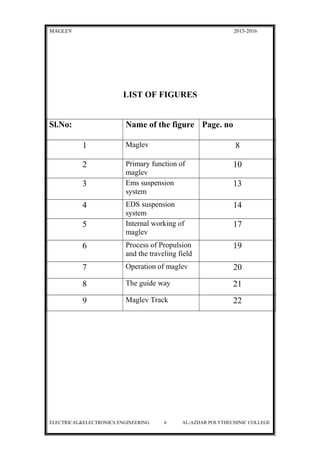
Sl.No: Name of the figure Page. no
1 Maglev 8
2 Primary function of
maglev
10
3 Ems suspension
system
13
4 EDS suspension
system
14
5 Internal working of
maglev
17
6 Process of Propulsion
and the traveling field
19
7 Operation of maglev 20
8 The guide way 21
9 Maglev Track 22
ELECTRICAL&ELECTRONICS ENGINEERING 6 AL-AZHAR POLYTHECHINIC COLLEGE
MAGLEV 2015-2016
Chapter 1
INTRODUCTION
The report titled ‘MAGLEV TRAINS’ accomplishes a research
on the developing discipline of magnetic levitation and its application to
transportation through trains. It provides detailed information about the
evolution of maglev science, its progression and improvisation till date.
High-speed magnetically levitated ground transportation (maglev) is a
new surface mode of transportation, in which vehicles glide above their
guideways, suspended, guided, and propelled by magnetic forces. This
report tries to explain the complexities involved in this technology in a
simple but precise manner, so that all the methods implemented in it are
understood by the reader at prima facie. This report, tries to compare the
conventional modes of transport with maglev trains in various aspects
such as safety, durability, speed, comfort and so on. Thus, providing the
advantages and disadvantages of the trains. Further, this report helps us
to learn about the various cities around the world, where maglev trains
currently run and also provides an overview of the proposals for such
trains, which are being considered as a promising investment globally.
Consecutively, it deals with the accidents that have occurred at places
where maglev trains have been implemented and the reasons that
triggered them. This data has been included so that such incidents may
be avoided in the future and in order that certain necessary modifications
are made to improve the safety measures of these trains. Capable of
travelling at speeds of 250 to 300 miles-per-hour or higher, maglev
would offer an attractive and convenient alternative for travellers
between large urban areas for trips of up to 600 miles. It would also help
relieve current and projected air and highway congestion by substituting
for short-haul air trips, thus releasing capacity for more efficient long-
haul service at crowded airports, and by diverting a portion of highway
trips. Finally, our report gives a peek into the future expansions of
maglev trains and thus undoubtedly assures its readers that maglev trains
are no longer a science fiction, and are in fact the future of world
transportation.
ELECTRICAL&ELECTRONICS ENGINEERING 7 AL-AZHAR POLYTHECHINIC COLLEGE
MAGLEV 2015-2016
Chapter 2
History
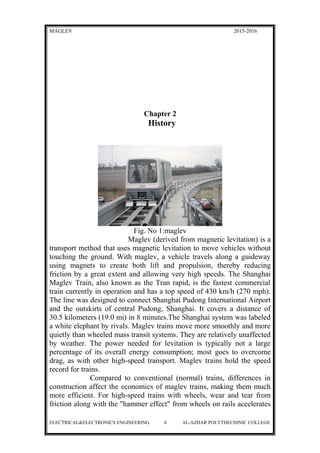
Fig. No 1:maglev
Maglev (derived from magnetic levitation) is a
transport method that uses magnetic levitation to move vehicles without
touching the ground. With maglev, a vehicle travels along a guideway
using magnets to create both lift and propulsion, thereby reducing
friction by a great extent and allowing very high speeds. The Shanghai
Maglev Train, also known as the Tran rapid, is the fastest commercial
train currently in operation and has a top speed of 430 km/h (270 mph).
The line was designed to connect Shanghai Pudong International Airport
and the outskirts of central Pudong, Shanghai. It covers a distance of
30.5 kilometers (19.0 mi) in 8 minutes.The Shanghai system was labeled
a white elephant by rivals. Maglev trains move more smoothly and more
quietly than wheeled mass transit systems. They are relatively unaffected
by weather. The power needed for levitation is typically not a large
percentage of its overall energy consumption; most goes to overcome
drag, as with other high-speed transport. Maglev trains hold the speed
record for trains.
Compared to conventional (normal) trains, differences in
construction affect the economics of maglev trains, making them much
more efficient. For high-speed trains with wheels, wear and tear from
friction along with the "hammer effect" from wheels on rails accelerates
ELECTRICAL&ELECTRONICS ENGINEERING 8 AL-AZHAR POLYTHECHINIC COLLEGE
MAGLEV 2015-2016
equipment wear and prevents high speeds. Conversely, maglev systems
have been much more expensive to construct, offsetting lower
maintenance costs. Despite decades of research and development, only
two commercial maglev transport systems are in operation, with two
others under construction.[note 1] In April 2004, Shanghai's Transrapid
system began commercial operations. In March 2005, Japan began
operation of its relatively low-speed HSST "Linimo" line in time for the
2005 World Expo. In its first three months, the Linimo line carried over
10 million passengers. South Korea became the world's second country
to succeed in commercializing maglev technology with the Incheon
Airport Maglev beginning commercial operation in February 3, 2016.
In the late 1940s, the British electrical engineer
Eric Laithwaite, a professor at Imperial College London, developed the
first full-size working model of the linear induction motor. He became
professor of heavy electrical engineering at Imperial College in 1964,
where he continued his successful development of the linear motor.
Since linear motors do not require physical contact between the vehicle
and guide way, they became a common fixture on advanced
transportation systems in the 1960s and 70s. Laithwaite joined one such
project, the tracked hovercraft, although the project was cancelled in
1973. The linear motor was naturally suited to use with maglev systems
as well. In the early 1970s, Laithwaite discovered a new arrangement of
magnets, the magnetic river, that allowed a single linear motor to
produce both lift and forward thrust, allowing a maglev system to be
built with a single set of magnets. Working at the British Rail Research
Division in Derby, along with teams at several civil engineering firms,
the "transverse-flux" system was developed into a working system. The
first commercial maglev people mover was simply called "MAGLEV"
and officially opened in 1984 near Birmingham, England. It operated on
an elevated 600-metre (2,000 ft) section of monorail track between
Birmingham Airport and Birmingham International railway station,
running at speeds up to 42 km/h (26 mph). The system was closed in
1995 due to reliability problems.
ELECTRICAL&ELECTRONICS ENGINEERING 9 AL-AZHAR POLYTHECHINIC COLLEGE
MAGLEV 2015-2016
Chapter 3
Maglev
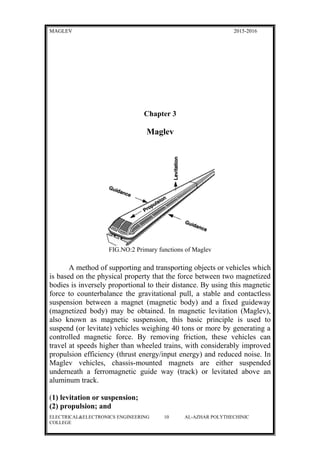
FIG.NO:2 Primary functions of Maglev
A method of supporting and transporting objects or vehicles which
is based on the physical property that the force between two magnetized
bodies is inversely proportional to their distance. By using this magnetic
force to counterbalance the gravitational pull, a stable and contactless
suspension between a magnet (magnetic body) and a fixed guideway
(magnetized body) may be obtained. In magnetic levitation (Maglev),
also known as magnetic suspension, this basic principle is used to
suspend (or levitate) vehicles weighing 40 tons or more by generating a
controlled magnetic force. By removing friction, these vehicles can
travel at speeds higher than wheeled trains, with considerably improved
propulsion efficiency (thrust energy/input energy) and reduced noise. In
Maglev vehicles, chassis-mounted magnets are either suspended
underneath a ferromagnetic guide way (track) or levitated above an
aluminum track.
(1) levitation or suspension;
(2) propulsion; and
ELECTRICAL&ELECTRONICS ENGINEERING 10 AL-AZHAR POLYTHECHINIC
COLLEGE
MAGLEV 2015-2016
(3) guidance.
In most current designs, magnetic forces are used to perform all
three functions, although a nonmagnetic source of propulsion could be
used. No consensus exists on an optimum design to perform each of the
primary functions.
In the attraction-type system, a magnet-guideway geometry is used to
attract a direct-current electromagnet toward the track. This system, also
known as the electromagnetic suspension (EMS) system, is suitable for
low- and high-speed passenger-carrying vehicles and a wide range of
magnetic bearings. The electromagnetic suspension system is inherently
nonlinear and unstable, requiring an active feedback to maintain an
upward lift force equal to the weight of the suspended magnet and its
payload (vehicle).
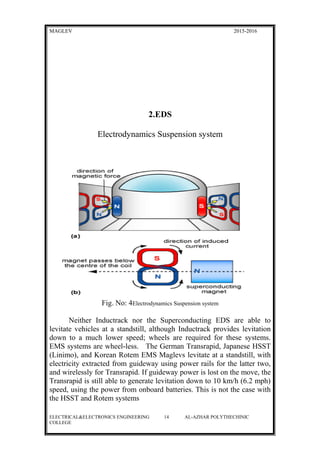
In the repulsion-type system, also known as the electrodynamic
levitation system (EDS or EDL), a superconducting coil operating in
persistent-current mode is moved longitudinally along a conducting
surface (an aluminum plate fixed on the ground and acting as the
guideway) to induce circulating eddy currents in the aluminum plate.
These eddy currents create a magnetic field which, by Lenz’s law,
opposes the magnetic field generated by the travelling coil. This
interaction produces a repulsion force on the moving coil. At lower
speeds, this vertical force is not sufficient to lift the coil (and its
payload), so supporting auxiliary wheels are needed until the net
repulsion force is positive. The speed at which the net upward lift force
is positive (critical speed) is dependent on the magnetic field in the
airgap and payload, and is typically around 80 km/h (50 mi/h). To
produce high flux from the traveling coils, hard superconductors (type II)
with relatively high values of the critical field (the magnetic field
strength of the coil at 0 K) are used to yield airgap flux densities of over
4 tesla. With this choice, the strong eddy-current induced magnetic field
is rejected by the superconducting field, giving a self-stabilizing
levitation force at high speeds (though additional control circuitry is
required for adequate damping and ride quality.
ELECTRICAL&ELECTRONICS ENGINEERING 11 AL-AZHAR POLYTHECHINIC
COLLEGE
MAGLEV 2015-2016
Chapter 4
The Types of Maglev Methods
• Repulsion between like poles of permanent magnets or
electromagnets.
• Repulsion between a magnet and a metallic conductor induced by
relative motion.
• Repulsion between a metallic conductor and an AC electromagnet.
• Repulsion between a magnetic field and a diamagnetic substance.
• Repulsion between a magnet and a superconductor.
• Attraction between unlike poles of permanent magnets or
electromagnets.
• Attraction between the open core of an electromagnetic solenoid
and a piece of iron or a magnet.
• Attraction between a permanent magnet or electromagnet and a
piece of iron.
• Attraction between an electromagnet and a piece of iron or a
magnet, with sensors and active control of the current to the
electromagnet used to maintain some distance between them.
• Repulsion between an electromagnet and a magnet, with sensors
and active control of the current to the electromagnet used to
maintain some distance between them.
ELECTRICAL&ELECTRONICS ENGINEERING 12 AL-AZHAR POLYTHECHINIC
COLLEGE
MAGLEV 2015-2016
Chapter 5
Suspension systems
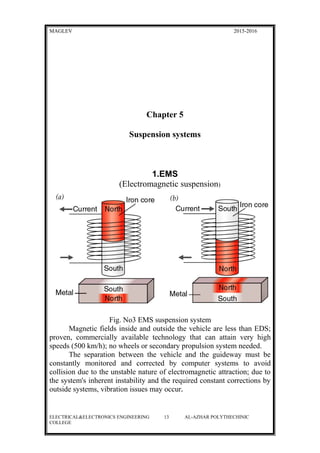
1.EMS
(Electromagnetic suspension)
Fig. No3 EMS suspension system
Magnetic fields inside and outside the vehicle are less than EDS;
proven, commercially available technology that can attain very high
speeds (500 km/h); no wheels or secondary propulsion system needed.
The separation between the vehicle and the guideway must be
constantly monitored and corrected by computer systems to avoid
collision due to the unstable nature of electromagnetic attraction; due to
the system's inherent instability and the required constant corrections by
outside systems, vibration issues may occur.
ELECTRICAL&ELECTRONICS ENGINEERING 13 AL-AZHAR POLYTHECHINIC
COLLEGE
MAGLEV 2015-2016
2.EDS
Electrodynamics Suspension system
Fig. No: 4Electrodynamics Suspension system
Neither Inductrack nor the Superconducting EDS are able to
levitate vehicles at a standstill, although Inductrack provides levitation
down to a much lower speed; wheels are required for these systems.
EMS systems are wheel-less. The German Transrapid, Japanese HSST
(Linimo), and Korean Rotem EMS Maglevs levitate at a standstill, with
electricity extracted from guideway using power rails for the latter two,
and wirelessly for Transrapid. If guideway power is lost on the move, the
Transrapid is still able to generate levitation down to 10 km/h (6.2 mph)
speed, using the power from onboard batteries. This is not the case with
the HSST and Rotem systems
ELECTRICAL&ELECTRONICS ENGINEERING 14 AL-AZHAR POLYTHECHINIC
COLLEGE
MAGLEV 2015-2016
Chapter 6
Evolution of Maglev
The goal of using magnets to achieve high speed travel with non-
contact magnetically levitated vehicles is almost a century old. In the
early 1900's, Bachelet in France and Goddard in the United States
discuss the possibility of using magnetically levitated vehicles for high
speed transport. However, they do not propose a practical way to achieve
this goal.
On August 14, 1934, Hermann Kemper of Germany receives a patent for
the magnetic levitation of trains. Research continues after World War II.
In the 1970s and 1980s, development, commissioning, testing and
implementation of various Maglev Train systems continues in Germany
by Thyssen Henschel. The Germans name their Maglev system
"Transrapid".
In 1966, in the USA, James Powell and Gordon Danby propose the first
practical system for magnetically levitated transport, using
superconducting magnets located on moving vehicles to induce currents
in normal aluminum loops on a guideway. The moving vehicles are
automatically levitated and stabilized, both vertically and laterally, as
they move along the guideway. The vehicles are magnetically propelled
along the guideway by a small AC current in the guideway.
In 1992, the Federal Government in Germany decides to include the 300
km long superspeed Maglev system route Berlin-Hamburg in the 1992
Federal Transportation Master Plan.
In June of 1998, the US congress passes the Transportation Equity Act
for the 21st Century (TEA 21). The law includes a Maglev deployment
program allocating public funds for preliminary activities with regard to
several projects and, later on, further funds for the design, engineering
and construction of a selected project. For the fiscal years 1999 - 2001,
$55 million are provided for the Maglev deployment program. An
additional $950 million are budgeted for the actual construction of the
first project. In November of 1999, the Chinese Ministry of Science and
Technology and Transrapid International sign a letter of intent to select a
ELECTRICAL&ELECTRONICS ENGINEERING 15 AL-AZHAR POLYTHECHINIC
COLLEGE
MAGLEV 2015-2016
suitable Transrapid route in the People's Republic of China and evaluate
its technical and economic feasibility.
In January of 2001, in the US, Transportation Secretary Rodney Slater
selects the Pittsburgh and the Washington - Baltimore routes for detailed
environmental and project planning. Later that month in China, a
contract is concluded between the city of Shanghai and the industrial
consortium consisting of Siemens, ThyssenKrupp, and Transrapid
International to realize16 the Shanghai airport link. In March, the
construction of the Shanghai project begins.
Currently, the original Powell-Danby Maglev inventions form the basis
for the Maglev system in Japan, which is being demonstrated in
Yamanashi Prefecture, Japan. Powell and Danby have subsequently
developed new Maglev inventions that form the basis for their second
generation M-2000 System. Other Maglev Train systems are in the
planning and development stages in various cities in the US, including
projects in Georgia, California and Pennsylvania.
In the future, Maglev promises to be the major new mode of transport for
the 21st Century and beyond because of its energy efficiency,
environmental benefits and time-saving high velocity transport. Because
there is no mechanical contact between the vehicles and the guideway,
speeds can be extremely high. Traveling in the atmosphere, air drag
limits vehicles to speeds of about 300 - 350 mph. Traveling in low
pressure tunnels, Maglev vehicles can operate at speeds of thousands of
miles per hour. The energy efficiency of Maglev transport, either in
kilowatt-hours per passenger mile for personal transport, or kilowatt
hours per ton-mile for freight, is much lower for Maglev than for autos,
trucks, and airplanes. It is pollution free, can use renewable energy
sources such as solar and wind power, and in contrast to oil and gas
fueled transport, does not contribute to global warming. It is weather
independent, and can carry enormous traffic loads - both people and
goods - on environmentally friendly, narrow guideways. The cost of
moving people and goods by Maglev will be considerably less than by
the present modes of auto, truck, rail, and air
ELECTRICAL&ELECTRONICS ENGINEERING 16 AL-AZHAR POLYTHECHINIC
COLLEGE
MAGLEV 2015-2016
Chapter 7
TECHNOLOGY AND WORKING OF MAGLEV TRAINS
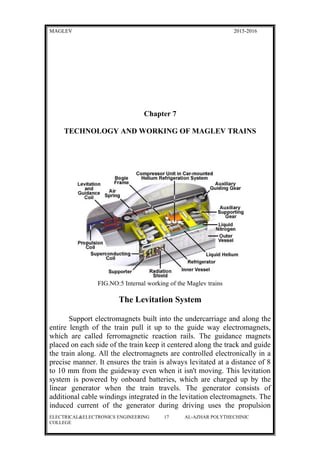
FIG.NO:5 Internal working of the Maglev trains
The Levitation System
Support electromagnets built into the undercarriage and along the
entire length of the train pull it up to the guide way electromagnets,
which are called ferromagnetic reaction rails. The guidance magnets
placed on each side of the train keep it centered along the track and guide
the train along. All the electromagnets are controlled electronically in a
precise manner. It ensures the train is always levitated at a distance of 8
to 10 mm from the guideway even when it isn't moving. This levitation
system is powered by onboard batteries, which are charged up by the
linear generator when the train travels. The generator consists of
additional cable windings integrated in the levitation electromagnets. The
induced current of the generator during driving uses the propulsion
ELECTRICAL&ELECTRONICS ENGINEERING 17 AL-AZHAR POLYTHECHINIC
COLLEGE
MAGLEV 2015-2016
magnetic field's harmonic waves, which are due to the side effects of the
grooves of the long stator so the charging up process does not consume
the useful propulsion magnetic field. The train can rely on this battery
power for up to one hour without an external power source. The
levitation system is independent from the propulsion system.
System
Electronically controlled support magnets located on both sides along the
entire length of the vehicle pull the vehicle up to the ferromagnetic stator
packs mounted to the underside of the guideway.
Guidance magnets located on both sides along the entire length of the
vehicle keep the vehicle laterally on the track. Electronic systems
guarantee that the clearance remains constant (nominally 10 mm). To
hover, the Maglev requires less power than its air conditioning
equipment. The levitation system is supplied from on-board batteries and
thus independent of the propulsion system. The vehicle is capable of
hovering up to one hour without external energy. While travelling, the
on-board batteries are recharged by linear generators integrated into the
support magnets
ELECTRICAL&ELECTRONICS ENGINEERING 18 AL-AZHAR POLYTHECHINIC
COLLEGE
MAGLEV 2015-2016
Propulsion System
FIG .NO6:Process of Propulsion and the traveling field
The synchronous longstator linear motor of the Maglev maglev system is
used both for propulsion and braking. It is functioning like a rotating
electric motor whose stator is cut open and stretched along under the
guideway. Inside the motor windings, alternating current is generating a
magnetic traveling field which moves the vehicle without contact. The
support magnets in the vehicle function as the excitation portion (rotor).
Theabove fig showsProcess of Propulsion and the traveling field
propulsion system in the guideway is activated only in the section
where the vehicle actually runs. The speed can be continuously
regulated by varying the frequency of the alternating current. If the
direction of the traveling field is reversed, the motor becomes a generator
which brakes the vehicle without any contact. The braking energy can be
re-used and fed back into the electrical network. The three-phase winded
ELECTRICAL&ELECTRONICS ENGINEERING 19 AL-AZHAR POLYTHECHINIC
COLLEGE
MAGLEV 2015-2016
stator generates an electromagnetic travelling field and moves the train
when it is supplied with an alternating current. The electronmagnetic
field from the support electromagnets (rotor) pulls it along. The magnetic
field direction and speed of the stator and the rotor are synchronized. The
Maglev's speed can vary from standstill to full operating speed by simply
adjusting the frequency of the alternating current. To bring the train to a
full stop, the direction of the travelling field is reversed. Even during
braking, there isn't any mechanical contact between the stator and the
rotor. Instead of consuming energy, the Maglev system acts as a
generator, converting the breaking energy into electricity, which can be
used elsewhere.
The Operation Control System
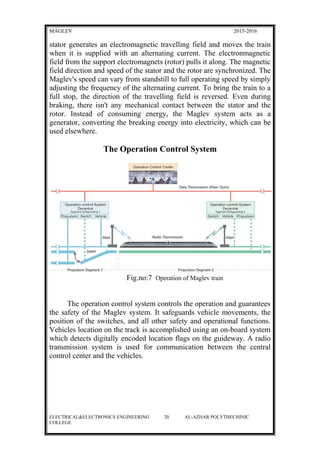
Fig.no:7 Operation of Maglev train
The operation control system controls the operation and guarantees
the safety of the Maglev system. It safeguards vehicle movements, the
position of the switches, and all other safety and operational functions.
Vehicles location on the track is accomplished using an on-board system
which detects digitally encoded location flags on the guideway. A radio
transmission system is used for communication between the central
control center and the vehicles.
ELECTRICAL&ELECTRONICS ENGINEERING 20 AL-AZHAR POLYTHECHINIC
COLLEGE
MAGLEV 2015-2016
The Guide way
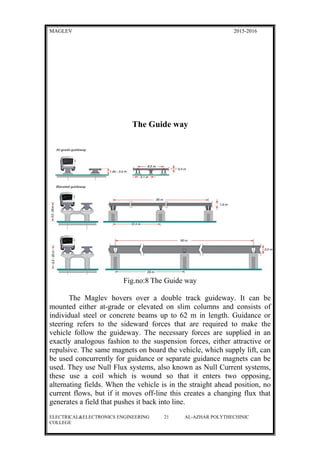
Fig.no:8 The Guide way
The Maglev hovers over a double track guideway. It can be
mounted either at-grade or elevated on slim columns and consists of
individual steel or concrete beams up to 62 m in length. Guidance or
steering refers to the sideward forces that are required to make the
vehicle follow the guideway. The necessary forces are supplied in an
exactly analogous fashion to the suspension forces, either attractive or
repulsive. The same magnets on board the vehicle, which supply lift, can
be used concurrently for guidance or separate guidance magnets can be
used. They use Null Flux systems, also known as Null Current systems,
these use a coil which is wound so that it enters two opposing,
alternating fields. When the vehicle is in the straight ahead position, no
current flows, but if it moves off-line this creates a changing flux that
generates a field that pushes it back into line.
ELECTRICAL&ELECTRONICS ENGINEERING 21 AL-AZHAR POLYTHECHINIC
COLLEGE
MAGLEV 2015-2016
The Maglev system changes tracks using steel bendable switches.
They consist of continuous steel box beams with length between 78 m
and 148 m (256 ft - 486 ft) which are elastically bent by means of
electromagnetic setting drives and securely locked in their end positions.
In the straight position, the vehicle can cross the switch without speed
restrictions, in the turnout position, the speed is limited to 200 km/h (125
mph) (high speed switch) or 100 km/h (62 mph) (low speed switch).
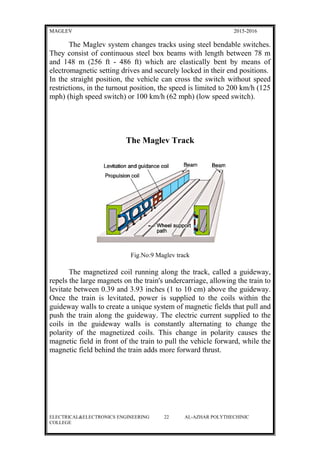
The Maglev Track
Fig.No:9 Maglev track
The magnetized coil running along the track, called a guideway,
repels the large magnets on the train's undercarriage, allowing the train to
levitate between 0.39 and 3.93 inches (1 to 10 cm) above the guideway.
Once the train is levitated, power is supplied to the coils within the
guideway walls to create a unique system of magnetic fields that pull and
push the train along the guideway. The electric current supplied to the
coils in the guideway walls is constantly alternating to change the
polarity of the magnetized coils. This change in polarity causes the
magnetic field in front of the train to pull the vehicle forward, while the
magnetic field behind the train adds more forward thrust.
ELECTRICAL&ELECTRONICS ENGINEERING 22 AL-AZHAR POLYTHECHINIC
COLLEGE
MAGLEV 2015-2016
CHAPTER 8
ADVANTAGES& DISADVANTGES
• The foremost advantage of maglev trains is the fact that it doesn't
have moving parts as conventional trains do, and therefore, the
wear and tear of parts is minimal, and that reduces the
maintenance cost by a significant extent.
• More importantly, there is no physical contact between the train
and track, so there is no rolling resistance. While electromagnetic
drag and air friction do exist, that doesn't hinder their ability to
clock a speed in excess of 200 mph.
• Absence of wheels also comes as a boon, as you don't have to
deal with deafening noise that is likely to come with them.
• Maglevs also boast of being environment friendly, as they don't
resort to internal combustion engines.
• These trains are weather proof, which means rain, snow, or severe
cold don't really hamper their performance.
• Experts are of the opinion that these trains are a lot safe than their
conventional counterparts as they are equipped with state-of-the-
art safety systems, which can keep things in control even when the
train is cruising at a high speed.
Disadvantages of Maglevs
• While the advantages of Maglev Train System may seem quite
promising in themselves, they are not enough to overshadow the
biggest problem with the maglev trains: the high cost incurred on
the initial setup. While the fast conventional trains that have been
introduced of late, work fine on tracks which were meant for slow
trains, maglev trains require an all new set up right from the
ELECTRICAL&ELECTRONICS ENGINEERING 23 AL-AZHAR POLYTHECHINIC
COLLEGE
MAGLEV 2015-2016
scratch. As the present railway infrastructure is of no use for
maglevs, it will either have to be replaced with the Maglev System
or an entirely new set up will have to be created―both of which
will cost a decent amount in terms of initial investment. Even
though inexpensive as compared to EDS, it is still expensive
compared to other modes.
CONCLUTION
This report gives us an insight about the principle of maglev as
well as its application in running maglev trains. Also, the intricate
complexities of the maglev technology have been explained. Its
implementation in the various cities of the world and its innumerable
advantages just take it a step closer to being the future of transportation.
Maglev trains are soon going to be the new way of transportation. Just a
few obstacles are in the way, but with some more improvisations nothing
is impossible. With no engine, no wheels, no pollution, new source of
energy, floating on air, the concept has taken tens of years to develop and
just recently its true capabilities have been realized. Competing planes
with speed, ships with efficiency, traditional trains with safety, and cars
with comfort, it seems like a promising means of transport. Maglev
trains are environment friendly; noise pollution is minimized because
there is no wheel to rail contact (frictionless). A maglev train operating at
150mph is inaudible to a person standing 25 miles away. The system
encourages land conservation, which is especially useful where land is
costly or unavailable. Tracks for the trains are easily built on elevated
platforms; this provides opportunity for construction and development
underneath and prevents land dissection and also reduces animal
collisions. This assertion can prove useful in constructing guide ways for
maglev trains across residential areas, schools, religious places, tourist
spots, etc. However, the cost of construction of these trains runs into
billions of dollars. The high cost of these trains is the only deterrent
factor which is preventing the train from being executed everywhere.
Continued research in this field along with active interest from the
various governments in the world can reduce the costing considerably
with cheaper options not compromising on the safety.
ELECTRICAL&ELECTRONICS ENGINEERING 24 AL-AZHAR POLYTHECHINIC
COLLEGE
MAGLEV 2015-2016
REFRENCE
1. www.hk-phy.org/articles/maglev/maglev_e.html
2. www.gluckman.com/Maglev.html
3. www.o-keating.com/hsr/maglev.htm
4. www.calpoly.edu/~cm/studpage/clottich/phys.html
5. www.sasked.gov.sk.ca/docs/physics/u7c3phy.html
6. www.tonmeister.ca/main/textbook/electronics/07.html
7. www.techtv.com/news/culture/story/ 0,24195,3370193,00.html
8. www.melroseps.vic.edu.au/Science
%20OnLine/Phy/sub/electmag/electmag.htm
9. http://
ELECTRICAL&ELECTRONICS ENGINEERING 25 AL-AZHAR POLYTHECHINIC
COLLEGE

MAGELEV TRAINS report seminar report

  • 1.
    SOLAR CAR 2015-2016 ELECTRICAL&ELECTRONICSENGINEERING 1 AL-AZHAR POLYTHECHINIC COLLEGE
  • 2.
  • 3.
    MAGLEV 2015-2016 CONTENTS CHAPTER TITTLESPAGE.NO Acknowledgement Abstract List of figures 1 Introduction 7 2 History 8-9 3 Maglev 10-11 4 The types of maglev Methods 12 5 Suspension systems 13-14 6 Evolution of maglev 15-16 7 Technology and working of maglev 17-22 8 Advantages&Disadvantage s 23 9 Conclusion 24 10 Reference 25 ELECTRICAL&ELECTRONICS ENGINEERING 3 AL-AZHAR POLYTHECHINIC COLLEGE
  • 4.
    MAGLEV 2015-2016 ACKNOWLEDGEMENT Gracious helpand guidance from many sources contributed much to the success of the report presentation. I have a lot of pleasure in expressing our thanks and whole hearted gratitude to Ms. AJITH.S , Head of Electrical & Electronics Engineering Department, Al-Azhar Polytechnic College, Perumpillichira, for her instructions and encouragement for the report presentation. I express my deep appreciation and sincere thanks to DHANYA K THOMAS, for providing the necessary advices, and all lecturers in Electrical & Electronics Engineering Department, Al-Azhar Polytechnic College for their whole hearted co-operation and adequate encouragement given to us. I am very much grateful to Mr. Midun, for his guidance and immense support. I also express my sincere thanks to Sri. Febin P Latheef, the Principal, Al-Azhar Polytechnic College, Perumpillichira, who gave me full support and encouragement. I also express my sincere thanks to Sri. Sheji Basheer, the Administrative officer, Al-Azhar Polytechnic College, Perumpillichira, for his immense support and encouragement. I also express my sincere thanks to all our staff members for their admissible help for my seminar. ELECTRICAL&ELECTRONICS ENGINEERING 4 AL-AZHAR POLYTHECHINIC COLLEGE
  • 5.
    MAGLEV 2015-2016 ABSTRACT Maglev systemsare becoming a popular application around the globe. Maglev trains are popular in transportation stations in big countries like Germany, China, Japan and the United States of America due to the demand for high-speed transportation, as the general public transportation services become more congested with increase of population. Maglev trains are magnetically levitated trains that traverse in a very high speed, with only electricity being its main source of energy. The train propels forward without any friction from moving mechanical parts. It has many advantages with minor drawbacks. The basis of maglev trains mechanisms are magnetic levitation. This is achieved with the principal of repulsion and attraction between two magnetic poles. When two magnets have the same poles, it will repel with each other and when it has different poles, the result would be otherwise. ELECTRICAL&ELECTRONICS ENGINEERING 5 AL-AZHAR POLYTHECHINIC COLLEGE
  • 6.
    MAGLEV 2015-2016 LIST OFFIGURES Sl.No: Name of the figure Page. no 1 Maglev 8 2 Primary function of maglev 10 3 Ems suspension system 13 4 EDS suspension system 14 5 Internal working of maglev 17 6 Process of Propulsion and the traveling field 19 7 Operation of maglev 20 8 The guide way 21 9 Maglev Track 22 ELECTRICAL&ELECTRONICS ENGINEERING 6 AL-AZHAR POLYTHECHINIC COLLEGE
  • 7.
    MAGLEV 2015-2016 Chapter 1 INTRODUCTION Thereport titled ‘MAGLEV TRAINS’ accomplishes a research on the developing discipline of magnetic levitation and its application to transportation through trains. It provides detailed information about the evolution of maglev science, its progression and improvisation till date. High-speed magnetically levitated ground transportation (maglev) is a new surface mode of transportation, in which vehicles glide above their guideways, suspended, guided, and propelled by magnetic forces. This report tries to explain the complexities involved in this technology in a simple but precise manner, so that all the methods implemented in it are understood by the reader at prima facie. This report, tries to compare the conventional modes of transport with maglev trains in various aspects such as safety, durability, speed, comfort and so on. Thus, providing the advantages and disadvantages of the trains. Further, this report helps us to learn about the various cities around the world, where maglev trains currently run and also provides an overview of the proposals for such trains, which are being considered as a promising investment globally. Consecutively, it deals with the accidents that have occurred at places where maglev trains have been implemented and the reasons that triggered them. This data has been included so that such incidents may be avoided in the future and in order that certain necessary modifications are made to improve the safety measures of these trains. Capable of travelling at speeds of 250 to 300 miles-per-hour or higher, maglev would offer an attractive and convenient alternative for travellers between large urban areas for trips of up to 600 miles. It would also help relieve current and projected air and highway congestion by substituting for short-haul air trips, thus releasing capacity for more efficient long- haul service at crowded airports, and by diverting a portion of highway trips. Finally, our report gives a peek into the future expansions of maglev trains and thus undoubtedly assures its readers that maglev trains are no longer a science fiction, and are in fact the future of world transportation. ELECTRICAL&ELECTRONICS ENGINEERING 7 AL-AZHAR POLYTHECHINIC COLLEGE
  • 8.
    MAGLEV 2015-2016 Chapter 2 History Fig.No 1:maglev Maglev (derived from magnetic levitation) is a transport method that uses magnetic levitation to move vehicles without touching the ground. With maglev, a vehicle travels along a guideway using magnets to create both lift and propulsion, thereby reducing friction by a great extent and allowing very high speeds. The Shanghai Maglev Train, also known as the Tran rapid, is the fastest commercial train currently in operation and has a top speed of 430 km/h (270 mph). The line was designed to connect Shanghai Pudong International Airport and the outskirts of central Pudong, Shanghai. It covers a distance of 30.5 kilometers (19.0 mi) in 8 minutes.The Shanghai system was labeled a white elephant by rivals. Maglev trains move more smoothly and more quietly than wheeled mass transit systems. They are relatively unaffected by weather. The power needed for levitation is typically not a large percentage of its overall energy consumption; most goes to overcome drag, as with other high-speed transport. Maglev trains hold the speed record for trains. Compared to conventional (normal) trains, differences in construction affect the economics of maglev trains, making them much more efficient. For high-speed trains with wheels, wear and tear from friction along with the "hammer effect" from wheels on rails accelerates ELECTRICAL&ELECTRONICS ENGINEERING 8 AL-AZHAR POLYTHECHINIC COLLEGE
  • 9.
    MAGLEV 2015-2016 equipment wearand prevents high speeds. Conversely, maglev systems have been much more expensive to construct, offsetting lower maintenance costs. Despite decades of research and development, only two commercial maglev transport systems are in operation, with two others under construction.[note 1] In April 2004, Shanghai's Transrapid system began commercial operations. In March 2005, Japan began operation of its relatively low-speed HSST "Linimo" line in time for the 2005 World Expo. In its first three months, the Linimo line carried over 10 million passengers. South Korea became the world's second country to succeed in commercializing maglev technology with the Incheon Airport Maglev beginning commercial operation in February 3, 2016. In the late 1940s, the British electrical engineer Eric Laithwaite, a professor at Imperial College London, developed the first full-size working model of the linear induction motor. He became professor of heavy electrical engineering at Imperial College in 1964, where he continued his successful development of the linear motor. Since linear motors do not require physical contact between the vehicle and guide way, they became a common fixture on advanced transportation systems in the 1960s and 70s. Laithwaite joined one such project, the tracked hovercraft, although the project was cancelled in 1973. The linear motor was naturally suited to use with maglev systems as well. In the early 1970s, Laithwaite discovered a new arrangement of magnets, the magnetic river, that allowed a single linear motor to produce both lift and forward thrust, allowing a maglev system to be built with a single set of magnets. Working at the British Rail Research Division in Derby, along with teams at several civil engineering firms, the "transverse-flux" system was developed into a working system. The first commercial maglev people mover was simply called "MAGLEV" and officially opened in 1984 near Birmingham, England. It operated on an elevated 600-metre (2,000 ft) section of monorail track between Birmingham Airport and Birmingham International railway station, running at speeds up to 42 km/h (26 mph). The system was closed in 1995 due to reliability problems. ELECTRICAL&ELECTRONICS ENGINEERING 9 AL-AZHAR POLYTHECHINIC COLLEGE
  • 10.
    MAGLEV 2015-2016 Chapter 3 Maglev FIG.NO:2Primary functions of Maglev A method of supporting and transporting objects or vehicles which is based on the physical property that the force between two magnetized bodies is inversely proportional to their distance. By using this magnetic force to counterbalance the gravitational pull, a stable and contactless suspension between a magnet (magnetic body) and a fixed guideway (magnetized body) may be obtained. In magnetic levitation (Maglev), also known as magnetic suspension, this basic principle is used to suspend (or levitate) vehicles weighing 40 tons or more by generating a controlled magnetic force. By removing friction, these vehicles can travel at speeds higher than wheeled trains, with considerably improved propulsion efficiency (thrust energy/input energy) and reduced noise. In Maglev vehicles, chassis-mounted magnets are either suspended underneath a ferromagnetic guide way (track) or levitated above an aluminum track. (1) levitation or suspension; (2) propulsion; and ELECTRICAL&ELECTRONICS ENGINEERING 10 AL-AZHAR POLYTHECHINIC COLLEGE
  • 11.
    MAGLEV 2015-2016 (3) guidance. Inmost current designs, magnetic forces are used to perform all three functions, although a nonmagnetic source of propulsion could be used. No consensus exists on an optimum design to perform each of the primary functions. In the attraction-type system, a magnet-guideway geometry is used to attract a direct-current electromagnet toward the track. This system, also known as the electromagnetic suspension (EMS) system, is suitable for low- and high-speed passenger-carrying vehicles and a wide range of magnetic bearings. The electromagnetic suspension system is inherently nonlinear and unstable, requiring an active feedback to maintain an upward lift force equal to the weight of the suspended magnet and its payload (vehicle). In the repulsion-type system, also known as the electrodynamic levitation system (EDS or EDL), a superconducting coil operating in persistent-current mode is moved longitudinally along a conducting surface (an aluminum plate fixed on the ground and acting as the guideway) to induce circulating eddy currents in the aluminum plate. These eddy currents create a magnetic field which, by Lenz’s law, opposes the magnetic field generated by the travelling coil. This interaction produces a repulsion force on the moving coil. At lower speeds, this vertical force is not sufficient to lift the coil (and its payload), so supporting auxiliary wheels are needed until the net repulsion force is positive. The speed at which the net upward lift force is positive (critical speed) is dependent on the magnetic field in the airgap and payload, and is typically around 80 km/h (50 mi/h). To produce high flux from the traveling coils, hard superconductors (type II) with relatively high values of the critical field (the magnetic field strength of the coil at 0 K) are used to yield airgap flux densities of over 4 tesla. With this choice, the strong eddy-current induced magnetic field is rejected by the superconducting field, giving a self-stabilizing levitation force at high speeds (though additional control circuitry is required for adequate damping and ride quality. ELECTRICAL&ELECTRONICS ENGINEERING 11 AL-AZHAR POLYTHECHINIC COLLEGE
  • 12.
    MAGLEV 2015-2016 Chapter 4 TheTypes of Maglev Methods • Repulsion between like poles of permanent magnets or electromagnets. • Repulsion between a magnet and a metallic conductor induced by relative motion. • Repulsion between a metallic conductor and an AC electromagnet. • Repulsion between a magnetic field and a diamagnetic substance. • Repulsion between a magnet and a superconductor. • Attraction between unlike poles of permanent magnets or electromagnets. • Attraction between the open core of an electromagnetic solenoid and a piece of iron or a magnet. • Attraction between a permanent magnet or electromagnet and a piece of iron. • Attraction between an electromagnet and a piece of iron or a magnet, with sensors and active control of the current to the electromagnet used to maintain some distance between them. • Repulsion between an electromagnet and a magnet, with sensors and active control of the current to the electromagnet used to maintain some distance between them. ELECTRICAL&ELECTRONICS ENGINEERING 12 AL-AZHAR POLYTHECHINIC COLLEGE
  • 13.
    MAGLEV 2015-2016 Chapter 5 Suspensionsystems 1.EMS (Electromagnetic suspension) Fig. No3 EMS suspension system Magnetic fields inside and outside the vehicle are less than EDS; proven, commercially available technology that can attain very high speeds (500 km/h); no wheels or secondary propulsion system needed. The separation between the vehicle and the guideway must be constantly monitored and corrected by computer systems to avoid collision due to the unstable nature of electromagnetic attraction; due to the system's inherent instability and the required constant corrections by outside systems, vibration issues may occur. ELECTRICAL&ELECTRONICS ENGINEERING 13 AL-AZHAR POLYTHECHINIC COLLEGE
  • 14.
    MAGLEV 2015-2016 2.EDS Electrodynamics Suspensionsystem Fig. No: 4Electrodynamics Suspension system Neither Inductrack nor the Superconducting EDS are able to levitate vehicles at a standstill, although Inductrack provides levitation down to a much lower speed; wheels are required for these systems. EMS systems are wheel-less. The German Transrapid, Japanese HSST (Linimo), and Korean Rotem EMS Maglevs levitate at a standstill, with electricity extracted from guideway using power rails for the latter two, and wirelessly for Transrapid. If guideway power is lost on the move, the Transrapid is still able to generate levitation down to 10 km/h (6.2 mph) speed, using the power from onboard batteries. This is not the case with the HSST and Rotem systems ELECTRICAL&ELECTRONICS ENGINEERING 14 AL-AZHAR POLYTHECHINIC COLLEGE
  • 15.
    MAGLEV 2015-2016 Chapter 6 Evolutionof Maglev The goal of using magnets to achieve high speed travel with non- contact magnetically levitated vehicles is almost a century old. In the early 1900's, Bachelet in France and Goddard in the United States discuss the possibility of using magnetically levitated vehicles for high speed transport. However, they do not propose a practical way to achieve this goal. On August 14, 1934, Hermann Kemper of Germany receives a patent for the magnetic levitation of trains. Research continues after World War II. In the 1970s and 1980s, development, commissioning, testing and implementation of various Maglev Train systems continues in Germany by Thyssen Henschel. The Germans name their Maglev system "Transrapid". In 1966, in the USA, James Powell and Gordon Danby propose the first practical system for magnetically levitated transport, using superconducting magnets located on moving vehicles to induce currents in normal aluminum loops on a guideway. The moving vehicles are automatically levitated and stabilized, both vertically and laterally, as they move along the guideway. The vehicles are magnetically propelled along the guideway by a small AC current in the guideway. In 1992, the Federal Government in Germany decides to include the 300 km long superspeed Maglev system route Berlin-Hamburg in the 1992 Federal Transportation Master Plan. In June of 1998, the US congress passes the Transportation Equity Act for the 21st Century (TEA 21). The law includes a Maglev deployment program allocating public funds for preliminary activities with regard to several projects and, later on, further funds for the design, engineering and construction of a selected project. For the fiscal years 1999 - 2001, $55 million are provided for the Maglev deployment program. An additional $950 million are budgeted for the actual construction of the first project. In November of 1999, the Chinese Ministry of Science and Technology and Transrapid International sign a letter of intent to select a ELECTRICAL&ELECTRONICS ENGINEERING 15 AL-AZHAR POLYTHECHINIC COLLEGE
  • 16.
    MAGLEV 2015-2016 suitable Transrapidroute in the People's Republic of China and evaluate its technical and economic feasibility. In January of 2001, in the US, Transportation Secretary Rodney Slater selects the Pittsburgh and the Washington - Baltimore routes for detailed environmental and project planning. Later that month in China, a contract is concluded between the city of Shanghai and the industrial consortium consisting of Siemens, ThyssenKrupp, and Transrapid International to realize16 the Shanghai airport link. In March, the construction of the Shanghai project begins. Currently, the original Powell-Danby Maglev inventions form the basis for the Maglev system in Japan, which is being demonstrated in Yamanashi Prefecture, Japan. Powell and Danby have subsequently developed new Maglev inventions that form the basis for their second generation M-2000 System. Other Maglev Train systems are in the planning and development stages in various cities in the US, including projects in Georgia, California and Pennsylvania. In the future, Maglev promises to be the major new mode of transport for the 21st Century and beyond because of its energy efficiency, environmental benefits and time-saving high velocity transport. Because there is no mechanical contact between the vehicles and the guideway, speeds can be extremely high. Traveling in the atmosphere, air drag limits vehicles to speeds of about 300 - 350 mph. Traveling in low pressure tunnels, Maglev vehicles can operate at speeds of thousands of miles per hour. The energy efficiency of Maglev transport, either in kilowatt-hours per passenger mile for personal transport, or kilowatt hours per ton-mile for freight, is much lower for Maglev than for autos, trucks, and airplanes. It is pollution free, can use renewable energy sources such as solar and wind power, and in contrast to oil and gas fueled transport, does not contribute to global warming. It is weather independent, and can carry enormous traffic loads - both people and goods - on environmentally friendly, narrow guideways. The cost of moving people and goods by Maglev will be considerably less than by the present modes of auto, truck, rail, and air ELECTRICAL&ELECTRONICS ENGINEERING 16 AL-AZHAR POLYTHECHINIC COLLEGE
  • 17.
    MAGLEV 2015-2016 Chapter 7 TECHNOLOGYAND WORKING OF MAGLEV TRAINS FIG.NO:5 Internal working of the Maglev trains The Levitation System Support electromagnets built into the undercarriage and along the entire length of the train pull it up to the guide way electromagnets, which are called ferromagnetic reaction rails. The guidance magnets placed on each side of the train keep it centered along the track and guide the train along. All the electromagnets are controlled electronically in a precise manner. It ensures the train is always levitated at a distance of 8 to 10 mm from the guideway even when it isn't moving. This levitation system is powered by onboard batteries, which are charged up by the linear generator when the train travels. The generator consists of additional cable windings integrated in the levitation electromagnets. The induced current of the generator during driving uses the propulsion ELECTRICAL&ELECTRONICS ENGINEERING 17 AL-AZHAR POLYTHECHINIC COLLEGE
  • 18.
    MAGLEV 2015-2016 magnetic field'sharmonic waves, which are due to the side effects of the grooves of the long stator so the charging up process does not consume the useful propulsion magnetic field. The train can rely on this battery power for up to one hour without an external power source. The levitation system is independent from the propulsion system. System Electronically controlled support magnets located on both sides along the entire length of the vehicle pull the vehicle up to the ferromagnetic stator packs mounted to the underside of the guideway. Guidance magnets located on both sides along the entire length of the vehicle keep the vehicle laterally on the track. Electronic systems guarantee that the clearance remains constant (nominally 10 mm). To hover, the Maglev requires less power than its air conditioning equipment. The levitation system is supplied from on-board batteries and thus independent of the propulsion system. The vehicle is capable of hovering up to one hour without external energy. While travelling, the on-board batteries are recharged by linear generators integrated into the support magnets ELECTRICAL&ELECTRONICS ENGINEERING 18 AL-AZHAR POLYTHECHINIC COLLEGE
  • 19.
    MAGLEV 2015-2016 Propulsion System FIG.NO6:Process of Propulsion and the traveling field The synchronous longstator linear motor of the Maglev maglev system is used both for propulsion and braking. It is functioning like a rotating electric motor whose stator is cut open and stretched along under the guideway. Inside the motor windings, alternating current is generating a magnetic traveling field which moves the vehicle without contact. The support magnets in the vehicle function as the excitation portion (rotor). Theabove fig showsProcess of Propulsion and the traveling field propulsion system in the guideway is activated only in the section where the vehicle actually runs. The speed can be continuously regulated by varying the frequency of the alternating current. If the direction of the traveling field is reversed, the motor becomes a generator which brakes the vehicle without any contact. The braking energy can be re-used and fed back into the electrical network. The three-phase winded ELECTRICAL&ELECTRONICS ENGINEERING 19 AL-AZHAR POLYTHECHINIC COLLEGE
  • 20.
    MAGLEV 2015-2016 stator generatesan electromagnetic travelling field and moves the train when it is supplied with an alternating current. The electronmagnetic field from the support electromagnets (rotor) pulls it along. The magnetic field direction and speed of the stator and the rotor are synchronized. The Maglev's speed can vary from standstill to full operating speed by simply adjusting the frequency of the alternating current. To bring the train to a full stop, the direction of the travelling field is reversed. Even during braking, there isn't any mechanical contact between the stator and the rotor. Instead of consuming energy, the Maglev system acts as a generator, converting the breaking energy into electricity, which can be used elsewhere. The Operation Control System Fig.no:7 Operation of Maglev train The operation control system controls the operation and guarantees the safety of the Maglev system. It safeguards vehicle movements, the position of the switches, and all other safety and operational functions. Vehicles location on the track is accomplished using an on-board system which detects digitally encoded location flags on the guideway. A radio transmission system is used for communication between the central control center and the vehicles. ELECTRICAL&ELECTRONICS ENGINEERING 20 AL-AZHAR POLYTHECHINIC COLLEGE
  • 21.
    MAGLEV 2015-2016 The Guideway Fig.no:8 The Guide way The Maglev hovers over a double track guideway. It can be mounted either at-grade or elevated on slim columns and consists of individual steel or concrete beams up to 62 m in length. Guidance or steering refers to the sideward forces that are required to make the vehicle follow the guideway. The necessary forces are supplied in an exactly analogous fashion to the suspension forces, either attractive or repulsive. The same magnets on board the vehicle, which supply lift, can be used concurrently for guidance or separate guidance magnets can be used. They use Null Flux systems, also known as Null Current systems, these use a coil which is wound so that it enters two opposing, alternating fields. When the vehicle is in the straight ahead position, no current flows, but if it moves off-line this creates a changing flux that generates a field that pushes it back into line. ELECTRICAL&ELECTRONICS ENGINEERING 21 AL-AZHAR POLYTHECHINIC COLLEGE
  • 22.
    MAGLEV 2015-2016 The Maglevsystem changes tracks using steel bendable switches. They consist of continuous steel box beams with length between 78 m and 148 m (256 ft - 486 ft) which are elastically bent by means of electromagnetic setting drives and securely locked in their end positions. In the straight position, the vehicle can cross the switch without speed restrictions, in the turnout position, the speed is limited to 200 km/h (125 mph) (high speed switch) or 100 km/h (62 mph) (low speed switch). The Maglev Track Fig.No:9 Maglev track The magnetized coil running along the track, called a guideway, repels the large magnets on the train's undercarriage, allowing the train to levitate between 0.39 and 3.93 inches (1 to 10 cm) above the guideway. Once the train is levitated, power is supplied to the coils within the guideway walls to create a unique system of magnetic fields that pull and push the train along the guideway. The electric current supplied to the coils in the guideway walls is constantly alternating to change the polarity of the magnetized coils. This change in polarity causes the magnetic field in front of the train to pull the vehicle forward, while the magnetic field behind the train adds more forward thrust. ELECTRICAL&ELECTRONICS ENGINEERING 22 AL-AZHAR POLYTHECHINIC COLLEGE
  • 23.
    MAGLEV 2015-2016 CHAPTER 8 ADVANTAGES&DISADVANTGES • The foremost advantage of maglev trains is the fact that it doesn't have moving parts as conventional trains do, and therefore, the wear and tear of parts is minimal, and that reduces the maintenance cost by a significant extent. • More importantly, there is no physical contact between the train and track, so there is no rolling resistance. While electromagnetic drag and air friction do exist, that doesn't hinder their ability to clock a speed in excess of 200 mph. • Absence of wheels also comes as a boon, as you don't have to deal with deafening noise that is likely to come with them. • Maglevs also boast of being environment friendly, as they don't resort to internal combustion engines. • These trains are weather proof, which means rain, snow, or severe cold don't really hamper their performance. • Experts are of the opinion that these trains are a lot safe than their conventional counterparts as they are equipped with state-of-the- art safety systems, which can keep things in control even when the train is cruising at a high speed. Disadvantages of Maglevs • While the advantages of Maglev Train System may seem quite promising in themselves, they are not enough to overshadow the biggest problem with the maglev trains: the high cost incurred on the initial setup. While the fast conventional trains that have been introduced of late, work fine on tracks which were meant for slow trains, maglev trains require an all new set up right from the ELECTRICAL&ELECTRONICS ENGINEERING 23 AL-AZHAR POLYTHECHINIC COLLEGE
  • 24.
    MAGLEV 2015-2016 scratch. Asthe present railway infrastructure is of no use for maglevs, it will either have to be replaced with the Maglev System or an entirely new set up will have to be created―both of which will cost a decent amount in terms of initial investment. Even though inexpensive as compared to EDS, it is still expensive compared to other modes. CONCLUTION This report gives us an insight about the principle of maglev as well as its application in running maglev trains. Also, the intricate complexities of the maglev technology have been explained. Its implementation in the various cities of the world and its innumerable advantages just take it a step closer to being the future of transportation. Maglev trains are soon going to be the new way of transportation. Just a few obstacles are in the way, but with some more improvisations nothing is impossible. With no engine, no wheels, no pollution, new source of energy, floating on air, the concept has taken tens of years to develop and just recently its true capabilities have been realized. Competing planes with speed, ships with efficiency, traditional trains with safety, and cars with comfort, it seems like a promising means of transport. Maglev trains are environment friendly; noise pollution is minimized because there is no wheel to rail contact (frictionless). A maglev train operating at 150mph is inaudible to a person standing 25 miles away. The system encourages land conservation, which is especially useful where land is costly or unavailable. Tracks for the trains are easily built on elevated platforms; this provides opportunity for construction and development underneath and prevents land dissection and also reduces animal collisions. This assertion can prove useful in constructing guide ways for maglev trains across residential areas, schools, religious places, tourist spots, etc. However, the cost of construction of these trains runs into billions of dollars. The high cost of these trains is the only deterrent factor which is preventing the train from being executed everywhere. Continued research in this field along with active interest from the various governments in the world can reduce the costing considerably with cheaper options not compromising on the safety. ELECTRICAL&ELECTRONICS ENGINEERING 24 AL-AZHAR POLYTHECHINIC COLLEGE
  • 25.
    MAGLEV 2015-2016 REFRENCE 1. www.hk-phy.org/articles/maglev/maglev_e.html 2.www.gluckman.com/Maglev.html 3. www.o-keating.com/hsr/maglev.htm 4. www.calpoly.edu/~cm/studpage/clottich/phys.html 5. www.sasked.gov.sk.ca/docs/physics/u7c3phy.html 6. www.tonmeister.ca/main/textbook/electronics/07.html 7. www.techtv.com/news/culture/story/ 0,24195,3370193,00.html 8. www.melroseps.vic.edu.au/Science %20OnLine/Phy/sub/electmag/electmag.htm 9. http:// ELECTRICAL&ELECTRONICS ENGINEERING 25 AL-AZHAR POLYTHECHINIC COLLEGE