



IN TRAINS
CONTENTS.
 INTRODUCTION.
 LEVITATION ??.
 MAGNETIC LEVITATION ??.
 BASIC PRINCIPLE OF MAGLEV TRAINS.
 TYPES OF MAGLEV TRAINS.
 MERITS & DEMERITS.
 COMPARISON WITH AIRCRAFT.
 COMPARISON WITH CONVENTIONAL TRAINS.
 ADVANTAGES OF MAGLEV TRAINS.
 APPLICATIONS.
 CONCLUSION.
INTRO TO MAGLEVINTRO TO MAGLEV
TRAINSTRAINS
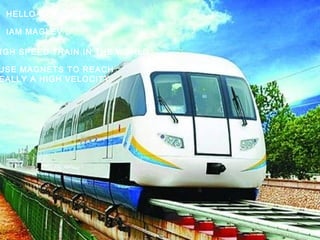
HELLO WORLD!
IAM MAGLEV .
IGH SPEED TRAIN IN THE WORLD.
USE MAGNETS TO REACH
EALLY A HIGH VELOCITY.
LEVITATION ??
The phenomenon of a person or a thing
rising into the air by supernatural means
is called LEVITATION.
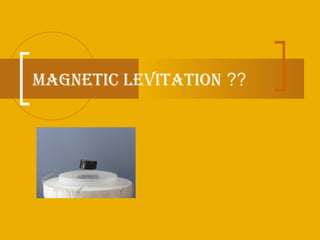
MAGNETIC LEVITATION ??
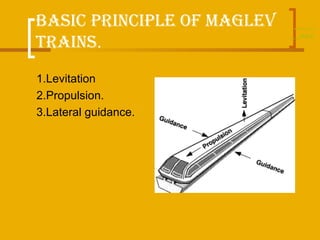
BAsIC prINCIpLE Of MAGLEV
TrAINs.
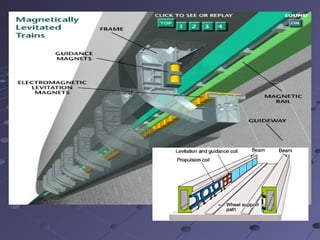
1.Levitation
2.Propulsion.
3.Lateral guidance.
.........
....<<<
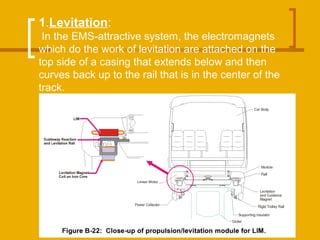
1.Levitation:
In the EMS-attractive system, the electromagnets
which do the work of levitation are attached on the
top side of a casing that extends below and then
curves back up to the rail that is in the center of the
track.
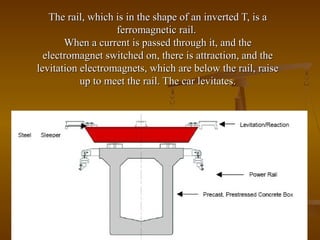
The rail, which is in the shape of an inverted T, is aThe rail, which is in the shape of an inverted T, is a
ferromagnetic rail.ferromagnetic rail.
When a current is passed through it, and theWhen a current is passed through it, and the
electromagnet switched on, there is attraction, and theelectromagnet switched on, there is attraction, and the
levitation electromagnets, which are below the rail, raiselevitation electromagnets, which are below the rail, raise
up to meet the rail. The car levitates.up to meet the rail. The car levitates.
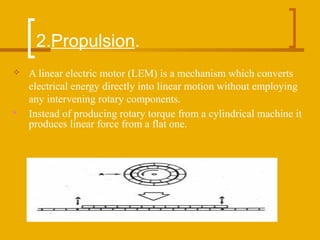
2.Propulsion.
 A linear electric motor (LEM) is a mechanism which converts
electrical energy directly into linear motion without employing
any intervening rotary components.
 Instead of producing rotary torque from a cylindrical machine it
produces linear force from a flat one.
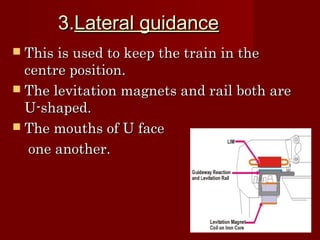
3.3.Lateral guidanceLateral guidance
 This is used to keep the train in theThis is used to keep the train in the
centre position.centre position.
 The levitation magnets and rail both areThe levitation magnets and rail both are
U-shaped.U-shaped.
 The mouths of U faceThe mouths of U face
one another.one another.
Types of MAGLeV TRAINsTypes of MAGLeV TRAINs
 ELECTROMAGNETIC SUSPENSION-ELECTROMAGNETIC SUSPENSION-
ATTRACTIVE(EMS).ATTRACTIVE(EMS).
 ELECTRODYNAMIC SUSPENSION-ELECTRODYNAMIC SUSPENSION-
REPULSIVE(EDS).REPULSIVE(EDS).
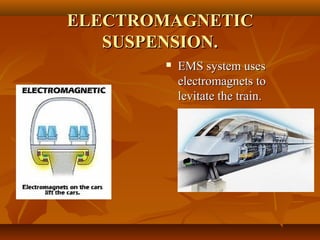
ELECTROMAGNETICELECTROMAGNETIC
SUSPENSION.SUSPENSION.
 EMS system usesEMS system uses
electromagnets toelectromagnets to
levitate the train.levitate the train.
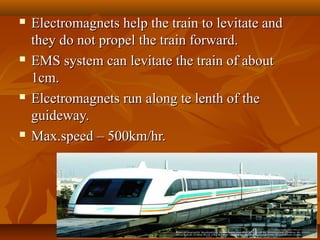
 Electromagnets help the train to levitate andElectromagnets help the train to levitate and
they do not propel the train forward.they do not propel the train forward.
 EMS system can levitate the train of aboutEMS system can levitate the train of about
1cm.1cm.
 Elcetromagnets run along te lenth of theElcetromagnets run along te lenth of the
guideway.guideway.
 Max.speed – 500km/hr.Max.speed – 500km/hr.
ELECTRODYNAMICELECTRODYNAMIC
SUSPENSIONSUSPENSION
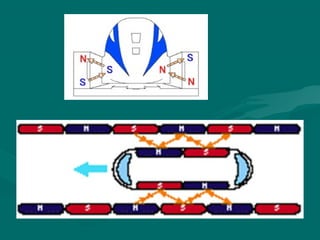
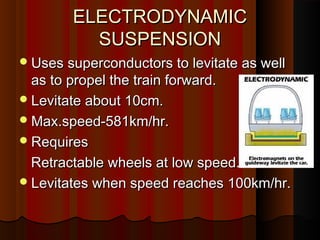
Uses superconductors to levitate as wellUses superconductors to levitate as well
as to propel the train forward.as to propel the train forward.
Levitate about 10cm.Levitate about 10cm.
Max.speed-581km/hr.Max.speed-581km/hr.
RequiresRequires
Retractable wheels at low speed.Retractable wheels at low speed.
Levitates when speed reaches 100km/hr.Levitates when speed reaches 100km/hr.
MERITS AND DEMERITS OFMERITS AND DEMERITS OF
EMS & EDSEMS & EDS
SYSTEMSYSTEM
MERITS OF ems &eds systemsMERITS OF ems &eds systems
MeritsMerits DemeritsDemerits
EE
MM
SS
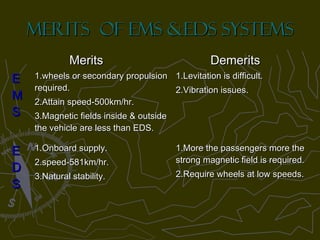
1.wheels or secondary propulsion1.wheels or secondary propulsion
required.required.
2.Attain speed-500km/hr.2.Attain speed-500km/hr.
3.Magnetic fields inside & outside3.Magnetic fields inside & outside
the vehicle are less than EDS.the vehicle are less than EDS.
1.Levitation is difficult.1.Levitation is difficult.
2.Vibration issues.2.Vibration issues.
EE
DD
SS
1.Onboard supply.1.Onboard supply.
2.speed-581km/hr.2.speed-581km/hr.
3.Natural stability.3.Natural stability.
1.More the passengers more the1.More the passengers more the
strong magnetic field is required.strong magnetic field is required.
2.Require wheels at low speeds.2.Require wheels at low speeds.
COMPARISON WITH AIRCRAFT
 Airlines cannot run in all the weather conditions.
 Very safe journey compared to Aircraft.
 Less fare.
 Many maglevs have lift-to-drag ratio that exceed
thatof aircraft.
COMPARISON WITH
CONVENTIONAL TRAINS.
 Speed.
 Maintenance.
 Efficiency.
 Weight.
 Noise.
 Design comparisons.
 Control systems.
ADVANTAGES OF MAGLEVADVANTAGES OF MAGLEV
TRAINSTRAINS
 Maglev uses 30% less energy thanMaglev uses 30% less energy than
a high-speed train.a high-speed train.
 The operating costs are reduced.The operating costs are reduced.
 Maglev vehicles require no fuel.Maglev vehicles require no fuel.
 20 times safer than airlines,20 times safer than airlines,
250 times safer than250 times safer than
conventional railroads,conventional railroads,
700 timessafer than automobile700 timessafer than automobile
travel.travel.
APPLICATIONSAPPLICATIONS............
NASA plans to use magneticlevitation forNASA plans to use magneticlevitation for
launching of space vehicles into low earthlaunching of space vehicles into low earth
orbit.orbit.
The mining industry will also benefit fromThe mining industry will also benefit from
Maglev.Maglev.
There are many more undiscovered apps.There are many more undiscovered apps.
ConClusionConClusion
• The Maglev offers a cheap,efficient alternative toThe Maglev offers a cheap,efficient alternative to
current rail system.current rail system.
• A country like INDIA could benefit more if thisA country like INDIA could benefit more if this
were implemented here.were implemented here.
......
....
...
..
.

MAGLEV TRAINS:SAIKRISHNA EEE

  • 1.
  • 2.
    CONTENTS.  INTRODUCTION.  LEVITATION??.  MAGNETIC LEVITATION ??.  BASIC PRINCIPLE OF MAGLEV TRAINS.  TYPES OF MAGLEV TRAINS.  MERITS & DEMERITS.  COMPARISON WITH AIRCRAFT.  COMPARISON WITH CONVENTIONAL TRAINS.  ADVANTAGES OF MAGLEV TRAINS.  APPLICATIONS.  CONCLUSION.
  • 3.
    INTRO TO MAGLEVINTROTO MAGLEV TRAINSTRAINS
  • 4.
    HELLO WORLD! IAM MAGLEV. IGH SPEED TRAIN IN THE WORLD. USE MAGNETS TO REACH EALLY A HIGH VELOCITY.
  • 5.
    LEVITATION ?? The phenomenonof a person or a thing rising into the air by supernatural means is called LEVITATION.
  • 6.
  • 7.
    BAsIC prINCIpLE OfMAGLEV TrAINs. 1.Levitation 2.Propulsion. 3.Lateral guidance. ......... ....<<<
  • 8.
    1.Levitation: In the EMS-attractivesystem, the electromagnets which do the work of levitation are attached on the top side of a casing that extends below and then curves back up to the rail that is in the center of the track.
  • 9.
    The rail, whichis in the shape of an inverted T, is aThe rail, which is in the shape of an inverted T, is a ferromagnetic rail.ferromagnetic rail. When a current is passed through it, and theWhen a current is passed through it, and the electromagnet switched on, there is attraction, and theelectromagnet switched on, there is attraction, and the levitation electromagnets, which are below the rail, raiselevitation electromagnets, which are below the rail, raise up to meet the rail. The car levitates.up to meet the rail. The car levitates.
  • 11.
    2.Propulsion.  A linearelectric motor (LEM) is a mechanism which converts electrical energy directly into linear motion without employing any intervening rotary components.  Instead of producing rotary torque from a cylindrical machine it produces linear force from a flat one.
  • 13.
    3.3.Lateral guidanceLateral guidance This is used to keep the train in theThis is used to keep the train in the centre position.centre position.  The levitation magnets and rail both areThe levitation magnets and rail both are U-shaped.U-shaped.  The mouths of U faceThe mouths of U face one another.one another.
  • 14.
    Types of MAGLeVTRAINsTypes of MAGLeV TRAINs  ELECTROMAGNETIC SUSPENSION-ELECTROMAGNETIC SUSPENSION- ATTRACTIVE(EMS).ATTRACTIVE(EMS).  ELECTRODYNAMIC SUSPENSION-ELECTRODYNAMIC SUSPENSION- REPULSIVE(EDS).REPULSIVE(EDS).
  • 15.
    ELECTROMAGNETICELECTROMAGNETIC SUSPENSION.SUSPENSION.  EMS systemusesEMS system uses electromagnets toelectromagnets to levitate the train.levitate the train.
  • 16.
     Electromagnets helpthe train to levitate andElectromagnets help the train to levitate and they do not propel the train forward.they do not propel the train forward.  EMS system can levitate the train of aboutEMS system can levitate the train of about 1cm.1cm.  Elcetromagnets run along te lenth of theElcetromagnets run along te lenth of the guideway.guideway.  Max.speed – 500km/hr.Max.speed – 500km/hr.
  • 17.
    ELECTRODYNAMICELECTRODYNAMIC SUSPENSIONSUSPENSION Uses superconductors tolevitate as wellUses superconductors to levitate as well as to propel the train forward.as to propel the train forward. Levitate about 10cm.Levitate about 10cm. Max.speed-581km/hr.Max.speed-581km/hr. RequiresRequires Retractable wheels at low speed.Retractable wheels at low speed. Levitates when speed reaches 100km/hr.Levitates when speed reaches 100km/hr.
  • 18.
    MERITS AND DEMERITSOFMERITS AND DEMERITS OF EMS & EDSEMS & EDS SYSTEMSYSTEM
  • 19.
    MERITS OF ems&eds systemsMERITS OF ems &eds systems MeritsMerits DemeritsDemerits EE MM SS 1.wheels or secondary propulsion1.wheels or secondary propulsion required.required. 2.Attain speed-500km/hr.2.Attain speed-500km/hr. 3.Magnetic fields inside & outside3.Magnetic fields inside & outside the vehicle are less than EDS.the vehicle are less than EDS. 1.Levitation is difficult.1.Levitation is difficult. 2.Vibration issues.2.Vibration issues. EE DD SS 1.Onboard supply.1.Onboard supply. 2.speed-581km/hr.2.speed-581km/hr. 3.Natural stability.3.Natural stability. 1.More the passengers more the1.More the passengers more the strong magnetic field is required.strong magnetic field is required. 2.Require wheels at low speeds.2.Require wheels at low speeds.
  • 20.
    COMPARISON WITH AIRCRAFT Airlines cannot run in all the weather conditions.  Very safe journey compared to Aircraft.  Less fare.  Many maglevs have lift-to-drag ratio that exceed thatof aircraft.
  • 21.
    COMPARISON WITH CONVENTIONAL TRAINS. Speed.  Maintenance.  Efficiency.  Weight.  Noise.  Design comparisons.  Control systems.
  • 22.
    ADVANTAGES OF MAGLEVADVANTAGESOF MAGLEV TRAINSTRAINS  Maglev uses 30% less energy thanMaglev uses 30% less energy than a high-speed train.a high-speed train.  The operating costs are reduced.The operating costs are reduced.  Maglev vehicles require no fuel.Maglev vehicles require no fuel.  20 times safer than airlines,20 times safer than airlines, 250 times safer than250 times safer than conventional railroads,conventional railroads, 700 timessafer than automobile700 timessafer than automobile travel.travel.
  • 23.
    APPLICATIONSAPPLICATIONS............ NASA plans touse magneticlevitation forNASA plans to use magneticlevitation for launching of space vehicles into low earthlaunching of space vehicles into low earth orbit.orbit. The mining industry will also benefit fromThe mining industry will also benefit from Maglev.Maglev. There are many more undiscovered apps.There are many more undiscovered apps.
  • 24.
    ConClusionConClusion • The Maglevoffers a cheap,efficient alternative toThe Maglev offers a cheap,efficient alternative to current rail system.current rail system. • A country like INDIA could benefit more if thisA country like INDIA could benefit more if this were implemented here.were implemented here.
  • 25.