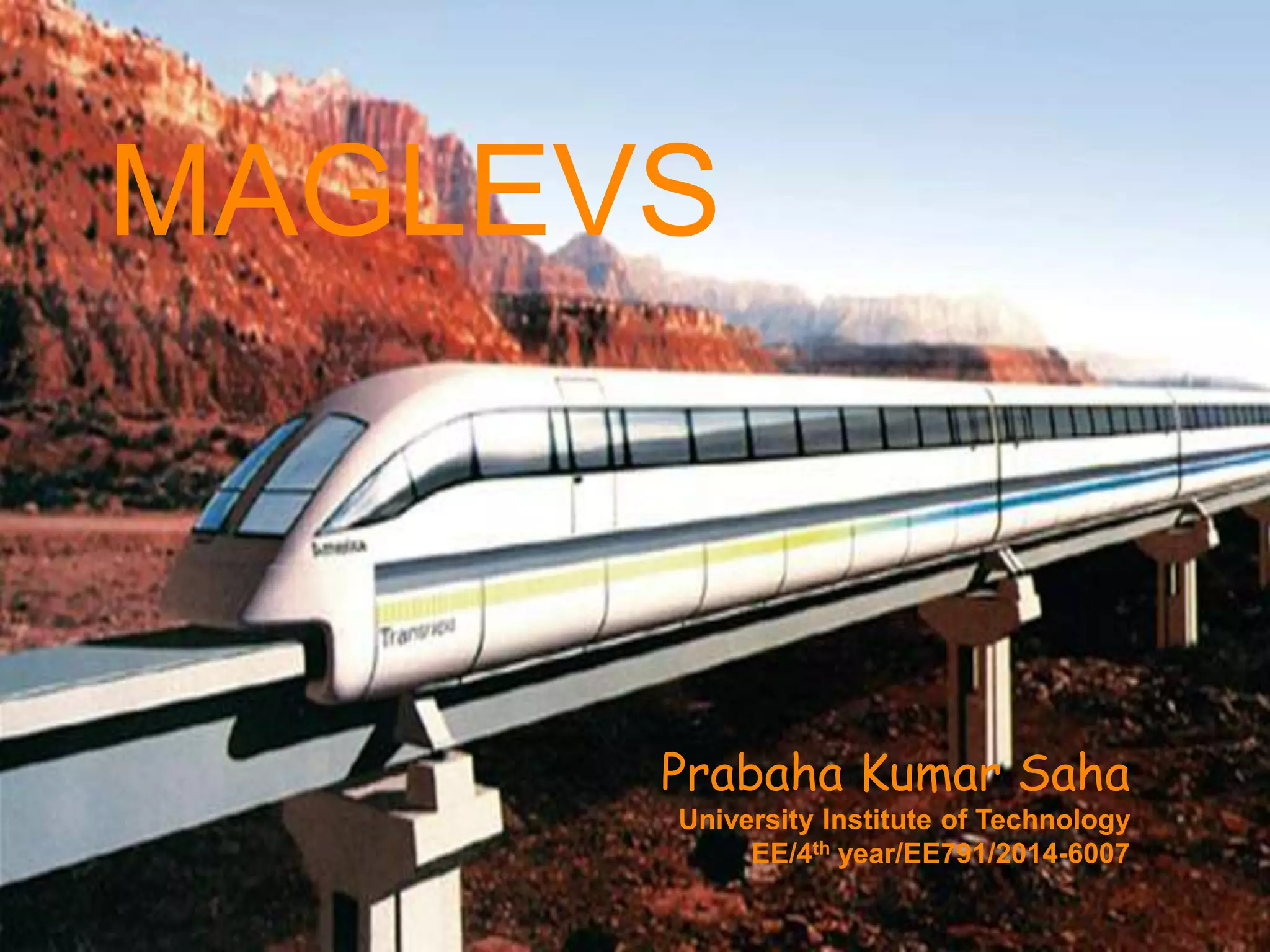
MAGLEVS
Prabaha Kumar Saha
University Institute of Technology
EE/4th year/EE791/2014-6007
WHAT DOES THIS ‘MAGLEV’ WORD
MEAN?
 MAGLEV = MAG = MAGnetic + LEV = LEVitaion
Anything which may ‘levitate’ or float or raise
by means of magnetic power is simply called
a “Magnetic Levitation.”
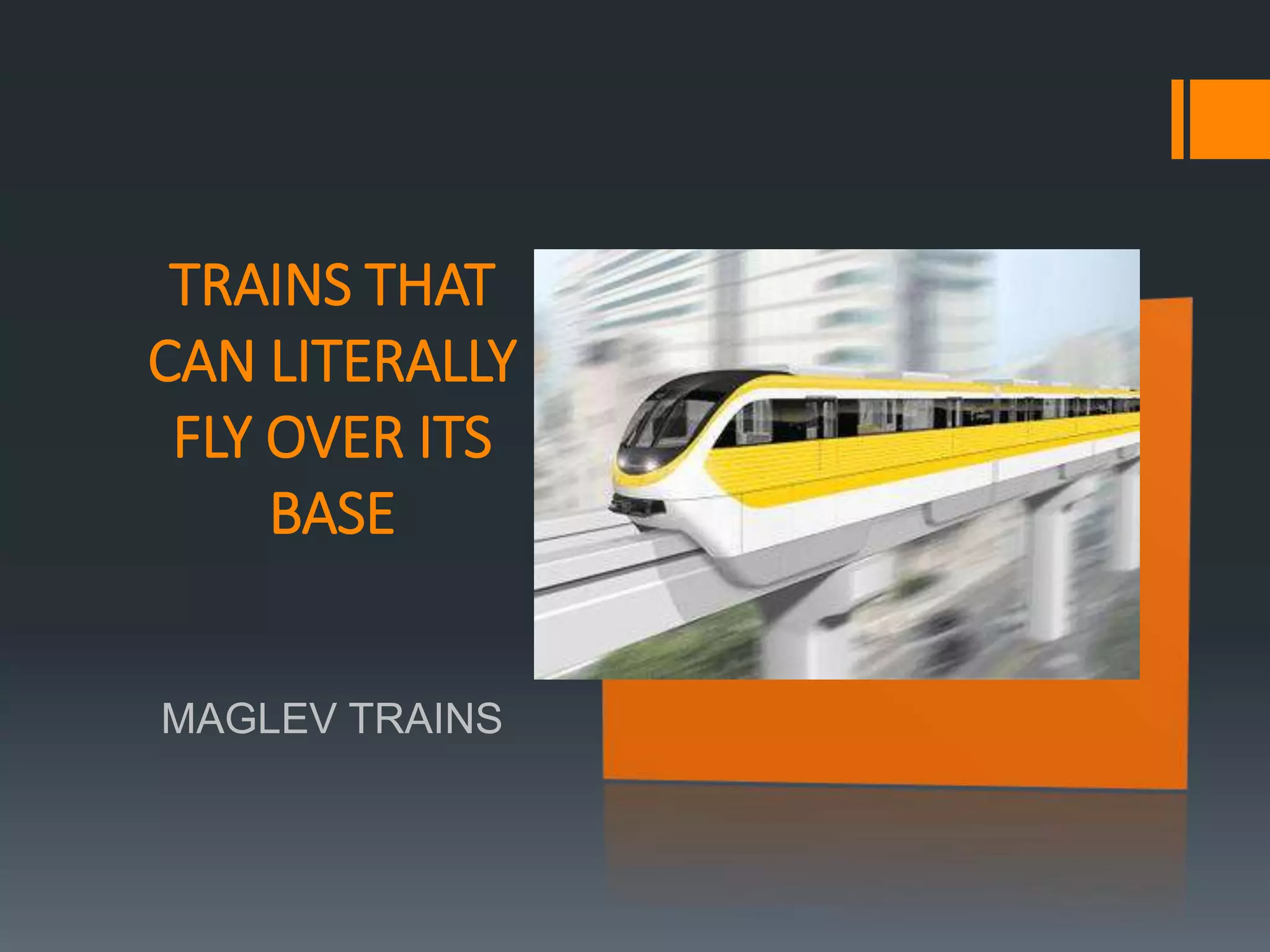
TRAINS THAT
CAN LITERALLY
FLY OVER ITS
BASE
MAGLEV TRAINS
BASIC PRINCIPLES OF MAGLEV TRAINS
There are mainly three basic principles that a MAGLEV train obeys to
be on such high speed
i) Levitation
ii) Propulsion
iii) Lateral
TYPES OF MAGLEVS
There are mainly two basic types of MAGLEVS that are used for
transportation purpose.
1. EMS or ELECTRO- 2. EDS or ELECTRO-
MAGNETIC SUSPENSION DYNAMIC SUSPENSION
Type Trains Type Trains
EMS System
This is also called ELECTROMAGNETIC SUSPENSION
System
In this system ELECTRO-
MAGNETS are used to
LEVTATE the Train
1.LEVITAION OF EMS SYSTEM
In EMS system “LEVITAION BY ATTRACTION” may take place.
Attraction is caused by having the currents within each of the circuits traveling
the same direction. It is important to note that with attractive forces created
between train and the track.
2. PRINCIPLE OF PROPULSION IN EMS
SYSTEM
The propulsion of the train is mainly based on two types of motors:
 Linear Electric Motor (LEM)
 Linear Induction Motor (LIM)
3. PRINCIPLE OF LATERAL GUIDANCE IN
EMS SYSTEM
 The levitation magnets and rail are both U shaped (with rail being an
inverted U)
 The mouths of U face one another
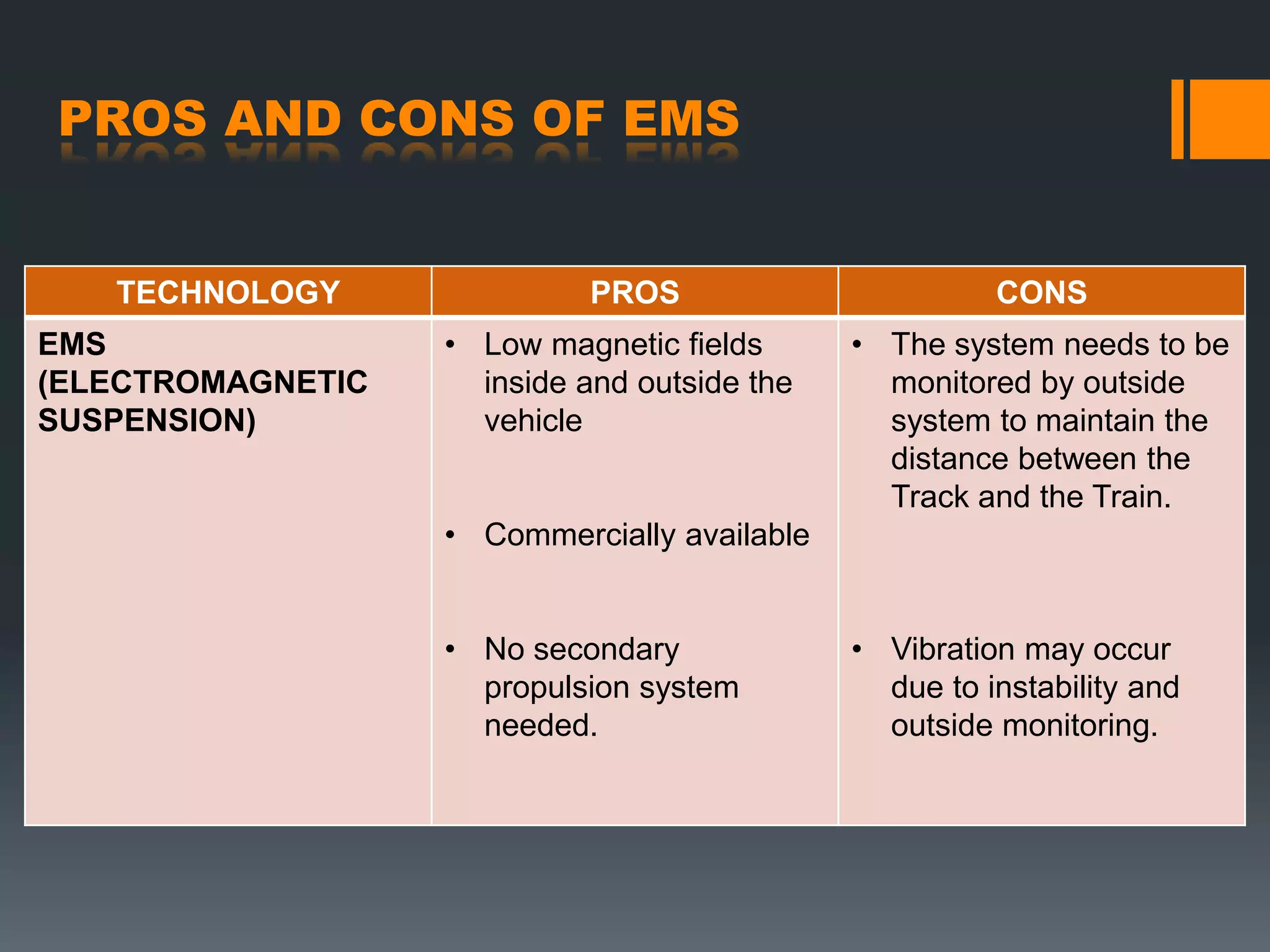
PROS AND CONS OF EMS
TECHNOLOGY PROS CONS
EMS
(ELECTROMAGNETIC
SUSPENSION)
• Low magnetic fields
inside and outside the
vehicle
• Commercially available
• No secondary
propulsion system
needed.
• The system needs to be
monitored by outside
system to maintain the
distance between the
Track and the Train.
• Vibration may occur
due to instability and
outside monitoring.
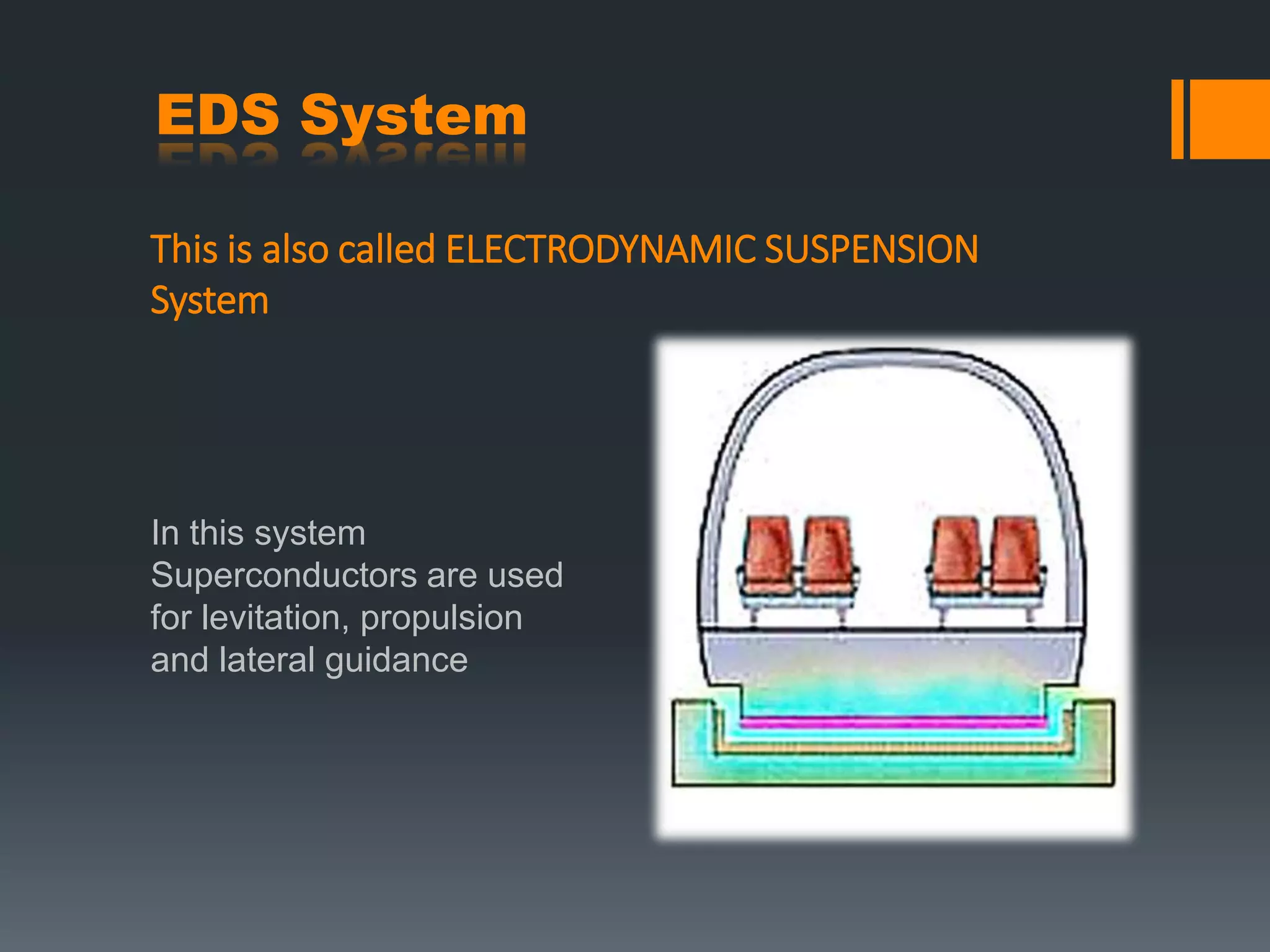
EDS System
This is also called ELECTRODYNAMIC SUSPENSION
System
In this system
Superconductors are used
for levitation, propulsion
and lateral guidance
1.LEVITAION OF EDS SYSTEM
In EDS system “LEVITAION BY REPULSION” may take place.
The current in the top circuit travels in the opposite direction of the current in
the bottom; resulting in an repulsion between two coils.
2. PRINCIPLE OF PROPULSION IN EDS
SYSTEM
The propulsion coils are located on the sidewalls on both sides of the
guideway are energized by a three-phase alternating current from a
substation, creating a shifting magnetic field on the guideway.
3. PRINCIPLE OF LATERAL GUIDANCE IN EDS
SYSTEM
 When one side of the train nears the side of the guideway, the
superconducting magnet on the train induces a repulsive force from the
levitation coils on the side closer to the train and an attractive force from the
coils on the further side.
 This keeps the train in the centre.
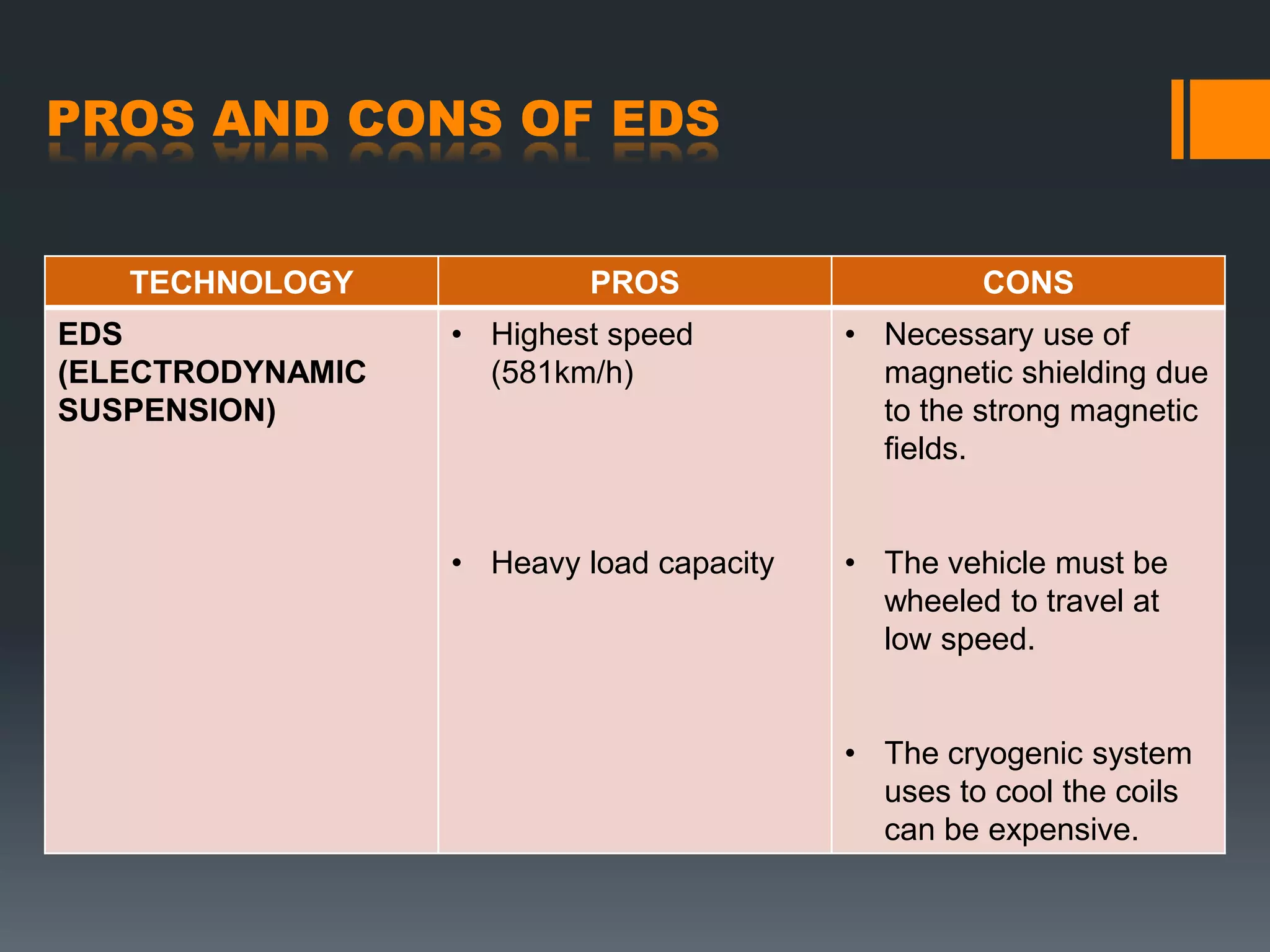
PROS AND CONS OF EDS
TECHNOLOGY PROS CONS
EDS
(ELECTRODYNAMIC
SUSPENSION)
• Highest speed
(581km/h)
• Heavy load capacity
• Necessary use of
magnetic shielding due
to the strong magnetic
fields.
• The vehicle must be
wheeled to travel at
low speed.
• The cryogenic system
uses to cool the coils
can be expensive.
INDUCTRACK
The “INDUCTRACK” is a newer type of EDS that uses permanent
room-temperature magnets.
There are two INDUCTRACK designs:
 INDUCTRACK I
 INDUCTRACK II
 INDUCTRACK I is designed for high speeds, while INDUCTRACK II is
suited for slow speeds.
 If the power fails, the train can slow down gradually and stop on its
auxiliary wheels.
OTHER APPLICATIONS
oNASA plans to use magnetic levitation for launching of space vehicles
into low earth orbit.
oBoeing is pursuing research in MAGLEV to provide a Hypersonic
Ground Test Facility for the air force.
oThe mining industry will also benefit from MAGLEV.
oThere are probably many more undiscovered applications!!
THE MAGLEV “Chuo Shinkansen”
Chuo Shinkansen is a Japanese MAGLEV line under construction
between TOKYO and NAGOYA, and planned to be extended
to OSAKA. Its initial section is between SHINAGAWA STATION in
TOKYO and NAGOYA STATION in Nagoya
Chuo Shinkansen
BASICS FEATURES
 This system is not ready for use now, but it should be ready in a few
years.
 It’s top speed with people aboard is 350 mph.
 The super conducting magnets create a strong magnetic field that
could be a problem for some passengers.
 The train is earthquake proof because the greater space (10 cm)
between the track and the train leaves more room for track
deformation
 Linear generators will produce all the electricity needed in the train’s
interior.
 Only the part of the track that is used will be electrified so no energy is
wasted.
SUMMARY
 Maglev trains use magnets to levitate and propel the trains
forward.
 Since there is no friction these trains can reach high speeds.
 It is a safe and efficient way to travel.
 Governments have mixed feelings about the technology. Some
countries, like China, have embraced it and others like Germany
have balked at the expense.
Thank You

Maglevs

  • 1.
    MAGLEVS Prabaha Kumar Saha UniversityInstitute of Technology EE/4th year/EE791/2014-6007
  • 2.
    WHAT DOES THIS‘MAGLEV’ WORD MEAN?  MAGLEV = MAG = MAGnetic + LEV = LEVitaion Anything which may ‘levitate’ or float or raise by means of magnetic power is simply called a “Magnetic Levitation.”
  • 3.
    TRAINS THAT CAN LITERALLY FLYOVER ITS BASE MAGLEV TRAINS
  • 4.
    BASIC PRINCIPLES OFMAGLEV TRAINS There are mainly three basic principles that a MAGLEV train obeys to be on such high speed i) Levitation ii) Propulsion iii) Lateral
  • 5.
    TYPES OF MAGLEVS Thereare mainly two basic types of MAGLEVS that are used for transportation purpose. 1. EMS or ELECTRO- 2. EDS or ELECTRO- MAGNETIC SUSPENSION DYNAMIC SUSPENSION Type Trains Type Trains
  • 6.
    EMS System This isalso called ELECTROMAGNETIC SUSPENSION System In this system ELECTRO- MAGNETS are used to LEVTATE the Train
  • 7.
    1.LEVITAION OF EMSSYSTEM In EMS system “LEVITAION BY ATTRACTION” may take place. Attraction is caused by having the currents within each of the circuits traveling the same direction. It is important to note that with attractive forces created between train and the track. 2. PRINCIPLE OF PROPULSION IN EMS SYSTEM The propulsion of the train is mainly based on two types of motors:  Linear Electric Motor (LEM)  Linear Induction Motor (LIM) 3. PRINCIPLE OF LATERAL GUIDANCE IN EMS SYSTEM  The levitation magnets and rail are both U shaped (with rail being an inverted U)  The mouths of U face one another
  • 8.
    PROS AND CONSOF EMS TECHNOLOGY PROS CONS EMS (ELECTROMAGNETIC SUSPENSION) • Low magnetic fields inside and outside the vehicle • Commercially available • No secondary propulsion system needed. • The system needs to be monitored by outside system to maintain the distance between the Track and the Train. • Vibration may occur due to instability and outside monitoring.
  • 9.
    EDS System This isalso called ELECTRODYNAMIC SUSPENSION System In this system Superconductors are used for levitation, propulsion and lateral guidance
  • 10.
    1.LEVITAION OF EDSSYSTEM In EDS system “LEVITAION BY REPULSION” may take place. The current in the top circuit travels in the opposite direction of the current in the bottom; resulting in an repulsion between two coils. 2. PRINCIPLE OF PROPULSION IN EDS SYSTEM The propulsion coils are located on the sidewalls on both sides of the guideway are energized by a three-phase alternating current from a substation, creating a shifting magnetic field on the guideway. 3. PRINCIPLE OF LATERAL GUIDANCE IN EDS SYSTEM  When one side of the train nears the side of the guideway, the superconducting magnet on the train induces a repulsive force from the levitation coils on the side closer to the train and an attractive force from the coils on the further side.  This keeps the train in the centre.
  • 11.
    PROS AND CONSOF EDS TECHNOLOGY PROS CONS EDS (ELECTRODYNAMIC SUSPENSION) • Highest speed (581km/h) • Heavy load capacity • Necessary use of magnetic shielding due to the strong magnetic fields. • The vehicle must be wheeled to travel at low speed. • The cryogenic system uses to cool the coils can be expensive.
  • 12.
    INDUCTRACK The “INDUCTRACK” isa newer type of EDS that uses permanent room-temperature magnets. There are two INDUCTRACK designs:  INDUCTRACK I  INDUCTRACK II  INDUCTRACK I is designed for high speeds, while INDUCTRACK II is suited for slow speeds.  If the power fails, the train can slow down gradually and stop on its auxiliary wheels.
  • 13.
    OTHER APPLICATIONS oNASA plansto use magnetic levitation for launching of space vehicles into low earth orbit. oBoeing is pursuing research in MAGLEV to provide a Hypersonic Ground Test Facility for the air force. oThe mining industry will also benefit from MAGLEV. oThere are probably many more undiscovered applications!!
  • 14.
    THE MAGLEV “ChuoShinkansen” Chuo Shinkansen is a Japanese MAGLEV line under construction between TOKYO and NAGOYA, and planned to be extended to OSAKA. Its initial section is between SHINAGAWA STATION in TOKYO and NAGOYA STATION in Nagoya Chuo Shinkansen
  • 15.
    BASICS FEATURES  Thissystem is not ready for use now, but it should be ready in a few years.  It’s top speed with people aboard is 350 mph.  The super conducting magnets create a strong magnetic field that could be a problem for some passengers.  The train is earthquake proof because the greater space (10 cm) between the track and the train leaves more room for track deformation  Linear generators will produce all the electricity needed in the train’s interior.  Only the part of the track that is used will be electrified so no energy is wasted.
  • 16.
    SUMMARY  Maglev trainsuse magnets to levitate and propel the trains forward.  Since there is no friction these trains can reach high speeds.  It is a safe and efficient way to travel.  Governments have mixed feelings about the technology. Some countries, like China, have embraced it and others like Germany have balked at the expense.
  • 17.