PLEASE WAIT
1
SUBMITTED BY:- SUBMITTED TO:-
MANOJ SINGARIYA
(IV YEARVII SEM)
EEBRANCH
PROF.ASADZAI
A
SEMINAR PRESENTATION
ON
“MAGLEV TRAIN AND MAGNETIC LEVIATION”
2
CONTENTS
1. Introduction
2. Developer of maglev train
3. Principle of maglev train
4. Basic principle of maglev train
5. Working of maglev train
6. Type of maglev train
7. Disadvantage of EDS System
8. Maglev v/s conventional train
9. better for environment
10. Most famous commercial maglev train
3
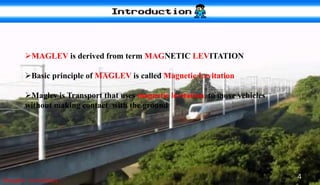
MAGLEV is derived from term MAGNETIC LEVITATION
Basic principle of MAGLEV is called Magnetic Levitation
Maglev is Transport that uses magnetic levitation to move vehicles
without making contact with the ground
4Shanghai train(china)
DEVELOPER OF “MAGLEV TRAIN”
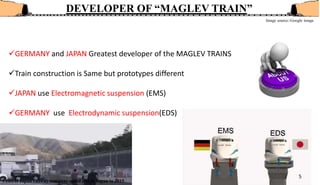
GERMANY and JAPAN Greatest developer of the MAGLEV TRAINS
Train construction is Same but prototypes different
JAPAN use Electromagnetic suspension (EMS)
GERMANY use Electrodynamic suspension(EDS)
5
Central Japan railway company speed test in Japan in 2015
Image source:-Google image
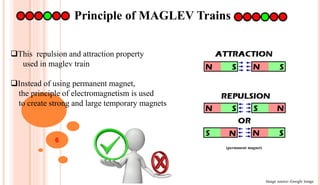
This repulsion and attraction property
used in maglev train
Instead of using permanent magnet,
the principle of electromagnetism is used
to create strong and large temporary magnets
Principle of MAGLEV Trains
6
(permanent magnet)
Image source:-Google image
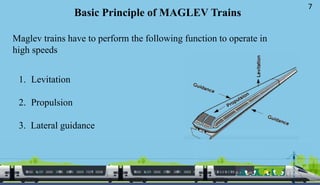
Basic Principle of MAGLEV Trains
Maglev trains have to perform the following function to operate in
high speeds
1. Levitation
2. Propulsion
3. Lateral guidance
7
7
WORKING OF MAGLEV TRAIN
South pole
North pole
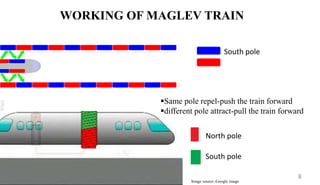
Same pole repel-push the train forward
different pole attract-pull the train forward
8
South pole
Image source:-Google image
TYPES OF MAGLEV TRAIN
Based on the techniques used for levitation
There are two types:-
1) Electromagnetic Suspension(EMS)
2) Electrodynamics Suspension(EDS)
9
9
10
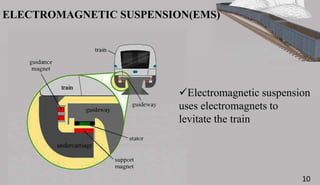
ELECTROMAGNETIC SUSPENSION(EMS)
Electromagnetic suspension
uses electromagnets to
levitate the train
10
ELECTROMAGNETIC SUSPENSION(EMS)
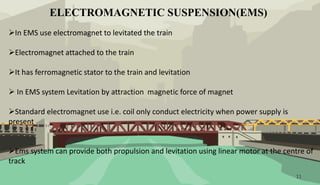
In EMS use electromagnet to levitated the train
Electromagnet attached to the train
It has ferromagnetic stator to the train and levitation
 In EMS system Levitation by attraction magnetic force of magnet
Standard electromagnet use i.e. coil only conduct electricity when power supply is
present
Ems system can provide both propulsion and levitation using linear motor at the centre of
track
11
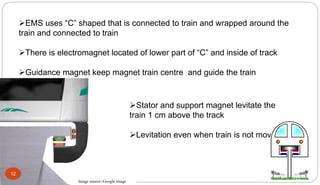
EMS uses “C” shaped that is connected to train and wrapped around the
train and connected to train
There is electromagnet located of lower part of “C” and inside of track
Guidance magnet keep magnet train centre and guide the train
Stator and support magnet levitate the
train 1 cm above the track
Levitation even when train is not moving
12
Image source:-Google image
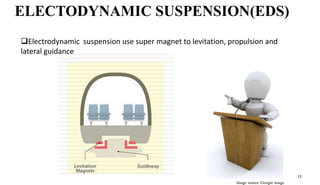
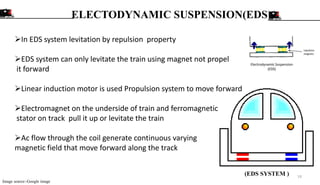
ELECTODYNAMIC SUSPENSION(EDS)
Electrodynamic suspension use super magnet to levitation, propulsion and
lateral guidance
13
Image source:-Google image
ELECTODYNAMIC SUSPENSION(EDS)
14
Image source:-Google image
In EDS system levitation by repulsion property
EDS system can only levitate the train using magnet not propel
it forward
Linear induction motor is used Propulsion system to move forward
Electromagnet on the underside of train and ferromagnetic
stator on track pull it up or levitate the train
Ac flow through the coil generate continuous varying
magnetic field that move forward along the track
(EDS SYSTEM )
Disadvantage of “EDS”
1. Maglev train must roll on rubber tires until reached a lift of speed about 62
miles/h(100km/h)
2.When it cross the 100km/h sped train levitation start
3.use super cooled , superconducting electromagnet, if in case of blackout
superconducting electromagnet can conduct electricity even after the power
supply OFF so it is costly
Disadvantage of “EMS”
1. System need to monitored by outside system to
maintain the distance between the track and train
15
“MAGLEV” train V/S “ CONVENTIONAL” Train
Maglev train Conventional train
No friction=less maintenance Routine maintenance needed
No engine=no fuel required Engine requires fossil fuels
Speed in excess of 300mph Speed up to 110mph
16
BETTER FOR ENVIRONVROMENT
Less energy consumption because no rail track
friction
Requires no fossil fuel
Maglev guidance and train take up less space than
convention train
Less noise pollution
17
Most famous commercial maglev train
1) Shanghai maglev train (shanghai-china)
Top speed-270 miles/hours
Average speed-160miles/hours
2) Central Japan railway company test speed in Japan
* 21 April 2015- 603km/hour
*2003 - 581 km/hour
18
19

Maglev train and it's leviation

  • 1.
  • 2.
    SUBMITTED BY:- SUBMITTEDTO:- MANOJ SINGARIYA (IV YEARVII SEM) EEBRANCH PROF.ASADZAI A SEMINAR PRESENTATION ON “MAGLEV TRAIN AND MAGNETIC LEVIATION” 2
  • 3.
    CONTENTS 1. Introduction 2. Developerof maglev train 3. Principle of maglev train 4. Basic principle of maglev train 5. Working of maglev train 6. Type of maglev train 7. Disadvantage of EDS System 8. Maglev v/s conventional train 9. better for environment 10. Most famous commercial maglev train 3
  • 4.
    MAGLEV is derivedfrom term MAGNETIC LEVITATION Basic principle of MAGLEV is called Magnetic Levitation Maglev is Transport that uses magnetic levitation to move vehicles without making contact with the ground 4Shanghai train(china)
  • 5.
    DEVELOPER OF “MAGLEVTRAIN” GERMANY and JAPAN Greatest developer of the MAGLEV TRAINS Train construction is Same but prototypes different JAPAN use Electromagnetic suspension (EMS) GERMANY use Electrodynamic suspension(EDS) 5 Central Japan railway company speed test in Japan in 2015 Image source:-Google image
  • 6.
    This repulsion andattraction property used in maglev train Instead of using permanent magnet, the principle of electromagnetism is used to create strong and large temporary magnets Principle of MAGLEV Trains 6 (permanent magnet) Image source:-Google image
  • 7.
    Basic Principle ofMAGLEV Trains Maglev trains have to perform the following function to operate in high speeds 1. Levitation 2. Propulsion 3. Lateral guidance 7 7
  • 8.
    WORKING OF MAGLEVTRAIN South pole North pole Same pole repel-push the train forward different pole attract-pull the train forward 8 South pole Image source:-Google image
  • 9.
    TYPES OF MAGLEVTRAIN Based on the techniques used for levitation There are two types:- 1) Electromagnetic Suspension(EMS) 2) Electrodynamics Suspension(EDS) 9 9
  • 10.
  • 11.
    ELECTROMAGNETIC SUSPENSION(EMS) In EMSuse electromagnet to levitated the train Electromagnet attached to the train It has ferromagnetic stator to the train and levitation  In EMS system Levitation by attraction magnetic force of magnet Standard electromagnet use i.e. coil only conduct electricity when power supply is present Ems system can provide both propulsion and levitation using linear motor at the centre of track 11
  • 12.
    EMS uses “C”shaped that is connected to train and wrapped around the train and connected to train There is electromagnet located of lower part of “C” and inside of track Guidance magnet keep magnet train centre and guide the train Stator and support magnet levitate the train 1 cm above the track Levitation even when train is not moving 12 Image source:-Google image
  • 13.
    ELECTODYNAMIC SUSPENSION(EDS) Electrodynamic suspensionuse super magnet to levitation, propulsion and lateral guidance 13 Image source:-Google image
  • 14.
    ELECTODYNAMIC SUSPENSION(EDS) 14 Image source:-Googleimage In EDS system levitation by repulsion property EDS system can only levitate the train using magnet not propel it forward Linear induction motor is used Propulsion system to move forward Electromagnet on the underside of train and ferromagnetic stator on track pull it up or levitate the train Ac flow through the coil generate continuous varying magnetic field that move forward along the track (EDS SYSTEM )
  • 15.
    Disadvantage of “EDS” 1.Maglev train must roll on rubber tires until reached a lift of speed about 62 miles/h(100km/h) 2.When it cross the 100km/h sped train levitation start 3.use super cooled , superconducting electromagnet, if in case of blackout superconducting electromagnet can conduct electricity even after the power supply OFF so it is costly Disadvantage of “EMS” 1. System need to monitored by outside system to maintain the distance between the track and train 15
  • 16.
    “MAGLEV” train V/S“ CONVENTIONAL” Train Maglev train Conventional train No friction=less maintenance Routine maintenance needed No engine=no fuel required Engine requires fossil fuels Speed in excess of 300mph Speed up to 110mph 16
  • 17.
    BETTER FOR ENVIRONVROMENT Lessenergy consumption because no rail track friction Requires no fossil fuel Maglev guidance and train take up less space than convention train Less noise pollution 17
  • 18.
    Most famous commercialmaglev train 1) Shanghai maglev train (shanghai-china) Top speed-270 miles/hours Average speed-160miles/hours 2) Central Japan railway company test speed in Japan * 21 April 2015- 603km/hour *2003 - 581 km/hour 18
  • 19.