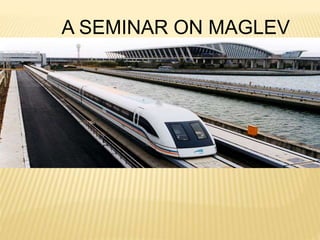
A SEMINAR ON MAGLEV
WHAT IS MEANT BY
MAGLEV?
Maglev=Magnetic + Levitation.
Any thing which may levitate(raise or float)
by means of a magnetic power is simply
called as magnetic levitation.
The term ‘MAGLEV’ can be briefly explained by
using an example of ‘MAGLEV TRAINS’.
BASIC PRINCIPLE OF MAGLEV TRAINS
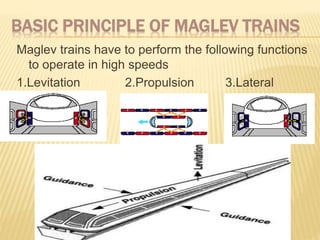
Maglev trains have to perform the following functions
to operate in high speeds
1.Levitation 2.Propulsion 3.Lateral
Guidance
TYPES OF MAGLEV TRAINS
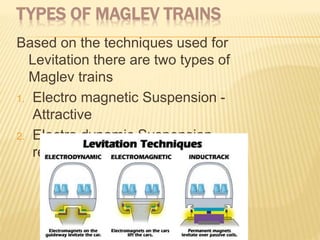
Based on the techniques used for
Levitation there are two types of
Maglev trains
1. Electro magnetic Suspension -
Attractive
2. Electro dynamic Suspension -
repulsive
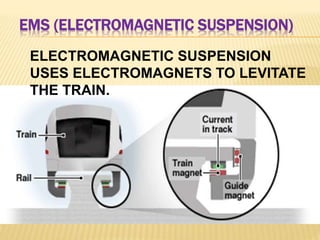
EMS (ELECTROMAGNETIC SUSPENSION)
ELECTROMAGNETIC SUSPENSION
USES ELECTROMAGNETS TO LEVITATE
THE TRAIN.
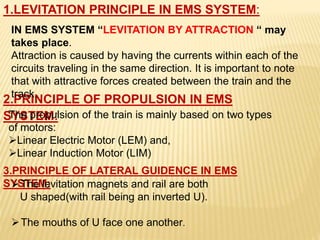
1.LEVITATION PRINCIPLE IN EMS SYSTEM:
2.PRINCIPLE OF PROPULSION IN EMS
SYSTEM:
The propulsion of the train is mainly based on two types
of motors:
Linear Electric Motor (LEM) and,
Linear Induction Motor (LIM)
IN EMS SYSTEM “LEVITATION BY ATTRACTION “ may
takes place.
Attraction is caused by having the currents within each of the
circuits traveling in the same direction. It is important to note
that with attractive forces created between the train and the
track.
3.PRINCIPLE OF LATERAL GUIDENCE IN EMS
SYSTEM:
The levitation magnets and rail are both
U shaped(with rail being an inverted U).
The mouths of U face one another.
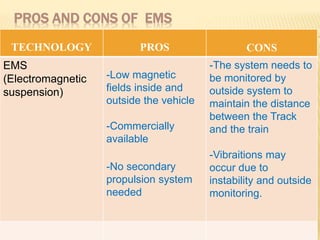
PROS AND CONS OF EMS
TECHNOLOGY PROS CONS
EMS
(Electromagnetic
suspension)
-Low magnetic
fields inside and
outside the vehicle
-Commercially
available
-No secondary
propulsion system
needed
-The system needs to
be monitored by
outside system to
maintain the distance
between the Track
and the train
-Vibraitions may
occur due to
instability and outside
monitoring.
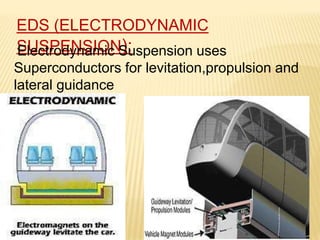
EDS (ELECTRODYNAMIC
SUSPENSION):
Electrodynamic Suspension uses
Superconductors for levitation,propulsion and
lateral guidance
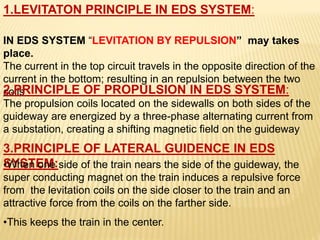
1.LEVITATON PRINCIPLE IN EDS SYSTEM:
IN EDS SYSTEM “LEVITATION BY REPULSION” may takes
place.
The current in the top circuit travels in the opposite direction of the
current in the bottom; resulting in an repulsion between the two
coils
2.PRINCIPLE OF PROPULSION IN EDS SYSTEM:
The propulsion coils located on the sidewalls on both sides of the
guideway are energized by a three-phase alternating current from
a substation, creating a shifting magnetic field on the guideway
3.PRINCIPLE OF LATERAL GUIDENCE IN EDS
SYSTEM:
•When one side of the train nears the side of the guideway, the
super conducting magnet on the train induces a repulsive force
from the levitation coils on the side closer to the train and an
attractive force from the coils on the farther side.
•This keeps the train in the center.
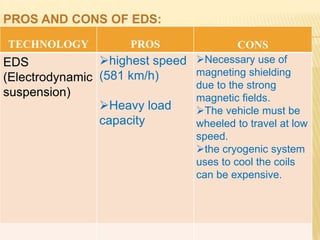
TECHNOLOGY PROS CONS
EDS
(Electrodynamic
suspension)
highest speed
(581 km/h)
Heavy load
capacity
Necessary use of
magneting shielding
due to the strong
magnetic fields.
The vehicle must be
wheeled to travel at low
speed.
the cryogenic system
uses to cool the coils
can be expensive.
PROS AND CONS OF EDS:
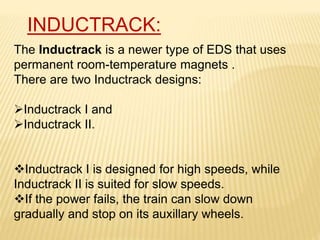
The Inductrack is a newer type of EDS that uses
permanent room-temperature magnets .
There are two Inductrack designs:
Inductrack I and
Inductrack II.
Inductrack I is designed for high speeds, while
Inductrack II is suited for slow speeds.
If the power fails, the train can slow down
gradually and stop on its auxillary wheels.
INDUCTRACK:
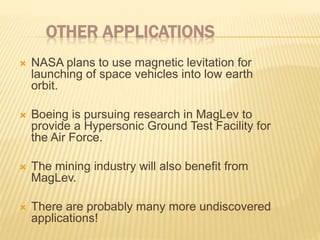
OTHER APPLICATIONS
 NASA plans to use magnetic levitation for
launching of space vehicles into low earth
orbit.
 Boeing is pursuing research in MagLev to
provide a Hypersonic Ground Test Facility for
the Air Force.
 The mining industry will also benefit from
MagLev.
 There are probably many more undiscovered
applications!
CONCLUSION
 Maglev trains use magnets to levitate and propel
the trains forward.
 Since there is no friction these trains can reach
high speeds.
 It is a safe and efficient way to travel.
Thank you

maglev.pptx

  • 1.
  • 2.
    WHAT IS MEANTBY MAGLEV? Maglev=Magnetic + Levitation. Any thing which may levitate(raise or float) by means of a magnetic power is simply called as magnetic levitation. The term ‘MAGLEV’ can be briefly explained by using an example of ‘MAGLEV TRAINS’.
  • 3.
    BASIC PRINCIPLE OFMAGLEV TRAINS Maglev trains have to perform the following functions to operate in high speeds 1.Levitation 2.Propulsion 3.Lateral Guidance
  • 4.
    TYPES OF MAGLEVTRAINS Based on the techniques used for Levitation there are two types of Maglev trains 1. Electro magnetic Suspension - Attractive 2. Electro dynamic Suspension - repulsive
  • 5.
    EMS (ELECTROMAGNETIC SUSPENSION) ELECTROMAGNETICSUSPENSION USES ELECTROMAGNETS TO LEVITATE THE TRAIN.
  • 6.
    1.LEVITATION PRINCIPLE INEMS SYSTEM: 2.PRINCIPLE OF PROPULSION IN EMS SYSTEM: The propulsion of the train is mainly based on two types of motors: Linear Electric Motor (LEM) and, Linear Induction Motor (LIM) IN EMS SYSTEM “LEVITATION BY ATTRACTION “ may takes place. Attraction is caused by having the currents within each of the circuits traveling in the same direction. It is important to note that with attractive forces created between the train and the track. 3.PRINCIPLE OF LATERAL GUIDENCE IN EMS SYSTEM: The levitation magnets and rail are both U shaped(with rail being an inverted U). The mouths of U face one another.
  • 7.
    PROS AND CONSOF EMS TECHNOLOGY PROS CONS EMS (Electromagnetic suspension) -Low magnetic fields inside and outside the vehicle -Commercially available -No secondary propulsion system needed -The system needs to be monitored by outside system to maintain the distance between the Track and the train -Vibraitions may occur due to instability and outside monitoring.
  • 8.
    EDS (ELECTRODYNAMIC SUSPENSION): Electrodynamic Suspensionuses Superconductors for levitation,propulsion and lateral guidance
  • 9.
    1.LEVITATON PRINCIPLE INEDS SYSTEM: IN EDS SYSTEM “LEVITATION BY REPULSION” may takes place. The current in the top circuit travels in the opposite direction of the current in the bottom; resulting in an repulsion between the two coils 2.PRINCIPLE OF PROPULSION IN EDS SYSTEM: The propulsion coils located on the sidewalls on both sides of the guideway are energized by a three-phase alternating current from a substation, creating a shifting magnetic field on the guideway 3.PRINCIPLE OF LATERAL GUIDENCE IN EDS SYSTEM: •When one side of the train nears the side of the guideway, the super conducting magnet on the train induces a repulsive force from the levitation coils on the side closer to the train and an attractive force from the coils on the farther side. •This keeps the train in the center.
  • 10.
    TECHNOLOGY PROS CONS EDS (Electrodynamic suspension) highestspeed (581 km/h) Heavy load capacity Necessary use of magneting shielding due to the strong magnetic fields. The vehicle must be wheeled to travel at low speed. the cryogenic system uses to cool the coils can be expensive. PROS AND CONS OF EDS:
  • 11.
    The Inductrack isa newer type of EDS that uses permanent room-temperature magnets . There are two Inductrack designs: Inductrack I and Inductrack II. Inductrack I is designed for high speeds, while Inductrack II is suited for slow speeds. If the power fails, the train can slow down gradually and stop on its auxillary wheels. INDUCTRACK:
  • 12.
    OTHER APPLICATIONS  NASAplans to use magnetic levitation for launching of space vehicles into low earth orbit.  Boeing is pursuing research in MagLev to provide a Hypersonic Ground Test Facility for the Air Force.  The mining industry will also benefit from MagLev.  There are probably many more undiscovered applications!
  • 13.
    CONCLUSION  Maglev trainsuse magnets to levitate and propel the trains forward.  Since there is no friction these trains can reach high speeds.  It is a safe and efficient way to travel.
  • 14.