From : RAHUL KHURANA
M-780-2K9
MAGLEV
 Maglev (derived from magnetic levitation), is a
system of transportation that uses magnetic
levitation to suspend, guide and propel vehicles
from magnets rather than using mechanical
methods, such as wheels, axles and bearings.
Maglev transport is a means of flying a vehicle or
object along a guideway by using magnets to
create both lift and thrust, only a few inches
above the guideway surface. The power needed for
levitation is not a particularly large percentage of
the overall energy consumption; most of the
power used is needed to overcome air resistance
(drag).
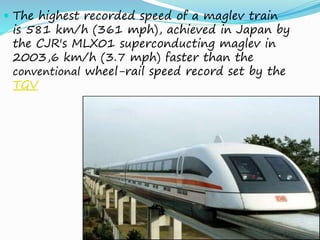
 The highest recorded speed of a maglev train
is 581 km/h (361 mph), achieved in Japan by
the CJR's MLX01 superconducting maglev in
2003,6 km/h (3.7 mph) faster than the
conventional wheel-rail speed record set by the
TGV
Magnetic levitation
 Magnetic levitation, maglev, or magnetic
suspension is a method by which an object
is suspended with no support other than
magnetic fields. Magnetic pressure is used
to counteract the effects of the gravitational
and any other accelerations.
 Earnshaw's theorem proves that using only
static ferromagnetism it is impossible to
stably levitate against gravity, but
servomechanisms, the use of diamagnetic
materials, superconduction, or systems
involving eddy currents permit this to
occur.
Technology
 There are two particularly notable types of
maglev technology:
 For electromagnetic suspension (EMS),
electronically controlled electromagnets in the
train attract it to a magnetically conductive
(usually steel) track.
 Electrodynamic suspension (EDS) uses
permanent magnets which create a magnetic
field that induces currents in nearby metallic
conductors when there is relative movement
which pushes the train away from the rail .
Electromagnetic suspension
 In current electromagnetic suspension (EMS)
systems, the train levitates above a steel rail
while electromagnets, attached to the train,
are oriented toward the rail from below. The
system is typically arranged on a series of C-
shaped arms, with the upper portion of the
arm attached to the vehicle, and the lower
inside edge containing the magnets. The rail is
situated between the upper and lower edges.
 Magnetic attraction varies inversely with the
cube of distance, so minor changes in distance
between the magnets and the rail produce
greatly varying forces.
The major advantage to suspended maglev
systems is that they work at all speeds,
unlike electrodynamic systems which only
work at a minimum speed of about 30 km/h
(19 mph). This eliminates the need for a
separate low-speed suspension system, and
can simplify the track layout as a result. On
the downside, the dynamic instability of the
system demands high tolerances of the track,
which can offset, or eliminate this
advantage.
Advantages&Disadvantages
 Magnetic fields inside and outside the vehicle
are less than EDS; proven, commercially
available technology that can attain very high
speeds (500 km/h (310 mph)); no wheels or
secondary propulsion system needed.
 The separation between the vehicle and the
guideway must be constantly monitored and
corrected by computer systems to avoid
collision due to the unstable nature of
electromagnetic attraction; due to the system's
inherent instability and the required constant
corrections by outside systems, vibration issues
may occur.
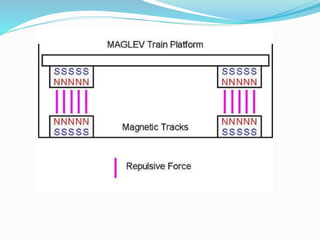
Electrodynamic suspension In electrodynamic suspension (EDS), both
the rail and the train exert a magnetic
field, and the train is levitated by the
repulsive force between these magnetic
fields. The magnetic field in the train is
produced by either superconducting
magnets or by an array of permanent
magnets (. The repulsive force in the
track is created by an induced magnetic
field in wires or other conducting strips
in the track.
A major advantage of the repulsive maglev
systems is that they are naturally stable—minor
narrowing in distance between the track and the
magnets creates strong forces to repel the magnets
back to their original position, while a slight
increase in distance greatly reduces the force and
again returns the vehicle to the right
separation.[25] No feedback control is needed.
Repulsive systems have a major downside as well.
At slow speeds, the current induced in these coils
and the resultant magnetic flux is not large
enough to support the weight of the train. For this
reason the train must have wheels or some other
form of landing gear to support the train until it
reaches a speed that can sustain levitation.
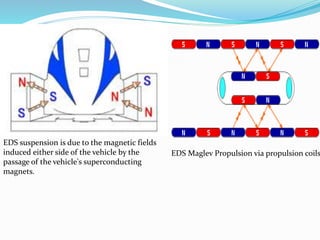
EDS suspension is due to the magnetic fields
induced either side of the vehicle by the
passage of the vehicle's superconducting
magnets.
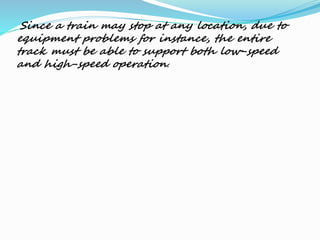
EDS Maglev Propulsion via propulsion coils
Since a train may stop at any location, due to
equipment problems for instance, the entire
track must be able to support both low-speed
and high-speed operation.
Propulsion
 An EDS system can provide both levitation and
propulsion using an onboard linear motor. EMS
systems can only levitate the train using the
magnets onboard, not propel it forward. As such,
vehicles need some other technology for
propulsion. A linear motor (propulsion coils)
mounted in the track is one solution. Over long
distances where the cost of propulsion coils could
be prohibitive, a propeller or jet engine could be
used.
Power and energy usage
 Energy for maglev trains is used to accelerate
the train, and may be regained when the
train slows down ("regenerative braking"). It is
also used to make the train levitate and to
stabilise the movement of the train. The main
part of the energy is needed to force the train
through the air ("air drag"). Also some energy
is used for air conditioning, heating, lighting
and other miscellaneous systems.
 At low speeds the percentage of power (energy
per time) used for levitation can be significant
consuming up to 15 % more power than a
subway or light rail service . Also for very
short distances the energy used for
acceleration might be considerable.
Comparison with conventional
trains
 Major comparative differences exist between the two
technologies. First of all, maglevs are not trains and
are more similar to wingless aircraft than wheel-less
trains. Maglev transport is non-contact, electric
powered and controlled flight. It does not rely on the
wheels, bearings and axles common to mechanical
friction-reliant rail systems
Maintenance Requirements Of Electronic Versus Mechanical Systems:
Maglev trains currently in operation have demonstrated the need for
nearly insignificant guideway maintenance.Traditional rail is subject
to the wear and tear of miles of friction on mechanical systems and
increases exponentially with speed, unlike maglev systems. This basic
difference reveals the huge cost advantage of maglev over rail and
also directly affects system reliability, availability and sustainability
All-Weather Operations: While maglev advocates claim trains
currently in operation are not stopped, slowed, or have their
schedules affected by snow, ice, severe cold, rain or high winds.
Efficiency: Due to the lack of physical contact between the track and
the vehicle, maglev trains experience no rolling resistance, leaving
only air resistance and electromagnetic drag, potentially improving
power efficiency.
Noise: Because the major source of noise of a maglev train comes
from displaced air, maglev trains produce less noise than a
conventional train at equivalent speeds
Thank You

Maglev

  • 1.
    From : RAHULKHURANA M-780-2K9
  • 2.
    MAGLEV  Maglev (derivedfrom magnetic levitation), is a system of transportation that uses magnetic levitation to suspend, guide and propel vehicles from magnets rather than using mechanical methods, such as wheels, axles and bearings. Maglev transport is a means of flying a vehicle or object along a guideway by using magnets to create both lift and thrust, only a few inches above the guideway surface. The power needed for levitation is not a particularly large percentage of the overall energy consumption; most of the power used is needed to overcome air resistance (drag).
  • 3.
     The highestrecorded speed of a maglev train is 581 km/h (361 mph), achieved in Japan by the CJR's MLX01 superconducting maglev in 2003,6 km/h (3.7 mph) faster than the conventional wheel-rail speed record set by the TGV
  • 5.
    Magnetic levitation  Magneticlevitation, maglev, or magnetic suspension is a method by which an object is suspended with no support other than magnetic fields. Magnetic pressure is used to counteract the effects of the gravitational and any other accelerations.  Earnshaw's theorem proves that using only static ferromagnetism it is impossible to stably levitate against gravity, but servomechanisms, the use of diamagnetic materials, superconduction, or systems involving eddy currents permit this to occur.
  • 6.
    Technology  There aretwo particularly notable types of maglev technology:  For electromagnetic suspension (EMS), electronically controlled electromagnets in the train attract it to a magnetically conductive (usually steel) track.  Electrodynamic suspension (EDS) uses permanent magnets which create a magnetic field that induces currents in nearby metallic conductors when there is relative movement which pushes the train away from the rail .
  • 7.
    Electromagnetic suspension  Incurrent electromagnetic suspension (EMS) systems, the train levitates above a steel rail while electromagnets, attached to the train, are oriented toward the rail from below. The system is typically arranged on a series of C- shaped arms, with the upper portion of the arm attached to the vehicle, and the lower inside edge containing the magnets. The rail is situated between the upper and lower edges.  Magnetic attraction varies inversely with the cube of distance, so minor changes in distance between the magnets and the rail produce greatly varying forces.
  • 8.
    The major advantageto suspended maglev systems is that they work at all speeds, unlike electrodynamic systems which only work at a minimum speed of about 30 km/h (19 mph). This eliminates the need for a separate low-speed suspension system, and can simplify the track layout as a result. On the downside, the dynamic instability of the system demands high tolerances of the track, which can offset, or eliminate this advantage.
  • 9.
    Advantages&Disadvantages  Magnetic fieldsinside and outside the vehicle are less than EDS; proven, commercially available technology that can attain very high speeds (500 km/h (310 mph)); no wheels or secondary propulsion system needed.  The separation between the vehicle and the guideway must be constantly monitored and corrected by computer systems to avoid collision due to the unstable nature of electromagnetic attraction; due to the system's inherent instability and the required constant corrections by outside systems, vibration issues may occur.
  • 10.
    Electrodynamic suspension Inelectrodynamic suspension (EDS), both the rail and the train exert a magnetic field, and the train is levitated by the repulsive force between these magnetic fields. The magnetic field in the train is produced by either superconducting magnets or by an array of permanent magnets (. The repulsive force in the track is created by an induced magnetic field in wires or other conducting strips in the track.
  • 11.
    A major advantageof the repulsive maglev systems is that they are naturally stable—minor narrowing in distance between the track and the magnets creates strong forces to repel the magnets back to their original position, while a slight increase in distance greatly reduces the force and again returns the vehicle to the right separation.[25] No feedback control is needed. Repulsive systems have a major downside as well. At slow speeds, the current induced in these coils and the resultant magnetic flux is not large enough to support the weight of the train. For this reason the train must have wheels or some other form of landing gear to support the train until it reaches a speed that can sustain levitation.
  • 12.
    EDS suspension isdue to the magnetic fields induced either side of the vehicle by the passage of the vehicle's superconducting magnets. EDS Maglev Propulsion via propulsion coils
  • 13.
    Since a trainmay stop at any location, due to equipment problems for instance, the entire track must be able to support both low-speed and high-speed operation.
  • 14.
    Propulsion  An EDSsystem can provide both levitation and propulsion using an onboard linear motor. EMS systems can only levitate the train using the magnets onboard, not propel it forward. As such, vehicles need some other technology for propulsion. A linear motor (propulsion coils) mounted in the track is one solution. Over long distances where the cost of propulsion coils could be prohibitive, a propeller or jet engine could be used.
  • 15.
    Power and energyusage  Energy for maglev trains is used to accelerate the train, and may be regained when the train slows down ("regenerative braking"). It is also used to make the train levitate and to stabilise the movement of the train. The main part of the energy is needed to force the train through the air ("air drag"). Also some energy is used for air conditioning, heating, lighting and other miscellaneous systems.  At low speeds the percentage of power (energy per time) used for levitation can be significant consuming up to 15 % more power than a subway or light rail service . Also for very short distances the energy used for acceleration might be considerable.
  • 16.
    Comparison with conventional trains Major comparative differences exist between the two technologies. First of all, maglevs are not trains and are more similar to wingless aircraft than wheel-less trains. Maglev transport is non-contact, electric powered and controlled flight. It does not rely on the wheels, bearings and axles common to mechanical friction-reliant rail systems
  • 17.
    Maintenance Requirements OfElectronic Versus Mechanical Systems: Maglev trains currently in operation have demonstrated the need for nearly insignificant guideway maintenance.Traditional rail is subject to the wear and tear of miles of friction on mechanical systems and increases exponentially with speed, unlike maglev systems. This basic difference reveals the huge cost advantage of maglev over rail and also directly affects system reliability, availability and sustainability All-Weather Operations: While maglev advocates claim trains currently in operation are not stopped, slowed, or have their schedules affected by snow, ice, severe cold, rain or high winds. Efficiency: Due to the lack of physical contact between the track and the vehicle, maglev trains experience no rolling resistance, leaving only air resistance and electromagnetic drag, potentially improving power efficiency. Noise: Because the major source of noise of a maglev train comes from displaced air, maglev trains produce less noise than a conventional train at equivalent speeds
  • 18.