1
Nucleic Acids
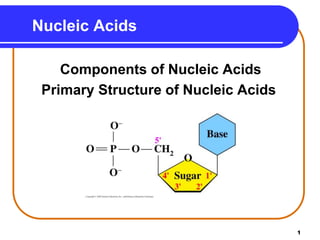
Components of Nucleic Acids
Primary Structure of Nucleic Acids
2
Nucleic Acids
Nucleic acids are:
• molecules that store information for
cellular growth and reproduction.
• deoxyribonucleic acid (DNA) and
ribonucleic acid (RNA).
• large molecules consisting of long
chains of monomers called
nucleotides.
3
Nucleic Acids
The nucleic acids DNA and
RNA
consist of monomers
called
nucleotides that consist of
a
• pentose sugar.
• nitrogen-containing
base.
• phosphate.
nucleotide
4
Nitrogen Bases
The nitrogen bases in
DNA and RNA are
• pyrimidines C, T, and U.
• purines A and G.
5
Nitrogen-Containing Bases in DNA
and RNA
DNA contains the nitrogen bases
• Cytosine (C)
• Guanine (G) same in both DNA and RNA
• Adenine (A)
• Thymine (T) different in DNA than RNA
RNA contains the nitrogen bases
• Cytosine (C)
• Guanine (G) same in both DNA and RNA
• Adenine (A)
• Uracil (U) different in DNA than RNA
6
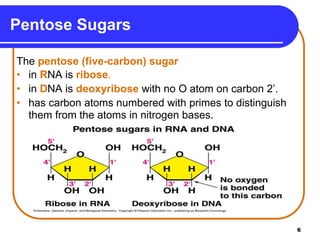
Pentose Sugars
The pentose (five-carbon) sugar
• in RNA is ribose.
• in DNA is deoxyribose with no O atom on carbon 2’.
• has carbon atoms numbered with primes to distinguish
them from the atoms in nitrogen bases.
7
HO
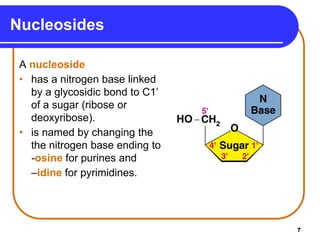
A nucleoside
• has a nitrogen base linked
by a glycosidic bond to C1’
of a sugar (ribose or
deoxyribose).
• is named by changing the
the nitrogen base ending to
-osine for purines and
–idine for pyrimidines.
Nucleosides
8
A nucleotide
• is a nucleoside that
forms a phosphate ester
with the C5’ –OH group
of a sugar (ribose or
deoxyribose).
• is named using the
name of the nucleoside
followed by
5’-monophosphate.
Nucleotides
9
Formation of a Nucleotide
A nucleotide forms when the −OH on C5’ of a
sugar bonds to phosphoric acid.
deoxycytidine monophosphate (dCMP)
O-
O-
O
P O CH2
O
NH2
N
N
OH
O
O-
O-
O
P OH +
deoxycytidine and phosphate
HO CH2
O
NH2
N
N
OH
O
5’
5’
10
Nucleosides and Nucleotides with
Purines
11
Nucleosides and Nucleotides with
Pyrimidines
12
Names of Nucleosides and
Nucleotides
13
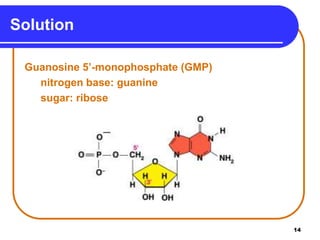
Learning Check
Give the name and abbreviation for the following and
list its nitrogen base and sugar.
14
Solution
Guanosine 5’-monophosphate (GMP)
nitrogen base: guanine
sugar: ribose
15
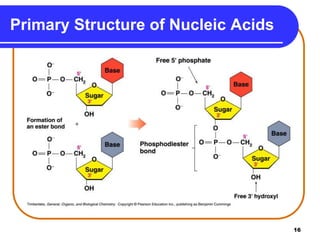
Primary Structure of Nucleic Acids
In the primary structure of nucleic acids
• nucleotides are joined by phosphodiester bonds.
• the 3’-OH group of the sugar in one nucleotide
forms an ester bond to the phosphate group on the
5’-carbon of the sugar of the next nucleotide.
16
Primary Structure of Nucleic Acids
17
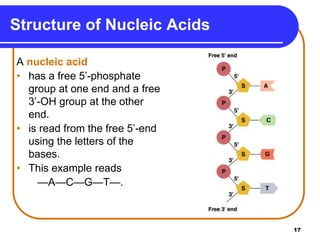
A nucleic acid
• has a free 5’-phosphate
group at one end and a free
3’-OH group at the other
end.
• is read from the free 5’-end
using the letters of the
bases.
• This example reads
—A—C—G—T—.
Structure of Nucleic Acids
18
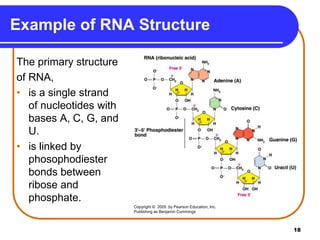
Example of RNA Structure
The primary structure
of RNA,
• is a single strand
of nucleotides with
bases A, C, G, and
U.
• is linked by
phosophodiester
bonds between
ribose and
phosphate.
Copyright © 2005 by Pearson Education, Inc.
Publishing as Benjamin Cummings
19
Nucleic Acids and Protein Synthesis
DNA Double Helix
Copyright © 2005 by Pearson Education, Inc.
Publishing as Benjamin Cummings
20
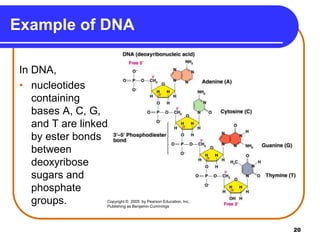
Example of DNA
In DNA,
• nucleotides
containing
bases A, C, G,
and T are linked
by ester bonds
between
deoxyribose
sugars and
phosphate
groups. Copyright © 2005 by Pearson Education, Inc.
Publishing as Benjamin Cummings
21
DNA Double Helix
A double helix
• is the structure of DNA.
• has two strands of nucleotides that wind together.
• is held in place by of two hydrogen bonds that form
between the base pairs A-T.
• is held in place by three hydrogen bonds that form
between the base pairs G-C.
22
Complementary Base Pairs
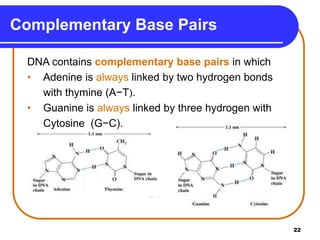
DNA contains complementary base pairs in which
• Adenine is always linked by two hydrogen bonds
with thymine (A−T).
• Guanine is always linked by three hydrogen with
Cytosine (G−C).
23
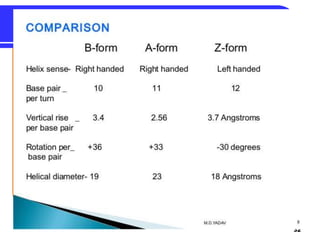
Double Helix of DNA
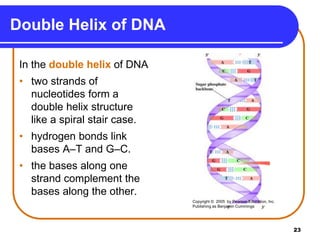
In the double helix of DNA
• two strands of
nucleotides form a
double helix structure
like a spiral stair case.
• hydrogen bonds link
bases A–T and G–C.
• the bases along one
strand complement the
bases along the other.
Copyright © 2005 by Pearson Education, Inc.
Publishing as Benjamin Cummings
24
Write the complementary base sequence for the
matching strand in the following DNA section:
—A—G—T—C—C—A—A—T—C—
Learning Check
25
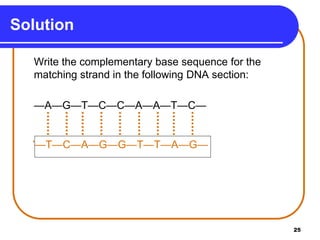
Write the complementary base sequence for the
matching strand in the following DNA section:
—A—G—T—C—C—A—A—T—C—
Solution
’—T—C—A—G—G—T—T—A—G—
26
DNA Replication
In DNA replication
• genetic information is
maintained each time a
cell divides.
• the DNA strands unwind.
• each parent strand bonds
with new complementary
bases.
• two new DNA strands form
that are exact copies of the
original DNA. Copyright © 2005 by
Pearson Education, Inc.
Publishing as Benjamin
Cummings
27
Nucleic Acids and Protein Synthesis
RNA and the Genetic Code
Copyright © 2005 by Pearson Education, Inc.
Publishing as Benjamin Cummings
28
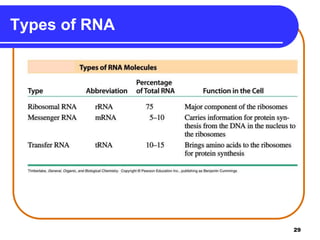
RNA
RNA
• transmits information from DNA to make proteins.
• has several types
Messenger RNA (mRNA) carries genetic
information from DNA to the ribosomes.
Transfer RNA (tRNA) brings amino acids to the
ribosome to make the protein.
Ribosomal RNA (rRNA) makes up 2/3 of
ribosomes where protein synthesis takes
place.
29
Types of RNA
30
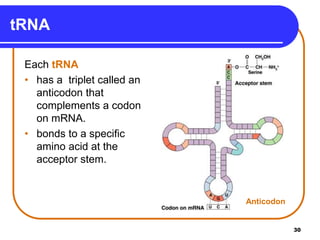
tRNA
Each tRNA
• has a triplet called an
anticodon that
complements a codon
on mRNA.
• bonds to a specific
amino acid at the
acceptor stem.
Anticodon
31
Protein Synthesis
Protein synthesis involves
• transcription
mRNA is formed from a gene on a DNA strand.
• translation
tRNA molecules bring amino acids to mRNA to
build a protein.
Copyright © 2005 by Pearson Education, Inc.
Publishing as Benjamin Cummings
32
33

NUCLEIC ACIDSsss.ppt

  • 1.
    1 Nucleic Acids Components ofNucleic Acids Primary Structure of Nucleic Acids
  • 2.
    2 Nucleic Acids Nucleic acidsare: • molecules that store information for cellular growth and reproduction. • deoxyribonucleic acid (DNA) and ribonucleic acid (RNA). • large molecules consisting of long chains of monomers called nucleotides.
  • 3.
    3 Nucleic Acids The nucleicacids DNA and RNA consist of monomers called nucleotides that consist of a • pentose sugar. • nitrogen-containing base. • phosphate. nucleotide
  • 4.
    4 Nitrogen Bases The nitrogenbases in DNA and RNA are • pyrimidines C, T, and U. • purines A and G.
  • 5.
    5 Nitrogen-Containing Bases inDNA and RNA DNA contains the nitrogen bases • Cytosine (C) • Guanine (G) same in both DNA and RNA • Adenine (A) • Thymine (T) different in DNA than RNA RNA contains the nitrogen bases • Cytosine (C) • Guanine (G) same in both DNA and RNA • Adenine (A) • Uracil (U) different in DNA than RNA
  • 6.
    6 Pentose Sugars The pentose(five-carbon) sugar • in RNA is ribose. • in DNA is deoxyribose with no O atom on carbon 2’. • has carbon atoms numbered with primes to distinguish them from the atoms in nitrogen bases.
  • 7.
    7 HO A nucleoside • hasa nitrogen base linked by a glycosidic bond to C1’ of a sugar (ribose or deoxyribose). • is named by changing the the nitrogen base ending to -osine for purines and –idine for pyrimidines. Nucleosides
  • 8.
    8 A nucleotide • isa nucleoside that forms a phosphate ester with the C5’ –OH group of a sugar (ribose or deoxyribose). • is named using the name of the nucleoside followed by 5’-monophosphate. Nucleotides
  • 9.
    9 Formation of aNucleotide A nucleotide forms when the −OH on C5’ of a sugar bonds to phosphoric acid. deoxycytidine monophosphate (dCMP) O- O- O P O CH2 O NH2 N N OH O O- O- O P OH + deoxycytidine and phosphate HO CH2 O NH2 N N OH O 5’ 5’
  • 10.
  • 11.
  • 12.
    12 Names of Nucleosidesand Nucleotides
  • 13.
    13 Learning Check Give thename and abbreviation for the following and list its nitrogen base and sugar.
  • 14.
  • 15.
    15 Primary Structure ofNucleic Acids In the primary structure of nucleic acids • nucleotides are joined by phosphodiester bonds. • the 3’-OH group of the sugar in one nucleotide forms an ester bond to the phosphate group on the 5’-carbon of the sugar of the next nucleotide.
  • 16.
  • 17.
    17 A nucleic acid •has a free 5’-phosphate group at one end and a free 3’-OH group at the other end. • is read from the free 5’-end using the letters of the bases. • This example reads —A—C—G—T—. Structure of Nucleic Acids
  • 18.
    18 Example of RNAStructure The primary structure of RNA, • is a single strand of nucleotides with bases A, C, G, and U. • is linked by phosophodiester bonds between ribose and phosphate. Copyright © 2005 by Pearson Education, Inc. Publishing as Benjamin Cummings
  • 19.
    19 Nucleic Acids andProtein Synthesis DNA Double Helix Copyright © 2005 by Pearson Education, Inc. Publishing as Benjamin Cummings
  • 20.
    20 Example of DNA InDNA, • nucleotides containing bases A, C, G, and T are linked by ester bonds between deoxyribose sugars and phosphate groups. Copyright © 2005 by Pearson Education, Inc. Publishing as Benjamin Cummings
  • 21.
    21 DNA Double Helix Adouble helix • is the structure of DNA. • has two strands of nucleotides that wind together. • is held in place by of two hydrogen bonds that form between the base pairs A-T. • is held in place by three hydrogen bonds that form between the base pairs G-C.
  • 22.
    22 Complementary Base Pairs DNAcontains complementary base pairs in which • Adenine is always linked by two hydrogen bonds with thymine (A−T). • Guanine is always linked by three hydrogen with Cytosine (G−C).
  • 23.
    23 Double Helix ofDNA In the double helix of DNA • two strands of nucleotides form a double helix structure like a spiral stair case. • hydrogen bonds link bases A–T and G–C. • the bases along one strand complement the bases along the other. Copyright © 2005 by Pearson Education, Inc. Publishing as Benjamin Cummings
  • 24.
    24 Write the complementarybase sequence for the matching strand in the following DNA section: —A—G—T—C—C—A—A—T—C— Learning Check
  • 25.
    25 Write the complementarybase sequence for the matching strand in the following DNA section: —A—G—T—C—C—A—A—T—C— Solution ’—T—C—A—G—G—T—T—A—G—
  • 26.
    26 DNA Replication In DNAreplication • genetic information is maintained each time a cell divides. • the DNA strands unwind. • each parent strand bonds with new complementary bases. • two new DNA strands form that are exact copies of the original DNA. Copyright © 2005 by Pearson Education, Inc. Publishing as Benjamin Cummings
  • 27.
    27 Nucleic Acids andProtein Synthesis RNA and the Genetic Code Copyright © 2005 by Pearson Education, Inc. Publishing as Benjamin Cummings
  • 28.
    28 RNA RNA • transmits informationfrom DNA to make proteins. • has several types Messenger RNA (mRNA) carries genetic information from DNA to the ribosomes. Transfer RNA (tRNA) brings amino acids to the ribosome to make the protein. Ribosomal RNA (rRNA) makes up 2/3 of ribosomes where protein synthesis takes place.
  • 29.
  • 30.
    30 tRNA Each tRNA • hasa triplet called an anticodon that complements a codon on mRNA. • bonds to a specific amino acid at the acceptor stem. Anticodon
  • 31.
    31 Protein Synthesis Protein synthesisinvolves • transcription mRNA is formed from a gene on a DNA strand. • translation tRNA molecules bring amino acids to mRNA to build a protein. Copyright © 2005 by Pearson Education, Inc. Publishing as Benjamin Cummings
  • 32.
  • 33.