Nucleic Acids
Nucleic Acids Are Essential For
Information Transfer in Cells
• Information encoded in a DNA molecule is
transcribed via synthesis of an RNA molecule
• The sequence of the RNA molecule is "read"
and is translated into the sequence of amino
acids in a protein.
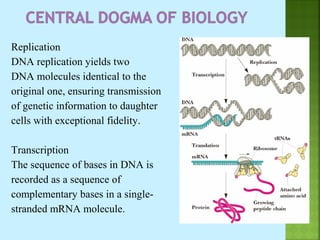
Replication
DNA replication yields two
DNA molecules identical to the
original one, ensuring transmission
of genetic information to daughter
cells with exceptional fidelity.
Transcription
The sequence of bases in DNA is
recorded as a sequence of
complementary bases in a singlestranded mRNA molecule.
Translation
Three-base codons on the
mRNA corresponding to
specific amino acids direct the
sequence of building a protein.
These codons are recognized by
tRNAs (transfer RNAs)
carrying the appropriate amino
acids. Ribosomes are the
“machinery” for protein
synthesis.


First discovered in 1869 by Miescher.



Found as a precipitate that formed when extracts
from nuclei were treated with acid.



Compound contained C, N, O, and high amount of
P.



Was an acid compound found in nuclei therefore
named nucleic acid


1944 Oswald, Avery, MacLeod and McCarty
demonstrated that DNA is the molecule that carrier
genetic information.



1953 Watson and Crick proposed the double helix
model for the structure of DNA


Nucleic acids are long polymers of nucleotides.



Nucleotides contain a 5 carbon sugar, a weakly
basic nitrogenous compound (base), one or
more phosphate groups.



Nucleosides are similar to nucleotides but have
no phosphate groups.
Pentoses of Nucleotides
• D-ribose (in RNA)
• 2-deoxy-D-ribose (in DNA)
• The difference - 2'-OH vs 2'-H
• This difference affects secondary structure
and stability
• Base is linked via a b-N-glycosidic bond
• The carbon of the glycosidic bond is anomeric
• Named by adding -idine to the root name of a
pyrimidine or -osine to the root name of a purine
• Conformation can be syn or anti
• Sugars make nucleosides more water-soluble than
free bases
Anti- conformation predominates in
nucleic acid polymers
Phosphate ester of nucleosides
Other Functions of Nucleotides
• Nucleoside 5'-triphosphates are carriers of
energy
• Bases serve as recognition units
• Cyclic nucleotides are signal molecules and
regulators of cellular metabolism and
reproduction


ATP is central to energy metabolism



GTP drives protein synthesis



CTP drives lipid synthesis



UTP drives carbohydrate metabolism


Nucleotide monomers are joined by 3’-5’ phosphodiester
linkages to form nucleic acid (polynucleotide) polymers


Nucleic acid backbone takes on extended
conformation.



Nucleotide residues are all oriented in the same
direction (5’ to 3’) giving the polymer
directionality.



The sequence of DNA molecules is always read in
the 5’ to 3’ direction
•Guanine pairs with
cytosine
•Adenine pairs with
thymine
Base compositions experimentally
determined for a variety of organisms
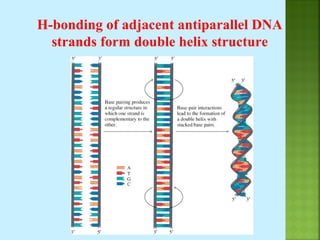
H-bonding of adjacent antiparallel DNA
strands form double helix structure


Distance between the 2 sugar-phosphate backbones
is always the same, give DNA molecule a regular
shape.



Plane of bases are oriented perpendicular to
backbone



Hydrophillic sugar phosphate backbone winds
around outside of helix


Noncovalent interactions between upper and lower
surfaces of base-pairs (stacking) forms a closely
packed hydrophobic interior.



Hydrophobic environment makes H-bonding
between bases stronger (no competition with
water)



Cause the sugar-phosphate backbone to twist.
Hydrophobic
Interior with base pair
stacking

Sugar-phosphate
backbone


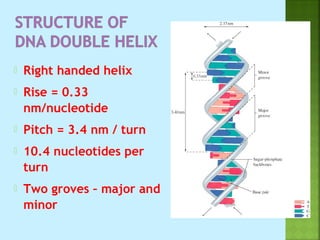
Right handed helix



Rise = 0.33
nm/nucleotide



Pitch = 3.4 nm / turn



10.4 nucleotides per
turn



Two groves – major and
minor


Within groves,
functional groups on
the edge of base pairs
exposed to exterior



involved in interaction
with proteins.


Hydrophobic interactions – burying hydrophobic
purine and pyrimidine rings in interior



Stacking interactions – van der Waals interactions
between stacked bases.



Hydrogen Bonding – H-bonding between bases


Charge-Charge Interactions – Electrostatic
repulsions of negatively charged phosphate
groups are minimized by interaction with cations
(e.g. Mg2+)

Nucleic acids

  • 2.
  • 3.
    Nucleic Acids AreEssential For Information Transfer in Cells • Information encoded in a DNA molecule is transcribed via synthesis of an RNA molecule • The sequence of the RNA molecule is "read" and is translated into the sequence of amino acids in a protein.
  • 4.
    Replication DNA replication yieldstwo DNA molecules identical to the original one, ensuring transmission of genetic information to daughter cells with exceptional fidelity. Transcription The sequence of bases in DNA is recorded as a sequence of complementary bases in a singlestranded mRNA molecule.
  • 5.
    Translation Three-base codons onthe mRNA corresponding to specific amino acids direct the sequence of building a protein. These codons are recognized by tRNAs (transfer RNAs) carrying the appropriate amino acids. Ribosomes are the “machinery” for protein synthesis.
  • 6.
     First discovered in1869 by Miescher.  Found as a precipitate that formed when extracts from nuclei were treated with acid.  Compound contained C, N, O, and high amount of P.  Was an acid compound found in nuclei therefore named nucleic acid
  • 7.
     1944 Oswald, Avery,MacLeod and McCarty demonstrated that DNA is the molecule that carrier genetic information.  1953 Watson and Crick proposed the double helix model for the structure of DNA
  • 8.
     Nucleic acids arelong polymers of nucleotides.  Nucleotides contain a 5 carbon sugar, a weakly basic nitrogenous compound (base), one or more phosphate groups.  Nucleosides are similar to nucleotides but have no phosphate groups.
  • 9.
    Pentoses of Nucleotides •D-ribose (in RNA) • 2-deoxy-D-ribose (in DNA) • The difference - 2'-OH vs 2'-H • This difference affects secondary structure and stability
  • 13.
    • Base islinked via a b-N-glycosidic bond • The carbon of the glycosidic bond is anomeric • Named by adding -idine to the root name of a pyrimidine or -osine to the root name of a purine • Conformation can be syn or anti • Sugars make nucleosides more water-soluble than free bases
  • 16.
    Anti- conformation predominatesin nucleic acid polymers
  • 17.
    Phosphate ester ofnucleosides
  • 19.
    Other Functions ofNucleotides • Nucleoside 5'-triphosphates are carriers of energy • Bases serve as recognition units • Cyclic nucleotides are signal molecules and regulators of cellular metabolism and reproduction
  • 20.
     ATP is centralto energy metabolism  GTP drives protein synthesis  CTP drives lipid synthesis  UTP drives carbohydrate metabolism
  • 21.
     Nucleotide monomers arejoined by 3’-5’ phosphodiester linkages to form nucleic acid (polynucleotide) polymers
  • 22.
     Nucleic acid backbonetakes on extended conformation.  Nucleotide residues are all oriented in the same direction (5’ to 3’) giving the polymer directionality.  The sequence of DNA molecules is always read in the 5’ to 3’ direction
  • 23.
  • 24.
  • 25.
    H-bonding of adjacentantiparallel DNA strands form double helix structure
  • 26.
     Distance between the2 sugar-phosphate backbones is always the same, give DNA molecule a regular shape.  Plane of bases are oriented perpendicular to backbone  Hydrophillic sugar phosphate backbone winds around outside of helix
  • 27.
     Noncovalent interactions betweenupper and lower surfaces of base-pairs (stacking) forms a closely packed hydrophobic interior.  Hydrophobic environment makes H-bonding between bases stronger (no competition with water)  Cause the sugar-phosphate backbone to twist.
  • 28.
    Hydrophobic Interior with basepair stacking Sugar-phosphate backbone
  • 29.
     Right handed helix  Rise= 0.33 nm/nucleotide  Pitch = 3.4 nm / turn  10.4 nucleotides per turn  Two groves – major and minor
  • 30.
     Within groves, functional groupson the edge of base pairs exposed to exterior  involved in interaction with proteins.
  • 31.
     Hydrophobic interactions –burying hydrophobic purine and pyrimidine rings in interior  Stacking interactions – van der Waals interactions between stacked bases.  Hydrogen Bonding – H-bonding between bases
  • 32.
     Charge-Charge Interactions –Electrostatic repulsions of negatively charged phosphate groups are minimized by interaction with cations (e.g. Mg2+)