Machine Learning
with R
Barbara Fusinska
@BasiaFusinska
About me
Programmer
Machine Learning
Data Solutions Architect
@BasiaFusinska
https://github.com/BasiaFusinska/MachineLearningWithR
Agenda
• What’s Machine Learning?
• Exploratory Data Analysis
• Classification
• Clustering
• Regression
Setup
• Install R:
https://www.r-project.org/
• Install RStudio:
https://www.rstudio.com/
• GitHub repository:
https://github.com/BasiaFusinska/Ma
chineLearningWithR
• Packages
Machine Learning?
Movies Genres
Title # Kisses # Kicks Genre
Taken 3 47 Action
Love story 24 2 Romance
P.S. I love you 17 3 Romance
Rush hours 5 51 Action
Bad boys 7 42 Action
Question:
What is the genre of
Gone with the wind
?
Data-based classification
Id Feature 1 Feature 2 Class
1. 3 47 A
2. 24 2 B
3. 17 3 B
4. 5 51 A
5. 7 42 A
Question:
What is the class of the entry
with the following features:
F1: 31, F2: 4
?
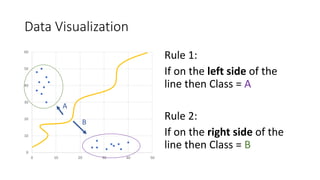
Data Visualization
0
10
20
30
40
50
60
0 10 20 30 40 50
Rule 1:
If on the left side of the
line then Class = A
Rule 2:
If on the right side of the
line then Class = B
A
B
Chick sexing
Supervised
learning
• Classification, regression
• Label, target value
• Training & Validation
phases
Unsupervised
learning
• Clustering, feature
selection
• Finding structure of data
• Statistical values
describing the data
Supervised Machine Learning workflow
Clean data Data split
Machine Learning
algorithm
Trained model Score
Preprocess
data
Training
data
Test data
Publishing the model
Machine Learning
Model
Model Training
Published
Machine Learning
Model
Prediction
Training data
Publish model
Test stream
Scores
Exploratory
Data Analysis
Demo
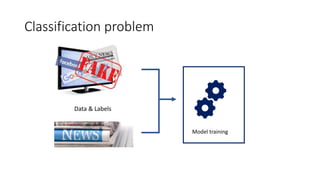
Classification problem
Model training
Data & Labels
Classification data
Source #Links #Characters ... Fake
TopNews 10 2750 … T
Twitter 2 120 … F
TopNews 235 502 … F
Channel X 1530 3024 … T
Twitter 24 70 … F
StoryLeaks 722 1408 … T
Facebook 98 230 … T
… … … … ...
Features
Labels
Task: Iris EDA
• Descriptive statistics (dimensions,
rows, columns, data types,
correlation)
• Data visualization (distributions,
outliers)
• Features distributions & classes
separation
• 2D visualisation
http://archive.ics.uci.edu/ml/datasets/Iris
K-Nearest Neighbours Algorithm
• Object is classified by a majority
vote
• k – algorithm parameter
• Distance metrics: Euclidean
(continuous variables), Hamming
(text)
?
Naïve Bayes classifier
𝑝 𝐶 𝑘 𝒙) =
𝑝 𝐶 𝑘 𝑝 𝒙 𝐶 𝑘)
𝑝(𝒙)
𝒙 = (𝑥1, … , 𝑥 𝑘)
𝑝 𝐶 𝑘 𝑥1, … , 𝑥 𝑘) likelihood
evidence
prior
posterior
Naïve Bayes example
Sex Height Weight Foot size
Male 6 190 11
Male 6.2 170 10
Female 5 130 6
… … … …
Sex Height Weight Foot size
? 5.9 140 8
𝑝 𝑚𝑎𝑙𝑒 𝒙 =
𝑝 𝑚𝑎𝑙𝑒 𝑝 5.9 𝑚𝑎𝑙𝑒 𝑝 140 𝑚𝑎𝑙𝑒 𝑝(8|𝑚𝑎𝑙𝑒)
𝑒𝑣𝑖𝑑𝑒𝑛𝑐𝑒
𝑒𝑣𝑖𝑑𝑒𝑛𝑐𝑒 = 𝑝 𝑚𝑎𝑙𝑒 𝑝 5.9 𝑚𝑎𝑙𝑒 𝑝 140 𝑚𝑎𝑙𝑒 𝑝 8 𝑚𝑎𝑙𝑒 +
𝑝 𝑓𝑒𝑚𝑎𝑙𝑒 𝑝 5.9 𝑓𝑒𝑚𝑎𝑙𝑒 𝑝 140 𝑓𝑒𝑚𝑎𝑙𝑒 𝑝(8|𝑓𝑒𝑚𝑎𝑙𝑒)
𝑝 𝑓𝑒𝑚𝑎𝑙𝑒 𝒙 =
𝑝 𝑓𝑒𝑚𝑎𝑙𝑒 𝑝 5.9 𝑓𝑒𝑚𝑎𝑙𝑒 𝑝 140 𝑓𝑒𝑚𝑎𝑙𝑒 𝑝(8|𝑓𝑒𝑚𝑎𝑙𝑒)
𝑒𝑣𝑖𝑑𝑒𝑛𝑐𝑒
Logistic regression
𝑧 = 𝛽0 + 𝛽1 𝑥1 + ⋯ + 𝛽 𝑘 𝑥 𝑘
𝑦 =
1 𝑓𝑜𝑟 𝑧 > 0
0 𝑓𝑜𝑟 𝑧 < 0
𝑦 =
1 𝑓𝑜𝑟 𝜙(𝑧) > 0.5
0 𝑓𝑜𝑟 𝜙(𝑧) < 0.5
Logistic function
Coefficients
Best fit of β
Data
processing
Demo
Data
classification
Demo
Evaluation methods for classification
Confusion
Matrix
Reference
Positive Negative
Prediction
Positive TP FP
Negative FN TN
Receiver Operating Characteristic
curve
Area under the curve
(AUC)
𝐴𝑐𝑐𝑢𝑟𝑎𝑐𝑦 =
#𝑐𝑜𝑟𝑟𝑒𝑐𝑡
#𝑝𝑟𝑒𝑑𝑖𝑐𝑡𝑖𝑜𝑛𝑠
=
𝑇𝑃 + 𝑇𝑁
𝑇𝑃 + 𝑇𝑁 + 𝐹𝑃 + 𝐹𝑁
𝑃𝑟𝑒𝑐𝑖𝑠𝑖𝑜𝑛 =
𝑇𝑃
𝑇𝑃 + 𝐹𝑃
𝑅𝑒𝑐𝑎𝑙𝑙 = 𝑆𝑒𝑛𝑠𝑖𝑡𝑖𝑣𝑖𝑡𝑦 =
𝑇𝑃
𝑇𝑃 + 𝐹𝑁
𝑆𝑝𝑒𝑐𝑖𝑓𝑖𝑐𝑖𝑡𝑦 =
𝑇𝑁
𝑇𝑁 + 𝐹𝑁
How good at avoiding
false alarms
How good it is at
detecting positives
Task: Iris
Classification
• Data preprocessing
• Split data for training and tests
sets
• Classification using: kNN and Naïve
Bayes
• Performance evaluation
• Results Visualisation
Task: Binary
Classification
• Only two slasses in the dataset
(versicolor & virginica)
• Classification using logistic
regression
• Performance evaluation
• Results Visualisation
Resampling: Bootstrapping
k-fold cross validation
Data
resampling
Demo
Data tuning
Demo
Task: Resampling
& Tuning
• Repeated k-fold cross validation
• Use Naïve Bayes as classification
algorithm
• Tune the parameters using specific
values
• Performance evaluation
Clustering problem
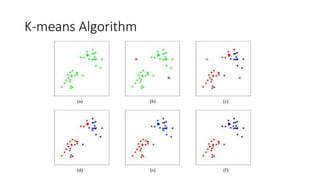
K-means Algorithm
Hierarchical clustering
• Decision of where the cluster
should be split
• Metric: distance between pairs
of observation
• Linkage criterion: dissimilarity of
sets
Clustering
Demo
Evaluating
methods for
clustering
• Sum of squares
• Class based measures
• Underlying true
Task: Iris
Clustering
• Clustering using k-means and
hierarchies
• Compare clusters with the original
classes assignments
• Visualise the findings
Regression problem
• Dependent value
• Predicting the real value
• Fitting the coefficients
• Analytical solutions
• Gradient descent
𝑓 𝒙 = 𝛽0 + 𝛽1 𝑥1 + ⋯ + 𝛽 𝑘 𝑥 𝑘
Ordinary linear regression
Residual sum of squares (RSS)
𝑆 𝑤 =
𝑖=1
𝑛
(𝑦𝑖 − 𝑥𝑖
𝑇
𝑤)2
= 𝑦 − 𝑋𝑤 𝑇
𝑦 − 𝑋𝑤
𝑤 = 𝑎𝑟𝑔 min
𝑤
𝑆(𝑤)
Task: Prestige EDA
• Descriptive statistics (dimensions,
rows, columns, data types,
correlation)
• Data visualization (distributions,
outliers)
• Handle missing data
• Features significance
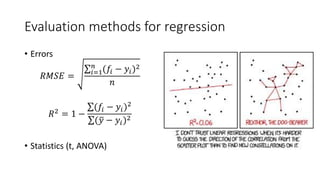
Evaluation methods for regression
• Errors
𝑅𝑀𝑆𝐸 = 𝑖=1
𝑛
(𝑓𝑖 − 𝑦𝑖)2
𝑛
𝑅2 = 1 −
(𝑓𝑖 − 𝑦𝑖)2
( 𝑦 − 𝑦𝑖)2
• Statistics (t, ANOVA)
Residuals vs
Fitted
• Check if residuals have non-
linear patterns
• Check if the model captures
the non-linear relationship
• Should show equally spread
residuals around the
horizontal line
Normal Q-Q
• Shows if the residuals are
normally distributed
• Values should be lined on the
straight dashed line
• Check if residuals do not
deviate severely
Scale-Location
• Show if residuals are spread
equally along the ranges of
predictors
• Test the assumption of equal
variance (homoscedasticity)
• Should show horizontal line
with equally (randomly)
spread points
Residuals vs
Leverage
• Helps to find influential cases
• When outside of the Cook’s
distance the cases are
influential
• With no influential cases
Cook’s distance lines should
be barely visible
Regression
problem
Demo
Task: Prestige
Regression
• Numeric and categorical features
• Other than linear relations
• Combining the features
Categorical data for regression
• Categories: A, B, C are coded as
dummy variables
• In general if the variable has k
categories it will be decoded into
k-1 dummy variables
Category V1 V2
A 0 0
B 1 0
C 0 0
𝑓 𝒙 = 𝛽0 + 𝛽1 𝑥1 + ⋯ + 𝛽𝑗 𝑥𝑗 + 𝛽𝑗+1 𝑣1 + ⋯ + 𝛽𝑗+𝑘−1 𝑣 𝑘
Categorical data for regression
𝑓 𝑥 = 𝛽0 + 𝛽1 𝑥 + 𝛽2 𝑣1 + ⋯ + 𝛽 𝑘 𝑣 𝑘−1 +
𝛽 𝑘+1 𝑣1 𝑥 + ⋯ + 𝛽2𝑘−1 𝑣 𝑘−1 𝑥
𝑦 ~ 𝑥 + 𝑐𝑎𝑡 + 𝑥: 𝑐𝑎𝑡
Keep in touch
BarbaraFusinska.com
@BasiaFusinska
https://github.com/BasiaFusinska/MachineLearningWithR

Machine Learning with R

  • 1.
    Machine Learning with R BarbaraFusinska @BasiaFusinska
  • 2.
    About me Programmer Machine Learning DataSolutions Architect @BasiaFusinska https://github.com/BasiaFusinska/MachineLearningWithR
  • 3.
    Agenda • What’s MachineLearning? • Exploratory Data Analysis • Classification • Clustering • Regression
  • 4.
    Setup • Install R: https://www.r-project.org/ •Install RStudio: https://www.rstudio.com/ • GitHub repository: https://github.com/BasiaFusinska/Ma chineLearningWithR • Packages
  • 5.
  • 7.
    Movies Genres Title #Kisses # Kicks Genre Taken 3 47 Action Love story 24 2 Romance P.S. I love you 17 3 Romance Rush hours 5 51 Action Bad boys 7 42 Action Question: What is the genre of Gone with the wind ?
  • 8.
    Data-based classification Id Feature1 Feature 2 Class 1. 3 47 A 2. 24 2 B 3. 17 3 B 4. 5 51 A 5. 7 42 A Question: What is the class of the entry with the following features: F1: 31, F2: 4 ?
  • 9.
    Data Visualization 0 10 20 30 40 50 60 0 1020 30 40 50 Rule 1: If on the left side of the line then Class = A Rule 2: If on the right side of the line then Class = B A B
  • 10.
  • 11.
    Supervised learning • Classification, regression •Label, target value • Training & Validation phases
  • 12.
    Unsupervised learning • Clustering, feature selection •Finding structure of data • Statistical values describing the data
  • 13.
    Supervised Machine Learningworkflow Clean data Data split Machine Learning algorithm Trained model Score Preprocess data Training data Test data
  • 14.
    Publishing the model MachineLearning Model Model Training Published Machine Learning Model Prediction Training data Publish model Test stream Scores
  • 15.
  • 16.
  • 17.
    Classification data Source #Links#Characters ... Fake TopNews 10 2750 … T Twitter 2 120 … F TopNews 235 502 … F Channel X 1530 3024 … T Twitter 24 70 … F StoryLeaks 722 1408 … T Facebook 98 230 … T … … … … ... Features Labels
  • 18.
    Task: Iris EDA •Descriptive statistics (dimensions, rows, columns, data types, correlation) • Data visualization (distributions, outliers) • Features distributions & classes separation • 2D visualisation http://archive.ics.uci.edu/ml/datasets/Iris
  • 19.
    K-Nearest Neighbours Algorithm •Object is classified by a majority vote • k – algorithm parameter • Distance metrics: Euclidean (continuous variables), Hamming (text) ?
  • 20.
    Naïve Bayes classifier 𝑝𝐶 𝑘 𝒙) = 𝑝 𝐶 𝑘 𝑝 𝒙 𝐶 𝑘) 𝑝(𝒙) 𝒙 = (𝑥1, … , 𝑥 𝑘) 𝑝 𝐶 𝑘 𝑥1, … , 𝑥 𝑘) likelihood evidence prior posterior
  • 21.
    Naïve Bayes example SexHeight Weight Foot size Male 6 190 11 Male 6.2 170 10 Female 5 130 6 … … … … Sex Height Weight Foot size ? 5.9 140 8 𝑝 𝑚𝑎𝑙𝑒 𝒙 = 𝑝 𝑚𝑎𝑙𝑒 𝑝 5.9 𝑚𝑎𝑙𝑒 𝑝 140 𝑚𝑎𝑙𝑒 𝑝(8|𝑚𝑎𝑙𝑒) 𝑒𝑣𝑖𝑑𝑒𝑛𝑐𝑒 𝑒𝑣𝑖𝑑𝑒𝑛𝑐𝑒 = 𝑝 𝑚𝑎𝑙𝑒 𝑝 5.9 𝑚𝑎𝑙𝑒 𝑝 140 𝑚𝑎𝑙𝑒 𝑝 8 𝑚𝑎𝑙𝑒 + 𝑝 𝑓𝑒𝑚𝑎𝑙𝑒 𝑝 5.9 𝑓𝑒𝑚𝑎𝑙𝑒 𝑝 140 𝑓𝑒𝑚𝑎𝑙𝑒 𝑝(8|𝑓𝑒𝑚𝑎𝑙𝑒) 𝑝 𝑓𝑒𝑚𝑎𝑙𝑒 𝒙 = 𝑝 𝑓𝑒𝑚𝑎𝑙𝑒 𝑝 5.9 𝑓𝑒𝑚𝑎𝑙𝑒 𝑝 140 𝑓𝑒𝑚𝑎𝑙𝑒 𝑝(8|𝑓𝑒𝑚𝑎𝑙𝑒) 𝑒𝑣𝑖𝑑𝑒𝑛𝑐𝑒
  • 22.
    Logistic regression 𝑧 =𝛽0 + 𝛽1 𝑥1 + ⋯ + 𝛽 𝑘 𝑥 𝑘 𝑦 = 1 𝑓𝑜𝑟 𝑧 > 0 0 𝑓𝑜𝑟 𝑧 < 0 𝑦 = 1 𝑓𝑜𝑟 𝜙(𝑧) > 0.5 0 𝑓𝑜𝑟 𝜙(𝑧) < 0.5 Logistic function Coefficients Best fit of β
  • 23.
  • 24.
  • 25.
    Evaluation methods forclassification Confusion Matrix Reference Positive Negative Prediction Positive TP FP Negative FN TN Receiver Operating Characteristic curve Area under the curve (AUC) 𝐴𝑐𝑐𝑢𝑟𝑎𝑐𝑦 = #𝑐𝑜𝑟𝑟𝑒𝑐𝑡 #𝑝𝑟𝑒𝑑𝑖𝑐𝑡𝑖𝑜𝑛𝑠 = 𝑇𝑃 + 𝑇𝑁 𝑇𝑃 + 𝑇𝑁 + 𝐹𝑃 + 𝐹𝑁 𝑃𝑟𝑒𝑐𝑖𝑠𝑖𝑜𝑛 = 𝑇𝑃 𝑇𝑃 + 𝐹𝑃 𝑅𝑒𝑐𝑎𝑙𝑙 = 𝑆𝑒𝑛𝑠𝑖𝑡𝑖𝑣𝑖𝑡𝑦 = 𝑇𝑃 𝑇𝑃 + 𝐹𝑁 𝑆𝑝𝑒𝑐𝑖𝑓𝑖𝑐𝑖𝑡𝑦 = 𝑇𝑁 𝑇𝑁 + 𝐹𝑁 How good at avoiding false alarms How good it is at detecting positives
  • 26.
    Task: Iris Classification • Datapreprocessing • Split data for training and tests sets • Classification using: kNN and Naïve Bayes • Performance evaluation • Results Visualisation
  • 27.
    Task: Binary Classification • Onlytwo slasses in the dataset (versicolor & virginica) • Classification using logistic regression • Performance evaluation • Results Visualisation
  • 28.
  • 29.
  • 30.
  • 31.
  • 32.
    Task: Resampling & Tuning •Repeated k-fold cross validation • Use Naïve Bayes as classification algorithm • Tune the parameters using specific values • Performance evaluation
  • 33.
  • 34.
  • 35.
    Hierarchical clustering • Decisionof where the cluster should be split • Metric: distance between pairs of observation • Linkage criterion: dissimilarity of sets
  • 36.
  • 37.
    Evaluating methods for clustering • Sumof squares • Class based measures • Underlying true
  • 38.
    Task: Iris Clustering • Clusteringusing k-means and hierarchies • Compare clusters with the original classes assignments • Visualise the findings
  • 39.
    Regression problem • Dependentvalue • Predicting the real value • Fitting the coefficients • Analytical solutions • Gradient descent 𝑓 𝒙 = 𝛽0 + 𝛽1 𝑥1 + ⋯ + 𝛽 𝑘 𝑥 𝑘
  • 40.
    Ordinary linear regression Residualsum of squares (RSS) 𝑆 𝑤 = 𝑖=1 𝑛 (𝑦𝑖 − 𝑥𝑖 𝑇 𝑤)2 = 𝑦 − 𝑋𝑤 𝑇 𝑦 − 𝑋𝑤 𝑤 = 𝑎𝑟𝑔 min 𝑤 𝑆(𝑤)
  • 41.
    Task: Prestige EDA •Descriptive statistics (dimensions, rows, columns, data types, correlation) • Data visualization (distributions, outliers) • Handle missing data • Features significance
  • 42.
    Evaluation methods forregression • Errors 𝑅𝑀𝑆𝐸 = 𝑖=1 𝑛 (𝑓𝑖 − 𝑦𝑖)2 𝑛 𝑅2 = 1 − (𝑓𝑖 − 𝑦𝑖)2 ( 𝑦 − 𝑦𝑖)2 • Statistics (t, ANOVA)
  • 43.
    Residuals vs Fitted • Checkif residuals have non- linear patterns • Check if the model captures the non-linear relationship • Should show equally spread residuals around the horizontal line
  • 44.
    Normal Q-Q • Showsif the residuals are normally distributed • Values should be lined on the straight dashed line • Check if residuals do not deviate severely
  • 45.
    Scale-Location • Show ifresiduals are spread equally along the ranges of predictors • Test the assumption of equal variance (homoscedasticity) • Should show horizontal line with equally (randomly) spread points
  • 46.
    Residuals vs Leverage • Helpsto find influential cases • When outside of the Cook’s distance the cases are influential • With no influential cases Cook’s distance lines should be barely visible
  • 47.
  • 48.
    Task: Prestige Regression • Numericand categorical features • Other than linear relations • Combining the features
  • 49.
    Categorical data forregression • Categories: A, B, C are coded as dummy variables • In general if the variable has k categories it will be decoded into k-1 dummy variables Category V1 V2 A 0 0 B 1 0 C 0 0 𝑓 𝒙 = 𝛽0 + 𝛽1 𝑥1 + ⋯ + 𝛽𝑗 𝑥𝑗 + 𝛽𝑗+1 𝑣1 + ⋯ + 𝛽𝑗+𝑘−1 𝑣 𝑘
  • 50.
    Categorical data forregression 𝑓 𝑥 = 𝛽0 + 𝛽1 𝑥 + 𝛽2 𝑣1 + ⋯ + 𝛽 𝑘 𝑣 𝑘−1 + 𝛽 𝑘+1 𝑣1 𝑥 + ⋯ + 𝛽2𝑘−1 𝑣 𝑘−1 𝑥 𝑦 ~ 𝑥 + 𝑐𝑎𝑡 + 𝑥: 𝑐𝑎𝑡
  • 52.