Outline
• Three Basic Algorithms
• kNN
• Linear Regression
• K-Means
• Training Issues
• Measuring model quality
• Over-fitting
• Cross-validation
Machine Learning
• Supervised: We are given input samples (X) and
output samples (y) of a function y = f(X). We would
like to “learn” f, and evaluate it on new data. Types:
• Classification: y is discrete (class labels).
• Regression: y is continuous, e.g. linear regression.
• Unsupervised: Given only samples X of the data, we
compute a function f such that y = f(X) is “simpler”.
• Clustering: y is discrete
• Y is continuous: Matrix factorization, Kalman filtering,
unsupervised neural networks.
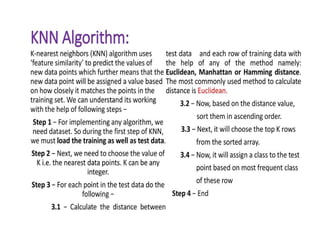
Machine Learning
• Supervised:
• Is this image a cat, dog, car, house?
• How would this user score that restaurant?
• Is this email spam?
• Is this blob a supernova?
• Unsupervised
• Cluster some hand-written digit data into 10 classes.
• What are the top 20 topics in Twitter right now?
• Find and cluster distinct accents of people at Berkeley.
Techniques
• Supervised Learning:
• kNN (k Nearest Neighbors)
• Linear Regression
• Naïve Bayes
• Logistic Regression
• Support Vector Machines
• Random Forests
• Unsupervised Learning:
• Clustering
• Factor analysis
• Topic Models
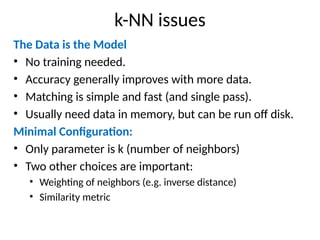
k-NN issues
The Data is the Model
• No training needed.
• Accuracy generally improves with more data.
• Matching is simple and fast (and single pass).
• Usually need data in memory, but can be run off disk.
Minimal Configuration:
• Only parameter is k (number of neighbors)
• Two other choices are important:
• Weighting of neighbors (e.g. inverse distance)
• Similarity metric
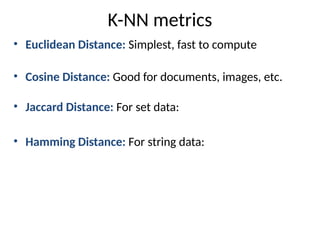
K-NN metrics
• Euclidean Distance: Simplest, fast to compute
• Cosine Distance: Good for documents, images, etc.
• Jaccard Distance: For set data:
• Hamming Distance: For string data:
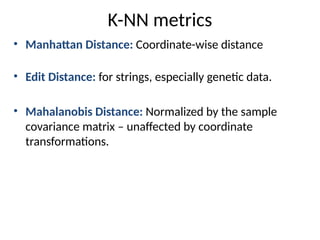
K-NN metrics
• Manhattan Distance: Coordinate-wise distance
• Edit Distance: for strings, especially genetic data.
• Mahalanobis Distance: Normalized by the sample
covariance matrix – unaffected by coordinate
transformations.
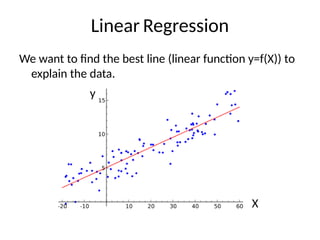
Linear Regression
We want to find the best line (linear function y=f(X)) to
explain the data.
X
y
Linear Regression
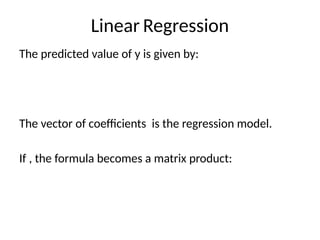
The predicted value of y is given by:
The vector of coefficients is the regression model.
If , the formula becomes a matrix product:
Linear Regression
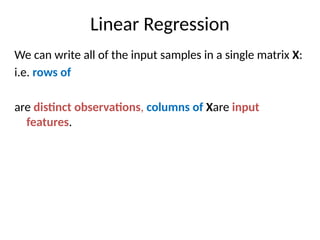
We can write all of the input samples in a single matrix X:
i.e. rows of
are distinct observations, columns of Xare input
features.
Residual Sum-of-Squares
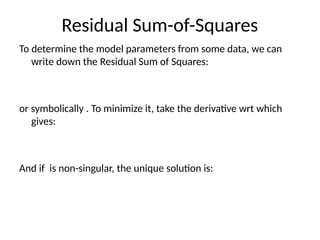
To determine the model parameters from some data, we can
write down the Residual Sum of Squares:
or symbolically . To minimize it, take the derivative wrt which
gives:
And if is non-singular, the unique solution is:
Iterative Regression Solutions
The exact method requires us to invert a matrix whose size is
nfeatures x nfeatures. This will often be too big.
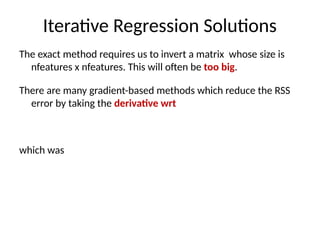
There are many gradient-based methods which reduce the RSS
error by taking the derivative wrt
which was
Stochastic Gradient
A very important set of iterative algorithms use stochastic
gradient updates.
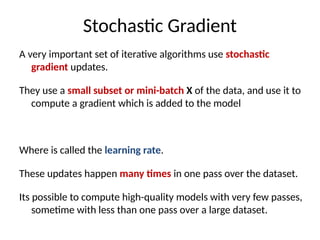
They use a small subset or mini-batch X of the data, and use it to
compute a gradient which is added to the model
Where is called the learning rate.
These updates happen many times in one pass over the dataset.
Its possible to compute high-quality models with very few passes,
sometime with less than one pass over a large dataset.
R2
-values and P-values
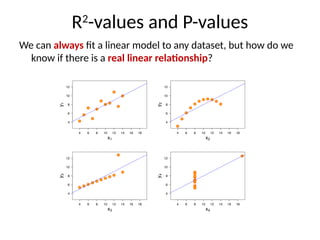
We can always fit a linear model to any dataset, but how do we
know if there is a real linear relationship?
R2
-values and P-values
Approach: Use a hypothesis test. The null hypothesis is that there
is no linear relationship (β = 0).
Statistic: Some value which should be small under the null
hypothesis, and large if the alternate hypothesis is true.
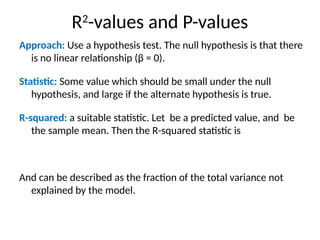
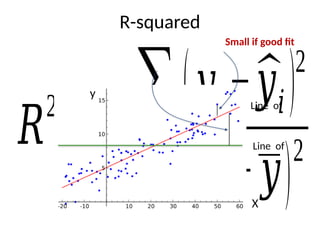
R-squared: a suitable statistic. Let be a predicted value, and be
the sample mean. Then the R-squared statistic is
And can be described as the fraction of the total variance not
explained by the model.
R-squared
𝑅
2
=1−
∑(𝑦𝑖−^
𝑦𝑖)2
∑(𝑦𝑖−𝑦)
2
X
y
Line of
Line of
Small if good fit
R2
-values and P-values
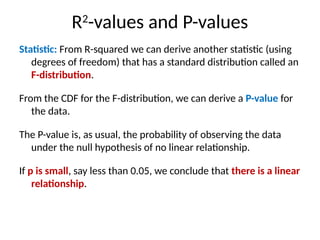
Statistic: From R-squared we can derive another statistic (using
degrees of freedom) that has a standard distribution called an
F-distribution.
From the CDF for the F-distribution, we can derive a P-value for
the data.
The P-value is, as usual, the probability of observing the data
under the null hypothesis of no linear relationship.
If p is small, say less than 0.05, we conclude that there is a linear
relationship.
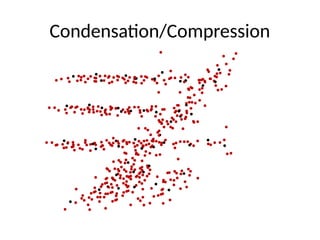
Clustering – Why?
Clustering has one or more goals:
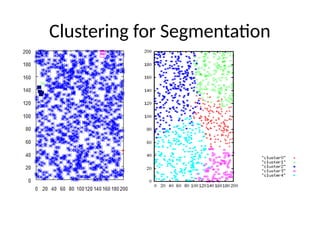
• Segment a large set of cases into small subsets that
can be treated similarly - segmentation
• Generate a more compact description of a dataset -
compression
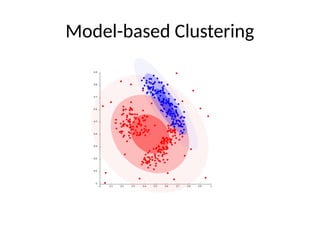
• Model an underlying process that generates the data
as a mixture of different, localized processes –
representation
Clustering – Why?
Examples:
• Segment: image segmentation
• Compression: Cluster-based kNN, e.g. handwritten
digit recognition.
• Underlying process: Accents of people at Berkeley
(??) – because place of origin strongly influences the
accent you have.
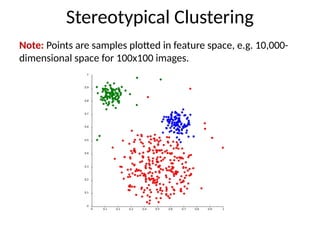
Stereotypical Clustering
Note: Points are samples plotted in feature space, e.g. 10,000-
dimensional space for 100x100 images.
Model-based Clustering
Clustering for Segmentation
Condensation/Compression
“Cluster Bias”
Upshot:
• Clustering is used more than it should be, because
people assume an underlying domain has discrete
classes in it.
• This is especially true for characteristics of people,
e.g. Myers-Briggs personality types like “ENTP”.
• In reality the underlying data is usually continuous.
• Just as with Netflix, continuous models (dimension
reduction, kNN) tend to do better.
Terminology
• Hierarchical clustering: clusters form a hierarchy. Can
be computed bottom-up or top-down.
• Flat clustering: no inter-cluster structure.
• Hard clustering: items assigned to a unique cluster.
• Soft clustering: cluster membership is a real-valued
function, distributed across several clusters.
K-means clustering
The standard k-means algorithm is based on Euclidean
distance.
The cluster quality measure is an intra-cluster measure
only, equivalent to the sum of item-to-centroid kernels.
A simple greedy algorithm locally optimizes this measure
(usually called Lloyd’s algorithm):
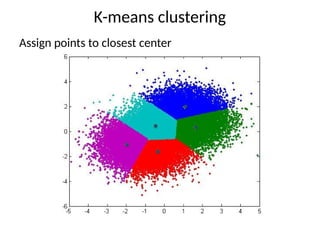
• Find the closest cluster center for each item, and assign it to that
cluster.
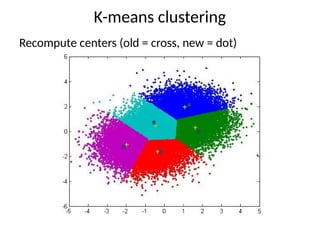
• Recompute the cluster centroid as the mean of items, for the
newly-assigned items in the cluster.
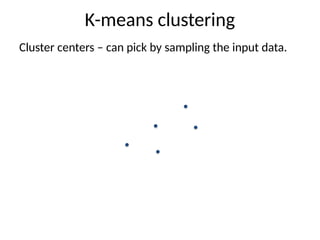
Cluster centers – can pick by sampling the input data.
K-means clustering
K-means clustering
Assign points to closest center
K-means clustering
Recompute centers (old = cross, new = dot)
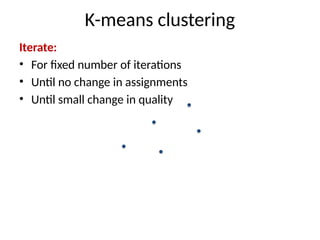
Iterate:
• For fixed number of iterations
• Until no change in assignments
• Until small change in quality
K-means clustering
K-means properties
• It’s a greedy algorithm with random setup – solution isn’t
optimal and varies significantly with different initial points.
• Very simple convergence proofs.
• Performance is O(nk) per iteration, not bad and can be
heuristically improved.
n = total features in the dataset, k = number clusters
• Many generalizations, e.g.
• Fixed-size clusters
• Simple generalization to m-best soft clustering
• As a “local” clustering method, it works well for data
condensation/compression.

DataAnalysis in machine learning using different techniques

  • 1.
    Outline • Three BasicAlgorithms • kNN • Linear Regression • K-Means • Training Issues • Measuring model quality • Over-fitting • Cross-validation
  • 2.
    Machine Learning • Supervised:We are given input samples (X) and output samples (y) of a function y = f(X). We would like to “learn” f, and evaluate it on new data. Types: • Classification: y is discrete (class labels). • Regression: y is continuous, e.g. linear regression. • Unsupervised: Given only samples X of the data, we compute a function f such that y = f(X) is “simpler”. • Clustering: y is discrete • Y is continuous: Matrix factorization, Kalman filtering, unsupervised neural networks.
  • 3.
    Machine Learning • Supervised: •Is this image a cat, dog, car, house? • How would this user score that restaurant? • Is this email spam? • Is this blob a supernova? • Unsupervised • Cluster some hand-written digit data into 10 classes. • What are the top 20 topics in Twitter right now? • Find and cluster distinct accents of people at Berkeley.
  • 4.
    Techniques • Supervised Learning: •kNN (k Nearest Neighbors) • Linear Regression • Naïve Bayes • Logistic Regression • Support Vector Machines • Random Forests • Unsupervised Learning: • Clustering • Factor analysis • Topic Models
  • 6.
    k-NN issues The Datais the Model • No training needed. • Accuracy generally improves with more data. • Matching is simple and fast (and single pass). • Usually need data in memory, but can be run off disk. Minimal Configuration: • Only parameter is k (number of neighbors) • Two other choices are important: • Weighting of neighbors (e.g. inverse distance) • Similarity metric
  • 7.
    K-NN metrics • EuclideanDistance: Simplest, fast to compute • Cosine Distance: Good for documents, images, etc. • Jaccard Distance: For set data: • Hamming Distance: For string data:
  • 8.
    K-NN metrics • ManhattanDistance: Coordinate-wise distance • Edit Distance: for strings, especially genetic data. • Mahalanobis Distance: Normalized by the sample covariance matrix – unaffected by coordinate transformations.
  • 9.
    Linear Regression We wantto find the best line (linear function y=f(X)) to explain the data. X y
  • 10.
    Linear Regression The predictedvalue of y is given by: The vector of coefficients is the regression model. If , the formula becomes a matrix product:
  • 11.
    Linear Regression We canwrite all of the input samples in a single matrix X: i.e. rows of are distinct observations, columns of Xare input features.
  • 12.
    Residual Sum-of-Squares To determinethe model parameters from some data, we can write down the Residual Sum of Squares: or symbolically . To minimize it, take the derivative wrt which gives: And if is non-singular, the unique solution is:
  • 13.
    Iterative Regression Solutions Theexact method requires us to invert a matrix whose size is nfeatures x nfeatures. This will often be too big. There are many gradient-based methods which reduce the RSS error by taking the derivative wrt which was
  • 14.
    Stochastic Gradient A veryimportant set of iterative algorithms use stochastic gradient updates. They use a small subset or mini-batch X of the data, and use it to compute a gradient which is added to the model Where is called the learning rate. These updates happen many times in one pass over the dataset. Its possible to compute high-quality models with very few passes, sometime with less than one pass over a large dataset.
  • 15.
    R2 -values and P-values Wecan always fit a linear model to any dataset, but how do we know if there is a real linear relationship?
  • 16.
    R2 -values and P-values Approach:Use a hypothesis test. The null hypothesis is that there is no linear relationship (β = 0). Statistic: Some value which should be small under the null hypothesis, and large if the alternate hypothesis is true. R-squared: a suitable statistic. Let be a predicted value, and be the sample mean. Then the R-squared statistic is And can be described as the fraction of the total variance not explained by the model.
  • 17.
  • 18.
    R2 -values and P-values Statistic:From R-squared we can derive another statistic (using degrees of freedom) that has a standard distribution called an F-distribution. From the CDF for the F-distribution, we can derive a P-value for the data. The P-value is, as usual, the probability of observing the data under the null hypothesis of no linear relationship. If p is small, say less than 0.05, we conclude that there is a linear relationship.
  • 19.
    Clustering – Why? Clusteringhas one or more goals: • Segment a large set of cases into small subsets that can be treated similarly - segmentation • Generate a more compact description of a dataset - compression • Model an underlying process that generates the data as a mixture of different, localized processes – representation
  • 20.
    Clustering – Why? Examples: •Segment: image segmentation • Compression: Cluster-based kNN, e.g. handwritten digit recognition. • Underlying process: Accents of people at Berkeley (??) – because place of origin strongly influences the accent you have.
  • 21.
    Stereotypical Clustering Note: Pointsare samples plotted in feature space, e.g. 10,000- dimensional space for 100x100 images.
  • 22.
  • 23.
  • 24.
  • 25.
  • 26.
    “Cluster Bias” Upshot: • Clusteringis used more than it should be, because people assume an underlying domain has discrete classes in it. • This is especially true for characteristics of people, e.g. Myers-Briggs personality types like “ENTP”. • In reality the underlying data is usually continuous. • Just as with Netflix, continuous models (dimension reduction, kNN) tend to do better.
  • 27.
    Terminology • Hierarchical clustering:clusters form a hierarchy. Can be computed bottom-up or top-down. • Flat clustering: no inter-cluster structure. • Hard clustering: items assigned to a unique cluster. • Soft clustering: cluster membership is a real-valued function, distributed across several clusters.
  • 28.
    K-means clustering The standardk-means algorithm is based on Euclidean distance. The cluster quality measure is an intra-cluster measure only, equivalent to the sum of item-to-centroid kernels. A simple greedy algorithm locally optimizes this measure (usually called Lloyd’s algorithm): • Find the closest cluster center for each item, and assign it to that cluster. • Recompute the cluster centroid as the mean of items, for the newly-assigned items in the cluster.
  • 29.
    Cluster centers –can pick by sampling the input data. K-means clustering
  • 30.
  • 31.
    K-means clustering Recompute centers(old = cross, new = dot)
  • 32.
    Iterate: • For fixednumber of iterations • Until no change in assignments • Until small change in quality K-means clustering
  • 33.
    K-means properties • It’sa greedy algorithm with random setup – solution isn’t optimal and varies significantly with different initial points. • Very simple convergence proofs. • Performance is O(nk) per iteration, not bad and can be heuristically improved. n = total features in the dataset, k = number clusters • Many generalizations, e.g. • Fixed-size clusters • Simple generalization to m-best soft clustering • As a “local” clustering method, it works well for data condensation/compression.

Editor's Notes

  • #17 What R-squared value would you expect under the null hypothesis ?