Location:
QuantUniversity Meetup
August 24th 2016
Boston MA
Machine Learning: An intuitive foundation
2016 Copyright QuantUniversity LLC.
Presented By:
Sri Krishnamurthy, CFA, CAP
www.QuantUniversity.com
sri@quantuniversity.com
2
Slides and Code will be available at:
http://www.analyticscertificate.com
- Analytics Advisory services
- Custom training programs
- Architecture assessments, advice and audits
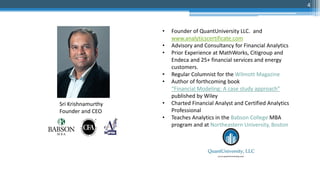
• Founder of QuantUniversity LLC. and
www.analyticscertificate.com
• Advisory and Consultancy for Financial Analytics
• Prior Experience at MathWorks, Citigroup and
Endeca and 25+ financial services and energy
customers.
• Regular Columnist for the Wilmott Magazine
• Author of forthcoming book
“Financial Modeling: A case study approach”
published by Wiley
• Charted Financial Analyst and Certified Analytics
Professional
• Teaches Analytics in the Babson College MBA
program and at Northeastern University, Boston
Sri Krishnamurthy
Founder and CEO
4
5
Quantitative Analytics and Big Data Analytics Onboarding
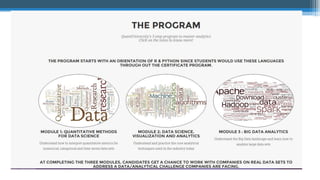
• Trained more than 500 students in
Quantitative methods, Data Science
and Big Data Technologies using
MATLAB, Python and R
• Launching the Analytics Certificate
Program in September
7
Quantitative Analytics and Big Data Analytics Onboarding
• Apply at:
www.analyticscertificate.com
• Program starting September 18th
• Module 1:
▫ Sep 18th , 25th , Oct 2nd, 9th
• Module 2:
▫ Oct 16th , 23th , 30th, Nov 6th
• Module 3:
▫ Nov 13th, 20th, Dec 4th, Dec 11th
• Capstone + Certification Ceremony
▫ Dec 18th
8
• September
▫ 11th, 12th : Spark Workshop, Boston
 www.analyticscertificate.com/SparkWorkshop
 Sponsored by IBM
▫ 19th, 20th : Anomaly Detection Workshop, New York
 www.analyticscertificate.com/AnomalyNYC
 Sponsored by Microsoft
Events of Interest
9
Agenda
1. Data
2. Goals
3. Machine learning algorithms
4. Process
5. Performance Evaluation
11
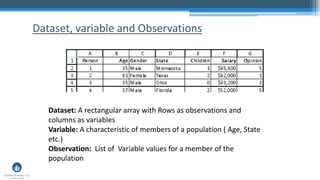
Dataset, variable and Observations
Dataset: A rectangular array with Rows as observations and
columns as variables
Variable: A characteristic of members of a population ( Age, State
etc.)
Observation: List of Variable values for a member of the
population
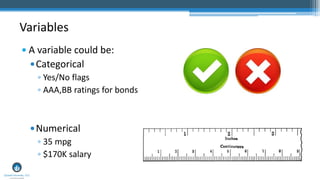
Variables
 A variable could be:
Categorical
 Yes/No flags
 AAA,BB ratings for bonds
Numerical
 35 mpg
 $170K salary
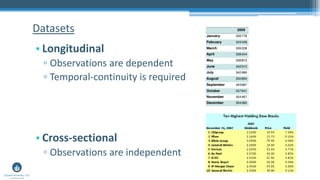
Datasets
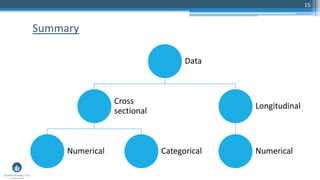
• Longitudinal
▫ Observations are dependent
▫ Temporal-continuity is required
• Cross-sectional
▫ Observations are independent
15
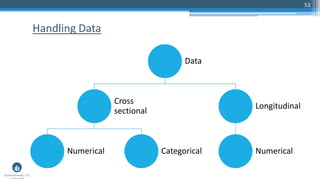
Data
Cross
sectional
Numerical Categorical
Longitudinal
Numerical
Summary
16
17
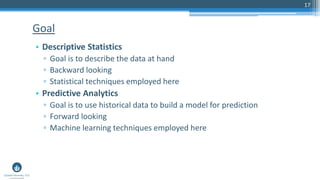
• Descriptive Statistics
▫ Goal is to describe the data at hand
▫ Backward looking
▫ Statistical techniques employed here
• Predictive Analytics
▫ Goal is to use historical data to build a model for prediction
▫ Forward looking
▫ Machine learning techniques employed here
Goal
18
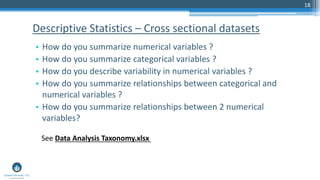
• How do you summarize numerical variables ?
• How do you summarize categorical variables ?
• How do you describe variability in numerical variables ?
• How do you summarize relationships between categorical and
numerical variables ?
• How do you summarize relationships between 2 numerical
variables?
Descriptive Statistics – Cross sectional datasets
See Data Analysis Taxonomy.xlsx
19
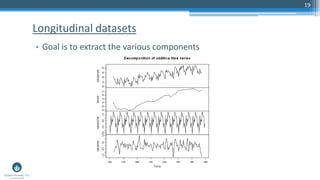
• Goal is to extract the various components
Longitudinal datasets
20
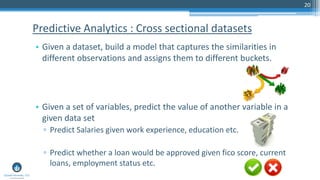
• Given a dataset, build a model that captures the similarities in
different observations and assigns them to different buckets.
• Given a set of variables, predict the value of another variable in a
given data set
▫ Predict Salaries given work experience, education etc.
▫ Predict whether a loan would be approved given fico score, current
loans, employment status etc.
Predictive Analytics : Cross sectional datasets
21
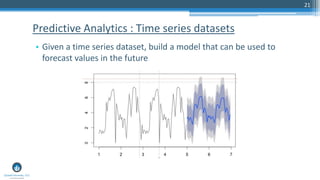
• Given a time series dataset, build a model that can be used to
forecast values in the future
Predictive Analytics : Time series datasets
22
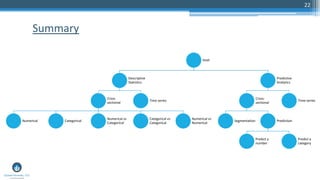
Goal
Descriptive
Statistics
Cross
sectional
Numerical Categorical
Numerical vs
Categorical
Categorical vs
Categorical
Numerical vs
Numerical
Time series
Predictive
Analytics
Cross-
sectional
Segmentation Prediction
Predict a
number
Predict a
category
Time-series
Summary
23
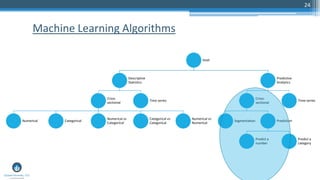
24
Machine Learning Algorithms
Goal
Descriptive
Statistics
Cross
sectional
Numerical Categorical
Numerical vs
Categorical
Categorical vs
Categorical
Numerical vs
Numerical
Time series
Predictive
Analytics
Cross-
sectional
Segmentation Prediction
Predict a
number
Predict a
category
Time-series
25
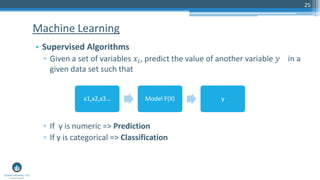
• Supervised Algorithms
▫ Given a set of variables 𝑥𝑖, predict the value of another variable 𝑦 in a
given data set such that
▫ If y is numeric => Prediction
▫ If y is categorical => Classification
Machine Learning
x1,x2,x3… Model F(X) y
26
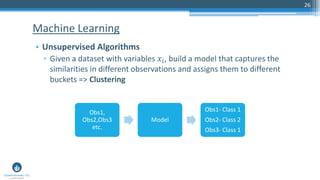
• Unsupervised Algorithms
▫ Given a dataset with variables 𝑥𝑖, build a model that captures the
similarities in different observations and assigns them to different
buckets => Clustering
Machine Learning
Obs1,
Obs2,Obs3
etc.
Model
Obs1- Class 1
Obs2- Class 2
Obs3- Class 1
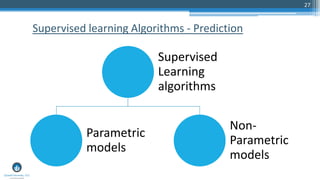
27
Supervised
Learning
algorithms
Parametric
models
Non-
Parametric
models
Supervised learning Algorithms - Prediction
28
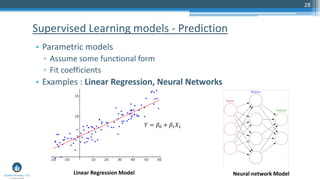
• Parametric models
▫ Assume some functional form
▫ Fit coefficients
• Examples : Linear Regression, Neural Networks
Supervised Learning models - Prediction
𝑌 = 𝛽0 + 𝛽1 𝑋1
Linear Regression Model Neural network Model
29
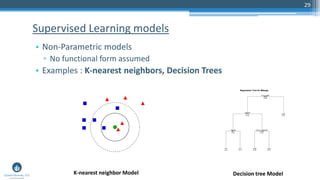
• Non-Parametric models
▫ No functional form assumed
• Examples : K-nearest neighbors, Decision Trees
Supervised Learning models
K-nearest neighbor Model Decision tree Model
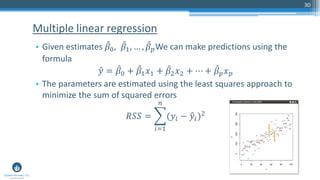
• Given estimates መ𝛽0, መ𝛽1, … , መ𝛽 𝑝We can make predictions using the
formula
ො𝑦 = መ𝛽0 + መ𝛽1 𝑥1 + መ𝛽2 𝑥2 + ⋯ + መ𝛽 𝑝 𝑥 𝑝
• The parameters are estimated using the least squares approach to
minimize the sum of squared errors
𝑅𝑆𝑆 = ෍
𝑖=1
𝑛
(𝑦𝑖 − ො𝑦𝑖)2
Multiple linear regression
30
31
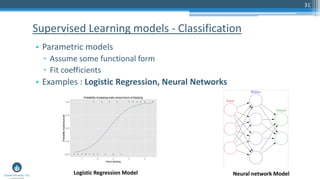
• Parametric models
▫ Assume some functional form
▫ Fit coefficients
• Examples : Logistic Regression, Neural Networks
Supervised Learning models - Classification
Logistic Regression Model Neural network Model
32
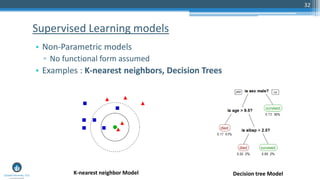
• Non-Parametric models
▫ No functional form assumed
• Examples : K-nearest neighbors, Decision Trees
Supervised Learning models
K-nearest neighbor Model Decision tree Model
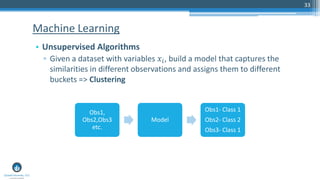
33
• Unsupervised Algorithms
▫ Given a dataset with variables 𝑥𝑖, build a model that captures the
similarities in different observations and assigns them to different
buckets => Clustering
Machine Learning
Obs1,
Obs2,Obs3
etc.
Model
Obs1- Class 1
Obs2- Class 2
Obs3- Class 1
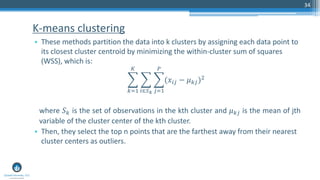
K-means clustering
• These methods partition the data into k clusters by assigning each data point to
its closest cluster centroid by minimizing the within-cluster sum of squares
(WSS), which is:
෍
𝑘=1
𝐾
෍
𝑖∈𝑆 𝑘
෍
𝑗=1
𝑃
(𝑥𝑖𝑗 − 𝜇 𝑘𝑗)2
where 𝑆 𝑘 is the set of observations in the kth cluster and 𝜇 𝑘𝑗 is the mean of jth
variable of the cluster center of the kth cluster.
• Then, they select the top n points that are the farthest away from their nearest
cluster centers as outliers.
34
35
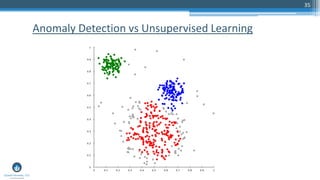
Anomaly Detection vs Unsupervised Learning
36
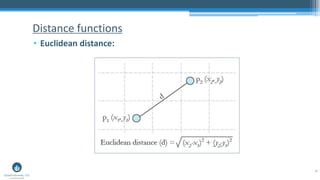
Distance functions
• Euclidean distance:
37
Distance functions
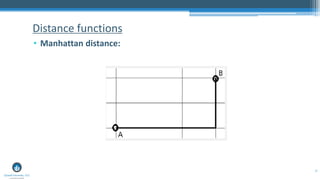
• Manhattan distance:
D =|𝑋𝐴- 𝑋 𝐵|+ |𝑌𝐴- 𝑌𝐵|
38
Distance functions
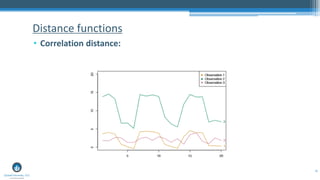
• Correlation distance:
39
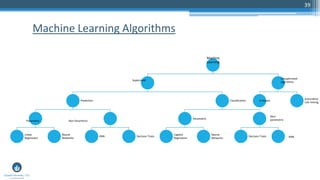
Machine Learning Algorithms
Machine
Learning
Supervised
Prediction
Parametric
Linear
Regression
Neural
Networks
Non-
parametric
KNN Decision Trees
Classification
Parametric
Logistic
Regression
Neural
Networks
Non Parametric
Decision Trees KNN
Unsupervised
algorithms
K-means
Associative
rule mining
40
41
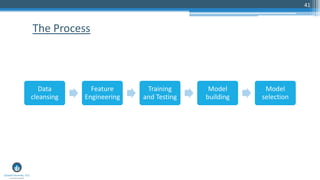
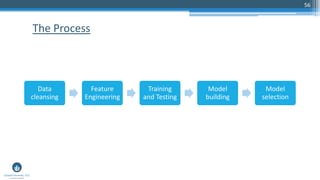
The Process
Data
cleansing
Feature
Engineering
Training
and Testing
Model
building
Model
selection
42
• What transformations do I need for the x and y variables ?
• Which are the best features to use?
▫ Dimension Reduction – PCA
▫ Best subset selection
 Forward selection
 Backward elimination
 Stepwise regression
Feature Engineering
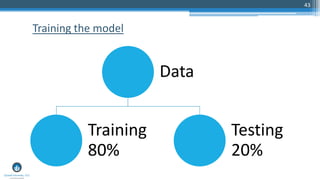
43
Data
Training
80%
Testing
20%
Training the model
44
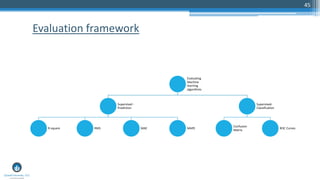
45
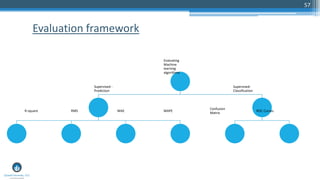
Evaluating
Machine
learning
algorithms
Supervised -
Prediction
R-square RMS MAE MAPE
Supervised-
Classification
Confusion
Matrix
ROC Curves
Evaluation framework
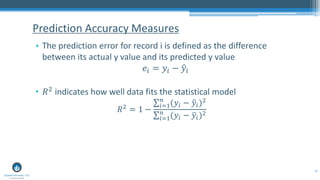
46
• The prediction error for record i is defined as the difference
between its actual y value and its predicted y value
𝑒𝑖 = 𝑦𝑖 − ො𝑦𝑖
• 𝑅2 indicates how well data fits the statistical model
𝑅2 = 1 −
σ𝑖=1
𝑛
(𝑦𝑖 − ො𝑦𝑖)2
σ𝑖=1
𝑛
(𝑦𝑖 − ത𝑦𝑖)2
Prediction Accuracy Measures
47
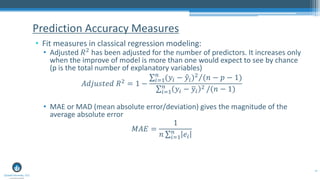
• Fit measures in classical regression modeling:
• Adjusted 𝑅2 has been adjusted for the number of predictors. It increases only
when the improve of model is more than one would expect to see by chance
(p is the total number of explanatory variables)
𝐴𝑑𝑗𝑢𝑠𝑡𝑒𝑑 𝑅2 = 1 −
Τσ𝑖=1
𝑛
(𝑦𝑖 − ො𝑦𝑖)2 (𝑛 − 𝑝 − 1)
σ𝑖=1
𝑛
𝑦𝑖 − ത𝑦𝑖
2 /(𝑛 − 1)
• MAE or MAD (mean absolute error/deviation) gives the magnitude of the
average absolute error
𝑀𝐴𝐸 =
1
𝑛 σ𝑖=1
𝑛
𝑒𝑖
Prediction Accuracy Measures
48
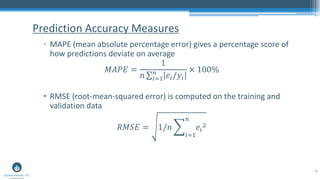
▫ MAPE (mean absolute percentage error) gives a percentage score of
how predictions deviate on average
𝑀𝐴𝑃𝐸 =
1
𝑛 σ𝑖=1
𝑛
𝑒𝑖/𝑦𝑖
× 100%
• RMSE (root-mean-squared error) is computed on the training and
validation data
𝑅𝑀𝑆𝐸 = 1/𝑛 ෍
𝑖=1
𝑛
𝑒𝑖
2
Prediction Accuracy Measures
49
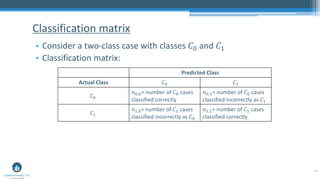
• Consider a two-class case with classes 𝐶0 and 𝐶1
• Classification matrix:
Classification matrix
Predicted Class
Actual Class 𝐶0 𝐶1
𝐶0
𝑛0,0= number of 𝐶0 cases
classified correctly
𝑛0,1= number of 𝐶0 cases
classified incorrectly as 𝐶1
𝐶1
𝑛1,0= number of 𝐶1 cases
classified incorrectly as 𝐶0
𝑛1,1= number of 𝐶1 cases
classified correctly
50
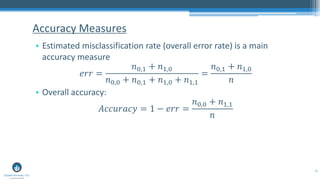
• Estimated misclassification rate (overall error rate) is a main
accuracy measure
𝑒𝑟𝑟 =
𝑛0,1 + 𝑛1,0
𝑛0,0 + 𝑛0,1 + 𝑛1,0 + 𝑛1,1
=
𝑛0,1 + 𝑛1,0
𝑛
• Overall accuracy:
𝐴𝑐𝑐𝑢𝑟𝑎𝑐𝑦 = 1 − 𝑒𝑟𝑟 =
𝑛0,0 + 𝑛1,1
𝑛
Accuracy Measures
51
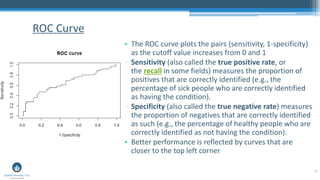
• The ROC curve plots the pairs {sensitivity, 1-specificity}
as the cutoff value increases from 0 and 1
• Sensitivity (also called the true positive rate, or
the recall in some fields) measures the proportion of
positives that are correctly identified (e.g., the
percentage of sick people who are correctly identified
as having the condition).
• Specificity (also called the true negative rate) measures
the proportion of negatives that are correctly identified
as such (e.g., the percentage of healthy people who are
correctly identified as not having the condition).
• Better performance is reflected by curves that are
closer to the top left corner
ROC Curve
Agenda
1. Data
2. Goals
3. Machine learning algorithms
4. Process
5. Performance Evaluation
53
Data
Cross
sectional
Numerical Categorical
Longitudinal
Numerical
Handling Data
54
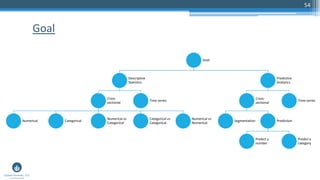
Goal
Descriptive
Statistics
Cross
sectional
Numerical Categorical
Numerical vs
Categorical
Categorical vs
Categorical
Numerical vs
Numerical
Time series
Predictive
Analytics
Cross-
sectional
Segmentation Prediction
Predict a
number
Predict a
category
Time-series
Goal
55
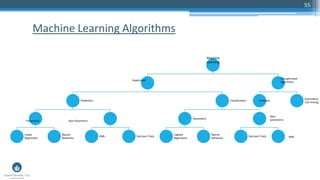
Machine Learning Algorithms
Machine
Learning
Supervised
Prediction
Parametric
Linear
Regression
Neural
Networks
Non-
parametric
KNN Decision Trees
Classification
Parametric
Logistic
Regression
Neural
Networks
Non Parametric
Decision Trees KNN
Unsupervised
algorithms
K-means
Associative
rule mining
56
The Process
Data
cleansing
Feature
Engineering
Training
and Testing
Model
building
Model
selection
57
Evaluating
Machine
learning
algorithms
Supervised -
Prediction
R-square RMS MAE MAPE
Supervised-
Classification
Confusion
Matrix
ROC Curves
Evaluation framework
60
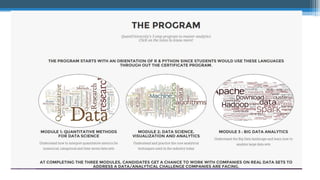
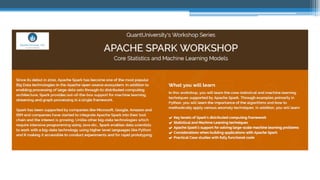
www.analyticscertificate.com/SparkWorkshop
61
Q&A
Slides, code and details about the Apache Spark Workshop
at: http://www.analyticscertificate.com/SparkWorkshop/
Thank you!
Members & Sponsors!
Sri Krishnamurthy, CFA, CAP
Founder and CEO
QuantUniversity LLC.
srikrishnamurthy
www.QuantUniversity.com
Contact
Information, data and drawings embodied in this presentation are strictly a property of QuantUniversity LLC. and shall not be
distributed or used in any other publication without the prior written consent of QuantUniversity LLC.
62

Machine learning meetup

  • 1.
    Location: QuantUniversity Meetup August 24th2016 Boston MA Machine Learning: An intuitive foundation 2016 Copyright QuantUniversity LLC. Presented By: Sri Krishnamurthy, CFA, CAP www.QuantUniversity.com sri@quantuniversity.com
  • 2.
    2 Slides and Codewill be available at: http://www.analyticscertificate.com
  • 3.
    - Analytics Advisoryservices - Custom training programs - Architecture assessments, advice and audits
  • 4.
    • Founder ofQuantUniversity LLC. and www.analyticscertificate.com • Advisory and Consultancy for Financial Analytics • Prior Experience at MathWorks, Citigroup and Endeca and 25+ financial services and energy customers. • Regular Columnist for the Wilmott Magazine • Author of forthcoming book “Financial Modeling: A case study approach” published by Wiley • Charted Financial Analyst and Certified Analytics Professional • Teaches Analytics in the Babson College MBA program and at Northeastern University, Boston Sri Krishnamurthy Founder and CEO 4
  • 5.
    5 Quantitative Analytics andBig Data Analytics Onboarding • Trained more than 500 students in Quantitative methods, Data Science and Big Data Technologies using MATLAB, Python and R • Launching the Analytics Certificate Program in September
  • 7.
    7 Quantitative Analytics andBig Data Analytics Onboarding • Apply at: www.analyticscertificate.com • Program starting September 18th • Module 1: ▫ Sep 18th , 25th , Oct 2nd, 9th • Module 2: ▫ Oct 16th , 23th , 30th, Nov 6th • Module 3: ▫ Nov 13th, 20th, Dec 4th, Dec 11th • Capstone + Certification Ceremony ▫ Dec 18th
  • 8.
    8 • September ▫ 11th,12th : Spark Workshop, Boston  www.analyticscertificate.com/SparkWorkshop  Sponsored by IBM ▫ 19th, 20th : Anomaly Detection Workshop, New York  www.analyticscertificate.com/AnomalyNYC  Sponsored by Microsoft Events of Interest
  • 9.
  • 10.
    Agenda 1. Data 2. Goals 3.Machine learning algorithms 4. Process 5. Performance Evaluation
  • 11.
  • 12.
    Dataset, variable andObservations Dataset: A rectangular array with Rows as observations and columns as variables Variable: A characteristic of members of a population ( Age, State etc.) Observation: List of Variable values for a member of the population
  • 13.
    Variables  A variablecould be: Categorical  Yes/No flags  AAA,BB ratings for bonds Numerical  35 mpg  $170K salary
  • 14.
    Datasets • Longitudinal ▫ Observationsare dependent ▫ Temporal-continuity is required • Cross-sectional ▫ Observations are independent
  • 15.
  • 16.
  • 17.
    17 • Descriptive Statistics ▫Goal is to describe the data at hand ▫ Backward looking ▫ Statistical techniques employed here • Predictive Analytics ▫ Goal is to use historical data to build a model for prediction ▫ Forward looking ▫ Machine learning techniques employed here Goal
  • 18.
    18 • How doyou summarize numerical variables ? • How do you summarize categorical variables ? • How do you describe variability in numerical variables ? • How do you summarize relationships between categorical and numerical variables ? • How do you summarize relationships between 2 numerical variables? Descriptive Statistics – Cross sectional datasets See Data Analysis Taxonomy.xlsx
  • 19.
    19 • Goal isto extract the various components Longitudinal datasets
  • 20.
    20 • Given adataset, build a model that captures the similarities in different observations and assigns them to different buckets. • Given a set of variables, predict the value of another variable in a given data set ▫ Predict Salaries given work experience, education etc. ▫ Predict whether a loan would be approved given fico score, current loans, employment status etc. Predictive Analytics : Cross sectional datasets
  • 21.
    21 • Given atime series dataset, build a model that can be used to forecast values in the future Predictive Analytics : Time series datasets
  • 22.
    22 Goal Descriptive Statistics Cross sectional Numerical Categorical Numerical vs Categorical Categoricalvs Categorical Numerical vs Numerical Time series Predictive Analytics Cross- sectional Segmentation Prediction Predict a number Predict a category Time-series Summary
  • 23.
  • 24.
    24 Machine Learning Algorithms Goal Descriptive Statistics Cross sectional NumericalCategorical Numerical vs Categorical Categorical vs Categorical Numerical vs Numerical Time series Predictive Analytics Cross- sectional Segmentation Prediction Predict a number Predict a category Time-series
  • 25.
    25 • Supervised Algorithms ▫Given a set of variables 𝑥𝑖, predict the value of another variable 𝑦 in a given data set such that ▫ If y is numeric => Prediction ▫ If y is categorical => Classification Machine Learning x1,x2,x3… Model F(X) y
  • 26.
    26 • Unsupervised Algorithms ▫Given a dataset with variables 𝑥𝑖, build a model that captures the similarities in different observations and assigns them to different buckets => Clustering Machine Learning Obs1, Obs2,Obs3 etc. Model Obs1- Class 1 Obs2- Class 2 Obs3- Class 1
  • 27.
  • 28.
    28 • Parametric models ▫Assume some functional form ▫ Fit coefficients • Examples : Linear Regression, Neural Networks Supervised Learning models - Prediction 𝑌 = 𝛽0 + 𝛽1 𝑋1 Linear Regression Model Neural network Model
  • 29.
    29 • Non-Parametric models ▫No functional form assumed • Examples : K-nearest neighbors, Decision Trees Supervised Learning models K-nearest neighbor Model Decision tree Model
  • 30.
    • Given estimatesመ𝛽0, መ𝛽1, … , መ𝛽 𝑝We can make predictions using the formula ො𝑦 = መ𝛽0 + መ𝛽1 𝑥1 + መ𝛽2 𝑥2 + ⋯ + መ𝛽 𝑝 𝑥 𝑝 • The parameters are estimated using the least squares approach to minimize the sum of squared errors 𝑅𝑆𝑆 = ෍ 𝑖=1 𝑛 (𝑦𝑖 − ො𝑦𝑖)2 Multiple linear regression 30
  • 31.
    31 • Parametric models ▫Assume some functional form ▫ Fit coefficients • Examples : Logistic Regression, Neural Networks Supervised Learning models - Classification Logistic Regression Model Neural network Model
  • 32.
    32 • Non-Parametric models ▫No functional form assumed • Examples : K-nearest neighbors, Decision Trees Supervised Learning models K-nearest neighbor Model Decision tree Model
  • 33.
    33 • Unsupervised Algorithms ▫Given a dataset with variables 𝑥𝑖, build a model that captures the similarities in different observations and assigns them to different buckets => Clustering Machine Learning Obs1, Obs2,Obs3 etc. Model Obs1- Class 1 Obs2- Class 2 Obs3- Class 1
  • 34.
    K-means clustering • Thesemethods partition the data into k clusters by assigning each data point to its closest cluster centroid by minimizing the within-cluster sum of squares (WSS), which is: ෍ 𝑘=1 𝐾 ෍ 𝑖∈𝑆 𝑘 ෍ 𝑗=1 𝑃 (𝑥𝑖𝑗 − 𝜇 𝑘𝑗)2 where 𝑆 𝑘 is the set of observations in the kth cluster and 𝜇 𝑘𝑗 is the mean of jth variable of the cluster center of the kth cluster. • Then, they select the top n points that are the farthest away from their nearest cluster centers as outliers. 34
  • 35.
    35 Anomaly Detection vsUnsupervised Learning
  • 36.
  • 37.
    37 Distance functions • Manhattandistance: D =|𝑋𝐴- 𝑋 𝐵|+ |𝑌𝐴- 𝑌𝐵|
  • 38.
  • 39.
    39 Machine Learning Algorithms Machine Learning Supervised Prediction Parametric Linear Regression Neural Networks Non- parametric KNNDecision Trees Classification Parametric Logistic Regression Neural Networks Non Parametric Decision Trees KNN Unsupervised algorithms K-means Associative rule mining
  • 40.
  • 41.
  • 42.
    42 • What transformationsdo I need for the x and y variables ? • Which are the best features to use? ▫ Dimension Reduction – PCA ▫ Best subset selection  Forward selection  Backward elimination  Stepwise regression Feature Engineering
  • 43.
  • 44.
  • 45.
    45 Evaluating Machine learning algorithms Supervised - Prediction R-square RMSMAE MAPE Supervised- Classification Confusion Matrix ROC Curves Evaluation framework
  • 46.
    46 • The predictionerror for record i is defined as the difference between its actual y value and its predicted y value 𝑒𝑖 = 𝑦𝑖 − ො𝑦𝑖 • 𝑅2 indicates how well data fits the statistical model 𝑅2 = 1 − σ𝑖=1 𝑛 (𝑦𝑖 − ො𝑦𝑖)2 σ𝑖=1 𝑛 (𝑦𝑖 − ത𝑦𝑖)2 Prediction Accuracy Measures
  • 47.
    47 • Fit measuresin classical regression modeling: • Adjusted 𝑅2 has been adjusted for the number of predictors. It increases only when the improve of model is more than one would expect to see by chance (p is the total number of explanatory variables) 𝐴𝑑𝑗𝑢𝑠𝑡𝑒𝑑 𝑅2 = 1 − Τσ𝑖=1 𝑛 (𝑦𝑖 − ො𝑦𝑖)2 (𝑛 − 𝑝 − 1) σ𝑖=1 𝑛 𝑦𝑖 − ത𝑦𝑖 2 /(𝑛 − 1) • MAE or MAD (mean absolute error/deviation) gives the magnitude of the average absolute error 𝑀𝐴𝐸 = 1 𝑛 σ𝑖=1 𝑛 𝑒𝑖 Prediction Accuracy Measures
  • 48.
    48 ▫ MAPE (meanabsolute percentage error) gives a percentage score of how predictions deviate on average 𝑀𝐴𝑃𝐸 = 1 𝑛 σ𝑖=1 𝑛 𝑒𝑖/𝑦𝑖 × 100% • RMSE (root-mean-squared error) is computed on the training and validation data 𝑅𝑀𝑆𝐸 = 1/𝑛 ෍ 𝑖=1 𝑛 𝑒𝑖 2 Prediction Accuracy Measures
  • 49.
    49 • Consider atwo-class case with classes 𝐶0 and 𝐶1 • Classification matrix: Classification matrix Predicted Class Actual Class 𝐶0 𝐶1 𝐶0 𝑛0,0= number of 𝐶0 cases classified correctly 𝑛0,1= number of 𝐶0 cases classified incorrectly as 𝐶1 𝐶1 𝑛1,0= number of 𝐶1 cases classified incorrectly as 𝐶0 𝑛1,1= number of 𝐶1 cases classified correctly
  • 50.
    50 • Estimated misclassificationrate (overall error rate) is a main accuracy measure 𝑒𝑟𝑟 = 𝑛0,1 + 𝑛1,0 𝑛0,0 + 𝑛0,1 + 𝑛1,0 + 𝑛1,1 = 𝑛0,1 + 𝑛1,0 𝑛 • Overall accuracy: 𝐴𝑐𝑐𝑢𝑟𝑎𝑐𝑦 = 1 − 𝑒𝑟𝑟 = 𝑛0,0 + 𝑛1,1 𝑛 Accuracy Measures
  • 51.
    51 • The ROCcurve plots the pairs {sensitivity, 1-specificity} as the cutoff value increases from 0 and 1 • Sensitivity (also called the true positive rate, or the recall in some fields) measures the proportion of positives that are correctly identified (e.g., the percentage of sick people who are correctly identified as having the condition). • Specificity (also called the true negative rate) measures the proportion of negatives that are correctly identified as such (e.g., the percentage of healthy people who are correctly identified as not having the condition). • Better performance is reflected by curves that are closer to the top left corner ROC Curve
  • 52.
    Agenda 1. Data 2. Goals 3.Machine learning algorithms 4. Process 5. Performance Evaluation
  • 53.
  • 54.
    54 Goal Descriptive Statistics Cross sectional Numerical Categorical Numerical vs Categorical Categoricalvs Categorical Numerical vs Numerical Time series Predictive Analytics Cross- sectional Segmentation Prediction Predict a number Predict a category Time-series Goal
  • 55.
    55 Machine Learning Algorithms Machine Learning Supervised Prediction Parametric Linear Regression Neural Networks Non- parametric KNNDecision Trees Classification Parametric Logistic Regression Neural Networks Non Parametric Decision Trees KNN Unsupervised algorithms K-means Associative rule mining
  • 56.
  • 57.
    57 Evaluating Machine learning algorithms Supervised - Prediction R-square RMSMAE MAPE Supervised- Classification Confusion Matrix ROC Curves Evaluation framework
  • 60.
  • 61.
    61 Q&A Slides, code anddetails about the Apache Spark Workshop at: http://www.analyticscertificate.com/SparkWorkshop/
  • 62.
    Thank you! Members &Sponsors! Sri Krishnamurthy, CFA, CAP Founder and CEO QuantUniversity LLC. srikrishnamurthy www.QuantUniversity.com Contact Information, data and drawings embodied in this presentation are strictly a property of QuantUniversity LLC. and shall not be distributed or used in any other publication without the prior written consent of QuantUniversity LLC. 62