Feature	Engineering
Dmitry	Larko,	Sr.	Data	Scientist	@	H2O.ai
dmitry@h2o.ai
About	me
6x
6x	
"Coming up with features is difficult, time-consuming, requires expert knowledge. “Applied machine
learning” is basically feature engineering." ~ Andrew Ng
Feature	Engineering
“… some machine learning projects succeed and some fail. What makes the difference? Easily the
most important factor is the features used.” ~ Pedro Domingos
“Good data preparation and feature engineering is integral to better prediction” ~ Marios Michailidis
(KazAnova), Kaggle GrandMaster, Kaggle #3, former #1
”you have to turn your inputs into things the algorithm can understand” ~ Shayne Miel, answer to
“What is the intuitive explanation of feature engineering in machine learning?”
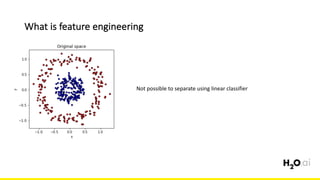
What	is	feature	engineering
6x	
Not	possible	to	separate	using	linear	classifier
What	is	feature	engineering
6x	
What	if	we	use	polar	coordinates	
instead?
What	is	feature	engineering
6x
Feature	Engineering
That’s	NOT	Feature	Engineering
6x	
• Initial	data	collection	
• Creating	the	target	variable.
• Removing	duplicates,	handling	missing	values,	or	fixing	mislabeled	
classes,	it’s	data	cleaning.
• Scaling	or	normalization
• Feature	selection,	although	I’m	going	to	mention	it	in	this	talk	J
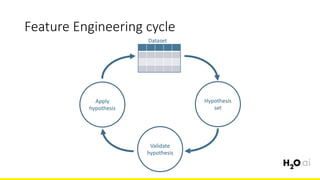
Feature	Engineering	cycle
6x	Hypothesis	
set
Validate	
hypothesis
Apply	
hypothesis
Dataset
Feature	Engineering	cycle
6x	Hypothesis	
set
Validate	
hypothesis
Apply	
hypothesis
Dataset
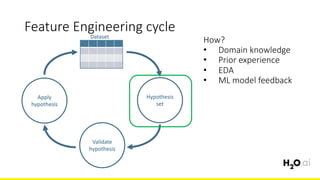
How?
• Domain	knowledge
• Prior	experience
• EDA
• ML	model	feedback
Feature	Engineering	cycle
6x	Hypothesis	
set
Validate	
hypothesis
Apply	
hypothesis
Dataset
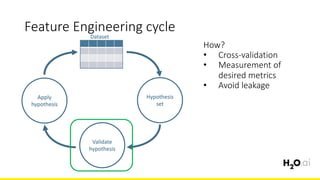
How?
• Cross-validation
• Measurement	of	
desired	metrics
• Avoid	leakage
Why	feature	engineering	is	hard
6x	
• Powerful	feature	transformations	(like	target	encoding)	
can	introduce	leakage	when	applied	wrong
• Usually	requires	domain	knowledge	about	how	
features	interact	with	each	other
• Time-consuming,	need	to	run	thousand	of	experiments
Feature	Engineering
6x	
• Extract	more	new	gold	features,	remove	irrelevant	
or	noisy	features	
• Simpler	models	with	better	results
• Key	Elements
• Target	Transformation
• Feature	Encoding
• Feature	Extraction
Target	Transformation
6x	
• Predictor/Response	Variable	Transformation
• Use	it	when	variable	shows	a	skewed	distribution	make	
the	residuals	more	close	to	“normal	distribution”	(bell	
curve)
• Can	improve	model	fit
• log(x),	log(x+1),	sqrt(x),	sqrt(x+1),	etc.
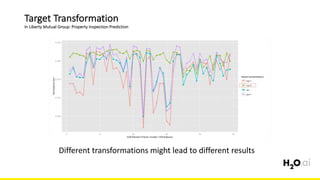
Target	Transformation	
In	Liberty	Mutual	Group:	Property	Inspection	Prediction
6x	
Different	transformations	might	lead	to	different	results
Feature	Encoding
6x	
• Turn	categorical	features	into	numeric	features	to	
provide	more	fine-grained	information
• Help	explicitly	capture	non-linear	relationships	and	
interactions	between	the	values	of	features
• Most	of	machine	learning	tools	only	accept	numbers	as	
their	input
• xgboost,	gbm,	glmnet,	libsvm,	liblinear,	etc.
Feature	Encoding
6x	
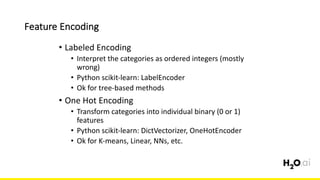
• Labeled	Encoding
• Interpret	the	categories	as	ordered	integers	(mostly	
wrong)
• Python	scikit-learn:	LabelEncoder
• Ok	for	tree-based	methods
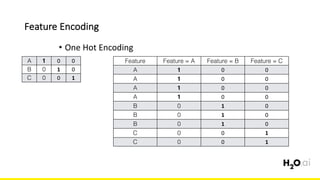
• One	Hot	Encoding
• Transform	categories	into	individual	binary	(0	or	1)	
features
• Python	scikit-learn:	DictVectorizer,	OneHotEncoder
• Ok	for	K-means,	Linear,	NNs,	etc.
Feature	Encoding
• Labeled	Encoding
Feature 1 Encoded Feature 1
A 0
A 0
A 0
A 0
B 1
B 1
B 1
C 2
C 2
A 0
B 1
C 2
Feature	Encoding
6x	
• One	Hot	Encoding
Feature Feature = A Feature = B Feature = C
A 1 0 0
A 1 0 0
A 1 0 0
A 1 0 0
B 0 1 0
B 0 1 0
B 0 1 0
C 0 0 1
C 0 0 1
A 1 0 0
B 0 1 0
C 0 0 1
Feature	Encoding
6x	
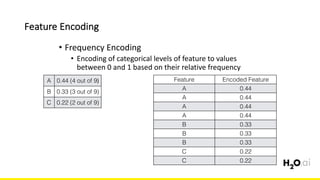
• Frequency	Encoding
• Encoding	of	categorical	levels	of	feature	to	values	
between	0	and	1	based	on	their	relative	frequency
Feature Encoded Feature
A 0.44
A 0.44
A 0.44
A 0.44
B 0.33
B 0.33
B 0.33
C 0.22
C 0.22
A 0.44 (4 out of 9)
B 0.33 (3 out of 9)
C 0.22 (2 out of 9)
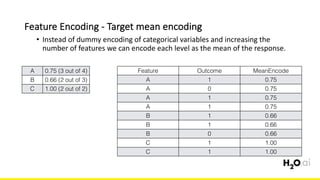
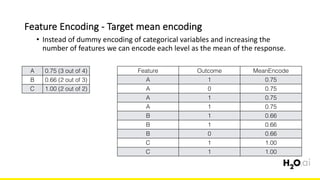
Feature	Encoding	- Target	mean	encoding
6x	
• Instead	of	dummy	encoding	of	categorical	variables	and	increasing	the	
number	of	features	we	can	encode	each	level	as	the	mean	of	the	response.
Feature Outcome MeanEncode
A 1 0.75
A 0 0.75
A 1 0.75
A 1 0.75
B 1 0.66
B 1 0.66
B 0 0.66
C 1 1.00
C 1 1.00
A 0.75 (3 out of 4)
B 0.66 (2 out of 3)
C 1.00 (2 out of 2)
Feature	Encoding	- Target	mean	encoding
6x	
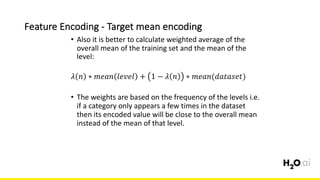
• Also	it	is	better	to	calculate	weighted	average	of	the	
overall	mean	of	the	training	set	and	the	mean	of	the	
level:
𝜆 𝑛 ∗ 𝑚𝑒𝑎𝑛 𝑙𝑒𝑣𝑒𝑙 + 1 − 𝜆 𝑛 ∗ 𝑚𝑒𝑎𝑛(𝑑𝑎𝑡𝑎𝑠𝑒𝑡)
• The	weights	are	based	on	the	frequency	of	the	levels	i.e.	
if	a	category	only	appears	a	few	times	in	the	dataset	
then	its	encoded	value	will	be	close	to	the	overall	mean	
instead	of	the	mean	of	that	level.
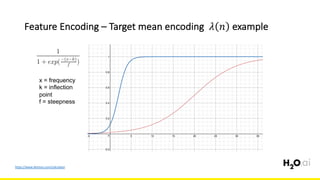
Feature	Encoding	– Target	mean	encoding		 𝜆 𝑛 example
6x	
x = frequency
k = inflection
point
f = steepness
https://www.desmos.com/calculator
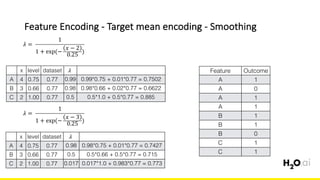
Feature	Encoding	- Target	mean	encoding	- Smoothing
6x	
Feature Outcome
A 1
A 0
A 1
A 1
B 1
B 1
B 0
C 1
C 1
x level dataset 𝜆
A 4 0.75 0.77 0.99 0.99*0.75 + 0.01*0.77 = 0.7502
B 3 0.66 0.77 0.98 0.98*0.66 + 0.02*0.77 = 0.6622
C 2 1.00 0.77 0.5 0.5*1.0 + 0.5*0.77 = 0.885
𝜆 =	
1
1 + exp	(−
𝑥 − 2
0.25
)
x level dataset 𝜆
A 4 0.75 0.77 0.98 0.98*0.75 + 0.01*0.77 = 0.7427
B 3 0.66 0.77 0.5 0.5*0.66 + 0.5*0.77 = 0.715
C 2 1.00 0.77 0.017 0.017*1.0 + 0.983*0.77 = 0.773
𝜆 =	
1
1 + exp	(−
𝑥 − 3
0.25
)
Feature	Encoding	- Target	mean	encoding
6x	
• Instead	of	dummy	encoding	of	categorical	variables	and	increasing	the	
number	of	features	we	can	encode	each	level	as	the	mean	of	the	response.
Feature Outcome MeanEncode
A 1 0.75
A 0 0.75
A 1 0.75
A 1 0.75
B 1 0.66
B 1 0.66
B 0 0.66
C 1 1.00
C 1 1.00
A 0.75 (3 out of 4)
B 0.66 (2 out of 3)
C 1.00 (2 out of 2)
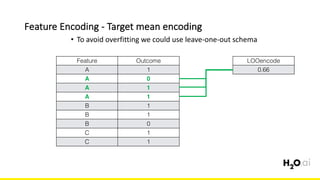
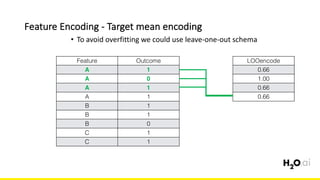
Feature	Encoding	- Target	mean	encoding
• To	avoid	overfitting	we	could	use	leave-one-out	schema
Feature Outcome
A 1
A 0
A 1
A 1
B 1
B 1
B 0
C 1
C 1
LOOencode
0.66
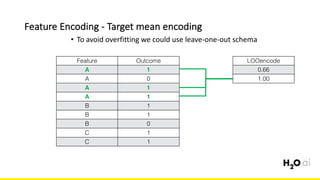
Feature	Encoding	- Target	mean	encoding
6x	
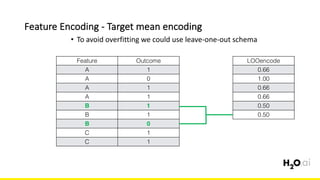
• To	avoid	overfitting	we	could	use	leave-one-out	schema
Feature Outcome
A 1
A 0
A 1
A 1
B 1
B 1
B 0
C 1
C 1
LOOencode
0.66
1.00
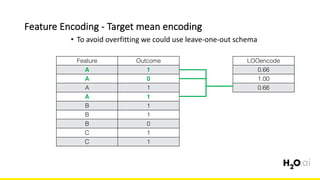
Feature	Encoding	- Target	mean	encoding
6x	
• To	avoid	overfitting	we	could	use	leave-one-out	schema
Feature Outcome
A 1
A 0
A 1
A 1
B 1
B 1
B 0
C 1
C 1
LOOencode
0.66
1.00
0.66
Feature	Encoding	- Target	mean	encoding
6x	
• To	avoid	overfitting	we	could	use	leave-one-out	schema
Feature Outcome
A 1
A 0
A 1
A 1
B 1
B 1
B 0
C 1
C 1
LOOencode
0.66
1.00
0.66
0.66
Feature	Encoding	- Target	mean	encoding
6x	
• To	avoid	overfitting	we	could	use	leave-one-out	schema
Feature Outcome
A 1
A 0
A 1
A 1
B 1
B 1
B 0
C 1
C 1
LOOencode
0.66
1.00
0.66
0.66
0.50
Feature	Encoding	- Target	mean	encoding
6x	
• To	avoid	overfitting	we	could	use	leave-one-out	schema
Feature Outcome
A 1
A 0
A 1
A 1
B 1
B 1
B 0
C 1
C 1
LOOencode
0.66
1.00
0.66
0.66
0.50
0.50
Feature	Encoding	- Target	mean	encoding
6x	
• To	avoid	overfitting	we	could	use	leave-one-out	schema
Feature Outcome
A 1
A 0
A 1
A 1
B 1
B 1
B 0
C 1
C 1
LOOencode
0.66
1.00
0.66
0.66
0.50
0.50
1.00
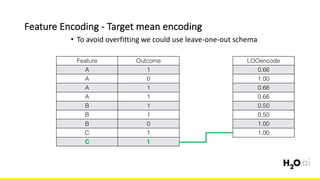
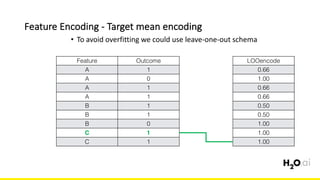
Feature	Encoding	- Target	mean	encoding
6x	
• To	avoid	overfitting	we	could	use	leave-one-out	schema
Feature Outcome
A 1
A 0
A 1
A 1
B 1
B 1
B 0
C 1
C 1
LOOencode
0.66
1.00
0.66
0.66
0.50
0.50
1.00
1.00
Feature	Encoding	- Target	mean	encoding
6x	
• To	avoid	overfitting	we	could	use	leave-one-out	schema
Feature Outcome
A 1
A 0
A 1
A 1
B 1
B 1
B 0
C 1
C 1
LOOencode
0.66
1.00
0.66
0.66
0.50
0.50
1.00
1.00
1.00
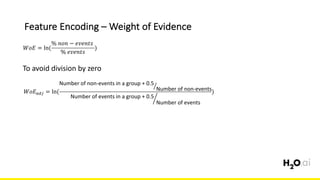
Feature	Encoding	– Weight	of	Evidence
6x	
To	avoid	division	by	zero
𝑊𝑜𝐸 = ln	(
%	𝑛𝑜𝑛 − 𝑒𝑣𝑒𝑛𝑡𝑠	
%	𝑒𝑣𝑒𝑛𝑡𝑠
)
𝑊𝑜𝐸BCD = ln	(
Number	of	non-events	in	a	group	+	0.5
Number	of	non-eventsE
Number	of	events	in	a	group +	0.5
Number	of	events
F
)
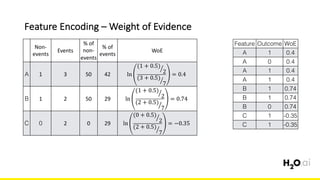
Feature	Encoding	– Weight	of	Evidence
6x	
Feature Outcome WoE
A 1 0.4
A 0 0.4
A 1 0.4
A 1 0.4
B 1 0.74
B 1 0.74
B 0 0.74
C 1 -0.35
C 1 -0.35
Non-
events
Events
%	of
non-
events
%	of	
events
WoE
A 1 3 50 42 ln
(1 + 0.5)
2
E
(3 + 0.5)
7
E
= 0.4
B 1 2 50 29 ln
(1 + 0.5)
2
E
(2 + 0.5)
7
E
= 0.74
C 0 2 0 29 ln
(0 + 0.5)
2
E
(2 + 0.5)
7
E
= −0.35
Feature	Encoding	– Weight	of	Evidence	and	Information	Value
6x	
Feature Outcome WoE
A 1 0.4
A 0 0.4
A 1 0.4
A 1 0.4
B 1 0.74
B 1 0.74
B 0 0.74
C 1 -0.35
C 1 -0.35
Non-
events
Events
%	of
non-
events
%	of	
events
WoE IV
A 1 3 50 42 ln
(1 + 0.5)
2
E
(3 + 0.5)
7
E
= 0.4 0.5	 − 0.42 ∗ 0.4 = 0.032
B 1 2 50 29 ln
(1 + 0.5)
2
E
(2 + 0.5)
7
E
= 0.74 0.5	 − 0.29 ∗ 0.4 = 0.084
C 0 2 0 29 ln
(0 + 0.5)
2
E
(2 + 0.5)
7
E
= −0.35 0	 − 0.29 ∗ −0.35 = 0.105
0.221
𝐼𝑉 =	M %	𝑛𝑜𝑛 − 𝑒𝑣𝑒𝑛𝑡𝑠	 − %	𝑒𝑣𝑒𝑛𝑡𝑠 ∗ 𝑊𝑜𝐸
Feature	Encoding	– Weight	of	Evidence	and	Information	Value
Information Value Variable Predictiveness
Less than 0.02 Not useful for prediction
0.02 to 0.1 Weak predictive Power
0.1 to 0.3 Medium predictive Power
0.3 to 0.5 Strong predictive Power
>0.5 Suspicious Predictive Power
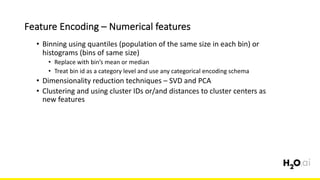
Feature	Encoding	– Numerical	features
6x	
• Binning	using	quantiles	(population	of	the	same	size	in	each	bin)	or	
histograms	(bins	of	same	size)
• Replace	with	bin’s	mean	or	median
• Treat	bin	id	as	a	category	level	and	use	any	categorical	encoding	schema
• Dimensionality	reduction	techniques	– SVD	and	PCA
• Clustering	and	using	cluster	IDs	or/and	distances	to	cluster	centers	as	
new	features
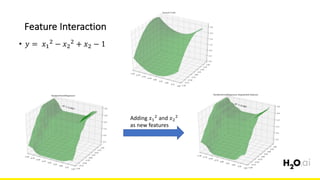
Feature	Interaction
6x	
• 𝑦 =	 𝑥P
Q − 𝑥Q
Q + 𝑥Q − 1
Adding	𝑥P
Q
and	𝑥Q
Q
as	new	features
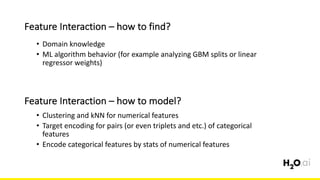
Feature	Interaction	– how	to	find?
6x	
• Domain	knowledge
• ML	algorithm	behavior	(for	example	analyzing	GBM	splits	or	linear	
regressor weights)
Feature	Interaction	– how	to	model?
• Clustering	and	kNN for	numerical	features
• Target	encoding	for	pairs	(or	even	triplets	and	etc.)	of	categorical	
features
• Encode	categorical	features	by	stats	of	numerical	features
Feature	Extraction
6x	
• There	usually	have	some	meaningful	features	inside	
existing	features,	you	need	to	extract	them	
manually
• Some	examples
• Location
• Address,	city,	state	and	zip	code	....	(categorical	or	numeric)	
• Time
• Year,	month,	day,	hour,	minute,	time	ranges,	....	(numeric)
• Weekdays	or	weekend	(binary)
• Morning,	noon,	afternoon,	evening,	...	(categorical)
• Numbers
• Turn	age	numbers	into	ranges	(ordinal	or	categorical)
Feature	Extraction:	Textual	Data
6x	
• Bag-of-Words:	extract	tokens	from	text	and	use	
their	occurrences	(or	TF/IDF	weights)	as	features	
• Require	some	NLP	techniques	to	aggregate	token	
counts	more	precisely
• Split	token	into	sub-tokens	by	delimiters	or	case	changes
• N-grams	at	word	(often	2-5	grams)	or	character	level
• Stemming	for	English	words
• Remove	stop	words	(not	always	necessary)
• Convert	all	words	to	lower	case	
• Bag-of-Words	Tools
• Python:	CountVectorizer,	TfidfTransformer in	scikit-learn	
package
Feature	Extraction:	Textual	Data
6x	
• Deep	Learning	for	textual	data
• Turn	each	token	into	a	vector	of	predefined	size
• Help	compute	“semantic	distance”	between	
tokens/words
• For	example,	the	semantic	distance	between	user	query	and	
product	titles	in	search	results	(how	relevant?)
• Greatly	reduce	the	number	of	text	features	used	for	
training
• Use	average	vector	of	all	words	in	given	text
• Vector	size:	100~300	is	often	enough
• Tools
• Word2vec,	Doc2vec,	GloVe
End

Feature Engineering