Thinking and Language
       Chapter 9
                    1
Thinking and Language
Language
 Language Structure
   Phonemes, Morphemes, grammar, syntax,
    semantics.
 Language Development
   Stages
   Theories (Operant Cond. V. Universal
    Grammar
 The Brain and Language
   Aphasia, Broca’s area, Wernicke’s area.
                                              2
Thinking and Language
 Language Influences Thinking and the
  dubious nature of the linguistic
  determinism

Animal Thinking and Language
 Do Animals Exhibit Language?
 The Case of the Apes


                                         3
Language
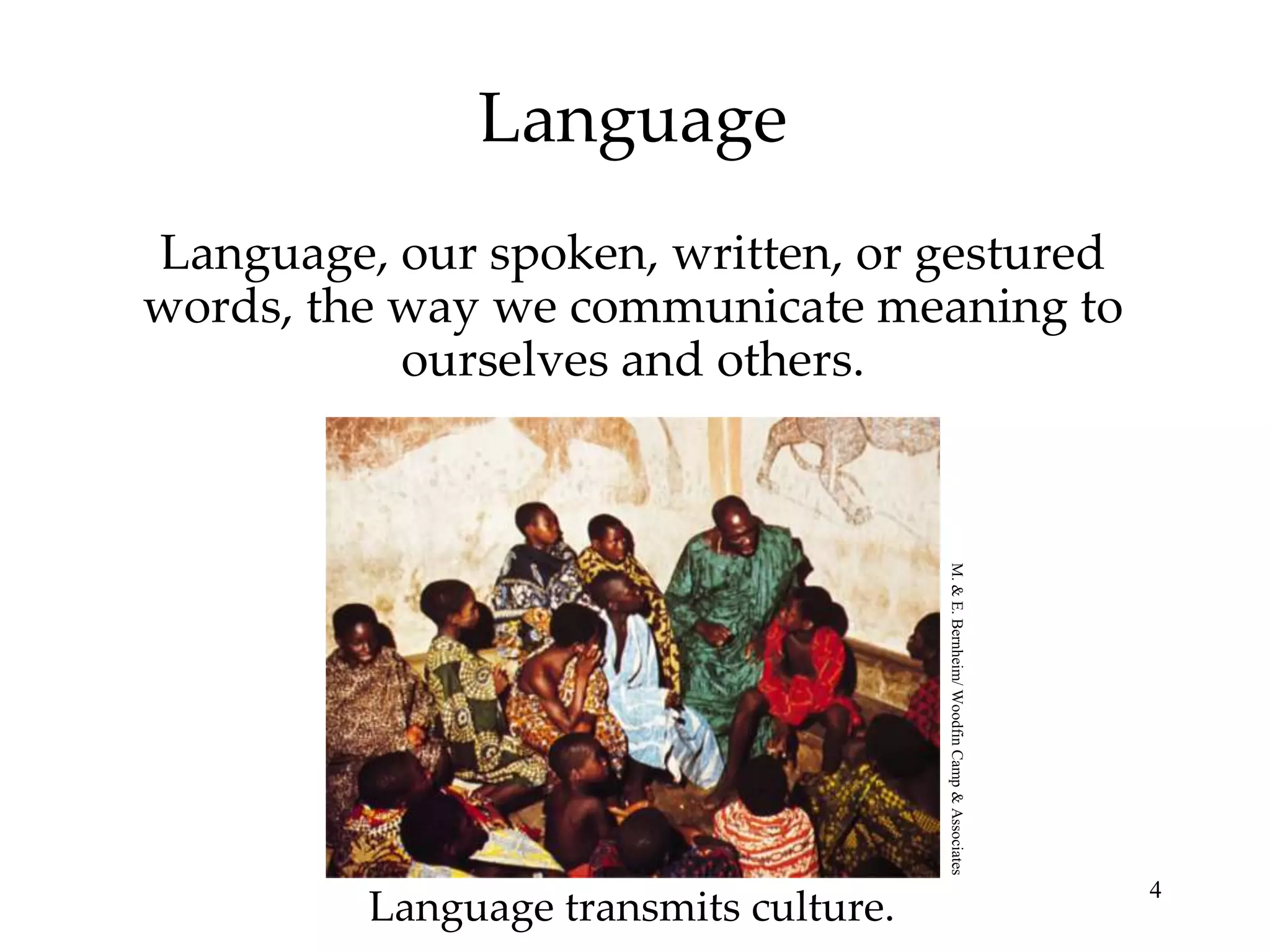
Language, our spoken, written, or gestured
words, the way we communicate meaning to
           ourselves and others.


                                       M. & E. Bernheim/ Woodfin Camp & Associates
                                                                                     4
         Language transmits culture.
Language Structure
• Phonemes
• Morphemes
• Grammar
  – Semantics
  – Syntax


                              5
Language Development
 Children learn their native languages much
         before learning to add 2+2.

We learn, on average (after age 1), 3,500 words
a year, amassing 60,000 words by the time we
         graduate from high school.

                  Motherese


                                                  6
When do we learn language?
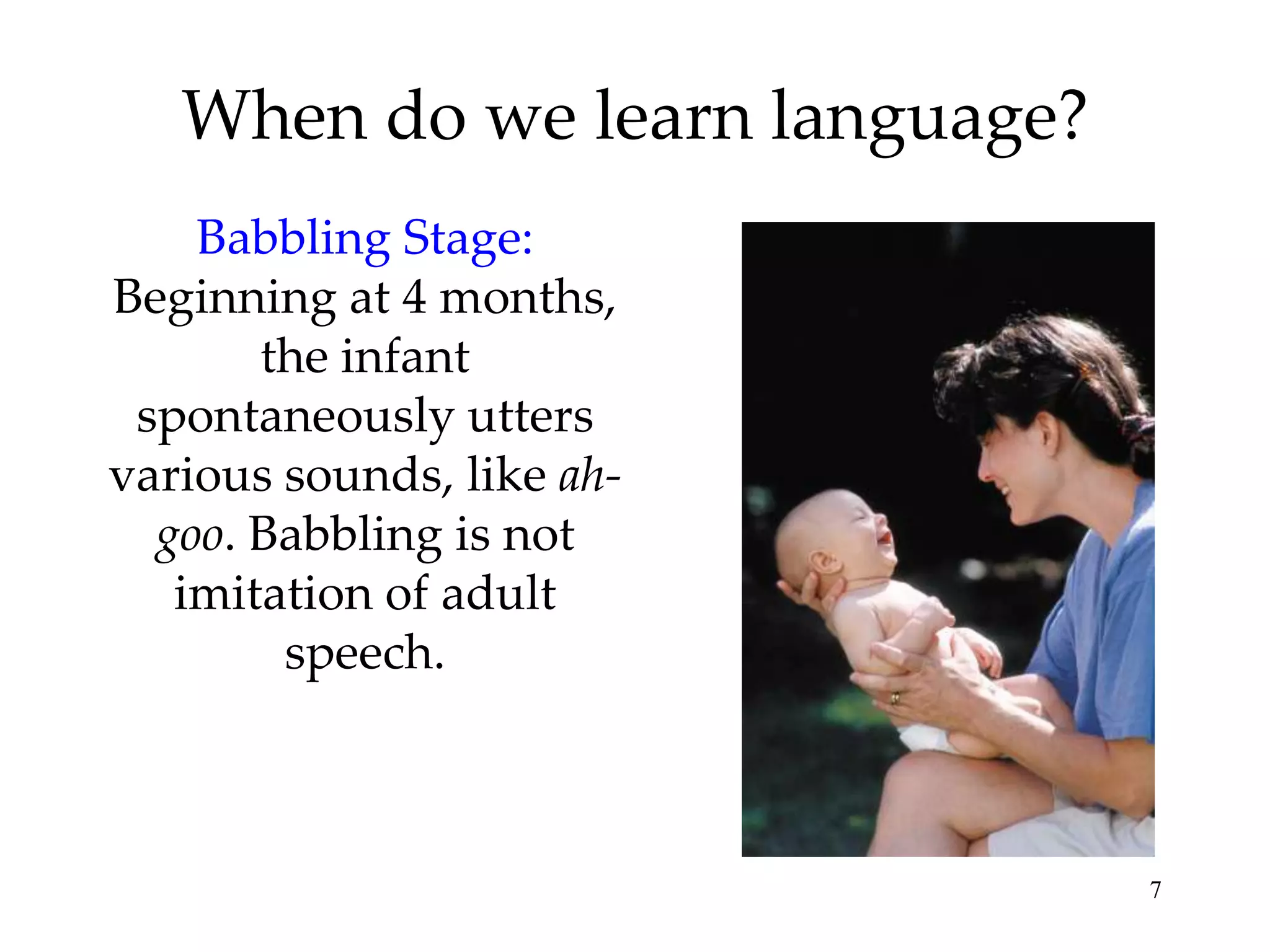
    Babbling Stage:
Beginning at 4 months,
       the infant
 spontaneously utters
various sounds, like ah-
  goo. Babbling is not
   imitation of adult
        speech.


                                7
When do we learn language?
One-Word Stage: Beginning at or around the
child’s first birthday, the child starts to speak one
word at a time and is able to make family
members understand him or her. The word doggy
may mean look at the dog out there.

Holophrase


                                                   8
When do we learn language?
Two-Word Stage: Before the 2nd year, a child
starts to speak in two-word sentences.

This form of speech is called telegraphic speech
because the child speaks like a telegram: “Go
car,” means I would like to go for a ride in the car.


                                                        9
When do we learn language?
Longer phrases: After telegraphic speech,
children begin uttering longer phrases (Mommy
get ball) with syntactical sense, and by early
elementary school they are employing humor.


                                             10
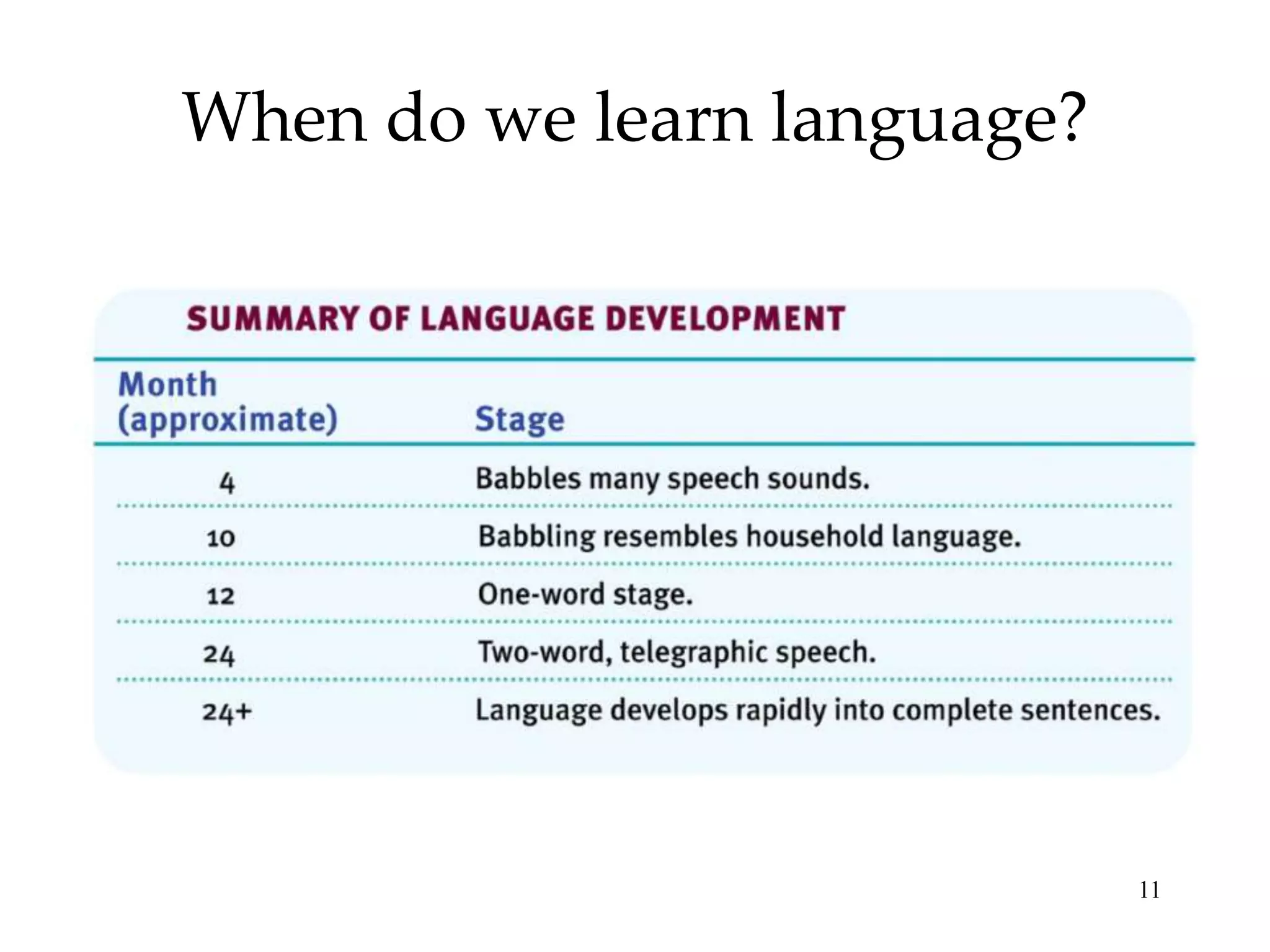
When do we learn language?


                             11
Explaining Language Development

1. Operant Learning: Skinner (1957, 1985)
   believed that language development may be
   explained on the basis of learning principles
   such as association, imitation, and
   reinforcement.


                                               12
Explaining Language Development

2. Inborn Universal Grammar: Chomsky
   (1959, 1987) opposed Skinner’s ideas and
   suggested that the rate of language
   acquisition is so fast that it cannot be
   explained through learning principles, and
   thus most of it is inborn.

     Universal Grammar
     A Language Acquisition Device


                                                13
Explaining Language Development

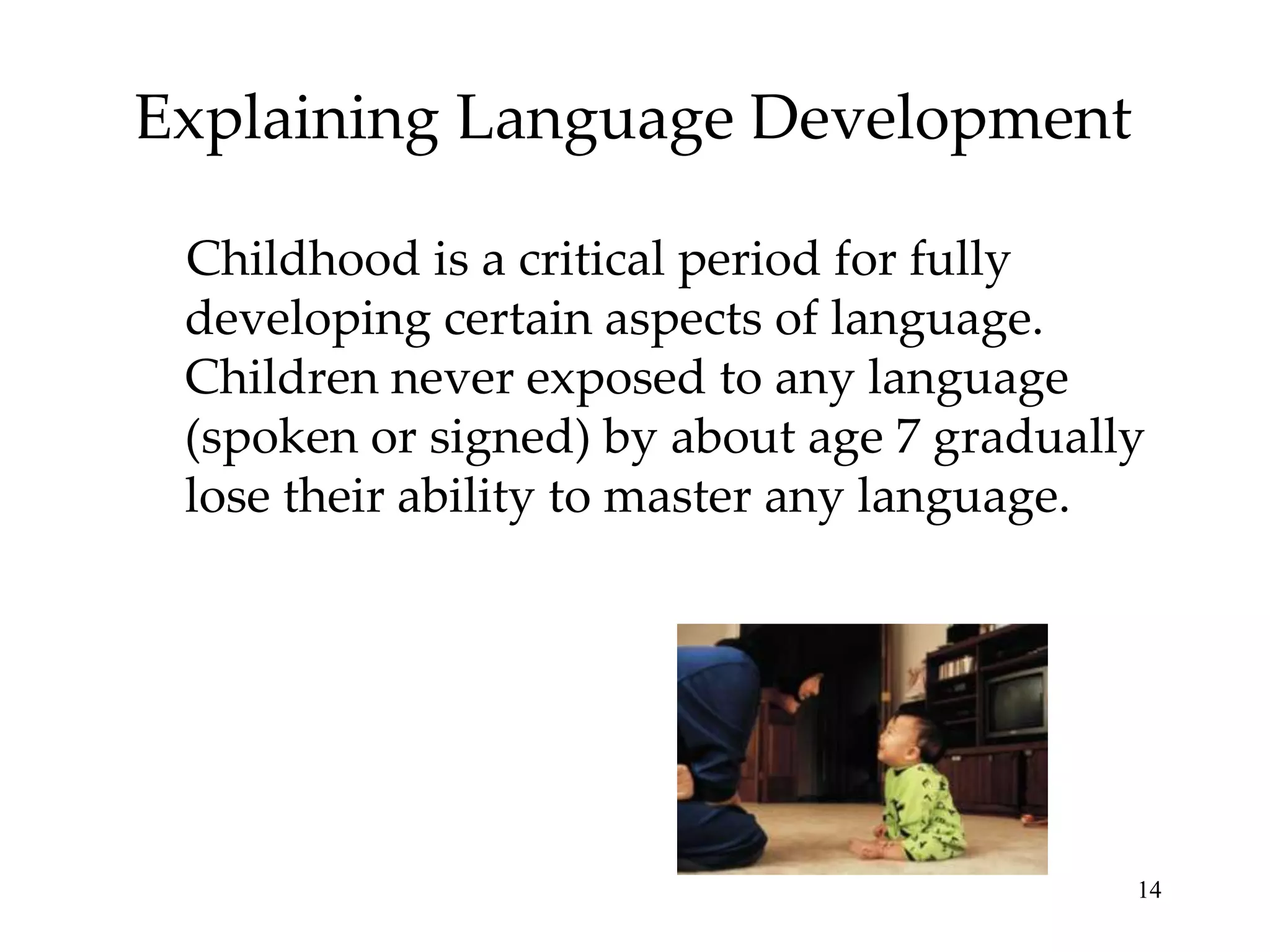
 Childhood is a critical period for fully
 developing certain aspects of language.
 Children never exposed to any language
 (spoken or signed) by about age 7 gradually
 lose their ability to master any language.


                                           14
Genes, Brain, & Language

    Genes design the mechanisms for a
language, and experience modifies the brain.

   In this way, language development is
thought to be a product of gene environment
                 interaction.


                                               15
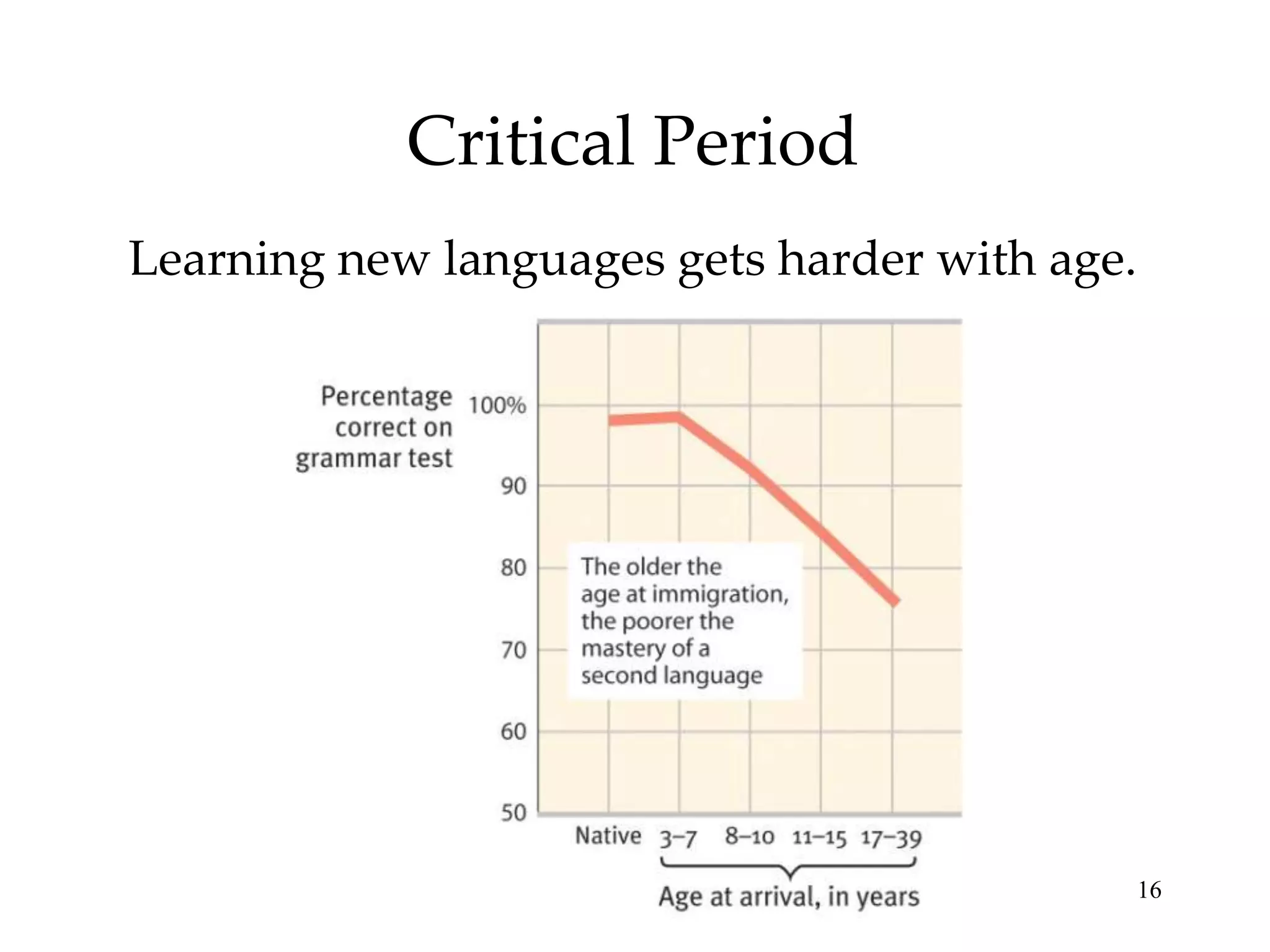
Critical Period
Learning new languages gets harder with age.


                                               16
Brain areas associated with
       language processing.
• Broca’s area
• Wernicke’s area
• Aphasia


                                  17
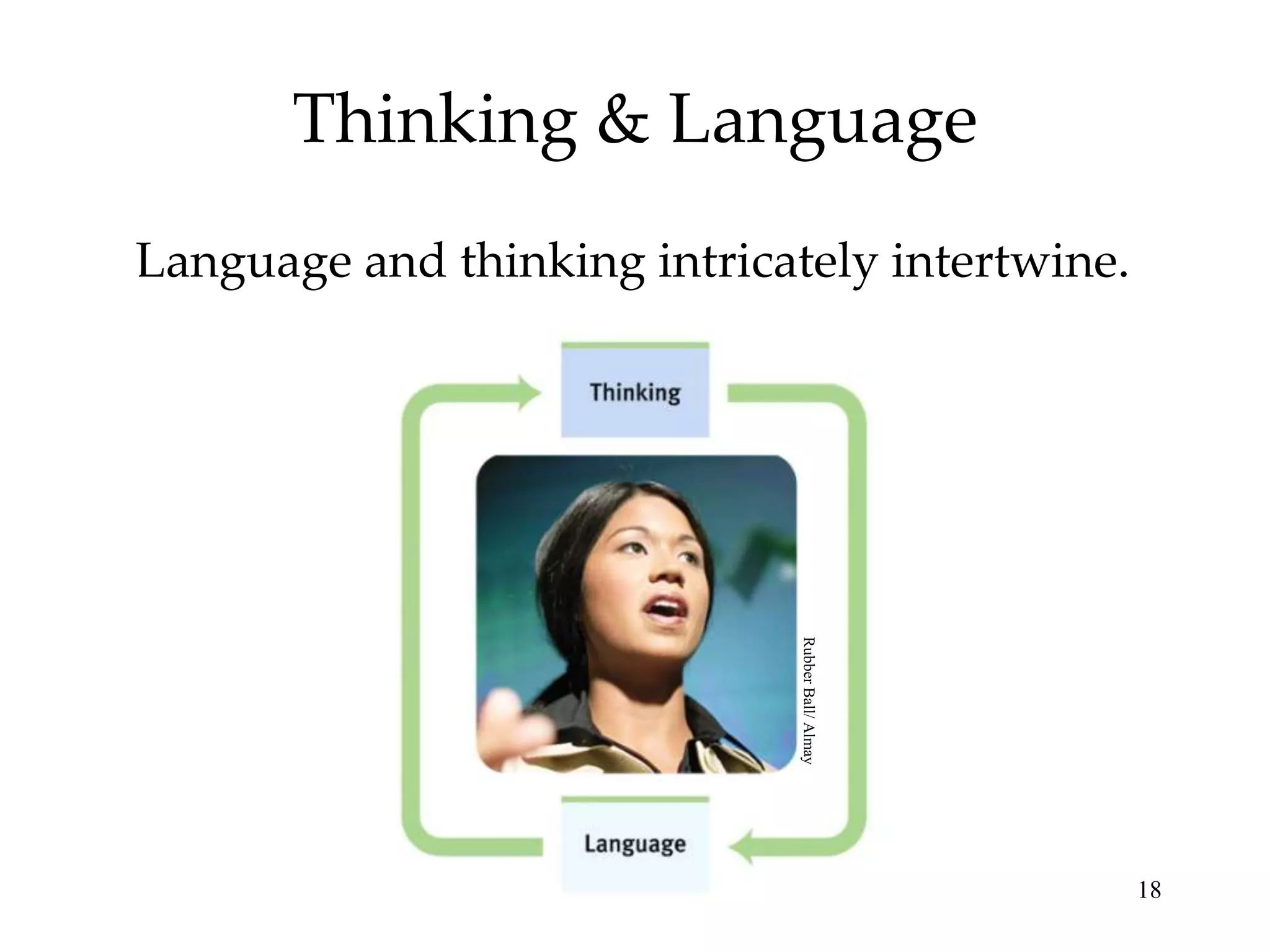
Thinking & Language
Language and thinking intricately intertwine.


                              Rubber Ball/ Almay


                                                   18
Language Influences Thinking
Linguistic Determinism: Whorf (1956) suggested
that language determines the way we think.

For example, he noted that the Hopi people do not
have the past tense for verbs. Therefore, the Hopi
cannot think readily about the past.

Sense of self and language.

Conclusion: Thought processes and language
interact.                                        19
Thinking in Images
To a large extent thinking is language-based.
   When alone, we may talk to ourselves.
     However, we also think in images.


            We don’t think in words:

      1. When we open the hot water tap.

      2. When we are riding our bicycle.

                                                20
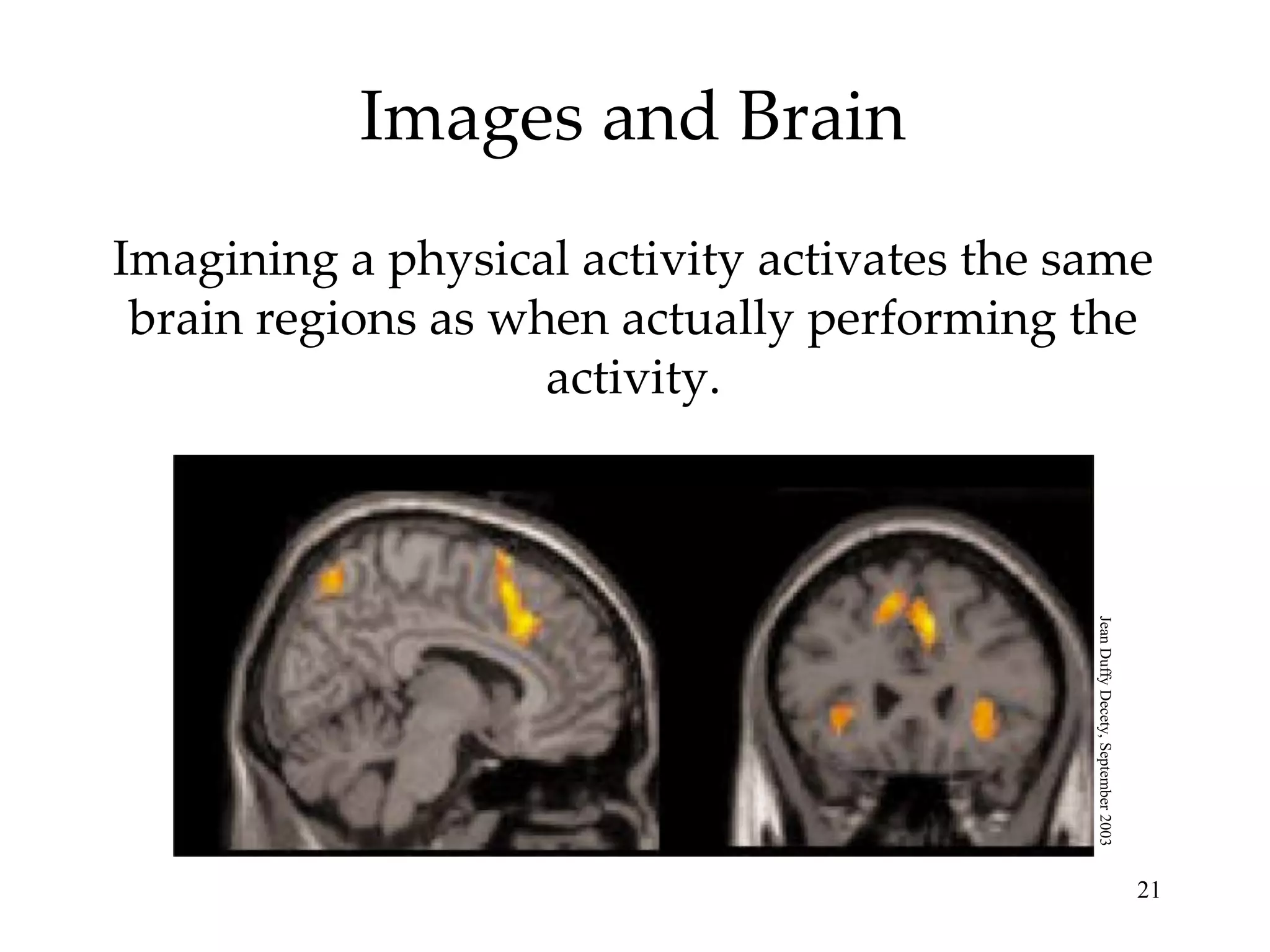
Images and Brain
Imagining a physical activity activates the same
 brain regions as when actually performing the
                    activity.


                                             Jean Duffy Decety, September 2003
                                                                                 21
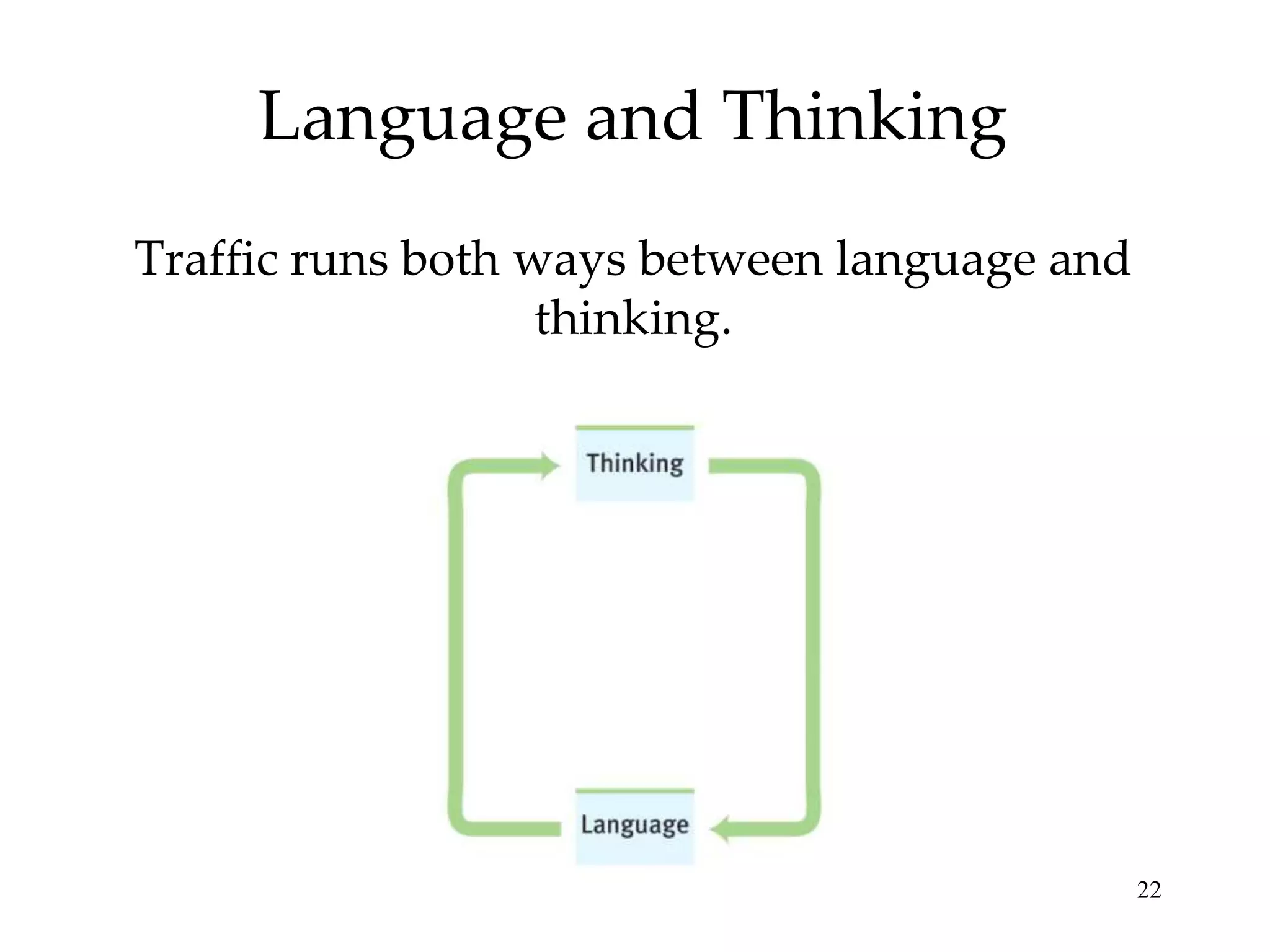
Language and Thinking
Traffic runs both ways between language and
                   thinking.


                                              22
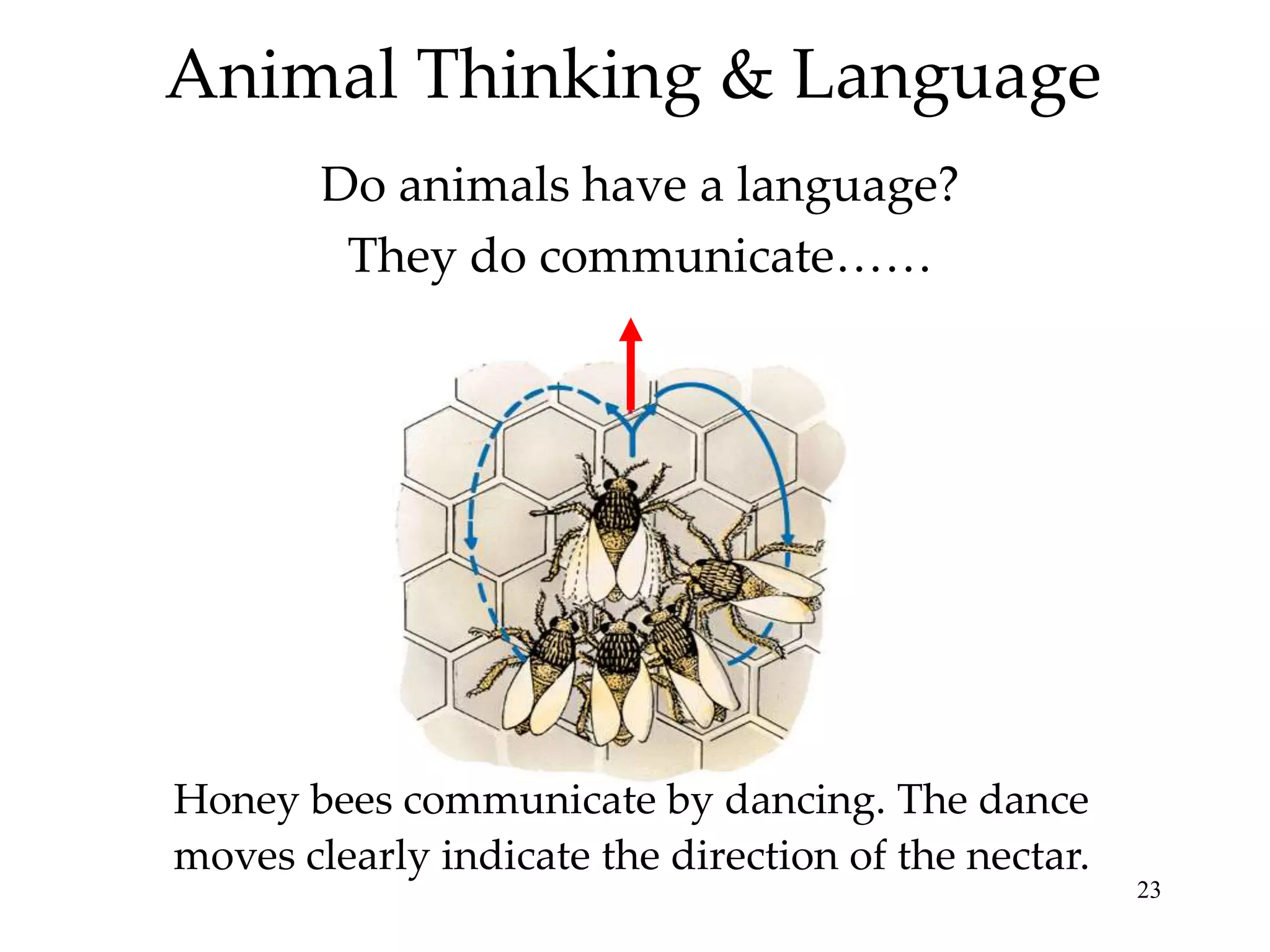
Animal Thinking & Language
        Do animals have a language?
         They do communicate……


Honey bees communicate by dancing. The dance
moves clearly indicate the direction of the nectar.
                                                      23
The Case of Apes


  Gardner and Gardner (1969) used
American Sign Language (ASL) to train
Washoe, a chimp, who learned 181 signs
           by the age of 32.


                                         24
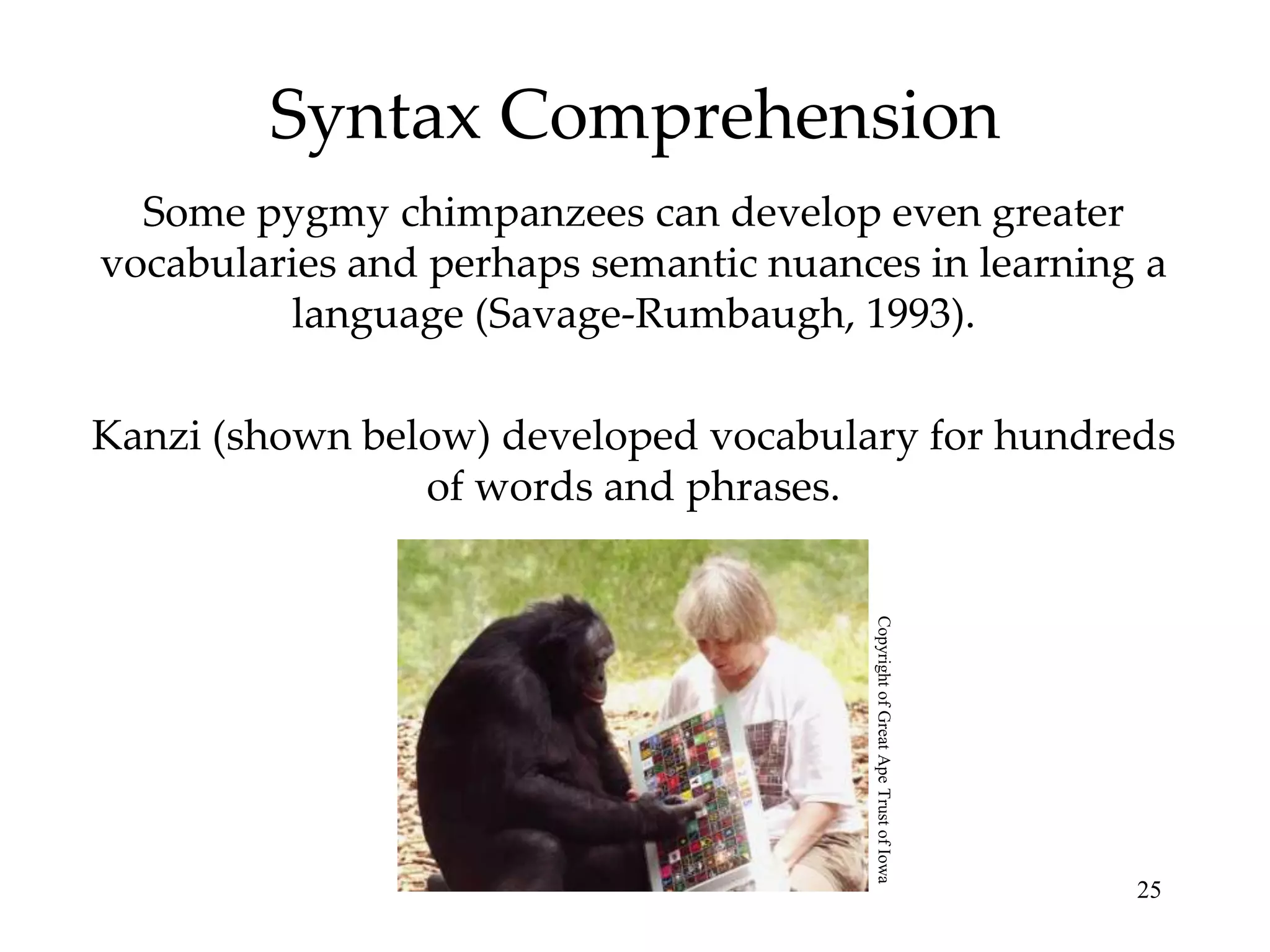
Syntax Comprehension
  Some pygmy chimpanzees can develop even greater
vocabularies and perhaps semantic nuances in learning a
         language (Savage-Rumbaugh, 1993).

Kanzi (shown below) developed vocabulary for hundreds
                of words and phrases.


                                       Copyright of Great Ape Trust of Iowa
                                                                              25
But Can Apes Really Talk?
1.   Apes acquire their limited vocabularies with a
     great deal of difficulty, unlike children who
     develop vocabularies at amazing rates.

2.   Chimpanzees can make signs to receive a
     reward, just as a pigeon who pecks at the key
     receives a reward. However, pigeons have not
     learned a language.

3.   Chimpanzees use signs meaningfully but lack
     human syntax.

                                                      26
Conclusions
   If we say that animals can use meaningful
 sequences of signs to communicate a capability
   for language, our understanding would be
naive… Steven Pinker (1995) concludes, “chimps
           do not develop language.”

This is especially so when we define language as
     verbal or signed expression of complex
                     grammar.

                                              27

Chapter 9

  • 1.
  • 2.
    Thinking and Language Language Language Structure  Phonemes, Morphemes, grammar, syntax, semantics.  Language Development  Stages  Theories (Operant Cond. V. Universal Grammar  The Brain and Language  Aphasia, Broca’s area, Wernicke’s area. 2
  • 3.
    Thinking and Language Language Influences Thinking and the dubious nature of the linguistic determinism Animal Thinking and Language  Do Animals Exhibit Language?  The Case of the Apes 3
  • 4.
    Language Language, our spoken,written, or gestured words, the way we communicate meaning to ourselves and others. M. & E. Bernheim/ Woodfin Camp & Associates 4 Language transmits culture.
  • 5.
    Language Structure • Phonemes •Morphemes • Grammar – Semantics – Syntax 5
  • 6.
    Language Development Childrenlearn their native languages much before learning to add 2+2. We learn, on average (after age 1), 3,500 words a year, amassing 60,000 words by the time we graduate from high school. Motherese 6
  • 7.
    When do welearn language? Babbling Stage: Beginning at 4 months, the infant spontaneously utters various sounds, like ah- goo. Babbling is not imitation of adult speech. 7
  • 8.
    When do welearn language? One-Word Stage: Beginning at or around the child’s first birthday, the child starts to speak one word at a time and is able to make family members understand him or her. The word doggy may mean look at the dog out there. Holophrase 8
  • 9.
    When do welearn language? Two-Word Stage: Before the 2nd year, a child starts to speak in two-word sentences. This form of speech is called telegraphic speech because the child speaks like a telegram: “Go car,” means I would like to go for a ride in the car. 9
  • 10.
    When do welearn language? Longer phrases: After telegraphic speech, children begin uttering longer phrases (Mommy get ball) with syntactical sense, and by early elementary school they are employing humor. 10
  • 11.
    When do welearn language? 11
  • 12.
    Explaining Language Development 1.Operant Learning: Skinner (1957, 1985) believed that language development may be explained on the basis of learning principles such as association, imitation, and reinforcement. 12
  • 13.
    Explaining Language Development 2.Inborn Universal Grammar: Chomsky (1959, 1987) opposed Skinner’s ideas and suggested that the rate of language acquisition is so fast that it cannot be explained through learning principles, and thus most of it is inborn. Universal Grammar A Language Acquisition Device 13
  • 14.
    Explaining Language Development Childhood is a critical period for fully developing certain aspects of language. Children never exposed to any language (spoken or signed) by about age 7 gradually lose their ability to master any language. 14
  • 15.
    Genes, Brain, &Language Genes design the mechanisms for a language, and experience modifies the brain. In this way, language development is thought to be a product of gene environment interaction. 15
  • 16.
    Critical Period Learning newlanguages gets harder with age. 16
  • 17.
    Brain areas associatedwith language processing. • Broca’s area • Wernicke’s area • Aphasia 17
  • 18.
    Thinking & Language Languageand thinking intricately intertwine. Rubber Ball/ Almay 18
  • 19.
    Language Influences Thinking LinguisticDeterminism: Whorf (1956) suggested that language determines the way we think. For example, he noted that the Hopi people do not have the past tense for verbs. Therefore, the Hopi cannot think readily about the past. Sense of self and language. Conclusion: Thought processes and language interact. 19
  • 20.
    Thinking in Images Toa large extent thinking is language-based. When alone, we may talk to ourselves. However, we also think in images. We don’t think in words: 1. When we open the hot water tap. 2. When we are riding our bicycle. 20
  • 21.
    Images and Brain Imagininga physical activity activates the same brain regions as when actually performing the activity. Jean Duffy Decety, September 2003 21
  • 22.
    Language and Thinking Trafficruns both ways between language and thinking. 22
  • 23.
    Animal Thinking &Language Do animals have a language? They do communicate…… Honey bees communicate by dancing. The dance moves clearly indicate the direction of the nectar. 23
  • 24.
    The Case ofApes Gardner and Gardner (1969) used American Sign Language (ASL) to train Washoe, a chimp, who learned 181 signs by the age of 32. 24
  • 25.
    Syntax Comprehension Some pygmy chimpanzees can develop even greater vocabularies and perhaps semantic nuances in learning a language (Savage-Rumbaugh, 1993). Kanzi (shown below) developed vocabulary for hundreds of words and phrases. Copyright of Great Ape Trust of Iowa 25
  • 26.
    But Can ApesReally Talk? 1. Apes acquire their limited vocabularies with a great deal of difficulty, unlike children who develop vocabularies at amazing rates. 2. Chimpanzees can make signs to receive a reward, just as a pigeon who pecks at the key receives a reward. However, pigeons have not learned a language. 3. Chimpanzees use signs meaningfully but lack human syntax. 26
  • 27.
    Conclusions If we say that animals can use meaningful sequences of signs to communicate a capability for language, our understanding would be naive… Steven Pinker (1995) concludes, “chimps do not develop language.” This is especially so when we define language as verbal or signed expression of complex grammar. 27