Normal Language Development A Presentation by Holly Kloiber-Dumproff WCTC December 10, 2009
What is Language? Language is a complex and dynamic system of conventional symbols that is used in various modes for thought and communication. Contemporary views of human language hold that:  language evolves within specific historical, social, and cultural contexts; language, as rule-governed behavior, is described by at least five parameters—phonologic, morphologic, syntactic, semantic, and pragmatic; language learning and use are determined by the interaction of biological, cognitive, psychosocial, and environmental factors; effective use of language for communication requires a broad understanding of human interaction including such associated factors as nonverbal cues, motivation, and sociocultural roles. American Speech-Language-Hearing Association. (1982). Language [Relevant Paper]. Available from www.asha.org/policy
Language is different from speech.   Language  is made up of socially shared rules that include the following: What words mean (e.g., "star" can refer to a bright object in the night sky or a celebrity)  How to make new words (e.g., friend, friendly, unfriendly)  How to put words together (e.g., "Peg walked to the new store" rather than "Peg walk store new")  What word combinations are best in what situations ("Would you mind moving your foot?“ could quickly change to "Get off my foot, please!" if the first request did not produce results)
Speech  is the verbal means of communicating. Speech consists of the following: Articulation : How speech sounds are made (e.g., children must learn how to produce the "r" sound in order to say "rabbit" instead of "wabbit").  Voice : Use of the vocal folds and breathing to produce sound (e.g., the voice can be abused from overuse or misuse and can lead to hoarseness or loss of voice).  Fluency : The rhythm of speech (e.g., hesitations or stuttering can affect fluency
Parts of Language Include Syntax=grammar Morphology=smallest unit of meaning within grammar (happy, unhappy, happier) Pragmatics=social rules of language Semantics=word meanings Phonology=sound rules in language Comprehension Phonics= rules of the alphabet
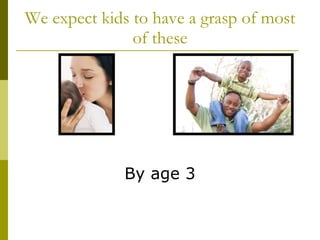
We expect kids to have a grasp of most of these By age 3
The First Three Years Brain development occurs at such a rapid rate during this time Language development during this period of time is central to a child’s later success with literacy and communication The foundation is laid for the rest of the child’s life
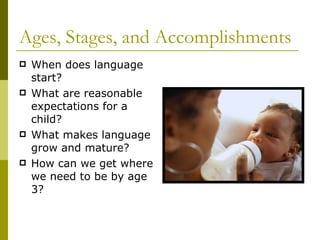
Ages, Stages, and Accomplishments When does language start? What are reasonable expectations for a child? What makes language grow and mature? How can we get where we need to be by age 3?
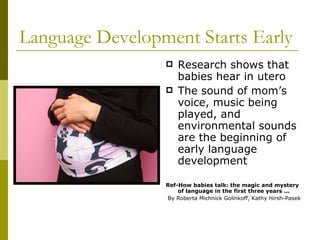
Language Development Starts Early Research shows that babies hear in utero The sound of mom’s voice, music being played, and environmental sounds are the beginning of early language development Ref-How babies talk: the magic and mystery of language in the first three years ...   By Roberta Michnick Golinkoff, Kathy Hirsh-Pasek
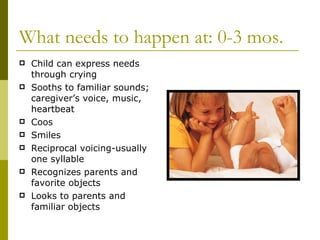
What needs to happen at: 0-3 mos. Child can express needs through crying Sooths to familiar sounds; caregiver’s voice, music, heartbeat Coos Smiles Reciprocal voicing-usually one syllable Recognizes parents and favorite objects Looks to parents and familiar objects
3-6 mos. Laughs Two syllable babble Recognizes caregiver voice
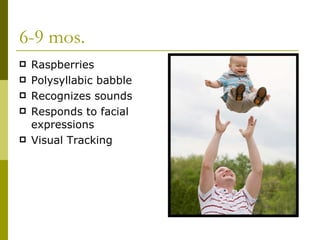
6-9 mos. Raspberries Polysyllabic babble Recognizes sounds Responds to facial expressions Visual Tracking
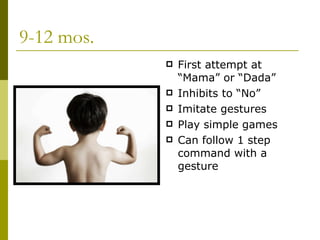
9-12 mos. First attempt at “Mama” or “Dada” Inhibits to “No” Imitate gestures Play simple games Can follow 1 step command with a gesture
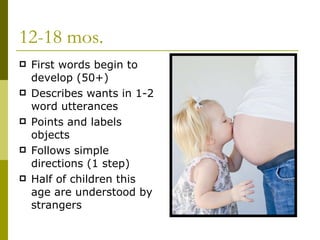
12-18 mos. First words begin to develop (50+) Describes wants in 1-2 word utterances Points and labels objects Follows simple directions (1 step) Half of children this age are understood by strangers
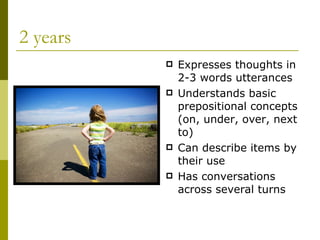
2 years Expresses thoughts in 2-3 words utterances Understands basic prepositional concepts (on, under, over, next to) Can describe items by their use Has conversations across several turns
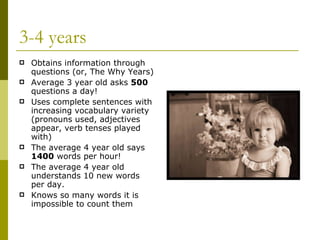
3-4 years Obtains information through questions (or, The Why Years) Average 3 year old asks  500  questions a day! Uses complete sentences with increasing vocabulary variety (pronouns used, adjectives appear, verb tenses played with) The average 4 year old says  1400  words per hour! The average 4 year old understands 10 new words per day. Knows so many words it is impossible to count them
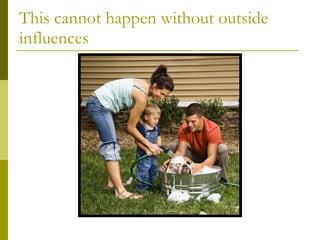
This cannot happen without outside influences
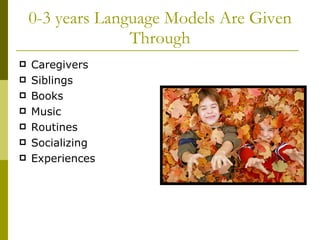
0-3 years Language Models Are Given Through Caregivers Siblings Books Music Routines Socializing Experiences
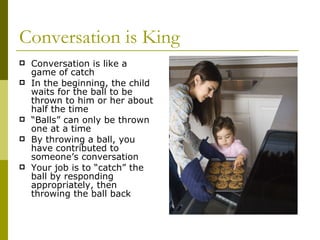
Conversation is King Conversation is like a game of catch In the beginning, the child waits for the ball to be thrown to him or her about half the time “ Balls” can only be thrown one at a time By throwing a ball, you have contributed to someone’s conversation Your job is to “catch” the ball by responding appropriately, then throwing the ball back
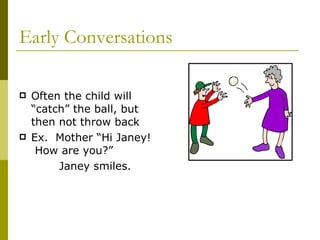
Early Conversations Often the child will “catch” the ball, but then not throw back Ex.  Mother “Hi Janey!  How are you?” Janey smiles.
Early Conversations Sometimes the child will let the speaker’s ball fall to the ground, and toss one of their own balls back Ex.  “Hi Janey!  How are you?” “ I want a new dolly.”
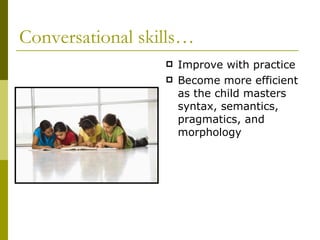
Conversational skills… Improve with practice Become more efficient as the child masters syntax, semantics, pragmatics, and morphology
How do we have “conversations” with babies? Joint attention Parallel play Facial expressions Back and forth games
How do we have conversations with toddlers? Expansion Enrichment Use topics of interest Play Experiences
How do we have conversations with young children? Listen Pretend play Expand and enrich Explain (Answer the 500 questions as best possible) Ask
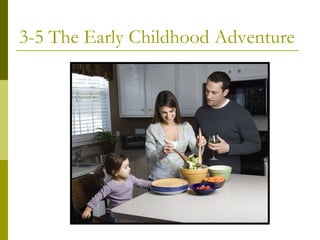
3-5 The Early Childhood Adventure
Narrative: a series of sentences that present an orderly and interconnected sequence of events
What are narrative skills? After 36 months, conversation shifts from “here and now” to more abstract topics Children start to develop the ability to tell someone (who wasn’t at the event) what already happened
Narrative skills require Increased levels of language understanding (syntax, semantics, phonology, morphology) World knowledge
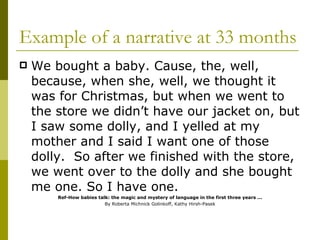
Example of a narrative at 33 months We bought a baby. Cause, the, well, because, when she, well, we thought it was for Christmas, but when we went to the store we didn’t have our jacket on, but I saw some dolly, and I yelled at my mother and I said I want one of those dolly.  So after we finished with the store, we went over to the dolly and she bought me one. So I have one. Ref-How babies talk: the magic and mystery of language in the first three years ...   By Roberta Michnick Golinkoff, Kathy Hirsh-Pasek
What would you ask that little girl?
How do we improve narrative skills in children? Children learn narrative skills by overhearing adults produce narratives Adults help children produce early narratives by creating structure and asking the child to “fill in the blanks” Adults ask pertinent questions after the narrative to help the child fill in the missing information
Narratives are… Sequential Scene based Informational Does this sound like anything else?
Ways to include narratives Experience books Show and tell Open ended questions (“tell me about your day…”) Draw and tell
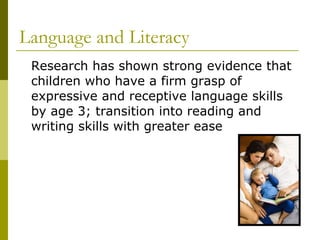
Language and Literacy Research has shown strong evidence that children who have a firm grasp of expressive and receptive language skills by age 3; transition into reading and writing skills with greater ease
Early language learning is… Essential to literacy A predictor of later success Something that doesn’t “just happen”
Holly Kloiber-Dumproff M.S.;CCC-SLP Speech-language Consultant Wisconsin Educational Services Program for the Deaf and Hard of Hearing Outreach [email_address]

Normal Language Development For Wctc

  • 1.
    Normal Language DevelopmentA Presentation by Holly Kloiber-Dumproff WCTC December 10, 2009
  • 2.
    What is Language?Language is a complex and dynamic system of conventional symbols that is used in various modes for thought and communication. Contemporary views of human language hold that: language evolves within specific historical, social, and cultural contexts; language, as rule-governed behavior, is described by at least five parameters—phonologic, morphologic, syntactic, semantic, and pragmatic; language learning and use are determined by the interaction of biological, cognitive, psychosocial, and environmental factors; effective use of language for communication requires a broad understanding of human interaction including such associated factors as nonverbal cues, motivation, and sociocultural roles. American Speech-Language-Hearing Association. (1982). Language [Relevant Paper]. Available from www.asha.org/policy
  • 3.
    Language is differentfrom speech. Language is made up of socially shared rules that include the following: What words mean (e.g., "star" can refer to a bright object in the night sky or a celebrity) How to make new words (e.g., friend, friendly, unfriendly) How to put words together (e.g., "Peg walked to the new store" rather than "Peg walk store new") What word combinations are best in what situations ("Would you mind moving your foot?“ could quickly change to "Get off my foot, please!" if the first request did not produce results)
  • 4.
    Speech isthe verbal means of communicating. Speech consists of the following: Articulation : How speech sounds are made (e.g., children must learn how to produce the "r" sound in order to say "rabbit" instead of "wabbit"). Voice : Use of the vocal folds and breathing to produce sound (e.g., the voice can be abused from overuse or misuse and can lead to hoarseness or loss of voice). Fluency : The rhythm of speech (e.g., hesitations or stuttering can affect fluency
  • 5.
    Parts of LanguageInclude Syntax=grammar Morphology=smallest unit of meaning within grammar (happy, unhappy, happier) Pragmatics=social rules of language Semantics=word meanings Phonology=sound rules in language Comprehension Phonics= rules of the alphabet
  • 6.
    We expect kidsto have a grasp of most of these By age 3
  • 7.
    The First ThreeYears Brain development occurs at such a rapid rate during this time Language development during this period of time is central to a child’s later success with literacy and communication The foundation is laid for the rest of the child’s life
  • 8.
    Ages, Stages, andAccomplishments When does language start? What are reasonable expectations for a child? What makes language grow and mature? How can we get where we need to be by age 3?
  • 9.
    Language Development StartsEarly Research shows that babies hear in utero The sound of mom’s voice, music being played, and environmental sounds are the beginning of early language development Ref-How babies talk: the magic and mystery of language in the first three years ...   By Roberta Michnick Golinkoff, Kathy Hirsh-Pasek
  • 10.
    What needs tohappen at: 0-3 mos. Child can express needs through crying Sooths to familiar sounds; caregiver’s voice, music, heartbeat Coos Smiles Reciprocal voicing-usually one syllable Recognizes parents and favorite objects Looks to parents and familiar objects
  • 11.
    3-6 mos. LaughsTwo syllable babble Recognizes caregiver voice
  • 12.
    6-9 mos. RaspberriesPolysyllabic babble Recognizes sounds Responds to facial expressions Visual Tracking
  • 13.
    9-12 mos. Firstattempt at “Mama” or “Dada” Inhibits to “No” Imitate gestures Play simple games Can follow 1 step command with a gesture
  • 14.
    12-18 mos. Firstwords begin to develop (50+) Describes wants in 1-2 word utterances Points and labels objects Follows simple directions (1 step) Half of children this age are understood by strangers
  • 15.
    2 years Expressesthoughts in 2-3 words utterances Understands basic prepositional concepts (on, under, over, next to) Can describe items by their use Has conversations across several turns
  • 16.
    3-4 years Obtainsinformation through questions (or, The Why Years) Average 3 year old asks 500 questions a day! Uses complete sentences with increasing vocabulary variety (pronouns used, adjectives appear, verb tenses played with) The average 4 year old says 1400 words per hour! The average 4 year old understands 10 new words per day. Knows so many words it is impossible to count them
  • 17.
    This cannot happenwithout outside influences
  • 18.
    0-3 years LanguageModels Are Given Through Caregivers Siblings Books Music Routines Socializing Experiences
  • 19.
    Conversation is KingConversation is like a game of catch In the beginning, the child waits for the ball to be thrown to him or her about half the time “ Balls” can only be thrown one at a time By throwing a ball, you have contributed to someone’s conversation Your job is to “catch” the ball by responding appropriately, then throwing the ball back
  • 20.
    Early Conversations Oftenthe child will “catch” the ball, but then not throw back Ex. Mother “Hi Janey! How are you?” Janey smiles.
  • 21.
    Early Conversations Sometimesthe child will let the speaker’s ball fall to the ground, and toss one of their own balls back Ex. “Hi Janey! How are you?” “ I want a new dolly.”
  • 22.
    Conversational skills… Improvewith practice Become more efficient as the child masters syntax, semantics, pragmatics, and morphology
  • 23.
    How do wehave “conversations” with babies? Joint attention Parallel play Facial expressions Back and forth games
  • 24.
    How do wehave conversations with toddlers? Expansion Enrichment Use topics of interest Play Experiences
  • 25.
    How do wehave conversations with young children? Listen Pretend play Expand and enrich Explain (Answer the 500 questions as best possible) Ask
  • 26.
    3-5 The EarlyChildhood Adventure
  • 27.
    Narrative: a seriesof sentences that present an orderly and interconnected sequence of events
  • 28.
    What are narrativeskills? After 36 months, conversation shifts from “here and now” to more abstract topics Children start to develop the ability to tell someone (who wasn’t at the event) what already happened
  • 29.
    Narrative skills requireIncreased levels of language understanding (syntax, semantics, phonology, morphology) World knowledge
  • 30.
    Example of anarrative at 33 months We bought a baby. Cause, the, well, because, when she, well, we thought it was for Christmas, but when we went to the store we didn’t have our jacket on, but I saw some dolly, and I yelled at my mother and I said I want one of those dolly. So after we finished with the store, we went over to the dolly and she bought me one. So I have one. Ref-How babies talk: the magic and mystery of language in the first three years ...   By Roberta Michnick Golinkoff, Kathy Hirsh-Pasek
  • 31.
    What would youask that little girl?
  • 32.
    How do weimprove narrative skills in children? Children learn narrative skills by overhearing adults produce narratives Adults help children produce early narratives by creating structure and asking the child to “fill in the blanks” Adults ask pertinent questions after the narrative to help the child fill in the missing information
  • 33.
    Narratives are… SequentialScene based Informational Does this sound like anything else?
  • 34.
    Ways to includenarratives Experience books Show and tell Open ended questions (“tell me about your day…”) Draw and tell
  • 35.
    Language and LiteracyResearch has shown strong evidence that children who have a firm grasp of expressive and receptive language skills by age 3; transition into reading and writing skills with greater ease
  • 36.
    Early language learningis… Essential to literacy A predictor of later success Something that doesn’t “just happen”
  • 37.
    Holly Kloiber-Dumproff M.S.;CCC-SLPSpeech-language Consultant Wisconsin Educational Services Program for the Deaf and Hard of Hearing Outreach [email_address]

Editor's Notes

  • #22 This leads to disjointed conversations where topics are not shared. Usually by age 3 this does not happen anymore.
  • #31 Narratives are not two sided like conversations. The burden for the information lies solely with the speaker. There are rules for narratives. They must be sequential. First, second, next, and last must be maintained. Also, a scene must be set.
  • #33 Kids like to hear about themselves and about the important people in their lives