Download to read offline
![IOSR Journal of Computer Engineering (IOSR-JCE)
e-ISSN: 2278-0661,p-ISSN: 2278-8727, Volume 18, Issue 3, Ver. I (May-Jun. 2016), PP 69-73
www.iosrjournals.org
DOI: 10.9790/0661-1803016973 www.iosrjournals.org 69 | Page
Haar Wavelet Based Joint Compression Method Using Adaptive
Fractal Image Compression
Ali Ibrahim Khaleel1
, N.Anupama2
1,2
(College of Engineering & Technology, Acharya Nagarjuna University ,AP ,India,)
Abstract: We are introducing the discrete wavelet transform based joint methodology with the existing
Adaptive Fractal Image Compression technique. By developing this method we will get the better quality of the
image w.r.t peak signal to noise ratio and improvement in the compression ratio. As we have previous FIC
methods in usage we are going to compare our results with them sequentially by applying image metrics to
show quality of the decompressed image after reconstruction. In this thesis, five methods have been proposed to:
reduce the long time of the FIC and Haar waveletincrease the compression ratio and keep the reconstructed
image quality. The five methods are:1- Discrete Wavelet Transform Adaptive Fractal Image Compression
DWT+AFIC, 2- The Adaptive Fractal Image Compression AFIC method.3- The ZM-RDE method, 4- Reducing
the Domain Image Size (RDIZ) method, 5- The Range Exclusion (RE) method.
Keywords: Fractal, range block, Discrete Wavelet Transform, image compression, Peak Signal to noise ratio
and compression ratio
I. Introduction
The people communicate ways are quickly modifying. The conventional wired voice call is no longer
the only reasonable and reliable method for communications and information transferring. Rather, many
methods ranging from voice calls over wireless networks to video calls over the telephone network have been
found, as well as the transmission of arbitrary images or through a computer network (distributed multi-media
systems) [1]
. Furthermore, the multimedia market is also growing rapidly, and the World Wide Web (WWW)
makes the internet easily accessible for everyone. So the digital images are widely used now in many different
applications, including entertainment, advertising, journalism, security and law enforcement, medical imaging,
and satellite imaging[2]
. For that, the amount of digital information and computer graphics applications was
grown and increased [3]
. These applications, especially those treating with digital photographs and other complex
color images can generate very large file sizes thus the digital image compression is needed for the storage and
the transmission requirements.Data compression provides an efficient way to represent information by using
techniques that can exploit the different kinds of structures that may be present in the data.
Since ancient times, the data compression has been a practice of humankind. The ancient Chinese used
special concise character syntax (Wen-Yan) to record daily spoken language in a short form, while the essence
of meaning was kept. In this way, they discarded the redundant characters that not affect the essential meaning;
therefore, the precise meaning can be saved. In the 18th century, to save the time in the communication between
London and important ports in the shutter telegraph, the British Admiralty uses a compressed language format.
Over than 200 words for different descriptions of snow have been used by the Eskimo therefore, a single word is
enough to describe the exact type of snow precisely [4]
.
The data compression can be defined as the process of compacting data files into smaller files to
enhance the efficiency of transmission and storage, in other words, compression is the process of representing
information compactly. At the revolutionary technology of multimedia, it would be practical to put images,
audio, and video in a compressed form on websites [5]
.
If the image contains a large amount of data, that’s mean much storage space, large transmission
bandwidth and long transmission time will be needed; therefore, it is better to store only the essential
information needed to reconstruct the image and that's what the image compression can make [6]
.
II. System Design Model
1- Discrete Wavelet Transform Adaptive Fractal Image Compression DWT+AFIC method, which made on
developing the haar based DWT method by adopting the AFIC in which we are going to do the DWT as
preprocessing to AFIC method.
2- The Adaptive Fractal Image Compression AFIC method, which made on developing the ZM-RDE method by
adopting the Adaptive Quadtree Partitioning Technique (AQPT) and the Domain Block Selection
Technique (DBST). The AQPT is an adaptive partitioning technique which depends on the uniformity of
the blocks as a partitioning criterion. It is independent of the fractal mapping](https://image.slidesharecdn.com/m1803016973-160704052510/85/M1803016973-1-320.jpg)
![Haar Wavelet Based Joint Compression Method Using Adaptive Fractal Image Compression
DOI: 10.9790/0661-1803016973 www.iosrjournals.org 70 | Page
3- The ZM-RDE method, which is the development of the RD-RE method. The development comes from
combining the RD-RE with the Zero Mean Intensity Level (ZMIL) method. The ZMIL method introduces
the transforms of the full search problem using a more convenient form by adopting an unconventional
affine parameter (i.e. The range mean r ) which has better properties than the conventional offset parameter
and a new search algorithm has been developed. Using ZMIL will lead to: Reducing the complexity of
matching operations which can speed up the encoding operation; Increase both of the compression ratio and
the reconstructed image quality. The results showed that ZM-RDE can achieve a better performance in
terms of the CR, ET and the PSNR than the RD-RE.
4- Reducing the Domain Image Size (RDIZ) method, which reduced the domain pool by minimizing the
Domain Image Size to only 1/16th
of the original image size? This in turn will affect the encoding time,
compression ratio and the image quality. The RE and RDIZ were coupled to work under one algorithm
called the RD-RE. The experimental results show that RD-RE can achieve a higher compression ratio and a
significant reduction in the encoding time but with some decay in the reconstructed image quality.
5- The Range Exclusion (RE) method, which is responsible for reducing the number of the ranges blocks that
needed in the matching process. RE used a variance factor as a criterion to indicate and exclude the
homogenous ranges from the matching process which lead to increase the compression ratio and decrease
the encoding time.
The goal of Fractal Image Compression FIC or encoding is to be able to store an image as a set of IFS
transformations instead of storing individual pixel data [8]
. So, the FIC is a data compression technique which
exploits the affine redundancy that is commonly present in all natural images and most artificial objects, this
redundancy is related to the similarity of an image with itself [96]
.
Michael Barnsley proposed FIC as a technique to store images in a small amount of space. His idea
was based on his work with fractal mathematics, and his observation that most natural scenes contain Affine
Redundancy, or sub-sections that look very similar [95, 97]
. Therefore, FIC can work to find the similar patterns
that exist on different scales and at different places in an image, and then eliminate as much redundancy as
possible.
Any fractal compression system involves a process that looks for these repetitions across scale and
position. Then, instead of saving information about every similar part of an image, the system merely saves the
common representation and how it is used on different scales and in different places [49]
, that when applied these
representations iteratively to an arbitrary initial image will converge to the desired image. However, the trick in
fractal compression is in finding the necessary transformations for a given image. Much of the
initial knowledge of fractal based compression is due to Barnsely and Sloan [70]
. But the idea of Barnsely is
suitable only for the artificial images like the Fern or the Sierpinski triangle where the whole image is self-
similar to all of its parts. But what about the natural images? Where there is no such whole self-similarity, for
that several researchers have taken up the challenge to design an automated algorithm to implement an image
compression using the basic IFS method and its generalizations. In a way, the work by Jacquin and his
subsequent papers broke the ice for FIC providing a starting point for further research and extensions in many
possible directions.
But still FIC has a disadvantage, since fractal image compression usually involves a large amount of
matching and geometric operations. The coding process is so asymmetrical that encoding of an image takes
much longer time than decoding. Thus, the computational complexity of it is still the greatest burden of its use
in practice, and many studies attempt to reduce this complexity.
III. Simulation Results
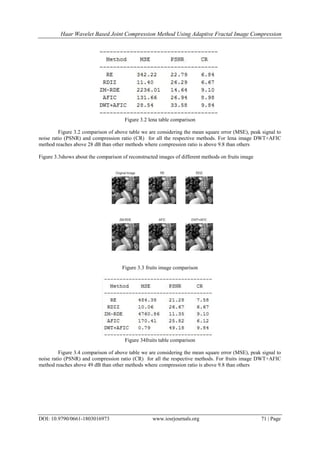
Figure 3.1 shows about the comparison of reconstructed images of different methods on lena image
Figure 3.1 lena image comparison](https://image.slidesharecdn.com/m1803016973-160704052510/85/M1803016973-2-320.jpg)
![Haar Wavelet Based Joint Compression Method Using Adaptive Fractal Image Compression
DOI: 10.9790/0661-1803016973 www.iosrjournals.org 72 | Page
Figure 3.5shows about the comparison of reconstructed images of different methods on lena image
Figure 3.5barbara image comparison
Figure 3.6barbara table comparison
Figure 3.6 comparison of above table we are considering the mean square error (MSE), peak signal to
noise ratio (PSNR) and compression ratio (CR) for all the respective methods. For barbara image DWT+AFIC
method reaches above 30 dB than other methods where compression ratio is above 9.8 than others
IV. Conclusion
The proposed DWT+AFIC worked on; decreasing the encoding time and increasing the compression
ratio at the same time. In addition, it made to keep the reconstructed image quality as much as possible. For that,
DWT+AFIC adopted the AFIC, AQPT, ZMIL, RE, RDIZ and DBST techniques, all these techniques worked
together to achieve the aim of DWT+AFIC and to minimize the trade-off among the ET, CR and the PSNR.
DWT+AFIC has many control parameters, these parameters give the DWT+AFIC a high flexibility to get
different performing results in term of CR, ET and PSNR so we can get a higher PSNR on the account of the ET
and CR and vice versa to accomplish the requirements of different applications. The comparison results show
that the DWT+AFIC has better performance than BFIC, Duh’s method,
References
[1] R. L. White, "High-performance compression of astronomical images," presented at the NASA conference publication, 1993.
[2] Y. Fisher, "Fractal Image Compression: Theory and Application," ed New York: Springier Verlage, 1994.
[3] G. M. Bernstein, C. Bebek, J. Rhodes, S. Stoughton, R. A. Vanderveld, and P. Yeh, "Noise and Bias In Square-Root Compression
Schemes," TheUniversity of Chicago Press on behalf of the Astronomical Society of the Pacific, vol. 122 (889), pp. 336-346, 2010.
[4] T. T. Barbara Penna, Enrico MagliE, and Gabriella Olmo, "Transform Coding Techniques for LossyHyperspectral Data
Compression," IEEETRANSACTIONS ON GEOSCIENCE AND REMOTE SENSING, vol. 45, pp.1408-1421, 2007.
[5] G.M.Padmaja, P.Nirupama, and G.M.Padmaja, "Analysis of Various Image Compression Techniques," ARPN Journal of Science
and Technology, vol. 2 (4), pp. 371-376, 2012.
[6] B. Furht, "Image Presentation and Compression," Department of Computer Science and Engineering,borko@cse.fau.edu, Boca
Raton, Florida 33431, Florida, 2000.
[7] P. C. Cosman, R. M. Gray, and R. A. Olshen, "Evaluating Quality of Compressed Medical Images SNR, Subjective Rating and
Diagnostic Accuracy," presented at the Proceedinds of IEEE, 1994.
[8] S. Fadhil, "Adaptive Fractal Image Compression," PhD, Al-Rasheed College of Engineering and Science, Technology University,
Baghad, 2004.](https://image.slidesharecdn.com/m1803016973-160704052510/85/M1803016973-4-320.jpg)
![Haar Wavelet Based Joint Compression Method Using Adaptive Fractal Image Compression
DOI: 10.9790/0661-1803016973 www.iosrjournals.org 73 | Page
[9] S. A. Naaman, "Fractal Image Compression Using Shape Structure," MSc, College of Science, Al-Mustansiriya University,
Baghdad, 2006.
[10] R. Y. Li, J. Kim, and N. Al-Shamakhi, "Image compression using transformed vector quantization," Image and Vision Computing,
vol. 20 (1), pp. 37-45, 2002.
[11] E. Bursztein, R. Beauxis, H. Paskov, D. Perito, C. Fabry, and J. Mitchell, "The Failure of Noise-Based Non-continuous Audio
Captchas," in Securityand Privacy (SP), 2011 IEEE Symposium on, 2011, pp. 19-31.
[12] S. S. Al-Barazanchi, "Image Compression Based on Fractal Coding and Wavelet Transform," M. Sc., College of Science, Al-
Nahrain University, Baghdad, 2004.
[13] D. Salomon, Data compression: the complete reference: Springer-Verlag New York Incorporated, 2004.
[14] K. Jaferzadeh, K. Kiani, and S. Mozaffari, "Acceleration of fractal image compression using fuzzy clustering and discrete-cosine-
transform-based metric," Iet Image Processing, vol. 6 (7), pp. 1024-1030, Oct 2012.
[15] G. Poggi, "Fast algorithm for full-search VQ encoding," 29, Electronics Letters, 1993.
[16] M. Barnsley, "Fractals Everywhere," ed: New York: Academic, 1988.
[17] M. Galabov, "Fractal image compression," in Proceedings of the 4thInternational Conference on Computer Systems and
Technologies , 2003, pp.320-326.
[18] T. Kovács, "A fast classification based method for fractal image encoding," Image and Vision Computing, vol. 26 (8), pp. 1129-
1136, 2008.
[19] M. Novak, Attractor coding of images: Citeseer, 1993.
[20] B. Hürtgen, P. Mols, and S. F. Simon, "Fractal transform coding of color images," in Proceedings of the SPIE—The International
Society for OpticalEngineering, 1994, pp. 1683-1691.
[21] M. Ruhl, H. Hartenstein, and D. Saupe, "Adaptive partitionings for fractal image compression," in Image Processing, 1997.
Proceedings., InternationalConference on, 1997, pp. 310-313 vol.2.
[22] B. Rejeb and W. Anheier, "A new approach for the speed up of fractal image coding," in Digital Signal Processing Proceedings,
1997. DSP 97., 199713th International Conference on, 1997, pp. 853-856 vol.2.
[23] H. Mahadevaswamy, "New Approaches to Image Compression," Regional Engineering College, 2000.](https://image.slidesharecdn.com/m1803016973-160704052510/85/M1803016973-5-320.jpg)

This document presents a new method for image compression called Haar Wavelet Based Joint Compression Method Using Adaptive Fractal Image Compression (DWT+AFIC). It combines discrete wavelet transform with an existing adaptive fractal image compression technique to improve compression ratio and reconstructed image quality compared to previous fractal image compression methods. The document introduces fractal image compression and its limitations, describes the proposed DWT+AFIC method and 5 other compression techniques, provides simulation results on test images showing DWT+AFIC achieves higher peak signal to noise ratios and compression ratios than other methods, and concludes DWT+AFIC decreases encoding time while increasing compression ratio and maintaining reconstructed image quality.


