International Research Journal of Engineering and Technology (IRJET) e-ISSN: 2395-0056
Volume: 05 Issue: 03 | Mar-2018 www.irjet.net p-ISSN: 2395-0072
© 2018, IRJET | Impact Factor value: 6.171 | ISO 9001:2008 Certified Journal | Page 3512
SATELLITE IMAGE RESOLUTION ENHANCEMENT
D.Swetha1, G. Tulasi2, B. Anusha3, Ch.Mounika4, D. Revanth5, G. Shailesh6
1Assistant Professor, Dept. of Electronics and Communication Engineering, Bapatla Engineering college,
Andhra Pradesh, India
2,3,4,5,6 Dept. of Electronics and Communication Engineering, Bapatla Engineering college,
---------------------------------------------------------------------***---------------------------------------------------------------------
Abstract - The main objective of this project is to improve
the resolution of satellite images. Generally satellite images
are having low resolution. Resolution is one of the most
important factor for an image. In order to get high resoluted
images DWT (Discrete Wavelet Transform), interpolationand
IDWT (Inverse Discrete Wavelet Transform)methodsareused.
The sharpness of an image is improved by estimating the high
frequency sub bands and edges are preserved by DWT
technique. Based on the visual appearance and quality metric
parameters image resolution is improved. This algorithm is
applied on LANDSAT 8 images and the method isimplemented
on MATLAB using image processing toolbox.
Key Words: DWT (Discrete Wavelet Transform),
interpolation, IDWT (inverse discretewavelettransform),
LANDSAT imaginary, Remote sensing.
1. INTRODUCTION
Satellite images are having many applicationsthesedays
due to the development in the sensor technologies. They are
widely used in weather forecasting, oceanography,
geographical information etc. The images from satellite are
having low resolution because they are affected by some
factors like scattering, weather conditions etc.Inordertoget
complete information through the satellite images we need
to get high resolution images from satellite since resolution
is an important factor for any image. The visibilityandclarity
of an image depends upon contrast and resolution. So to
enhance the quality of an image there are many techniques.
DWT (discrete Wavelet Transform) and interpolationcanbe
used to get high resolution satellite images.InDWTanimage
is decomposed into four sub bands namely LL band, LH
band, HL band, HH band using bi orthogonal wavelet which
exhibits the property of linear phase. Then after the division
of image into sub bands, interpolation technique is applied
on each sub band which constructs the new dadapointswith
the range of a discrete set of known data points. There are
many types of interpolation techniques like linear
interpolation, bilinear interpolation, cubic interpolation, bi
cubic interpolation etc. one can choose the interpolation
technique as per the requirement.
Image resolution enhancement techniques are
categorized into two major classes. They are spatial domain
and transform domain. In spatial domain gray level
transformation, histogram modeling, gray level slicing,
neighborhood pixel adjustments techniques are available.
The input image can also be transformed into other
transformations likeDFT, DCT and SVD to achieve theimage
resolution enhancement. The proposed paper uses DWT in
the starting stage. In intermediate stage interpolation
technique is used and finally IDWT is used to enhance the
quality of an image.
2. METHODOLOGY
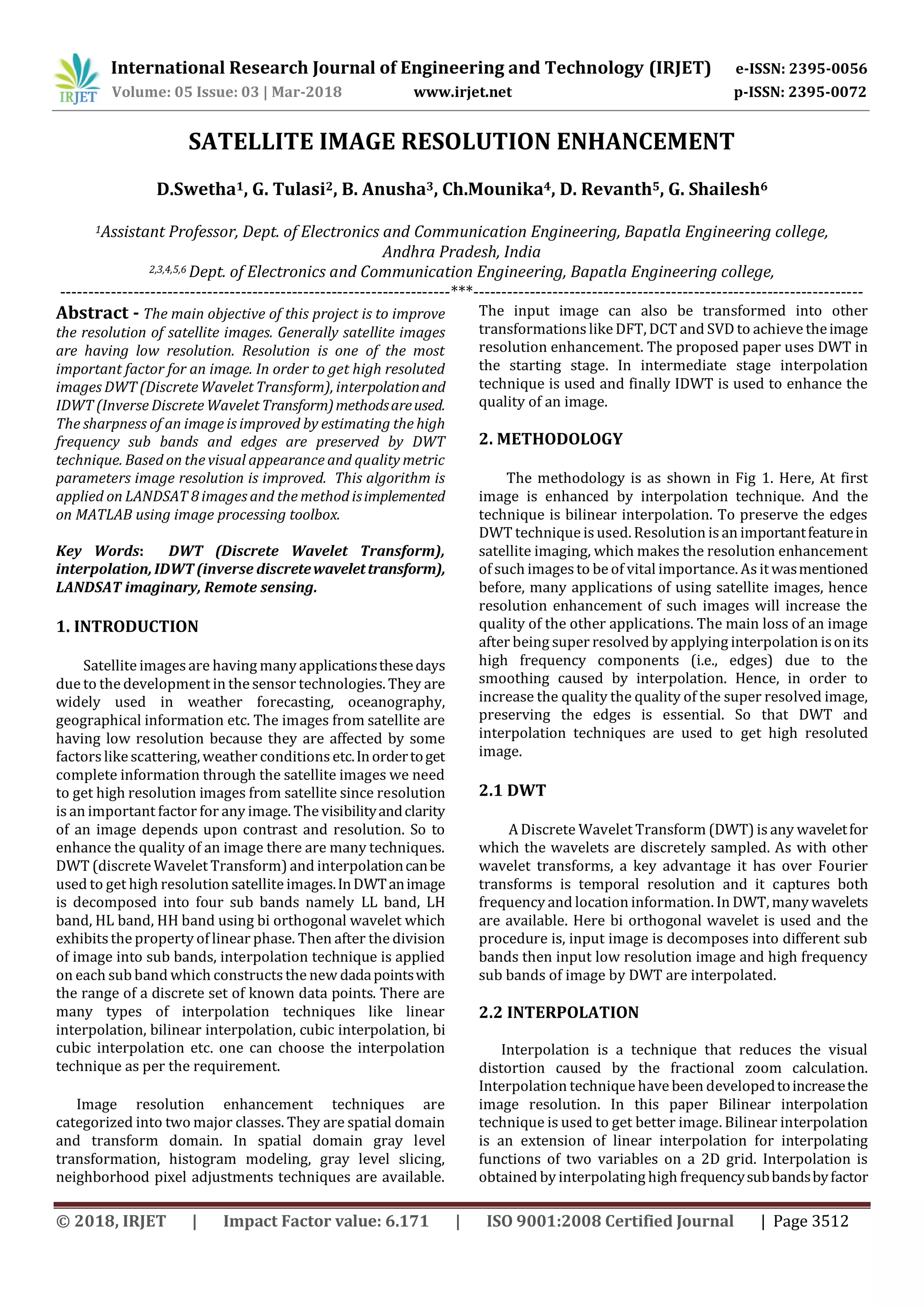
The methodology is as shown in Fig 1. Here, At first
image is enhanced by interpolation technique. And the
technique is bilinear interpolation. To preserve the edges
DWT technique is used. Resolution is an importantfeaturein
satellite imaging, which makes the resolution enhancement
of such imagesto be of vital importance. Asitwasmentioned
before, many applications of using satellite images, hence
resolution enhancement of such images will increase the
quality of the other applications. The main loss of an image
after being super resolved by applying interpolation isonits
high frequency components (i.e., edges) due to the
smoothing caused by interpolation. Hence, in order to
increase the quality the quality of the super resolved image,
preserving the edges is essential. So that DWT and
interpolation techniques are used to get high resoluted
image.
2.1 DWT
A Discrete Wavelet Transform (DWT) is any waveletfor
which the wavelets are discretely sampled. As with other
wavelet transforms, a key advantage it has over Fourier
transforms is temporal resolution and it captures both
frequency and location information. In DWT, many wavelets
are available. Here bi orthogonal wavelet is used and the
procedure is, input image is decomposes into different sub
bands then input low resolution image and high frequency
sub bands of image by DWT are interpolated.
2.2 INTERPOLATION
Interpolation is a technique that reduces the visual
distortion caused by the fractional zoom calculation.
Interpolation technique have been developedtoincreasethe
image resolution. In this paper Bilinear interpolation
technique is used to get better image. Bilinear interpolation
is an extension of linear interpolation for interpolating
functions of two variables on a 2D grid. Interpolation is
obtained by interpolating high frequencysubbandsbyfactor
International Research Journal of Engineering and Technology (IRJET) e-ISSN: 2395-0056
Volume: 05 Issue: 03 | Mar-2018 www.irjet.net p-ISSN: 2395-0072
© 2018, IRJET | Impact Factor value: 6.171 | ISO 9001:2008 Certified Journal | Page 3513
2 and then including the difference image into estimated
high frequency images. We get sharper and cleanerimageby
adding difference image containing high frequency
components. Due to interpolation of isolated high frequency
components HH, HL and LH frequency components will be
preserved.
Finally combine the interpolated sub bands obtained in
DWT by performing Inverse Discrete Fourier Transform
(IDWT). IDWT is the inverse process of DWT performs a
single-level one dimensional wavelet reconstruction with
Fig-1. Methodology
2.3 ALGORITHM
1) Discrete Wavelet Transform is applied ontheinputimage
which decomposes the image into four sub bands.
2) Interpolation is performed on these four sub bands. The
low frequency sub band contains less information as
compared to the original input image. Hence original input
image is used in the interpolation process.
3) Each sub band of input low resolution image is
interpolated by the factor α/2.
4) To preserve edge information interpolation on high
frequency sub bands are performed.
5) The difference between the low resolution input image
and interpolated LL sub band image generates their high
frequency components. This difference image and
interpolated LH, HL and HH bandsare added to estimate the
respective hi components.
6) The resultant estimated high frequency sub band images
and interpolated input image interpolation aregoesthrough
inverse DWT to get enhanced satellite image of original
image.
The proposed method of enhanced is not just interpolated
the image but also preserve the high Frequency component
of images. So that resultant output image resolution is
enhanced.
3. EXPERIMENTAL RESULTS AND DISCUSSIONS
Satellite image enhancement quality is measured using
subjective and objective measures. And the original imageis
denoted by ),( jIIin and reconstructed enhanced image is
denoted by ).,( jIIout and the size of an image is
represented by NM  pixels. PSNR, MSE and Entropy are
used as a objective measuresfor result analysis.PSNRcanbe
calculated by equation (1)
PSNR=10*log10 (R2/MSE) (1)
Where, R is no. of bits required to represent an image
MSE is the Mean Square Error between the input original
image and resultant enhanced image that can be calculated
by equation (2)
International Research Journal of Engineering and Technology (IRJET) e-ISSN: 2395-0056
Volume: 05 Issue: 03 | Mar-2018 www.irjet.net p-ISSN: 2395-0072
© 2018, IRJET | Impact Factor value: 6.171 | ISO 9001:2008 Certified Journal | Page 3514
MSE=
NM
jiIjiIji
outin

,
2)),(),((
(2)
Image entropy is a quantity which is used to describe
business of the image i.e., the amount of information which
must be coded by a compression algorithm. Imageentropyis
calculated with the formula
ENTROPY= 
i
ii PP 2log (3)
Where, Pi is the probability that the difference between
two adjacent pixels is equal to i and log2 in the base 2
logarithm.
The satellite images with three different locations and
feature of 256*256 pixel size are used for comparisons.
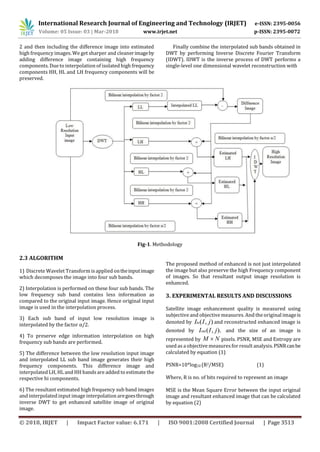
Table I shows the PSNR values of proposed method is
improved as compared with other methods. Table II and III
compare the MSE and Entropy performance of the proposed
technique with bilinear, bi cubic techniquesrespectively.The
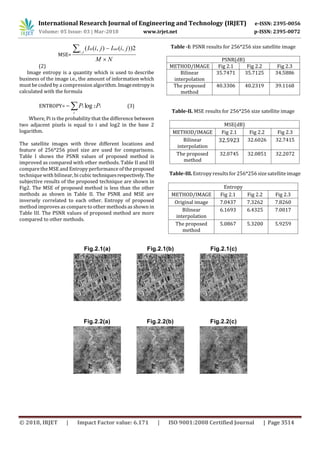
subjective results of the proposed technique are shown in
Fig2. The MSE of proposed method is less than the other
methods as shown in Table II. The PSNR and MSE are
inversely correlated to each other. Entropy of proposed
method improves as compare to other methodsas shown in
Table III. The PSNR values of proposed method are more
compared to other methods.
Table -I: PSNR results for 256*256 size satellite image
PSNR(dB)
METHOD/IMAGE Fig 2.1 Fig 2.2 Fig 2.3
Bilinear
interpolation
35.7471 35.7125 34.5886
The proposed
method
40.3306 40.2319 39.1168
Table-II. MSE results for 256*256 size satellite image
MSE(dB)
METHOD/IMAGE Fig 2.1 Fig 2.2 Fig 2.3
Bilinear
interpolation
32.5923 32.6026 32.7415
The proposed
method
32.0745 32.0851 32.2072
Table-III. Entropy results for 256*256 size satellite image
Entropy
METHOD/IMAGE Fig 2.1 Fig 2.2 Fig 2.3
Original image 7.0437 7.3262 7.8260
Bilinear
interpolation
6.1693 6.4325 7.0017
The proposed
method
5.0867 5.3200 5.9259
International Research Journal of Engineering and Technology (IRJET) e-ISSN: 2395-0056
Volume: 05 Issue: 03 | Mar-2018 www.irjet.net p-ISSN: 2395-0072
© 2018, IRJET | Impact Factor value: 6.171 | ISO 9001:2008 Certified Journal | Page 3515
Fig 2. Results (a) original (b) bilinear (c) IDWT
4. CONCLUSION
This paper presents the satellite image enhancement
technique based on the interpolation and DWT of high
frequency subbands.The proposedtechniquedecomposesan
low resolution input image into four subband images, and
interpolation is appilied on high frequency sub bandimages.
The interpolation factor of half is applied to the high
frequency subband images as well as input image. The
performance parameters such as PSNR, MSE and ENTROPY
improve as compared to the conventional and state of art
methods. In future this technique can be tested on different
satellite images and fusion of algorithms is also ossible for
further improvements in the result.
REFERENCES
[1] B.D. Jadhav, P.M. Patil, ‘An effective method for satellite
image enhancement”, vol.17, No.4, March 2014.
[2] Parth Bhatt, Ankit Shah, “Image enhancement using
various interpolation methods”,Vol. 2, No.4, August 2012.
[3] Ravi B. Mehta, Richard Sonaliya, “Survey On Satellite
Image Enhancement Techniques”, Vol. 5 (6) 2014, 7411-
7414.
[4] Prachi R Rajarapollu, Vijay R Mankar, “Interpolation
algorithms implementation for image appearance
enhancement”, Vol. 8, Iss ue 2, April - June 2017.
[5] Dr.P.V Nagarjaneyulu, S.Krishna priya ,”Comparision of
image resolution analysis by wzp and decomposition
methods”,vol.1 (2), 2012.
[6] Thorat Ashwini Anil , Katariya S. S,” Image Resolution
Improvement By Using DWT & SWT Transform”, Vol-1
Issue-4 2015.
[7] USGS landsat8 data download [online]
http://landsat.gov/tools_faq.php

IRJET- Satellite Image Resolution Enhancement

  • 1.
    International Research Journalof Engineering and Technology (IRJET) e-ISSN: 2395-0056 Volume: 05 Issue: 03 | Mar-2018 www.irjet.net p-ISSN: 2395-0072 © 2018, IRJET | Impact Factor value: 6.171 | ISO 9001:2008 Certified Journal | Page 3512 SATELLITE IMAGE RESOLUTION ENHANCEMENT D.Swetha1, G. Tulasi2, B. Anusha3, Ch.Mounika4, D. Revanth5, G. Shailesh6 1Assistant Professor, Dept. of Electronics and Communication Engineering, Bapatla Engineering college, Andhra Pradesh, India 2,3,4,5,6 Dept. of Electronics and Communication Engineering, Bapatla Engineering college, ---------------------------------------------------------------------***--------------------------------------------------------------------- Abstract - The main objective of this project is to improve the resolution of satellite images. Generally satellite images are having low resolution. Resolution is one of the most important factor for an image. In order to get high resoluted images DWT (Discrete Wavelet Transform), interpolationand IDWT (Inverse Discrete Wavelet Transform)methodsareused. The sharpness of an image is improved by estimating the high frequency sub bands and edges are preserved by DWT technique. Based on the visual appearance and quality metric parameters image resolution is improved. This algorithm is applied on LANDSAT 8 images and the method isimplemented on MATLAB using image processing toolbox. Key Words: DWT (Discrete Wavelet Transform), interpolation, IDWT (inverse discretewavelettransform), LANDSAT imaginary, Remote sensing. 1. INTRODUCTION Satellite images are having many applicationsthesedays due to the development in the sensor technologies. They are widely used in weather forecasting, oceanography, geographical information etc. The images from satellite are having low resolution because they are affected by some factors like scattering, weather conditions etc.Inordertoget complete information through the satellite images we need to get high resolution images from satellite since resolution is an important factor for any image. The visibilityandclarity of an image depends upon contrast and resolution. So to enhance the quality of an image there are many techniques. DWT (discrete Wavelet Transform) and interpolationcanbe used to get high resolution satellite images.InDWTanimage is decomposed into four sub bands namely LL band, LH band, HL band, HH band using bi orthogonal wavelet which exhibits the property of linear phase. Then after the division of image into sub bands, interpolation technique is applied on each sub band which constructs the new dadapointswith the range of a discrete set of known data points. There are many types of interpolation techniques like linear interpolation, bilinear interpolation, cubic interpolation, bi cubic interpolation etc. one can choose the interpolation technique as per the requirement. Image resolution enhancement techniques are categorized into two major classes. They are spatial domain and transform domain. In spatial domain gray level transformation, histogram modeling, gray level slicing, neighborhood pixel adjustments techniques are available. The input image can also be transformed into other transformations likeDFT, DCT and SVD to achieve theimage resolution enhancement. The proposed paper uses DWT in the starting stage. In intermediate stage interpolation technique is used and finally IDWT is used to enhance the quality of an image. 2. METHODOLOGY The methodology is as shown in Fig 1. Here, At first image is enhanced by interpolation technique. And the technique is bilinear interpolation. To preserve the edges DWT technique is used. Resolution is an importantfeaturein satellite imaging, which makes the resolution enhancement of such imagesto be of vital importance. Asitwasmentioned before, many applications of using satellite images, hence resolution enhancement of such images will increase the quality of the other applications. The main loss of an image after being super resolved by applying interpolation isonits high frequency components (i.e., edges) due to the smoothing caused by interpolation. Hence, in order to increase the quality the quality of the super resolved image, preserving the edges is essential. So that DWT and interpolation techniques are used to get high resoluted image. 2.1 DWT A Discrete Wavelet Transform (DWT) is any waveletfor which the wavelets are discretely sampled. As with other wavelet transforms, a key advantage it has over Fourier transforms is temporal resolution and it captures both frequency and location information. In DWT, many wavelets are available. Here bi orthogonal wavelet is used and the procedure is, input image is decomposes into different sub bands then input low resolution image and high frequency sub bands of image by DWT are interpolated. 2.2 INTERPOLATION Interpolation is a technique that reduces the visual distortion caused by the fractional zoom calculation. Interpolation technique have been developedtoincreasethe image resolution. In this paper Bilinear interpolation technique is used to get better image. Bilinear interpolation is an extension of linear interpolation for interpolating functions of two variables on a 2D grid. Interpolation is obtained by interpolating high frequencysubbandsbyfactor
  • 2.
    International Research Journalof Engineering and Technology (IRJET) e-ISSN: 2395-0056 Volume: 05 Issue: 03 | Mar-2018 www.irjet.net p-ISSN: 2395-0072 © 2018, IRJET | Impact Factor value: 6.171 | ISO 9001:2008 Certified Journal | Page 3513 2 and then including the difference image into estimated high frequency images. We get sharper and cleanerimageby adding difference image containing high frequency components. Due to interpolation of isolated high frequency components HH, HL and LH frequency components will be preserved. Finally combine the interpolated sub bands obtained in DWT by performing Inverse Discrete Fourier Transform (IDWT). IDWT is the inverse process of DWT performs a single-level one dimensional wavelet reconstruction with Fig-1. Methodology 2.3 ALGORITHM 1) Discrete Wavelet Transform is applied ontheinputimage which decomposes the image into four sub bands. 2) Interpolation is performed on these four sub bands. The low frequency sub band contains less information as compared to the original input image. Hence original input image is used in the interpolation process. 3) Each sub band of input low resolution image is interpolated by the factor α/2. 4) To preserve edge information interpolation on high frequency sub bands are performed. 5) The difference between the low resolution input image and interpolated LL sub band image generates their high frequency components. This difference image and interpolated LH, HL and HH bandsare added to estimate the respective hi components. 6) The resultant estimated high frequency sub band images and interpolated input image interpolation aregoesthrough inverse DWT to get enhanced satellite image of original image. The proposed method of enhanced is not just interpolated the image but also preserve the high Frequency component of images. So that resultant output image resolution is enhanced. 3. EXPERIMENTAL RESULTS AND DISCUSSIONS Satellite image enhancement quality is measured using subjective and objective measures. And the original imageis denoted by ),( jIIin and reconstructed enhanced image is denoted by ).,( jIIout and the size of an image is represented by NM  pixels. PSNR, MSE and Entropy are used as a objective measuresfor result analysis.PSNRcanbe calculated by equation (1) PSNR=10*log10 (R2/MSE) (1) Where, R is no. of bits required to represent an image MSE is the Mean Square Error between the input original image and resultant enhanced image that can be calculated by equation (2)
  • 3.
    International Research Journalof Engineering and Technology (IRJET) e-ISSN: 2395-0056 Volume: 05 Issue: 03 | Mar-2018 www.irjet.net p-ISSN: 2395-0072 © 2018, IRJET | Impact Factor value: 6.171 | ISO 9001:2008 Certified Journal | Page 3514 MSE= NM jiIjiIji outin  , 2)),(),(( (2) Image entropy is a quantity which is used to describe business of the image i.e., the amount of information which must be coded by a compression algorithm. Imageentropyis calculated with the formula ENTROPY=  i ii PP 2log (3) Where, Pi is the probability that the difference between two adjacent pixels is equal to i and log2 in the base 2 logarithm. The satellite images with three different locations and feature of 256*256 pixel size are used for comparisons. Table I shows the PSNR values of proposed method is improved as compared with other methods. Table II and III compare the MSE and Entropy performance of the proposed technique with bilinear, bi cubic techniquesrespectively.The subjective results of the proposed technique are shown in Fig2. The MSE of proposed method is less than the other methods as shown in Table II. The PSNR and MSE are inversely correlated to each other. Entropy of proposed method improves as compare to other methodsas shown in Table III. The PSNR values of proposed method are more compared to other methods. Table -I: PSNR results for 256*256 size satellite image PSNR(dB) METHOD/IMAGE Fig 2.1 Fig 2.2 Fig 2.3 Bilinear interpolation 35.7471 35.7125 34.5886 The proposed method 40.3306 40.2319 39.1168 Table-II. MSE results for 256*256 size satellite image MSE(dB) METHOD/IMAGE Fig 2.1 Fig 2.2 Fig 2.3 Bilinear interpolation 32.5923 32.6026 32.7415 The proposed method 32.0745 32.0851 32.2072 Table-III. Entropy results for 256*256 size satellite image Entropy METHOD/IMAGE Fig 2.1 Fig 2.2 Fig 2.3 Original image 7.0437 7.3262 7.8260 Bilinear interpolation 6.1693 6.4325 7.0017 The proposed method 5.0867 5.3200 5.9259
  • 4.
    International Research Journalof Engineering and Technology (IRJET) e-ISSN: 2395-0056 Volume: 05 Issue: 03 | Mar-2018 www.irjet.net p-ISSN: 2395-0072 © 2018, IRJET | Impact Factor value: 6.171 | ISO 9001:2008 Certified Journal | Page 3515 Fig 2. Results (a) original (b) bilinear (c) IDWT 4. CONCLUSION This paper presents the satellite image enhancement technique based on the interpolation and DWT of high frequency subbands.The proposedtechniquedecomposesan low resolution input image into four subband images, and interpolation is appilied on high frequency sub bandimages. The interpolation factor of half is applied to the high frequency subband images as well as input image. The performance parameters such as PSNR, MSE and ENTROPY improve as compared to the conventional and state of art methods. In future this technique can be tested on different satellite images and fusion of algorithms is also ossible for further improvements in the result. REFERENCES [1] B.D. Jadhav, P.M. Patil, ‘An effective method for satellite image enhancement”, vol.17, No.4, March 2014. [2] Parth Bhatt, Ankit Shah, “Image enhancement using various interpolation methods”,Vol. 2, No.4, August 2012. [3] Ravi B. Mehta, Richard Sonaliya, “Survey On Satellite Image Enhancement Techniques”, Vol. 5 (6) 2014, 7411- 7414. [4] Prachi R Rajarapollu, Vijay R Mankar, “Interpolation algorithms implementation for image appearance enhancement”, Vol. 8, Iss ue 2, April - June 2017. [5] Dr.P.V Nagarjaneyulu, S.Krishna priya ,”Comparision of image resolution analysis by wzp and decomposition methods”,vol.1 (2), 2012. [6] Thorat Ashwini Anil , Katariya S. S,” Image Resolution Improvement By Using DWT & SWT Transform”, Vol-1 Issue-4 2015. [7] USGS landsat8 data download [online] http://landsat.gov/tools_faq.php