Made by Zaeem Ahmad Varaich
Please inform if you find any error in any solution!
EE08.SOLUTIONS
DRILL PROBLEMS : CHAPTER 2
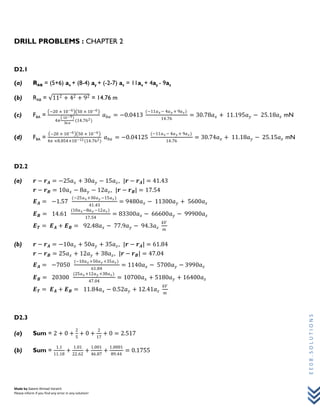
D2.1
(a) RAB = (5+6) ax + (8-4) ay + (-2-7) az = 11ax + 4ay - 9az
(b) RAB = 112 + 42 + 92 = 14.76 m
(c) FBA =
−20 × 10−6 50 × 10−6
4𝜋
10−9
36 𝜋
(14.762)
𝑎 𝑏𝑎 = −0.0413
(−11𝑎 𝑥 − 4𝑎 𝑦 + 9𝑎 𝑧)
14.76
= 30.78𝑎 𝑥 + 11.195𝑎 𝑦 − 25.18𝑎 𝑧 mN
(d) FBA =
−20 × 10−6 50 × 10−6
4𝜋 ×8.854×10−12 (14.762)
𝑎 𝑏𝑎 = −0.04125
(−11𝑎 𝑥 − 4𝑎 𝑦 + 9𝑎 𝑧)
14.76
= 30.74𝑎 𝑥 + 11.18𝑎 𝑦 − 25.15𝑎 𝑧 mN
D2.2
(a) 𝒓 − 𝒓 𝑨 = −25𝑎 𝑥 + 30𝑎 𝑦 − 15𝑎 𝑧, |𝒓 − 𝒓 𝑨| = 41.43
𝒓 − 𝒓 𝑩 = 10𝑎 𝑥 − 8𝑎 𝑦 − 12𝑎 𝑧, |𝒓 − 𝒓 𝑩| = 17.54
𝑬 𝑨 = −1.57
(−25𝑎 𝑥 +30𝑎 𝑦 −15𝑎 𝑧)
41.43
= 9480𝑎 𝑥 − 11300𝑎 𝑦 + 5600𝑎 𝑧
𝑬 𝑩 = 14.61
(10𝑎 𝑥 −8𝑎 𝑦 −12𝑎 𝑧)
17.54
= 83300𝑎 𝑥 − 66600𝑎 𝑦 − 99900𝑎 𝑧
𝑬 𝑻 = 𝑬 𝑨 + 𝑬 𝑩 = 92.48𝑎 𝑥 − 77.9𝑎 𝑦 − 94.3𝑎 𝑧
𝑘𝑉
𝑚
(b) 𝒓 − 𝒓 𝑨 = −10𝑎 𝑥 + 50𝑎 𝑦 + 35𝑎 𝑧, |𝒓 − 𝒓 𝑨| = 61.84
𝒓 − 𝒓 𝑩 = 25𝑎 𝑥 + 12𝑎 𝑦 + 38𝑎 𝑧, |𝒓 − 𝒓 𝑩| = 47.04
𝑬 𝑨 = −7050
(−10𝑎 𝑥 +50𝑎 𝑦 +35𝑎 𝑧)
61.84
= 1140𝑎 𝑥 − 5700𝑎 𝑦 − 3990𝑎 𝑧
𝑬 𝑩 = 20300
(25𝑎 𝑥 +12𝑎 𝑦 +38𝑎 𝑧)
47.04
= 10700𝑎 𝑥 + 5180𝑎 𝑦 + 16400𝑎 𝑧
𝑬 𝑻 = 𝑬 𝑨 + 𝑬 𝑩 = 11.84𝑎 𝑥 − 0.52𝑎 𝑦 + 12.41𝑎 𝑧
𝑘𝑉
𝑚
D2.3
(a) Sum = 2 + 0 +
2
5
+ 0 +
2
17
+ 0 = 2.517
(b) Sum =
1.1
11.18
+
1.01
22.62
+
1.001
46.87
+
1.0001
89.44
= 0.1755
Made by Zaeem Ahmad Varaich
Please inform if you find any error in any solution!
EE08.SOLUTIONS
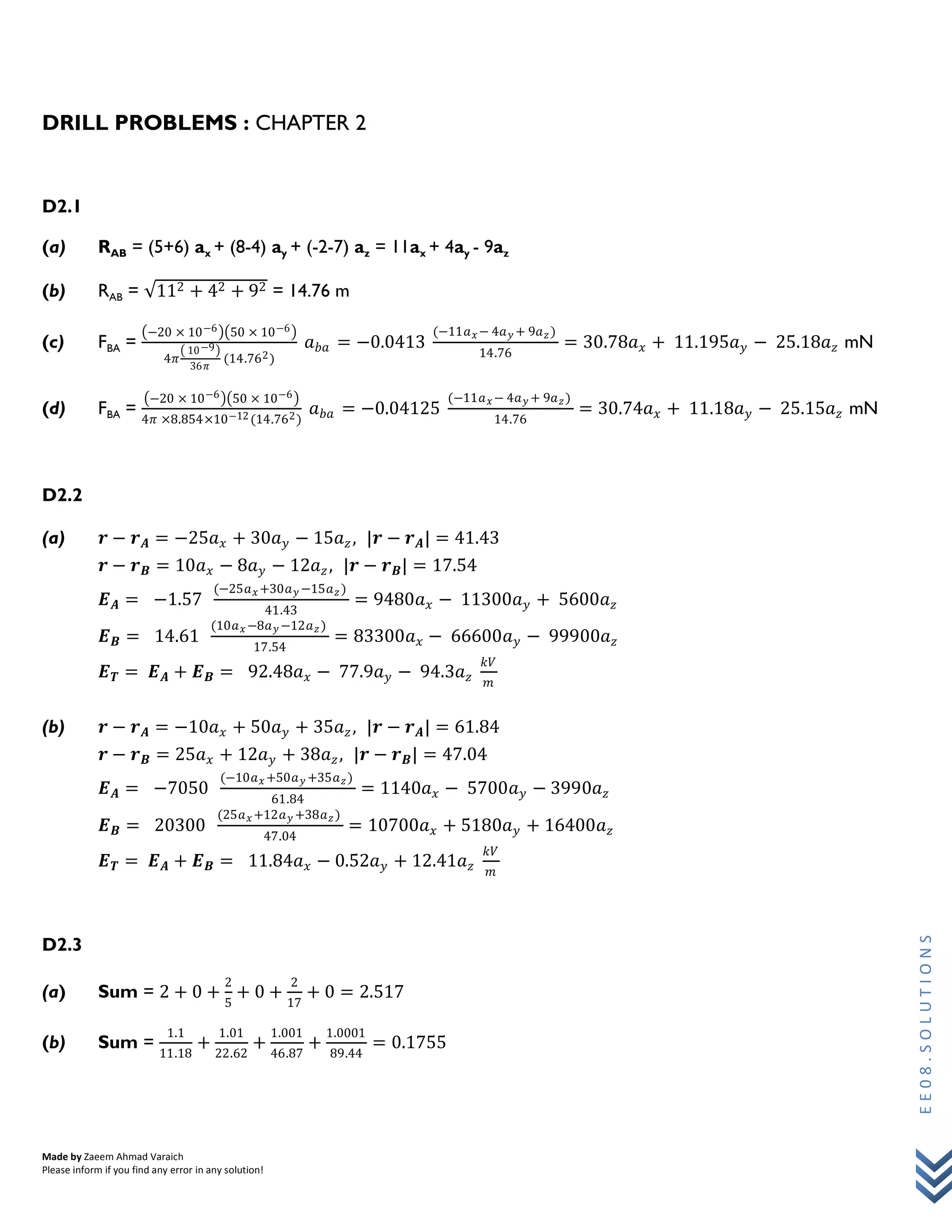
D2.4
(a) 𝑄 = 𝜌𝑣𝑣𝑜𝑙
𝑑𝑣 =
1
𝑥3 𝑦3 𝑧3 𝑑𝑥𝑑𝑦𝑑𝑧 +
−0.1
−0.2
−0.1
−0.2
−0.1
−0.2
1
𝑥3 𝑦3 𝑧3 𝑑𝑥𝑑𝑦𝑑𝑧
0.2
0.1
0.2
0.1
0.2
0.1
= −
1
8 𝑥2
−02
−0.1 𝑦2
−02
−0.1 𝑧2
−02
−0.1 − −
1
8 𝑥2
0.1
0.2 𝑦2
0.1
0.2 𝑧2
0.1
0.2 =
1
8×(0.03)
−
1
8×(0.03)
= 0
(b) 𝜌3
𝑧2
sin 0.6𝜑 𝑑𝑧𝑑𝜌𝑑𝜑
4
2
0.1
0
𝜋
0
= (−
cos 0.6𝜑
0.6
)
0
𝜋
(
𝜌4
4
)
0
0.1
(
𝑧3
3
)
2
4
= 1.018 𝑚𝐶
(c) 𝑒−2𝑟
sin 𝜃 𝑑𝜑
2𝜋
0
2𝜋
0
∞
0
𝑑𝜃𝑑𝑟 = (−
𝑒−2𝑟
2
)
0
∞
(cos 𝜃) 0
2𝜋
(𝜑) 0
2𝜋
= −6.28 𝐶
D2.5
(a) E = 2 ×
5×10−9
2𝜋𝜀 𝑜 (4)
𝒂 𝒛 = 44.95
𝑉
𝑚
(b) Ex =
5×10⁻⁹
2𝜋𝜀 𝑜 (5)
(3𝒂 𝒚+4𝒂 𝒛)
5
= 10.788𝒂 𝒚 + 14.384𝒂 𝒛
𝑉
𝑚
, Ey =
5×10⁻⁹
2𝜋𝜀 𝑜 (4)
𝒂 𝒛 = 22.4775 𝒂 𝒛
𝑉
𝑚
E = Ex + Ey = 10.788𝒂 𝒚 + 36.86𝒂 𝒛
𝑉
𝑚
D2.6
i) Electric field due to 3 nC/m2
: E1 =
3×10⁻⁹
2𝜀 𝑜
𝒂 𝑵= 169.5 𝒂 𝒛
ii) Electric field due to 6 nC/m2
: E2 =
6×10⁻⁹
2𝜀 𝑜
𝒂 𝑵= 338.8 𝒂 𝒛
iii) Electric field due to -8 nC/m2
: E3 =
−8×10⁻⁹
2𝜀 𝑜
𝒂 𝑵= −451.76 𝒂 𝒛
According to the direction of point relative to normal:
(a) E = - E1 - E2 - E3 = −56.6 𝒂 𝒛
𝑉
𝑚
(a) E = E1 - E2 - E3 = 283 𝒂 𝒛
𝑉
𝑚
(a) E = E1 + E2 - E3 = 961 𝒂 𝒛
𝑉
𝑚
(a) E = E1 + E2 + E3 = 56.6 𝒂 𝒛
𝑉
𝑚
Made by Zaeem Ahmad Varaich
Please inform if you find any error in any solution!
EE08.SOLUTIONS
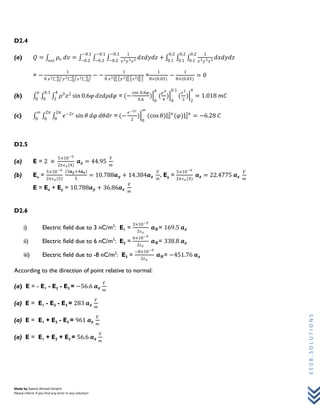
D2.7
(a)
𝐸 𝑦
𝐸 𝑥
=
𝑑𝑦
𝑑𝑥
→
4𝑥2
𝑦2
×
𝑦
8𝑥
=
𝑑𝑦
𝑑𝑥
→ 𝑥𝑑𝑥 = − 2𝑦𝑑𝑦 → 𝑥2
+ 2𝑦2
= 𝑐
Put x = 1 and y = 2 to get 𝑐 = 33 giving: 𝒙 𝟐
+ 𝟐𝒚 𝟐
= 𝟑𝟑
(b)
𝐸 𝑦
𝐸 𝑥
=
𝑑𝑦
𝑑𝑥
→
𝑦(5𝑥+1)
𝑥
=
𝑑𝑦
𝑑𝑥
→
1
5
×
5𝑥+1−1
5𝑥+1
𝑑𝑥 = 𝑦𝑑𝑦 → 0.4𝑥 − 0.08 ln 5𝑥 + 1 + 𝑐 = 𝑦2
Put x = 1 and y = 2 to get 𝑐 = 15.74 giving: 𝟎. 𝟒𝒙 − 𝟎. 𝟎𝟖 𝐥𝐧 𝟓𝒙 + 𝟏 + 𝟏𝟓. 𝟕𝟒 = 𝒚 𝟐
Solved by Saad & Zaeem. Please report if you find any mistake!
EE08.SOLUTIONS
DRILL PROBLEMS 3
D3.1
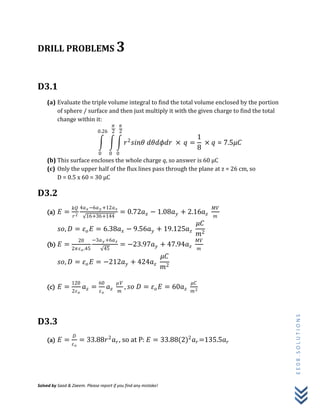
(a) Evaluate the triple volume integral to find the total volume enclosed by the portion
of sphere / surface and then just multiply it with the given charge to find the total
change within it:
𝑟2
𝑠𝑖𝑛𝜃 𝑑𝜃𝑑𝜙𝑑𝑟 ×
𝜋
2
0
𝜋
2
0
0.26
0
𝑞 =
1
8
× 𝑞 = 7.5𝜇𝐶
(b) This surface encloses the whole charge q, so answer is 60 µC
(c) Only the upper half of the flux lines pass through the plane at z = 26 cm, so
D = 0.5 x 60 = 30 µC
D3.2
(a) 𝐸 =
𝑘𝑄
𝑟2
4𝑎 𝑥 −6𝑎 𝑦 +12𝑎 𝑧
16+36+144
= 0.72𝑎 𝑥 − 1.08𝑎 𝑦 + 2.16𝑎 𝑧
𝑀𝑉
𝑚
𝑠𝑜, 𝐷 = 𝜀 𝑜 𝐸 = 6.38𝑎 𝑥 − 9.56𝑎 𝑦 + 19.125𝑎 𝑧
𝜇𝐶
𝑚2
(b) 𝐸 =
20
2𝜋𝜀 𝑜.45
−3𝑎 𝑦 +6𝑎 𝑧
45
= −23.97𝑎 𝑦 + 47.94𝑎 𝑧
𝑀𝑉
𝑚
𝑠𝑜, 𝐷 = 𝜀 𝑜 𝐸 = −212𝑎 𝑦 + 424𝑎 𝑧
𝜇𝐶
𝑚2
(c) 𝐸 =
120
2𝜀 𝑜
𝑎 𝑧 =
60
𝜀 𝑜
𝑎 𝑧
𝜇 𝑉
𝑚
, 𝑠𝑜 𝐷 = 𝜀 𝑜 𝐸 = 60𝑎 𝑧
𝜇𝐶
𝑚2
D3.3
(a) 𝐸 =
𝐷
𝜀 𝑜
= 33.88𝑟2
𝑎 𝑟, so at P: 𝐸 = 33.88(2)2
𝑎 𝑟=135.5𝑎 𝑟
Solved by Saad & Zaeem. Please report if you find any mistake!
EE08.SOLUTIONS
(b) 𝑄 =
𝐷. 𝑑𝑠 = 𝑎2
𝑠𝑖𝑛𝜃 𝑑𝜃𝑑𝜙𝑎 𝑟 × 0.3𝑟2
𝑎 𝑟 =
𝜋
0
2𝜋
0
24.3 −𝑐𝑜𝑠𝜃|0
𝜋2𝜋
0
𝑑𝜙 =
48.6 𝑑𝜙 = 305
2𝜋
0
. 208 𝑛𝐶
(c) On same steps: 𝑄 = 76.8 −𝑐𝑜𝑠𝜃|0
𝜋
𝑑𝜙 = 964.608 μC
2𝜋
0
D3.4
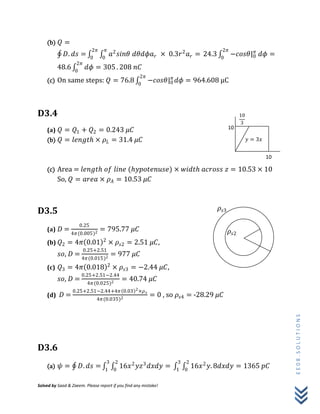
(a) 𝑄 = 𝑄1 + 𝑄2 = 0.243 𝜇𝐶
(b) 𝑄 = 𝑙𝑒𝑛𝑔𝑡𝑕 × 𝜌 𝐿 = 31.4 𝜇𝐶
(c) Area = 𝑙𝑒𝑛𝑔𝑡𝑕 𝑜𝑓 𝑙𝑖𝑛𝑒 (𝑕𝑦𝑝𝑜𝑡𝑒𝑛𝑢𝑠𝑒) × 𝑤𝑖𝑑𝑡𝑕 𝑎𝑐𝑟𝑜𝑠𝑠 𝑧 = 10.53 × 10
So, 𝑄 = 𝑎𝑟𝑒𝑎 × 𝜌 𝐴 = 10.53 𝜇𝐶
D3.5
(a) 𝐷 =
0.25
4𝜋(0.005)2
= 795.77 𝜇𝐶
(b) 𝑄2 = 4𝜋 0.01 2
× 𝜌𝑠2 = 2.51 𝜇𝐶,
𝑠𝑜, 𝐷 =
0.25+2.51
4𝜋(0.015)2
= 977 𝜇𝐶
(c) 𝑄3 = 4𝜋 0.018 2
× 𝜌𝑠3 = −2.44 𝜇𝐶,
𝑠𝑜, 𝐷 =
0.25+2.51−2.44
4𝜋(0.025)2
= 40.74 𝜇𝐶
(d) 𝐷 =
0.25+2.51−2.44+4𝜋 0.03 2×𝜌 𝑠
4𝜋(0.035)2
= 0 , so 𝜌𝑠4 = -28.29 𝜇𝐶
D3.6
(a) 𝜓 = 𝐷. 𝑑𝑠 = 16𝑥2
𝑦𝑧3
𝑑𝑥𝑑𝑦 =
2
0
3
1
16𝑥2
𝑦. 8𝑑𝑥𝑑𝑦 = 1365 𝑝𝐶
2
0
3
1
10
10
10
3
𝑦 = 3𝑥
𝜌𝑠2
𝜌𝑠3
Solved by Saad & Zaeem. Please report if you find any mistake!
EE08.SOLUTIONS
(b) 𝐸 =
𝐷
𝜀 𝑜
𝑎𝑛𝑑 𝑒𝑣𝑎𝑙𝑢𝑎𝑡𝑒 𝑖𝑡 𝑎𝑡 𝑃
(c) 𝐸𝑣𝑎𝑙𝑢𝑎𝑡𝑒 𝑡𝑕𝑒 𝑓𝑜𝑟𝑚𝑢𝑙𝑎 8 𝑎𝑡 𝑃 𝑎𝑛𝑑 ∆𝑉 = 10−12
𝑚3
D3.7
𝐸𝑣𝑎𝑙𝑢𝑎𝑡𝑒 𝑡𝑕𝑒 𝑐𝑜𝑟𝑟𝑒𝑠𝑝𝑜𝑛𝑑𝑖𝑛𝑔 𝑓𝑜𝑟𝑚𝑢𝑙𝑎𝑒 𝑓𝑜𝑟 div 𝐃 𝑖. 𝑒. 15, 16 & 17 𝑎𝑡
𝑡𝑕𝑒 𝑔𝑖𝑣𝑒𝑛 𝑝𝑜𝑖𝑛𝑡𝑠 𝑃
D3.7
𝑇𝑎𝑘𝑒 div 𝐃 𝑎𝑠 𝑠𝑡𝑎𝑡𝑒𝑑 𝑏𝑦 𝑀𝑎𝑥𝑤𝑒𝑙𝑙′
𝑠1𝑠𝑡 𝑒𝑞𝑢𝑎𝑡𝑖𝑜𝑛 𝑡𝑜 𝑔𝑒𝑡 𝑡𝑕𝑒 𝑒𝑥𝑝𝑟𝑒𝑠𝑠𝑖𝑜𝑛𝑠
𝑓𝑜𝑟 𝜌 𝑣, 𝑤𝑖𝑡𝑕 𝑝𝑟𝑜𝑝𝑒𝑟 𝑡𝑟𝑖𝑔𝑛𝑜𝑚𝑒𝑡𝑟𝑖𝑐 𝑚𝑎𝑛𝑖𝑝𝑢𝑙𝑎𝑡𝑖𝑜𝑛
D3.8
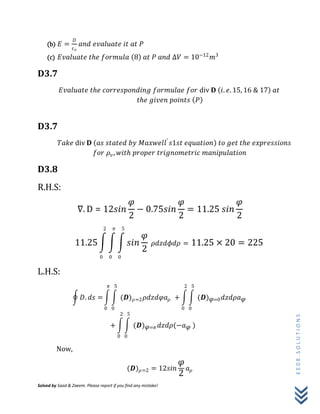
R.H.S:
∇. D = 12𝑠𝑖𝑛
𝜑
2
− 0.75𝑠𝑖𝑛
𝜑
2
= 11.25 𝑠𝑖𝑛
𝜑
2
11.25 𝑠𝑖𝑛
𝜑
2
𝜌𝑑𝑧𝑑𝜙𝑑𝜌 = 11.25 × 20 = 225
5
0
𝜋
0
2
0
L.H.S:
𝐷. 𝑑𝑠 = (𝑫) 𝜌=2 𝜌𝑑𝑧𝑑𝜑𝑎 𝜌
5
0
𝜋
0
+ (𝑫) 𝜑=0 𝑑𝑧𝑑𝜌𝑎 𝜑
5
0
2
0
+ (𝑫) 𝜑=𝜋 𝑑𝑧𝑑𝜌(−𝑎 𝜑 )
5
0
2
0
Now,
(𝑫) 𝜌=2 = 12𝑠𝑖𝑛
𝜑
2
𝑎 𝜌
Solved by Saad & Zaeem. Please report if you find any mistake!
EE08.SOLUTIONS
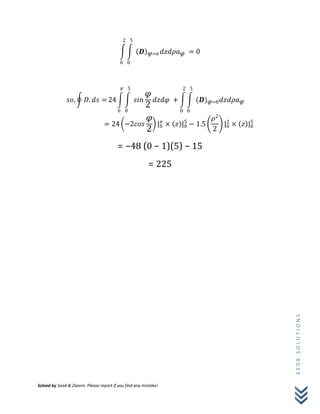
𝑫 𝜑=𝜋 𝑑𝑧𝑑𝜌𝑎 𝜑
5
0
2
0
= 0
𝑠𝑜, 𝐷. 𝑑𝑠 = 24 𝑠𝑖𝑛
𝜑
2
𝑑𝑧𝑑𝜑 + (𝑫) 𝜑=0 𝑑𝑧𝑑𝜌𝑎 𝜑
5
0
2
0
5
0
𝜋
0
= 24 −2𝑐𝑜𝑠
𝜑
2
|0
𝜋
× 𝑧 |0
5
− 1.5
𝜌2
2
|0
2
× 𝑧 |0
5
= −48 0 − 1 5 − 15
= 225
Solved by Aqeel Anwar (aqeelanwar.co.cc) Digitized by Zaeem (ee08.net.tc)
Solved by Zaeem. Please report if you find any mistake!
EE08.SOLUTIONS
DRILL PROBLEMS5
D5.1
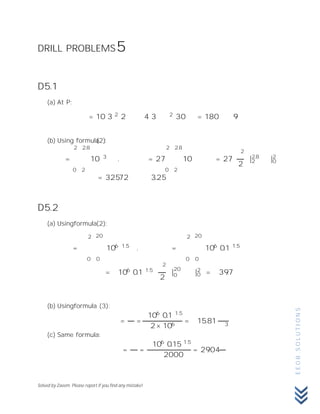
(a) At P:
= 10 3 2
2 4 3 2
30 = 180 9
(b) Using formula(2):
= 10 3
.
2.8
2
2
0
= 27 10
2.8
2
2
0
= 27
2
2
|2
2.8
|0
2
= 325.72 3.25
D5.2
(a) Usingformula (2):
= 106 1.5
.
20
0
2
0
= 106
0.1 1.5
20
0
2
0
= 106
0.1 1.5
2
2
|0
20
|0
2
= 39.7
(b) Usingformula (3):
= =
106
0.1 1.5
2 × 106
= 15.81 3
(c) Same formula:
= =
106
0.15 1.5
2000
= 29.04
Solved by Zaeem. Please report if you find any mistake!
EE08.SOLUTIONS
D5.5
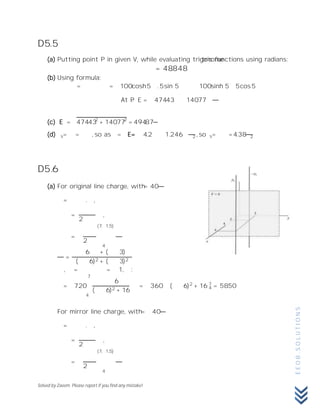
(a) Putting point P in given V, while evaluating trigonometric functions using radians:
= 48.848
(b) Using formula:
= = 100 cosh 5 .5 sin 5 100 sinh 5 5 cos 5
At P: E = 474.43 140.77
(c) E = 474.432
+ 140.772
= 494.87
(d) s= = ,so as = E= 4.2 1.246 2 , so s= = 4.38 2
D5.6
(a) For original line charge, with = 40
= . ,
=
2
,
=
2
(7, 1,5)
4
=
6 + ( 3)
( 6)2 + ( 3)2
, = = 1, :
= 720
6
( 6)2 + 16
= 360 ( 6)2
+ 16 4
7
7
4
= 58.50
For mirror line charge, with = 40
= . ,
=
2
,
=
2
(7, 1,5)
4
1
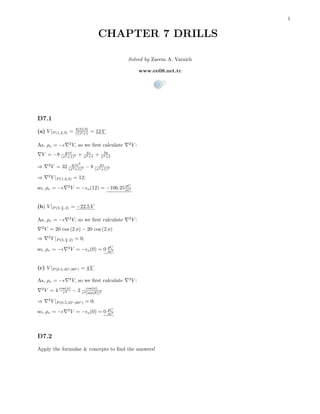
CHAPTER 7 DRILLS
Solved by Zaeem A. Varaich
www.ee08.net.tc
D7.1
(a) V |P (1,2,3) = 4(2)(3)
(1)2+1 = 12 V
As, ρv = − 2
V, so we first calculate 2
V :
V = −8 yzx
(x2+1)2 + 4z
x2+1 + 4y
x2+1
⇒ 2
V = 32 yzx2
(x2+1)3 − 8 yz
(x2+1)2
⇒ 2
V |P (1,2,3) = 12;
so, ρv = − 2
V = − o(12) = −106.25 pC
m3
(b) V |P (3, π
3 ,2) = −22.5 V
As, ρv = − 2
V, so we first calculate 2
V :
2
V = 20 cos (2 φ) − 20 cos (2 φ)
⇒ 2
V |P (3, π
3 ,2) = 0;
so, ρv = − 2
V = − o(0) = 0 pC
m3
(c) V |P (0.5,45o,60o) = 4 V
As, ρv = − 2
V, so we first calculate 2
V :
2
V = 4 cos(φ)
r4 − 2 cos(φ)
r4(sin(θ))2
⇒ 2
V |P (0.5,45o,60o) = 0;
so, ρv = − 2
V = − o(0) = 0 pC
m3
D7.2
Apply the formulae & concepts to find the answers!
2
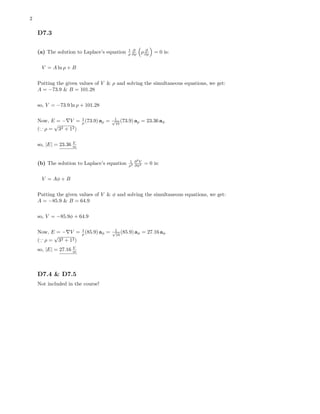
D7.3
(a) The solution to Laplace’s equation 1
ρ
∂
∂ρ ρ ∂
∂ρ = 0 is:
V = A ln ρ + B
Putting the given values of V & ρ and solving the simultaneous equations, we get:
A = −73.9 & B = 101.28
so, V = −73.9 ln ρ + 101.28
Now, E = − V = 1
ρ (73.9) aρ = 1√
10
(73.9) aρ = 23.36 aφ
( ρ =
√
32 + 12)
so, |E| = 23.36 V
m
(b) The solution to Laplace’s equation 1
ρ2
∂2
V
∂φ2 = 0 is:
V = Aφ + B
Putting the given values of V & φ and solving the simultaneous equations, we get:
A = −85.9 & B = 64.9
so, V = −85.9φ + 64.9
Now, E = − V = 1
ρ (85.9) aφ = 1√
10
(85.9) aφ = 27.16 aφ
( ρ =
√
32 + 12)
so, |E| = 27.16 V
m
D7.4 & D7.5
Not included in the course!
3
D7.6
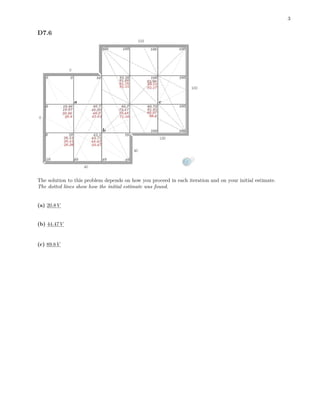
The solution to this problem depends on how you proceed in each iteration and on your initial estimate.
The dotted lines show how the initial estimate was found.
(a) 20.8 V
(b) 44.47 V
(c) 89.8 V
4
Please report to the following e-mail, if you find any mistake:
ee08.uet@gmail.com
1
CHAPTER 8 DRILLS
(Upto D8.3)
Solved by Zaeem A. Varaich
www.ee08.net.tc
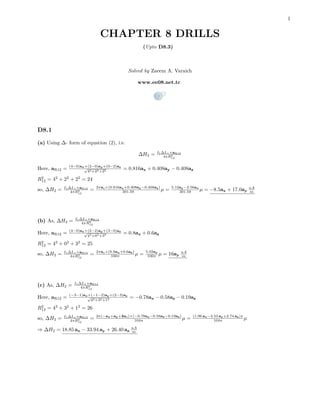
D8.1
(a) Using ∆- form of equation (2), i.e.
∆H2 = I1∆L1×aR12
4πR2
12
Here, aR12 =
(4−0)ax+(2−0)ay+(0−2)az
√
42+22+22
= 0.816ax + 0.408ay − 0.408az
R2
12 = 42
+ 22
+ 22
= 24
so, ∆H2 = I1∆L1×aR12
4πR2
12
=
2πaz×(0.816ax+0.408ay−0.408az)
301.59 µ =
5.12ay−2.56ax
301.59 µ = −8.5ax + 17.0ay
nA
m
(b) As, ∆H2 = I1∆L1×aR12
4πR2
12
Here, aR12 =
(4−0)ax+(2−2)ay+(3−0)az
√
42+02+32
= 0.8ax + 0.6az
R2
12 = 42
+ 02
+ 32
= 25
so, ∆H2 = I1∆L1×aR12
4πR2
12
= 2πaz×(0.8ax+0.6az)
100π µ =
5.02ay
100π µ = 16ay
nA
m
(c) As, ∆H2 = I1∆L1×aR12
4πR2
12
Here, aR12 =
(−3−1)ax+(−1−2)ay+(2−3)az
√
42+32+12
= −0.78ax − 0.58az − 0.19az
R2
12 = 42
+ 32
+ 12
= 26
so, ∆H2 = I1∆L1×aR12
4πR2
12
=
2π(−ax+ay+2az)×(−0.78ax−0.58az−0.19az)
104π µ =
(1.96 ax−3.53 ay+2.74 az)π
104π µ
⇒ ∆H2 = 18.85 ax − 33.94 ay + 26.40 az
nA
m
2
D8.2
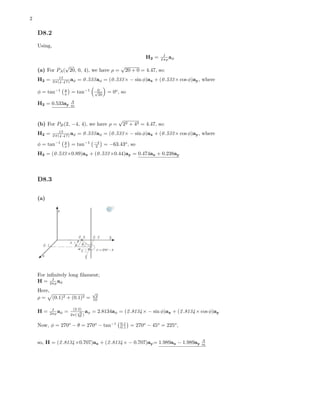
Using,
H2 = I
2πρ aφ
(a) For PA(
√
20, 0, 4), we have ρ =
√
20 + 0 = 4.47, so:
H2 = 15
2π(4.47) aφ = 0.533aφ = (0.533× − sin φ)ax + (0.533× cos φ)ay, where
φ = tan−1 y
x = tan−1 0√
20
= 0o
, so
H2 = 0.533ay
A
m
(b) For PB(2, −4, 4), we have ρ =
√
22 + 42 = 4.47, so:
H2 = 15
2π(4.47) aφ = 0.533aφ = (0.533× − sin φ)ax + (0.533× cos φ)ay, where
φ = tan−1 y
x = tan−1 −4
2 = −63.43o
, so
H2 = (0.533×0.89)ax + (0.533×0.44)ay = 0.474ax + 0.238ay
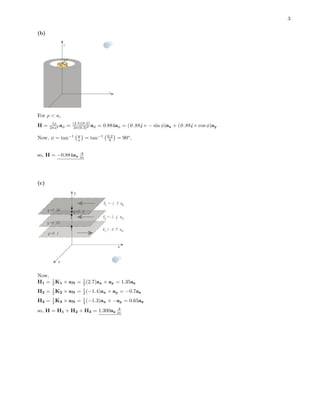
D8.3
(a)
For infinitely long filament;
H = I
2πρ aφ
Here,
ρ = (0.1)2 + (0.1)2 =
√
2
10
H = I
2πρ aφ = (2.5)
2π(
√
2
10 )
aφ = 2.8134aφ = (2.8134× − sin φ)ax + (2.8134× cos φ)ay
Now, φ = 270o
− θ = 270o
− tan−1 0.1
0.1 = 270o
− 45o
= 225o
,
so, H = (2.8134×0.707)ax + (2.8134× − 0.707)ay= 1.989ax − 1.989ay
A
m
3
(b)
For ρ < a,
H = Iρ
2πa2 aφ = (2.5)(0.2)
2π(0.3)2 aφ = 0.884aφ = (0.884× − sin φ)ax + (0.884× cos φ)ay
Now, φ = tan−1 y
x = tan−1 0.2
0 = 90o
,
so, H = −0.884ax
A
m
(c)
Now,
H1 = 1
2 K1 × aN = 1
2 (2.7)ax × ay = 1.35az
H2 = 1
2 K2 × aN = 1
2 (−1.4)ax × ay = −0.7az
H3 = 1
2 K3 × aN = 1
2 (−1.3)ax × −ay = 0.65az
so, H = H1 + H2 + H3 = 1.300az
A
m
4
Please report to the following e-mail, if you find any mistake:
ee08.uet@gmail.com
CHAPTER 8 DRILLS
CHAPTER 8 DRILLS
(D8.4 onwards)
Solved by Zaeem A. Varaich
www.ee08.net.tc
D8.4
(a) For path 1:
´
(3zax − 2x3
az).(dxax + dyay+dzaz) =
´ 4
2
(3zdx) = 3(4)(4 − 2) = 24 A
For path 2:´
(3zax − 2x3
az).(dxax + dyay+dzaz) =
´ 1
4
(−2x3
dz) = −2(43
)(1 − 4) = 384 A
For path 3:´
(3zax − 2x3
az).(dxax + dyay+dzaz) =
´ 2
4
(3zdx) = 3(1)(2 − 4) = −6 A
For path 4:´
(3zax − 2x3
az).(dxax + dyay+dzaz) =
´ 4
1
(−2x3
dz) = −2(23
)(4 − 1) = −48 A
So,
¸
H.dL = 24 + 384 − 6 − 48 = 354 A
(b) SN = 3 × 2 = 6 m2
, so
( × H)y =
¸
H.dL
SN
= 354
6 = 59 A
m2
(c) ( × H) =
ax ay az
∂
∂x
∂
∂y
∂
∂z
Hx Hy Hz
=
ax ay az
∂
∂x
∂
∂y
∂
∂z
3z 0 −2x3
= (0 − 0)ax−(−6x2
− 3)ay+(0 − 0)az = (6x2
+ 3)ay
At the center, x = 3, z = 2.5, so
( × H)y = [6(3)2
+ 3]=57 A
m2
1 ee08.net.tc
CHAPTER 8 DRILLS
D8.5
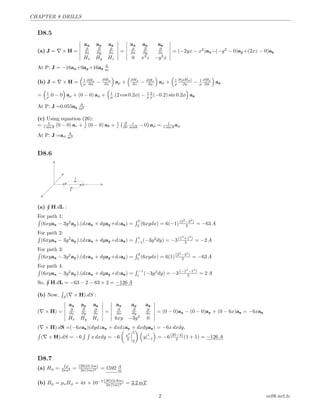
(a) J = × H =
ax ay az
∂
∂x
∂
∂y
∂
∂z
Hx Hy Hz
=
ax ay az
∂
∂x
∂
∂y
∂
∂z
0 x2
z −y2
x
= (−2yx − x2
)ax−(−y2
− 0)ay+(2xz − 0)az
At P: J = −16ax+9ay+16az
A
m
(b) J = × H = 1
ρ
∂Hz
∂φ −
∂Hφ
∂z aρ +
∂Hρ
∂z − ∂Hz
∂ρ aφ + 1
ρ
∂(ρHφ)
∂ρ − 1
ρ
∂Hρ
∂φ az
= 1
ρ .0 − 0 aρ + (0 − 0) aφ + 1
ρ .(2 cos 0.2φ) − 1
ρ
2
ρ (−0.2) sin 0.2φ az
At P: J =0.055az
A
m2
(c) Using equation (26):
= 1
r sin θ (0 − 0) ar + 1
r (0 − 0) aθ + 1
r
∂
∂r
r
sinθ − 0 aφ = 1
r sin θ aφ
At P: J =aφ
A
m2
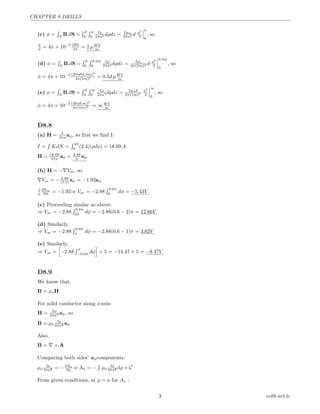
D8.6
(a)
¸
H.dL :
For path 1:
´
(6xyax − 3y2
ay).(dxax + dyay+dzaz) =
´ 5
2
(6xydx) = 6(−1)(52
−22
)
2 = −63 A
For path 2:
´
(6xyax − 3y2
ay).(dxax + dyay+dzaz) =
´ 1
−1
(−3y2
dy) = −3(13
+13
)
3 = −2 A
For path 3:
´
(6xyax − 3y2
ay).(dxax + dyay+dzaz) =
´ 2
5
(6xydx) = 6(1)(22
−52
)
2 = −63 A
For path 4:
´
(6xyax − 3y2
ay).(dxax + dyay+dzaz) =
´ −1
1
(−3y2
dy) = −3(−13
−13
)
3 = 2 A
So,
¸
H.dL = −63 − 2 − 63 + 2 = −126 A
(b) Now,
´
S
( × H).dS :
( × H) =
ax ay az
∂
∂x
∂
∂y
∂
∂z
Hx Hy Hz
=
ax ay az
∂
∂x
∂
∂y
∂
∂z
6xy −3y2
0
= (0 − 0)ax − (0 − 0)ay + (0 − 6x)az = −6xaz
( × H).dS =(−6xaz)(dydzax + dxdzay + dxdyaz) = −6x dxdy,
´
( × H).dS = −6
´ ´
x dxdy = −6 x2
2
5
2
y|
1
−1 = −6(25−4)
2 (1 + 1) = −126 A
D8.7
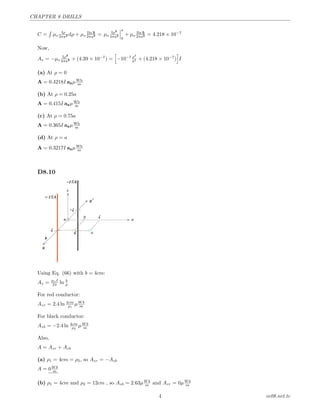
(a) Hφ = Iρ
2πa2 = (20)(0.5m)
2π(1m)2 = 1592 A
m
(b) Bφ = µoHφ = 4π × 10−7 (20)(0.8m)
2π(1m)2 = 3.2 mT
2 ee08.net.tc
CHAPTER 8 DRILLS
(c) φ =
´
S
B.dS =
´ d
0
´ a
0
Iρ
2πa2 dρdz = IµO
2πa2 d ρ2
2
a
0
, so
φ
d = 4π × 10−7 (20)
4π = 2 µW b
m
(d) φ =
´
S
B.dS =
´ d
0
´ 0.5m
0
Iρ
2πa2 dρdz = Iµo
2π(1m)2 d ρ2
2
0.5m
0
, so
φ = 4π × 10−7 (20)d(0.5m)2
4π(1m)2 = 0.5d µW b
m
(e) φ =
´
S
B.dS =
´ d
0
´ ∞
0
Iρ
2πa2 dρdz = Iµod
2π(1m)2
ρ2
2
∞
0
, so
φ = 4π × 10−7 (20)d(∞)2
4π(1m)2 = ∞W b
m
D8.8
(a) H = I
2πρ aφ, so first we find I:
I =
´
KdN =
´ 2π
0
(2.4)(ρdφ) = 18.09 A
H = 18.09
2πρ aφ = 2.88
ρ aφ
(b) H = − Vm, so
Vm = − 2.88
(1.5) aφ = −1.92aφ
1
ρ
∂Vm
∂φ = −1.92⇒ Vm = −2.88
´ 0.6π
0
dφ = −5.43V
(c) Proceeding similar as above:
⇒ Vm = −2.88
´ 0.6π
2π
dφ = −2.88(0.6 − 2)π = 12.66V
(d) Similarly,
⇒ Vm = −2.88
´ 0.6π
π
dφ = −2.88(0.6 − 1)π = 3.62V
(e) Similarly,
⇒ Vm = −2.88
´ π
−0.6π
dφ + 5 = −14.47 + 5 = −9.47V
D8.9
We know that,
B = µoH
For solid conductor along z-axis:
H = Iρ
2πa2 aφ, so
B = µo
Iρ
2πa2 aφ
Also,
B = × A
Comparing both sides’ aφcomponents:
µo
Iρ
2πa2 = −∂Az
∂ρ ⇒ Az = −
´
µo
Iρ
2πa2 dρ + C
From given conditions, at ρ = a for Az :
3 ee08.net.tc
CHAPTER 8 DRILLS
C =
´
µo
Iρ
2πa2 dρ + µo
Iln 5
2πa2 = µo
Iρ2
4πa2
a
0
+ µo
Iln 5
2πa2 = 4.218 × 10⁻⁷
Now,
Az = −µo
Iρ2
4πa2 + (4.39 × 10⁻⁷
) = −10−7 ρ2
a2 + (4.218 × 10⁻⁷
) I
(a) At ρ = 0
A = 0.4218I azµWb
m
(b) At ρ = 0.25a
A = 0.415I azµWb
m
(c) At ρ = 0.75a
A = 0.365I azµWb
m
(d) At ρ = a
A = 0.3217I azµWb
m
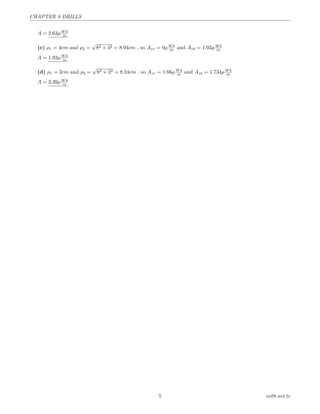
D8.10
Using Eq. (66) with b = 4cm:
Az = µoI
2π ln b
ρ
For red conductor:
Azr = 2.4 ln 4cm
ρ1
µW b
m
For black conductor:
Azb = −2.4 ln 4cm
ρ2
µW b
m
Also,
A = Azr + Azb
(a) ρ1 = 4cm = ρ2, so Azr = −Azb
A = 0W b
m
(b) ρ1 = 4cm and ρ2 = 12cm , so Azb = 2.63µW b
m and Azr = 0µW b
m
4 ee08.net.tc
CHAPTER 8 DRILLS
A = 2.63µW b
m
(c) ρ1 = 4cm and ρ2 =
√
82 + 42 = 8.94cm , so Azr = 0µW b
m and Azb = 1.93µW b
m
A = 1.93µW b
m
(d) ρ1 = 2cm and ρ2 =
√
82 + 22 = 8.24cm , so Azr = 1.66µW b
m and Azb = 1.734µW b
m
A = 3.39µW b
m
5 ee08.net.tc
CHAPTER 8 DRILLS
Please report to the following e-mail, if you find any mistake:
ee08.uet@gmail.com
6 ee08.net.tc
CHAPTER 9 DRILLS
Solved by Zaeem A. Varaich
www.ee08.net.tc
D9.1
(a) F = qv × B = qvav × B = 9 × 10⁻⁵
(3.3ax − 4.5ay + 4.65az)
so, F = 654µN
(b) F = qE = 18n × 103
(−3ax + 4ay + 6az) = 140.58µN
(c)F = q(E + v × B)
= (2.97 × 10⁻⁴
ax − 4.05 × 10⁻⁴
ay + 4.185 × 10⁻⁴
az) + (−5.4 × 10⁻⁵
ax + 7.2 × 10⁻⁵
ay + 1.08 × 10⁻⁴
az)
= 2.43 × 10⁻⁴
ax − 3.3 × 10⁻⁴
ay + 5.265 × 10⁻⁴
az
so, F = 664µN
D9.2
(a) aAB = ax, so
F = −I
¸
B×dL = −(12)
¸ 2
1
(−2ax+3ay+4az)×axdx.10−3
= −12×10−3
´ 2
1
−3az+4aydx = −48ay + 36az mN
(b) aAB = 2ax+4ax+5ax
3
√
5
, so
F = −I
¸
B × dL
= −(12×10−3
)
´ 3
1
(−2ax + 3ay + 4az) × axdx +
´ 5
1
(−2ax + 3ay + 4az) × aydy +
´ 6
1
(−2ax + 3ay + 4az) × azdz
= −(12 × 10−3
)
´ 3
1
(−3az + 4ay)dx +
´ 5
1
(−2az − 4ax)dy +
´ 6
1
(2ay + 3ax)dz
= −(12 × 10−3
) [2(−3az + 4ay) + 4(−2az − 4ax) + 5(2ay + 3ax)]
= 12ax − 216ay + 168az mN
1 ee08.net.tc
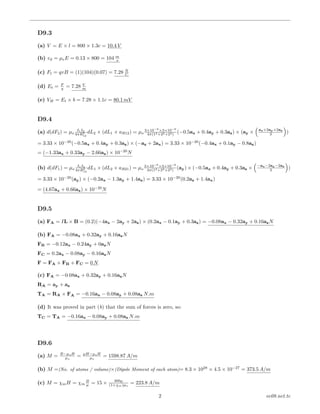
D9.3
(a) V = E × l = 800 × 1.3c = 10.4 V
(b) vd = µeE = 0.13 × 800 = 104 m
s
(c) Ft = qvB = (1)(104)(0.07) = 7.28 N
C
(d) Et = F
q = 7.28 V
m
(e) VH = Et × b = 7.28 × 1.1c = 80.1 mV
D9.4
(a) d(dF2) = µo
I1I2
4πR2
12
dL2 × (dL1 × aR12) = µo
3×10−6
×3×10−6
4π(12+22+22) (−0.5ax + 0.4ay + 0.3az) × (ay ×
ax+2ay+2az
3 )
= 3.33 × 10⁻²⁰
(−0.5ax + 0.4ay + 0.3az) × (−az + 2ax) = 3.33 × 10⁻²⁰
(−0.4ax + 0.1ay − 0.8az)
= (−1.33ax + 0.33ay − 2.66az) × 10−20
N
(b) d(dF1) = µo
I1I2
4πR2
12
dL1 × (dL2 × aR21) = µo
3×10−6
×3×10−6
4π(12+22+22) (ay) × (−0.5ax + 0.4ay + 0.3az ×
−ax−2ay−2az
3 )
= 3.33 × 10⁻²⁰
(ay) × (−0.2ax − 1.3ay + 1.4az) = 3.33 × 10⁻²⁰
(0.2az + 1.4ax)
= (4.67ax + 0.66az) × 10−20
N
D9.5
(a) FA = IL × B = (0.2)(−4ax − 2ay + 2az) × (0.2ax − 0.1ay + 0.3az) = −0.08ax − 0.32ay + 0.16azN
(b) FA = −0.08ax + 0.32ay + 0.16azN
FB = −0.12ax − 0.24ay + 0azN
FC = 0.2ax − 0.08ay − 0.16azN
F = FA + FB + FC = 0 N
(c) FA = −0.08ax + 0.32ay + 0.16azN
RA = ay + az
TA = RA × FA = −0.16ax − 0.08ay + 0.08az N.m
(d) It was proved in part (b) that the sum of forces is zero, so:
TC = TA = −0.16ax − 0.08ay + 0.08az N.m
D9.6
(a) M = B−µoH
µo
= µH−µoH
µo
= 1598.87 A/m
(b) M =(No. of atoms / volume)×(Dipole Moment of each atom)= 8.3 × 1028
× 4.5 × 10−27
= 373.5 A/m
(c) M = χmH = χm
B
µ = 15 × 300µ
(1+χm)µo
= 223.8 A/m
2 ee08.net.tc
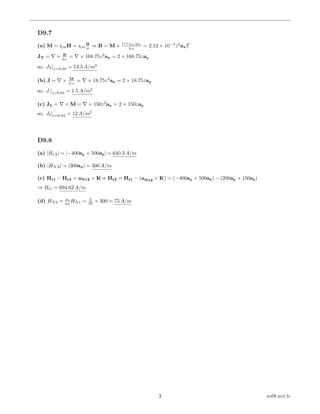
D9.7
(a) M = χmH = χm
B
µ ⇒ B = M × (1+χm)µo
χm
= 2.12 × 10⁻⁴
z2
axT
JT = × B
µo
= × 168.75z2
ax = 2 × 168.75zay
so, JT |z=0.04 = 13.5 A/m2
(b) J = × M
χm
= × 18.75z2
ax = 2 × 18.75zay
so, J |z=0.04 = 1.5 A/m2
(c) Jb = × M = × 150z2
ax = 2 × 150zay
so, Jb|z=0.04 = 12 A/m2
D9.8
(a) |HtA| = |−400ay + 500az| = 640.3 A/m
(b) |HNA| = |300ax| = 300 A/m
(c) Ht1 − Ht2 = aN12 × K⇒ Ht2 = Ht1 − (aN12 × K) = (−400ay + 500az) − (200ay + 150az)
⇒ Ht1 = 694.62 A/m
(d) HN2 = µ1
µ2
HN1 = 5
20 × 300 = 75 A/m
3 ee08.net.tc
Please report to the following e-mail, if you find any mistake or typo:
zaeemvaraich@yahoo.com
4 ee08.net.tc
CHAPTER 10 DRILLS
Solved by Zaeem A. Varaich
www.ee08.net.tc
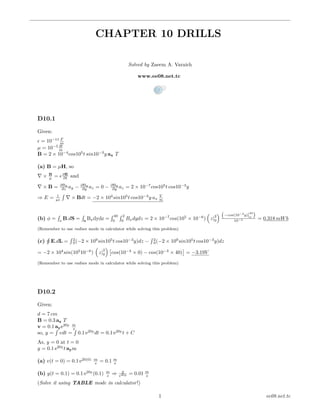
D10.1
Given:
= 10−11 F
m
µ = 10−5 H
m
B = 2 × 10⁻⁴
cos105
t sin10−3
y ax T
(a) B = µH, so
× B
µ = ∂E
∂t and
× B = ∂Bx
∂z ay − ∂Bx
∂y az = 0 − ∂Bx
∂y az = 2 × 10⁻⁷
cos105
t cos10−3
y
⇒ E = 1
µ
´
× Bdt = −2 × 10⁴
sin105
t cos10−3
y ax
V
m
(b) φ =
´
s
B.dS =
´
s
Bxdydz =
´ 40
0
´ 2
0
Bxdydz = 2 × 10⁻⁷
cos(105
× 10−6
) z|
2
0
−cos(10−3
y)|
40
0
10−3 = 0.318 mWb
(Remember to use radian mode in calculator while solving this problem)
(c)
¸
E.dL =
´ 2
0(−2 × 10⁹
sin105
t cos10−3
y)dz −
´ 2
0(−2 × 10⁹
sin105
t cos10−3
y)dz
= −2 × 10⁴
sin(105
10−6
) z|
2
0 cos(10−3
× 0) − cos(10−3
× 40) = −3.19V
(Remember to use radian mode in calculator while solving this problem)
D10.2
Given:
d = 7 cm
B = 0.3 az T
v = 0.1 aye20y m
s
so, y =
´
vdt =
´
0.1 e20y
dt = 0.1 e20y
t + C
As, y = 0 at t = 0
y = 0.1 e20y
t aym
(a) v(t = 0) = 0.1 e20(0) m
s = 0.1 m
s
(b) y(t = 0.1) = 0.1 e20y
(0.1) m
s ⇒ y
e20y = 0.01 m
s
(Solve it using TABLE mode in calculator!)
1 ee08.net.tc
so, y(t = 0.1) ≈ 0.012 m
Alternatively, using MAPLE:
y = −0.05000000000 LambertW (−2.0 t)
y = 0.01295855509 m = 1.29 cm
(c) v(t = 0.1) = 0.1 e20(0.0129) m
s = 0.129 m
s
(d) V12 = −Bvd = −0.3 × 0.129 × 0.07 = −2.718 mV
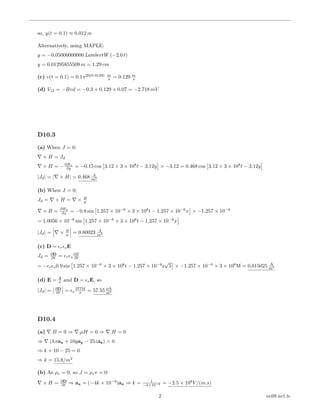
D10.3
(a) When J = 0:
× H = Jd
× H = −∂Hx
∂y = −0.15 cos 3.12 × 3 × 108
t − 3.12y × −3.12 = 0.468 cos 3.12 × 3 × 108
t − 3.12y
|Jd| = | × H| = 0.468 A
m2
(b) When J = 0:
Jd = × H = × B
µ
× B =
∂Hy
∂x = −0.8 sin 1.257 × 10−6
× 3 × 108
t − 1.257 × 10⁻⁶
x × −1.257 × 10−6
= 1.0056 × 10⁻⁶
sin 1.257 × 10−6
× 3 × 108
t − 1.257 × 10⁻⁶
x
|Jd| = × B
µ = 0.80023 A
m2
(c) D = r oE
Jd = ∂D
∂t = r o
∂E
∂t
= − r o0.9 sin 1.257 × 10−6
× 3 × 108
t − 1.257 × 10⁻⁶
z
√
5 × −1.257 × 10−6
× 3 × 108
M = 0.015025 A
m2
(d) E = J
σ and D = oE, so
|Jd| = ∂D
∂t = o
377M
σ = 57.55 pA
m2
D10.4
(a) .B = 0 ⇒ .µH = 0 ⇒ .H = 0
⇒ .(kxax + 10yay − 25zaz) = 0
⇒ k + 10 − 25 = 0
⇒ k = 15A/m2
(b) As ρv = 0, so J = ρvv = 0:
× H = ∂D
∂t ⇒ ax = (−4k × 10−9
)ax ⇒ k = 1
−4×10−9 = −2.5 × 10⁸
V/(m.s)
2 ee08.net.tc
D10.5
Let u = 0.64ax + 0.6ay − 0.48az
(a) BN1 = B1.u = 2T
(b) Bt1 = |B1 × u| = 3.16T
(c) BN2 = BN1 = 2T
(d) B2 = BN2 + Bt1 = 5.16T
D10.6
(a) ρs = DN1 = | o rE|t=6ns,z=0.3 = 20 o rcos(2 × 10⁸
t − 2.58z) = 0.806 nC/m2
(b) × E = −∂B
∂t = −∂µH
∂t ⇒ H = − 1
µ
´
× E dt
= 13.68 × 10⁶
× − cos(2×10⁸
t−2.58z)
2×10⁸ ax
t=6ns, z=0.3
= −62.3axmA/m
(c) Ht1 = K × aN ⇒ −62.3ax = K × ay, so K = −62.3azmA/m
(Cyclic rule of cross product)
D10.7
(a) [ρv1] = 4cos(108
π(t − R
v )), where t = 15ns, R = 450 − 1.5, v = 3 × 10⁸
m/s
[ρv1] = 4cos(108
π(t − R
v )) = 4µ
[ρv2] = −4cos(108
π(t − R
v )), where t = 15ns, R = 450 + 1.5, v = 3 × 10⁸
m/s
[ρv2] = −4(−1) = 4µ
[ρv] = [ρv1] + [ρv2] = 8µ
Now, considering a unit volume:
V = [ρv]
4π oR = 159.77V
(b) [ρv1] = 4cos(108
π(t − R
v )), where t = 15ns, R =
√
4502 + 1.52 = 450.0025, v = 3 × 10⁸
m/s
[ρv1] = 4cos(108
π(t − R
v )) = −0.01047µ
[ρv2] = −4cos(108
π(t − R
v )), where t = 15ns, R =
√
4502 + 1.52 = 450.0025, v = 3 × 10⁸
m/s
[ρv2] = −4(−1) = 0.01047µ
[ρv] = [ρv1] + [ρv2] = 0µ
Now, considering a unit volume:
V = [ρv]
4π oR = 0V
(c) [ρv1] = 4cos(108
π(t − R
v )), where t = 15ns, R =
√
316.72 + 318.22 = 449, v = 3 × 10⁸
m/s
[ρv1] = 4cos(108
π(t − R
v )) = 3.46µ
[ρv2] = −4cos(108
π(t − R
v )), where t = 15ns, R =
√
319.72 + 318.22 = 451.06, v = 3 × 10⁸
m/s
[ρv2] = −4(−1) = 3.58µ
[ρv] = [ρv1] + [ρv2] = 7.04µ
Now, considering a unit volume:
V = [ρv]
4π oR = 140.65V
3 ee08.net.tc
Please report to the following e-mail, if you find any mistake or typo:
zaeemvaraich@yahoo.com
4 ee08.net.tc

William hyatt-7th-edition-drill-problems-solution

  • 1.
    Made by ZaeemAhmad Varaich Please inform if you find any error in any solution! EE08.SOLUTIONS DRILL PROBLEMS : CHAPTER 2 D2.1 (a) RAB = (5+6) ax + (8-4) ay + (-2-7) az = 11ax + 4ay - 9az (b) RAB = 112 + 42 + 92 = 14.76 m (c) FBA = −20 × 10−6 50 × 10−6 4𝜋 10−9 36 𝜋 (14.762) 𝑎 𝑏𝑎 = −0.0413 (−11𝑎 𝑥 − 4𝑎 𝑦 + 9𝑎 𝑧) 14.76 = 30.78𝑎 𝑥 + 11.195𝑎 𝑦 − 25.18𝑎 𝑧 mN (d) FBA = −20 × 10−6 50 × 10−6 4𝜋 ×8.854×10−12 (14.762) 𝑎 𝑏𝑎 = −0.04125 (−11𝑎 𝑥 − 4𝑎 𝑦 + 9𝑎 𝑧) 14.76 = 30.74𝑎 𝑥 + 11.18𝑎 𝑦 − 25.15𝑎 𝑧 mN D2.2 (a) 𝒓 − 𝒓 𝑨 = −25𝑎 𝑥 + 30𝑎 𝑦 − 15𝑎 𝑧, |𝒓 − 𝒓 𝑨| = 41.43 𝒓 − 𝒓 𝑩 = 10𝑎 𝑥 − 8𝑎 𝑦 − 12𝑎 𝑧, |𝒓 − 𝒓 𝑩| = 17.54 𝑬 𝑨 = −1.57 (−25𝑎 𝑥 +30𝑎 𝑦 −15𝑎 𝑧) 41.43 = 9480𝑎 𝑥 − 11300𝑎 𝑦 + 5600𝑎 𝑧 𝑬 𝑩 = 14.61 (10𝑎 𝑥 −8𝑎 𝑦 −12𝑎 𝑧) 17.54 = 83300𝑎 𝑥 − 66600𝑎 𝑦 − 99900𝑎 𝑧 𝑬 𝑻 = 𝑬 𝑨 + 𝑬 𝑩 = 92.48𝑎 𝑥 − 77.9𝑎 𝑦 − 94.3𝑎 𝑧 𝑘𝑉 𝑚 (b) 𝒓 − 𝒓 𝑨 = −10𝑎 𝑥 + 50𝑎 𝑦 + 35𝑎 𝑧, |𝒓 − 𝒓 𝑨| = 61.84 𝒓 − 𝒓 𝑩 = 25𝑎 𝑥 + 12𝑎 𝑦 + 38𝑎 𝑧, |𝒓 − 𝒓 𝑩| = 47.04 𝑬 𝑨 = −7050 (−10𝑎 𝑥 +50𝑎 𝑦 +35𝑎 𝑧) 61.84 = 1140𝑎 𝑥 − 5700𝑎 𝑦 − 3990𝑎 𝑧 𝑬 𝑩 = 20300 (25𝑎 𝑥 +12𝑎 𝑦 +38𝑎 𝑧) 47.04 = 10700𝑎 𝑥 + 5180𝑎 𝑦 + 16400𝑎 𝑧 𝑬 𝑻 = 𝑬 𝑨 + 𝑬 𝑩 = 11.84𝑎 𝑥 − 0.52𝑎 𝑦 + 12.41𝑎 𝑧 𝑘𝑉 𝑚 D2.3 (a) Sum = 2 + 0 + 2 5 + 0 + 2 17 + 0 = 2.517 (b) Sum = 1.1 11.18 + 1.01 22.62 + 1.001 46.87 + 1.0001 89.44 = 0.1755
  • 2.
    Made by ZaeemAhmad Varaich Please inform if you find any error in any solution! EE08.SOLUTIONS D2.4 (a) 𝑄 = 𝜌𝑣𝑣𝑜𝑙 𝑑𝑣 = 1 𝑥3 𝑦3 𝑧3 𝑑𝑥𝑑𝑦𝑑𝑧 + −0.1 −0.2 −0.1 −0.2 −0.1 −0.2 1 𝑥3 𝑦3 𝑧3 𝑑𝑥𝑑𝑦𝑑𝑧 0.2 0.1 0.2 0.1 0.2 0.1 = − 1 8 𝑥2 −02 −0.1 𝑦2 −02 −0.1 𝑧2 −02 −0.1 − − 1 8 𝑥2 0.1 0.2 𝑦2 0.1 0.2 𝑧2 0.1 0.2 = 1 8×(0.03) − 1 8×(0.03) = 0 (b) 𝜌3 𝑧2 sin 0.6𝜑 𝑑𝑧𝑑𝜌𝑑𝜑 4 2 0.1 0 𝜋 0 = (− cos 0.6𝜑 0.6 ) 0 𝜋 ( 𝜌4 4 ) 0 0.1 ( 𝑧3 3 ) 2 4 = 1.018 𝑚𝐶 (c) 𝑒−2𝑟 sin 𝜃 𝑑𝜑 2𝜋 0 2𝜋 0 ∞ 0 𝑑𝜃𝑑𝑟 = (− 𝑒−2𝑟 2 ) 0 ∞ (cos 𝜃) 0 2𝜋 (𝜑) 0 2𝜋 = −6.28 𝐶 D2.5 (a) E = 2 × 5×10−9 2𝜋𝜀 𝑜 (4) 𝒂 𝒛 = 44.95 𝑉 𝑚 (b) Ex = 5×10⁻⁹ 2𝜋𝜀 𝑜 (5) (3𝒂 𝒚+4𝒂 𝒛) 5 = 10.788𝒂 𝒚 + 14.384𝒂 𝒛 𝑉 𝑚 , Ey = 5×10⁻⁹ 2𝜋𝜀 𝑜 (4) 𝒂 𝒛 = 22.4775 𝒂 𝒛 𝑉 𝑚 E = Ex + Ey = 10.788𝒂 𝒚 + 36.86𝒂 𝒛 𝑉 𝑚 D2.6 i) Electric field due to 3 nC/m2 : E1 = 3×10⁻⁹ 2𝜀 𝑜 𝒂 𝑵= 169.5 𝒂 𝒛 ii) Electric field due to 6 nC/m2 : E2 = 6×10⁻⁹ 2𝜀 𝑜 𝒂 𝑵= 338.8 𝒂 𝒛 iii) Electric field due to -8 nC/m2 : E3 = −8×10⁻⁹ 2𝜀 𝑜 𝒂 𝑵= −451.76 𝒂 𝒛 According to the direction of point relative to normal: (a) E = - E1 - E2 - E3 = −56.6 𝒂 𝒛 𝑉 𝑚 (a) E = E1 - E2 - E3 = 283 𝒂 𝒛 𝑉 𝑚 (a) E = E1 + E2 - E3 = 961 𝒂 𝒛 𝑉 𝑚 (a) E = E1 + E2 + E3 = 56.6 𝒂 𝒛 𝑉 𝑚
  • 3.
    Made by ZaeemAhmad Varaich Please inform if you find any error in any solution! EE08.SOLUTIONS D2.7 (a) 𝐸 𝑦 𝐸 𝑥 = 𝑑𝑦 𝑑𝑥 → 4𝑥2 𝑦2 × 𝑦 8𝑥 = 𝑑𝑦 𝑑𝑥 → 𝑥𝑑𝑥 = − 2𝑦𝑑𝑦 → 𝑥2 + 2𝑦2 = 𝑐 Put x = 1 and y = 2 to get 𝑐 = 33 giving: 𝒙 𝟐 + 𝟐𝒚 𝟐 = 𝟑𝟑 (b) 𝐸 𝑦 𝐸 𝑥 = 𝑑𝑦 𝑑𝑥 → 𝑦(5𝑥+1) 𝑥 = 𝑑𝑦 𝑑𝑥 → 1 5 × 5𝑥+1−1 5𝑥+1 𝑑𝑥 = 𝑦𝑑𝑦 → 0.4𝑥 − 0.08 ln 5𝑥 + 1 + 𝑐 = 𝑦2 Put x = 1 and y = 2 to get 𝑐 = 15.74 giving: 𝟎. 𝟒𝒙 − 𝟎. 𝟎𝟖 𝐥𝐧 𝟓𝒙 + 𝟏 + 𝟏𝟓. 𝟕𝟒 = 𝒚 𝟐
  • 4.
    Solved by Saad& Zaeem. Please report if you find any mistake! EE08.SOLUTIONS DRILL PROBLEMS 3 D3.1 (a) Evaluate the triple volume integral to find the total volume enclosed by the portion of sphere / surface and then just multiply it with the given charge to find the total change within it: 𝑟2 𝑠𝑖𝑛𝜃 𝑑𝜃𝑑𝜙𝑑𝑟 × 𝜋 2 0 𝜋 2 0 0.26 0 𝑞 = 1 8 × 𝑞 = 7.5𝜇𝐶 (b) This surface encloses the whole charge q, so answer is 60 µC (c) Only the upper half of the flux lines pass through the plane at z = 26 cm, so D = 0.5 x 60 = 30 µC D3.2 (a) 𝐸 = 𝑘𝑄 𝑟2 4𝑎 𝑥 −6𝑎 𝑦 +12𝑎 𝑧 16+36+144 = 0.72𝑎 𝑥 − 1.08𝑎 𝑦 + 2.16𝑎 𝑧 𝑀𝑉 𝑚 𝑠𝑜, 𝐷 = 𝜀 𝑜 𝐸 = 6.38𝑎 𝑥 − 9.56𝑎 𝑦 + 19.125𝑎 𝑧 𝜇𝐶 𝑚2 (b) 𝐸 = 20 2𝜋𝜀 𝑜.45 −3𝑎 𝑦 +6𝑎 𝑧 45 = −23.97𝑎 𝑦 + 47.94𝑎 𝑧 𝑀𝑉 𝑚 𝑠𝑜, 𝐷 = 𝜀 𝑜 𝐸 = −212𝑎 𝑦 + 424𝑎 𝑧 𝜇𝐶 𝑚2 (c) 𝐸 = 120 2𝜀 𝑜 𝑎 𝑧 = 60 𝜀 𝑜 𝑎 𝑧 𝜇 𝑉 𝑚 , 𝑠𝑜 𝐷 = 𝜀 𝑜 𝐸 = 60𝑎 𝑧 𝜇𝐶 𝑚2 D3.3 (a) 𝐸 = 𝐷 𝜀 𝑜 = 33.88𝑟2 𝑎 𝑟, so at P: 𝐸 = 33.88(2)2 𝑎 𝑟=135.5𝑎 𝑟
  • 5.
    Solved by Saad& Zaeem. Please report if you find any mistake! EE08.SOLUTIONS (b) 𝑄 = 𝐷. 𝑑𝑠 = 𝑎2 𝑠𝑖𝑛𝜃 𝑑𝜃𝑑𝜙𝑎 𝑟 × 0.3𝑟2 𝑎 𝑟 = 𝜋 0 2𝜋 0 24.3 −𝑐𝑜𝑠𝜃|0 𝜋2𝜋 0 𝑑𝜙 = 48.6 𝑑𝜙 = 305 2𝜋 0 . 208 𝑛𝐶 (c) On same steps: 𝑄 = 76.8 −𝑐𝑜𝑠𝜃|0 𝜋 𝑑𝜙 = 964.608 μC 2𝜋 0 D3.4 (a) 𝑄 = 𝑄1 + 𝑄2 = 0.243 𝜇𝐶 (b) 𝑄 = 𝑙𝑒𝑛𝑔𝑡𝑕 × 𝜌 𝐿 = 31.4 𝜇𝐶 (c) Area = 𝑙𝑒𝑛𝑔𝑡𝑕 𝑜𝑓 𝑙𝑖𝑛𝑒 (𝑕𝑦𝑝𝑜𝑡𝑒𝑛𝑢𝑠𝑒) × 𝑤𝑖𝑑𝑡𝑕 𝑎𝑐𝑟𝑜𝑠𝑠 𝑧 = 10.53 × 10 So, 𝑄 = 𝑎𝑟𝑒𝑎 × 𝜌 𝐴 = 10.53 𝜇𝐶 D3.5 (a) 𝐷 = 0.25 4𝜋(0.005)2 = 795.77 𝜇𝐶 (b) 𝑄2 = 4𝜋 0.01 2 × 𝜌𝑠2 = 2.51 𝜇𝐶, 𝑠𝑜, 𝐷 = 0.25+2.51 4𝜋(0.015)2 = 977 𝜇𝐶 (c) 𝑄3 = 4𝜋 0.018 2 × 𝜌𝑠3 = −2.44 𝜇𝐶, 𝑠𝑜, 𝐷 = 0.25+2.51−2.44 4𝜋(0.025)2 = 40.74 𝜇𝐶 (d) 𝐷 = 0.25+2.51−2.44+4𝜋 0.03 2×𝜌 𝑠 4𝜋(0.035)2 = 0 , so 𝜌𝑠4 = -28.29 𝜇𝐶 D3.6 (a) 𝜓 = 𝐷. 𝑑𝑠 = 16𝑥2 𝑦𝑧3 𝑑𝑥𝑑𝑦 = 2 0 3 1 16𝑥2 𝑦. 8𝑑𝑥𝑑𝑦 = 1365 𝑝𝐶 2 0 3 1 10 10 10 3 𝑦 = 3𝑥 𝜌𝑠2 𝜌𝑠3
  • 6.
    Solved by Saad& Zaeem. Please report if you find any mistake! EE08.SOLUTIONS (b) 𝐸 = 𝐷 𝜀 𝑜 𝑎𝑛𝑑 𝑒𝑣𝑎𝑙𝑢𝑎𝑡𝑒 𝑖𝑡 𝑎𝑡 𝑃 (c) 𝐸𝑣𝑎𝑙𝑢𝑎𝑡𝑒 𝑡𝑕𝑒 𝑓𝑜𝑟𝑚𝑢𝑙𝑎 8 𝑎𝑡 𝑃 𝑎𝑛𝑑 ∆𝑉 = 10−12 𝑚3 D3.7 𝐸𝑣𝑎𝑙𝑢𝑎𝑡𝑒 𝑡𝑕𝑒 𝑐𝑜𝑟𝑟𝑒𝑠𝑝𝑜𝑛𝑑𝑖𝑛𝑔 𝑓𝑜𝑟𝑚𝑢𝑙𝑎𝑒 𝑓𝑜𝑟 div 𝐃 𝑖. 𝑒. 15, 16 & 17 𝑎𝑡 𝑡𝑕𝑒 𝑔𝑖𝑣𝑒𝑛 𝑝𝑜𝑖𝑛𝑡𝑠 𝑃 D3.7 𝑇𝑎𝑘𝑒 div 𝐃 𝑎𝑠 𝑠𝑡𝑎𝑡𝑒𝑑 𝑏𝑦 𝑀𝑎𝑥𝑤𝑒𝑙𝑙′ 𝑠1𝑠𝑡 𝑒𝑞𝑢𝑎𝑡𝑖𝑜𝑛 𝑡𝑜 𝑔𝑒𝑡 𝑡𝑕𝑒 𝑒𝑥𝑝𝑟𝑒𝑠𝑠𝑖𝑜𝑛𝑠 𝑓𝑜𝑟 𝜌 𝑣, 𝑤𝑖𝑡𝑕 𝑝𝑟𝑜𝑝𝑒𝑟 𝑡𝑟𝑖𝑔𝑛𝑜𝑚𝑒𝑡𝑟𝑖𝑐 𝑚𝑎𝑛𝑖𝑝𝑢𝑙𝑎𝑡𝑖𝑜𝑛 D3.8 R.H.S: ∇. D = 12𝑠𝑖𝑛 𝜑 2 − 0.75𝑠𝑖𝑛 𝜑 2 = 11.25 𝑠𝑖𝑛 𝜑 2 11.25 𝑠𝑖𝑛 𝜑 2 𝜌𝑑𝑧𝑑𝜙𝑑𝜌 = 11.25 × 20 = 225 5 0 𝜋 0 2 0 L.H.S: 𝐷. 𝑑𝑠 = (𝑫) 𝜌=2 𝜌𝑑𝑧𝑑𝜑𝑎 𝜌 5 0 𝜋 0 + (𝑫) 𝜑=0 𝑑𝑧𝑑𝜌𝑎 𝜑 5 0 2 0 + (𝑫) 𝜑=𝜋 𝑑𝑧𝑑𝜌(−𝑎 𝜑 ) 5 0 2 0 Now, (𝑫) 𝜌=2 = 12𝑠𝑖𝑛 𝜑 2 𝑎 𝜌
  • 7.
    Solved by Saad& Zaeem. Please report if you find any mistake! EE08.SOLUTIONS 𝑫 𝜑=𝜋 𝑑𝑧𝑑𝜌𝑎 𝜑 5 0 2 0 = 0 𝑠𝑜, 𝐷. 𝑑𝑠 = 24 𝑠𝑖𝑛 𝜑 2 𝑑𝑧𝑑𝜑 + (𝑫) 𝜑=0 𝑑𝑧𝑑𝜌𝑎 𝜑 5 0 2 0 5 0 𝜋 0 = 24 −2𝑐𝑜𝑠 𝜑 2 |0 𝜋 × 𝑧 |0 5 − 1.5 𝜌2 2 |0 2 × 𝑧 |0 5 = −48 0 − 1 5 − 15 = 225
  • 8.
    Solved by AqeelAnwar (aqeelanwar.co.cc) Digitized by Zaeem (ee08.net.tc)
  • 9.
    Solved by AqeelAnwar (aqeelanwar.co.cc) Digitized by Zaeem (ee08.net.tc)
  • 10.
    Solved by AqeelAnwar (aqeelanwar.co.cc) Digitized by Zaeem (ee08.net.tc)
  • 11.
    Solved by AqeelAnwar (aqeelanwar.co.cc) Digitized by Zaeem (ee08.net.tc)
  • 12.
    Solved by AqeelAnwar (aqeelanwar.co.cc) Digitized by Zaeem (ee08.net.tc)
  • 13.
    Solved by AqeelAnwar (aqeelanwar.co.cc) Digitized by Zaeem (ee08.net.tc)
  • 14.
    Solved by AqeelAnwar (aqeelanwar.co.cc) Digitized by Zaeem (ee08.net.tc)
  • 15.
    Solved by AqeelAnwar (aqeelanwar.co.cc) Digitized by Zaeem (ee08.net.tc)
  • 16.
    Solved by AqeelAnwar (aqeelanwar.co.cc) Digitized by Zaeem (ee08.net.tc)
  • 17.
    Solved by AqeelAnwar (aqeelanwar.co.cc) Digitized by Zaeem (ee08.net.tc)
  • 18.
    Solved by AqeelAnwar (aqeelanwar.co.cc) Digitized by Zaeem (ee08.net.tc)
  • 19.
    Solved by AqeelAnwar (aqeelanwar.co.cc) Digitized by Zaeem (ee08.net.tc)
  • 20.
    Solved by Zaeem.Please report if you find any mistake! EE08.SOLUTIONS DRILL PROBLEMS5 D5.1 (a) At P: = 10 3 2 2 4 3 2 30 = 180 9 (b) Using formula(2): = 10 3 . 2.8 2 2 0 = 27 10 2.8 2 2 0 = 27 2 2 |2 2.8 |0 2 = 325.72 3.25 D5.2 (a) Usingformula (2): = 106 1.5 . 20 0 2 0 = 106 0.1 1.5 20 0 2 0 = 106 0.1 1.5 2 2 |0 20 |0 2 = 39.7 (b) Usingformula (3): = = 106 0.1 1.5 2 × 106 = 15.81 3 (c) Same formula: = = 106 0.15 1.5 2000 = 29.04
  • 22.
    Solved by Zaeem.Please report if you find any mistake! EE08.SOLUTIONS D5.5 (a) Putting point P in given V, while evaluating trigonometric functions using radians: = 48.848 (b) Using formula: = = 100 cosh 5 .5 sin 5 100 sinh 5 5 cos 5 At P: E = 474.43 140.77 (c) E = 474.432 + 140.772 = 494.87 (d) s= = ,so as = E= 4.2 1.246 2 , so s= = 4.38 2 D5.6 (a) For original line charge, with = 40 = . , = 2 , = 2 (7, 1,5) 4 = 6 + ( 3) ( 6)2 + ( 3)2 , = = 1, : = 720 6 ( 6)2 + 16 = 360 ( 6)2 + 16 4 7 7 4 = 58.50 For mirror line charge, with = 40 = . , = 2 , = 2 (7, 1,5) 4
  • 24.
    1 CHAPTER 7 DRILLS Solvedby Zaeem A. Varaich www.ee08.net.tc D7.1 (a) V |P (1,2,3) = 4(2)(3) (1)2+1 = 12 V As, ρv = − 2 V, so we first calculate 2 V : V = −8 yzx (x2+1)2 + 4z x2+1 + 4y x2+1 ⇒ 2 V = 32 yzx2 (x2+1)3 − 8 yz (x2+1)2 ⇒ 2 V |P (1,2,3) = 12; so, ρv = − 2 V = − o(12) = −106.25 pC m3 (b) V |P (3, π 3 ,2) = −22.5 V As, ρv = − 2 V, so we first calculate 2 V : 2 V = 20 cos (2 φ) − 20 cos (2 φ) ⇒ 2 V |P (3, π 3 ,2) = 0; so, ρv = − 2 V = − o(0) = 0 pC m3 (c) V |P (0.5,45o,60o) = 4 V As, ρv = − 2 V, so we first calculate 2 V : 2 V = 4 cos(φ) r4 − 2 cos(φ) r4(sin(θ))2 ⇒ 2 V |P (0.5,45o,60o) = 0; so, ρv = − 2 V = − o(0) = 0 pC m3 D7.2 Apply the formulae & concepts to find the answers!
  • 25.
    2 D7.3 (a) The solutionto Laplace’s equation 1 ρ ∂ ∂ρ ρ ∂ ∂ρ = 0 is: V = A ln ρ + B Putting the given values of V & ρ and solving the simultaneous equations, we get: A = −73.9 & B = 101.28 so, V = −73.9 ln ρ + 101.28 Now, E = − V = 1 ρ (73.9) aρ = 1√ 10 (73.9) aρ = 23.36 aφ ( ρ = √ 32 + 12) so, |E| = 23.36 V m (b) The solution to Laplace’s equation 1 ρ2 ∂2 V ∂φ2 = 0 is: V = Aφ + B Putting the given values of V & φ and solving the simultaneous equations, we get: A = −85.9 & B = 64.9 so, V = −85.9φ + 64.9 Now, E = − V = 1 ρ (85.9) aφ = 1√ 10 (85.9) aφ = 27.16 aφ ( ρ = √ 32 + 12) so, |E| = 27.16 V m D7.4 & D7.5 Not included in the course!
  • 26.
    3 D7.6 The solution tothis problem depends on how you proceed in each iteration and on your initial estimate. The dotted lines show how the initial estimate was found. (a) 20.8 V (b) 44.47 V (c) 89.8 V
  • 27.
    4 Please report tothe following e-mail, if you find any mistake: ee08.uet@gmail.com
  • 28.
    1 CHAPTER 8 DRILLS (UptoD8.3) Solved by Zaeem A. Varaich www.ee08.net.tc D8.1 (a) Using ∆- form of equation (2), i.e. ∆H2 = I1∆L1×aR12 4πR2 12 Here, aR12 = (4−0)ax+(2−0)ay+(0−2)az √ 42+22+22 = 0.816ax + 0.408ay − 0.408az R2 12 = 42 + 22 + 22 = 24 so, ∆H2 = I1∆L1×aR12 4πR2 12 = 2πaz×(0.816ax+0.408ay−0.408az) 301.59 µ = 5.12ay−2.56ax 301.59 µ = −8.5ax + 17.0ay nA m (b) As, ∆H2 = I1∆L1×aR12 4πR2 12 Here, aR12 = (4−0)ax+(2−2)ay+(3−0)az √ 42+02+32 = 0.8ax + 0.6az R2 12 = 42 + 02 + 32 = 25 so, ∆H2 = I1∆L1×aR12 4πR2 12 = 2πaz×(0.8ax+0.6az) 100π µ = 5.02ay 100π µ = 16ay nA m (c) As, ∆H2 = I1∆L1×aR12 4πR2 12 Here, aR12 = (−3−1)ax+(−1−2)ay+(2−3)az √ 42+32+12 = −0.78ax − 0.58az − 0.19az R2 12 = 42 + 32 + 12 = 26 so, ∆H2 = I1∆L1×aR12 4πR2 12 = 2π(−ax+ay+2az)×(−0.78ax−0.58az−0.19az) 104π µ = (1.96 ax−3.53 ay+2.74 az)π 104π µ ⇒ ∆H2 = 18.85 ax − 33.94 ay + 26.40 az nA m
  • 29.
    2 D8.2 Using, H2 = I 2πρaφ (a) For PA( √ 20, 0, 4), we have ρ = √ 20 + 0 = 4.47, so: H2 = 15 2π(4.47) aφ = 0.533aφ = (0.533× − sin φ)ax + (0.533× cos φ)ay, where φ = tan−1 y x = tan−1 0√ 20 = 0o , so H2 = 0.533ay A m (b) For PB(2, −4, 4), we have ρ = √ 22 + 42 = 4.47, so: H2 = 15 2π(4.47) aφ = 0.533aφ = (0.533× − sin φ)ax + (0.533× cos φ)ay, where φ = tan−1 y x = tan−1 −4 2 = −63.43o , so H2 = (0.533×0.89)ax + (0.533×0.44)ay = 0.474ax + 0.238ay D8.3 (a) For infinitely long filament; H = I 2πρ aφ Here, ρ = (0.1)2 + (0.1)2 = √ 2 10 H = I 2πρ aφ = (2.5) 2π( √ 2 10 ) aφ = 2.8134aφ = (2.8134× − sin φ)ax + (2.8134× cos φ)ay Now, φ = 270o − θ = 270o − tan−1 0.1 0.1 = 270o − 45o = 225o , so, H = (2.8134×0.707)ax + (2.8134× − 0.707)ay= 1.989ax − 1.989ay A m
  • 30.
    3 (b) For ρ <a, H = Iρ 2πa2 aφ = (2.5)(0.2) 2π(0.3)2 aφ = 0.884aφ = (0.884× − sin φ)ax + (0.884× cos φ)ay Now, φ = tan−1 y x = tan−1 0.2 0 = 90o , so, H = −0.884ax A m (c) Now, H1 = 1 2 K1 × aN = 1 2 (2.7)ax × ay = 1.35az H2 = 1 2 K2 × aN = 1 2 (−1.4)ax × ay = −0.7az H3 = 1 2 K3 × aN = 1 2 (−1.3)ax × −ay = 0.65az so, H = H1 + H2 + H3 = 1.300az A m
  • 31.
    4 Please report tothe following e-mail, if you find any mistake: ee08.uet@gmail.com
  • 32.
    CHAPTER 8 DRILLS CHAPTER8 DRILLS (D8.4 onwards) Solved by Zaeem A. Varaich www.ee08.net.tc D8.4 (a) For path 1: ´ (3zax − 2x3 az).(dxax + dyay+dzaz) = ´ 4 2 (3zdx) = 3(4)(4 − 2) = 24 A For path 2:´ (3zax − 2x3 az).(dxax + dyay+dzaz) = ´ 1 4 (−2x3 dz) = −2(43 )(1 − 4) = 384 A For path 3:´ (3zax − 2x3 az).(dxax + dyay+dzaz) = ´ 2 4 (3zdx) = 3(1)(2 − 4) = −6 A For path 4:´ (3zax − 2x3 az).(dxax + dyay+dzaz) = ´ 4 1 (−2x3 dz) = −2(23 )(4 − 1) = −48 A So, ¸ H.dL = 24 + 384 − 6 − 48 = 354 A (b) SN = 3 × 2 = 6 m2 , so ( × H)y = ¸ H.dL SN = 354 6 = 59 A m2 (c) ( × H) = ax ay az ∂ ∂x ∂ ∂y ∂ ∂z Hx Hy Hz = ax ay az ∂ ∂x ∂ ∂y ∂ ∂z 3z 0 −2x3 = (0 − 0)ax−(−6x2 − 3)ay+(0 − 0)az = (6x2 + 3)ay At the center, x = 3, z = 2.5, so ( × H)y = [6(3)2 + 3]=57 A m2 1 ee08.net.tc
  • 33.
    CHAPTER 8 DRILLS D8.5 (a)J = × H = ax ay az ∂ ∂x ∂ ∂y ∂ ∂z Hx Hy Hz = ax ay az ∂ ∂x ∂ ∂y ∂ ∂z 0 x2 z −y2 x = (−2yx − x2 )ax−(−y2 − 0)ay+(2xz − 0)az At P: J = −16ax+9ay+16az A m (b) J = × H = 1 ρ ∂Hz ∂φ − ∂Hφ ∂z aρ + ∂Hρ ∂z − ∂Hz ∂ρ aφ + 1 ρ ∂(ρHφ) ∂ρ − 1 ρ ∂Hρ ∂φ az = 1 ρ .0 − 0 aρ + (0 − 0) aφ + 1 ρ .(2 cos 0.2φ) − 1 ρ 2 ρ (−0.2) sin 0.2φ az At P: J =0.055az A m2 (c) Using equation (26): = 1 r sin θ (0 − 0) ar + 1 r (0 − 0) aθ + 1 r ∂ ∂r r sinθ − 0 aφ = 1 r sin θ aφ At P: J =aφ A m2 D8.6 (a) ¸ H.dL : For path 1: ´ (6xyax − 3y2 ay).(dxax + dyay+dzaz) = ´ 5 2 (6xydx) = 6(−1)(52 −22 ) 2 = −63 A For path 2: ´ (6xyax − 3y2 ay).(dxax + dyay+dzaz) = ´ 1 −1 (−3y2 dy) = −3(13 +13 ) 3 = −2 A For path 3: ´ (6xyax − 3y2 ay).(dxax + dyay+dzaz) = ´ 2 5 (6xydx) = 6(1)(22 −52 ) 2 = −63 A For path 4: ´ (6xyax − 3y2 ay).(dxax + dyay+dzaz) = ´ −1 1 (−3y2 dy) = −3(−13 −13 ) 3 = 2 A So, ¸ H.dL = −63 − 2 − 63 + 2 = −126 A (b) Now, ´ S ( × H).dS : ( × H) = ax ay az ∂ ∂x ∂ ∂y ∂ ∂z Hx Hy Hz = ax ay az ∂ ∂x ∂ ∂y ∂ ∂z 6xy −3y2 0 = (0 − 0)ax − (0 − 0)ay + (0 − 6x)az = −6xaz ( × H).dS =(−6xaz)(dydzax + dxdzay + dxdyaz) = −6x dxdy, ´ ( × H).dS = −6 ´ ´ x dxdy = −6 x2 2 5 2 y| 1 −1 = −6(25−4) 2 (1 + 1) = −126 A D8.7 (a) Hφ = Iρ 2πa2 = (20)(0.5m) 2π(1m)2 = 1592 A m (b) Bφ = µoHφ = 4π × 10−7 (20)(0.8m) 2π(1m)2 = 3.2 mT 2 ee08.net.tc
  • 34.
    CHAPTER 8 DRILLS (c)φ = ´ S B.dS = ´ d 0 ´ a 0 Iρ 2πa2 dρdz = IµO 2πa2 d ρ2 2 a 0 , so φ d = 4π × 10−7 (20) 4π = 2 µW b m (d) φ = ´ S B.dS = ´ d 0 ´ 0.5m 0 Iρ 2πa2 dρdz = Iµo 2π(1m)2 d ρ2 2 0.5m 0 , so φ = 4π × 10−7 (20)d(0.5m)2 4π(1m)2 = 0.5d µW b m (e) φ = ´ S B.dS = ´ d 0 ´ ∞ 0 Iρ 2πa2 dρdz = Iµod 2π(1m)2 ρ2 2 ∞ 0 , so φ = 4π × 10−7 (20)d(∞)2 4π(1m)2 = ∞W b m D8.8 (a) H = I 2πρ aφ, so first we find I: I = ´ KdN = ´ 2π 0 (2.4)(ρdφ) = 18.09 A H = 18.09 2πρ aφ = 2.88 ρ aφ (b) H = − Vm, so Vm = − 2.88 (1.5) aφ = −1.92aφ 1 ρ ∂Vm ∂φ = −1.92⇒ Vm = −2.88 ´ 0.6π 0 dφ = −5.43V (c) Proceeding similar as above: ⇒ Vm = −2.88 ´ 0.6π 2π dφ = −2.88(0.6 − 2)π = 12.66V (d) Similarly, ⇒ Vm = −2.88 ´ 0.6π π dφ = −2.88(0.6 − 1)π = 3.62V (e) Similarly, ⇒ Vm = −2.88 ´ π −0.6π dφ + 5 = −14.47 + 5 = −9.47V D8.9 We know that, B = µoH For solid conductor along z-axis: H = Iρ 2πa2 aφ, so B = µo Iρ 2πa2 aφ Also, B = × A Comparing both sides’ aφcomponents: µo Iρ 2πa2 = −∂Az ∂ρ ⇒ Az = − ´ µo Iρ 2πa2 dρ + C From given conditions, at ρ = a for Az : 3 ee08.net.tc
  • 35.
    CHAPTER 8 DRILLS C= ´ µo Iρ 2πa2 dρ + µo Iln 5 2πa2 = µo Iρ2 4πa2 a 0 + µo Iln 5 2πa2 = 4.218 × 10⁻⁷ Now, Az = −µo Iρ2 4πa2 + (4.39 × 10⁻⁷ ) = −10−7 ρ2 a2 + (4.218 × 10⁻⁷ ) I (a) At ρ = 0 A = 0.4218I azµWb m (b) At ρ = 0.25a A = 0.415I azµWb m (c) At ρ = 0.75a A = 0.365I azµWb m (d) At ρ = a A = 0.3217I azµWb m D8.10 Using Eq. (66) with b = 4cm: Az = µoI 2π ln b ρ For red conductor: Azr = 2.4 ln 4cm ρ1 µW b m For black conductor: Azb = −2.4 ln 4cm ρ2 µW b m Also, A = Azr + Azb (a) ρ1 = 4cm = ρ2, so Azr = −Azb A = 0W b m (b) ρ1 = 4cm and ρ2 = 12cm , so Azb = 2.63µW b m and Azr = 0µW b m 4 ee08.net.tc
  • 36.
    CHAPTER 8 DRILLS A= 2.63µW b m (c) ρ1 = 4cm and ρ2 = √ 82 + 42 = 8.94cm , so Azr = 0µW b m and Azb = 1.93µW b m A = 1.93µW b m (d) ρ1 = 2cm and ρ2 = √ 82 + 22 = 8.24cm , so Azr = 1.66µW b m and Azb = 1.734µW b m A = 3.39µW b m 5 ee08.net.tc
  • 37.
    CHAPTER 8 DRILLS Pleasereport to the following e-mail, if you find any mistake: ee08.uet@gmail.com 6 ee08.net.tc
  • 38.
    CHAPTER 9 DRILLS Solvedby Zaeem A. Varaich www.ee08.net.tc D9.1 (a) F = qv × B = qvav × B = 9 × 10⁻⁵ (3.3ax − 4.5ay + 4.65az) so, F = 654µN (b) F = qE = 18n × 103 (−3ax + 4ay + 6az) = 140.58µN (c)F = q(E + v × B) = (2.97 × 10⁻⁴ ax − 4.05 × 10⁻⁴ ay + 4.185 × 10⁻⁴ az) + (−5.4 × 10⁻⁵ ax + 7.2 × 10⁻⁵ ay + 1.08 × 10⁻⁴ az) = 2.43 × 10⁻⁴ ax − 3.3 × 10⁻⁴ ay + 5.265 × 10⁻⁴ az so, F = 664µN D9.2 (a) aAB = ax, so F = −I ¸ B×dL = −(12) ¸ 2 1 (−2ax+3ay+4az)×axdx.10−3 = −12×10−3 ´ 2 1 −3az+4aydx = −48ay + 36az mN (b) aAB = 2ax+4ax+5ax 3 √ 5 , so F = −I ¸ B × dL = −(12×10−3 ) ´ 3 1 (−2ax + 3ay + 4az) × axdx + ´ 5 1 (−2ax + 3ay + 4az) × aydy + ´ 6 1 (−2ax + 3ay + 4az) × azdz = −(12 × 10−3 ) ´ 3 1 (−3az + 4ay)dx + ´ 5 1 (−2az − 4ax)dy + ´ 6 1 (2ay + 3ax)dz = −(12 × 10−3 ) [2(−3az + 4ay) + 4(−2az − 4ax) + 5(2ay + 3ax)] = 12ax − 216ay + 168az mN 1 ee08.net.tc
  • 39.
    D9.3 (a) V =E × l = 800 × 1.3c = 10.4 V (b) vd = µeE = 0.13 × 800 = 104 m s (c) Ft = qvB = (1)(104)(0.07) = 7.28 N C (d) Et = F q = 7.28 V m (e) VH = Et × b = 7.28 × 1.1c = 80.1 mV D9.4 (a) d(dF2) = µo I1I2 4πR2 12 dL2 × (dL1 × aR12) = µo 3×10−6 ×3×10−6 4π(12+22+22) (−0.5ax + 0.4ay + 0.3az) × (ay × ax+2ay+2az 3 ) = 3.33 × 10⁻²⁰ (−0.5ax + 0.4ay + 0.3az) × (−az + 2ax) = 3.33 × 10⁻²⁰ (−0.4ax + 0.1ay − 0.8az) = (−1.33ax + 0.33ay − 2.66az) × 10−20 N (b) d(dF1) = µo I1I2 4πR2 12 dL1 × (dL2 × aR21) = µo 3×10−6 ×3×10−6 4π(12+22+22) (ay) × (−0.5ax + 0.4ay + 0.3az × −ax−2ay−2az 3 ) = 3.33 × 10⁻²⁰ (ay) × (−0.2ax − 1.3ay + 1.4az) = 3.33 × 10⁻²⁰ (0.2az + 1.4ax) = (4.67ax + 0.66az) × 10−20 N D9.5 (a) FA = IL × B = (0.2)(−4ax − 2ay + 2az) × (0.2ax − 0.1ay + 0.3az) = −0.08ax − 0.32ay + 0.16azN (b) FA = −0.08ax + 0.32ay + 0.16azN FB = −0.12ax − 0.24ay + 0azN FC = 0.2ax − 0.08ay − 0.16azN F = FA + FB + FC = 0 N (c) FA = −0.08ax + 0.32ay + 0.16azN RA = ay + az TA = RA × FA = −0.16ax − 0.08ay + 0.08az N.m (d) It was proved in part (b) that the sum of forces is zero, so: TC = TA = −0.16ax − 0.08ay + 0.08az N.m D9.6 (a) M = B−µoH µo = µH−µoH µo = 1598.87 A/m (b) M =(No. of atoms / volume)×(Dipole Moment of each atom)= 8.3 × 1028 × 4.5 × 10−27 = 373.5 A/m (c) M = χmH = χm B µ = 15 × 300µ (1+χm)µo = 223.8 A/m 2 ee08.net.tc
  • 40.
    D9.7 (a) M =χmH = χm B µ ⇒ B = M × (1+χm)µo χm = 2.12 × 10⁻⁴ z2 axT JT = × B µo = × 168.75z2 ax = 2 × 168.75zay so, JT |z=0.04 = 13.5 A/m2 (b) J = × M χm = × 18.75z2 ax = 2 × 18.75zay so, J |z=0.04 = 1.5 A/m2 (c) Jb = × M = × 150z2 ax = 2 × 150zay so, Jb|z=0.04 = 12 A/m2 D9.8 (a) |HtA| = |−400ay + 500az| = 640.3 A/m (b) |HNA| = |300ax| = 300 A/m (c) Ht1 − Ht2 = aN12 × K⇒ Ht2 = Ht1 − (aN12 × K) = (−400ay + 500az) − (200ay + 150az) ⇒ Ht1 = 694.62 A/m (d) HN2 = µ1 µ2 HN1 = 5 20 × 300 = 75 A/m 3 ee08.net.tc
  • 41.
    Please report tothe following e-mail, if you find any mistake or typo: zaeemvaraich@yahoo.com 4 ee08.net.tc
  • 42.
    CHAPTER 10 DRILLS Solvedby Zaeem A. Varaich www.ee08.net.tc D10.1 Given: = 10−11 F m µ = 10−5 H m B = 2 × 10⁻⁴ cos105 t sin10−3 y ax T (a) B = µH, so × B µ = ∂E ∂t and × B = ∂Bx ∂z ay − ∂Bx ∂y az = 0 − ∂Bx ∂y az = 2 × 10⁻⁷ cos105 t cos10−3 y ⇒ E = 1 µ ´ × Bdt = −2 × 10⁴ sin105 t cos10−3 y ax V m (b) φ = ´ s B.dS = ´ s Bxdydz = ´ 40 0 ´ 2 0 Bxdydz = 2 × 10⁻⁷ cos(105 × 10−6 ) z| 2 0 −cos(10−3 y)| 40 0 10−3 = 0.318 mWb (Remember to use radian mode in calculator while solving this problem) (c) ¸ E.dL = ´ 2 0(−2 × 10⁹ sin105 t cos10−3 y)dz − ´ 2 0(−2 × 10⁹ sin105 t cos10−3 y)dz = −2 × 10⁴ sin(105 10−6 ) z| 2 0 cos(10−3 × 0) − cos(10−3 × 40) = −3.19V (Remember to use radian mode in calculator while solving this problem) D10.2 Given: d = 7 cm B = 0.3 az T v = 0.1 aye20y m s so, y = ´ vdt = ´ 0.1 e20y dt = 0.1 e20y t + C As, y = 0 at t = 0 y = 0.1 e20y t aym (a) v(t = 0) = 0.1 e20(0) m s = 0.1 m s (b) y(t = 0.1) = 0.1 e20y (0.1) m s ⇒ y e20y = 0.01 m s (Solve it using TABLE mode in calculator!) 1 ee08.net.tc
  • 43.
    so, y(t =0.1) ≈ 0.012 m Alternatively, using MAPLE: y = −0.05000000000 LambertW (−2.0 t) y = 0.01295855509 m = 1.29 cm (c) v(t = 0.1) = 0.1 e20(0.0129) m s = 0.129 m s (d) V12 = −Bvd = −0.3 × 0.129 × 0.07 = −2.718 mV D10.3 (a) When J = 0: × H = Jd × H = −∂Hx ∂y = −0.15 cos 3.12 × 3 × 108 t − 3.12y × −3.12 = 0.468 cos 3.12 × 3 × 108 t − 3.12y |Jd| = | × H| = 0.468 A m2 (b) When J = 0: Jd = × H = × B µ × B = ∂Hy ∂x = −0.8 sin 1.257 × 10−6 × 3 × 108 t − 1.257 × 10⁻⁶ x × −1.257 × 10−6 = 1.0056 × 10⁻⁶ sin 1.257 × 10−6 × 3 × 108 t − 1.257 × 10⁻⁶ x |Jd| = × B µ = 0.80023 A m2 (c) D = r oE Jd = ∂D ∂t = r o ∂E ∂t = − r o0.9 sin 1.257 × 10−6 × 3 × 108 t − 1.257 × 10⁻⁶ z √ 5 × −1.257 × 10−6 × 3 × 108 M = 0.015025 A m2 (d) E = J σ and D = oE, so |Jd| = ∂D ∂t = o 377M σ = 57.55 pA m2 D10.4 (a) .B = 0 ⇒ .µH = 0 ⇒ .H = 0 ⇒ .(kxax + 10yay − 25zaz) = 0 ⇒ k + 10 − 25 = 0 ⇒ k = 15A/m2 (b) As ρv = 0, so J = ρvv = 0: × H = ∂D ∂t ⇒ ax = (−4k × 10−9 )ax ⇒ k = 1 −4×10−9 = −2.5 × 10⁸ V/(m.s) 2 ee08.net.tc
  • 44.
    D10.5 Let u =0.64ax + 0.6ay − 0.48az (a) BN1 = B1.u = 2T (b) Bt1 = |B1 × u| = 3.16T (c) BN2 = BN1 = 2T (d) B2 = BN2 + Bt1 = 5.16T D10.6 (a) ρs = DN1 = | o rE|t=6ns,z=0.3 = 20 o rcos(2 × 10⁸ t − 2.58z) = 0.806 nC/m2 (b) × E = −∂B ∂t = −∂µH ∂t ⇒ H = − 1 µ ´ × E dt = 13.68 × 10⁶ × − cos(2×10⁸ t−2.58z) 2×10⁸ ax t=6ns, z=0.3 = −62.3axmA/m (c) Ht1 = K × aN ⇒ −62.3ax = K × ay, so K = −62.3azmA/m (Cyclic rule of cross product) D10.7 (a) [ρv1] = 4cos(108 π(t − R v )), where t = 15ns, R = 450 − 1.5, v = 3 × 10⁸ m/s [ρv1] = 4cos(108 π(t − R v )) = 4µ [ρv2] = −4cos(108 π(t − R v )), where t = 15ns, R = 450 + 1.5, v = 3 × 10⁸ m/s [ρv2] = −4(−1) = 4µ [ρv] = [ρv1] + [ρv2] = 8µ Now, considering a unit volume: V = [ρv] 4π oR = 159.77V (b) [ρv1] = 4cos(108 π(t − R v )), where t = 15ns, R = √ 4502 + 1.52 = 450.0025, v = 3 × 10⁸ m/s [ρv1] = 4cos(108 π(t − R v )) = −0.01047µ [ρv2] = −4cos(108 π(t − R v )), where t = 15ns, R = √ 4502 + 1.52 = 450.0025, v = 3 × 10⁸ m/s [ρv2] = −4(−1) = 0.01047µ [ρv] = [ρv1] + [ρv2] = 0µ Now, considering a unit volume: V = [ρv] 4π oR = 0V (c) [ρv1] = 4cos(108 π(t − R v )), where t = 15ns, R = √ 316.72 + 318.22 = 449, v = 3 × 10⁸ m/s [ρv1] = 4cos(108 π(t − R v )) = 3.46µ [ρv2] = −4cos(108 π(t − R v )), where t = 15ns, R = √ 319.72 + 318.22 = 451.06, v = 3 × 10⁸ m/s [ρv2] = −4(−1) = 3.58µ [ρv] = [ρv1] + [ρv2] = 7.04µ Now, considering a unit volume: V = [ρv] 4π oR = 140.65V 3 ee08.net.tc
  • 45.
    Please report tothe following e-mail, if you find any mistake or typo: zaeemvaraich@yahoo.com 4 ee08.net.tc