1
CHAPTER 6
Additional Topics in Trigonometry
2
INFORMATION - TUESDAY 1 AUGUST 2017
1. CLASS TEST 11. CLASS TEST 1 on par. 6.5 is scheduled foron par. 6.5 is scheduled for
Thursday 3 August.Thursday 3 August.
2. Worksheet 22. Worksheet 2 on par. 6.3 (vectors) & par. 6.5
(trigonometry form of complex numbers) is
scheduled for Tuesday 8 August. You
can use your textbook and class notes.
3. Find all info on uLink.
6.3
Vectors in the
Plane
4
4
Objectives
► Geometric Description of Vectors
► Vectors in the Coordinate Plane
► Using Vectors to Model Velocity
5
Vectors in Two Dimensions
In applications of mathematics, certain quantities
are determined completely by their magnitude;
length, mass, area, temperature, and energy.
We speak of a length of 5 m or a mass of 3 kg;
only one number is needed to describe each of
these quantities. Such a quantity is called a
scalarscalar.
On the other hand, to describe the displacement
of an object, two numbers are required: the
magnitudemagnitude and the directiondirection of the
displacement.
6
Vectors in Two Dimensions
To describe the velocity of a moving object, we
must specify both the speedspeed and the directiondirection
of travel.
Quantities such as displacement, velocity,
acceleration, and force that involve magnitude
as well as direction are called directed
quantities.
One way to represent such quantities
mathematically is through the use of vectorsvectors.
7
Geometric Description of Vectors
8
Geometric Description of Vectors
A vector in the plane is a line segment with an assigned
direction. We sketch a vector as shown in Figure 1 with an
arrow to specify the direction.
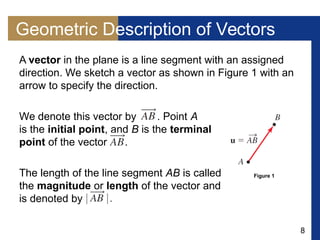
We denote this vector by . Point A
is the initial point, and B is the terminal
point of the vector .
The length of the line segment AB is called
the magnitude or length of the vector and
is denoted by
Figure 1
9
Geometric Description of Vectors
We use boldface letters to denote vectors. Thus we write
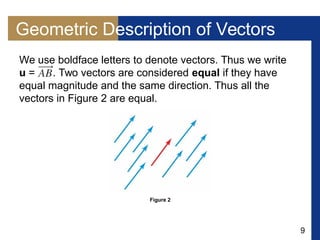
u = . Two vectors are considered equal if they have
equal magnitude and the same direction. Thus all the
vectors in Figure 2 are equal.
Figure 2
10
Geometric Description of Vectors
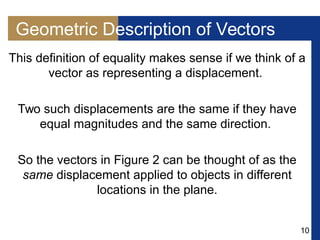
This definition of equality makes sense if we think of a
vector as representing a displacement.
Two such displacements are the same if they have
equal magnitudes and the same direction.
So the vectors in Figure 2 can be thought of as the
same displacement applied to objects in different
locations in the plane.
11
Geometric Description of Vectors
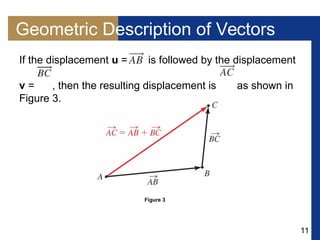
If the displacement u = is followed by the displacement
v = , then the resulting displacement is as shown in
Figure 3.
Figure 3
12
Geometric Description of Vectors
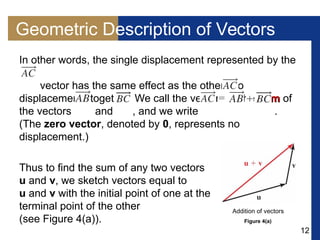
In other words, the single displacement represented by the
vector has the same effect as the other two
displacements together. We call the vector the sumsum of
the vectors and , and we write .
(The zero vector, denoted by 0, represents no
displacement.)
Thus to find the sum of any two vectors
u and v, we sketch vectors equal to
u and v with the initial point of one at the
terminal point of the other
(see Figure 4(a)).
Addition of vectors
Figure 4(a)
13
Geometric Description of Vectors
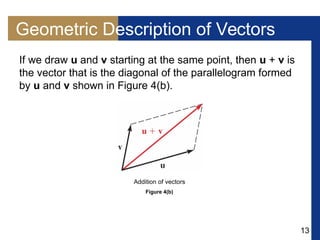
If we draw u and v starting at the same point, then u + v is
the vector that is the diagonal of the parallelogram formed
by u and v shown in Figure 4(b).
Figure 4(b)
Addition of vectors
14
Geometric Description of Vectors
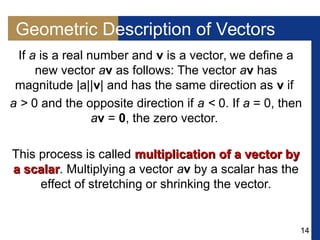
If a is a real number and v is a vector, we define a
new vector av as follows: The vector av has
magnitude |a||v| and has the same direction as v if
a > 0 and the opposite direction if a < 0. If a = 0, then
av = 0, the zero vector.
This process is called multiplication of a vector bymultiplication of a vector by
a scalara scalar. Multiplying a vector av by a scalar has the
effect of stretching or shrinking the vector.
15
Geometric Description of Vectors
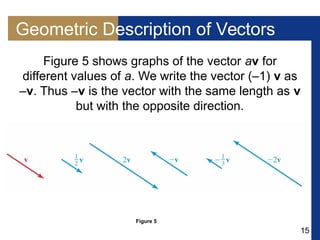
Figure 5 shows graphs of the vector av for
different values of a. We write the vector (–1) v as
–v. Thus –v is the vector with the same length as v
but with the opposite direction.
Figure 5
16
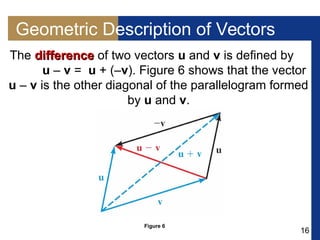
Geometric Description of Vectors
The differencedifference of two vectors u and v is defined by
u – v = u + (–v). Figure 6 shows that the vector
u – v is the other diagonal of the parallelogram formed
by u and v.
Figure 6
17
Vectors in the Coordinate Plane
18
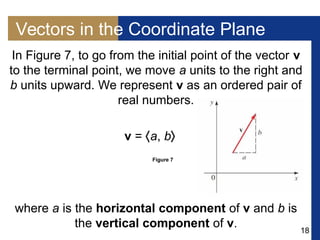
Vectors in the Coordinate Plane
In Figure 7, to go from the initial point of the vector v
to the terminal point, we move a units to the right and
b units upward. We represent v as an ordered pair of
real numbers.
v = a, b
where a is the horizontal component of v and b is
the vertical component of v.
Figure 7
19
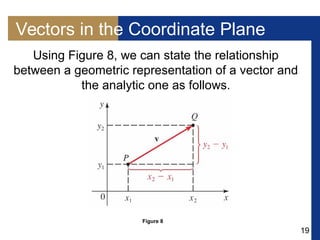
Vectors in the Coordinate Plane
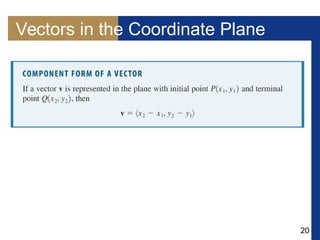
Using Figure 8, we can state the relationship
between a geometric representation of a vector and
the analytic one as follows.
Figure 8
20
Vectors in the Coordinate Plane
21
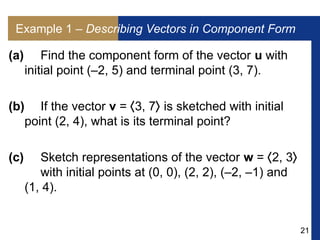
Example 1 – Describing Vectors in Component Form
(a) Find the component form of the vector u with
initial point (–2, 5) and terminal point (3, 7).
(b) If the vector v = 3, 7 is sketched with initial
point (2, 4), what is its terminal point?
(c) Sketch representations of the vector w = 2, 3
with initial points at (0, 0), (2, 2), (–2, –1) and
(1, 4).
22
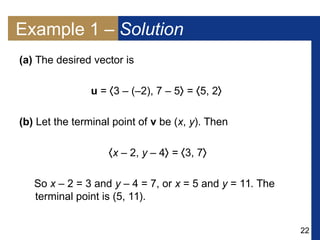
Example 1 – Solution
(a) The desired vector is
u = 3 – (–2), 7 – 5 = 5, 2
(b) Let the terminal point of v be (x, y). Then
x – 2, y – 4 = 3, 7
So x – 2 = 3 and y – 4 = 7, or x = 5 and y = 11. The
terminal point is (5, 11).
23
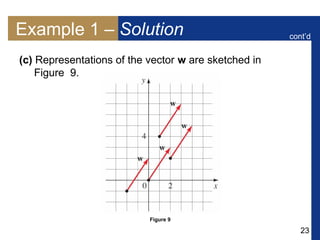
Example 1 – Solution
(c) Representations of the vector w are sketched in
Figure 9.
cont’d
Figure 9
24
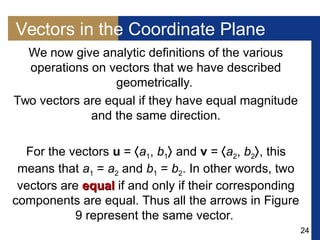
Vectors in the Coordinate Plane
We now give analytic definitions of the various
operations on vectors that we have described
geometrically.
Two vectors are equal if they have equal magnitude
and the same direction.
For the vectors u = a1, b1 and v = a2, b2, this
means that a1 = a2 and b1 = b2. In other words, two
vectors are equalequal if and only if their corresponding
components are equal. Thus all the arrows in Figure
9 represent the same vector.
25
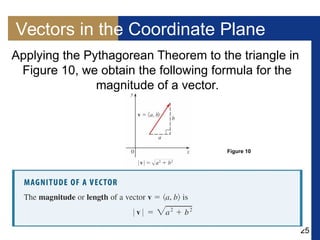
Vectors in the Coordinate Plane
Applying the Pythagorean Theorem to the triangle in
Figure 10, we obtain the following formula for the
magnitude of a vector.
Figure 10
26
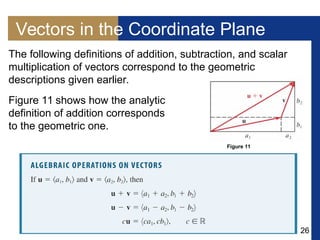
Vectors in the Coordinate Plane
The following definitions of addition, subtraction, and scalar
multiplication of vectors correspond to the geometric
descriptions given earlier.
Figure 11 shows how the analytic
definition of addition corresponds
to the geometric one.
Figure 11
27
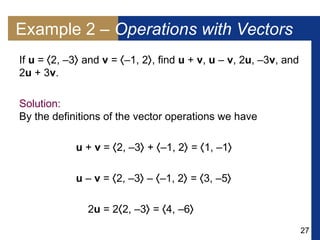
Example 2 – Operations with Vectors
If u = 2, –3 and v = –1, 2, find u + v, u – v, 2u, –3v, and
2u + 3v.
Solution:
By the definitions of the vector operations we have
u + v = 2, –3 + –1, 2 = 1, –1
u – v = 2, –3 – –1, 2 = 3, –5
2u = 22, –3 = 4, –6
28
Example 2 – Solution
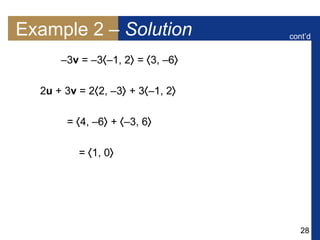
–3v = –3–1, 2 = 3, –6
2u + 3v = 22, –3 + 3–1, 2
= 4, –6 + –3, 6
= 1, 0
cont’d
29
Vectors in the Coordinate Plane
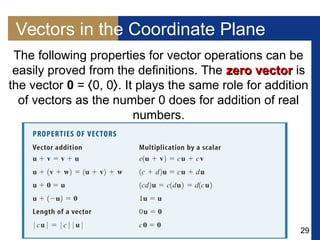
The following properties for vector operations can be
easily proved from the definitions. The zero vectorzero vector is
the vector 0 = 0, 0. It plays the same role for addition
of vectors as the number 0 does for addition of real
numbers.
30
Vectors in the Coordinate Plane
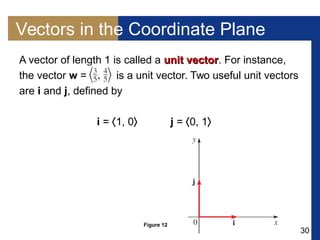
A vector of length 1 is called a unit vectorunit vector. For instance,
the vector w = is a unit vector. Two useful unit vectors
are i and j, defined by
i = 1, 0 j = 0, 1
Figure 12
31
Vectors in the Coordinate Plane
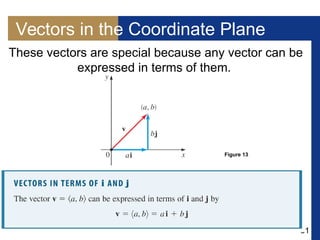
These vectors are special because any vector can be
expressed in terms of them.
Figure 13
32
Example 3 – Vectors in Terms of i and j
(a) Write the vector u = 5, –8 in terms of i and j.
(b) If u = 3i + 2j and v = –i + 6j, write 2u + 5v in terms of
i and j.
Solution:
(a) u = 5i + (–8)j = 5i – 8j
33
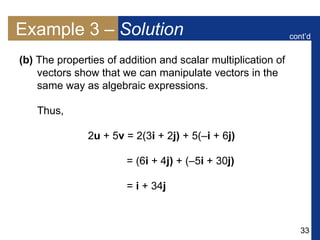
Example 3 – Solution
(b) The properties of addition and scalar multiplication of
vectors show that we can manipulate vectors in the
same way as algebraic expressions.
Thus,
2u + 5v = 2(3i + 2j) + 5(–i + 6j)
= (6i + 4j) + (–5i + 30j)
= i + 34j
cont’d
34
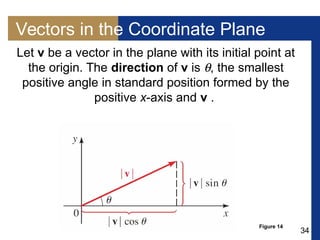
Vectors in the Coordinate Plane
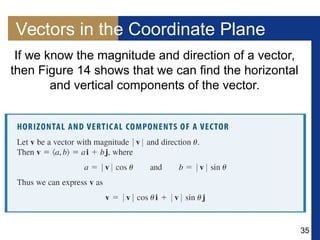
Let v be a vector in the plane with its initial point at
the origin. The direction of v is , the smallest
positive angle in standard position formed by the
positive x-axis and v .
Figure 14
35
Vectors in the Coordinate Plane
If we know the magnitude and direction of a vector,
then Figure 14 shows that we can find the horizontal
and vertical components of the vector.
36
Example 4 – Components and Direction of a Vector
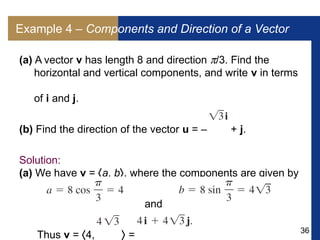
(a) A vector v has length 8 and direction /3. Find the
horizontal and vertical components, and write v in terms
of i and j.
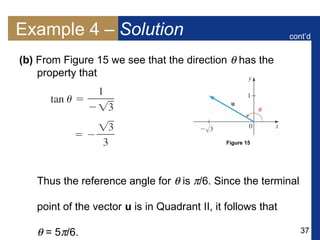
(b) Find the direction of the vector u = – + j.
Solution:
(a) We have v = a, b, where the components are given by
and
Thus v = 4,  =
37
Example 4 – Solution
(b) From Figure 15 we see that the direction  has the
property that
Thus the reference angle for  is /6. Since the terminal
point of the vector u is in Quadrant II, it follows that
 = 5/6.
cont’d
Figure 15
38
Using Vectors to Model Velocity
39
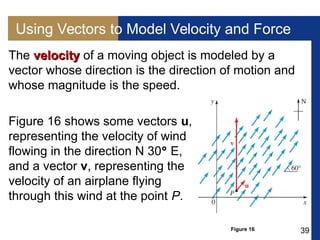
Using Vectors to Model Velocity and Force
The velocityvelocity of a moving object is modeled by a
vector whose direction is the direction of motion and
whose magnitude is the speed.
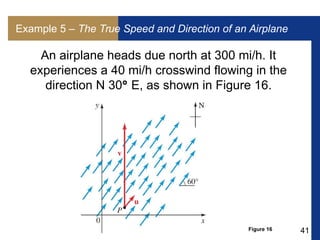
Figure 16 shows some vectors u,
representing the velocity of wind
flowing in the direction N 30 E,
and a vector v, representing the
velocity of an airplane flying
through this wind at the point P.
Figure 16
40
Using Vectors to Model Velocity and Force
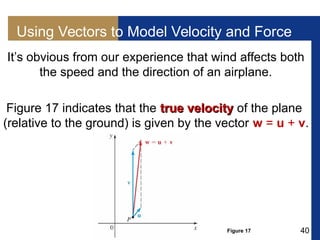
It’s obvious from our experience that wind affects both
the speed and the direction of an airplane.
Figure 17 indicates that the true velocitytrue velocity of the plane
(relative to the ground) is given by the vector w = u + v.
Figure 17
41
Example 5 – The True Speed and Direction of an Airplane
An airplane heads due north at 300 mi/h. It
experiences a 40 mi/h crosswind flowing in the
direction N 30 E, as shown in Figure 16.
Figure 16
42
Example 5 – The True Speed and Direction of an Airplane
(a) Express the velocity v of the airplane relative
to the air, and the velocity u of the wind, in
component form.
(b) Find the true velocity of the airplane as a
vector.
(c) Find the true speed and direction of the
airplane.
43
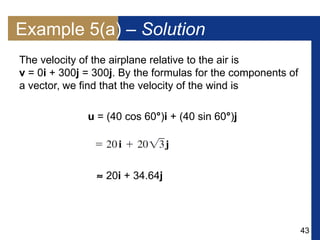
The velocity of the airplane relative to the air is
v = 0i + 300j = 300j. By the formulas for the components of
a vector, we find that the velocity of the wind is
u = (40 cos 60°)i + (40 sin 60°)j
 20i + 34.64j
Example 5(a) – Solution
44
Example 5(b) – Solution
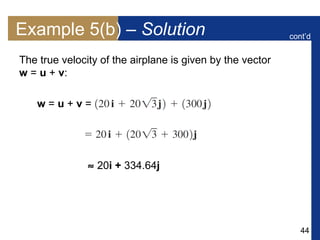
The true velocity of the airplane is given by the vector
w = u + v:
w = u + v =
 20i + 334.64j
cont’d
45
Example 5(c) – Solution
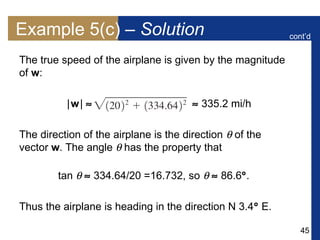
The true speed of the airplane is given by the magnitude
of w:
|w|   335.2 mi/h
The direction of the airplane is the direction  of the
vector w. The angle  has the property that
tan   334.64/20 =16.732, so   86.6.
Thus the airplane is heading in the direction N 3.4 E.
cont’d

precalculus 6.3

  • 1.
  • 2.
    2 INFORMATION - TUESDAY1 AUGUST 2017 1. CLASS TEST 11. CLASS TEST 1 on par. 6.5 is scheduled foron par. 6.5 is scheduled for Thursday 3 August.Thursday 3 August. 2. Worksheet 22. Worksheet 2 on par. 6.3 (vectors) & par. 6.5 (trigonometry form of complex numbers) is scheduled for Tuesday 8 August. You can use your textbook and class notes. 3. Find all info on uLink.
  • 3.
  • 4.
    4 Objectives ► Geometric Descriptionof Vectors ► Vectors in the Coordinate Plane ► Using Vectors to Model Velocity
  • 5.
    5 Vectors in TwoDimensions In applications of mathematics, certain quantities are determined completely by their magnitude; length, mass, area, temperature, and energy. We speak of a length of 5 m or a mass of 3 kg; only one number is needed to describe each of these quantities. Such a quantity is called a scalarscalar. On the other hand, to describe the displacement of an object, two numbers are required: the magnitudemagnitude and the directiondirection of the displacement.
  • 6.
    6 Vectors in TwoDimensions To describe the velocity of a moving object, we must specify both the speedspeed and the directiondirection of travel. Quantities such as displacement, velocity, acceleration, and force that involve magnitude as well as direction are called directed quantities. One way to represent such quantities mathematically is through the use of vectorsvectors.
  • 7.
  • 8.
    8 Geometric Description ofVectors A vector in the plane is a line segment with an assigned direction. We sketch a vector as shown in Figure 1 with an arrow to specify the direction. We denote this vector by . Point A is the initial point, and B is the terminal point of the vector . The length of the line segment AB is called the magnitude or length of the vector and is denoted by Figure 1
  • 9.
    9 Geometric Description ofVectors We use boldface letters to denote vectors. Thus we write u = . Two vectors are considered equal if they have equal magnitude and the same direction. Thus all the vectors in Figure 2 are equal. Figure 2
  • 10.
    10 Geometric Description ofVectors This definition of equality makes sense if we think of a vector as representing a displacement. Two such displacements are the same if they have equal magnitudes and the same direction. So the vectors in Figure 2 can be thought of as the same displacement applied to objects in different locations in the plane.
  • 11.
    11 Geometric Description ofVectors If the displacement u = is followed by the displacement v = , then the resulting displacement is as shown in Figure 3. Figure 3
  • 12.
    12 Geometric Description ofVectors In other words, the single displacement represented by the vector has the same effect as the other two displacements together. We call the vector the sumsum of the vectors and , and we write . (The zero vector, denoted by 0, represents no displacement.) Thus to find the sum of any two vectors u and v, we sketch vectors equal to u and v with the initial point of one at the terminal point of the other (see Figure 4(a)). Addition of vectors Figure 4(a)
  • 13.
    13 Geometric Description ofVectors If we draw u and v starting at the same point, then u + v is the vector that is the diagonal of the parallelogram formed by u and v shown in Figure 4(b). Figure 4(b) Addition of vectors
  • 14.
    14 Geometric Description ofVectors If a is a real number and v is a vector, we define a new vector av as follows: The vector av has magnitude |a||v| and has the same direction as v if a > 0 and the opposite direction if a < 0. If a = 0, then av = 0, the zero vector. This process is called multiplication of a vector bymultiplication of a vector by a scalara scalar. Multiplying a vector av by a scalar has the effect of stretching or shrinking the vector.
  • 15.
    15 Geometric Description ofVectors Figure 5 shows graphs of the vector av for different values of a. We write the vector (–1) v as –v. Thus –v is the vector with the same length as v but with the opposite direction. Figure 5
  • 16.
    16 Geometric Description ofVectors The differencedifference of two vectors u and v is defined by u – v = u + (–v). Figure 6 shows that the vector u – v is the other diagonal of the parallelogram formed by u and v. Figure 6
  • 17.
    17 Vectors in theCoordinate Plane
  • 18.
    18 Vectors in theCoordinate Plane In Figure 7, to go from the initial point of the vector v to the terminal point, we move a units to the right and b units upward. We represent v as an ordered pair of real numbers. v = a, b where a is the horizontal component of v and b is the vertical component of v. Figure 7
  • 19.
    19 Vectors in theCoordinate Plane Using Figure 8, we can state the relationship between a geometric representation of a vector and the analytic one as follows. Figure 8
  • 20.
    20 Vectors in theCoordinate Plane
  • 21.
    21 Example 1 –Describing Vectors in Component Form (a) Find the component form of the vector u with initial point (–2, 5) and terminal point (3, 7). (b) If the vector v = 3, 7 is sketched with initial point (2, 4), what is its terminal point? (c) Sketch representations of the vector w = 2, 3 with initial points at (0, 0), (2, 2), (–2, –1) and (1, 4).
  • 22.
    22 Example 1 –Solution (a) The desired vector is u = 3 – (–2), 7 – 5 = 5, 2 (b) Let the terminal point of v be (x, y). Then x – 2, y – 4 = 3, 7 So x – 2 = 3 and y – 4 = 7, or x = 5 and y = 11. The terminal point is (5, 11).
  • 23.
    23 Example 1 –Solution (c) Representations of the vector w are sketched in Figure 9. cont’d Figure 9
  • 24.
    24 Vectors in theCoordinate Plane We now give analytic definitions of the various operations on vectors that we have described geometrically. Two vectors are equal if they have equal magnitude and the same direction. For the vectors u = a1, b1 and v = a2, b2, this means that a1 = a2 and b1 = b2. In other words, two vectors are equalequal if and only if their corresponding components are equal. Thus all the arrows in Figure 9 represent the same vector.
  • 25.
    25 Vectors in theCoordinate Plane Applying the Pythagorean Theorem to the triangle in Figure 10, we obtain the following formula for the magnitude of a vector. Figure 10
  • 26.
    26 Vectors in theCoordinate Plane The following definitions of addition, subtraction, and scalar multiplication of vectors correspond to the geometric descriptions given earlier. Figure 11 shows how the analytic definition of addition corresponds to the geometric one. Figure 11
  • 27.
    27 Example 2 –Operations with Vectors If u = 2, –3 and v = –1, 2, find u + v, u – v, 2u, –3v, and 2u + 3v. Solution: By the definitions of the vector operations we have u + v = 2, –3 + –1, 2 = 1, –1 u – v = 2, –3 – –1, 2 = 3, –5 2u = 22, –3 = 4, –6
  • 28.
    28 Example 2 –Solution –3v = –3–1, 2 = 3, –6 2u + 3v = 22, –3 + 3–1, 2 = 4, –6 + –3, 6 = 1, 0 cont’d
  • 29.
    29 Vectors in theCoordinate Plane The following properties for vector operations can be easily proved from the definitions. The zero vectorzero vector is the vector 0 = 0, 0. It plays the same role for addition of vectors as the number 0 does for addition of real numbers.
  • 30.
    30 Vectors in theCoordinate Plane A vector of length 1 is called a unit vectorunit vector. For instance, the vector w = is a unit vector. Two useful unit vectors are i and j, defined by i = 1, 0 j = 0, 1 Figure 12
  • 31.
    31 Vectors in theCoordinate Plane These vectors are special because any vector can be expressed in terms of them. Figure 13
  • 32.
    32 Example 3 –Vectors in Terms of i and j (a) Write the vector u = 5, –8 in terms of i and j. (b) If u = 3i + 2j and v = –i + 6j, write 2u + 5v in terms of i and j. Solution: (a) u = 5i + (–8)j = 5i – 8j
  • 33.
    33 Example 3 –Solution (b) The properties of addition and scalar multiplication of vectors show that we can manipulate vectors in the same way as algebraic expressions. Thus, 2u + 5v = 2(3i + 2j) + 5(–i + 6j) = (6i + 4j) + (–5i + 30j) = i + 34j cont’d
  • 34.
    34 Vectors in theCoordinate Plane Let v be a vector in the plane with its initial point at the origin. The direction of v is , the smallest positive angle in standard position formed by the positive x-axis and v . Figure 14
  • 35.
    35 Vectors in theCoordinate Plane If we know the magnitude and direction of a vector, then Figure 14 shows that we can find the horizontal and vertical components of the vector.
  • 36.
    36 Example 4 –Components and Direction of a Vector (a) A vector v has length 8 and direction /3. Find the horizontal and vertical components, and write v in terms of i and j. (b) Find the direction of the vector u = – + j. Solution: (a) We have v = a, b, where the components are given by and Thus v = 4,  =
  • 37.
    37 Example 4 –Solution (b) From Figure 15 we see that the direction  has the property that Thus the reference angle for  is /6. Since the terminal point of the vector u is in Quadrant II, it follows that  = 5/6. cont’d Figure 15
  • 38.
    38 Using Vectors toModel Velocity
  • 39.
    39 Using Vectors toModel Velocity and Force The velocityvelocity of a moving object is modeled by a vector whose direction is the direction of motion and whose magnitude is the speed. Figure 16 shows some vectors u, representing the velocity of wind flowing in the direction N 30 E, and a vector v, representing the velocity of an airplane flying through this wind at the point P. Figure 16
  • 40.
    40 Using Vectors toModel Velocity and Force It’s obvious from our experience that wind affects both the speed and the direction of an airplane. Figure 17 indicates that the true velocitytrue velocity of the plane (relative to the ground) is given by the vector w = u + v. Figure 17
  • 41.
    41 Example 5 –The True Speed and Direction of an Airplane An airplane heads due north at 300 mi/h. It experiences a 40 mi/h crosswind flowing in the direction N 30 E, as shown in Figure 16. Figure 16
  • 42.
    42 Example 5 –The True Speed and Direction of an Airplane (a) Express the velocity v of the airplane relative to the air, and the velocity u of the wind, in component form. (b) Find the true velocity of the airplane as a vector. (c) Find the true speed and direction of the airplane.
  • 43.
    43 The velocity ofthe airplane relative to the air is v = 0i + 300j = 300j. By the formulas for the components of a vector, we find that the velocity of the wind is u = (40 cos 60°)i + (40 sin 60°)j  20i + 34.64j Example 5(a) – Solution
  • 44.
    44 Example 5(b) –Solution The true velocity of the airplane is given by the vector w = u + v: w = u + v =  20i + 334.64j cont’d
  • 45.
    45 Example 5(c) –Solution The true speed of the airplane is given by the magnitude of w: |w|   335.2 mi/h The direction of the airplane is the direction  of the vector w. The angle  has the property that tan   334.64/20 =16.732, so   86.6. Thus the airplane is heading in the direction N 3.4 E. cont’d