Non-finite clauses and clauses
        without verbs
Main topics
1.   Four kinds of non-finite clauses
2.   The form of non-finite clauses
3.   The functions of non-finite clauses
4.   The catenative construction
5.   Verbless clauses
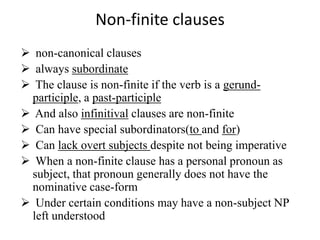
Non-finite clauses
 non-canonical clauses
 always subordinate
 The clause is non-finite if the verb is a gerund-
  participle, a past-participle
 And also infinitival clauses are non-finite
 Can have special subordinators(to and for)
 Can lack overt subjects despite not being imperative
 When a non-finite clause has a personal pronoun as
  subject, that pronoun generally does not have the
  nominative case-form
 Under certain conditions may have a non-subject NP
  left understood
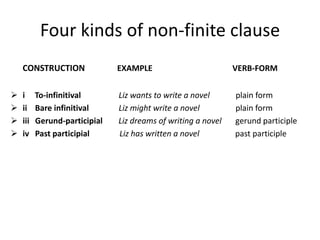
Four kinds of non-finite clause
    CONSTRUCTION               EXAMPLE                         VERB-FORM


   i     To-infinitival       Liz wants to write a novel      plain form
   ii    Bare infinitival     Liz might write a novel         plain form
   iii   Gerund-participial   Liz dreams of writing a novel   gerund participle
   iv    Past participial     Liz has written a novel         past participle
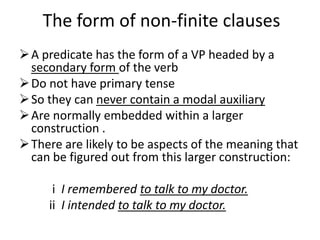
The form of non-finite clauses
 A predicate has the form of a VP headed by a
  secondary form of the verb
 Do not have primary tense
 So they can never contain a modal auxiliary
 Are normally embedded within a larger
  construction .
 There are likely to be aspects of the meaning that
  can be figured out from this larger construction:

      i I remembered to talk to my doctor.
     ii I intended to talk to my doctor.
Subordinators in to-infinitivals: to and
                   for

 To-infinitivals are marked by the word „to”
 „to” is a member of the subordinator category
 When a to-infinitival contains a subject, it also contains the
  clause subordinator „for”
 „for” appears at the beginning of the clause, right before the
  subject:

       i [For John to lose his temper like that] is highly unusual
      ii *We can’t afford *for everyone to travel business class].
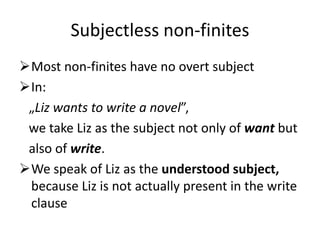
Subjectless non-finites
Most non-finites have no overt subject
In:
 „Liz wants to write a novel”,
 we take Liz as the subject not only of want but
 also of write.
We speak of Liz as the understood subject,
 because Liz is not actually present in the write
 clause
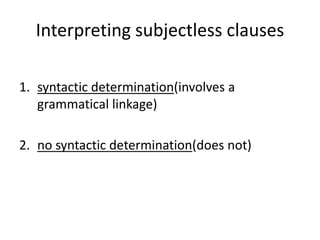
Interpreting subjectless clauses

1. syntactic determination(involves a
   grammatical linkage)

2. no syntactic determination(does not)
Syntactic determination
          i Ed promised to resign from the board
         ii They called on Ed to resign from the board

• We can see what the understood subject must be by looking
  at a linguistic antecedent that appears in the matrix
  construction („Ed promised…” or „They called on Ed…”)

• Retrieval(=recovery) of the missing subject is determined by a
  rule referring to the syntactic structure
No syntactic determination
The meaning depends heavily on
 inference(=conclusion)

  i It is unwise to go swimming straight after a meal
  ii It was unwise to invite Ed to the party
Non-finite clauses functioning as
                 adjunct
i Having read the report, Mary was sure there had been a
  miscarriage of justice


 „Having read the report” is an adjunct
 „Mary was sure…..” Is a matrix clause
 the missing subject is retrievable by looking at
  the subject of the matrix clause
 So we understand the sentence as saying that it
  was Mary who read the report
Non finites with an overt subject


1. Infinitival clauses
2. Gerund-participial as complement
3. Gerund-participial as adjunct
1.Infinitival clauses
In to-infinitivals a personal pronoun always
 takes accusative form:

    i [For them to refuse you a visa] was quite
  outrageous
   ii All I want is [for us to be reunited]
2.Gerund-participials as complement
   i She insisted on [my/me being present throughout the interview].
  ii She insisted on *her father’s/her father being present throughout the
   interview].
  iii She insisted on [there being a counsellor present throughout the
   interview].


 Genitive and non-genitive subjects are possible
 The genitive is characteristic of formal style
 If a personal pronoun subject is not in the genitive, then it takes
  accusative case(as with „me” in *i])
 Some NPs(such as „there” in *iii+) cannot take genitive case at
  all
3.Gerund-participials as adjunct

 Genitive subjects are not permitted at all
 The choice is between nominative and accusative:


      i She sought advice from Ed, [he being the most experienced of
  her colleagues].
     ii She sought advice from Ed, [him being the most experienced
  of her colleagues].
Hollow non-finites
 Incomplete structure- they have a hole somewhere
  inside them

 Some non-subject element is missing yet
  recoverable from an antecedent expression

  i The house will be ready [ for you to inspect__] in a few days.
 ii The new car took me quite a long time [to get used to__].
Properties of hollow non-finites:

Form: Predominantly to-infinitivals

Function of missing element: direct object or
 object of a preposition

Antecedent: a NP( often the matrix subject) or
 a nominal( head of the NP in which the hollow
 clause is embedded)
The functions of non-finite clauses:
                1)To infinitivals
   subject                   To turn back now would be a mistake.
   Extraposed subject         It would be a mistake to turn back now.
   Extraposed object        We considered it sensible to take legal advice.
   Internal compl of verb   Her parents [intend to buy her a car].
   Comp Of preposition       I go to the gym [in order to keep fit].
   Adjunct in clause         I go to the gym to keep fit.
   Comp Of noun             It provides [an opportunity to broaden the mind].
   Modifier in NP           We found [a big box in which to keep the CDs].
                             We found [a big box to keep the CDs in].
 Comp Of adjective          He was [anxious to make a good impression].
 Indirect comp              He’s still *too young to be left alone].
2) Bare infinitivals
 A very limited set of functions
 They occur as internal complements of certain verbs with no subject
  permitted

 i You should take legal advice.            [complement of modal auxiliary]
 ii I want you to help clear up the garage. [complement of help]
iii All I did was ask a simple question     [complement of specifying be]
3) Gerund-participials

   Subject                  Bringing your dad in on the deal was a great idea.
   Extraposed subject      It’s been a pleasure talking to you both.
   Object                  I find talking to Max rather stressful.
   Extraposed object       He considers it a waste of time going to meetings.
   Internal comp of verb   I remember telling you about her visit.
   Comp of preposition     He insist [on checking everything himself].
   Adjunct in clause       Having read the paper, I can’t see why you care.
   Modifier in NP          Who was [the doctor performing the operation]?
4) Past-participials
 Internal comp of verb   She [has written another novel]
                          I could [have you dismissed on the spot]


 Modifier in NP          [The guns stolen in the break-in] were
                                                      recovered
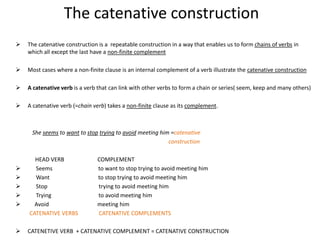
The catenative construction
   The catenative construction is a repeatable construction in a way that enables us to form chains of verbs in
    which all except the last have a non-finite complement

   Most cases where a non-finite clause is an internal complement of a verb illustrate the catenative construction

   A catenative verb is a verb that can link with other verbs to form a chain or series( seem, keep and many others)

   A catenative verb (=chain verb) takes a non-finite clause as its complement.


     She seems to want to stop trying to avoid meeting him =catenative
                                                          construction

      HEAD VERB                COMPLEMENT
     Seems                    to want to stop trying to avoid meeting him
     Want                     to stop trying to avoid meeting him
     Stop                     trying to avoid meeting him
     Trying                   to avoid meeting him
     Avoid                    meeting him
    CATENATIVE VERBS           CATENATIVE COMPLEMENTS

   CATENETIVE VERB + CATENATIVE COMPLEMENT = CATENATIVE CONSTRUCTION
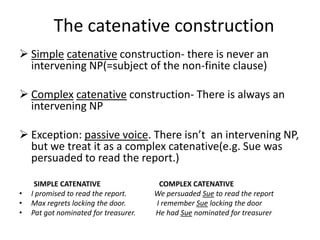
The catenative construction
 Simple catenative construction- there is never an
  intervening NP(=subject of the non-finite clause)

 Complex catenative construction- There is always an
  intervening NP

 Exception: passive voice. There isn’t an intervening NP,
  but we treat it as a complex catenative(e.g. Sue was
  persuaded to read the report.)

     SIMPLE CATENATIVE                  COMPLEX CATENATIVE
•   I promised to read the report.     We persuaded Sue to read the report
•   Max regrets locking the door.      I remember Sue locking the door
•   Pat got nominated for treasurer.   He had Sue nominated for treasurer
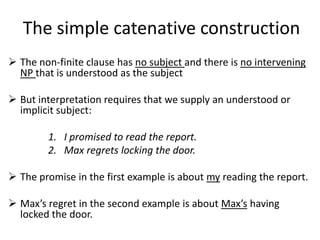
The simple catenative construction
 The non-finite clause has no subject and there is no intervening
  NP that is understood as the subject

 But interpretation requires that we supply an understood or
  implicit subject:

        1. I promised to read the report.
        2. Max regrets locking the door.

 The promise in the first example is about my reading the report.

 Max’s regret in the second example is about Max’s having
  locked the door.
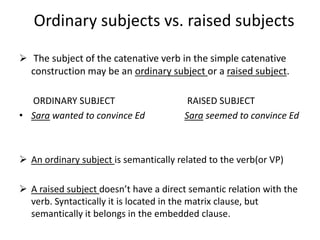
Ordinary subjects vs. raised subjects

 The subject of the catenative verb in the simple catenative
  construction may be an ordinary subject or a raised subject.

  ORDINARY SUBJECT                       RAISED SUBJECT
• Sara wanted to convince Ed            Sara seemed to convince Ed


 An ordinary subject is semantically related to the verb(or VP)

 A raised subject doesn’t have a direct semantic relation with the
  verb. Syntactically it is located in the matrix clause, but
  semantically it belongs in the embedded clause.
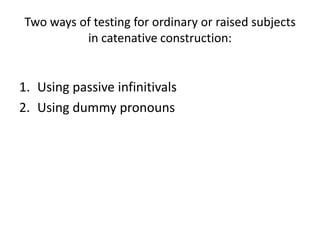
Two ways of testing for ordinary or raised subjects
          in catenative construction:


1. Using passive infinitivals
2. Using dummy pronouns
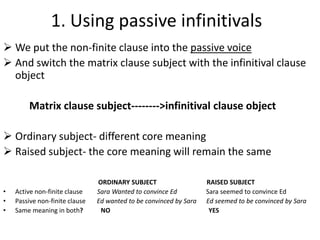
1. Using passive infinitivals
 We put the non-finite clause into the passive voice
 And switch the matrix clause subject with the infinitival clause
  object

         Matrix clause subject-------->infinitival clause object

 Ordinary subject- different core meaning
 Raised subject- the core meaning will remain the same

                                ORDINARY SUBJECT                    RAISED SUBJECT
•   Active non-finite clause    Sara Wanted to convince Ed          Sara seemed to convince Ed
•   Passive non-finite clause   Ed wanted to be convinced by Sara   Ed seemed to be convinced by Sara
•   Same meaning in both?        NO                                  YES
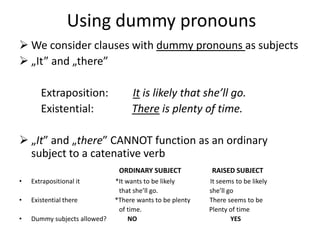
Using dummy pronouns
 We consider clauses with dummy pronouns as subjects
 „It” and „there”

       Extraposition:              It is likely that she’ll go.
       Existential:                There is plenty of time.

 „It” and „there” CANNOT function as an ordinary
  subject to a catenative verb
                               ORDINARY SUBJECT            RAISED SUBJECT
•   Extrapositional it        *It wants to be likely      It seems to be likely
                               that she’ll go.            she’ll go
•   Existential there         *There wants to be plenty   There seems to be
                               of time.                   Plenty of time
•   Dummy subjects allowed?        NO                             YES
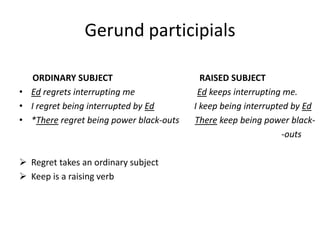
Gerund participials

   ORDINARY SUBJECT                        RAISED SUBJECT
• Ed regrets interrupting me              Ed keeps interrupting me.
• I regret being interrupted by Ed       I keep being interrupted by Ed
• *There regret being power black-outs   There keep being power black-
                                                                -outs

 Regret takes an ordinary subject
 Keep is a raising verb
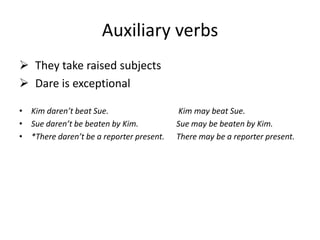
Auxiliary verbs
 They take raised subjects
 Dare is exceptional

• Kim daren’t beat Sue.                    Kim may beat Sue.
• Sue daren’t be beaten by Kim.           Sue may be beaten by Kim.
• *There daren’t be a reporter present.   There may be a reporter present.
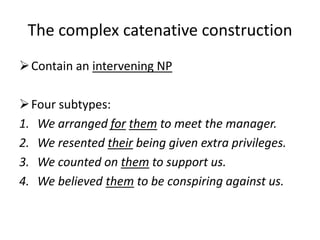
The complex catenative construction
 Contain an intervening NP

 Four subtypes:
1. We arranged for them to meet the manager.
2. We resented their being given extra privileges.
3. We counted on them to support us.
4. We believed them to be conspiring against us.
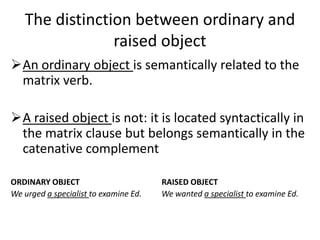
The distinction between ordinary and
                raised object
An ordinary object is semantically related to the
 matrix verb.

A raised object is not: it is located syntactically in
 the matrix clause but belongs semantically in the
 catenative complement

ORDINARY OBJECT                        RAISED OBJECT
We urged a specialist to examine Ed.   We wanted a specialist to examine Ed.
Verbless clauses

1. verbless clauses functioning as
   complement to a preposition

1. verbless clauses functioning directly as
   adjuncts
1. Verbless clauses as complement to a
                  preposition
 There is no preposition that licenses ONLY a verbless clause as
  complement
 With, without accept non-finite and verbless clauses
 Although, if, once, while accept finite, non-finite and verbless
  clauses

  i He’d been on the beach *without anyone noticing him]   [non-finite]
 ii He’d been on the beach *without any sunscreen on].     [Verbless]
iii [While I was working in Boston] I lived with my aunt    [finite]
iv [While working in Boston] I lived with my aunt.          [non finite]
v [While in Boston] I lived with my aunt.                   [verbless]
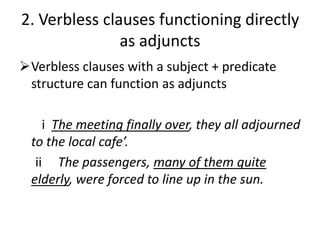
2. Verbless clauses functioning directly
               as adjuncts
Verbless clauses with a subject + predicate
 structure can function as adjuncts

     i The meeting finally over, they all adjourned
  to the local cafe’.
   ii The passengers, many of them quite
  elderly, were forced to line up in the sun.
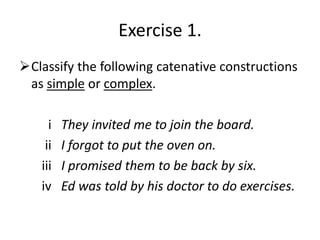
Exercise 1.
Classify the following catenative constructions
 as simple or complex.

     i   They invited me to join the board.
    ii   I forgot to put the oven on.
   iii   I promised them to be back by six.
   iv    Ed was told by his doctor to do exercises.
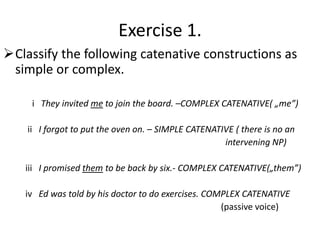
Exercise 1.
Classify the following catenative constructions as
 simple or complex.

     i They invited me to join the board. –COMPLEX CATENATIVE( „me”)

    ii I forgot to put the oven on. – SIMPLE CATENATIVE ( there is no an
                                                     intervening NP)

   iii I promised them to be back by six.- COMPLEX CATENATIVE(„them”)

   iv Ed was told by his doctor to do exercises. COMPLEX CATENATIVE
                                                    (passive voice)
Thank You

Non finite clauses and clauses without verbs chapter 13

  • 1.
    Non-finite clauses andclauses without verbs
  • 2.
    Main topics 1. Four kinds of non-finite clauses 2. The form of non-finite clauses 3. The functions of non-finite clauses 4. The catenative construction 5. Verbless clauses
  • 3.
    Non-finite clauses  non-canonicalclauses  always subordinate  The clause is non-finite if the verb is a gerund- participle, a past-participle  And also infinitival clauses are non-finite  Can have special subordinators(to and for)  Can lack overt subjects despite not being imperative  When a non-finite clause has a personal pronoun as subject, that pronoun generally does not have the nominative case-form  Under certain conditions may have a non-subject NP left understood
  • 4.
    Four kinds ofnon-finite clause CONSTRUCTION EXAMPLE VERB-FORM  i To-infinitival Liz wants to write a novel plain form  ii Bare infinitival Liz might write a novel plain form  iii Gerund-participial Liz dreams of writing a novel gerund participle  iv Past participial Liz has written a novel past participle
  • 5.
    The form ofnon-finite clauses  A predicate has the form of a VP headed by a secondary form of the verb  Do not have primary tense  So they can never contain a modal auxiliary  Are normally embedded within a larger construction .  There are likely to be aspects of the meaning that can be figured out from this larger construction: i I remembered to talk to my doctor. ii I intended to talk to my doctor.
  • 6.
    Subordinators in to-infinitivals:to and for  To-infinitivals are marked by the word „to”  „to” is a member of the subordinator category  When a to-infinitival contains a subject, it also contains the clause subordinator „for”  „for” appears at the beginning of the clause, right before the subject: i [For John to lose his temper like that] is highly unusual ii *We can’t afford *for everyone to travel business class].
  • 7.
    Subjectless non-finites Most non-finiteshave no overt subject In: „Liz wants to write a novel”, we take Liz as the subject not only of want but also of write. We speak of Liz as the understood subject, because Liz is not actually present in the write clause
  • 8.
    Interpreting subjectless clauses 1.syntactic determination(involves a grammatical linkage) 2. no syntactic determination(does not)
  • 9.
    Syntactic determination i Ed promised to resign from the board ii They called on Ed to resign from the board • We can see what the understood subject must be by looking at a linguistic antecedent that appears in the matrix construction („Ed promised…” or „They called on Ed…”) • Retrieval(=recovery) of the missing subject is determined by a rule referring to the syntactic structure
  • 10.
    No syntactic determination Themeaning depends heavily on inference(=conclusion) i It is unwise to go swimming straight after a meal ii It was unwise to invite Ed to the party
  • 11.
    Non-finite clauses functioningas adjunct i Having read the report, Mary was sure there had been a miscarriage of justice  „Having read the report” is an adjunct  „Mary was sure…..” Is a matrix clause  the missing subject is retrievable by looking at the subject of the matrix clause  So we understand the sentence as saying that it was Mary who read the report
  • 12.
    Non finites withan overt subject 1. Infinitival clauses 2. Gerund-participial as complement 3. Gerund-participial as adjunct
  • 13.
    1.Infinitival clauses In to-infinitivalsa personal pronoun always takes accusative form: i [For them to refuse you a visa] was quite outrageous ii All I want is [for us to be reunited]
  • 14.
    2.Gerund-participials as complement i She insisted on [my/me being present throughout the interview]. ii She insisted on *her father’s/her father being present throughout the interview]. iii She insisted on [there being a counsellor present throughout the interview].  Genitive and non-genitive subjects are possible  The genitive is characteristic of formal style  If a personal pronoun subject is not in the genitive, then it takes accusative case(as with „me” in *i])  Some NPs(such as „there” in *iii+) cannot take genitive case at all
  • 15.
    3.Gerund-participials as adjunct Genitive subjects are not permitted at all  The choice is between nominative and accusative: i She sought advice from Ed, [he being the most experienced of her colleagues]. ii She sought advice from Ed, [him being the most experienced of her colleagues].
  • 16.
    Hollow non-finites  Incompletestructure- they have a hole somewhere inside them  Some non-subject element is missing yet recoverable from an antecedent expression i The house will be ready [ for you to inspect__] in a few days. ii The new car took me quite a long time [to get used to__].
  • 17.
    Properties of hollownon-finites: Form: Predominantly to-infinitivals Function of missing element: direct object or object of a preposition Antecedent: a NP( often the matrix subject) or a nominal( head of the NP in which the hollow clause is embedded)
  • 18.
    The functions ofnon-finite clauses: 1)To infinitivals  subject To turn back now would be a mistake.  Extraposed subject It would be a mistake to turn back now.  Extraposed object We considered it sensible to take legal advice.  Internal compl of verb Her parents [intend to buy her a car].  Comp Of preposition I go to the gym [in order to keep fit].  Adjunct in clause I go to the gym to keep fit.  Comp Of noun It provides [an opportunity to broaden the mind].  Modifier in NP We found [a big box in which to keep the CDs]. We found [a big box to keep the CDs in].  Comp Of adjective He was [anxious to make a good impression].  Indirect comp He’s still *too young to be left alone].
  • 19.
    2) Bare infinitivals A very limited set of functions  They occur as internal complements of certain verbs with no subject permitted i You should take legal advice. [complement of modal auxiliary] ii I want you to help clear up the garage. [complement of help] iii All I did was ask a simple question [complement of specifying be]
  • 20.
    3) Gerund-participials  Subject Bringing your dad in on the deal was a great idea.  Extraposed subject It’s been a pleasure talking to you both.  Object I find talking to Max rather stressful.  Extraposed object He considers it a waste of time going to meetings.  Internal comp of verb I remember telling you about her visit.  Comp of preposition He insist [on checking everything himself].  Adjunct in clause Having read the paper, I can’t see why you care.  Modifier in NP Who was [the doctor performing the operation]?
  • 21.
    4) Past-participials  Internalcomp of verb She [has written another novel] I could [have you dismissed on the spot]  Modifier in NP [The guns stolen in the break-in] were recovered
  • 22.
    The catenative construction  The catenative construction is a repeatable construction in a way that enables us to form chains of verbs in which all except the last have a non-finite complement  Most cases where a non-finite clause is an internal complement of a verb illustrate the catenative construction  A catenative verb is a verb that can link with other verbs to form a chain or series( seem, keep and many others)  A catenative verb (=chain verb) takes a non-finite clause as its complement. She seems to want to stop trying to avoid meeting him =catenative construction HEAD VERB COMPLEMENT  Seems to want to stop trying to avoid meeting him  Want to stop trying to avoid meeting him  Stop trying to avoid meeting him  Trying to avoid meeting him  Avoid meeting him CATENATIVE VERBS CATENATIVE COMPLEMENTS  CATENETIVE VERB + CATENATIVE COMPLEMENT = CATENATIVE CONSTRUCTION
  • 23.
    The catenative construction Simple catenative construction- there is never an intervening NP(=subject of the non-finite clause)  Complex catenative construction- There is always an intervening NP  Exception: passive voice. There isn’t an intervening NP, but we treat it as a complex catenative(e.g. Sue was persuaded to read the report.) SIMPLE CATENATIVE COMPLEX CATENATIVE • I promised to read the report. We persuaded Sue to read the report • Max regrets locking the door. I remember Sue locking the door • Pat got nominated for treasurer. He had Sue nominated for treasurer
  • 24.
    The simple catenativeconstruction  The non-finite clause has no subject and there is no intervening NP that is understood as the subject  But interpretation requires that we supply an understood or implicit subject: 1. I promised to read the report. 2. Max regrets locking the door.  The promise in the first example is about my reading the report.  Max’s regret in the second example is about Max’s having locked the door.
  • 25.
    Ordinary subjects vs.raised subjects  The subject of the catenative verb in the simple catenative construction may be an ordinary subject or a raised subject. ORDINARY SUBJECT RAISED SUBJECT • Sara wanted to convince Ed Sara seemed to convince Ed  An ordinary subject is semantically related to the verb(or VP)  A raised subject doesn’t have a direct semantic relation with the verb. Syntactically it is located in the matrix clause, but semantically it belongs in the embedded clause.
  • 26.
    Two ways oftesting for ordinary or raised subjects in catenative construction: 1. Using passive infinitivals 2. Using dummy pronouns
  • 27.
    1. Using passiveinfinitivals  We put the non-finite clause into the passive voice  And switch the matrix clause subject with the infinitival clause object Matrix clause subject-------->infinitival clause object  Ordinary subject- different core meaning  Raised subject- the core meaning will remain the same ORDINARY SUBJECT RAISED SUBJECT • Active non-finite clause Sara Wanted to convince Ed Sara seemed to convince Ed • Passive non-finite clause Ed wanted to be convinced by Sara Ed seemed to be convinced by Sara • Same meaning in both? NO YES
  • 28.
    Using dummy pronouns We consider clauses with dummy pronouns as subjects  „It” and „there” Extraposition: It is likely that she’ll go. Existential: There is plenty of time.  „It” and „there” CANNOT function as an ordinary subject to a catenative verb ORDINARY SUBJECT RAISED SUBJECT • Extrapositional it *It wants to be likely It seems to be likely that she’ll go. she’ll go • Existential there *There wants to be plenty There seems to be of time. Plenty of time • Dummy subjects allowed? NO YES
  • 29.
    Gerund participials ORDINARY SUBJECT RAISED SUBJECT • Ed regrets interrupting me Ed keeps interrupting me. • I regret being interrupted by Ed I keep being interrupted by Ed • *There regret being power black-outs There keep being power black- -outs  Regret takes an ordinary subject  Keep is a raising verb
  • 30.
    Auxiliary verbs  Theytake raised subjects  Dare is exceptional • Kim daren’t beat Sue. Kim may beat Sue. • Sue daren’t be beaten by Kim. Sue may be beaten by Kim. • *There daren’t be a reporter present. There may be a reporter present.
  • 31.
    The complex catenativeconstruction  Contain an intervening NP  Four subtypes: 1. We arranged for them to meet the manager. 2. We resented their being given extra privileges. 3. We counted on them to support us. 4. We believed them to be conspiring against us.
  • 32.
    The distinction betweenordinary and raised object An ordinary object is semantically related to the matrix verb. A raised object is not: it is located syntactically in the matrix clause but belongs semantically in the catenative complement ORDINARY OBJECT RAISED OBJECT We urged a specialist to examine Ed. We wanted a specialist to examine Ed.
  • 33.
    Verbless clauses 1. verblessclauses functioning as complement to a preposition 1. verbless clauses functioning directly as adjuncts
  • 34.
    1. Verbless clausesas complement to a preposition  There is no preposition that licenses ONLY a verbless clause as complement  With, without accept non-finite and verbless clauses  Although, if, once, while accept finite, non-finite and verbless clauses i He’d been on the beach *without anyone noticing him] [non-finite] ii He’d been on the beach *without any sunscreen on]. [Verbless] iii [While I was working in Boston] I lived with my aunt [finite] iv [While working in Boston] I lived with my aunt. [non finite] v [While in Boston] I lived with my aunt. [verbless]
  • 35.
    2. Verbless clausesfunctioning directly as adjuncts Verbless clauses with a subject + predicate structure can function as adjuncts i The meeting finally over, they all adjourned to the local cafe’. ii The passengers, many of them quite elderly, were forced to line up in the sun.
  • 36.
    Exercise 1. Classify thefollowing catenative constructions as simple or complex. i They invited me to join the board. ii I forgot to put the oven on. iii I promised them to be back by six. iv Ed was told by his doctor to do exercises.
  • 37.
    Exercise 1. Classify thefollowing catenative constructions as simple or complex. i They invited me to join the board. –COMPLEX CATENATIVE( „me”) ii I forgot to put the oven on. – SIMPLE CATENATIVE ( there is no an intervening NP) iii I promised them to be back by six.- COMPLEX CATENATIVE(„them”) iv Ed was told by his doctor to do exercises. COMPLEX CATENATIVE (passive voice)
  • 38.