SYNTACTIC CLASIFICATION OF
VERBS
Slide 2: Transitive verbs
Slide 3:Monotransitive verbs
Slide 4: Bitransitive verbs
Slide 5: Complex transitive verbs
Slide 6: Intransitive verbs
Slide 7: IVCP
Slide 8: IVIP
MONO TRANSITIVE VERBS
They require only a direct object. They cannot
take and indirect one because we use it as the
reciever of the action that the direct object gives.
For example:
Rob- someone robbed the national bank
In this case the direct object is the national bank so
we say that this verb is monotransitive.
Slide 1: Home
TRANSITIVE VERBS
 We call transitive verbs to those verbs that require:
 Direct object
 Indirect object
 Adverbial compliments
 Slide 1: Home
BITRANSITIVE VERBS
 They can take direct object + indirect object or the
other way around.
 DO+ IO I gave the book to peter.
 IO + DO I gave peter the book.
 Peter is the IO or to peter in the case of the first
sentence, whereas the book is the direct object.
 Slide 1: Home
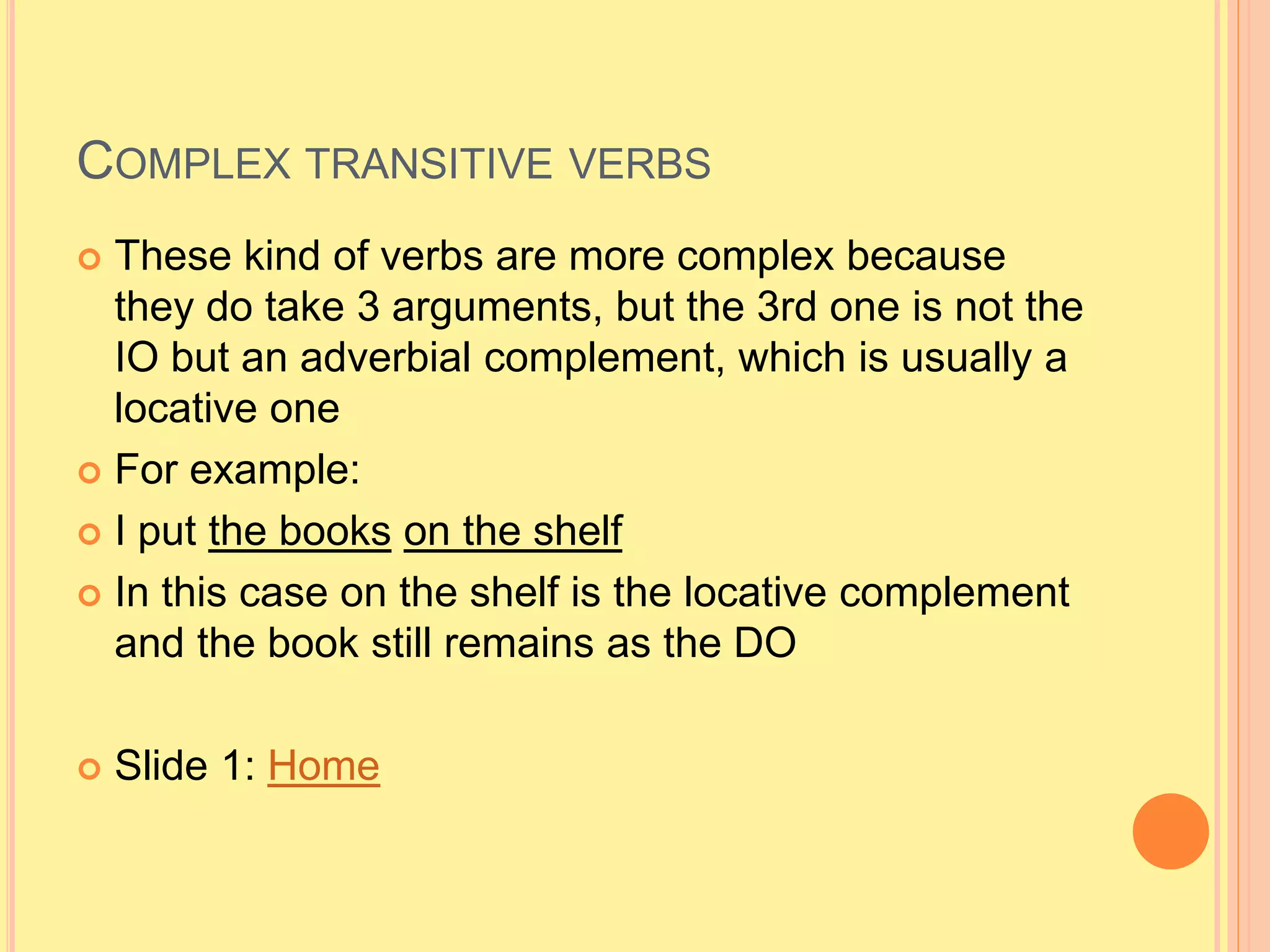
COMPLEX TRANSITIVE VERBS
 These kind of verbs are more complex because
they do take 3 arguments, but the 3rd one is not the
IO but an adverbial complement, which is usually a
locative one
 For example:
 I put the books on the shelf
 In this case on the shelf is the locative complement
and the book still remains as the DO
 Slide 1: Home
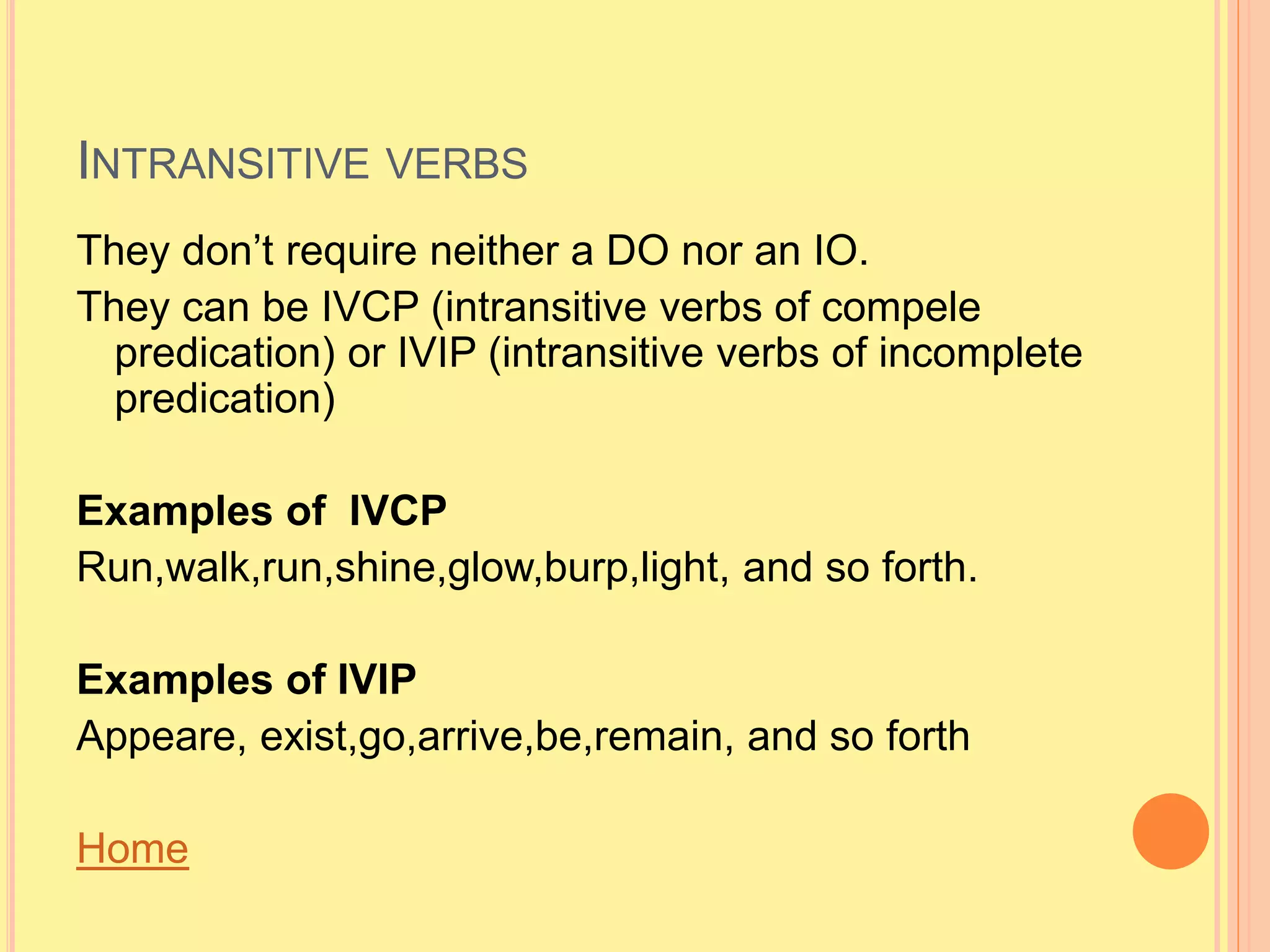
INTRANSITIVE VERBS
They don’t require neither a DO nor an IO.
They can be IVCP (intransitive verbs of compele
predication) or IVIP (intransitive verbs of incomplete
predication)
Examples of IVCP
Run,walk,run,shine,glow,burp,light, and so forth.
Examples of IVIP
Appeare, exist,go,arrive,be,remain, and so forth
Home
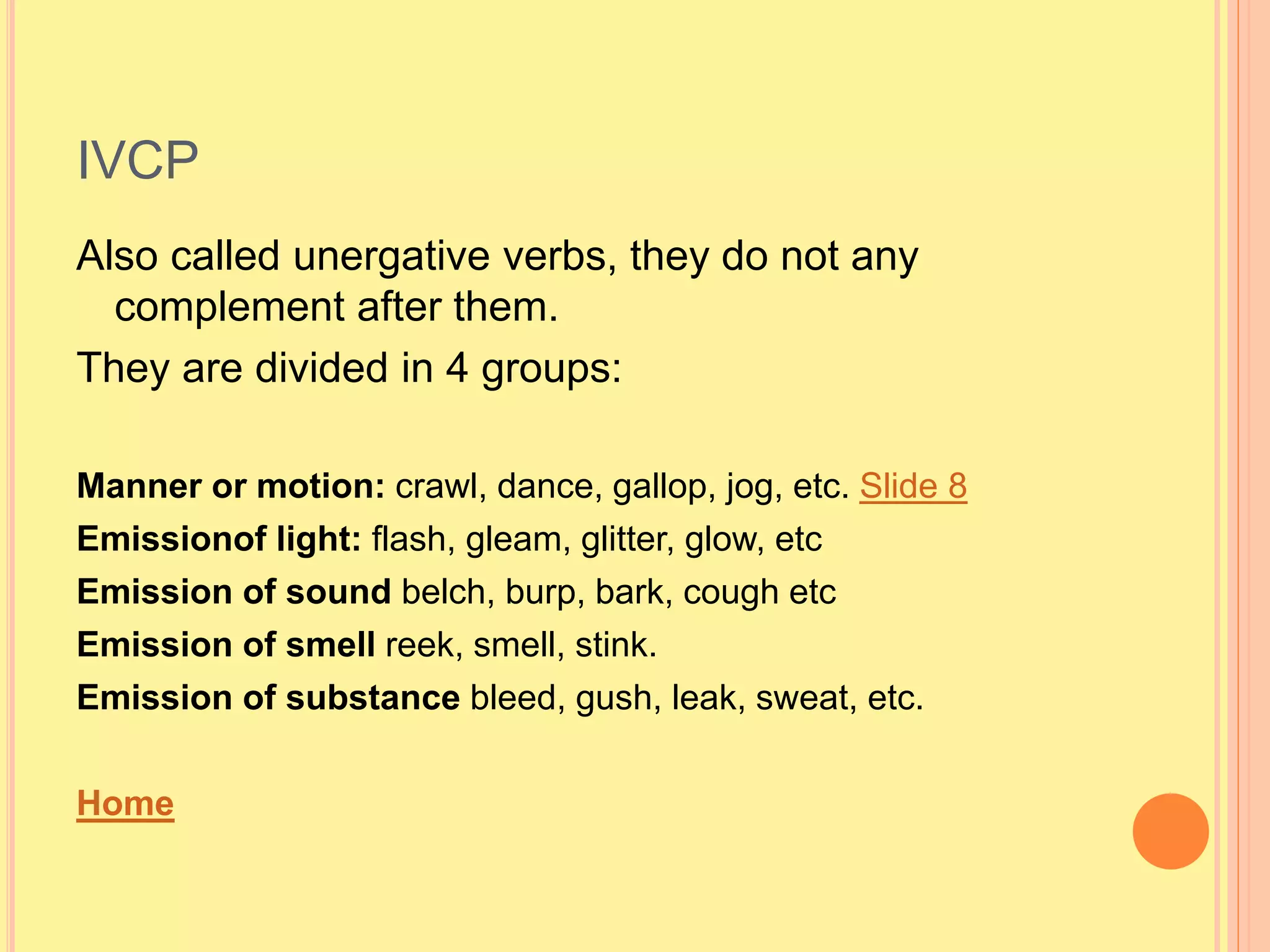
IVCP
Also called unergative verbs, they do not any
complement after them.
They are divided in 4 groups:
Manner or motion: crawl, dance, gallop, jog, etc. Slide 8
Emissionof light: flash, gleam, glitter, glow, etc
Emission of sound belch, burp, bark, cough etc
Emission of smell reek, smell, stink.
Emission of substance bleed, gush, leak, sweat, etc.
Home
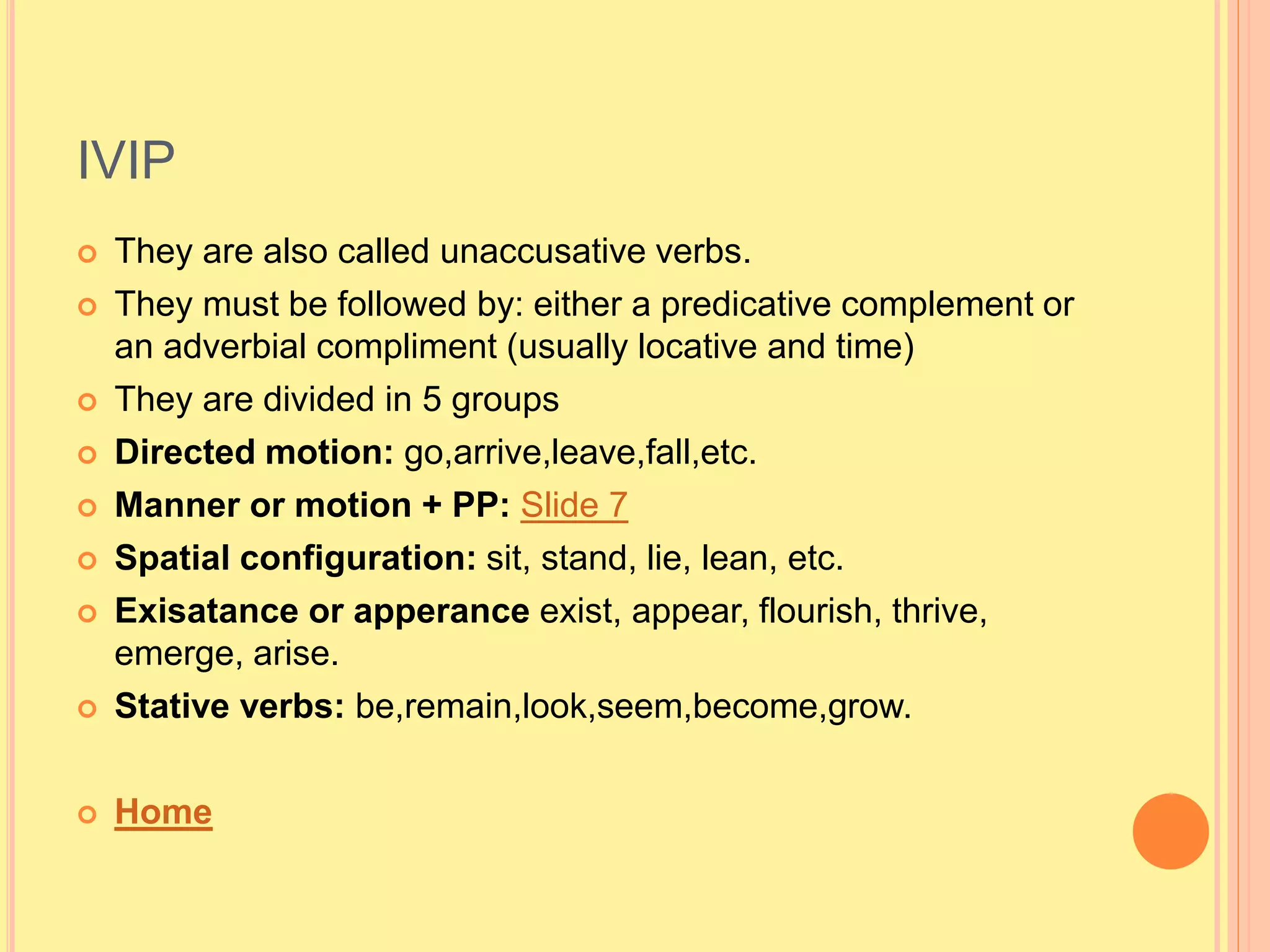
IVIP
 They are also called unaccusative verbs.
 They must be followed by: either a predicative complement or
an adverbial compliment (usually locative and time)
 They are divided in 5 groups
 Directed motion: go,arrive,leave,fall,etc.
 Manner or motion + PP: Slide 7
 Spatial configuration: sit, stand, lie, lean, etc.
 Exisatance or apperance exist, appear, flourish, thrive,
emerge, arise.
 Stative verbs: be,remain,look,seem,become,grow.
 Home

Syntactic clasification of verbs

  • 1.
    SYNTACTIC CLASIFICATION OF VERBS Slide2: Transitive verbs Slide 3:Monotransitive verbs Slide 4: Bitransitive verbs Slide 5: Complex transitive verbs Slide 6: Intransitive verbs Slide 7: IVCP Slide 8: IVIP
  • 2.
    MONO TRANSITIVE VERBS Theyrequire only a direct object. They cannot take and indirect one because we use it as the reciever of the action that the direct object gives. For example: Rob- someone robbed the national bank In this case the direct object is the national bank so we say that this verb is monotransitive. Slide 1: Home
  • 3.
    TRANSITIVE VERBS  Wecall transitive verbs to those verbs that require:  Direct object  Indirect object  Adverbial compliments  Slide 1: Home
  • 4.
    BITRANSITIVE VERBS  Theycan take direct object + indirect object or the other way around.  DO+ IO I gave the book to peter.  IO + DO I gave peter the book.  Peter is the IO or to peter in the case of the first sentence, whereas the book is the direct object.  Slide 1: Home
  • 5.
    COMPLEX TRANSITIVE VERBS These kind of verbs are more complex because they do take 3 arguments, but the 3rd one is not the IO but an adverbial complement, which is usually a locative one  For example:  I put the books on the shelf  In this case on the shelf is the locative complement and the book still remains as the DO  Slide 1: Home
  • 6.
    INTRANSITIVE VERBS They don’trequire neither a DO nor an IO. They can be IVCP (intransitive verbs of compele predication) or IVIP (intransitive verbs of incomplete predication) Examples of IVCP Run,walk,run,shine,glow,burp,light, and so forth. Examples of IVIP Appeare, exist,go,arrive,be,remain, and so forth Home
  • 7.
    IVCP Also called unergativeverbs, they do not any complement after them. They are divided in 4 groups: Manner or motion: crawl, dance, gallop, jog, etc. Slide 8 Emissionof light: flash, gleam, glitter, glow, etc Emission of sound belch, burp, bark, cough etc Emission of smell reek, smell, stink. Emission of substance bleed, gush, leak, sweat, etc. Home
  • 8.
    IVIP  They arealso called unaccusative verbs.  They must be followed by: either a predicative complement or an adverbial compliment (usually locative and time)  They are divided in 5 groups  Directed motion: go,arrive,leave,fall,etc.  Manner or motion + PP: Slide 7  Spatial configuration: sit, stand, lie, lean, etc.  Exisatance or apperance exist, appear, flourish, thrive, emerge, arise.  Stative verbs: be,remain,look,seem,become,grow.  Home