Innovative and Effective
Approaches in
Inclusive Education
MULTIPLE INTELLIGENCE THEORY
Theory of multiple intelligences
 encompasses the idea that all people have a unique profile of
abilities, natural or learned, in which they are proficient and
these are rarely the same as other people
 requires the promotion of an inclusive classroom through the
use of teaching strategies that will incorporate all students’
strengths and needs
Howard Gardner’s theory of multiple
intelligences
 students should be seen as a set of abilities, talents
or mental skills, which we call intelligences
 students learn, and should be taught, in a variety of
ways
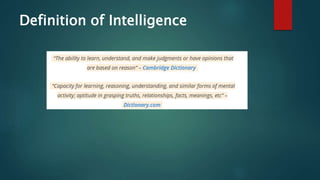
Definition of Intelligence
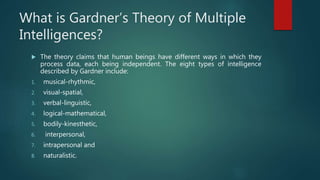
What is Gardner’s Theory of Multiple
Intelligences?
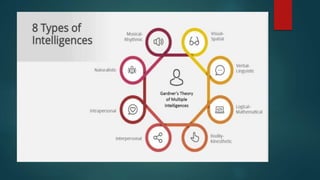
 The theory claims that human beings have different ways in which they
process data, each being independent. The eight types of intelligence
described by Gardner include:
1. musical-rhythmic,
2. visual-spatial,
3. verbal-linguistic,
4. logical-mathematical,
5. bodily-kinesthetic,
6. interpersonal,
7. intrapersonal and
8. naturalistic.
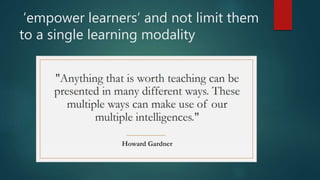
’empower learners’ and not limit them
to a single learning modality
1. Musical-Rhythmic
 According to Gardner, people who possess a high
degree of musical intelligence have good thinking in
rhythms, sounds, or patterns. Therefore, a person
with higher musical-rhythmic intelligence can be a
good musician, conductor, composer, singer, etc.
2. Visual-Spatial
 People who possess better visual-spatial intelligence
can visualize objects better, such as images,
illustrations, maps, charts, videos, and the like. A few
examples of suitable professions for such people
might include working as an architect, photographer,
interior designer, etc.
3. Verbal-Linguistic
 When we look at teachers, writers, public speakers,
newscasters, and actors, we usually see people with a
high degree of verbal-linguistic intelligence. This type
of intelligence enables people to master the use of
words, both verbally and in written form.
4. Logical-Mathematical
 Some people can solve complex math problems in
minutes or even seconds, whereas; others find it hard
to grasp them even after spending a long time
pondering how they work. A high degree of logical-
mathematical intelligence makes it possible for some
people to be good at logical and mathematical skills,
ranging from scientists to mathematicians and
accountants.
5. Bodily-Kinesthetic
 Farmers, mechanics, carpenters, dancers, and athletes
possess good hand-eye coordination and agility.
According to Gardner’s model, such people have high
bodily-kinesthetic intelligence.
6. Interpersonal
 People with good interpersonal intelligence are
proficient at coaching, customer service, mental
health counseling, sales, etc. This type of intelligence
enables better public dealing, as these people can
better evaluate other people’s emotions, moods,
desires, and motivations.
7. Intrapersonal
 People with better intrapersonal intelligence like to
better understand and evaluate their own emotions,
motivations, and relationship with others. Someone
with a high degree of intelligence can be a good
author, philosopher, or entrepreneur. Better
intrapersonal intelligence leads to introspection. Self-
evaluation can enable people to explore their
philosophical side and explore things from a lens that
gives them depth in understanding things.
8. Naturalistic
 Biologists, gardeners, farmers, animal trainers, and
geologists have an in-depth understanding of nature.
These people have real intelligence that allows them
to be in tune with nature.
Inclusion
 Inclusion is defined as a set of beliefs and practices indicating that all
children should be educated, regardless of differences.
 An inclusive classroom is one that caters for all students’ diverse
educational needs.
 Inclusivity is important as it contributes to eliminating tension, competition
and pressure.
 This will help students further develop, both academically and emotionally.
 An inclusive classroom promotes a positive emotional environment for
students, thus enhancing students’ emotional development by making
them feel comfortable, happy and more confident.
Differentiation for inclusion
 Differentiation involves teachers adjusting the learning environment,
teaching style and curriculum content “to fulfil our responsibility to reach
and teach all of the diverse learners in our classroom”.
 To differentiate, the teacher must make modifications to the content that
is delivered, the process of how it is delivered and the overall product.
 The learning environment should be differentiated to change the pace of
how things are delivered, create activities that are challenging in order to
push students, be relevant to students and be flexible and varied.
Importance of using MI theory to
create an inclusive classroom
 Linguistic intelligence (words and language people use) – brainstorm, in peer groups,
the roles of the different characters and their characteristics.
 Logical-mathematical intelligence – classify and categorise the characters, based on
visual characteristics.
 Spatial intelligence – using the characteristics that have been outlined, draw a visual
description of the characters identified in the visual storyline.
 Bodily-kinesthetic intelligence – classroom theatre
 Musical intelligence – create mood music
 Interpersonal intelligence – using peer sharing and cooperative groups, students
brainstorm what the book cover suggests about the characters.
 Intrapersonal intelligence – individual time to create connections between how students
view the characters prior to peer sharing and how differing views have helped them
create a whole picture of the characters.
 Naturalistic intelligence (discriminate between living things) – students are asked to
look at the relationship between the people in the story and compare these to people
they know.
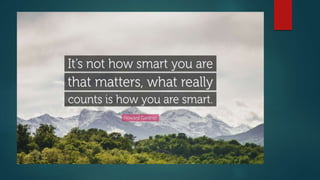
Gardner

Gardner

  • 1.
    Innovative and Effective Approachesin Inclusive Education MULTIPLE INTELLIGENCE THEORY
  • 2.
    Theory of multipleintelligences  encompasses the idea that all people have a unique profile of abilities, natural or learned, in which they are proficient and these are rarely the same as other people  requires the promotion of an inclusive classroom through the use of teaching strategies that will incorporate all students’ strengths and needs
  • 3.
    Howard Gardner’s theoryof multiple intelligences  students should be seen as a set of abilities, talents or mental skills, which we call intelligences  students learn, and should be taught, in a variety of ways
  • 4.
  • 5.
    What is Gardner’sTheory of Multiple Intelligences?  The theory claims that human beings have different ways in which they process data, each being independent. The eight types of intelligence described by Gardner include: 1. musical-rhythmic, 2. visual-spatial, 3. verbal-linguistic, 4. logical-mathematical, 5. bodily-kinesthetic, 6. interpersonal, 7. intrapersonal and 8. naturalistic.
  • 6.
    ’empower learners’ andnot limit them to a single learning modality
  • 8.
    1. Musical-Rhythmic  Accordingto Gardner, people who possess a high degree of musical intelligence have good thinking in rhythms, sounds, or patterns. Therefore, a person with higher musical-rhythmic intelligence can be a good musician, conductor, composer, singer, etc.
  • 9.
    2. Visual-Spatial  Peoplewho possess better visual-spatial intelligence can visualize objects better, such as images, illustrations, maps, charts, videos, and the like. A few examples of suitable professions for such people might include working as an architect, photographer, interior designer, etc.
  • 10.
    3. Verbal-Linguistic  Whenwe look at teachers, writers, public speakers, newscasters, and actors, we usually see people with a high degree of verbal-linguistic intelligence. This type of intelligence enables people to master the use of words, both verbally and in written form.
  • 11.
    4. Logical-Mathematical  Somepeople can solve complex math problems in minutes or even seconds, whereas; others find it hard to grasp them even after spending a long time pondering how they work. A high degree of logical- mathematical intelligence makes it possible for some people to be good at logical and mathematical skills, ranging from scientists to mathematicians and accountants.
  • 12.
    5. Bodily-Kinesthetic  Farmers,mechanics, carpenters, dancers, and athletes possess good hand-eye coordination and agility. According to Gardner’s model, such people have high bodily-kinesthetic intelligence.
  • 13.
    6. Interpersonal  Peoplewith good interpersonal intelligence are proficient at coaching, customer service, mental health counseling, sales, etc. This type of intelligence enables better public dealing, as these people can better evaluate other people’s emotions, moods, desires, and motivations.
  • 14.
    7. Intrapersonal  Peoplewith better intrapersonal intelligence like to better understand and evaluate their own emotions, motivations, and relationship with others. Someone with a high degree of intelligence can be a good author, philosopher, or entrepreneur. Better intrapersonal intelligence leads to introspection. Self- evaluation can enable people to explore their philosophical side and explore things from a lens that gives them depth in understanding things.
  • 15.
    8. Naturalistic  Biologists,gardeners, farmers, animal trainers, and geologists have an in-depth understanding of nature. These people have real intelligence that allows them to be in tune with nature.
  • 16.
    Inclusion  Inclusion isdefined as a set of beliefs and practices indicating that all children should be educated, regardless of differences.  An inclusive classroom is one that caters for all students’ diverse educational needs.  Inclusivity is important as it contributes to eliminating tension, competition and pressure.  This will help students further develop, both academically and emotionally.  An inclusive classroom promotes a positive emotional environment for students, thus enhancing students’ emotional development by making them feel comfortable, happy and more confident.
  • 17.
    Differentiation for inclusion Differentiation involves teachers adjusting the learning environment, teaching style and curriculum content “to fulfil our responsibility to reach and teach all of the diverse learners in our classroom”.  To differentiate, the teacher must make modifications to the content that is delivered, the process of how it is delivered and the overall product.  The learning environment should be differentiated to change the pace of how things are delivered, create activities that are challenging in order to push students, be relevant to students and be flexible and varied.
  • 18.
    Importance of usingMI theory to create an inclusive classroom  Linguistic intelligence (words and language people use) – brainstorm, in peer groups, the roles of the different characters and their characteristics.  Logical-mathematical intelligence – classify and categorise the characters, based on visual characteristics.  Spatial intelligence – using the characteristics that have been outlined, draw a visual description of the characters identified in the visual storyline.  Bodily-kinesthetic intelligence – classroom theatre  Musical intelligence – create mood music  Interpersonal intelligence – using peer sharing and cooperative groups, students brainstorm what the book cover suggests about the characters.  Intrapersonal intelligence – individual time to create connections between how students view the characters prior to peer sharing and how differing views have helped them create a whole picture of the characters.  Naturalistic intelligence (discriminate between living things) – students are asked to look at the relationship between the people in the story and compare these to people they know.