Intelligence Types
Test
Presentation by Ilona Jerabek, PhD


                                     1
Workshop Plan
       Introduction
       Intelligence Types Test
             Theoretical background
             Overview of the factors covered by the assessment
             Managing people according to their dominant intelligence type
                 Work assignment based on one’s strengths
                 Communicating information based on intelligence type
                 Coaching others to understand and make the most of their learning and information
                  processing style
             Validation of the Intelligence Types Test
                 Summary of results from studies
                 Tidbits and insights
       Integrating results from the Career Motivation Test and the Intelligence
        Types Test
       Question period


                                                                                                  2
Introduction
   The theory of multiple intelligences is based on work by Howard Earl
    Gardner (Harvard University)
   It was introduced in 1983 in Frames of Mind: The Theory of Multiple
    Intelligences
   Traditional types of intelligence, such as fluid and crystallized IQ,
    the g-factor, logic IQ, etc. fail to fully explain cognitive ability.
   Traditional definitions of intelligence are lacking in ability to fully
    explain performance outcomes.
   The theory explores various forms or expressions of intelligence
    available to cognition
   Each individual manifests varying levels of different intelligences.


                                                                          3
Criteria for inclusion
   Criteria for inclusion of an intelligence type are
     the  potential for brain isolation by brain damage,
     its place in evolutionary history,
     the presence of core operations,
     susceptibility to encoding (symbolic expression),
     a distinct developmental progression,
     the existence of idiot-savants, prodigies and other
      exceptional people,
     support from experimental psychology and
      psychometric findings.


                                                            4
The 8 + 1 Intelligence Types
   Spatial
   Linguistic
   Logical-mathematical
   Bodily-Kinesthetic
   Musical
   Interpersonal
   Intrapersonal
   Naturalistic
   (Existential )

                               5
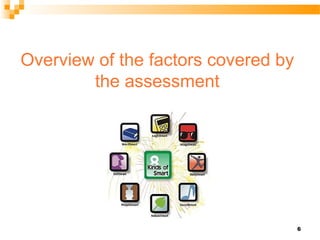
Overview of the factors covered by
        the assessment


                                     6
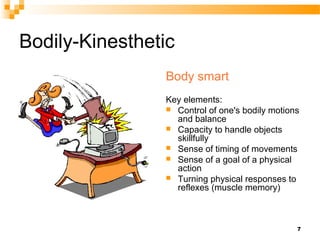
Bodily-Kinesthetic
                Body smart
                Key elements:
                 Control of one's bodily motions
                  and balance
                 Capacity to handle objects
                  skillfully
                 Sense of timing of movements
                 Sense of a goal of a physical
                  action
                 Turning physical responses to
                  reflexes (muscle memory)


                                                7
Bodily-Kinesthetic
Usually good at                  Learning/coaching tips
 Athletics                       They process knowledge

 Performing arts (dancers,
                                   through bodily sensations.
                                  They learn best by doing
  actors, musicians)               something physically, acting it
 Crafts                           out, or physically interacting
 Trades                           with others.
                                  New knowledge should be
 Manual labor & tools
                                   linked with real life examples.
 Protective services (police,
                                  Move around. Pace and recite
  firefighters, soldiers)          when learning.
 Medical services (surgeons,     Teach material to someone
  doctors, lab workers)            else


                                                                 8
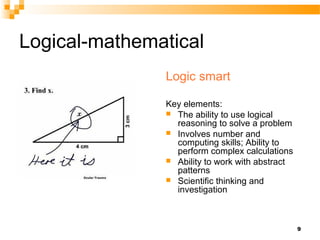
Logical-mathematical
               Logic smart

               Key elements:
                The ability to use logical
                 reasoning to solve a problem
                Involves number and
                 computing skills; Ability to
                 perform complex calculations
                Ability to work with abstract
                 patterns
                Scientific thinking and
                 investigation


                                                 9
Logical-Mathematical
Usually good at                                Learning/coaching tips
 Math, arithmetic, solving mysteries and       Make charts and graphs of new
   logic problems                                 information
 Proposing and testing hypotheses
                                                Classify and categorize notes
 Finding patterns, categories, logical
                                                Use flowcharts and diagrams
   relationships – figuring our “algorithms”
 Using abstract, symbolic thought              Use rational, logical arguments when
 Sequential reasoning                            trying to persuade them
 Inductive and deductive thinking              Use if-then scenarios
 Solving complex problems                      Write short summaries
 Strategy games                                Take time to think about new info,
 Keeping things in order                         considering cause-effect and other
 Figuring out how things work                    logical relationships
 IT-related stuff
 Science
 Detective work


                                                                                    10
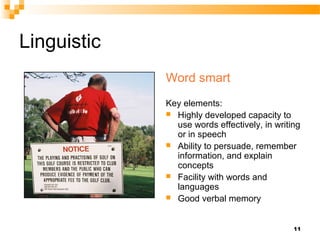
Linguistic
             Word smart
             Key elements:
              Highly developed capacity to
               use words effectively, in writing
               or in speech
              Ability to persuade, remember
               information, and explain
               concepts
              Facility with words and
               languages
              Good verbal memory


                                              11
Linguistic
Usually good at                       Learning/coaching tips
 Writing & reading – have a way       Take detailed notes
   with words                          Keep learning journal and
 Story-telling                          elaborate on your thoughts about
 Debating and arguing                   learned material
 Explaining things                    Create flash cards to memorize
 Vocabulary (enjoy learning new         material
                                       Rewrite notes
   words)
 Public speaking, journalism          Create outlines
 Cross-word puzzles                   Talk about what you think about a
 Learning new languages                 problem or solution
                                       Recite or rephrase information you
 Often also interpersonal learners
                                         need to retain
                                       Be the note taker/editor in group
                                         project


                                                                        12
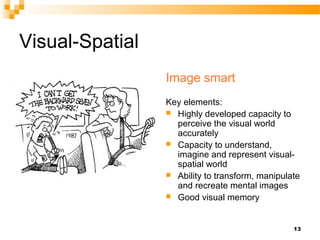
Visual-Spatial
                 Image smart
                 Key elements:
                  Highly developed capacity to
                   perceive the visual world
                   accurately
                  Capacity to understand,
                   imagine and represent visual-
                   spatial world
                  Ability to transform, manipulate
                   and recreate mental images
                  Good visual memory


                                                 13
Visual-Spatial
Usually good at                                   Learning/coaching tips
 Mazes & jigsaw puzzles                           Create mental maps of new concepts
 Geometry                                         Create conceptual maps (mind maps)
 Noticing details in patterns and images          Create charts and graphs to visualize
 Fine arts, drawing & doodling                      information
 Navigation and spatial orientation               Create flowcharts, diagrams and
 Thinking in 3D                                     timelines
                                                   Draw pictures alongside with notes
 Mental imagery
                                                   Color-code notes
 Hand-eye coordination
                                                   Use flash cards
 Image manipulation
                                                   Visualize goals
 Graphical skills
                                                   Learn by watching an instructional
 Work requiring spatial orientation
                                                     video
   (pilots, sailors, architects, truck driving)
                                                   Make outlines when writing

Drawbacks:
 Not great at retaining spoken words
   and ideas

                                                                                        14
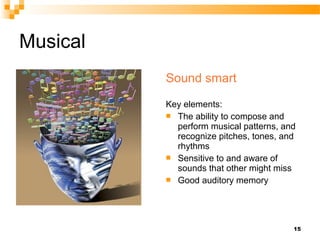
Musical
          Sound smart

          Key elements:
           The ability to compose and
            perform musical patterns, and
            recognize pitches, tones, and
            rhythms
           Sensitive to and aware of
            sounds that other might miss
           Good auditory memory


                                        15
Musical
Usually good at                        Learning/coaching tips
 Ear for music - discerning rhythm,    Listen to music when learning or
   pitch, timber, and tone                working (instrumental music is
 Producing music - playing               less distracting)
   instruments, vocalization,           Create rhythmical rhymes or
   composing, conducting                  mnemonics to remember
 Musical memory – recognition,           information
   creation, reproduction of music,     Auditory learners – hearing
   and reflection on music                something is remembered more
 Awareness of sounds others might        than seeing it
   miss                                 Beat out rhythms when learning
 Often good at logic & math            Take breaks and listen to music
 Sensitive listening to others
 Learning accent in foreign
   languages


                                                                            16
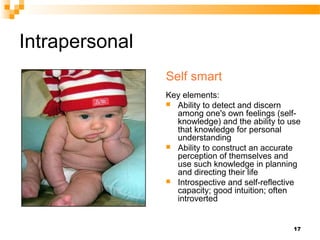
Intrapersonal
                Self smart
                Key elements:
                 Ability to detect and discern
                  among one's own feelings (self-
                  knowledge) and the ability to use
                  that knowledge for personal
                  understanding
                 Ability to construct an accurate
                  perception of themselves and
                  use such knowledge in planning
                  and directing their life
                 Introspective and self-reflective
                  capacity; good intuition; often
                  introverted


                                                 17
Intrapersonal
Usually good at                        Learning/coaching tips
 Thinking and reflection               Process information alone when
 Awareness of their feeling              learning new things
 Self-motivation                       Brainstorm on your own first
 Complex ideas and problems            Keep personal notes along with
 Critical analysis                       original material
                                        Related new material to personal
 Deconstructing arguments
                                          experiences
 Psychology, philosophy, theology
                                        Take time to reflect and ponder the
                                          complexity of issues
Downside                                Don’t rush them into action; they need
 Rumination                              to process information and fully
 Getting lost in one’s thoughts          understand before they get going
 Daydreaming                           Watch out for time management and

 Self-criticism and second-guessing      project creep
   oneself


                                                                             18
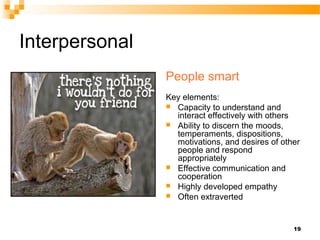
Interpersonal
                People smart
                Key elements:
                 Capacity to understand and
                  interact effectively with others
                 Ability to discern the moods,
                  temperaments, dispositions,
                  motivations, and desires of other
                  people and respond
                  appropriately
                 Effective communication and
                  cooperation
                 Highly developed empathy
                 Often extraverted


                                                 19
Interpersonal
Usually good at                  Learning/coaching tips
 Leadership                      Learn new things in groups (study
 Communication                     groups, project kickoff meetings).
 Brainstorming                   Problem-solve in groups
 Reading people                    (brainstorming, bouncing ideas off
                                    others)
 Social insight and empathy –
                                  Assign them to projects that
   reading social dynamics          require significant team work
 Social skills
                                  Get them actively involved in
 “Mind-reading”
                                    brainstorming sessions
 Supporting others               Appoint them to even planning
 Social sciences                   committees
 Teaching, training, coaching    Don’t put them into positions
 Politics                          where they would feel isolated,
 Social work                       unless they also have high
                                    intrapersonal intelligence


                                                                    20
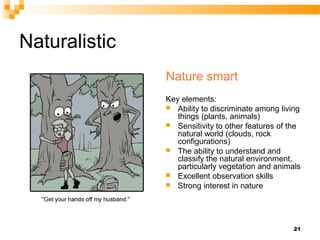
Naturalistic
               Nature smart
               Key elements:
                Ability to discriminate among living
                  things (plants, animals)
                Sensitivity to other features of the
                  natural world (clouds, rock
                  configurations)
                The ability to understand and
                  classify the natural environment,
                  particularly vegetation and animals
                Excellent observation skills
                Strong interest in nature


                                                   21
Naturalistic
Usually good at                  Learning/coaching tips
 Categorizing things             Learn outside whenever
 Understanding anything to do     possible
  with nature                     Classify things into categories
 Being in tune with nature
                                  Relate abstract information to
 Have a way with animals
                                   something concrete in nature
 Environmental sciences
                                  Take breaks and go for a walk,
 Agriculture
                                   play with an animal or watch a
 Geology & mineralogy
                                   nature video
 Meteorology & astronomy
                                  Use nature as a reward when
 Zoology & oceanography
                                   you accomplish a goal
 Botany


                                                                22
Validation study

Highlights and Tidbits


                         23
Sample description
   Sample size: 10,135 subjects

   Gender
      Women:                  5463 subjects (54%)
      Men:                    3595 subjects (35%)
      Unknown gender:         1077 subjects (11%)

   Age distribution:
        Below 17 (n = 2984)   (29.0 %)
        18-24 (n = 2933)      (29.0 %)
        25-29 (n = 1073)      (11.0 %)
        30-39 (n = 1191)      (12.0 %)
        40+ (n = 1091)        (11.0 %)
        Unknown (n = 863)     (8.0 %)


                                                     24
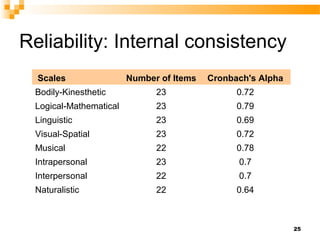
Reliability: Internal consistency
  Scales                Number of Items   Cronbach's Alpha
 Bodily-Kinesthetic           23                0.72
 Logical-Mathematical         23                0.79
 Linguistic                   23                0.69
 Visual-Spatial               23                0.72
 Musical                      22                0.78
 Intrapersonal                23                0.7
 Interpersonal                22                0.7
 Naturalistic                 22                0.64


                                                             25
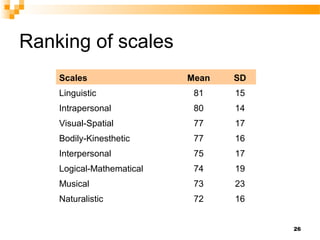
Ranking of scales
    Scales                 Mean   SD
    Linguistic              81    15
    Intrapersonal           80    14
    Visual-Spatial          77    17
    Bodily-Kinesthetic      77    16
    Interpersonal           75    17
    Logical-Mathematical    74    19
    Musical                 73    23
    Naturalistic            72    16


                                       26
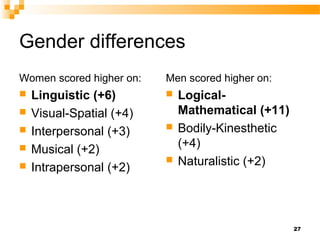
Gender differences
Women scored higher on:   Men scored higher on:
   Linguistic (+6)          Logical-
   Visual-Spatial (+4)       Mathematical (+11)
   Interpersonal (+3)       Bodily-Kinesthetic
   Musical (+2)              (+4)
   Intrapersonal (+2)
                             Naturalistic (+2)


                                                   27
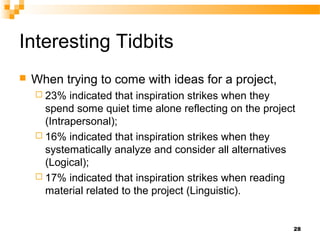
Interesting Tidbits
   When trying to come with ideas for a project,
     23%   indicated that inspiration strikes when they
      spend some quiet time alone reflecting on the project
      (Intrapersonal);
     16% indicated that inspiration strikes when they
      systematically analyze and consider all alternatives
      (Logical);
     17% indicated that inspiration strikes when reading
      material related to the project (Linguistic).


                                                          28
Interesting Tidbits
   When asked “Imagine you had to perform a new
    job for just one week. Which of the following
    positions could you most imagine yourself
    pulling off?” the top three jobs were
     Manager  (40%),
     Philosopher/Psychologist (40%).
     Athlete/Dancer/Actor (30%),
     The least likely job was Meteorologist, at 14%.


                                                        29
Interesting Tidbits
   84% indicated that the best way for them to
    learn something new is to try it on their own –
    this makes hands-on experience during the
    onboarding process essential!
   Top subjects in school:
     46% chose Reading comprehension and writing
     44% chose Math and/or Computer Science
     39% chose Biology/Science
     Music came in last with 24%.


                                                      30
Interesting Tidbits
   Birds of a feather…
     Bodily-Kinesthetic  intelligence was most closely
      correlated with Naturalistic intelligence.
     Logical-Mathematical, Linguistic, and Naturalistic
      intelligence were all closely correlated with
      Intrapersonal intelligence.
     Visual-Spatial intelligence was most closely correlated
      with Musical and Naturalistic intelligence.


                                                           31
Interesting Tidbits
   What do grades got to do with it?
     Those   who attained average grades in school scored
      highest on Bodily-Kinesthetic intelligence.
     Those who did well in school scored highest on
      Logical-Mathematical, Linguistic, Visual-Spatial,
      Intrapersonal, Naturalistic, and Musical intelligence.
     And just to show that studying non-stop isn’t always
      ideal: those with top grades had one of the lowest
      scores on Interpersonal intelligence.


                                                           32
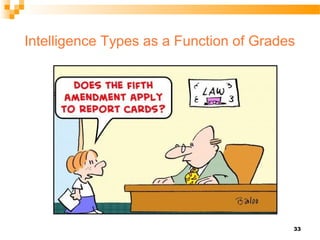
Intelligence Types as a Function of Grades


                                         33
Logical-Mathematical as a Function of Grades


                                               34
Linguistic as a Function of Grades


                                     35
Visual-Spatial as a Function of Grades


                                         36
Bodily-Kinesthetic as a Function of Grades


                                             37
Intrapersonal as a Function of Grades


                                        38
Interpersonal as a Function of Grades


                                        39
Naturalistic as a Function of Grades


                                       40
Intelligence Types as a Function of Position


                                           41
Bodily-Kinesthetic as a Function of Position


                                               42
Logical-Mathematical as a Function of Position


                                             43
Linguistic as a Function of Position


                                       44
Musical as a Function of Position


                                    45
Intrapersonal as a Function of Position


                                          46
Interpersonal as a Function of Position


                                          47
Naturalistic as a Function of Position


                                         48
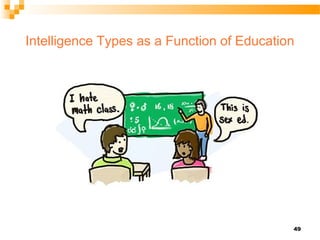
Intelligence Types as a Function of Education


                                            49
Logical-Mathematical Scale as a Function of
Education


                                              50
Linguistic Scale as a Function of Education


                                              51
Intrapersonal Scale as a Function of Education


                                             52
Interpersonal Scale as a Function of Education


                                             53
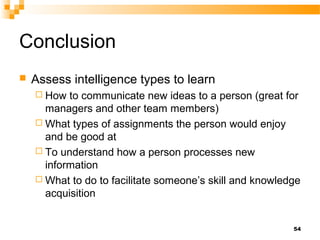
Conclusion
   Assess intelligence types to learn
     How  to communicate new ideas to a person (great for
      managers and other team members)
     What types of assignments the person would enjoy
      and be good at
     To understand how a person processes new
      information
     What to do to facilitate someone’s skill and knowledge
      acquisition


                                                          54
Ilona Jerabek, PhD
9001 blvd. de l’Acadie, Suite 802
    Montreal, Qc H4N 3H5

      ilona@psychtests.com
Direct line: 514-745-3189, ext 112
         Fax: 514-745-6242

      http://archprofile.com
   http://www.psychtests.com


                                     55

Intelligence Types Test

  • 1.
  • 2.
    Workshop Plan  Introduction  Intelligence Types Test  Theoretical background  Overview of the factors covered by the assessment  Managing people according to their dominant intelligence type  Work assignment based on one’s strengths  Communicating information based on intelligence type  Coaching others to understand and make the most of their learning and information processing style  Validation of the Intelligence Types Test  Summary of results from studies  Tidbits and insights  Integrating results from the Career Motivation Test and the Intelligence Types Test  Question period 2
  • 3.
    Introduction  The theory of multiple intelligences is based on work by Howard Earl Gardner (Harvard University)  It was introduced in 1983 in Frames of Mind: The Theory of Multiple Intelligences  Traditional types of intelligence, such as fluid and crystallized IQ, the g-factor, logic IQ, etc. fail to fully explain cognitive ability.  Traditional definitions of intelligence are lacking in ability to fully explain performance outcomes.  The theory explores various forms or expressions of intelligence available to cognition  Each individual manifests varying levels of different intelligences. 3
  • 4.
    Criteria for inclusion  Criteria for inclusion of an intelligence type are  the potential for brain isolation by brain damage,  its place in evolutionary history,  the presence of core operations,  susceptibility to encoding (symbolic expression),  a distinct developmental progression,  the existence of idiot-savants, prodigies and other exceptional people,  support from experimental psychology and psychometric findings. 4
  • 5.
    The 8 +1 Intelligence Types  Spatial  Linguistic  Logical-mathematical  Bodily-Kinesthetic  Musical  Interpersonal  Intrapersonal  Naturalistic  (Existential ) 5
  • 6.
    Overview of thefactors covered by the assessment 6
  • 7.
    Bodily-Kinesthetic Body smart Key elements:  Control of one's bodily motions and balance  Capacity to handle objects skillfully  Sense of timing of movements  Sense of a goal of a physical action  Turning physical responses to reflexes (muscle memory) 7
  • 8.
    Bodily-Kinesthetic Usually good at Learning/coaching tips  Athletics  They process knowledge  Performing arts (dancers, through bodily sensations.  They learn best by doing actors, musicians) something physically, acting it  Crafts out, or physically interacting  Trades with others.  New knowledge should be  Manual labor & tools linked with real life examples.  Protective services (police,  Move around. Pace and recite firefighters, soldiers) when learning.  Medical services (surgeons,  Teach material to someone doctors, lab workers) else 8
  • 9.
    Logical-mathematical Logic smart Key elements:  The ability to use logical reasoning to solve a problem  Involves number and computing skills; Ability to perform complex calculations  Ability to work with abstract patterns  Scientific thinking and investigation 9
  • 10.
    Logical-Mathematical Usually good at Learning/coaching tips  Math, arithmetic, solving mysteries and  Make charts and graphs of new logic problems information  Proposing and testing hypotheses  Classify and categorize notes  Finding patterns, categories, logical  Use flowcharts and diagrams relationships – figuring our “algorithms”  Using abstract, symbolic thought  Use rational, logical arguments when  Sequential reasoning trying to persuade them  Inductive and deductive thinking  Use if-then scenarios  Solving complex problems  Write short summaries  Strategy games  Take time to think about new info,  Keeping things in order considering cause-effect and other  Figuring out how things work logical relationships  IT-related stuff  Science  Detective work 10
  • 11.
    Linguistic Word smart Key elements:  Highly developed capacity to use words effectively, in writing or in speech  Ability to persuade, remember information, and explain concepts  Facility with words and languages  Good verbal memory 11
  • 12.
    Linguistic Usually good at Learning/coaching tips  Writing & reading – have a way  Take detailed notes with words  Keep learning journal and  Story-telling elaborate on your thoughts about  Debating and arguing learned material  Explaining things  Create flash cards to memorize  Vocabulary (enjoy learning new material  Rewrite notes words)  Public speaking, journalism  Create outlines  Cross-word puzzles  Talk about what you think about a  Learning new languages problem or solution  Recite or rephrase information you  Often also interpersonal learners need to retain  Be the note taker/editor in group project 12
  • 13.
    Visual-Spatial Image smart Key elements:  Highly developed capacity to perceive the visual world accurately  Capacity to understand, imagine and represent visual- spatial world  Ability to transform, manipulate and recreate mental images  Good visual memory 13
  • 14.
    Visual-Spatial Usually good at Learning/coaching tips  Mazes & jigsaw puzzles  Create mental maps of new concepts  Geometry  Create conceptual maps (mind maps)  Noticing details in patterns and images  Create charts and graphs to visualize  Fine arts, drawing & doodling information  Navigation and spatial orientation  Create flowcharts, diagrams and  Thinking in 3D timelines  Draw pictures alongside with notes  Mental imagery  Color-code notes  Hand-eye coordination  Use flash cards  Image manipulation  Visualize goals  Graphical skills  Learn by watching an instructional  Work requiring spatial orientation video (pilots, sailors, architects, truck driving)  Make outlines when writing Drawbacks:  Not great at retaining spoken words and ideas 14
  • 15.
    Musical Sound smart Key elements:  The ability to compose and perform musical patterns, and recognize pitches, tones, and rhythms  Sensitive to and aware of sounds that other might miss  Good auditory memory 15
  • 16.
    Musical Usually good at Learning/coaching tips  Ear for music - discerning rhythm,  Listen to music when learning or pitch, timber, and tone working (instrumental music is  Producing music - playing less distracting) instruments, vocalization,  Create rhythmical rhymes or composing, conducting mnemonics to remember  Musical memory – recognition, information creation, reproduction of music,  Auditory learners – hearing and reflection on music something is remembered more  Awareness of sounds others might than seeing it miss  Beat out rhythms when learning  Often good at logic & math  Take breaks and listen to music  Sensitive listening to others  Learning accent in foreign languages 16
  • 17.
    Intrapersonal Self smart Key elements:  Ability to detect and discern among one's own feelings (self- knowledge) and the ability to use that knowledge for personal understanding  Ability to construct an accurate perception of themselves and use such knowledge in planning and directing their life  Introspective and self-reflective capacity; good intuition; often introverted 17
  • 18.
    Intrapersonal Usually good at Learning/coaching tips  Thinking and reflection  Process information alone when  Awareness of their feeling learning new things  Self-motivation  Brainstorm on your own first  Complex ideas and problems  Keep personal notes along with  Critical analysis original material  Related new material to personal  Deconstructing arguments experiences  Psychology, philosophy, theology  Take time to reflect and ponder the complexity of issues Downside  Don’t rush them into action; they need  Rumination to process information and fully  Getting lost in one’s thoughts understand before they get going  Daydreaming  Watch out for time management and  Self-criticism and second-guessing project creep oneself 18
  • 19.
    Interpersonal People smart Key elements:  Capacity to understand and interact effectively with others  Ability to discern the moods, temperaments, dispositions, motivations, and desires of other people and respond appropriately  Effective communication and cooperation  Highly developed empathy  Often extraverted 19
  • 20.
    Interpersonal Usually good at Learning/coaching tips  Leadership  Learn new things in groups (study  Communication groups, project kickoff meetings).  Brainstorming  Problem-solve in groups  Reading people (brainstorming, bouncing ideas off others)  Social insight and empathy –  Assign them to projects that reading social dynamics require significant team work  Social skills  Get them actively involved in  “Mind-reading” brainstorming sessions  Supporting others  Appoint them to even planning  Social sciences committees  Teaching, training, coaching  Don’t put them into positions  Politics where they would feel isolated,  Social work unless they also have high intrapersonal intelligence 20
  • 21.
    Naturalistic Nature smart Key elements:  Ability to discriminate among living things (plants, animals)  Sensitivity to other features of the natural world (clouds, rock configurations)  The ability to understand and classify the natural environment, particularly vegetation and animals  Excellent observation skills  Strong interest in nature 21
  • 22.
    Naturalistic Usually good at Learning/coaching tips  Categorizing things  Learn outside whenever  Understanding anything to do possible with nature  Classify things into categories  Being in tune with nature  Relate abstract information to  Have a way with animals something concrete in nature  Environmental sciences  Take breaks and go for a walk,  Agriculture play with an animal or watch a  Geology & mineralogy nature video  Meteorology & astronomy  Use nature as a reward when  Zoology & oceanography you accomplish a goal  Botany 22
  • 23.
  • 24.
    Sample description  Sample size: 10,135 subjects  Gender  Women: 5463 subjects (54%)  Men: 3595 subjects (35%)  Unknown gender: 1077 subjects (11%)  Age distribution:  Below 17 (n = 2984) (29.0 %)  18-24 (n = 2933) (29.0 %)  25-29 (n = 1073) (11.0 %)  30-39 (n = 1191) (12.0 %)  40+ (n = 1091) (11.0 %)  Unknown (n = 863) (8.0 %) 24
  • 25.
    Reliability: Internal consistency  Scales Number of Items Cronbach's Alpha Bodily-Kinesthetic 23 0.72 Logical-Mathematical 23 0.79 Linguistic 23 0.69 Visual-Spatial 23 0.72 Musical 22 0.78 Intrapersonal 23 0.7 Interpersonal 22 0.7 Naturalistic 22 0.64 25
  • 26.
    Ranking of scales Scales Mean SD Linguistic 81 15 Intrapersonal 80 14 Visual-Spatial 77 17 Bodily-Kinesthetic 77 16 Interpersonal 75 17 Logical-Mathematical 74 19 Musical 73 23 Naturalistic 72 16 26
  • 27.
    Gender differences Women scoredhigher on: Men scored higher on:  Linguistic (+6)  Logical-  Visual-Spatial (+4) Mathematical (+11)  Interpersonal (+3)  Bodily-Kinesthetic  Musical (+2) (+4)  Intrapersonal (+2)  Naturalistic (+2) 27
  • 28.
    Interesting Tidbits  When trying to come with ideas for a project,  23% indicated that inspiration strikes when they spend some quiet time alone reflecting on the project (Intrapersonal);  16% indicated that inspiration strikes when they systematically analyze and consider all alternatives (Logical);  17% indicated that inspiration strikes when reading material related to the project (Linguistic). 28
  • 29.
    Interesting Tidbits  When asked “Imagine you had to perform a new job for just one week. Which of the following positions could you most imagine yourself pulling off?” the top three jobs were  Manager (40%),  Philosopher/Psychologist (40%).  Athlete/Dancer/Actor (30%),  The least likely job was Meteorologist, at 14%. 29
  • 30.
    Interesting Tidbits  84% indicated that the best way for them to learn something new is to try it on their own – this makes hands-on experience during the onboarding process essential!  Top subjects in school:  46% chose Reading comprehension and writing  44% chose Math and/or Computer Science  39% chose Biology/Science  Music came in last with 24%. 30
  • 31.
    Interesting Tidbits  Birds of a feather…  Bodily-Kinesthetic intelligence was most closely correlated with Naturalistic intelligence.  Logical-Mathematical, Linguistic, and Naturalistic intelligence were all closely correlated with Intrapersonal intelligence.  Visual-Spatial intelligence was most closely correlated with Musical and Naturalistic intelligence. 31
  • 32.
    Interesting Tidbits  What do grades got to do with it?  Those who attained average grades in school scored highest on Bodily-Kinesthetic intelligence.  Those who did well in school scored highest on Logical-Mathematical, Linguistic, Visual-Spatial, Intrapersonal, Naturalistic, and Musical intelligence.  And just to show that studying non-stop isn’t always ideal: those with top grades had one of the lowest scores on Interpersonal intelligence. 32
  • 33.
    Intelligence Types asa Function of Grades 33
  • 34.
    Logical-Mathematical as aFunction of Grades 34
  • 35.
    Linguistic as aFunction of Grades 35
  • 36.
    Visual-Spatial as aFunction of Grades 36
  • 37.
    Bodily-Kinesthetic as aFunction of Grades 37
  • 38.
    Intrapersonal as aFunction of Grades 38
  • 39.
    Interpersonal as aFunction of Grades 39
  • 40.
    Naturalistic as aFunction of Grades 40
  • 41.
    Intelligence Types asa Function of Position 41
  • 42.
    Bodily-Kinesthetic as aFunction of Position 42
  • 43.
    Logical-Mathematical as aFunction of Position 43
  • 44.
    Linguistic as aFunction of Position 44
  • 45.
    Musical as aFunction of Position 45
  • 46.
    Intrapersonal as aFunction of Position 46
  • 47.
    Interpersonal as aFunction of Position 47
  • 48.
    Naturalistic as aFunction of Position 48
  • 49.
    Intelligence Types asa Function of Education 49
  • 50.
    Logical-Mathematical Scale asa Function of Education 50
  • 51.
    Linguistic Scale asa Function of Education 51
  • 52.
    Intrapersonal Scale asa Function of Education 52
  • 53.
    Interpersonal Scale asa Function of Education 53
  • 54.
    Conclusion  Assess intelligence types to learn  How to communicate new ideas to a person (great for managers and other team members)  What types of assignments the person would enjoy and be good at  To understand how a person processes new information  What to do to facilitate someone’s skill and knowledge acquisition 54
  • 55.
    Ilona Jerabek, PhD 9001blvd. de l’Acadie, Suite 802 Montreal, Qc H4N 3H5 ilona@psychtests.com Direct line: 514-745-3189, ext 112 Fax: 514-745-6242 http://archprofile.com http://www.psychtests.com 55