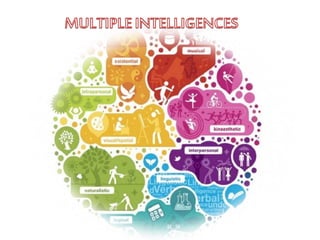
Multiple
Intelligences
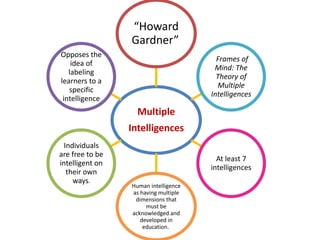
“Howard
Gardner”
Frames of
Mind: The
Theory of
Multiple
Intelligences
At least 7
intelligences
Human intelligence
as having multiple
dimensions that
must be
acknowledged and
developed in
education.
Individuals
are free to be
intelligent on
their own
ways.
Opposes the
idea of
labeling
learners to a
specific
intelligence
The capacity to solve problems or to fashion
products that are valued in one or more
cultural setting. (Gardner & Hatch, 1989).
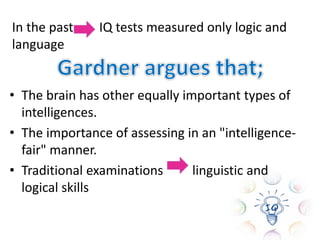
• The brain has other equally important types of
intelligences.
• The importance of assessing in an "intelligence-
fair" manner.
• Traditional examinations linguistic and
logical skills
In the past IQ tests measured only logic and
language
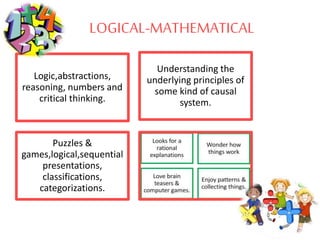
LOGICAL-MATHEMATICAL
Logic,abstractions,
reasoning, numbers and
critical thinking.
Understanding the
underlying principles of
some kind of causal
system.
Puzzles &
games,logical,sequential
presentations,
classifications,
categorizations.
VISUAL-SPATIAL
Aware of their
surroundings and are
good at remembering
images.
Great sense of
direction.
Learn best through
drawings and visual
aids.
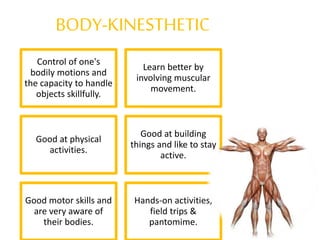
BODY-KINESTHETIC
Control of one's
bodily motions and
the capacity to handle
objects skillfully.
Learn better by
involving muscular
movement.
Good at physical
activities.
Good at building
things and like to stay
active.
Good motor skills and
are very aware of
their bodies.
Hands-on activities,
field trips &
pantomime.
MUSICAL/RHTHMIC
sounds,
rhythms, tones &
music
able to sing, play
musical
instruments, and
compose music.
“auditory” :learn
best via lecture
use songs or
rhythms to
learn
INTERPERSONAL
Interaction with others.
Sensitive to others' moods,
feelings, temperaments and
motivations.
Ability to cooperate in order
to work as part of a group.
(pairwok,project work, group
problem-solving)
Communicate effectively and
empathize easily with others.
Learn best by working with
others and often enjoy
discussion and debate.
Gardner: “sales
persons,politicians,managers
,teachers,counselors,social
workers.
INTRAPERSONAL
Introspective and self-
reflective capacities.
Having a deep
understanding of the
self; strengths/
weaknesses,what makes
one unique.
Being able to predict
one's own
reactions/emotions.
Prefer working alone.
Spends time thinking
and reflecting.
Psychologist,
philosopher,writer,
theologian
Self-evaluation,journal
keeping, options for
home work.
VERBAL-LINGUISTIC
Good at reading,
writing, telling stories
and memorizing words
along with dates
Talented with words.
Ability to teach and
explain things to
others.
Learn best by reading,
taking notes and going
to lectures.
Note taking,story
telling,debates.
Everyone can possess these intelligences.
They are not equally developed.
Teachers create activities which draws
attention of all intelligences-to faciliate lg
acquisition & realize their full potential.
Presenting every intelligence in
every lesson plan is impossible
as the list of intelligences
growing.
For ex:
Gardner
(1999) has
added an 8th
intelligence.
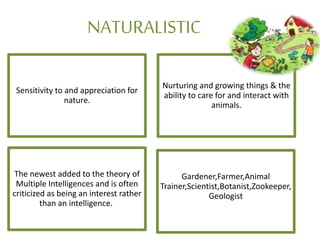
NATURALISTIC
Sensitivity to and appreciation for
nature.
Nurturing and growing things & the
ability to care for and interact with
animals.
The newest added to the theory of
Multiple Intelligences and is often
criticized as being an interest rather
than an intelligence.
Gardener,Farmer,Animal
Trainer,Scientist,Botanist,Zookeeper,
Geologist
EXISTENTIAL
Some proponents of
multiple intelligence theory
proposed spiritual or
religious intelligence as a
possible additional type.
Gardner did not want to
commit to a spiritual
intelligence, but suggested
that an "existential"
intelligence may be a useful
construct.[
Talented with words.
FIND A PERSON WHOSE …INTELLEGENCE IS DOMINANT
How to design a
multiple
intelligences
lesson
There is no goals stated in MI.
There is no syllabus(recommended).
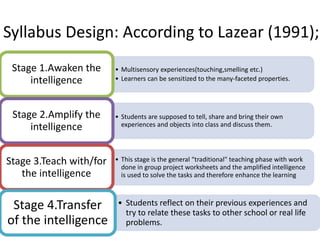
But there is a basic developmental sequence
which can be considered as “syllabus design”.
• Multisensory experiences(touching,smelling etc.)
• Learners can be sensitized to the many-faceted properties.
Stage 1.Awaken the
intelligence
• Students are supposed to tell, share and bring their own
experiences and objects into class and discuss them.
Stage 2.Amplify the
intelligence
• This stage is the general “traditional" teaching phase with work
done in group project worksheets and the amplified intelligence
is used to solve the tasks and therefore enhance the learning
Stage 3.Teach with/for
the intelligence
• Students reflect on their previous experiences and
try to relate these tasks to other school or real life
problems.
Stage 4.Transfer
of the intelligence
Syllabus Design: According to Lazear (1991);
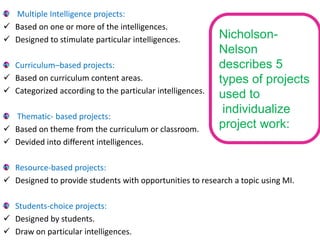
Multiple Intelligence projects:
 Based on one or more of the intelligences.
 Designed to stimulate particular intelligences.
Curriculum–based projects:
 Based on curriculum content areas.
 Categorized according to the particular intelligences.
Thematic- based projects:
 Based on theme from the curriculum or classroom.
 Devided into different intelligences.
Resource-based projects:
 Designed to provide students with opportunities to research a topic using MI.
Students-choice projects:
 Designed by students.
 Draw on particular intelligences.
Nicholson-
Nelson
describes 5
types of projects
used to
individualize
project work:
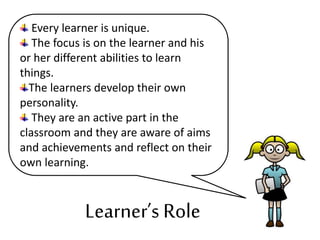
Learner’s Role
Every learner is unique.
The focus is on the learner and his
or her different abilities to learn
things.
The learners develop their own
personality.
They are an active part in the
classroom and they are aware of aims
and achievements and reflect on their
own learning.
Teacher’s Role
Introducing students to the
existence of multiple intelligences
and guide them in identifying.
Making use of all their
intelligences through language
learning activities that exercise the
students' multiple intelligences.
Multiple intelligences

Multiple intelligences

  • 2.
    Multiple Intelligences “Howard Gardner” Frames of Mind: The Theoryof Multiple Intelligences At least 7 intelligences Human intelligence as having multiple dimensions that must be acknowledged and developed in education. Individuals are free to be intelligent on their own ways. Opposes the idea of labeling learners to a specific intelligence
  • 3.
    The capacity tosolve problems or to fashion products that are valued in one or more cultural setting. (Gardner & Hatch, 1989).
  • 4.
    • The brainhas other equally important types of intelligences. • The importance of assessing in an "intelligence- fair" manner. • Traditional examinations linguistic and logical skills In the past IQ tests measured only logic and language
  • 6.
    LOGICAL-MATHEMATICAL Logic,abstractions, reasoning, numbers and criticalthinking. Understanding the underlying principles of some kind of causal system. Puzzles & games,logical,sequential presentations, classifications, categorizations.
  • 7.
    VISUAL-SPATIAL Aware of their surroundingsand are good at remembering images. Great sense of direction. Learn best through drawings and visual aids.
  • 8.
    BODY-KINESTHETIC Control of one's bodilymotions and the capacity to handle objects skillfully. Learn better by involving muscular movement. Good at physical activities. Good at building things and like to stay active. Good motor skills and are very aware of their bodies. Hands-on activities, field trips & pantomime.
  • 9.
    MUSICAL/RHTHMIC sounds, rhythms, tones & music ableto sing, play musical instruments, and compose music. “auditory” :learn best via lecture use songs or rhythms to learn
  • 10.
    INTERPERSONAL Interaction with others. Sensitiveto others' moods, feelings, temperaments and motivations. Ability to cooperate in order to work as part of a group. (pairwok,project work, group problem-solving) Communicate effectively and empathize easily with others. Learn best by working with others and often enjoy discussion and debate. Gardner: “sales persons,politicians,managers ,teachers,counselors,social workers.
  • 11.
    INTRAPERSONAL Introspective and self- reflectivecapacities. Having a deep understanding of the self; strengths/ weaknesses,what makes one unique. Being able to predict one's own reactions/emotions. Prefer working alone. Spends time thinking and reflecting. Psychologist, philosopher,writer, theologian Self-evaluation,journal keeping, options for home work.
  • 12.
    VERBAL-LINGUISTIC Good at reading, writing,telling stories and memorizing words along with dates Talented with words. Ability to teach and explain things to others. Learn best by reading, taking notes and going to lectures. Note taking,story telling,debates.
  • 13.
    Everyone can possessthese intelligences. They are not equally developed. Teachers create activities which draws attention of all intelligences-to faciliate lg acquisition & realize their full potential.
  • 14.
    Presenting every intelligencein every lesson plan is impossible as the list of intelligences growing.
  • 15.
  • 16.
    NATURALISTIC Sensitivity to andappreciation for nature. Nurturing and growing things & the ability to care for and interact with animals. The newest added to the theory of Multiple Intelligences and is often criticized as being an interest rather than an intelligence. Gardener,Farmer,Animal Trainer,Scientist,Botanist,Zookeeper, Geologist
  • 17.
    EXISTENTIAL Some proponents of multipleintelligence theory proposed spiritual or religious intelligence as a possible additional type. Gardner did not want to commit to a spiritual intelligence, but suggested that an "existential" intelligence may be a useful construct.[ Talented with words.
  • 18.
    FIND A PERSONWHOSE …INTELLEGENCE IS DOMINANT
  • 19.
    How to designa multiple intelligences lesson
  • 20.
    There is nogoals stated in MI. There is no syllabus(recommended). But there is a basic developmental sequence which can be considered as “syllabus design”.
  • 21.
    • Multisensory experiences(touching,smellingetc.) • Learners can be sensitized to the many-faceted properties. Stage 1.Awaken the intelligence • Students are supposed to tell, share and bring their own experiences and objects into class and discuss them. Stage 2.Amplify the intelligence • This stage is the general “traditional" teaching phase with work done in group project worksheets and the amplified intelligence is used to solve the tasks and therefore enhance the learning Stage 3.Teach with/for the intelligence • Students reflect on their previous experiences and try to relate these tasks to other school or real life problems. Stage 4.Transfer of the intelligence Syllabus Design: According to Lazear (1991);
  • 22.
    Multiple Intelligence projects: Based on one or more of the intelligences.  Designed to stimulate particular intelligences. Curriculum–based projects:  Based on curriculum content areas.  Categorized according to the particular intelligences. Thematic- based projects:  Based on theme from the curriculum or classroom.  Devided into different intelligences. Resource-based projects:  Designed to provide students with opportunities to research a topic using MI. Students-choice projects:  Designed by students.  Draw on particular intelligences. Nicholson- Nelson describes 5 types of projects used to individualize project work:
  • 23.
    Learner’s Role Every learneris unique. The focus is on the learner and his or her different abilities to learn things. The learners develop their own personality. They are an active part in the classroom and they are aware of aims and achievements and reflect on their own learning.
  • 24.
    Teacher’s Role Introducing studentsto the existence of multiple intelligences and guide them in identifying. Making use of all their intelligences through language learning activities that exercise the students' multiple intelligences.