Theory of Multiple Intelligences Presented by  Prof..K.Prabhakar [email_address]
Why all the interest in Intelligence  The educational opportunities depend on one type of testing or other it is used as a predictive tool for performance in the job situations Many a times we miss Einsteins, Gandhis,Balamuralikrishnas and brand them as dunces  In fact human potential is not identified as we are not able to understand it
What is Human Potential? We all go through various tests such as SAT,CAT,MAT,GMAT, IIT Entrance Examinations, IAS etc. Do they measure the potential of a Humanbeing to perform future tasks or tests what we know already?  What it measures? How it measures? Is it more focussed on the tool than on what it is supposed to measure?
What is Intelligence ? It is the single general capacity that every Humanbeing possess to a greater or lesser extent It can be measured by standardized verbal instruments, such as short answers, paper and pencil tests
Who is true genius? A mind of large general powers , accidentally determined to some particular directions- S.Johnson  What is large general powers? The mind has potential to deal with many different content, does it mean that persons ability with one kind has an effect on other content? No scientific proof is available to prove the state ment of Samuel Johnson
How Intelligence is expressed?   Think and write five sentences on your idea of intelligence  Keep it until we go the slide on How it is expressed.
 
 
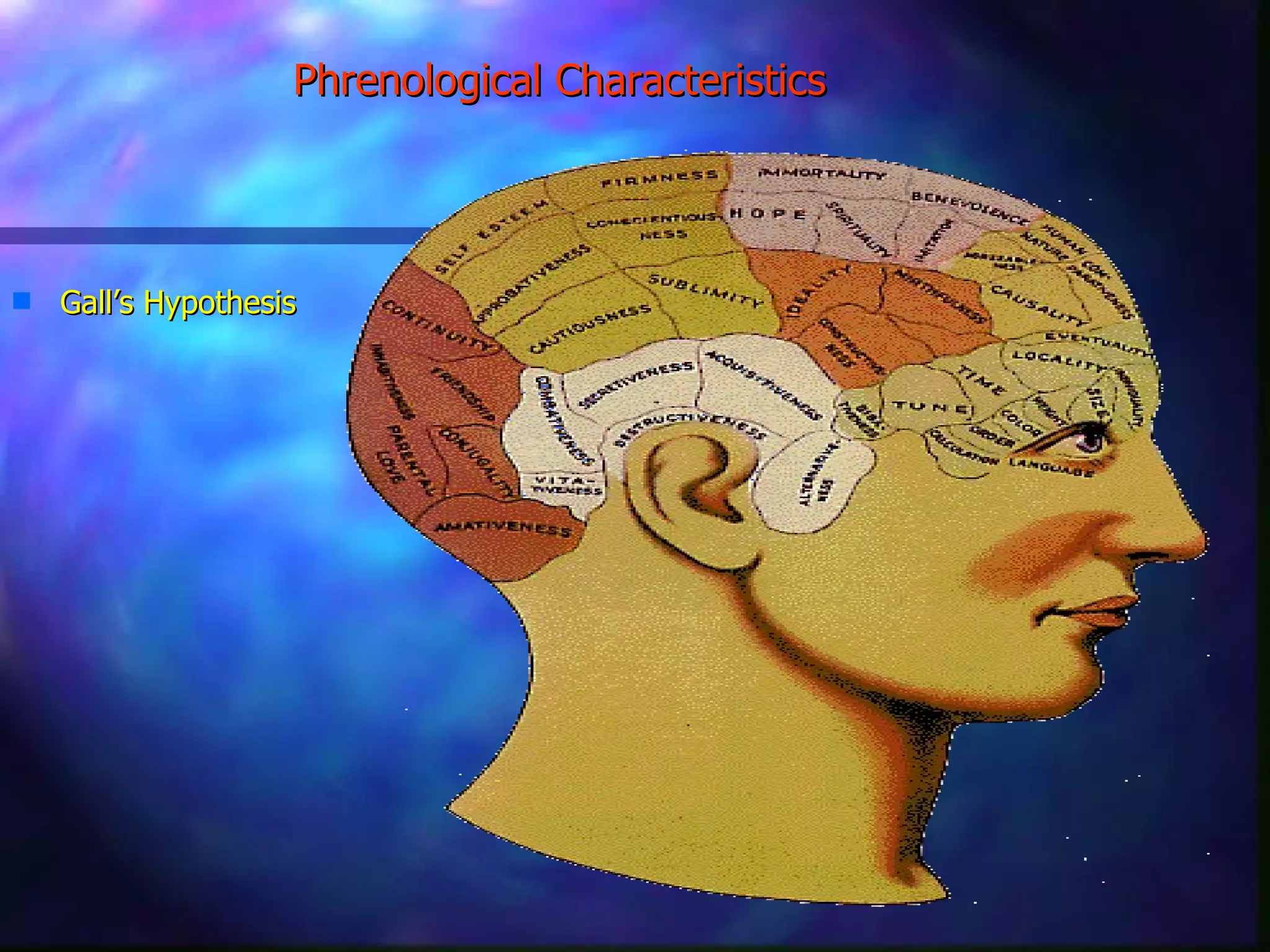
Intelligence  Earlier views   Joseph Gall has observed a relationship between certain mental characteristics of his schoolmates and shapes of their heads
Phrenological Characteristics   Gall’s Hypothesis
 
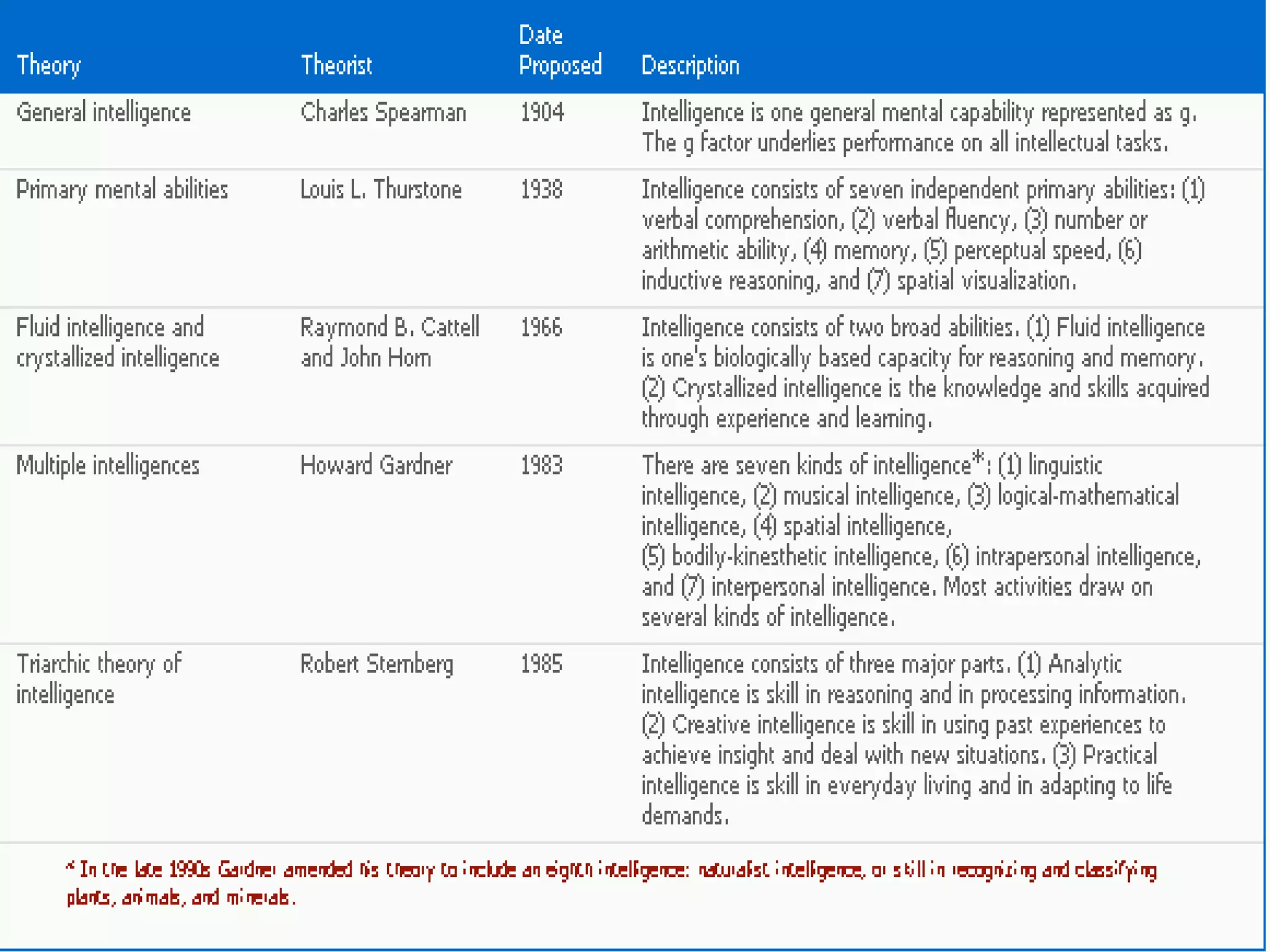
Charles Spearman’ Two factor theory In examining correlation of various subsets of intelligence, he found that certain subsets tend to correlate higher than others His  hypothesis is all intellectual tasks must entail the exercise of a factor known as general intelligence(g factor) Each individual type of item requiring specific factor called S factor.
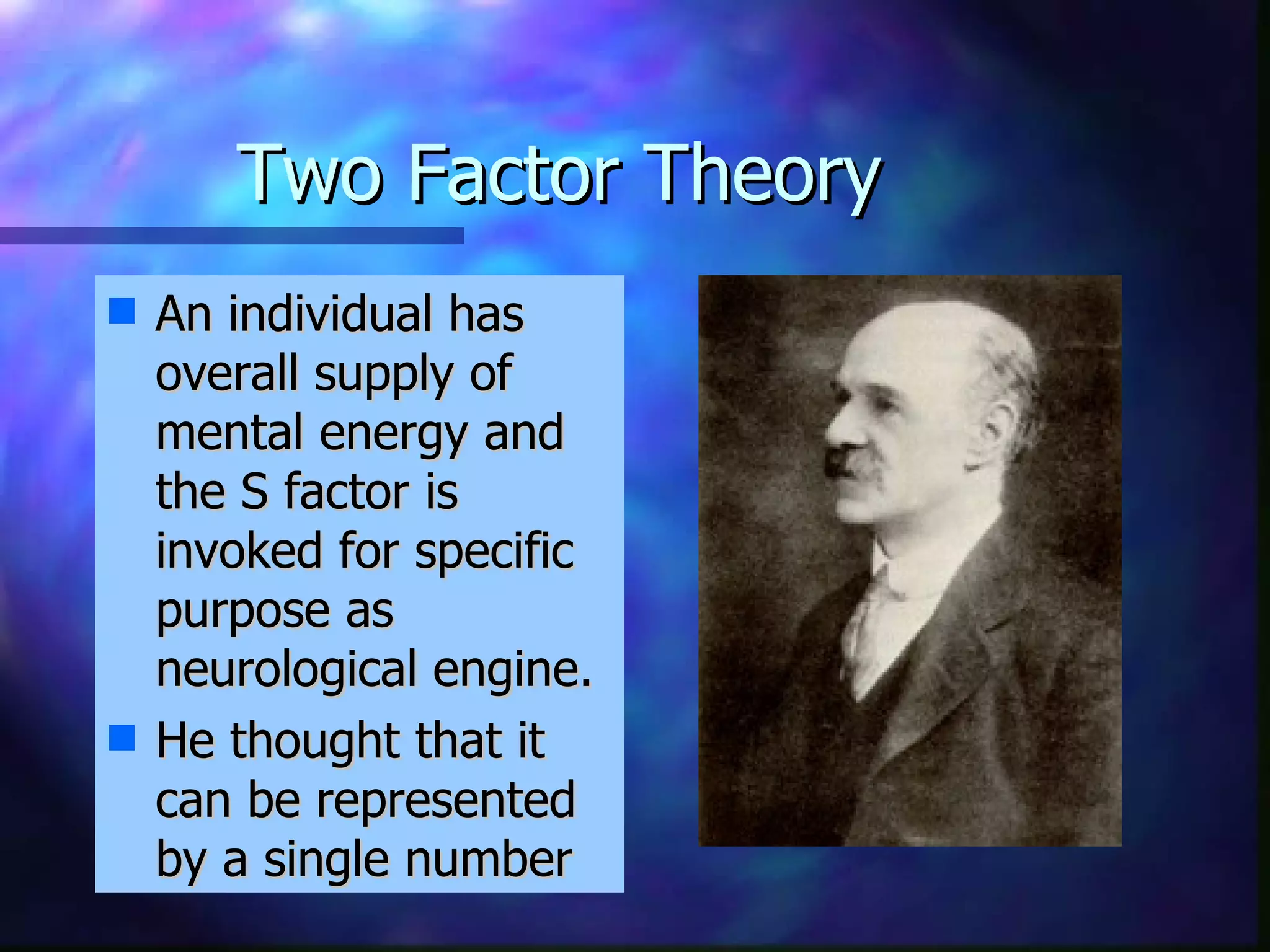
Two Factor Theory  An individual has overall supply of mental energy and the S factor is invoked for specific purpose as neurological engine. He thought that it can be represented by a single number
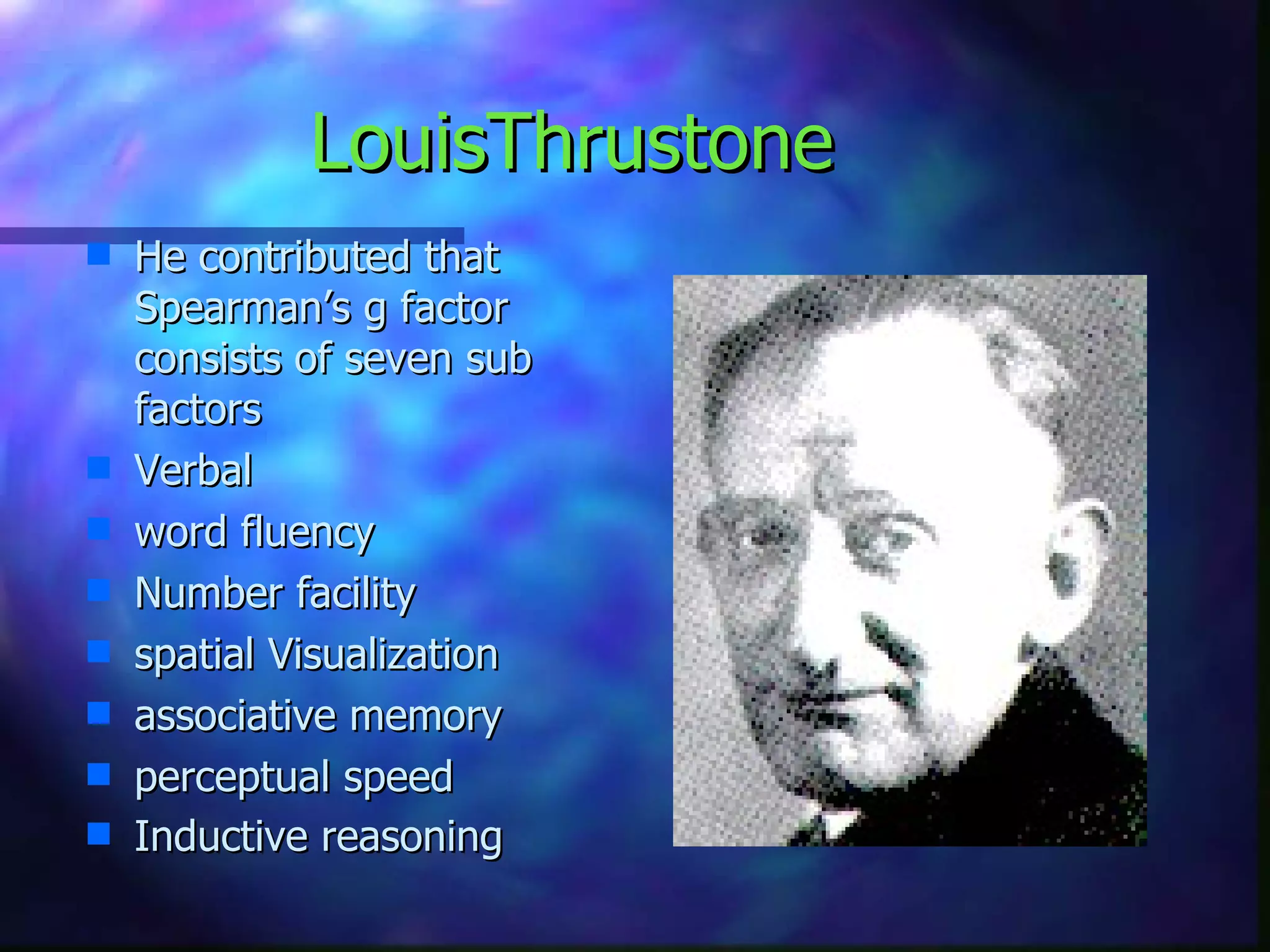
LouisThrustone He contributed that Spearman’s g factor consists of seven sub factors Verbal word fluency  Number facility  spatial Visualization  associative memory perceptual speed Inductive reasoning
Cattell Fluid Intelligence characterized by Biological factors Crystallized Intelligence More characterized by environment
Historical Continuum of Phases of Intelligence Measurement   Lay theories Standard Psychometric Approach Pluralization Hierarchization  Contextualization Distribution
Lay Theories For most of the part of history there was no scientific definition of intelligence. Out standing men and women are labeled as ‘Clever’ Nobody challenged each other on what is intelligence.
The standard Psychometric Approach A century ago, psychologists made the first efforts to define intelligence technically and to devise test that measure intelligence. However, there is no scientific advance in psychometric community that really helped to improve upon the system
Pluralization and Hierachization   Charles Spearman-Lewis Terman tended to believe that intelligence was best conceptualized as a single general capacity for conceptualization and problem solving. They sought to demonstrate that a group of scores on tests reflected a single underlying factor of ‘General Intelligence’.
Pluralizaton and Hierarchization   Thurstone-Guilford argued for existence of a number of factors, or components of intelligence. In broader sense Howard Gardner agrees with this tradition but he relies on different source of evidence. It is not on group of test but on neurological ,evolutionary and cross cultured evidence.
Contextualization Is it possible for us to ignore critical differences among contexts within which human beings live and develop. Do you thing the person living in the same era as ours is same as in Neolithic and Homeric era.Part of intelligence can be attributed to cultures and their attributes rather than differences among individuals.
Distribution   Distribution goes a step further it talks about relation of person with things and objects in the immediate environment rather than on structures and values in larger context of culture.
Distribution... Traditional View is that intelligence is carried within one’s head.i.e. it can be measured in isolation. However it does not stop with one’s skin, It encompasses tools, (paper,pencil,computer etc) and notional memory such as colleagues, office files, library etc. We can say that the Cognition is distributed.
It is not the end of the story Arthur Jensen-Eyseneck-Bouchard They provided evidence on high heritability of psychometric intelligence.The examples of twins reared apart.  They felt that there is no need to pay attention to cultures,contexts and distribution of intelligence.
Anderson’s  Electrophysiological View They said that intelligence is reflected  a basic property of the nervous system and can be assessed electrophysiologically without going through the paper and pencil tests. Anderson has evidence to suggest that indices of intelligence is found in infants.
Are we in a collision course? Cultural and distribution nature of intelligence, now how do we account for the intelligence expressed outside the paper and pencil tests? We call it a tender side of intelligence. Genetic and Neurological basis of intelligence  Speed and flexibility of nervous conduction is largely inborn.And we go by tough minded approach to intelligence
Expression of Intelligence Specific tasks Domains Disciplines There is no pure spatial intelligence, it is expressed in  puzzle-solutions,block building or in passing basket ball for children
What about adults?  How do we assess their  intelligence? They exhibit as chess players, artists or geometricians We have to assess the intelligence by watching people who are familiar with and have skills in these pursuits or we can introduce people to the domain and observe how well one can move beyond the novice stage, with or without specific support.
What are Intelligence, domains and fields At the level of individual we are speaking about one or more of human intelligences. They are part of our birth. We are born in cultures that house a large number of domains-diciplines,crafts and other pursuits in shich one can become encultured and then can be assessed in terms of level of competence one has attained.
Let us go further in this path Individual practitioners Persons who elect to enter a professional realm, secure training, and pursue their own personal and professional goals
Individual practitioners Important points  Knowledge was evenly distributed among prehistoric era , in a tribe if a person happens to know about medicine, he continued to be hunter but his knowledge is used by community. It took thousands of years for the society to develop the specialized profession.
Domain Knowledge ,Skill, practices, rules and values captured in various codes.A culture consists of numerous domains and domains have ethical dimensions.
Domain...   When sufficient knowledge is accumulated it is codified for smooth transmission to new practitioners Culture has many domains which can be subdivided into further sub domains Mathematics  can be subdivided into Calculus, Algebra etc.
Domain... Domain has both ideas and symbolic codes.The symbols used by a particular set of people in a domain has a specific system that helps them to communicate with each other and to profession.
Field   The role that individuals practice when working with symbols of the domain; field also include institutions. A society consists of numerous fields. There major roles: elite gatekeepers, expert practitioners, apprentices and students.
What is the relation between Intelligence-Domain-Field? Think and give your comments
Let us imagine that we do not know about Intelligence What are the roles or end states that are prized by cultures? Hunters Fishermen Religious leaders athletes  artists Musicians Poets
Let us consider three examples   Pulawat Sailor Koranic student Parisian composer Using computer
If we want to encompass the realm of Human cognition what we have to do?
We have to include wider Universal set of Competencies If you closely observe the competencies required by the end states we said, they do not lend themselves to measurement by standard verbal methods
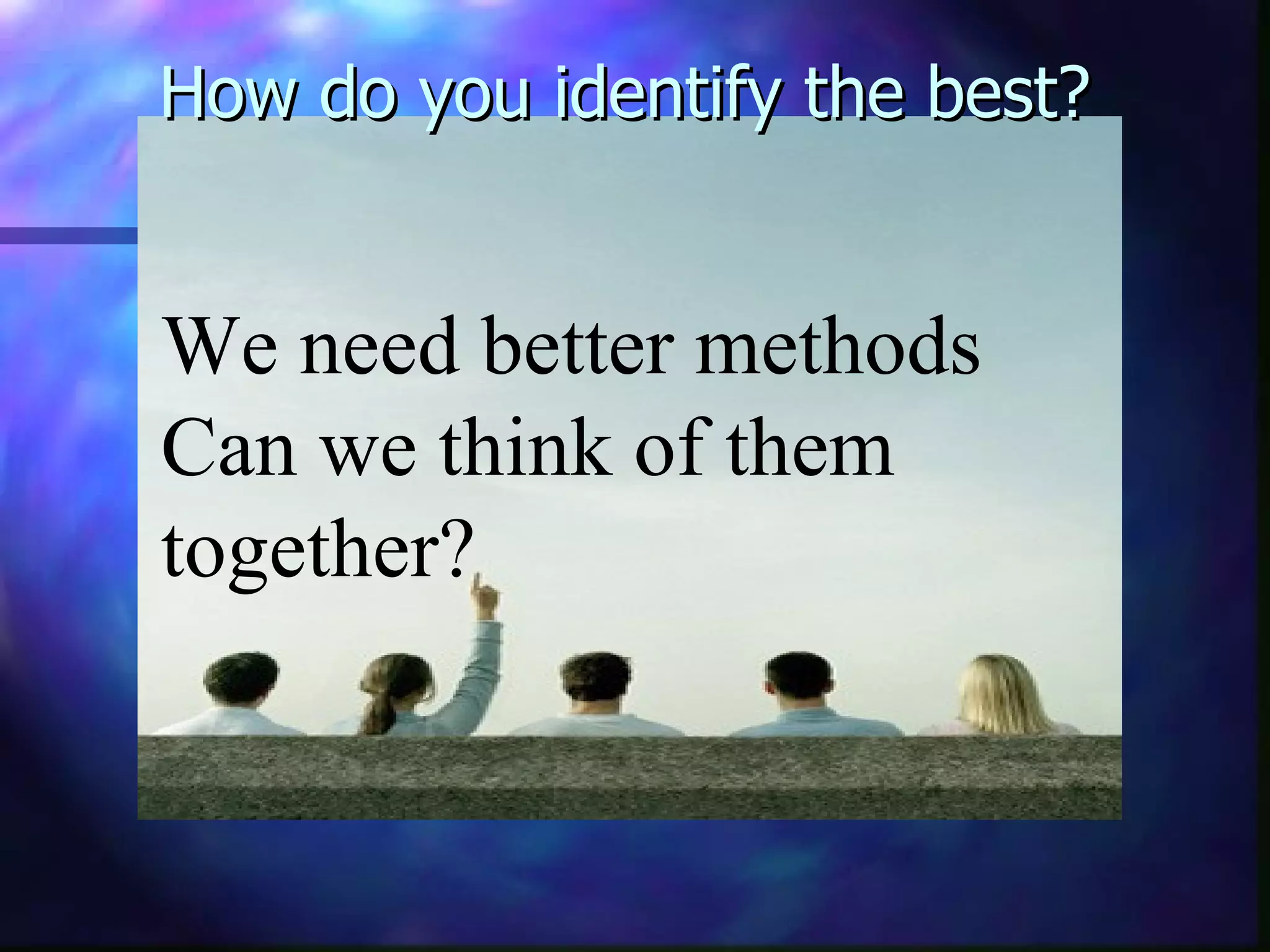
How do you identify the best? We need better methods Can we think of them together?
Thank you very much and this presentation is dedicated to Dr. Howard Gardner

Theory of Multiple Intelligences

  • 1.
    Theory of MultipleIntelligences Presented by Prof..K.Prabhakar [email_address]
  • 2.
    Why all theinterest in Intelligence The educational opportunities depend on one type of testing or other it is used as a predictive tool for performance in the job situations Many a times we miss Einsteins, Gandhis,Balamuralikrishnas and brand them as dunces In fact human potential is not identified as we are not able to understand it
  • 3.
    What is HumanPotential? We all go through various tests such as SAT,CAT,MAT,GMAT, IIT Entrance Examinations, IAS etc. Do they measure the potential of a Humanbeing to perform future tasks or tests what we know already? What it measures? How it measures? Is it more focussed on the tool than on what it is supposed to measure?
  • 4.
    What is Intelligence? It is the single general capacity that every Humanbeing possess to a greater or lesser extent It can be measured by standardized verbal instruments, such as short answers, paper and pencil tests
  • 5.
    Who is truegenius? A mind of large general powers , accidentally determined to some particular directions- S.Johnson What is large general powers? The mind has potential to deal with many different content, does it mean that persons ability with one kind has an effect on other content? No scientific proof is available to prove the state ment of Samuel Johnson
  • 6.
    How Intelligence isexpressed? Think and write five sentences on your idea of intelligence Keep it until we go the slide on How it is expressed.
  • 7.
  • 8.
  • 9.
    Intelligence Earlierviews Joseph Gall has observed a relationship between certain mental characteristics of his schoolmates and shapes of their heads
  • 10.
    Phrenological Characteristics Gall’s Hypothesis
  • 11.
  • 12.
    Charles Spearman’ Twofactor theory In examining correlation of various subsets of intelligence, he found that certain subsets tend to correlate higher than others His hypothesis is all intellectual tasks must entail the exercise of a factor known as general intelligence(g factor) Each individual type of item requiring specific factor called S factor.
  • 13.
    Two Factor Theory An individual has overall supply of mental energy and the S factor is invoked for specific purpose as neurological engine. He thought that it can be represented by a single number
  • 14.
    LouisThrustone He contributedthat Spearman’s g factor consists of seven sub factors Verbal word fluency Number facility spatial Visualization associative memory perceptual speed Inductive reasoning
  • 15.
    Cattell Fluid Intelligencecharacterized by Biological factors Crystallized Intelligence More characterized by environment
  • 16.
    Historical Continuum ofPhases of Intelligence Measurement Lay theories Standard Psychometric Approach Pluralization Hierarchization Contextualization Distribution
  • 17.
    Lay Theories Formost of the part of history there was no scientific definition of intelligence. Out standing men and women are labeled as ‘Clever’ Nobody challenged each other on what is intelligence.
  • 18.
    The standard PsychometricApproach A century ago, psychologists made the first efforts to define intelligence technically and to devise test that measure intelligence. However, there is no scientific advance in psychometric community that really helped to improve upon the system
  • 19.
    Pluralization and Hierachization Charles Spearman-Lewis Terman tended to believe that intelligence was best conceptualized as a single general capacity for conceptualization and problem solving. They sought to demonstrate that a group of scores on tests reflected a single underlying factor of ‘General Intelligence’.
  • 20.
    Pluralizaton and Hierarchization Thurstone-Guilford argued for existence of a number of factors, or components of intelligence. In broader sense Howard Gardner agrees with this tradition but he relies on different source of evidence. It is not on group of test but on neurological ,evolutionary and cross cultured evidence.
  • 21.
    Contextualization Is itpossible for us to ignore critical differences among contexts within which human beings live and develop. Do you thing the person living in the same era as ours is same as in Neolithic and Homeric era.Part of intelligence can be attributed to cultures and their attributes rather than differences among individuals.
  • 22.
    Distribution Distribution goes a step further it talks about relation of person with things and objects in the immediate environment rather than on structures and values in larger context of culture.
  • 23.
    Distribution... Traditional Viewis that intelligence is carried within one’s head.i.e. it can be measured in isolation. However it does not stop with one’s skin, It encompasses tools, (paper,pencil,computer etc) and notional memory such as colleagues, office files, library etc. We can say that the Cognition is distributed.
  • 24.
    It is notthe end of the story Arthur Jensen-Eyseneck-Bouchard They provided evidence on high heritability of psychometric intelligence.The examples of twins reared apart. They felt that there is no need to pay attention to cultures,contexts and distribution of intelligence.
  • 25.
    Anderson’s ElectrophysiologicalView They said that intelligence is reflected a basic property of the nervous system and can be assessed electrophysiologically without going through the paper and pencil tests. Anderson has evidence to suggest that indices of intelligence is found in infants.
  • 26.
    Are we ina collision course? Cultural and distribution nature of intelligence, now how do we account for the intelligence expressed outside the paper and pencil tests? We call it a tender side of intelligence. Genetic and Neurological basis of intelligence Speed and flexibility of nervous conduction is largely inborn.And we go by tough minded approach to intelligence
  • 27.
    Expression of IntelligenceSpecific tasks Domains Disciplines There is no pure spatial intelligence, it is expressed in puzzle-solutions,block building or in passing basket ball for children
  • 28.
    What about adults? How do we assess their intelligence? They exhibit as chess players, artists or geometricians We have to assess the intelligence by watching people who are familiar with and have skills in these pursuits or we can introduce people to the domain and observe how well one can move beyond the novice stage, with or without specific support.
  • 29.
    What are Intelligence,domains and fields At the level of individual we are speaking about one or more of human intelligences. They are part of our birth. We are born in cultures that house a large number of domains-diciplines,crafts and other pursuits in shich one can become encultured and then can be assessed in terms of level of competence one has attained.
  • 30.
    Let us gofurther in this path Individual practitioners Persons who elect to enter a professional realm, secure training, and pursue their own personal and professional goals
  • 31.
    Individual practitioners Importantpoints Knowledge was evenly distributed among prehistoric era , in a tribe if a person happens to know about medicine, he continued to be hunter but his knowledge is used by community. It took thousands of years for the society to develop the specialized profession.
  • 32.
    Domain Knowledge ,Skill,practices, rules and values captured in various codes.A culture consists of numerous domains and domains have ethical dimensions.
  • 33.
    Domain... When sufficient knowledge is accumulated it is codified for smooth transmission to new practitioners Culture has many domains which can be subdivided into further sub domains Mathematics can be subdivided into Calculus, Algebra etc.
  • 34.
    Domain... Domain hasboth ideas and symbolic codes.The symbols used by a particular set of people in a domain has a specific system that helps them to communicate with each other and to profession.
  • 35.
    Field The role that individuals practice when working with symbols of the domain; field also include institutions. A society consists of numerous fields. There major roles: elite gatekeepers, expert practitioners, apprentices and students.
  • 36.
    What is therelation between Intelligence-Domain-Field? Think and give your comments
  • 37.
    Let us imaginethat we do not know about Intelligence What are the roles or end states that are prized by cultures? Hunters Fishermen Religious leaders athletes artists Musicians Poets
  • 38.
    Let us considerthree examples Pulawat Sailor Koranic student Parisian composer Using computer
  • 39.
    If we wantto encompass the realm of Human cognition what we have to do?
  • 40.
    We have toinclude wider Universal set of Competencies If you closely observe the competencies required by the end states we said, they do not lend themselves to measurement by standard verbal methods
  • 41.
    How do youidentify the best? We need better methods Can we think of them together?
  • 42.
    Thank you verymuch and this presentation is dedicated to Dr. Howard Gardner