SEMINARON
IDENTIFICATIONO LYMPHOCYTESANDTHEIRSUBSETSIN
BLO
By:
Poornima R.
1ST M.Sc. Biotechnology
INTRODUCTION
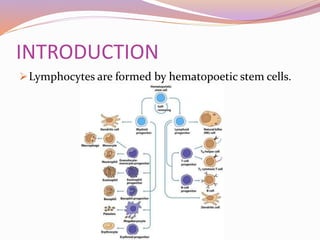
Lymphocytes are formed by hematopoetic stem cells.
Their common functions are
1. NK Cells:
Usually have cytotoxic activity against a wide range of
tumor cells and also against some cells infected with
viruses.
2. T-Lymphocytes
They identify and bind to antigenswhich are bound
to MHC complex,a self antigen on the surface of T-
cells.
3. B-Lymphocytes
Produce antibodies against a given antigen.The Abs
act as receptors.
 These cells are identified in blood depending on the
CD antigens [cluster of differentiation] expressed
characteristically, but not uniquely, by the cells of
certain lineage and certain stage of their
differentiation.
 Examples
Cd45RA and CD62L identify naive T-cells
CD45RO identifies memory B-cell
CD16 and CD56 idntify NK cells
Identification:
Monoclonal antibodies for unique CD regions is
synthesised and incubated with aliquotes of blood
sample.
Flow cytometry is used to identify and count the cells
using an automated fluorescence activated cell
scanner which measures the fluorescence generated by
each labelled cell.
Cells are aspirated into the machine and surrounded
by a sheath fluid, which forcs the cells to flow through
a chamber in single file past a beam laser and light
sensor.
Light emitted by the excited fluorescent dye on the cell
surface is detected by the sensor and analysed by
computer softwares.
 In total lymphocyte count
a. 60% to 70% is that of CD3+ T-cell
b. B-cells make upto ‹10 %
c. Remaining are NK cells.
REFERENCE
 Kuby immunology by
 Clinical immunology by Rabindra Narain
 Clinical immunology by Chapel,Haeney,Misbah and
Snowden
Lymphocytes

Lymphocytes

  • 1.
  • 2.
    INTRODUCTION Lymphocytes are formedby hematopoetic stem cells.
  • 3.
    Their common functionsare 1. NK Cells: Usually have cytotoxic activity against a wide range of tumor cells and also against some cells infected with viruses. 2. T-Lymphocytes They identify and bind to antigenswhich are bound to MHC complex,a self antigen on the surface of T- cells. 3. B-Lymphocytes Produce antibodies against a given antigen.The Abs act as receptors.
  • 4.
     These cellsare identified in blood depending on the CD antigens [cluster of differentiation] expressed characteristically, but not uniquely, by the cells of certain lineage and certain stage of their differentiation.  Examples Cd45RA and CD62L identify naive T-cells CD45RO identifies memory B-cell CD16 and CD56 idntify NK cells
  • 6.
    Identification: Monoclonal antibodies forunique CD regions is synthesised and incubated with aliquotes of blood sample. Flow cytometry is used to identify and count the cells using an automated fluorescence activated cell scanner which measures the fluorescence generated by each labelled cell. Cells are aspirated into the machine and surrounded by a sheath fluid, which forcs the cells to flow through a chamber in single file past a beam laser and light sensor.
  • 7.
    Light emitted bythe excited fluorescent dye on the cell surface is detected by the sensor and analysed by computer softwares.
  • 8.
     In totallymphocyte count a. 60% to 70% is that of CD3+ T-cell b. B-cells make upto ‹10 % c. Remaining are NK cells.
  • 9.
    REFERENCE  Kuby immunologyby  Clinical immunology by Rabindra Narain  Clinical immunology by Chapel,Haeney,Misbah and Snowden