Lymphocytes
Presented by : Aya naser al deen
Supervised by : Dr.Izz Aldin Eqtiti
Outlines
• 1- Introduction.
• 2- hematopoiesis.
• 3-Lymphocyte.
• 4- Lymphocytosis.
• 5- Lymphopenia
Functions of Blood :
• Deliver O2
• Remove metabolic wastes
• Maintain temperature, pH, and fluid volume
• Protection from blood loss- platelets
• Prevent infection- antibodies and WBC
• Transport hormones
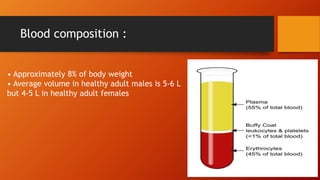
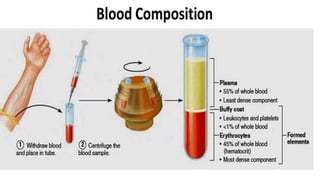
Blood composition :
• Approximately 8% of body weight
• Average volume in healthy adult males is 5-6 L
but 4-5 L in healthy adult females
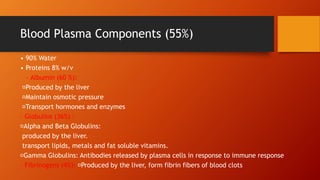
Blood Plasma Components (55%)
• 90% Water
• Proteins 8% w/v
– Albumin (60 %):
Produced by the liver
Maintain osmotic pressure
Transport hormones and enzymes
– Globulins (36%) :
Alpha and Beta Globulins:
produced by the liver.
transport lipids, metals and fat soluble vitamins.
Gamma Globulins: Antibodies released by plasma cells in response to immune response
– Fibrinogens (4%): Produced by the liver, form fibrin fibers of blood clots
Blood Plasma Components (55%)
• Gas
• Electrolytes:
Na+, K+, Ca2+, Mg2+, Cl-, SO4-, HCO3
Maintain plasma osmotic pressure and pH
Blood Plasma Components (55%)
• Organic Nutrients
– Carbohydrates – Amino Acids – Lipids – Vitamins
• Hormones: Steroid and thyroid hormones are carried by plasma
proteins
• Metabolic waste – CO2, urea, uric acid, creatinin, ammonium salts
Where is blood formed?
• The circulation and blood develop at the same time, from around 3 weeks’
gestation
• Primitive red blood cells, platelet precursors and macrophages are initially
formed in the vasculature of the extra-embryonic yolk sac
• Principal site of haematopoiesis shifts to the fetal liver at around 5–8
weeks’ gestation until shortly before birth
• Bone marrow starts to develop haematopoietic activity from 10 weeks’
gestation
• After birth, the marrow is the sole site of haematopoiesis in healthy
individuals
• By adulthood haematopoiesis is limited to marrow in the vertebrae, pelvis,
sternum and the proximal ends of the femora and humeri, with minor
contributions from the skull bones, ribs and scapulae.
• Haematopoietic tissues may also appear in the adult liver and spleen (known
as extra medullary haematopoiesis) in certain circumstances !
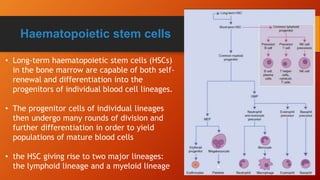
Haematopoietic stem cells
• Long-term haematopoietic stem cells (HSCs)
in the bone marrow are capable of both self-
renewal and differentiation into the
progenitors of individual blood cell lineages.
• The progenitor cells of individual lineages
then undergo many rounds of division and
further differentiation in order to yield
populations of mature blood cells
• the HSC giving rise to two major lineages:
the lymphoid lineage and a myeloid lineage
The process of haematopoiesis has several
advantages:
• It permits the massive expansion of cell numbers needed to
maintain an adequate population of mature blood cells.
• It means that the production of each type of mature blood cell
can be controlled individually
• It requires relatively little proliferative activity on the part of the
long-term HSCs themselves, thereby minimizing the risk of
developing mutations in these crucial cells during DNA replication
and cell division.
Lymphocyte :
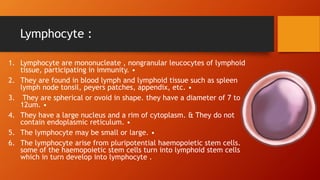
1. Lymphocyte are mononucleate , nongranular leucocytes of lymphoid
tissue, participating in immunity. •
2. They are found in blood lymph and lymphoid tissue such as spleen
lymph node tonsil, peyers patches, appendix, etc. •
3. They are spherical or ovoid in shape. they have a diameter of 7 to
12um. •
4. They have a large nucleus and a rim of cytoplasm. & They do not
contain endoplasmic reticulum. •
5. The lymphocyte may be small or large. •
6. The lymphocyte arise from pluripotential haemopoietic stem cells.
some of the haemopoietic stem cells turn into lymphoid stem cells
which in turn develop into lymphocyte .
7. The surface membrane or lymphocytes contains certain unique protein called surface markers.
•
8.The lymphocytes are of three types. They have B-lymphocytes, T- lymphocyte and null cells. •
The null cells contain about 3% ,the B-cell about 27 % and the T-cell about 70% of the total
lymphocytes. •
9. B-lymphocytes mature in in bone marrow. The B-lymphocyte produce antibodies and hence
they are responsible for humoral immunity. The B cells kill bacteria, virus etc •
10. T- lymphocyte mature in the thymus under the influence of thymic hormones. The T
lymphocytes bring about cell mediated immunity. , responsible for the killing of Cancer cells,
killing viral infected cells, allocraft rejection,etc. •
11. The null cells form a third population of lymphocytes. They are immediate between T and B
cells. They have cytotoxic property.
Lymphopoiesis
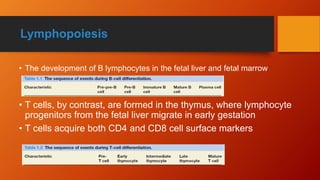
• The development of B lymphocytes in the fetal liver and fetal marrow
• T cells, by contrast, are formed in the thymus, where lymphocyte
progenitors from the fetal liver migrate in early gestation
• T cells acquire both CD4 and CD8 cell surface markers
• CD4+ lymphocytes are known as T ‘helper’ (Th) cells, and form the
majority of the circulating T-cell population.
• Their roles include the production of cytokines includes interleukins
4, 5 and 13.
• The effects of cytokine production includes:
1. Activation of the monocyte/macrophage system
2. Promotion of granulocyte maturation
3. Induction of antibody synthesis by B cells.
• CD8+ lymphocytes are T suppressor/cytotoxic cells, comprising approximately
one-quarter of the T cells in the peripheral blood.
• Their function is to destroy any cells expressing a peptide to which their TCR
can bind (e.g. virally infected cells).
• A small minority of mature lymphocytes are distinct from both B- and T-cell
lineages.
• These are the NK cells, which have a role in the innate immune system,
through cell-mediated cytotoxicity.
•The abnormal production, function
or destruction of these cells =
Clinical haematology .
Lympocytosis :
(Transient , persistent)
An increase in the blood lymphocyte count is called a
lymphocytosis. This is defined as a lymphocyte count greater than 4.0 X 10⁹/L.
Transient lymphocytosis
The most common cause of reactive lymphocytosis is infectious mononucleosis.
Lymphocytosis may be associated with other viral infections such
as cytomegalovirus (CMV), hepatitis and humanimmunodeficiency virus (HIV;
early stages). Whooping cough (Bordetella pertussis) is an important cause
of lymphocytosis in children.
Persistent lymphocytosis
Persistent lymphocytosis is suggestive of an under- lying
lymphoproliferative disorder and requires further characterization.
There are benign causes ,but in older Persons the most common
cause is chronic lymphocytic leukaemia. The profile Of antigens
expressed by cells can be determined by the technique of flow
cytometry. This allows differ- entiation between malignant and
benign conditions and also allows characterization of individual cells
into B- and T-cell subtypes.
Lymphopenia :
• Lymphopenia refers to a decrease in the number of circulating
lymphocytes and is defined as a total lymphocyte count below 1 x
109/L. In normal blood, most lymphocytes are CD4+ T cells.
• Important causes of lymphopenia include HIV, radiotherapy,
chemotherapy and steroid therapy. A transient low lymphocyte
count is often found in patients with severe infection.
THANK YOU

hematology presentation.pptx

  • 1.
    Lymphocytes Presented by :Aya naser al deen Supervised by : Dr.Izz Aldin Eqtiti
  • 2.
    Outlines • 1- Introduction. •2- hematopoiesis. • 3-Lymphocyte. • 4- Lymphocytosis. • 5- Lymphopenia
  • 3.
    Functions of Blood: • Deliver O2 • Remove metabolic wastes • Maintain temperature, pH, and fluid volume • Protection from blood loss- platelets • Prevent infection- antibodies and WBC • Transport hormones
  • 4.
    Blood composition : •Approximately 8% of body weight • Average volume in healthy adult males is 5-6 L but 4-5 L in healthy adult females
  • 6.
    Blood Plasma Components(55%) • 90% Water • Proteins 8% w/v – Albumin (60 %): Produced by the liver Maintain osmotic pressure Transport hormones and enzymes – Globulins (36%) : Alpha and Beta Globulins: produced by the liver. transport lipids, metals and fat soluble vitamins. Gamma Globulins: Antibodies released by plasma cells in response to immune response – Fibrinogens (4%): Produced by the liver, form fibrin fibers of blood clots
  • 7.
    Blood Plasma Components(55%) • Gas • Electrolytes: Na+, K+, Ca2+, Mg2+, Cl-, SO4-, HCO3 Maintain plasma osmotic pressure and pH
  • 8.
    Blood Plasma Components(55%) • Organic Nutrients – Carbohydrates – Amino Acids – Lipids – Vitamins • Hormones: Steroid and thyroid hormones are carried by plasma proteins • Metabolic waste – CO2, urea, uric acid, creatinin, ammonium salts
  • 9.
    Where is bloodformed? • The circulation and blood develop at the same time, from around 3 weeks’ gestation • Primitive red blood cells, platelet precursors and macrophages are initially formed in the vasculature of the extra-embryonic yolk sac • Principal site of haematopoiesis shifts to the fetal liver at around 5–8 weeks’ gestation until shortly before birth • Bone marrow starts to develop haematopoietic activity from 10 weeks’ gestation
  • 10.
    • After birth,the marrow is the sole site of haematopoiesis in healthy individuals • By adulthood haematopoiesis is limited to marrow in the vertebrae, pelvis, sternum and the proximal ends of the femora and humeri, with minor contributions from the skull bones, ribs and scapulae. • Haematopoietic tissues may also appear in the adult liver and spleen (known as extra medullary haematopoiesis) in certain circumstances !
  • 11.
    Haematopoietic stem cells •Long-term haematopoietic stem cells (HSCs) in the bone marrow are capable of both self- renewal and differentiation into the progenitors of individual blood cell lineages. • The progenitor cells of individual lineages then undergo many rounds of division and further differentiation in order to yield populations of mature blood cells • the HSC giving rise to two major lineages: the lymphoid lineage and a myeloid lineage
  • 12.
    The process ofhaematopoiesis has several advantages: • It permits the massive expansion of cell numbers needed to maintain an adequate population of mature blood cells. • It means that the production of each type of mature blood cell can be controlled individually • It requires relatively little proliferative activity on the part of the long-term HSCs themselves, thereby minimizing the risk of developing mutations in these crucial cells during DNA replication and cell division.
  • 13.
    Lymphocyte : 1. Lymphocyteare mononucleate , nongranular leucocytes of lymphoid tissue, participating in immunity. • 2. They are found in blood lymph and lymphoid tissue such as spleen lymph node tonsil, peyers patches, appendix, etc. • 3. They are spherical or ovoid in shape. they have a diameter of 7 to 12um. • 4. They have a large nucleus and a rim of cytoplasm. & They do not contain endoplasmic reticulum. • 5. The lymphocyte may be small or large. • 6. The lymphocyte arise from pluripotential haemopoietic stem cells. some of the haemopoietic stem cells turn into lymphoid stem cells which in turn develop into lymphocyte .
  • 14.
    7. The surfacemembrane or lymphocytes contains certain unique protein called surface markers. • 8.The lymphocytes are of three types. They have B-lymphocytes, T- lymphocyte and null cells. • The null cells contain about 3% ,the B-cell about 27 % and the T-cell about 70% of the total lymphocytes. • 9. B-lymphocytes mature in in bone marrow. The B-lymphocyte produce antibodies and hence they are responsible for humoral immunity. The B cells kill bacteria, virus etc • 10. T- lymphocyte mature in the thymus under the influence of thymic hormones. The T lymphocytes bring about cell mediated immunity. , responsible for the killing of Cancer cells, killing viral infected cells, allocraft rejection,etc. • 11. The null cells form a third population of lymphocytes. They are immediate between T and B cells. They have cytotoxic property.
  • 15.
    Lymphopoiesis • The developmentof B lymphocytes in the fetal liver and fetal marrow • T cells, by contrast, are formed in the thymus, where lymphocyte progenitors from the fetal liver migrate in early gestation • T cells acquire both CD4 and CD8 cell surface markers
  • 16.
    • CD4+ lymphocytesare known as T ‘helper’ (Th) cells, and form the majority of the circulating T-cell population. • Their roles include the production of cytokines includes interleukins 4, 5 and 13. • The effects of cytokine production includes: 1. Activation of the monocyte/macrophage system 2. Promotion of granulocyte maturation 3. Induction of antibody synthesis by B cells.
  • 17.
    • CD8+ lymphocytesare T suppressor/cytotoxic cells, comprising approximately one-quarter of the T cells in the peripheral blood. • Their function is to destroy any cells expressing a peptide to which their TCR can bind (e.g. virally infected cells). • A small minority of mature lymphocytes are distinct from both B- and T-cell lineages. • These are the NK cells, which have a role in the innate immune system, through cell-mediated cytotoxicity.
  • 18.
    •The abnormal production,function or destruction of these cells = Clinical haematology .
  • 19.
    Lympocytosis : (Transient ,persistent) An increase in the blood lymphocyte count is called a lymphocytosis. This is defined as a lymphocyte count greater than 4.0 X 10⁹/L. Transient lymphocytosis The most common cause of reactive lymphocytosis is infectious mononucleosis. Lymphocytosis may be associated with other viral infections such as cytomegalovirus (CMV), hepatitis and humanimmunodeficiency virus (HIV; early stages). Whooping cough (Bordetella pertussis) is an important cause of lymphocytosis in children.
  • 20.
    Persistent lymphocytosis Persistent lymphocytosisis suggestive of an under- lying lymphoproliferative disorder and requires further characterization. There are benign causes ,but in older Persons the most common cause is chronic lymphocytic leukaemia. The profile Of antigens expressed by cells can be determined by the technique of flow cytometry. This allows differ- entiation between malignant and benign conditions and also allows characterization of individual cells into B- and T-cell subtypes.
  • 21.
    Lymphopenia : • Lymphopeniarefers to a decrease in the number of circulating lymphocytes and is defined as a total lymphocyte count below 1 x 10⁹/L. In normal blood, most lymphocytes are CD4+ T cells. • Important causes of lymphopenia include HIV, radiotherapy, chemotherapy and steroid therapy. A transient low lymphocyte count is often found in patients with severe infection.
  • 22.