JAI KUMAR PILLAI
KIMS, BANGALORE
DENDRITIC CELLS
1
 Innate immunity-Immune mechanisms that are
used by the host to immediately defend itself
 Comprises of bariers, complements, antimicrobial
peptides, cytokines, macrophages, DCs , NK cells,
PMNs
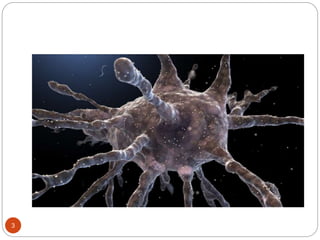
 Dendritic cells (DCs) are component of innate

immune system. Their main function is to process
antigen material and present it on the surface to T-
cells, thus functioning as antigen-presenting cells.
2
3
Location
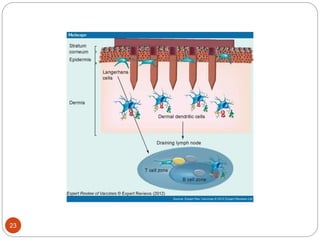
 Dendritic cells -skin ( Langerhans cells,dermal
dendritic cells)
 inner lining of the nose, lungs, stomach and
intestines.
 They can also be found in an immature state in
the blood.
4
FUNCTIONS OF DENDRITIC
CELLS
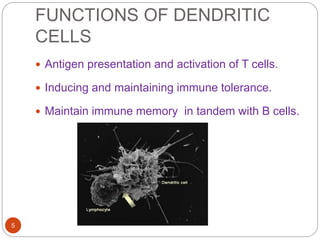
 Antigen presentation and activation of T cells.
 Inducing and maintaining immune tolerance.
 Maintain immune memory in tandem with B cells.
5
TYPES OF DENDRITIC CELLS
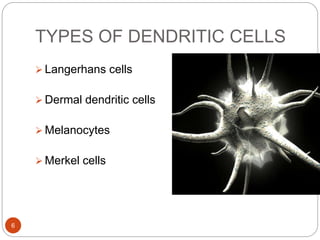
 Langerhans cells
 Dermal dendritic cells
 Melanocytes
 Merkel cells
6
LANGERHANS CELLS
 First described by Paul langerhans
in 1868
 They are bone marrow derived , dendritic ,antigen
presenting cells situated in middle of epidermis
 They are present in
epidermis,dermis,thymus,tonsils,lymph nodes,
epithelia of oral and genital mucous membranes.
7
Embryology
 They appear by fourteenth week of fetal life
 Derived from mesenchymal precursors in bone
marrow
• until the 12th wk, cd1a- & lack birbecks granules
not present
8
 They are distributed in basal ,spinous and
granular cell layers,
 They constitute 2% to 8% of total epidermal cell
population.
 They vary in distribution according to their
anatomical sites, their number ranging between
460 and 1000/sqmm of epidermis.
9
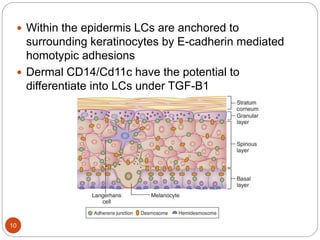
 Within the epidermis LCs are anchored to
surrounding keratinocytes by E-cadherin mediated
homotypic adhesions
 Dermal CD14/Cd11c have the potential to
differentiate into LCs under TGF-B1
10
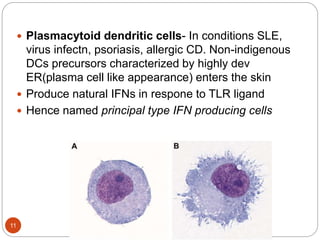
 Plasmacytoid dendritic cells- In conditions SLE,
virus infectn, psoriasis, allergic CD. Non-indigenous
DCs precursors characterized by highly dev
ER(plasma cell like appearance) enters the skin
 Produce natural IFNs in respone to TLR ligand
 Hence named principal type IFN producing cells
11
 In conditions like Atopic dermatitis, contact eczema
another non indigenous DC precursors originate
from myeloid precursors
 Inflammatory dendritic epidermal cells
 Characterized by expression of CD1a, CD1b, CD23
& CD36
 Immune response triggered by these is in TH112
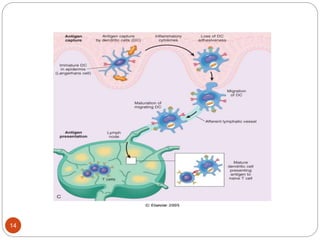
Danger signals
TLR ligands, chemical haptens, hypoxia
 LCs enlarges,downregulation of Fc receptors & E-
cadherin, increased MHC 2
 Migrate downward into dermis-enter afferent
lymphatics- reach T cell zones of lymph node
 TNF-a & IL-1B stimulates this process
 To penetrate BM, LCs attach to it via a6 containing
integrin receptors producing type 4
collagenase(MMP9)
 Osteopontin
13
14
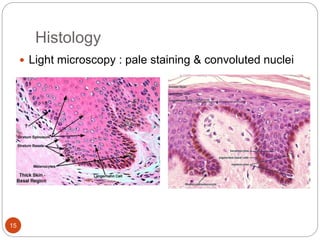
Histology
 Light microscopy : pale staining & convoluted nuclei
15
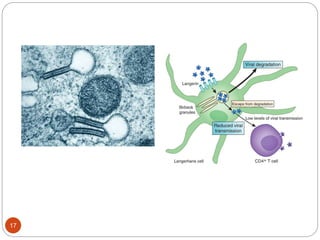
On EM: lobulated nucleus
• Absence of tonofilaments, desmosomes
• Flat plate like structure with hemispherical blebs at
one end (birbecks granule)
• C/S app: tennis racquet shape.
`
 arise from infolding of plasma membrane function as
phagosomes that digest extracellular material
16
17
 Identified by special techniques
like impregnation by gold
chloride ,staining by ATPase
and alpha-D-mannose.
Immunohistochemical Markers
 ATPase +ve , DOPA negative
 S100, CD1a +ve
 HLA-DR,DP,DQ antigen +ve
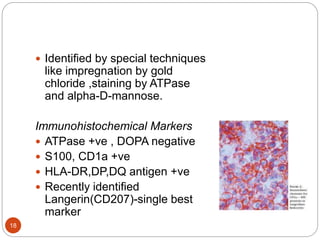
 Recently identified
Langerin(CD207)-single best
marker
18
Other importance
 Membrane receptors for C3b & Fc portion of IgG
 Recognition of antigens& cell mediated immunologic
reactions as allergic CD
 Allograft rejection(1a antigens)
 Immune surveillance against UV neoplasia(UV
decreases no. of langerhans cells)
19
FUNCTIONS
 cutaneous immune mechanism,especially in
antigen presentation ,
 stimulation of T cell response
 phagocytosis
 regulation of epidermal differentiation
20
APPLIED ASPECTS
Implicated in various immune processes
 allergic contact dermatitis,
 HIV,
 allograft rejection,
 immune tolerance and
 surveillance against neoplasia.
 Psoriasis, sarcoidosis, CD their no. in skin is reduced
 Because of their antigen presenting ability they have
become prospective vehicle for tumor therapy and
tumor vaccines
21
Dermal Dendritic Cells
 Bone marrow derived leukocytes having migratory and
AP property
 Markers include CD1b, CD1c, subunitA of clotting factor
X111
 Differentiated from macrophages
• expression of MHC 2
• CD205
• absence of phagolysosome
 DDC are located in the vicinity of superficial plexus
 DDC proliferate constitutively in human dermis
22
23
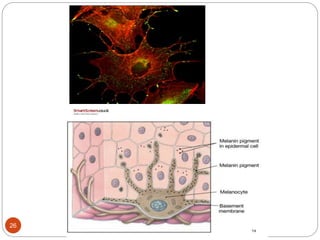
MELANOCYTES
 Dendritic cells that synthesize and secrete
melanin contaning organelles called
melanosomes.
 Appearance of melanocytes in epidermis takes
place in craniocaudal direction
 in accordance with the development of neural
crest from which they are derived.
24
EMBRYOLOGY
 Neural crest, they migrate to epidermis, various
mucous epithelia, hair follicle, dermis,
leptomeninges inner ear, uveal tissue
 In retina originate from optic cup of primitive
forebrain
 Primitive melanocytes in skin are first found
during eighth week of fetal life
 At 5mon melanosomes begin to transfer pigment
to keratinocytes
25
26
`
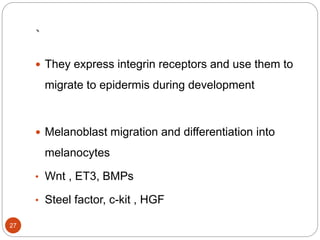
 They express integrin receptors and use them to
migrate to epidermis during development
 Melanoblast migration and differentiation into
melanocytes
• Wnt , ET3, BMPs
• Steel factor, c-kit , HGF
27
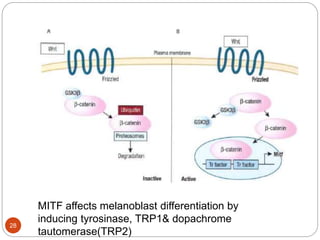
MITF affects melanoblast differentiation by
inducing tyrosinase, TRP1& dopachrome
tautomerase(TRP2)
28
 BMPs- disulfide linked dimeric proteins
 belongs to TGF-B family
 Signaling suppresses neural crest differentiation
into melanoblast
 Functions as Wnt antagonists
29
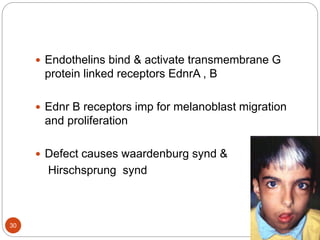
 Endothelins bind & activate transmembrane G
protein linked receptors EdnrA , B
 Ednr B receptors imp for melanoblast migration
and proliferation
 Defect causes waardenburg synd &
Hirschsprung synd
30
 SF-early melanoblast development requires
cytokine SF and its TK transmembrane receptor
c-kit
Mutn of c-kit/Sf causes Piebaldism
 HGF is ligand for transmembrane TK receptor
met, also essential for melanoblast proliferation &
differentiation
31
Types
 Dendritic :- these are capable of pigment transfer to
other cells
 Non-dendritic :- they retain the melanosomes
synthesized
Eg: uvea, retina , leptomeninges
32
Site specific melanocytes
1]Cutaneous Melanocytes
• Largest no. of melanocytes
• Skin & hair follicle
• Part of “epidermal melanin
unit”
2] Melanocyte stem cells
• present in hair follicle bulge
• Express TRP2 & nestin
• Other transcription factr-
SOX10 & Pax5
33
3]Ocular melanocyte
uveal tract; they do not transfer their
melanosomes
required for proper routing of I/L & C/L neural
fibres in optic chiasm
Imp: visual abn in pts with albinism
34
 4]Otic Melannocyte
• reside in cochlea & imp for hearing
• Maintainence of endolymph through regulation of
K transport
• Imp: Waardenburg synd
 5]CEPHALIC Melanocyte
distributed through out the meninges & more
dense in leptomeninges above pons & medulla
oblongata.
35
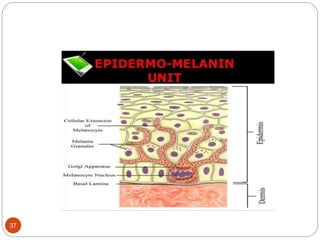
Epidermal melanin unit
 Assn between dendritic melanocytes and keratinocytes
within epidermis
 One melanocyte is in contact with 36 basal and
suprabasal keratinocyte
 Ratio of melanocyte to keratinocyte in basal layer of
epidermis varies frm 1:4 to 1:10
36
37
DISTRIBUTION
 Melanocytes are more abundant in skin of face
and male genitalia upto 2900/mm2 than on trunk
upto 1250/mm2
 As a rule greater amount of melanin is present in
basal keratinocytes than in melanocytes
 basal cells at tip of rete ridges are more38
MELANIN SYNTHESIS AND
MELANOSOMES
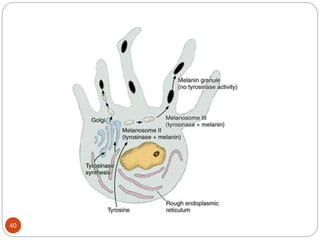
 Melanin is produced in melanosomes(pigment
granules or organelles)
 A key protein involved in melanosome assembly is
NCKX5 encoded by SLC24A5.
 The major hormone controlling melanin synthesis is
MSH from the pitutary gland.
39
40
Melanin Synthesis
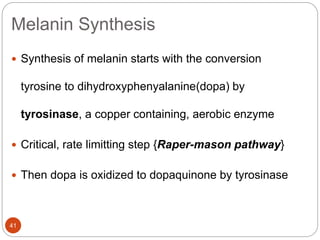
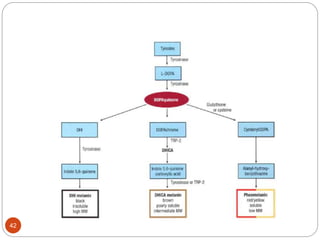
 Synthesis of melanin starts with the conversion
tyrosine to dihydroxyphenyalanine(dopa) by
tyrosinase, a copper containing, aerobic enzyme
 Critical, rate limitting step {Raper-mason pathway}
 Then dopa is oxidized to dopaquinone by tyrosinase
41
42
 These reactions occurs in melanosomes
 then passed on to surrounding keratinocytes
 undergo series of developmental and biochemical
stages;
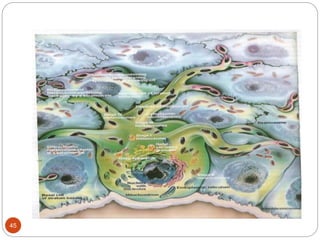
STAGES OF MELANIZATION
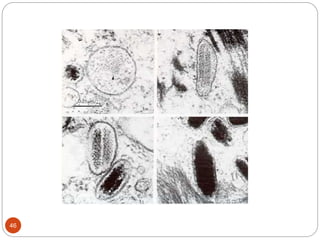
 Stage1:melanosomes are spherical, membrane bound
vesicles 0.3um composed of longitudinally oriented
concentric lamellae.
No melanin.
43
 Stage2: melanosomes are ellipsoidal 0.5um
Melanin deposited within cross-linked long filaments .
 Stage 3: melanin deposition increases by enzymatic
and non-enzymatic polymerizatn
 Stage 4: melanosomes are fully developed and electron
opaque because of dense deposits of melanin.
mainly by polymerization
44
45
46
 Between these electron dense melanized cores and
their outer membranes mature melanosomes house
distinct vesicles 40nm in diameter called
vesiculoglobular bodies.
 Inv in internal organization & melanization of eu- and
pheomelanosomes
 During progression from stage 1 to stage 4 tyrosinase
decreases and acid phosphatase increases( helping in
degradation)
47
FACTORS INFLUENCING MELANIN
SYNTHESIS
 UV LIGHT : Increases melanocytes
 HORMONES:MSH,ACTH, oestrogen,
progestrone,Androgens,lipotropins,thyroxine
all have melanocyte stimulating property
 OTHERS:- pgd2,pge2,arachidonic acid,oleic acid
 AGEING : Causes decrease in follicular
melanocytes
48
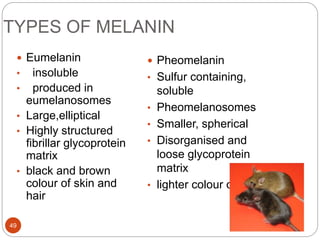
TYPES OF MELANIN
 Eumelanin
• insoluble
• produced in
eumelanosomes
• Large,elliptical
• Highly structured
fibrillar glycoprotein
matrix
• black and brown
colour of skin and
hair
 Pheomelanin
• Sulfur containing,
soluble
• Pheomelanosomes
• Smaller, spherical
• Disorganised and
loose glycoprotein
matrix
• lighter colour of hair
49
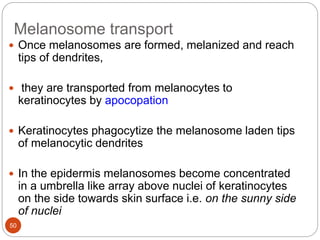
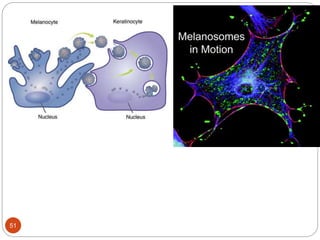
Melanosome transport
 Once melanosomes are formed, melanized and reach
tips of dendrites,
 they are transported from melanocytes to
keratinocytes by apocopation
 Keratinocytes phagocytize the melanosome laden tips
of melanocytic dendrites
 In the epidermis melanosomes become concentrated
in a umbrella like array above nuclei of keratinocytes
on the side towards skin surface i.e. on the sunny side
of nuclei
50
51
 Following transfer to keratinocytes
 fully melanized melanosomes are conveyed
upwards as basal keratinoctes mature
 are eventually degraded by lysosomal enzymes
and
 shed as cornified cells are desquamated.
52
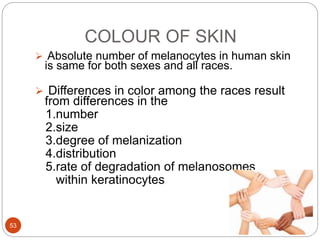
COLOUR OF SKIN
 Absolute number of melanocytes in human skin
is same for both sexes and all races.
 Differences in color among the races result
from differences in the
1.number
2.size
3.degree of melanization
4.distribution
5.rate of degradation of melanosomes
within keratinocytes
53
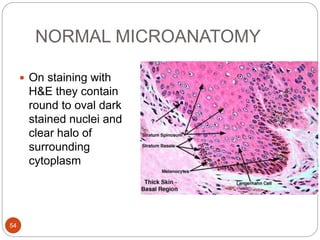
NORMAL MICROANATOMY
 On staining with
H&E they contain
round to oval dark
stained nuclei and
clear halo of
surrounding
cytoplasm
54
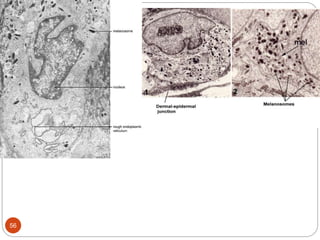
 On electron microscopy,these cells characteristically
‘hang down’ from basal cell layer and are devoid of
tonofilaments or desmosomes.
 abundant melanosomes in varying stages of
melanisation.
 numerous mitochondria , well developed RER Golgi55
56
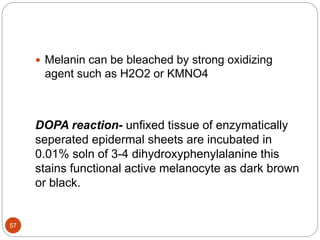
 Melanin can be bleached by strong oxidizing
agent such as H2O2 or KMNO4
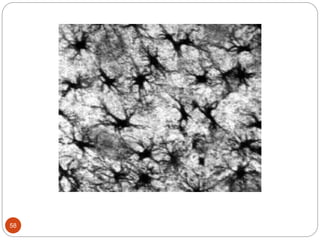
DOPA reaction- unfixed tissue of enzymatically
seperated epidermal sheets are incubated in
0.01% soln of 3-4 dihydroxyphenylalanine this
stains functional active melanocyte as dark brown
or black.
57
58
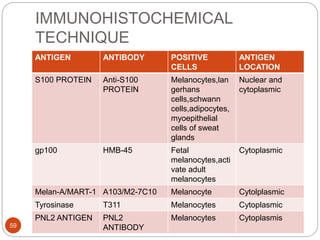
IMMUNOHISTOCHEMICAL
TECHNIQUE
ANTIGEN ANTIBODY POSITIVE
CELLS
ANTIGEN
LOCATION
S100 PROTEIN Anti-S100
PROTEIN
Melanocytes,lan
gerhans
cells,schwann
cells,adipocytes,
myoepithelial
cells of sweat
glands
Nuclear and
cytoplasmic
gp100 HMB-45 Fetal
melanocytes,acti
vate adult
melanocytes
Cytoplasmic
Melan-A/MART-1 A103/M2-7C10 Melanocyte Cytolplasmic
Tyrosinase T311 Melanocytes Cytoplasmic
PNL2 ANTIGEN PNL2
ANTIBODY
Melanocytes Cytoplasmis
59
FUNCTIONS OF MELANIN
 Absorption of UV (phototoxic and photosensitize)
 Thermoregulation
 Free radical quencher
 Protection against lipid peroxidation
 Photoprotection, photoageing
 Protection from photocarcinogenesis,
 Regulation of vit D synthesis.
 Camouflage and sexual appeal.
60
APPLIED ASPECTS
 In vitiligo melanocytes are destroyed.
 In albinism melanocytes are normal in number but
unable to synthesize fully pigmented
melanosomes because of defective enzymatic
formation of melanin.
 Freckles result from increase in production of
pigment by normal number of melanocytes.
 Nevi are benign proliferations of melanocytes
 Malignant counterpart - melanoma
61
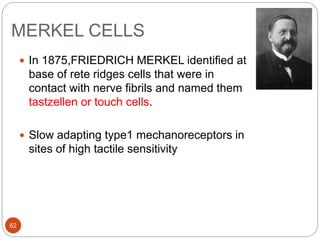
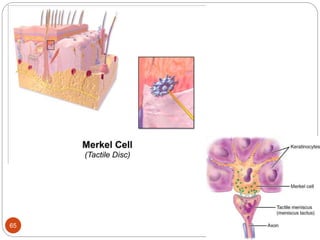
MERKEL CELLS
 In 1875,FRIEDRICH MERKEL identified at
base of rete ridges cells that were in
contact with nerve fibrils and named them
tastzellen or touch cells.
 Slow adapting type1 mechanoreceptors in
sites of high tactile sensitivity
62
Embryology
 Appear in fetal skin by sixteenth week of
gestation.
 They originate in the epidermis itself, presumably
from germinative keratocytes
63
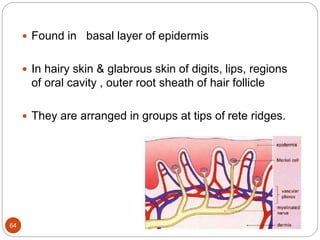
 Found in basal layer of epidermis
 In hairy skin & glabrous skin of digits, lips, regions
of oral cavity , outer root sheath of hair follicle
 They are arranged in groups at tips of rete ridges.
64
65
STRUCTURE
 Electron lucent cytoplasm rich in organelles
 Lobulated nuclei
 Margins of cells project cytoplasmic “spines” towards
keratinocytes
 Poorly developed desmosomes,delicate cytoplasmic
microfilaments.
 Characteristic spherical granules which are
membrane limited with a dense central core
66
67
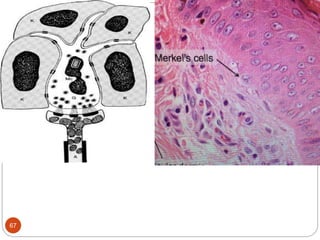
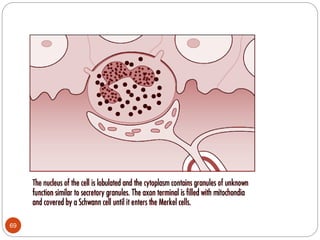
 Merkel cells are supplied by myelinated nerves
 as they near epidermis lose their myelin sheaths and
continue as unmelinated axons
 surrounded by cytoplasm and basement membranes
of schwann cells.
 The nerve fibres terminate in flat,meniscus like
contacts that are studded along basal aspects of
merkel cells.
68
69
 On silver impregnated sections, the meniscoid
nerve terminal that covers basal portion of each
merkel cell can be seen as merkel disk.
 Immunohistochemical markers :-
 K8, K18, K19 & K20
 K20 is highly specific for merkel cells.
70
 Merkel cells express neuroendocrine markers
such as chromogranin A and synaptophysin.
 Neurosecretory substances in particular
neuropeptides that are stored in densecore
granules include VIP , CGRP, Serotonin,
substanceP.
71
FUNCTIONS
 They are slowly adapting , low threshold type 1
mechanoreceptors.
 They may enhance or induce the excitability of
sensory nerve endings via release of
neuropeptides.
72
APPLIED ASPECTS
 Merkel cell hyperplasia with keratinocyte
hyperproliferation is seen in adnexal tumors such
as naevus sebaceus, tricoblastomas,
trichoepitheliomas, nodular hidradenomas.
 Merkel cell hyperplasia with hyperplasia of nerve
endings neurofibromas
neurilemmomas,
nodular prurigo
neurodermatitis
73
THANK YOU
74

Dendritic cells

  • 1.
    JAI KUMAR PILLAI KIMS,BANGALORE DENDRITIC CELLS 1
  • 2.
     Innate immunity-Immunemechanisms that are used by the host to immediately defend itself  Comprises of bariers, complements, antimicrobial peptides, cytokines, macrophages, DCs , NK cells, PMNs  Dendritic cells (DCs) are component of innate immune system. Their main function is to process antigen material and present it on the surface to T- cells, thus functioning as antigen-presenting cells. 2
  • 3.
  • 4.
    Location  Dendritic cells-skin ( Langerhans cells,dermal dendritic cells)  inner lining of the nose, lungs, stomach and intestines.  They can also be found in an immature state in the blood. 4
  • 5.
    FUNCTIONS OF DENDRITIC CELLS Antigen presentation and activation of T cells.  Inducing and maintaining immune tolerance.  Maintain immune memory in tandem with B cells. 5
  • 6.
    TYPES OF DENDRITICCELLS  Langerhans cells  Dermal dendritic cells  Melanocytes  Merkel cells 6
  • 7.
    LANGERHANS CELLS  Firstdescribed by Paul langerhans in 1868  They are bone marrow derived , dendritic ,antigen presenting cells situated in middle of epidermis  They are present in epidermis,dermis,thymus,tonsils,lymph nodes, epithelia of oral and genital mucous membranes. 7
  • 8.
    Embryology  They appearby fourteenth week of fetal life  Derived from mesenchymal precursors in bone marrow • until the 12th wk, cd1a- & lack birbecks granules not present 8
  • 9.
     They aredistributed in basal ,spinous and granular cell layers,  They constitute 2% to 8% of total epidermal cell population.  They vary in distribution according to their anatomical sites, their number ranging between 460 and 1000/sqmm of epidermis. 9
  • 10.
     Within theepidermis LCs are anchored to surrounding keratinocytes by E-cadherin mediated homotypic adhesions  Dermal CD14/Cd11c have the potential to differentiate into LCs under TGF-B1 10
  • 11.
     Plasmacytoid dendriticcells- In conditions SLE, virus infectn, psoriasis, allergic CD. Non-indigenous DCs precursors characterized by highly dev ER(plasma cell like appearance) enters the skin  Produce natural IFNs in respone to TLR ligand  Hence named principal type IFN producing cells 11
  • 12.
     In conditionslike Atopic dermatitis, contact eczema another non indigenous DC precursors originate from myeloid precursors  Inflammatory dendritic epidermal cells  Characterized by expression of CD1a, CD1b, CD23 & CD36  Immune response triggered by these is in TH112
  • 13.
    Danger signals TLR ligands,chemical haptens, hypoxia  LCs enlarges,downregulation of Fc receptors & E- cadherin, increased MHC 2  Migrate downward into dermis-enter afferent lymphatics- reach T cell zones of lymph node  TNF-a & IL-1B stimulates this process  To penetrate BM, LCs attach to it via a6 containing integrin receptors producing type 4 collagenase(MMP9)  Osteopontin 13
  • 14.
  • 15.
    Histology  Light microscopy: pale staining & convoluted nuclei 15
  • 16.
    On EM: lobulatednucleus • Absence of tonofilaments, desmosomes • Flat plate like structure with hemispherical blebs at one end (birbecks granule) • C/S app: tennis racquet shape. `  arise from infolding of plasma membrane function as phagosomes that digest extracellular material 16
  • 17.
  • 18.
     Identified byspecial techniques like impregnation by gold chloride ,staining by ATPase and alpha-D-mannose. Immunohistochemical Markers  ATPase +ve , DOPA negative  S100, CD1a +ve  HLA-DR,DP,DQ antigen +ve  Recently identified Langerin(CD207)-single best marker 18
  • 19.
    Other importance  Membranereceptors for C3b & Fc portion of IgG  Recognition of antigens& cell mediated immunologic reactions as allergic CD  Allograft rejection(1a antigens)  Immune surveillance against UV neoplasia(UV decreases no. of langerhans cells) 19
  • 20.
    FUNCTIONS  cutaneous immunemechanism,especially in antigen presentation ,  stimulation of T cell response  phagocytosis  regulation of epidermal differentiation 20
  • 21.
    APPLIED ASPECTS Implicated invarious immune processes  allergic contact dermatitis,  HIV,  allograft rejection,  immune tolerance and  surveillance against neoplasia.  Psoriasis, sarcoidosis, CD their no. in skin is reduced  Because of their antigen presenting ability they have become prospective vehicle for tumor therapy and tumor vaccines 21
  • 22.
    Dermal Dendritic Cells Bone marrow derived leukocytes having migratory and AP property  Markers include CD1b, CD1c, subunitA of clotting factor X111  Differentiated from macrophages • expression of MHC 2 • CD205 • absence of phagolysosome  DDC are located in the vicinity of superficial plexus  DDC proliferate constitutively in human dermis 22
  • 23.
  • 24.
    MELANOCYTES  Dendritic cellsthat synthesize and secrete melanin contaning organelles called melanosomes.  Appearance of melanocytes in epidermis takes place in craniocaudal direction  in accordance with the development of neural crest from which they are derived. 24
  • 25.
    EMBRYOLOGY  Neural crest,they migrate to epidermis, various mucous epithelia, hair follicle, dermis, leptomeninges inner ear, uveal tissue  In retina originate from optic cup of primitive forebrain  Primitive melanocytes in skin are first found during eighth week of fetal life  At 5mon melanosomes begin to transfer pigment to keratinocytes 25
  • 26.
  • 27.
    `  They expressintegrin receptors and use them to migrate to epidermis during development  Melanoblast migration and differentiation into melanocytes • Wnt , ET3, BMPs • Steel factor, c-kit , HGF 27
  • 28.
    MITF affects melanoblastdifferentiation by inducing tyrosinase, TRP1& dopachrome tautomerase(TRP2) 28
  • 29.
     BMPs- disulfidelinked dimeric proteins  belongs to TGF-B family  Signaling suppresses neural crest differentiation into melanoblast  Functions as Wnt antagonists 29
  • 30.
     Endothelins bind& activate transmembrane G protein linked receptors EdnrA , B  Ednr B receptors imp for melanoblast migration and proliferation  Defect causes waardenburg synd & Hirschsprung synd 30
  • 31.
     SF-early melanoblastdevelopment requires cytokine SF and its TK transmembrane receptor c-kit Mutn of c-kit/Sf causes Piebaldism  HGF is ligand for transmembrane TK receptor met, also essential for melanoblast proliferation & differentiation 31
  • 32.
    Types  Dendritic :-these are capable of pigment transfer to other cells  Non-dendritic :- they retain the melanosomes synthesized Eg: uvea, retina , leptomeninges 32
  • 33.
    Site specific melanocytes 1]CutaneousMelanocytes • Largest no. of melanocytes • Skin & hair follicle • Part of “epidermal melanin unit” 2] Melanocyte stem cells • present in hair follicle bulge • Express TRP2 & nestin • Other transcription factr- SOX10 & Pax5 33
  • 34.
    3]Ocular melanocyte uveal tract;they do not transfer their melanosomes required for proper routing of I/L & C/L neural fibres in optic chiasm Imp: visual abn in pts with albinism 34
  • 35.
     4]Otic Melannocyte •reside in cochlea & imp for hearing • Maintainence of endolymph through regulation of K transport • Imp: Waardenburg synd  5]CEPHALIC Melanocyte distributed through out the meninges & more dense in leptomeninges above pons & medulla oblongata. 35
  • 36.
    Epidermal melanin unit Assn between dendritic melanocytes and keratinocytes within epidermis  One melanocyte is in contact with 36 basal and suprabasal keratinocyte  Ratio of melanocyte to keratinocyte in basal layer of epidermis varies frm 1:4 to 1:10 36
  • 37.
  • 38.
    DISTRIBUTION  Melanocytes aremore abundant in skin of face and male genitalia upto 2900/mm2 than on trunk upto 1250/mm2  As a rule greater amount of melanin is present in basal keratinocytes than in melanocytes  basal cells at tip of rete ridges are more38
  • 39.
    MELANIN SYNTHESIS AND MELANOSOMES Melanin is produced in melanosomes(pigment granules or organelles)  A key protein involved in melanosome assembly is NCKX5 encoded by SLC24A5.  The major hormone controlling melanin synthesis is MSH from the pitutary gland. 39
  • 40.
  • 41.
    Melanin Synthesis  Synthesisof melanin starts with the conversion tyrosine to dihydroxyphenyalanine(dopa) by tyrosinase, a copper containing, aerobic enzyme  Critical, rate limitting step {Raper-mason pathway}  Then dopa is oxidized to dopaquinone by tyrosinase 41
  • 42.
  • 43.
     These reactionsoccurs in melanosomes  then passed on to surrounding keratinocytes  undergo series of developmental and biochemical stages; STAGES OF MELANIZATION  Stage1:melanosomes are spherical, membrane bound vesicles 0.3um composed of longitudinally oriented concentric lamellae. No melanin. 43
  • 44.
     Stage2: melanosomesare ellipsoidal 0.5um Melanin deposited within cross-linked long filaments .  Stage 3: melanin deposition increases by enzymatic and non-enzymatic polymerizatn  Stage 4: melanosomes are fully developed and electron opaque because of dense deposits of melanin. mainly by polymerization 44
  • 45.
  • 46.
  • 47.
     Between theseelectron dense melanized cores and their outer membranes mature melanosomes house distinct vesicles 40nm in diameter called vesiculoglobular bodies.  Inv in internal organization & melanization of eu- and pheomelanosomes  During progression from stage 1 to stage 4 tyrosinase decreases and acid phosphatase increases( helping in degradation) 47
  • 48.
    FACTORS INFLUENCING MELANIN SYNTHESIS UV LIGHT : Increases melanocytes  HORMONES:MSH,ACTH, oestrogen, progestrone,Androgens,lipotropins,thyroxine all have melanocyte stimulating property  OTHERS:- pgd2,pge2,arachidonic acid,oleic acid  AGEING : Causes decrease in follicular melanocytes 48
  • 49.
    TYPES OF MELANIN Eumelanin • insoluble • produced in eumelanosomes • Large,elliptical • Highly structured fibrillar glycoprotein matrix • black and brown colour of skin and hair  Pheomelanin • Sulfur containing, soluble • Pheomelanosomes • Smaller, spherical • Disorganised and loose glycoprotein matrix • lighter colour of hair 49
  • 50.
    Melanosome transport  Oncemelanosomes are formed, melanized and reach tips of dendrites,  they are transported from melanocytes to keratinocytes by apocopation  Keratinocytes phagocytize the melanosome laden tips of melanocytic dendrites  In the epidermis melanosomes become concentrated in a umbrella like array above nuclei of keratinocytes on the side towards skin surface i.e. on the sunny side of nuclei 50
  • 51.
  • 52.
     Following transferto keratinocytes  fully melanized melanosomes are conveyed upwards as basal keratinoctes mature  are eventually degraded by lysosomal enzymes and  shed as cornified cells are desquamated. 52
  • 53.
    COLOUR OF SKIN Absolute number of melanocytes in human skin is same for both sexes and all races.  Differences in color among the races result from differences in the 1.number 2.size 3.degree of melanization 4.distribution 5.rate of degradation of melanosomes within keratinocytes 53
  • 54.
    NORMAL MICROANATOMY  Onstaining with H&E they contain round to oval dark stained nuclei and clear halo of surrounding cytoplasm 54
  • 55.
     On electronmicroscopy,these cells characteristically ‘hang down’ from basal cell layer and are devoid of tonofilaments or desmosomes.  abundant melanosomes in varying stages of melanisation.  numerous mitochondria , well developed RER Golgi55
  • 56.
  • 57.
     Melanin canbe bleached by strong oxidizing agent such as H2O2 or KMNO4 DOPA reaction- unfixed tissue of enzymatically seperated epidermal sheets are incubated in 0.01% soln of 3-4 dihydroxyphenylalanine this stains functional active melanocyte as dark brown or black. 57
  • 58.
  • 59.
    IMMUNOHISTOCHEMICAL TECHNIQUE ANTIGEN ANTIBODY POSITIVE CELLS ANTIGEN LOCATION S100PROTEIN Anti-S100 PROTEIN Melanocytes,lan gerhans cells,schwann cells,adipocytes, myoepithelial cells of sweat glands Nuclear and cytoplasmic gp100 HMB-45 Fetal melanocytes,acti vate adult melanocytes Cytoplasmic Melan-A/MART-1 A103/M2-7C10 Melanocyte Cytolplasmic Tyrosinase T311 Melanocytes Cytoplasmic PNL2 ANTIGEN PNL2 ANTIBODY Melanocytes Cytoplasmis 59
  • 60.
    FUNCTIONS OF MELANIN Absorption of UV (phototoxic and photosensitize)  Thermoregulation  Free radical quencher  Protection against lipid peroxidation  Photoprotection, photoageing  Protection from photocarcinogenesis,  Regulation of vit D synthesis.  Camouflage and sexual appeal. 60
  • 61.
    APPLIED ASPECTS  Invitiligo melanocytes are destroyed.  In albinism melanocytes are normal in number but unable to synthesize fully pigmented melanosomes because of defective enzymatic formation of melanin.  Freckles result from increase in production of pigment by normal number of melanocytes.  Nevi are benign proliferations of melanocytes  Malignant counterpart - melanoma 61
  • 62.
    MERKEL CELLS  In1875,FRIEDRICH MERKEL identified at base of rete ridges cells that were in contact with nerve fibrils and named them tastzellen or touch cells.  Slow adapting type1 mechanoreceptors in sites of high tactile sensitivity 62
  • 63.
    Embryology  Appear infetal skin by sixteenth week of gestation.  They originate in the epidermis itself, presumably from germinative keratocytes 63
  • 64.
     Found inbasal layer of epidermis  In hairy skin & glabrous skin of digits, lips, regions of oral cavity , outer root sheath of hair follicle  They are arranged in groups at tips of rete ridges. 64
  • 65.
  • 66.
    STRUCTURE  Electron lucentcytoplasm rich in organelles  Lobulated nuclei  Margins of cells project cytoplasmic “spines” towards keratinocytes  Poorly developed desmosomes,delicate cytoplasmic microfilaments.  Characteristic spherical granules which are membrane limited with a dense central core 66
  • 67.
  • 68.
     Merkel cellsare supplied by myelinated nerves  as they near epidermis lose their myelin sheaths and continue as unmelinated axons  surrounded by cytoplasm and basement membranes of schwann cells.  The nerve fibres terminate in flat,meniscus like contacts that are studded along basal aspects of merkel cells. 68
  • 69.
  • 70.
     On silverimpregnated sections, the meniscoid nerve terminal that covers basal portion of each merkel cell can be seen as merkel disk.  Immunohistochemical markers :-  K8, K18, K19 & K20  K20 is highly specific for merkel cells. 70
  • 71.
     Merkel cellsexpress neuroendocrine markers such as chromogranin A and synaptophysin.  Neurosecretory substances in particular neuropeptides that are stored in densecore granules include VIP , CGRP, Serotonin, substanceP. 71
  • 72.
    FUNCTIONS  They areslowly adapting , low threshold type 1 mechanoreceptors.  They may enhance or induce the excitability of sensory nerve endings via release of neuropeptides. 72
  • 73.
    APPLIED ASPECTS  Merkelcell hyperplasia with keratinocyte hyperproliferation is seen in adnexal tumors such as naevus sebaceus, tricoblastomas, trichoepitheliomas, nodular hidradenomas.  Merkel cell hyperplasia with hyperplasia of nerve endings neurofibromas neurilemmomas, nodular prurigo neurodermatitis 73
  • 74.