Presented by-
Bhagyashree Srivastava
B.T. 2nd year
Introduction
O The process of formation of blood cells i.e.
RBC’S, WBC’S and platelets is called as
hematopoiesis and the sites where it
occurs are known as hematopoietic
tissues or organs (bone marrow, liver,
spleen).
O Cells responsible to do function of
hematopoiesis are first seen in yolk sac of
embryo in third week of embryonic
development and these cells are known
as hematopoietic stem cells.
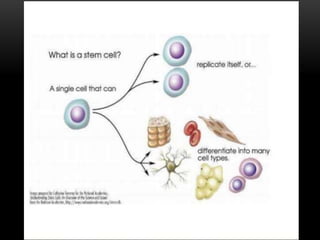
Cells capable of
asymmetrically dividing,
one group of cell is
responsible for production
of well differentiated
products and another
group of cell is responsible
to maintain the original
population if stem cell and
shows a character called
as self- renewal.
What are
stem cells?
• Hematopoietic stem cells also take origin in mesoderm of
aorta, mesoderm of gonads and mesoderm of meso- nephrons
• Hematopoietic stem cells present in yolk sac migrate to other
parts like liver, spleen and bone marrow
• The hematopoietic stem cells present in yolk sac at third week
of embryo migrate to liver at around third month of fetal life
• So, around third month of embryo the liver gets populated with
these stem cells and become a major organ for hematopoiesis-
DOMINANT MIGRATION
• Some hematopoietic stem cells also migrate to lymph nodes,
spleen –MINOR MIGRATION
• Liver , lymph nodes and spleen continue as hematopoietic
organs until birth
• After birth, liver stops its hematopoietic activity because
around 4th month of fetal life migration of stem cells from liver,
lymph nodes and spleen takes place to bone marrow
• Bone marrow is permanent residence for hematopoietic
stem cells
• At time of birth, all hematopoietic stem cells are limited to
bone marrow and bone marrow will be active
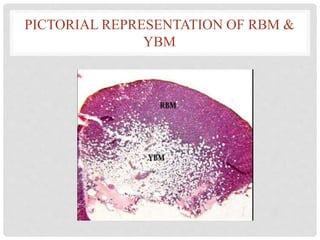
• Active bone marrow is called as RED BONE MARROW
and inactive bone marrow is called as YELLOW BONE
MARROW
• Yellow bone marrow is accumulated with fat cells, so it is
yellow in colour and red bone marrow is highly vascular
and rich in hematopoietic stem cells
• For new born baby, all bone marrow are red and as age
increases red bone marrow is active only in membranous
bones
• Up to puberty , all most all bone marrow is red and at age
of puberty and after puberty hematopoiesis stops in large
bones and is limited to axial skeleton,
PICTORIAL REPRESENTATION OF RBM &
YBM
• In new born, if hematopoiesis is going on outside of
bone marrow i.e. in liver, spleen and lymph nodes it
is called as EXTRA MEDULLARY HEMATOPOIESIS
• If there is need of excessive hematopoietic activity,
yellow bone marrow has a capacity is to be
reactivated and converted into red bone marrow (
seen in severe hemolysis)
• When there is excessive hematopoiesis, red bone
marrow expands too much into outer bone table o
skull and in x-ray outer bone table is not visible and
this condition is known as HAIR ON END
APPEARANCE
• Bone marrow has reserve function—when in need it
can increase erythropoietic activity significantly
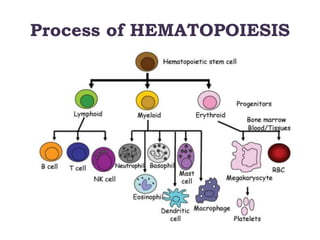
Process of HEMATOPOIESIS
 It starts with first generation stem cell called as Pluripotent
stem cell and the term pluripotent stem cell refers that they
have a potency to convert into many different types of
tissues
 Pleuripotent stem cells divides into two different types of
multipotent stem cells:
 Multipotent stem cells are cells that have a capacity to self
renew by dividing and to develop into multiple specialised
cell types present in a specific tissue or organ
 The two types of multipotent stem cells are:
1) cells related to lymphoid system are known as
Common Lymphoid Stem Cells and
2) the cells related to myeloid system are known as
Common Myeloid Stem Cells
*
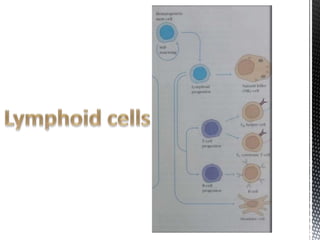
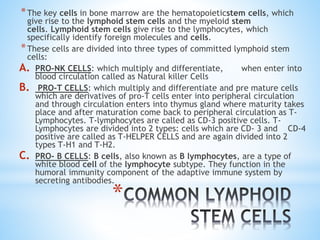
*The key cells in bone marrow are the hematopoieticstem cells, which
give rise to the lymphoid stem cells and the myeloid stem
cells. Lymphoid stem cells give rise to the lymphocytes, which
specifically identify foreign molecules and cells.
*These cells are divided into three types of committed lymphoid stem
cells:
A. PRO-NK CELLS: which multiply and differentiate, when enter into
blood circulation called as Natural killer Cells
B. PRO-T CELLS: which multiply and differentiate and pre mature cells
which are derivatives of pro-T cells enter into peripheral circulation
and through circulation enters into thymus gland where maturity takes
place and after maturation come back to peripheral circulation as T-
Lymphocytes. T-lymphocytes are called as CD-3 positive cells. T-
Lymphocytes are divided into 2 types: cells which are CD- 3 and CD-4
positive are called as T-HELPER CELLS and are again divided into 2
types T-H1 and T-H2.
C. PRO- B CELLS: B cells, also known as B lymphocytes, are a type of
white blood cell of the lymphocyte subtype. They function in the
humoral immunity component of the adaptive immune system by
secreting antibodies.
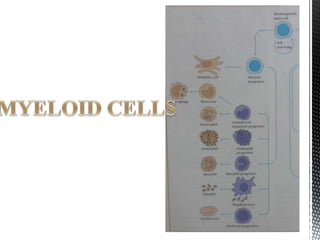
COMMON MYELOID STEM
CELL
• Multipotent stem cells
• Divided into 3 types of committed stem cells:
A) ERYTHROID MEGAKARYOID BASOPHILIC STEM CELL :
Has a potential to go into morphologically recognizable precursors of
3 types:
I. ERYTHROID SYSTEM :Gets converted into erythroblast and passes
to different stages to form reticuloblast which later on produces
Mature RBC
II. MEGAKARYOID SYSTEM : Gets converted into megakaryoblast
which passes on different stages and enter into blood circulation
as PLATELETS
III. BASOPHILS SYSTEM : Gets converted into basoblast which passes
on different stages and enter peripheral circulation as basophils.
B) GRANULOCYTE MONOCYTE STEM CELLS
 It is divided into 2 types of morphologically precursor
cells:
i. GRANULOCYTE: after series of divisions myloblast
is formed and enters into peripheral circulation as
Neutrophils :Neutrophils has granules of red and
blue colour.
ii. MONOCYTE: convert into Monoblast after series of
divisions and enters into peripheral circulation as
Monocytes - Monocytes also have granules but
these are agranulocytes. Monocytes when shifted
to tissue where inflammation occurs are called as
inflammatory macrophages.
C) EOSINOPHILOID STEM CELLS
• Produce precursor cell called as
EOSINOPHIOLOBALST and enter blood circulation to
give rise to Eosinophil.
• Eosinophils have red granules
• The condition in which the stem cells cannot multiply with
enough speed to maintain RBC’S, WBC’S, and platelets
number in peripheral circulation is called as Aplastic
Anemia , so blood cells number is reduced in blood.
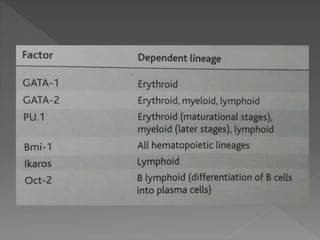
 Induction of megakaryocyte differentiation in the murine myeloid cell
line upon forced expression of GATA-1 provides persuasive evidence for
an influence on lineage commitment.
 This lineage reprogramming was similarly provoked by expression of
GATA-2 or GATA-3 and by exposure of cells to 5-azacytidine.
 In this latter respect, the phenomenon resembles myogenic conversion
of fibroblasts.
 As megakaryocytes develop normally in the absence of GATA-1,The
similar activities of GATA-2 and GATA-3 in promoting megakaryocytic
differentiation of cells suggest that GATA factors are largely
interchangeable with respect to this pathway.
 Hematopoiesis: process of formation of
blood cells.
 Common Lymphoid Stem Cells:
i. PRO-NK CELLS
ii. PRO-T CELLS
iii. PRO- B CELLS
 Comon myleoid cells:
i. Basophils
ii. Granulocyte-monocyte cells
iii. Eosinophil cell
 Factors essential for hematopoiesis.
Hematopoiesis (Immunology)

Hematopoiesis (Immunology)

  • 1.
  • 2.
    Introduction O The processof formation of blood cells i.e. RBC’S, WBC’S and platelets is called as hematopoiesis and the sites where it occurs are known as hematopoietic tissues or organs (bone marrow, liver, spleen). O Cells responsible to do function of hematopoiesis are first seen in yolk sac of embryo in third week of embryonic development and these cells are known as hematopoietic stem cells.
  • 3.
    Cells capable of asymmetricallydividing, one group of cell is responsible for production of well differentiated products and another group of cell is responsible to maintain the original population if stem cell and shows a character called as self- renewal. What are stem cells?
  • 5.
    • Hematopoietic stemcells also take origin in mesoderm of aorta, mesoderm of gonads and mesoderm of meso- nephrons • Hematopoietic stem cells present in yolk sac migrate to other parts like liver, spleen and bone marrow • The hematopoietic stem cells present in yolk sac at third week of embryo migrate to liver at around third month of fetal life • So, around third month of embryo the liver gets populated with these stem cells and become a major organ for hematopoiesis- DOMINANT MIGRATION • Some hematopoietic stem cells also migrate to lymph nodes, spleen –MINOR MIGRATION • Liver , lymph nodes and spleen continue as hematopoietic organs until birth • After birth, liver stops its hematopoietic activity because around 4th month of fetal life migration of stem cells from liver, lymph nodes and spleen takes place to bone marrow
  • 6.
    • Bone marrowis permanent residence for hematopoietic stem cells • At time of birth, all hematopoietic stem cells are limited to bone marrow and bone marrow will be active • Active bone marrow is called as RED BONE MARROW and inactive bone marrow is called as YELLOW BONE MARROW • Yellow bone marrow is accumulated with fat cells, so it is yellow in colour and red bone marrow is highly vascular and rich in hematopoietic stem cells • For new born baby, all bone marrow are red and as age increases red bone marrow is active only in membranous bones • Up to puberty , all most all bone marrow is red and at age of puberty and after puberty hematopoiesis stops in large bones and is limited to axial skeleton,
  • 7.
  • 8.
    • In newborn, if hematopoiesis is going on outside of bone marrow i.e. in liver, spleen and lymph nodes it is called as EXTRA MEDULLARY HEMATOPOIESIS • If there is need of excessive hematopoietic activity, yellow bone marrow has a capacity is to be reactivated and converted into red bone marrow ( seen in severe hemolysis) • When there is excessive hematopoiesis, red bone marrow expands too much into outer bone table o skull and in x-ray outer bone table is not visible and this condition is known as HAIR ON END APPEARANCE • Bone marrow has reserve function—when in need it can increase erythropoietic activity significantly
  • 9.
  • 10.
     It startswith first generation stem cell called as Pluripotent stem cell and the term pluripotent stem cell refers that they have a potency to convert into many different types of tissues  Pleuripotent stem cells divides into two different types of multipotent stem cells:  Multipotent stem cells are cells that have a capacity to self renew by dividing and to develop into multiple specialised cell types present in a specific tissue or organ  The two types of multipotent stem cells are: 1) cells related to lymphoid system are known as Common Lymphoid Stem Cells and 2) the cells related to myeloid system are known as Common Myeloid Stem Cells
  • 12.
    * *The key cellsin bone marrow are the hematopoieticstem cells, which give rise to the lymphoid stem cells and the myeloid stem cells. Lymphoid stem cells give rise to the lymphocytes, which specifically identify foreign molecules and cells. *These cells are divided into three types of committed lymphoid stem cells: A. PRO-NK CELLS: which multiply and differentiate, when enter into blood circulation called as Natural killer Cells B. PRO-T CELLS: which multiply and differentiate and pre mature cells which are derivatives of pro-T cells enter into peripheral circulation and through circulation enters into thymus gland where maturity takes place and after maturation come back to peripheral circulation as T- Lymphocytes. T-lymphocytes are called as CD-3 positive cells. T- Lymphocytes are divided into 2 types: cells which are CD- 3 and CD-4 positive are called as T-HELPER CELLS and are again divided into 2 types T-H1 and T-H2. C. PRO- B CELLS: B cells, also known as B lymphocytes, are a type of white blood cell of the lymphocyte subtype. They function in the humoral immunity component of the adaptive immune system by secreting antibodies.
  • 14.
    COMMON MYELOID STEM CELL •Multipotent stem cells • Divided into 3 types of committed stem cells: A) ERYTHROID MEGAKARYOID BASOPHILIC STEM CELL : Has a potential to go into morphologically recognizable precursors of 3 types: I. ERYTHROID SYSTEM :Gets converted into erythroblast and passes to different stages to form reticuloblast which later on produces Mature RBC II. MEGAKARYOID SYSTEM : Gets converted into megakaryoblast which passes on different stages and enter into blood circulation as PLATELETS III. BASOPHILS SYSTEM : Gets converted into basoblast which passes on different stages and enter peripheral circulation as basophils.
  • 15.
    B) GRANULOCYTE MONOCYTESTEM CELLS  It is divided into 2 types of morphologically precursor cells: i. GRANULOCYTE: after series of divisions myloblast is formed and enters into peripheral circulation as Neutrophils :Neutrophils has granules of red and blue colour. ii. MONOCYTE: convert into Monoblast after series of divisions and enters into peripheral circulation as Monocytes - Monocytes also have granules but these are agranulocytes. Monocytes when shifted to tissue where inflammation occurs are called as inflammatory macrophages.
  • 16.
    C) EOSINOPHILOID STEMCELLS • Produce precursor cell called as EOSINOPHIOLOBALST and enter blood circulation to give rise to Eosinophil. • Eosinophils have red granules • The condition in which the stem cells cannot multiply with enough speed to maintain RBC’S, WBC’S, and platelets number in peripheral circulation is called as Aplastic Anemia , so blood cells number is reduced in blood.
  • 17.
     Induction ofmegakaryocyte differentiation in the murine myeloid cell line upon forced expression of GATA-1 provides persuasive evidence for an influence on lineage commitment.  This lineage reprogramming was similarly provoked by expression of GATA-2 or GATA-3 and by exposure of cells to 5-azacytidine.  In this latter respect, the phenomenon resembles myogenic conversion of fibroblasts.  As megakaryocytes develop normally in the absence of GATA-1,The similar activities of GATA-2 and GATA-3 in promoting megakaryocytic differentiation of cells suggest that GATA factors are largely interchangeable with respect to this pathway.
  • 19.
     Hematopoiesis: processof formation of blood cells.  Common Lymphoid Stem Cells: i. PRO-NK CELLS ii. PRO-T CELLS iii. PRO- B CELLS  Comon myleoid cells: i. Basophils ii. Granulocyte-monocyte cells iii. Eosinophil cell  Factors essential for hematopoiesis.