SYMPATHOMIMETICS
Prof. Amol B. Deore
• Department of Pharmacology
• MVP’s Institute of Pharmaceutical Sciences, Nashik
Sympathetic system: Overview
• Your sympathetic nervous system is best known for its
role in responding to dangerous or stressful situations.
• In these situations, your sympathetic nervous system
activates to speed up your heart rate, deliver more
blood to areas of your body that need more oxygen or
other responses to help your get out of danger.
Sympathetic division
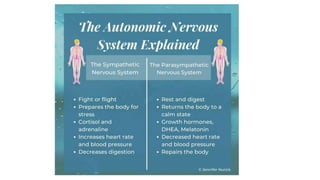
• The sympathetic division prepares the body for “fight or
flight” response to stress, danger, excitement, exercise,
emotions, and embarrassment.
• The sympathetic division deals with energy expenditure by
increasing heart rate and breathing.
• The sympathetic division is dominant in stressful situations,
which include anger, fear, or anxiety, as well as exercise.
Sympathetic division
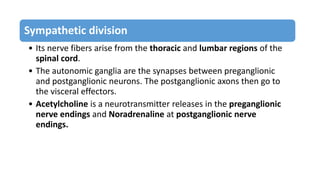
• Its nerve fibers arise from the thoracic and lumbar regions of the
spinal cord.
• The autonomic ganglia are the synapses between preganglionic
and postganglionic neurons. The postganglionic axons then go to
the visceral effectors.
• Acetylcholine is a neurotransmitter releases in the preganglionic
nerve endings and Noradrenaline at postganglionic nerve
endings.
SYMPATHETIC DIVISION PATHWAY
Sympathetic Neurotransmission
• The synthesis of noradrenaline is the first step in the sympathetic
neurotransmission.
• It is synthesized inside the nerve axon, stored within vesicles, then
released by the nerve when an action potential travels down the nerve.
• The amino acid tyrosine is transported into the sympathetic nerve.
• Tyrosine is converted to DOPA by tyrosine hydroxylase.
• DOPA is converted to dopamine (DA) by DOPA decarboxylase.
• Dopamine is transported into vesicles then converted to noradrenaline
(NA).
• Noradrenaline further converted in to adrenaline.
Tyrosine L-dopa Dopamine Noradrenaline Adrenaline
Tyrosine hydroxylase dopa decarboxylase Hydroxylation Methylation
Adrenaline
Nor adrenaline
Synthesis of Noradrenaline
Sympathetic Neurotransmission
Sympathetic Neurotransmission (to be continued)
• An action potential traveling down the axon depolarizes the
membrane and causes calcium to enter the axon.
• Increased intracellular calcium causes the exocytosis of
synaptic vesicles to release noradrenaline
• Some free noradrenaline molecules interact with presynaptic
autoreceptors (alpha 2) in order to control the further release
of the catecholmine by negative feedback mechanism.
• Some fraction of noradrenaline molecules get metabolized by
an enzyme COMT (catechol ortho methyl transferase).
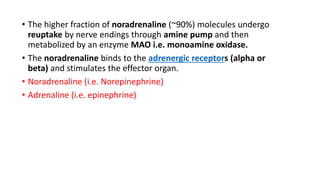
• The higher fraction of noradrenaline (~90%) molecules undergo
reuptake by nerve endings through amine pump and then
metabolized by an enzyme MAO i.e. monoamine oxidase.
• The noradrenaline binds to the adrenergic receptors (alpha or
beta) and stimulates the effector organ.
• Noradrenaline (i.e. Norepinephrine)
• Adrenaline (i.e. epinephrine)
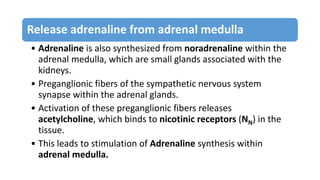
Release adrenaline from adrenal medulla
• Adrenaline is also synthesized from noradrenaline within the
adrenal medulla, which are small glands associated with the
kidneys.
• Preganglionic fibers of the sympathetic nervous system
synapse within the adrenal glands.
• Activation of these preganglionic fibers releases
acetylcholine, which binds to nicotinic receptors (NN) in the
tissue.
• This leads to stimulation of Adrenaline synthesis within
adrenal medulla.
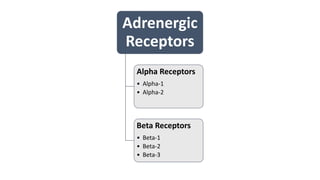
Adrenergic
Receptors
Alpha Receptors
• Alpha-1
• Alpha-2
Beta Receptors
• Beta-1
• Beta-2
• Beta-3
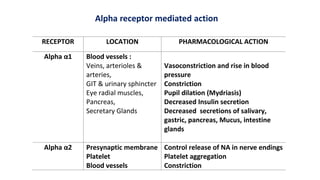
RECEPTOR LOCATION PHARMACOLOGICAL ACTION
Alpha α1 Blood vessels :
Veins, arterioles &
arteries,
GIT & urinary sphincter
Eye radial muscles,
Pancreas,
Secretary Glands
Vasoconstriction and rise in blood
pressure
Constriction
Pupil dilation (Mydriasis)
Decreased Insulin secretion
Decreased secretions of salivary,
gastric, pancreas, Mucus, intestine
glands
Alpha α2 Presynaptic membrane
Platelet
Blood vessels
Control release of NA in nerve endings
Platelet aggregation
Constriction
Alpha receptor mediated action
Beta β1 Heart Increased
Heart rate (+ Chronotropic effect)
Contractility(+ ionotropic effect)
Conduction velocity(+ dromotropic
effect)
Excitability (+ Bathmotropic effect)
Beta β2 Smooth muscles of
Gastrointestinal tract
Respiratory tract
Urinary Tract
Skeletal Muscle
Blood vessels (arteries)
Kidney
Liver
Decreased motility, peristalsis
Bronchodilation (relaxation)
Bladder relaxation
Stimulation
Vasodilation
Increased Renin secretion
Glycogenolysis
Beta β3 Adipose tissue Lipolysis
Beta receptor mediated action
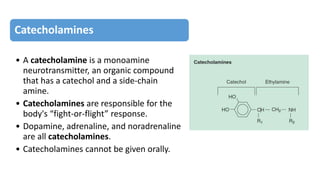
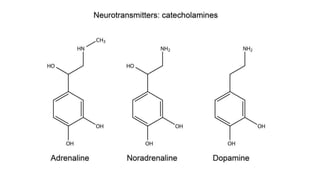
Catecholamines
• A catecholamine is a monoamine
neurotransmitter, an organic compound
that has a catechol and a side-chain
amine.
• Catecholamines are responsible for the
body's “fight-or-flight” response.
• Dopamine, adrenaline, and noradrenaline
are all catecholamines.
• Catecholamines cannot be given orally.
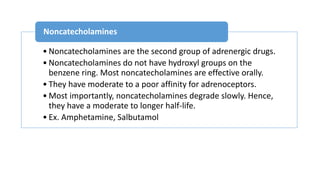
• Noncatecholamines are the second group of adrenergic drugs.
• Noncatecholamines do not have hydroxyl groups on the
benzene ring. Most noncatecholamines are effective orally.
• They have moderate to a poor affinity for adrenoceptors.
• Most importantly, noncatecholamines degrade slowly. Hence,
they have a moderate to longer half-life.
• Ex. Amphetamine, Salbutamol
Noncatecholamines
Sympathomimetics
(Adrenergic Agents)
Sympathomimetics (Adrenergic Agents)
• The drugs which mimic the action sympathetic division are
called sympathomimetics.
• They show similar actions as that of catecholamines.
• They act by either by directly interacting with adrenergic
receptors (alpha or beta) or stimulation of the adrenergic
nerve endings.
CLASSIFICATION OF THE
SYMPATHOMIMETIC DRUGS
ACCORDING TO MECHANISM OF ACTIONS
B} ACCORDING TO CLINICAL USES
1) Vasopressor agents
Ex. Noradrenaline, Adrenaline, Ephedrine, dopamine, Dobutamine, Phenylephrine
2) Bronchodilators
Ex. Isoprenaline, Salbutamol, Terbutaline, Salmeterol, Falmoterol
3) CNS stimulants
Ex. Amphetamine, Dexamphetamine, Methamphetamine
4) Uterine relaxants
Ex. Ritodrine, Salbutamol
5) Cardiac Stimulants
Ex. Adrenaline, Noradrenaline, isoprenaline
6) Nasal Decongestants
Ex. Naphazoline, Phenylephrine, Phenylpropanollamine, Pseudoephedrine
7) Anorectic and antiobesity
Ex. Amphetamine, fenfluramine, dexfenfluramine, phenteramine
Pharmacological actions of
parasympathomimetics
Cardiovascular System: Heart
•Adrenaline is a powerful cardiac stimulant. Acting
through β1 receptors, it increases the heart rate, force
of contraction, cardiac output and conduction velocity.
•It increases cardiac output and the resultant oxygen
consumption also increased.
Blood Vessels
• Stimulation of α1 receptors causes vasoconstriction whereas β2 stimulation
leads to dilation of blood vessels.
• Effect of sympathetic system depends on the predominant type of receptor (α1
or β2 ) present in a particular vascular bed.
• Skin, mucosal and splanchnic blood vessels are constricted due to
predominance of α1 receptors
• whereas skeletal muscular blood vessels and coronaries are dilated because of
the presence of β2 receptors in excess.
Smooth Muscles
Bronchus:
• Bronchial smooth
muscle contains β2
receptors but no
sympathetic supply.
• Exogenous drugs
can cause
bronchodilation by
stimulation of β2
receptors.
GIT:
• Smooth muscles of
GIT are relaxed by
direct action of β2
receptors and
indirect action of α2
receptors.
Urinary system
• Urinary retention
can occur due to
relaxation of
detrussor by β2
action
• Contraction of
trigone (sphincter)
by α1 action.
Uterus
• Non-pregnant
uterus— contracts
• Last month of
pregnancy—
relaxes. (beta 2
stimulation)
Genitourinary tract
• alpha -Receptor agonist contraction of the bladder wall,
urethral sphincter, prostate, seminal vesicles, and vas
deferens.
Glands:
•Secretion of salivary glands becomes thick.
•Sweating is stimulated by sympathetic cholinergic
receptors (M3 action).
Metabolic effects
Stimulation of β3 receptors causes breakdown of triglycerides
to free fatty acids.
Hyperglycemia is caused by promotion of glycogenolysis and
gluconeogenesis on β2 stimulation.
Pharmacokinetics
•As catecholamines are rapidly inactivated in the
gut and the liver they are not given orally.
•Adrenaline and NA are metabolised by COMT and
MAO.
Adverse Effects of Adrenaline
• The more common side effects include tachycardia,
hypertension, headache, anxiety, apprehension,
palpitations, diaphoresis, nausea, vomiting, weakness,
and tremors.
Dose and Route:
• Adrenaline Injection BP. 1/1000 (1mg/ml) may be
administered undiluted by S.C. or IM injection
Contraindications to use of Adrenaline
• Hypertension.
• Diabetes.
• Hyperthyroidism.
• Parkinson's disease,
• Pheochromocytoma,
• Cerebrovascular disease
• Renal impairment use caution
ADRENALINE IS ALWAYS KEPT IN EMERGENCY KITS.
• Its clinical uses are mostly based on the actions on bronchial
smooth muscles, heart and blood vessels.
• Bronchial asthma: Adrenaline acts on the bronchial smooth
muscle (β2 receptors) and induces brochodilation, and inhibits
mucus secretion. Hence adrenaline is used in treatment of acute
and severe attacks of bronchial asthma as well as status
asthmaticus.
• Hypersensitivity reactions: Adrenaline is a potent antiallergic
agent and used for relief of life- threatening allergic reactions like
serum sickness, angioedema, Hay fever and anaphylaxis shock.
To be continued
• Local hemostasis: Adrenaline is frequently used as topical hemostatic agent,
because of its vasoconstriction action. It stops bleeding from the gums as well as
epistaxis (nose bleed). Adrenaline soaked packs are applied locally Or it is sprayed
over the bleeding region.
• Adrenaline limits the systemic absorption of local anesthetics. Hence it is given in
combination with the local anesthetics (like lignocaine) to prolong the duration of
action.
• Cardiac arrest and heart block: For the treatment of Cardiac arrest about 0.3 to 0.5
ml of adrenaline (1:1000) injected directly in to right atrium of the heart. For the
treatment of Heart block, 0.3 to 0.6 ml of adrenaline (1:1000) injected
subcutaneously.
• Ophthalmic: Adrenaline solution may be instilled into the eye to treat conjunctival
congestion, to treat hemorrhage and in treatment of open angle glaucoma.
Thanking You

Sympathomimetics.pptx

  • 1.
    SYMPATHOMIMETICS Prof. Amol B.Deore • Department of Pharmacology • MVP’s Institute of Pharmaceutical Sciences, Nashik
  • 2.
    Sympathetic system: Overview •Your sympathetic nervous system is best known for its role in responding to dangerous or stressful situations. • In these situations, your sympathetic nervous system activates to speed up your heart rate, deliver more blood to areas of your body that need more oxygen or other responses to help your get out of danger.
  • 4.
    Sympathetic division • Thesympathetic division prepares the body for “fight or flight” response to stress, danger, excitement, exercise, emotions, and embarrassment. • The sympathetic division deals with energy expenditure by increasing heart rate and breathing. • The sympathetic division is dominant in stressful situations, which include anger, fear, or anxiety, as well as exercise.
  • 6.
    Sympathetic division • Itsnerve fibers arise from the thoracic and lumbar regions of the spinal cord. • The autonomic ganglia are the synapses between preganglionic and postganglionic neurons. The postganglionic axons then go to the visceral effectors. • Acetylcholine is a neurotransmitter releases in the preganglionic nerve endings and Noradrenaline at postganglionic nerve endings.
  • 8.
  • 9.
    Sympathetic Neurotransmission • Thesynthesis of noradrenaline is the first step in the sympathetic neurotransmission. • It is synthesized inside the nerve axon, stored within vesicles, then released by the nerve when an action potential travels down the nerve. • The amino acid tyrosine is transported into the sympathetic nerve. • Tyrosine is converted to DOPA by tyrosine hydroxylase. • DOPA is converted to dopamine (DA) by DOPA decarboxylase. • Dopamine is transported into vesicles then converted to noradrenaline (NA). • Noradrenaline further converted in to adrenaline.
  • 10.
    Tyrosine L-dopa DopamineNoradrenaline Adrenaline Tyrosine hydroxylase dopa decarboxylase Hydroxylation Methylation Adrenaline Nor adrenaline Synthesis of Noradrenaline
  • 11.
  • 12.
    Sympathetic Neurotransmission (tobe continued) • An action potential traveling down the axon depolarizes the membrane and causes calcium to enter the axon. • Increased intracellular calcium causes the exocytosis of synaptic vesicles to release noradrenaline • Some free noradrenaline molecules interact with presynaptic autoreceptors (alpha 2) in order to control the further release of the catecholmine by negative feedback mechanism. • Some fraction of noradrenaline molecules get metabolized by an enzyme COMT (catechol ortho methyl transferase).
  • 13.
    • The higherfraction of noradrenaline (~90%) molecules undergo reuptake by nerve endings through amine pump and then metabolized by an enzyme MAO i.e. monoamine oxidase. • The noradrenaline binds to the adrenergic receptors (alpha or beta) and stimulates the effector organ. • Noradrenaline (i.e. Norepinephrine) • Adrenaline (i.e. epinephrine)
  • 14.
    Release adrenaline fromadrenal medulla • Adrenaline is also synthesized from noradrenaline within the adrenal medulla, which are small glands associated with the kidneys. • Preganglionic fibers of the sympathetic nervous system synapse within the adrenal glands. • Activation of these preganglionic fibers releases acetylcholine, which binds to nicotinic receptors (NN) in the tissue. • This leads to stimulation of Adrenaline synthesis within adrenal medulla.
  • 16.
    Adrenergic Receptors Alpha Receptors • Alpha-1 •Alpha-2 Beta Receptors • Beta-1 • Beta-2 • Beta-3
  • 17.
    RECEPTOR LOCATION PHARMACOLOGICALACTION Alpha α1 Blood vessels : Veins, arterioles & arteries, GIT & urinary sphincter Eye radial muscles, Pancreas, Secretary Glands Vasoconstriction and rise in blood pressure Constriction Pupil dilation (Mydriasis) Decreased Insulin secretion Decreased secretions of salivary, gastric, pancreas, Mucus, intestine glands Alpha α2 Presynaptic membrane Platelet Blood vessels Control release of NA in nerve endings Platelet aggregation Constriction Alpha receptor mediated action
  • 18.
    Beta β1 HeartIncreased Heart rate (+ Chronotropic effect) Contractility(+ ionotropic effect) Conduction velocity(+ dromotropic effect) Excitability (+ Bathmotropic effect) Beta β2 Smooth muscles of Gastrointestinal tract Respiratory tract Urinary Tract Skeletal Muscle Blood vessels (arteries) Kidney Liver Decreased motility, peristalsis Bronchodilation (relaxation) Bladder relaxation Stimulation Vasodilation Increased Renin secretion Glycogenolysis Beta β3 Adipose tissue Lipolysis Beta receptor mediated action
  • 19.
    Catecholamines • A catecholamineis a monoamine neurotransmitter, an organic compound that has a catechol and a side-chain amine. • Catecholamines are responsible for the body's “fight-or-flight” response. • Dopamine, adrenaline, and noradrenaline are all catecholamines. • Catecholamines cannot be given orally.
  • 21.
    • Noncatecholamines arethe second group of adrenergic drugs. • Noncatecholamines do not have hydroxyl groups on the benzene ring. Most noncatecholamines are effective orally. • They have moderate to a poor affinity for adrenoceptors. • Most importantly, noncatecholamines degrade slowly. Hence, they have a moderate to longer half-life. • Ex. Amphetamine, Salbutamol Noncatecholamines
  • 22.
  • 23.
    Sympathomimetics (Adrenergic Agents) •The drugs which mimic the action sympathetic division are called sympathomimetics. • They show similar actions as that of catecholamines. • They act by either by directly interacting with adrenergic receptors (alpha or beta) or stimulation of the adrenergic nerve endings.
  • 24.
  • 25.
  • 26.
    B} ACCORDING TOCLINICAL USES 1) Vasopressor agents Ex. Noradrenaline, Adrenaline, Ephedrine, dopamine, Dobutamine, Phenylephrine 2) Bronchodilators Ex. Isoprenaline, Salbutamol, Terbutaline, Salmeterol, Falmoterol 3) CNS stimulants Ex. Amphetamine, Dexamphetamine, Methamphetamine 4) Uterine relaxants Ex. Ritodrine, Salbutamol 5) Cardiac Stimulants Ex. Adrenaline, Noradrenaline, isoprenaline 6) Nasal Decongestants Ex. Naphazoline, Phenylephrine, Phenylpropanollamine, Pseudoephedrine 7) Anorectic and antiobesity Ex. Amphetamine, fenfluramine, dexfenfluramine, phenteramine
  • 27.
  • 28.
    Cardiovascular System: Heart •Adrenalineis a powerful cardiac stimulant. Acting through β1 receptors, it increases the heart rate, force of contraction, cardiac output and conduction velocity. •It increases cardiac output and the resultant oxygen consumption also increased.
  • 29.
    Blood Vessels • Stimulationof α1 receptors causes vasoconstriction whereas β2 stimulation leads to dilation of blood vessels. • Effect of sympathetic system depends on the predominant type of receptor (α1 or β2 ) present in a particular vascular bed. • Skin, mucosal and splanchnic blood vessels are constricted due to predominance of α1 receptors • whereas skeletal muscular blood vessels and coronaries are dilated because of the presence of β2 receptors in excess.
  • 30.
    Smooth Muscles Bronchus: • Bronchialsmooth muscle contains β2 receptors but no sympathetic supply. • Exogenous drugs can cause bronchodilation by stimulation of β2 receptors. GIT: • Smooth muscles of GIT are relaxed by direct action of β2 receptors and indirect action of α2 receptors. Urinary system • Urinary retention can occur due to relaxation of detrussor by β2 action • Contraction of trigone (sphincter) by α1 action. Uterus • Non-pregnant uterus— contracts • Last month of pregnancy— relaxes. (beta 2 stimulation)
  • 31.
    Genitourinary tract • alpha-Receptor agonist contraction of the bladder wall, urethral sphincter, prostate, seminal vesicles, and vas deferens.
  • 32.
    Glands: •Secretion of salivaryglands becomes thick. •Sweating is stimulated by sympathetic cholinergic receptors (M3 action).
  • 33.
    Metabolic effects Stimulation ofβ3 receptors causes breakdown of triglycerides to free fatty acids. Hyperglycemia is caused by promotion of glycogenolysis and gluconeogenesis on β2 stimulation.
  • 34.
    Pharmacokinetics •As catecholamines arerapidly inactivated in the gut and the liver they are not given orally. •Adrenaline and NA are metabolised by COMT and MAO.
  • 35.
    Adverse Effects ofAdrenaline • The more common side effects include tachycardia, hypertension, headache, anxiety, apprehension, palpitations, diaphoresis, nausea, vomiting, weakness, and tremors.
  • 36.
    Dose and Route: •Adrenaline Injection BP. 1/1000 (1mg/ml) may be administered undiluted by S.C. or IM injection
  • 37.
    Contraindications to useof Adrenaline • Hypertension. • Diabetes. • Hyperthyroidism. • Parkinson's disease, • Pheochromocytoma, • Cerebrovascular disease • Renal impairment use caution
  • 38.
    ADRENALINE IS ALWAYSKEPT IN EMERGENCY KITS. • Its clinical uses are mostly based on the actions on bronchial smooth muscles, heart and blood vessels. • Bronchial asthma: Adrenaline acts on the bronchial smooth muscle (β2 receptors) and induces brochodilation, and inhibits mucus secretion. Hence adrenaline is used in treatment of acute and severe attacks of bronchial asthma as well as status asthmaticus. • Hypersensitivity reactions: Adrenaline is a potent antiallergic agent and used for relief of life- threatening allergic reactions like serum sickness, angioedema, Hay fever and anaphylaxis shock.
  • 39.
    To be continued •Local hemostasis: Adrenaline is frequently used as topical hemostatic agent, because of its vasoconstriction action. It stops bleeding from the gums as well as epistaxis (nose bleed). Adrenaline soaked packs are applied locally Or it is sprayed over the bleeding region. • Adrenaline limits the systemic absorption of local anesthetics. Hence it is given in combination with the local anesthetics (like lignocaine) to prolong the duration of action. • Cardiac arrest and heart block: For the treatment of Cardiac arrest about 0.3 to 0.5 ml of adrenaline (1:1000) injected directly in to right atrium of the heart. For the treatment of Heart block, 0.3 to 0.6 ml of adrenaline (1:1000) injected subcutaneously. • Ophthalmic: Adrenaline solution may be instilled into the eye to treat conjunctival congestion, to treat hemorrhage and in treatment of open angle glaucoma.
  • 41.