Prof. Amol B. Deore
Department of Pharmacology
MVP’s Institute of Pharmaceutical Sciences, Nashik
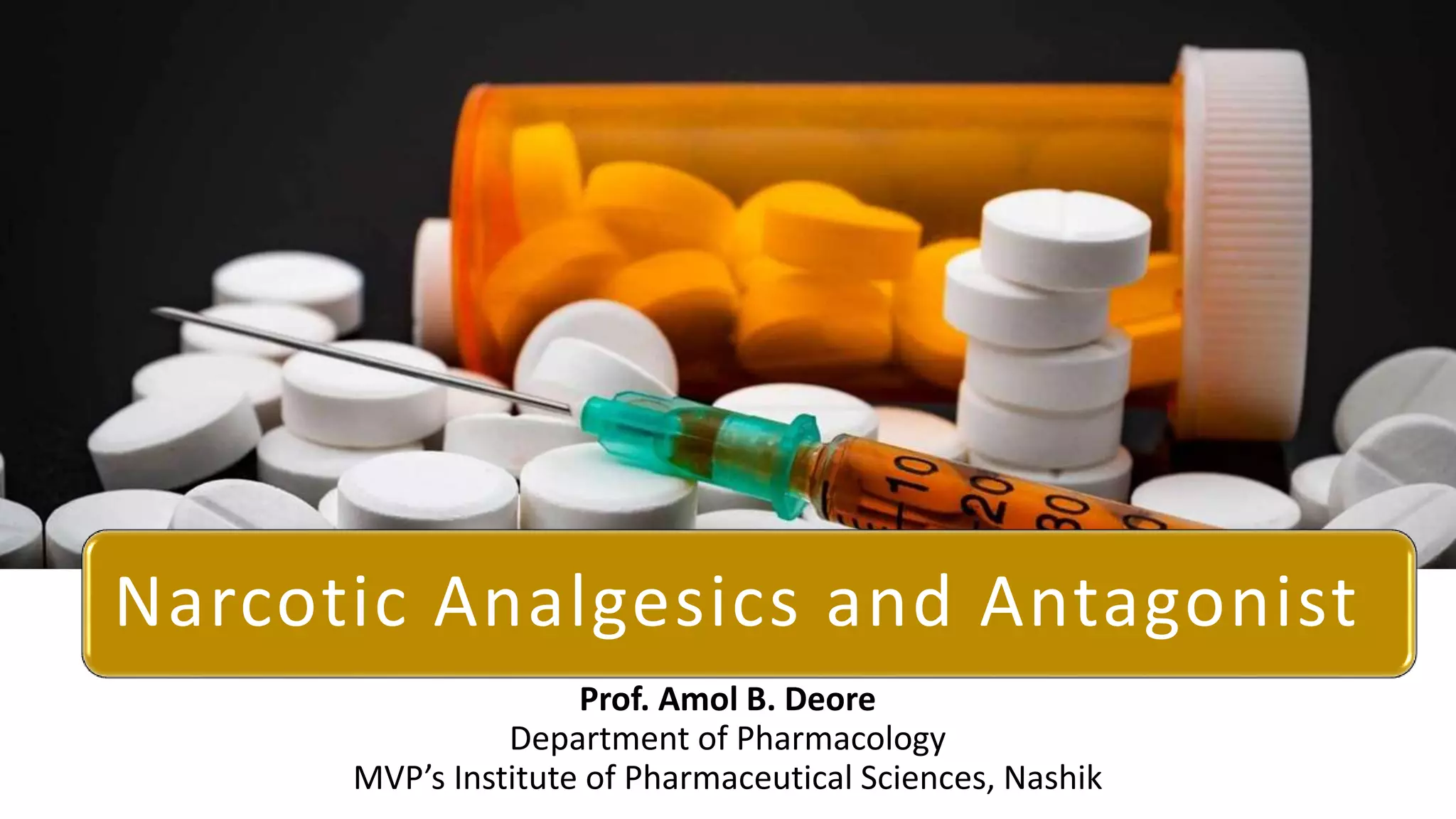
Narcotic Analgesics and Antagonist
Narcotic Analgesic
• Narcotics analgesics are drugs used to relieve moderate
to severe pain by binding to opioid receptors, which are
present in the central and peripheral nervous system.
• Narcotic refers to opium derivatives, and their semi-
synthetic or synthetic substitutes as well as cocaine and
coca leaves.
• They are only used for pain that is severe and is not
helped by other types of painkillers. When used
carefully and under a health care provider's direct care.
Opioids
• Any naturally occurring, semi-synthetic or synthetic compounds that bind
specifically to opioid receptors and share the properties of one or more of the
naturally occurring endogenous opioids.
• Opium is a mixture of alkaloids from the poppy plant- Papaver Somniferum.
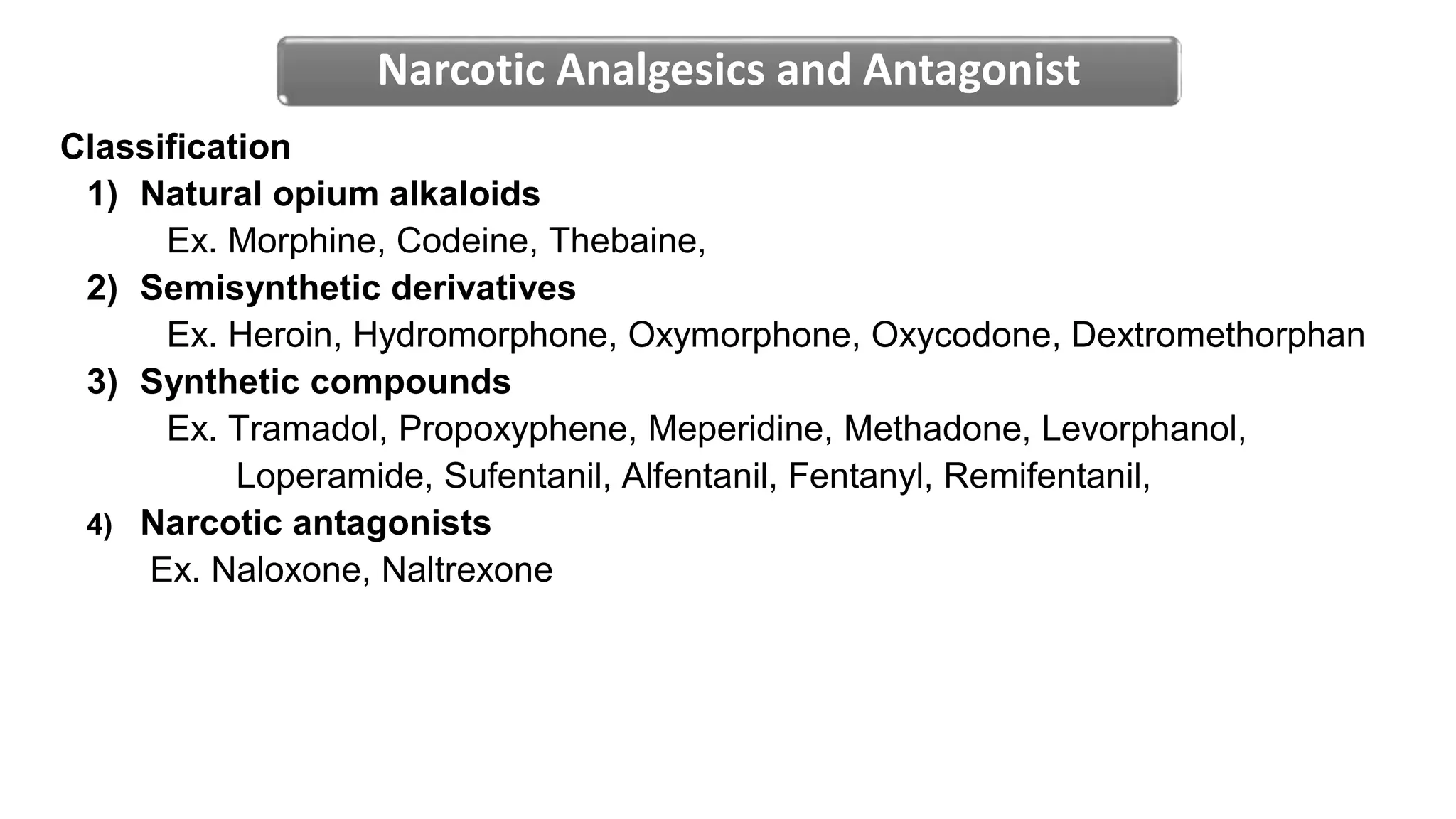
Classification
1) Natural opium alkaloids
Ex. Morphine, Codeine, Thebaine,
2) Semisynthetic derivatives
Ex. Heroin, Hydromorphone, Oxymorphone, Oxycodone, Dextromethorphan
3) Synthetic compounds
Ex. Tramadol, Propoxyphene, Meperidine, Methadone, Levorphanol,
Loperamide, Sufentanil, Alfentanil, Fentanyl, Remifentanil,
4) Narcotic antagonists
Ex. Naloxone, Naltrexone
Narcotic Analgesics and Antagonist
Mechanism of action
• As morphine binds to opioid receptors and activates
the receptors to exert certain actions.
• There are three major types of opioid receptors and
these are:
• μ receptor (Mu) – These receptors are present in the
brainstem and the thalamus, activation of these
receptors can result in pain relief, sedation and
euphoria as well as respiratory depression,
constipation and physical dependence.
κ receptor (kappa) - This receptor is present in the limbic
system, the brain stem and spinal cord. Activation of this
receptor causes pain relief, sedation, loss of breath and
dependence.
δ receptor (delta) - This receptor is widely distributed in the
brain and also present in the spinal cord and digestive tract.
Stimulation of this receptor leads to analgesic as well as
antidepressant effects but may also cause respiratory
depression.
Pharmacological actions of
Morphine
Central Nervous System
•Analgesia: Most effective in relieving severe and
continuous pain arising from deeper structures and
less effective against superficial and sharp pain.
Sedation: Drowsiness, feeling of heaviness
and difficulty in concentrating are
common. Sleep may occur with relief of
pain, but they are not true hypnotics.
Euphoria and dysphoria: Morphine and
other opioids cause a sense of fulfillment,
satisfaction and euphoria. Euphoria is the
experience of pleasure or excitement and
intense feelings of well-being and
happiness.
Hallucination: Morphine and other opioids may cause
hallucinations. The hallucinations are where someone
sees, hears, smells, tastes or feels things that do not
exist outside their mind.
Hallucinations are sensations that appear real but are
created by your mind.
Tolerance and Dependence: Dependence exists when
the sudden withdrawn of an opioid, after repeated
use over a prolonged period, results in various
physical and psychological signs and symptoms. These
include; restlessness, irritability, increased salivation,
anorexia, lacrimation and sweating, muscle cramps,
vomiting and diarrhea.
Cardiovascular System
• Mild bradycardia is common because of decreased
sympathetic activity and a direct effect on the SA node.
Peripheral vasodilatation caused by histamine release and
reduced sympathetic activity may result in fall in blood
pressure.
Respiratory System
• It depresses the respiratory center in medulla oblongata and
decreases rate of respiration and tidal volume. In large doses,
it produces respiratory failure and hypoxia condition.
Suppression of cough
• Opioids depress the cough reflects
by depressant action on the cough
center in medulla oblongata.
Gastrointestinal System
• It decreases the gastrointestinal tract secretions and peristaltic
movements. It also decreases the gastric motility thus decreasing the
gastric emptying.
• It inhibits the defecation reflex and spasm of the anal sphincters all
these effects result in the complete absorption of the water causing
drying of the stools and inability to defecate thus producing the
constipation.
• Therefore, in diarrhea opium tincture (1 to 2 ml) can be given to
produce constipation.
• Preparation and doses-
• Morphine Hcl – 10 to 20 mg SC or IM
• Morphine sulfate – 10 to 20 mg SC or IM
Clinical uses of morphine
• For relief of severe pain- morphine is one of the most
powerful analgesic.it is use to relieve severe pain such as
myocardial infarction, accidental pain, post-operative
pain, fracture of the long bones, severe burns, acute
pericarditis and terminal stage of the cancer that is cancer
pain
• As preanesthetic medication- morphine is used before
operation or surgery To produce sedation and anxiolytic
effect. it also reduces dose of the general Anesthetic
required.
• Antitussive action– morphine can be used to suppress severe cough
but codeine is preferred.
• Antidiarrheal action: In diarrhea, morphine (tincture of opium 1 to 2
ml) can be used to produce constipation in severe diarrhea but
loperamide is preferred as the potent antidiarrheal drug.
Adverse drug reactions-
• Vomiting, nausea, constipation, vertigo
• Respiratory depression
• dizziness, drowsiness
• Pin-point pupil of eye and miosis
• Urinary retention
• Euphoria, and hallucinations
• Drug tolerance
• Drug dependence
• Increased intracranial pressure
• biliary spasm
Contraindications
• Head injury
• The diagnostic features of head injury are
mydriasis, vomiting and respiratory depression.
Morphine produces miosis, pin point pupil, nausea,
vomiting, respiratory depression and increases
intracranial pressure of Cerebrospinal fluid in brain.
• This may complicate the patient condition in head
injury. By producing miosis, respiratory depression
and mental clouding it may interfere with diagnosis
and assessment of head injury.
Bronchial asthma
• Morphine can precipitate an acute attack of
bronchial asthma by causing bronchospasm due to
direct action on bronchial smooth muscles and
depression of respiratory centre in medulla
oblongata in CNS.
Prostate enlargement
• Morphine can produce urinary retention, difficulty in urine
micturition by causing spasm of urinary sphincter of bladder.
• Morphine is strictly contraindicated in– Children, Old
patients, Pregnancy
Acute Opioid Poisoning
•Causes of opioid intoxication
•Opioid intoxication occurs when someone takes
too many opioids. Opioid intoxication can occur if
someone:
•overdoses
•mixes opioids together
•takes opioids without a prescription or for longer
than prescribed
Symptoms
• A cold or clammy feel to the skin,
• Bluish hue in the fingertips and lips,
• Pinpoint pupil (miosis),
• Blurry vision,
• Nausea and Vomiting,
• Severe constipation,
• Respiratory depression: irregular breathing,
• hypothermia and hypoglycaemia,
• Slow heartbeat, hypotension,
• CNS depression: Severe sleepiness,
• Loss of consciousness,
• Coma.
Management
• Gastric lavage by potassium permanganate solution to
oxidise the morphine to oxymorphine (less toxic) and to
wash out unabsorbed morphine from the stomach.
• Artificial ventilator is given for breathing
• Administration of specific opioid antidote- Naloxone or
nalorphine given by intravenously.
• Administration of intravenous fluids.
Morphine is good analgesic but worst drug for
addiction OR Morphine causes addiction.
• Morphine is an Opioid analgesic used to relieve very severe pain such
as cancer pain, myocardial infarction pain, accidental pain, post-
operative pain and for cough and diarrhoea.
• Morphine interacts with opioid receptors (mu, kappa, delta and
sigma) in the brain and CNS thereby producing sedation, euphoria,
mental state of well-being, pleasure, hallucinations.
• Hence, to experience positive state of mind and satisfaction,
individual continue the drug on its own therapeutic indication
(without prescription or consult). This develops tolerance and strong
degree of psychological drug dependence, which cause addiction.
Morphine should be contraindicated in children, old people and
pregnant women.
• Morphine is an Opioids analgesic shows adverse drug reactions–respiratory
depression, circulatory depression, pin point pupil, difficulty in urine micturition
and prostate enlargement which cannot be tolerated by children and old people.
• The drug metabolism capacity is not completely developed in children and
become weaker in old age.
• In pregnancy, morphine crosses placental barrier and depress fetal respiration.
Therefore, Morphine is strictly contraindicated in children, old people and
pregnant women.
Morphine should not be given in abdominal
pain before diagnosis.
• Abdominal pain may be due to peptic ulcer, gallbladder
stone, appendix swelling, pancreatitis and amoebiasis.
These conditions show different symptoms. Hence, their
diagnosis should be done.
• If narcotic analgesic like morphine is given, it relives
pain that interferes in the detection of the symptoms of
above mentioned diseases. This results into the faulty
diagnosis. Therefore
In treatment of biliary colic, morphine is always
combined with atropine. Why?
•Biliary Colic is the condition in which there is severe
pain due to spasm (sustained contraction) in biliary
tract.
•Morphine, an opioid analgesic relieves pain while
atropine is antispasmodic which reduces spasm.
•Combination of atropine and morphine gives
synergistic effect. Therefore….
• Thanking You

Narcotic analgesic and antagonist.pptx

  • 1.
    Prof. Amol B.Deore Department of Pharmacology MVP’s Institute of Pharmaceutical Sciences, Nashik Narcotic Analgesics and Antagonist
  • 2.
    Narcotic Analgesic • Narcoticsanalgesics are drugs used to relieve moderate to severe pain by binding to opioid receptors, which are present in the central and peripheral nervous system. • Narcotic refers to opium derivatives, and their semi- synthetic or synthetic substitutes as well as cocaine and coca leaves. • They are only used for pain that is severe and is not helped by other types of painkillers. When used carefully and under a health care provider's direct care.
  • 3.
    Opioids • Any naturallyoccurring, semi-synthetic or synthetic compounds that bind specifically to opioid receptors and share the properties of one or more of the naturally occurring endogenous opioids. • Opium is a mixture of alkaloids from the poppy plant- Papaver Somniferum.
  • 4.
    Classification 1) Natural opiumalkaloids Ex. Morphine, Codeine, Thebaine, 2) Semisynthetic derivatives Ex. Heroin, Hydromorphone, Oxymorphone, Oxycodone, Dextromethorphan 3) Synthetic compounds Ex. Tramadol, Propoxyphene, Meperidine, Methadone, Levorphanol, Loperamide, Sufentanil, Alfentanil, Fentanyl, Remifentanil, 4) Narcotic antagonists Ex. Naloxone, Naltrexone Narcotic Analgesics and Antagonist
  • 5.
    Mechanism of action •As morphine binds to opioid receptors and activates the receptors to exert certain actions. • There are three major types of opioid receptors and these are: • μ receptor (Mu) – These receptors are present in the brainstem and the thalamus, activation of these receptors can result in pain relief, sedation and euphoria as well as respiratory depression, constipation and physical dependence.
  • 7.
    κ receptor (kappa)- This receptor is present in the limbic system, the brain stem and spinal cord. Activation of this receptor causes pain relief, sedation, loss of breath and dependence. δ receptor (delta) - This receptor is widely distributed in the brain and also present in the spinal cord and digestive tract. Stimulation of this receptor leads to analgesic as well as antidepressant effects but may also cause respiratory depression.
  • 8.
  • 9.
    Central Nervous System •Analgesia:Most effective in relieving severe and continuous pain arising from deeper structures and less effective against superficial and sharp pain.
  • 10.
    Sedation: Drowsiness, feelingof heaviness and difficulty in concentrating are common. Sleep may occur with relief of pain, but they are not true hypnotics. Euphoria and dysphoria: Morphine and other opioids cause a sense of fulfillment, satisfaction and euphoria. Euphoria is the experience of pleasure or excitement and intense feelings of well-being and happiness.
  • 11.
    Hallucination: Morphine andother opioids may cause hallucinations. The hallucinations are where someone sees, hears, smells, tastes or feels things that do not exist outside their mind. Hallucinations are sensations that appear real but are created by your mind. Tolerance and Dependence: Dependence exists when the sudden withdrawn of an opioid, after repeated use over a prolonged period, results in various physical and psychological signs and symptoms. These include; restlessness, irritability, increased salivation, anorexia, lacrimation and sweating, muscle cramps, vomiting and diarrhea.
  • 12.
    Cardiovascular System • Mildbradycardia is common because of decreased sympathetic activity and a direct effect on the SA node. Peripheral vasodilatation caused by histamine release and reduced sympathetic activity may result in fall in blood pressure. Respiratory System • It depresses the respiratory center in medulla oblongata and decreases rate of respiration and tidal volume. In large doses, it produces respiratory failure and hypoxia condition.
  • 13.
    Suppression of cough •Opioids depress the cough reflects by depressant action on the cough center in medulla oblongata.
  • 14.
    Gastrointestinal System • Itdecreases the gastrointestinal tract secretions and peristaltic movements. It also decreases the gastric motility thus decreasing the gastric emptying. • It inhibits the defecation reflex and spasm of the anal sphincters all these effects result in the complete absorption of the water causing drying of the stools and inability to defecate thus producing the constipation. • Therefore, in diarrhea opium tincture (1 to 2 ml) can be given to produce constipation.
  • 15.
    • Preparation anddoses- • Morphine Hcl – 10 to 20 mg SC or IM • Morphine sulfate – 10 to 20 mg SC or IM
  • 16.
    Clinical uses ofmorphine • For relief of severe pain- morphine is one of the most powerful analgesic.it is use to relieve severe pain such as myocardial infarction, accidental pain, post-operative pain, fracture of the long bones, severe burns, acute pericarditis and terminal stage of the cancer that is cancer pain • As preanesthetic medication- morphine is used before operation or surgery To produce sedation and anxiolytic effect. it also reduces dose of the general Anesthetic required.
  • 17.
    • Antitussive action–morphine can be used to suppress severe cough but codeine is preferred. • Antidiarrheal action: In diarrhea, morphine (tincture of opium 1 to 2 ml) can be used to produce constipation in severe diarrhea but loperamide is preferred as the potent antidiarrheal drug.
  • 18.
    Adverse drug reactions- •Vomiting, nausea, constipation, vertigo • Respiratory depression • dizziness, drowsiness • Pin-point pupil of eye and miosis • Urinary retention • Euphoria, and hallucinations • Drug tolerance • Drug dependence • Increased intracranial pressure • biliary spasm
  • 19.
    Contraindications • Head injury •The diagnostic features of head injury are mydriasis, vomiting and respiratory depression. Morphine produces miosis, pin point pupil, nausea, vomiting, respiratory depression and increases intracranial pressure of Cerebrospinal fluid in brain. • This may complicate the patient condition in head injury. By producing miosis, respiratory depression and mental clouding it may interfere with diagnosis and assessment of head injury.
  • 20.
    Bronchial asthma • Morphinecan precipitate an acute attack of bronchial asthma by causing bronchospasm due to direct action on bronchial smooth muscles and depression of respiratory centre in medulla oblongata in CNS.
  • 21.
    Prostate enlargement • Morphinecan produce urinary retention, difficulty in urine micturition by causing spasm of urinary sphincter of bladder. • Morphine is strictly contraindicated in– Children, Old patients, Pregnancy
  • 22.
    Acute Opioid Poisoning •Causesof opioid intoxication •Opioid intoxication occurs when someone takes too many opioids. Opioid intoxication can occur if someone: •overdoses •mixes opioids together •takes opioids without a prescription or for longer than prescribed
  • 23.
    Symptoms • A coldor clammy feel to the skin, • Bluish hue in the fingertips and lips, • Pinpoint pupil (miosis), • Blurry vision, • Nausea and Vomiting, • Severe constipation, • Respiratory depression: irregular breathing, • hypothermia and hypoglycaemia, • Slow heartbeat, hypotension, • CNS depression: Severe sleepiness, • Loss of consciousness, • Coma.
  • 24.
    Management • Gastric lavageby potassium permanganate solution to oxidise the morphine to oxymorphine (less toxic) and to wash out unabsorbed morphine from the stomach. • Artificial ventilator is given for breathing • Administration of specific opioid antidote- Naloxone or nalorphine given by intravenously. • Administration of intravenous fluids.
  • 25.
    Morphine is goodanalgesic but worst drug for addiction OR Morphine causes addiction. • Morphine is an Opioid analgesic used to relieve very severe pain such as cancer pain, myocardial infarction pain, accidental pain, post- operative pain and for cough and diarrhoea. • Morphine interacts with opioid receptors (mu, kappa, delta and sigma) in the brain and CNS thereby producing sedation, euphoria, mental state of well-being, pleasure, hallucinations. • Hence, to experience positive state of mind and satisfaction, individual continue the drug on its own therapeutic indication (without prescription or consult). This develops tolerance and strong degree of psychological drug dependence, which cause addiction.
  • 26.
    Morphine should becontraindicated in children, old people and pregnant women. • Morphine is an Opioids analgesic shows adverse drug reactions–respiratory depression, circulatory depression, pin point pupil, difficulty in urine micturition and prostate enlargement which cannot be tolerated by children and old people. • The drug metabolism capacity is not completely developed in children and become weaker in old age. • In pregnancy, morphine crosses placental barrier and depress fetal respiration. Therefore, Morphine is strictly contraindicated in children, old people and pregnant women.
  • 27.
    Morphine should notbe given in abdominal pain before diagnosis. • Abdominal pain may be due to peptic ulcer, gallbladder stone, appendix swelling, pancreatitis and amoebiasis. These conditions show different symptoms. Hence, their diagnosis should be done. • If narcotic analgesic like morphine is given, it relives pain that interferes in the detection of the symptoms of above mentioned diseases. This results into the faulty diagnosis. Therefore
  • 28.
    In treatment ofbiliary colic, morphine is always combined with atropine. Why? •Biliary Colic is the condition in which there is severe pain due to spasm (sustained contraction) in biliary tract. •Morphine, an opioid analgesic relieves pain while atropine is antispasmodic which reduces spasm. •Combination of atropine and morphine gives synergistic effect. Therefore….
  • 29.