Lymph & Lymphatic's
Mr . Bala Chandrudu
RVM Medical college & RC
Lymphatic system is an accessory route through Which
fluid flows from the interstitial spaces in to the blood.
Almost all the tissue of the body have lymphatics.
exceptions being the skin, brain ,bone , Cartilage, &
Epithelial tissue
Organization of the Lymphatic system
The Lymphatic system begins from tissue and is made
up of a meshwork of delicate vessels termed Lymph
Capillaries . These lymph capillaries begin as enlarged
terminals call Capillary bulbs.
The lymphatic capillary contain valves which cause
the flow of lymph in one direction.
The capillary bulbs contain smooth muscles.
Contraction of smooth muscles helps in the flow of
lymph.
The Lymphatic capillaries unite to form larger
lymphatic vessels as they proceed toward the
venous system of the heart.
Along the course of these lymphatic vessels,
masses of lymphoid tissues called Lymph nodes
are present .
LYMPH :-
Lymph is a modified tissue fluid derived from
interstitial fluid . It flows in a closed sytem consisting
of Lymphatic channels in a one way direction.
Lymphatic flow occurs from the tissues toward the
right side of the heart. (or)
Lymph, also called lymphatic fluid, is a collection of the
extra fluid that drains from cells and tissues plus
other substances. The other substances include
proteins, minerals, fats, nutrients, damaged cells,
cancer cells and foreign invaders (bacteria, viruses,
etc). Lymph also transports infection-fighting white
blood cells (lymphocytes).
Composition of Lymph :-
Lymph is a transparent, yellowish liquid. It contains
water- 96% & Solid 4%.
The reaction is slightly alkaline in nature
It contain Proteins, fats, clotting factors, ions
such as Na+, K+ , Cl-, Ca2+ , Lymphocytes, few
RBC, & Platelets.
Proteins :- The protein content of lymph varies
widely in different tissues. It is highest in the liver.
(6 g/dl) . It is also found in substantial quantities in
the intestines, heart, & lungs. Lymph drained from
the choroid plexus does not contain proteins.
Lipids :- Lymph drained from the intestinal region contains
significant amounts of lipids since the Lymphatics of
intestinal villi absorb lipids. The intestinal lymph is
therefore milky in color . This milky lymph is called Chyle &
The lymphatic's in the mesentry are called Lacteals.
Clotting factors :- These are present in the lymph
since they are formed in the liver
Lymphocytes : -Lymph also contains a large number of
lymphocytes.
Other components :-
Carbohydrates , Creatinine,Water – 94%, Urea, Chlorides,
Enzymes ,The small amount of fats,
Proteins –Globulin, albumin, and fibrinogen
Non-protein nitrogenous substances.
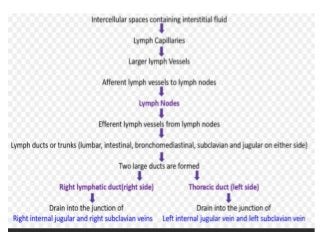
Flow of Lymph :-
Lymph from lower parts of the body & left upper
parts of the body pass through lymphatic channels &
empty into the venous system via the thoracic duct.
Lymph from the right upper parts of the body
enters the right lymphatic duct which later empties
into the venous system at the junction of right
subclavian & internal jugular veins.
Lymph flow is helped by IFP, Muscle contraction,
Arterial pulsation, Respiration & Rhythmic contraction
of the smooth muscles initiated due to stretching of
vessels.
Formation of Lymph :-
Lymph is formed from the Interstitial fluid.
therefore, the composition of lymph is initially
similar to interstitial fluid.
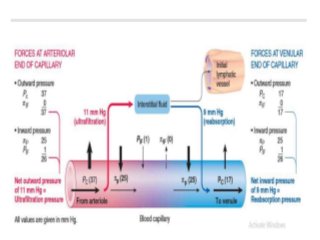
Most of fluid filtered from the blood capillaries
flows around the cells & is reabsorbed back at the
venous end of the capillaries. About 10% of the fluid
flows through lymphatic capillaries & forms lymph.
This fluid returning through the lymphatic's contain
high molecular weight substances such as proteins
that cannot be absorbed into the blood directly.
The Normal Lymphatic flow is 2-4L /day
The Lymphatic flow is determined by 2 factors..
Interstitial fluid Pressure :- An increase in the interstitial
fluid pressure  increase lymph flow .Increased
Capillary pressure & decreased interstitial fluid colloidal
osmotic pressure increase the interstitial fluid
pressure causing an increase in lymph flow.
Activity of the lymphatic pump :- Lymphatic channels
have valves . These valves prevent back flow of lymph.
The portion of lymphatic channels b/w 2 valves forms a
segment. Stretch of these segments by lymph causes
contraction of the smooth muscles causing pumping of
lymph into the next segment this continues in the
subsequent segment until the fluid is emptied into the
veins.
The Lymphatic pump can generate pressure up to 100mmhg
Functions of lymph:-
Absorbs Nutrients from GIT:- Lymph is an important
route through which nutrients, especially lipids, are
absorbed into the body.
Maintains the Normal Interstitial fluid Pressure :-
Extra fluid present in tissue spaces is absorbed by
lymphatic & Returned back to the circulation. Therefore,
accumulation of fluid in the interstitial spaces is prevented.
Transport Proteins :- Lymph returns the proteins leaked
into the interstitial space back into circulation.
Defense mechanism :- foreign particles present in the
tissue are removed by lymph & transported to nearest
lymph node. Phagocytes present in lymph nodes destroy
these bacteria & foreign particles.
Clinical Notes :-
EDEMA :- Edema is accumulation of abnormally large
quantities of fluid in the 3space , Reduced lymphatic drainage
causes EDEMA. This is due the leakage of proteins into the
interstitial space, that raise the colloidal osmotic pressure of 3
space .
EDEMA is seen in diseases of lymphatic caused by infections
such as filariasis or surgical removal of lymph nodes ( Radical
Mastectomy)
Filariasis leads to development of oedema in the affected
part also called Elephantiasis .Lymphatics form a route of
spread of Cancer cells.
Lymphangitis: This is an inflammation of the lymph
vessels.
Lymphangioma:-This is a condition that you're born
with. It’s a malformation in the lymphatic system.
Lymphangiomatosis is the presence of multiple or
widespread lymphatic vascular malformations.
Intestinal lymphangiectasia:-This is a condition in
which loss of lymph tissue in the small intestine
leads to loss of protein, gamma globulins,
albumin and lymphocytes.
Lymphocytosis:-This is a condition in which there is
a higher-than-normal amount of lymphocytes in
the body.
Lymphatic filariasis:- This is an infection caused
by a parasite that causes the lymphatic system
not to function correctly.
Castleman disease:- Castleman disease involves
an overgrowth of cells in the body’s lymphatic
system.

LYMPHATIC SYSTEM

  • 1.
    Lymph & Lymphatic's Mr. Bala Chandrudu RVM Medical college & RC
  • 2.
    Lymphatic system isan accessory route through Which fluid flows from the interstitial spaces in to the blood. Almost all the tissue of the body have lymphatics. exceptions being the skin, brain ,bone , Cartilage, & Epithelial tissue Organization of the Lymphatic system The Lymphatic system begins from tissue and is made up of a meshwork of delicate vessels termed Lymph Capillaries . These lymph capillaries begin as enlarged terminals call Capillary bulbs.
  • 3.
    The lymphatic capillarycontain valves which cause the flow of lymph in one direction. The capillary bulbs contain smooth muscles. Contraction of smooth muscles helps in the flow of lymph. The Lymphatic capillaries unite to form larger lymphatic vessels as they proceed toward the venous system of the heart. Along the course of these lymphatic vessels, masses of lymphoid tissues called Lymph nodes are present .
  • 4.
    LYMPH :- Lymph isa modified tissue fluid derived from interstitial fluid . It flows in a closed sytem consisting of Lymphatic channels in a one way direction. Lymphatic flow occurs from the tissues toward the right side of the heart. (or) Lymph, also called lymphatic fluid, is a collection of the extra fluid that drains from cells and tissues plus other substances. The other substances include proteins, minerals, fats, nutrients, damaged cells, cancer cells and foreign invaders (bacteria, viruses, etc). Lymph also transports infection-fighting white blood cells (lymphocytes).
  • 5.
    Composition of Lymph:- Lymph is a transparent, yellowish liquid. It contains water- 96% & Solid 4%. The reaction is slightly alkaline in nature It contain Proteins, fats, clotting factors, ions such as Na+, K+ , Cl-, Ca2+ , Lymphocytes, few RBC, & Platelets. Proteins :- The protein content of lymph varies widely in different tissues. It is highest in the liver. (6 g/dl) . It is also found in substantial quantities in the intestines, heart, & lungs. Lymph drained from the choroid plexus does not contain proteins.
  • 6.
    Lipids :- Lymphdrained from the intestinal region contains significant amounts of lipids since the Lymphatics of intestinal villi absorb lipids. The intestinal lymph is therefore milky in color . This milky lymph is called Chyle & The lymphatic's in the mesentry are called Lacteals. Clotting factors :- These are present in the lymph since they are formed in the liver Lymphocytes : -Lymph also contains a large number of lymphocytes. Other components :- Carbohydrates , Creatinine,Water – 94%, Urea, Chlorides, Enzymes ,The small amount of fats, Proteins –Globulin, albumin, and fibrinogen Non-protein nitrogenous substances.
  • 7.
    Flow of Lymph:- Lymph from lower parts of the body & left upper parts of the body pass through lymphatic channels & empty into the venous system via the thoracic duct. Lymph from the right upper parts of the body enters the right lymphatic duct which later empties into the venous system at the junction of right subclavian & internal jugular veins. Lymph flow is helped by IFP, Muscle contraction, Arterial pulsation, Respiration & Rhythmic contraction of the smooth muscles initiated due to stretching of vessels.
  • 9.
    Formation of Lymph:- Lymph is formed from the Interstitial fluid. therefore, the composition of lymph is initially similar to interstitial fluid. Most of fluid filtered from the blood capillaries flows around the cells & is reabsorbed back at the venous end of the capillaries. About 10% of the fluid flows through lymphatic capillaries & forms lymph. This fluid returning through the lymphatic's contain high molecular weight substances such as proteins that cannot be absorbed into the blood directly. The Normal Lymphatic flow is 2-4L /day
  • 11.
    The Lymphatic flowis determined by 2 factors.. Interstitial fluid Pressure :- An increase in the interstitial fluid pressure  increase lymph flow .Increased Capillary pressure & decreased interstitial fluid colloidal osmotic pressure increase the interstitial fluid pressure causing an increase in lymph flow. Activity of the lymphatic pump :- Lymphatic channels have valves . These valves prevent back flow of lymph. The portion of lymphatic channels b/w 2 valves forms a segment. Stretch of these segments by lymph causes contraction of the smooth muscles causing pumping of lymph into the next segment this continues in the subsequent segment until the fluid is emptied into the veins. The Lymphatic pump can generate pressure up to 100mmhg
  • 12.
    Functions of lymph:- AbsorbsNutrients from GIT:- Lymph is an important route through which nutrients, especially lipids, are absorbed into the body. Maintains the Normal Interstitial fluid Pressure :- Extra fluid present in tissue spaces is absorbed by lymphatic & Returned back to the circulation. Therefore, accumulation of fluid in the interstitial spaces is prevented. Transport Proteins :- Lymph returns the proteins leaked into the interstitial space back into circulation. Defense mechanism :- foreign particles present in the tissue are removed by lymph & transported to nearest lymph node. Phagocytes present in lymph nodes destroy these bacteria & foreign particles.
  • 13.
    Clinical Notes :- EDEMA:- Edema is accumulation of abnormally large quantities of fluid in the 3space , Reduced lymphatic drainage causes EDEMA. This is due the leakage of proteins into the interstitial space, that raise the colloidal osmotic pressure of 3 space . EDEMA is seen in diseases of lymphatic caused by infections such as filariasis or surgical removal of lymph nodes ( Radical Mastectomy) Filariasis leads to development of oedema in the affected part also called Elephantiasis .Lymphatics form a route of spread of Cancer cells.
  • 15.
    Lymphangitis: This isan inflammation of the lymph vessels. Lymphangioma:-This is a condition that you're born with. It’s a malformation in the lymphatic system. Lymphangiomatosis is the presence of multiple or widespread lymphatic vascular malformations. Intestinal lymphangiectasia:-This is a condition in which loss of lymph tissue in the small intestine leads to loss of protein, gamma globulins, albumin and lymphocytes. Lymphocytosis:-This is a condition in which there is a higher-than-normal amount of lymphocytes in the body.
  • 16.
    Lymphatic filariasis:- Thisis an infection caused by a parasite that causes the lymphatic system not to function correctly. Castleman disease:- Castleman disease involves an overgrowth of cells in the body’s lymphatic system.