ANATOMY
OF
LUNGS
MISS KALYANI R. SAUDAGAR
1. Gross Anatomy of Lungs
2. Surfaces and Borders of Lungs
3. Hilum and Root of Lungs
4. Fissures and Lobes of Lungs
5. Broncho pulmonary segments
6. Histopathology of Alveoli
7. Surfactant
8. Blood supply of lungs
9. Lymphatics of Lungs
10. Nerve supply of Lungs
11. Pleura
12. Mediastinum
GROSS ANATOMY OF LUNGS
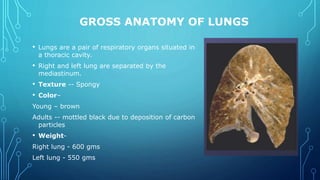
• Lungs are a pair of respiratory organs situated in
a thoracic cavity.
• Right and left lung are separated by the
mediastinum.
• Texture -- Spongy
• Color–
Young – brown
Adults -- mottled black due to deposition of carbon
particles
• Weight-
Right lung - 600 gms
Left lung - 550 gms
Thoracic cavity
CONICAL
(apex pulmonis)
(basis pulmonis)
3 Borders - anterior (margo anterior)
posterior (margo posterior)
Inferior (margo inferior)
2 Surfaces - costal (facies costalis)
medial (facies mediastinus)
• anterior (mediastinal)
• posterior (vertebral)
APEX
• Blunt
• Lies above the level of Lies above the level of anterior end of 1
anterior end of 1st Rib.
• Reaches 1 Reaches 1-2 cm above 2 cm above medial 1/3 medial
1/3rd of clavicle. of clavicle.
• Coverings– cervical pleura.
suprapleural membane
• Grooved by-
Subclavian artery
Subclavian vein
BASE
• Semilunar and concave. and concave.
• Rests on dome of Diaphragm. Rests on dome of Diaphragm.
• Right sided dome is higher than left.
BORDERS
ANTERIOR BORDER ANTERIOR BORDER –
1. Corresponds to the anterior (Costomediastinal) line of pleural
reflection.
2. It is deeply notched in the left lung posterior to 5th costal
cartilage by the pericardium costal cartilage by the pericardiu and
extends vertically downwards to form Lingula. This is called cardiac
notch (percussion in this area gives a dull note as compared to dull
note obtained over lung).
INFERIOR BORDER INFERIOR BORDER
• Thin and sharp
• It seperates seperates the base of lung from the costal surface and
extends into costal surface and extends into phrenicocostal sinus.
POSTERIOR BORDER POSTERIOR BORDER
• Thick and ill defined
• Fits into deep Fits into deep paravertebral gutter.
• Extends from C7 to T10.
SURFACES OF THE LUNG
1. Costal Surface - It is in contact with costal
pleura and overlying
thoracic wall.
2. Medial Surface - Posterior / Vertebral Part
Anterior / Mediastinal Part
RELATIONS OF POSTERIOR PART
• 1. Vertebral Part
• 2. Intervertebral Discs
• 3. Posterior Intercostal Vessels
• 4. Splanchic Nerves
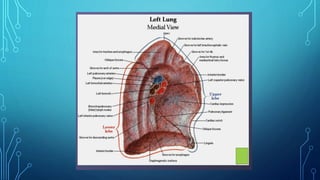
RELATIONS OF ANTERIOR PART
RIGHT SIDE
• 1. Right atrium Right atrium
• 2. Small part of RV Small part of
RV
• 3. SVC
• 4. Right brachiocephalic vein(lower
part)
• 5. Azygos vein
• 6. Esophagus
• 7. IVC
• 8. Trachea
• 9. Right vagus nerve
• 10. Right phrenic nerve
LEFT SIDE
1. Left ventricle Left ventricle
2. Pulmonary trunk
3. Arch of Aorta
4. Descending thoracic aorta
5. Left Subclavian Artery
6. Thoracic duct
7. Left Brachiocephalic vein
8. Left vagus nerve
9. Left phrenic nerve
10. Left recurrent laryngeal nerve
HILUM
• It is a large depressed area that lies near the centre of the
medial surface.
• Various structures enter and leave the lung via its root.
ROOT OF THE LUNG
• The root is enclosed in a short
tubular sheet of pleura that joins the
pleura that joins the pulmonary and
mediastinal parts of pleura .
• It extends inferiorly as a narrow fold
- The pulmonary ligament.
• It lies opposite of the bodies of 5th,
6th and bodies of 5th, 6th and 7th
thoracic vertebra.
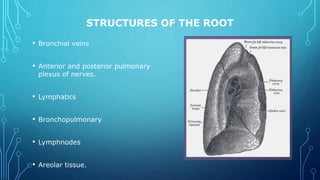
STRUCTURES OF THE ROOT
•Principal Bronchus on the left side.
•Eparterial and Hyparterial on the
right side.
•One pulmonary artery .
•Two pulmonary veins -
Superior
Inferior
•Bronchial arteries
One on right side
Two on left side
STRUCTURES OF THE ROOT
• Bronchial veins
• Anterior and posterior pulmonary
plexus of nerves.
• Lymphatics
• Bronchopulmonary
• Lymphnodes
• Areolar tissue.
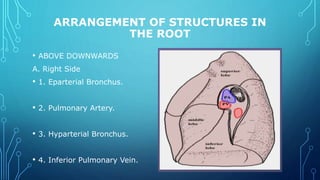
ARRANGEMENT OF STRUCTURES IN THE
ROOT
• BEFORE BACKWARDS
• 1. Superior pulmonary vein.
•
• 2. Pulmonary artery.
• 3. Bronchus.
ARRANGEMENT OF STRUCTURES IN
THE ROOT
• ABOVE DOWNWARDS
A. Right Side
• 1. Eparterial Bronchus.
• 2. Pulmonary Artery.
• 3. Hyparterial Bronchus.
• 4. Inferior Pulmonary Vein.
ARRANGEMENT OF STRUCTURES IN THE ROOT
ABOVE DOWNWARDS
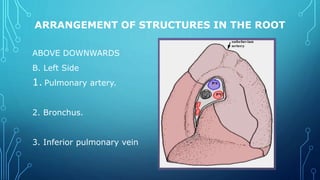
B. Left Side
1. Pulmonary artery.
2. Bronchus.
3. Inferior pulmonary vein
FISSURES AND LOBES OF LUNGS
OBLIQUE FISSURE
• It begins posteriorly at the level of 5th at the level of 5th thoracic vertebra.
• Passes antero-inferiorly in a spiral course to meet the inferior margin close to
6th costochondral junction.
HORIZONTAL FISSURE HORIZONTAL
It extends from anterior margin at the level of 4th costal cartilage. 4th costal
cartilage.
• Runs horizontally backwards to meet the oblique fissure in the mid axillary
line.
• Pulmonary pleura extends into the fissures of the lungs so that the lobes can
move on each other during respiration.
BRONCHO PULMONARY SEGMENTS
• These are well defined areas of the lungs, each of which is
aerated by a segmental / tertiary bronchus.
• Trachea
• Right and Left Principal Bronchus
• Lobar Bronchi(Secondary)[2L,3R]
• Segmental Bronchi(Tertiary)[8L,10R]
• Terminal Bronchioles(25000 in no.)
• Respiratory Bronchioles
• Alveolar ducts
• Alveolar sacs
• Alveoli
ACINUS
• The ultimate pulmonary unit from respiratory brochiole to
alveoli is called Acinus.
• There are about 28 orders of division of tracheo bronchial
tree.
• Total no. of alveoli has been estimated to be between 200 -
600 million, with a total surface 600 million, with a total
surface area of 40-80 meter square.
BRONCHOPULMONARY SEGMENTS
Right main bronchus
1. Shorter
2. Wider.
3. More in line with trachea.
Left main bronchus Left main
1.Longer
2. Narrower.
3. More oblique than the
right.
BRONCHOPULMONARY SEGMENTS
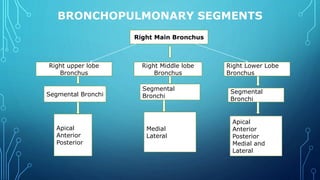
Right Main Bronchus
Right upper lobe
Bronchus
Right Middle lobe
Bronchus
Right Lower Lobe
Bronchus
Segmental Bronchi
Segmental
Bronchi
Segmental
Bronchi
Apical
Anterior
Posterior
Medial
Lateral
Apical
Anterior
Posterior
Medial and
Lateral
BRONCHOPULMONARY SEGMENTS
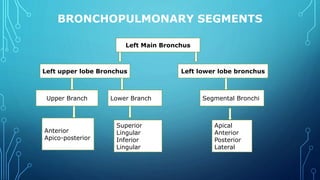
Left Main Bronchus
Left upper lobe Bronchus Left lower lobe bronchus
Upper Branch Lower Branch
Anterior
Apico-posterior
Superior
Lingular
Inferior
Lingular
Segmental Bronchi
Apical
Anterior
Posterior
Lateral
• These segments are pyramidal in shape with apex towards the root of
lung.
• Each segment is an independent respiratory unit.
• Each segment has its own separate artery(branches of pulmonary artery).
• Pulmonary Veins run in inter-segmental planes between adjoining
segments.
• Thus a broncho pulmonary segment is not a broncho vascular segment as
it does not have its own vein.
CLINICAL SIGNIFICANCE CLINICAL
SIGNIFICANCE
• Segmental resection with minimal destruction to the
surrounding lung tissue.
• To visualize the interior of a bronchi through a bronchoscope
when diseases through a bronchoscope when diseases
process is limited in a segment.
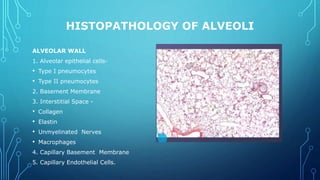
HISTOPATHOLOGY OF ALVEOLI
ALVEOLAR WALL
1. Alveolar epithelial cells-
• Type I pneumocytes
• Type II pneumocytes
2. Basement Membrane
3. Interstitial Space -
• Collagen
• Elastin
• Unmyelinated Nerves
• Macrophages
4. Capillary Basement Membrane
5. Capillary Endothelial Cells.
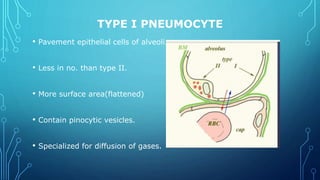
TYPE I PNEUMOCYTE
• Pavement epithelial cells of alveoli.
• Less in no. than type II.
• More surface area(flattened)
• Contain pinocytic vesicles.
• Specialized for diffusion of gases.
TYPE II PNEUMOCYTES
• More numerous than type I.
• Cuboidal in shape.
• Rich in mitochondria, ER and
vacuoles containing osmiophillic
lamellar bodies.
• Type I are precursors of type II.
ENDOTHELIAL CELLS
• Most numerous.
• Presence of pinocytic vacuoles
that meet the luminal surface
to form caveolae.
• Walls of caveolae has, ACE.
• Source of NO, natural
pulmonary vasodilator.
ALVEOLAR MACROPHAGES
• Primary defence mechanism.
• Takes part in inflammatory and
Immunological reactions.
• Activates lysosomes, proteases,
complement , thrombo-plastin,
cytokines - IF-α, TNF-α, IL-1, IL-8.
SURFACTANT
• Lines the inner layer of alveolar epithelium.
• Synthesized by SER of type II pneumocytes.
Function –
1. To reduce the surface tension of alveoli mainly during expiration,
thus reduces the work of lung inflation.
2. Waterproofing.
• Surfactant synthesis starts after 26 weeks of fetal life. Therefore
premature infants,with insufficient surfactant suffer from HMD.

Lungs

  • 1.
  • 2.
    1. Gross Anatomyof Lungs 2. Surfaces and Borders of Lungs 3. Hilum and Root of Lungs 4. Fissures and Lobes of Lungs 5. Broncho pulmonary segments 6. Histopathology of Alveoli 7. Surfactant 8. Blood supply of lungs 9. Lymphatics of Lungs 10. Nerve supply of Lungs 11. Pleura 12. Mediastinum
  • 3.
    GROSS ANATOMY OFLUNGS • Lungs are a pair of respiratory organs situated in a thoracic cavity. • Right and left lung are separated by the mediastinum. • Texture -- Spongy • Color– Young – brown Adults -- mottled black due to deposition of carbon particles • Weight- Right lung - 600 gms Left lung - 550 gms
  • 4.
  • 5.
    CONICAL (apex pulmonis) (basis pulmonis) 3Borders - anterior (margo anterior) posterior (margo posterior) Inferior (margo inferior) 2 Surfaces - costal (facies costalis) medial (facies mediastinus) • anterior (mediastinal) • posterior (vertebral)
  • 6.
    APEX • Blunt • Liesabove the level of Lies above the level of anterior end of 1 anterior end of 1st Rib. • Reaches 1 Reaches 1-2 cm above 2 cm above medial 1/3 medial 1/3rd of clavicle. of clavicle. • Coverings– cervical pleura. suprapleural membane • Grooved by- Subclavian artery Subclavian vein
  • 8.
    BASE • Semilunar andconcave. and concave. • Rests on dome of Diaphragm. Rests on dome of Diaphragm. • Right sided dome is higher than left.
  • 9.
    BORDERS ANTERIOR BORDER ANTERIORBORDER – 1. Corresponds to the anterior (Costomediastinal) line of pleural reflection. 2. It is deeply notched in the left lung posterior to 5th costal cartilage by the pericardium costal cartilage by the pericardiu and extends vertically downwards to form Lingula. This is called cardiac notch (percussion in this area gives a dull note as compared to dull note obtained over lung).
  • 10.
    INFERIOR BORDER INFERIORBORDER • Thin and sharp • It seperates seperates the base of lung from the costal surface and extends into costal surface and extends into phrenicocostal sinus. POSTERIOR BORDER POSTERIOR BORDER • Thick and ill defined • Fits into deep Fits into deep paravertebral gutter. • Extends from C7 to T10.
  • 11.
    SURFACES OF THELUNG 1. Costal Surface - It is in contact with costal pleura and overlying thoracic wall. 2. Medial Surface - Posterior / Vertebral Part Anterior / Mediastinal Part
  • 12.
    RELATIONS OF POSTERIORPART • 1. Vertebral Part • 2. Intervertebral Discs • 3. Posterior Intercostal Vessels • 4. Splanchic Nerves
  • 13.
    RELATIONS OF ANTERIORPART RIGHT SIDE • 1. Right atrium Right atrium • 2. Small part of RV Small part of RV • 3. SVC • 4. Right brachiocephalic vein(lower part) • 5. Azygos vein • 6. Esophagus • 7. IVC • 8. Trachea • 9. Right vagus nerve • 10. Right phrenic nerve LEFT SIDE 1. Left ventricle Left ventricle 2. Pulmonary trunk 3. Arch of Aorta 4. Descending thoracic aorta 5. Left Subclavian Artery 6. Thoracic duct 7. Left Brachiocephalic vein 8. Left vagus nerve 9. Left phrenic nerve 10. Left recurrent laryngeal nerve
  • 16.
    HILUM • It isa large depressed area that lies near the centre of the medial surface. • Various structures enter and leave the lung via its root.
  • 17.
    ROOT OF THELUNG • The root is enclosed in a short tubular sheet of pleura that joins the pleura that joins the pulmonary and mediastinal parts of pleura . • It extends inferiorly as a narrow fold - The pulmonary ligament. • It lies opposite of the bodies of 5th, 6th and bodies of 5th, 6th and 7th thoracic vertebra.
  • 18.
    STRUCTURES OF THEROOT •Principal Bronchus on the left side. •Eparterial and Hyparterial on the right side. •One pulmonary artery . •Two pulmonary veins - Superior Inferior •Bronchial arteries One on right side Two on left side
  • 19.
    STRUCTURES OF THEROOT • Bronchial veins • Anterior and posterior pulmonary plexus of nerves. • Lymphatics • Bronchopulmonary • Lymphnodes • Areolar tissue.
  • 20.
    ARRANGEMENT OF STRUCTURESIN THE ROOT • BEFORE BACKWARDS • 1. Superior pulmonary vein. • • 2. Pulmonary artery. • 3. Bronchus.
  • 21.
    ARRANGEMENT OF STRUCTURESIN THE ROOT • ABOVE DOWNWARDS A. Right Side • 1. Eparterial Bronchus. • 2. Pulmonary Artery. • 3. Hyparterial Bronchus. • 4. Inferior Pulmonary Vein.
  • 22.
    ARRANGEMENT OF STRUCTURESIN THE ROOT ABOVE DOWNWARDS B. Left Side 1. Pulmonary artery. 2. Bronchus. 3. Inferior pulmonary vein
  • 23.
  • 24.
    OBLIQUE FISSURE • Itbegins posteriorly at the level of 5th at the level of 5th thoracic vertebra. • Passes antero-inferiorly in a spiral course to meet the inferior margin close to 6th costochondral junction. HORIZONTAL FISSURE HORIZONTAL It extends from anterior margin at the level of 4th costal cartilage. 4th costal cartilage. • Runs horizontally backwards to meet the oblique fissure in the mid axillary line. • Pulmonary pleura extends into the fissures of the lungs so that the lobes can move on each other during respiration.
  • 26.
    BRONCHO PULMONARY SEGMENTS •These are well defined areas of the lungs, each of which is aerated by a segmental / tertiary bronchus.
  • 28.
    • Trachea • Rightand Left Principal Bronchus • Lobar Bronchi(Secondary)[2L,3R] • Segmental Bronchi(Tertiary)[8L,10R] • Terminal Bronchioles(25000 in no.) • Respiratory Bronchioles • Alveolar ducts • Alveolar sacs • Alveoli ACINUS
  • 30.
    • The ultimatepulmonary unit from respiratory brochiole to alveoli is called Acinus. • There are about 28 orders of division of tracheo bronchial tree. • Total no. of alveoli has been estimated to be between 200 - 600 million, with a total surface 600 million, with a total surface area of 40-80 meter square.
  • 32.
    BRONCHOPULMONARY SEGMENTS Right mainbronchus 1. Shorter 2. Wider. 3. More in line with trachea. Left main bronchus Left main 1.Longer 2. Narrower. 3. More oblique than the right.
  • 33.
    BRONCHOPULMONARY SEGMENTS Right MainBronchus Right upper lobe Bronchus Right Middle lobe Bronchus Right Lower Lobe Bronchus Segmental Bronchi Segmental Bronchi Segmental Bronchi Apical Anterior Posterior Medial Lateral Apical Anterior Posterior Medial and Lateral
  • 34.
    BRONCHOPULMONARY SEGMENTS Left MainBronchus Left upper lobe Bronchus Left lower lobe bronchus Upper Branch Lower Branch Anterior Apico-posterior Superior Lingular Inferior Lingular Segmental Bronchi Apical Anterior Posterior Lateral
  • 36.
    • These segmentsare pyramidal in shape with apex towards the root of lung. • Each segment is an independent respiratory unit. • Each segment has its own separate artery(branches of pulmonary artery). • Pulmonary Veins run in inter-segmental planes between adjoining segments. • Thus a broncho pulmonary segment is not a broncho vascular segment as it does not have its own vein.
  • 38.
    CLINICAL SIGNIFICANCE CLINICAL SIGNIFICANCE •Segmental resection with minimal destruction to the surrounding lung tissue. • To visualize the interior of a bronchi through a bronchoscope when diseases through a bronchoscope when diseases process is limited in a segment.
  • 39.
    HISTOPATHOLOGY OF ALVEOLI ALVEOLARWALL 1. Alveolar epithelial cells- • Type I pneumocytes • Type II pneumocytes 2. Basement Membrane 3. Interstitial Space - • Collagen • Elastin • Unmyelinated Nerves • Macrophages 4. Capillary Basement Membrane 5. Capillary Endothelial Cells.
  • 40.
    TYPE I PNEUMOCYTE •Pavement epithelial cells of alveoli. • Less in no. than type II. • More surface area(flattened) • Contain pinocytic vesicles. • Specialized for diffusion of gases.
  • 41.
    TYPE II PNEUMOCYTES •More numerous than type I. • Cuboidal in shape. • Rich in mitochondria, ER and vacuoles containing osmiophillic lamellar bodies. • Type I are precursors of type II.
  • 42.
    ENDOTHELIAL CELLS • Mostnumerous. • Presence of pinocytic vacuoles that meet the luminal surface to form caveolae. • Walls of caveolae has, ACE. • Source of NO, natural pulmonary vasodilator.
  • 43.
    ALVEOLAR MACROPHAGES • Primarydefence mechanism. • Takes part in inflammatory and Immunological reactions. • Activates lysosomes, proteases, complement , thrombo-plastin, cytokines - IF-α, TNF-α, IL-1, IL-8.
  • 44.
    SURFACTANT • Lines theinner layer of alveolar epithelium. • Synthesized by SER of type II pneumocytes. Function – 1. To reduce the surface tension of alveoli mainly during expiration, thus reduces the work of lung inflation. 2. Waterproofing. • Surfactant synthesis starts after 26 weeks of fetal life. Therefore premature infants,with insufficient surfactant suffer from HMD.