Hridya. P
And it’s branchesit’s
Branches
 The aorta is the main artery in the human body
originating from the left ventricle of the heart and
extending down the abdomen, where it splits into 2
smaller arteries ( The common iliac arteries )
 The aorta distributes oxygenated blood to all part of the
body through the systemic circulation
 The aorta initialy one inch wide in diameter
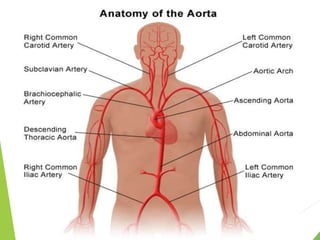
 The aorta can be divided into four sections:
1.The ascending aorta
2.The aortic arch Thoracic
3.The thoracic (descending)
aorta
4.The abdominal aorta.
.The first 3 parts are confined to the thoracic cavity and
together create the thoracic aorta
Function
 The Aorta Supplies blood to the entire body, except the respiratory zone of
the lungs.
 Ascending Aorta supplies blood to the heart
 Arch of Aorta- Supplies blood to the Head, neck and arms
 Descending Aorta- Supplies blood to the Chest
 Abdominal Aorta-Supplies blood to the Abdomen
 At the cellular level aorta is composed of
three layers:
 The Tunica Intima,which surrounds the
lumen & is composed of single squamous
epithelial cells.
 The Tunica Media ,composed of smooth
cell muscles & elastic fibres.
 The Tunica Adventitia,composed of loose
collagen fibres
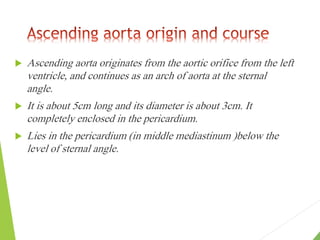
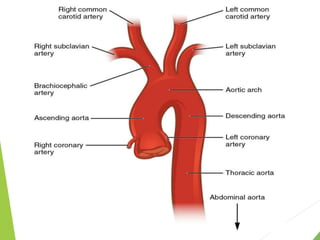
 Ascending aorta originates from the aortic orifice from the left
ventricle, and continues as an arch of aorta at the sternal
angle.
 It is about 5cm long and its diameter is about 3cm. It
completely enclosed in the pericardium.
 Lies in the pericardium (in middle mediastinum )below the
level of sternal angle.
 Branches :
 The left and right aortic sinuses are dilations in the ascending
aorta, located at the level of the aortic valve. These give rise
to:
 The left coronary artery
 The right coronary artery
- These supply the myocardium
 Located in the superior mediastinum
 About 2.5 cm diameter.
 It is a continuation of the ascending aorta and begins at the
level of second sternocostal joint.
 The arch is directed upward, backwards to the left and then
downwards on to the left side of vertebral column.
 The aortic arch ends at the level of sternal angle
 The arch is still connected to the pulmonary trunk by the
ligamentum arteriosum(remnant of the foetal ductus
arteriosus)
 The first &largest from the aortic arch.
 It is about 4-5 cm in length.
 Branchiocephalic artery arises opposite the center of manubrium,
ascends upwards, backwrads and to the right.
 The branchiocephalic artery ends behind the right sternoclavicular joint
by dividing to,
1.Right Subclavian artery
2.Right common carotid artery
 These arteries supply the right side of the head and neck and right upper
limb.
 It found below the clavicle
 It supplies the left arm
 It runs upwards on the left mediastinal pleura and makes groove on the left
lung and enters the neck by passing behind the left sternoclavicular joint.
 At the outer border of the first rib, it furnishes by becoming axillary artery.it
extends along the upper arm as brachial artery to divided into two terminal
branches radial and ulnar arteries below the elbow.
Parts
 Each of subclavian artery is madeup of three parts defined in the relation
to the anterior scalene muscle of the neck
 First part- This part of subclavian artery is medial to the anterior scalene
muscle
Branches : Vertebral artery,Internal thoracic artery,Thyrocervical
trunk
 Second part-This part of subclavian is posterior to the anterior scalene
muscle .
Branches : Costocervical trunk
 Third part – This part of subclavian lies lateral to the anterior scalene
muscle
Branches : Dorsal scapular artery.
 There are 2 common carotid arteries, left and right.
 These are the main arteries of the head and neck.
 The left common carotid artery originates directly from the arch
of aorta in thorax.
 It ascends to the back of left sternoclavicular joint and enters the
neck.
 The left common carotid artery runs upwards from left
sternoclavicular joint to the upper border of thyroid cartilage.
 Left common carotid artery supplies the head and neck
 The descending thoracic aorta which is contained in the
posterior mediastinum
 It is the continuation of the arch of aorta .
 Descends in front of vertebral column
Thoracic aorta
Branches
1.Bronchial arteries: Paired visceral branch arising laterally to supply bronchial &
peribronchial tissue,& visceral pleura. most commonly only the paired left
bronchial artery arises directly from the aorta
2. Mediastinal arteries :Small artery that supply the lymph glands & loose areolar
tissue in the posterior mediastinum
3. Oesophageal arteries: Unpaired visceral branches arising anteriorly to supply the
oesophagus
4. Pericardial arteries: small unpaired arteries that arise anteriorly to supply the dorsal
portion of the pericardium.
5.Superior phrenic arteries:Paired parietal branches that supply the superior portion of
diaphragm
 Intercostal & Subcostal arteries : Small paired arteries that branch off
throughout the length of posterior thoracic aorta. The 9 paires of intercostal
arteries supply the Intercostal space, with the exception of first & second( They
are supplied by a branch from the subclavian artery). The subcostal arteries
supply the flat abdominal wall muscles
 Abdominal aorta is a continuation of the thoracic aorta .It is approximately 13cm
long
 It descends and terminating by divided into right and left common illiac arteries
 The branches of abdominal aorta are,
1. Inferior phrenic arteries:They supply the diaphragm
2.Coeliac artery : supplies the liver, stomach, abdominal oesophagus, spleen,
the superior duodenum & superior pancreas
3.Superior mescentric artery: it supply the distal duodenum, jejuno –ileum,
ascending colon& the part of transver
4.Middle suprarenal artery: They supply the adrenal glands
5.Renal arteries: supply the kidneys
6.Gonadal arteries:Supply the testicular artery,& ovarian artery
7.Inferior mesenteric artery: It supplies the large intestine .
8.Median Sacral artery : supply the Coccyx, lumbar vertebrae,& the
sacrum.
9.Lumbar arteries: supply the abdominal wall and spinal cord.
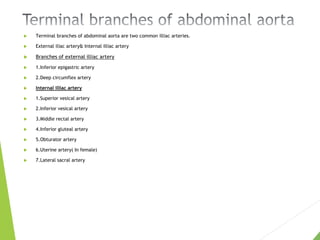
 Terminal branches of abdominal aorta are two common illiac arteries.
 External iliac artery& Internal illiac artery
 Branches of external illiac artery
 1.Inferior epigastric artery
 2.Deep circumflex artery
 Internal illiac artery
 1.Superior vesical artery
 2.Inferior vesical artery
 3.Middle rectal artery
 4.Inferior gluteal artery
 5.Obturator artery
 6.Uterine artery( In female)
 7.Lateral sacral artery
 It describe the dialation of the artery to more than 1.5 times its original size .
 The abdominal component of the aorta is the most common site for aneurysmal
changes.
 Patients suffering with an abdominal aortic aneurysm may experience
abdominal pulsations,abdominal pain &back pain.
 The aneurysm may also compress nerve roots causing pain/numbness in the
lower limbs.
 A patient with an aortic arch aneurysm may have a hoarse voice due to the
dilation stretching the left recurrent laryngeal nerve .Patients may not have
any symptoms at all.
 Small aortic aneurysms do not usually pose a serious immediate
threat.Diagnosis is made from an ultrasound &the weakened vessel wall can be
surgically replaced with a piece of synthetic tubing.if left untreated, a large
aneurysm can rupture. This is a medical emergency & often fatal.
 Coarctation of aorta refers to narrowing of vessel, Usually at the insertion
of ligamentum arteriosum( former ductus arteriosus)
 It is congential narrowing of the aorta just proximal or distal to the
entrance of the ductus arteriosus.
 The narrow vessel has a increased resistance to blood flow which increases
the after load for the left ventricle – leading to left ventricular
hypertrophy
 Coarctation are most common in the Arch of Aorta
 Accordingly it is named as preductal type and postductal type of
coarctalion of aorta.
 The blood supply to the head, neck & upper limbs is not compromised as
the vessel that supply them emerge proximal to the coarctation, However
yhe blood supply to the rest of the body reduced, This result in a weak,
delayed femoral pulse which prevent clinically as radio-femoral delay
 It probably take place because of hyper involution of the ductus arteriosus.
 The narrowing is proximal to the ductus arteriosus . Life threatening , if
severe;seen in Turner’s syndrome .
The narrowing occurs at the insertion of the ductus arteriosus this kind usually
appears when the ductus arteriosus closes.
The narrowing is distal to the insertion of the ductus arteriosus .Postductal
coarctation is most likely the result of the extenction of a muscular artery in to
an elastic artery .This type is most common in adult.
Aorta&its branches . pptx.pptx

Aorta&its branches . pptx.pptx

  • 1.
    Hridya. P And it’sbranchesit’s Branches
  • 2.
     The aortais the main artery in the human body originating from the left ventricle of the heart and extending down the abdomen, where it splits into 2 smaller arteries ( The common iliac arteries )  The aorta distributes oxygenated blood to all part of the body through the systemic circulation  The aorta initialy one inch wide in diameter
  • 3.
     The aortacan be divided into four sections: 1.The ascending aorta 2.The aortic arch Thoracic 3.The thoracic (descending) aorta 4.The abdominal aorta. .The first 3 parts are confined to the thoracic cavity and together create the thoracic aorta
  • 5.
    Function  The AortaSupplies blood to the entire body, except the respiratory zone of the lungs.  Ascending Aorta supplies blood to the heart  Arch of Aorta- Supplies blood to the Head, neck and arms  Descending Aorta- Supplies blood to the Chest  Abdominal Aorta-Supplies blood to the Abdomen
  • 6.
     At thecellular level aorta is composed of three layers:  The Tunica Intima,which surrounds the lumen & is composed of single squamous epithelial cells.  The Tunica Media ,composed of smooth cell muscles & elastic fibres.  The Tunica Adventitia,composed of loose collagen fibres
  • 7.
     Ascending aortaoriginates from the aortic orifice from the left ventricle, and continues as an arch of aorta at the sternal angle.  It is about 5cm long and its diameter is about 3cm. It completely enclosed in the pericardium.  Lies in the pericardium (in middle mediastinum )below the level of sternal angle.
  • 8.
     Branches : The left and right aortic sinuses are dilations in the ascending aorta, located at the level of the aortic valve. These give rise to:  The left coronary artery  The right coronary artery - These supply the myocardium
  • 10.
     Located inthe superior mediastinum  About 2.5 cm diameter.  It is a continuation of the ascending aorta and begins at the level of second sternocostal joint.  The arch is directed upward, backwards to the left and then downwards on to the left side of vertebral column.  The aortic arch ends at the level of sternal angle  The arch is still connected to the pulmonary trunk by the ligamentum arteriosum(remnant of the foetal ductus arteriosus)
  • 11.
     The first&largest from the aortic arch.  It is about 4-5 cm in length.  Branchiocephalic artery arises opposite the center of manubrium, ascends upwards, backwrads and to the right.  The branchiocephalic artery ends behind the right sternoclavicular joint by dividing to, 1.Right Subclavian artery 2.Right common carotid artery  These arteries supply the right side of the head and neck and right upper limb.
  • 12.
     It foundbelow the clavicle  It supplies the left arm  It runs upwards on the left mediastinal pleura and makes groove on the left lung and enters the neck by passing behind the left sternoclavicular joint.  At the outer border of the first rib, it furnishes by becoming axillary artery.it extends along the upper arm as brachial artery to divided into two terminal branches radial and ulnar arteries below the elbow.
  • 13.
    Parts  Each ofsubclavian artery is madeup of three parts defined in the relation to the anterior scalene muscle of the neck  First part- This part of subclavian artery is medial to the anterior scalene muscle Branches : Vertebral artery,Internal thoracic artery,Thyrocervical trunk  Second part-This part of subclavian is posterior to the anterior scalene muscle . Branches : Costocervical trunk  Third part – This part of subclavian lies lateral to the anterior scalene muscle Branches : Dorsal scapular artery.
  • 14.
     There are2 common carotid arteries, left and right.  These are the main arteries of the head and neck.  The left common carotid artery originates directly from the arch of aorta in thorax.  It ascends to the back of left sternoclavicular joint and enters the neck.  The left common carotid artery runs upwards from left sternoclavicular joint to the upper border of thyroid cartilage.  Left common carotid artery supplies the head and neck
  • 15.
     The descendingthoracic aorta which is contained in the posterior mediastinum  It is the continuation of the arch of aorta .  Descends in front of vertebral column
  • 16.
    Thoracic aorta Branches 1.Bronchial arteries:Paired visceral branch arising laterally to supply bronchial & peribronchial tissue,& visceral pleura. most commonly only the paired left bronchial artery arises directly from the aorta 2. Mediastinal arteries :Small artery that supply the lymph glands & loose areolar tissue in the posterior mediastinum 3. Oesophageal arteries: Unpaired visceral branches arising anteriorly to supply the oesophagus 4. Pericardial arteries: small unpaired arteries that arise anteriorly to supply the dorsal portion of the pericardium. 5.Superior phrenic arteries:Paired parietal branches that supply the superior portion of diaphragm
  • 17.
     Intercostal &Subcostal arteries : Small paired arteries that branch off throughout the length of posterior thoracic aorta. The 9 paires of intercostal arteries supply the Intercostal space, with the exception of first & second( They are supplied by a branch from the subclavian artery). The subcostal arteries supply the flat abdominal wall muscles
  • 18.
     Abdominal aortais a continuation of the thoracic aorta .It is approximately 13cm long  It descends and terminating by divided into right and left common illiac arteries  The branches of abdominal aorta are, 1. Inferior phrenic arteries:They supply the diaphragm 2.Coeliac artery : supplies the liver, stomach, abdominal oesophagus, spleen, the superior duodenum & superior pancreas 3.Superior mescentric artery: it supply the distal duodenum, jejuno –ileum, ascending colon& the part of transver 4.Middle suprarenal artery: They supply the adrenal glands
  • 19.
    5.Renal arteries: supplythe kidneys 6.Gonadal arteries:Supply the testicular artery,& ovarian artery 7.Inferior mesenteric artery: It supplies the large intestine . 8.Median Sacral artery : supply the Coccyx, lumbar vertebrae,& the sacrum. 9.Lumbar arteries: supply the abdominal wall and spinal cord.
  • 20.
     Terminal branchesof abdominal aorta are two common illiac arteries.  External iliac artery& Internal illiac artery  Branches of external illiac artery  1.Inferior epigastric artery  2.Deep circumflex artery  Internal illiac artery  1.Superior vesical artery  2.Inferior vesical artery  3.Middle rectal artery  4.Inferior gluteal artery  5.Obturator artery  6.Uterine artery( In female)  7.Lateral sacral artery
  • 22.
     It describethe dialation of the artery to more than 1.5 times its original size .  The abdominal component of the aorta is the most common site for aneurysmal changes.  Patients suffering with an abdominal aortic aneurysm may experience abdominal pulsations,abdominal pain &back pain.  The aneurysm may also compress nerve roots causing pain/numbness in the lower limbs.  A patient with an aortic arch aneurysm may have a hoarse voice due to the dilation stretching the left recurrent laryngeal nerve .Patients may not have any symptoms at all.  Small aortic aneurysms do not usually pose a serious immediate threat.Diagnosis is made from an ultrasound &the weakened vessel wall can be surgically replaced with a piece of synthetic tubing.if left untreated, a large aneurysm can rupture. This is a medical emergency & often fatal.
  • 24.
     Coarctation ofaorta refers to narrowing of vessel, Usually at the insertion of ligamentum arteriosum( former ductus arteriosus)  It is congential narrowing of the aorta just proximal or distal to the entrance of the ductus arteriosus.  The narrow vessel has a increased resistance to blood flow which increases the after load for the left ventricle – leading to left ventricular hypertrophy  Coarctation are most common in the Arch of Aorta  Accordingly it is named as preductal type and postductal type of coarctalion of aorta.  The blood supply to the head, neck & upper limbs is not compromised as the vessel that supply them emerge proximal to the coarctation, However yhe blood supply to the rest of the body reduced, This result in a weak, delayed femoral pulse which prevent clinically as radio-femoral delay  It probably take place because of hyper involution of the ductus arteriosus.
  • 25.
     The narrowingis proximal to the ductus arteriosus . Life threatening , if severe;seen in Turner’s syndrome . The narrowing occurs at the insertion of the ductus arteriosus this kind usually appears when the ductus arteriosus closes. The narrowing is distal to the insertion of the ductus arteriosus .Postductal coarctation is most likely the result of the extenction of a muscular artery in to an elastic artery .This type is most common in adult.