MISS. KALYANI R. SAUDAGAR
Functions of The Respiratory System
• To allow gases from the environment to enter the
bronchial tree through inspiration by expanding the
thoracic volume.
• To allow gas exchange to occur at the respiratory
membrane, so that oxygen diffuses into the blood while
carbon dioxidediffuses into the bronchial tree.
• To permit gases in the lungs to be eliminated through
expiration by decreasing the thoracic volume.
General anatomy of The respiratory
System
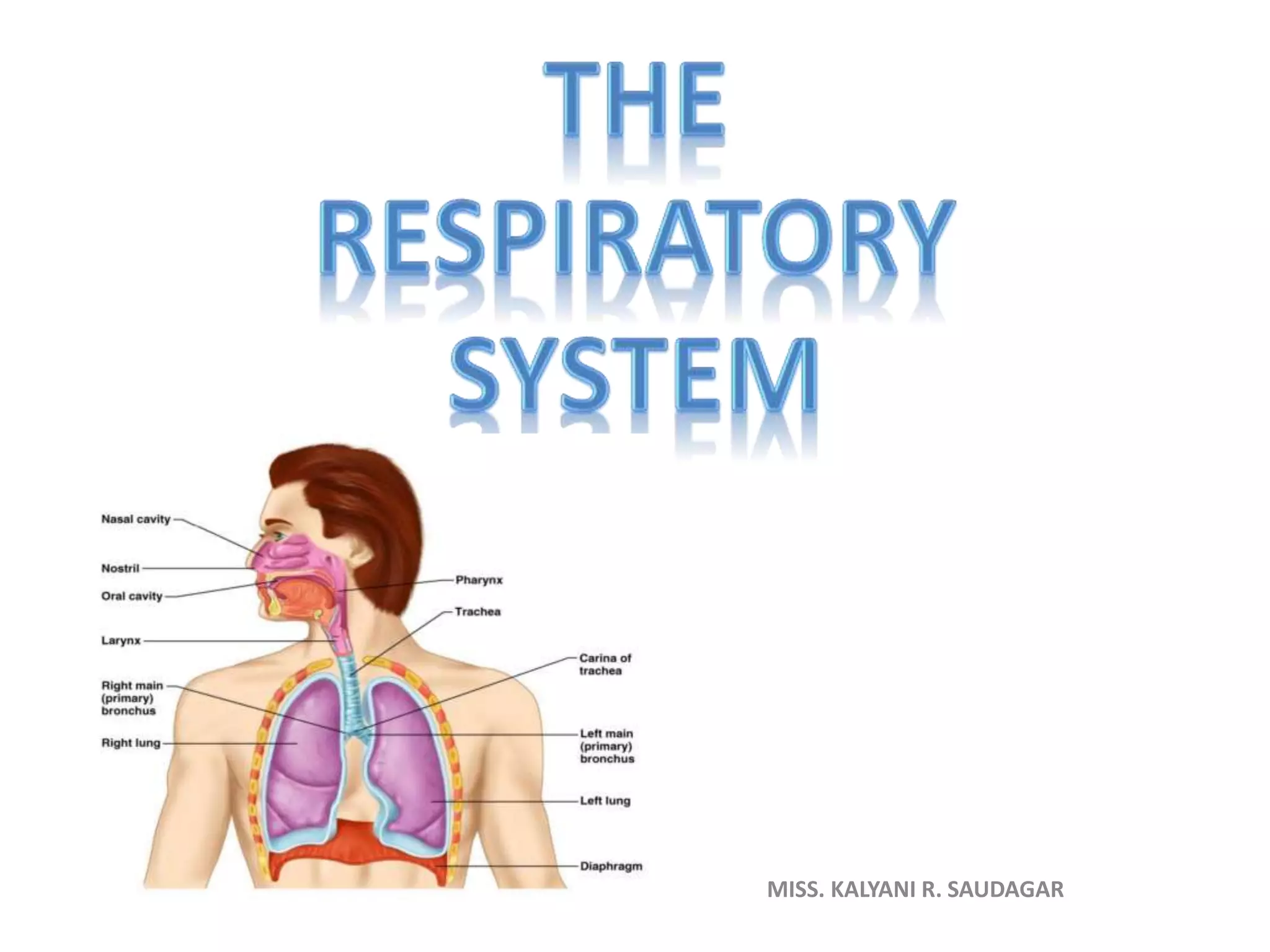
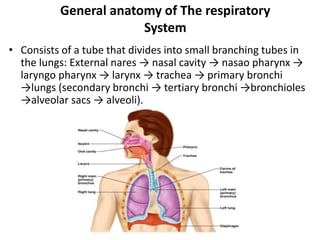
• Consists of a tube that divides into small branching tubes in
the lungs: External nares → nasal cavity → nasao pharynx →
laryngo pharynx → larynx → trachea → primary bronchi
→lungs (secondary bronchi → tertiary bronchi →bronchioles
→alveolar sacs → alveoli).
Lungs
• Cone – shaped organs located in the thoracic cavity.
• Thoracic cavity is lined with a body membrane called parietal pleura, while
the surface of lungs is covered with visceral pleura.
• The thin space between the two pleural membranes is called pleural cavity
which is filled with a clear fluid called plural fluid to minimize friction
between the tissues and to provide surface tension in the pleural cavity.
[water molecules in the pleural fluid allow the two pleural membranes to
adhere to one another, to prevent collapsing of the lungs].
• A chemical substance called surfactant secreted by the lungs also facilitate
the surface tension.
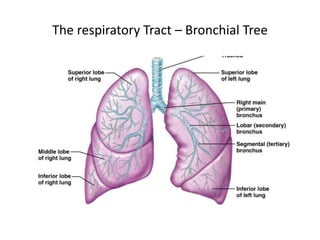
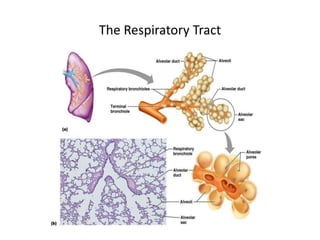
The respiratory Tract – Bronchial Tree
The Respiratory Tract
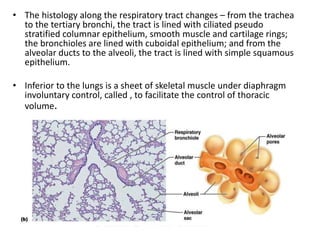
• The histology along the respiratory tract changes – from the trachea
to the tertiary bronchi, the tract is lined with ciliated pseudo
stratified columnar epithelium, smooth muscle and cartilage rings;
the bronchioles are lined with cuboidal epithelium; and from the
alveolar ducts to the alveoli, the tract is lined with simple squamous
epithelium.
• Inferior to the lungs is a sheet of skeletal muscle under diaphragm
involuntary control, called , to facilitate the control of thoracic
volume.
The Bronchial tree
• tree – like branching tubes extended from the trachea. Only the primary
bronchi are external to the lungs, while the rest of the bronchial tree is
embedded in lung tissues.
• diameters of the tubes from primary bronchi to tertiary bronchi are large,
so that support with cartilage rings is necessary.
• diameter at the bronchioles is down to 1 mm where the tubes do not
need cartilage rings for support. This structure is composed of cuboidal
cells where diffusion is also not possible.
• from the alveolar duct to the alveoli, the lining tissue becomes simple
squamous epithelium where gas exchange is possible. Since there is a
much larger surface area at the alveoli, almost all gas exchange occurs at
the alveoli [300 million alveoli provide a total surface area similar to a
tennis court!].
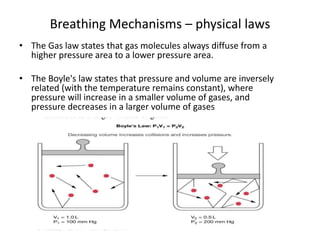
Breathing Mechanisms – physical laws
• The Gas law states that gas molecules always diffuse from a
higher pressure area to a lower pressure area.
• The Boyle's law states that pressure and volume are inversely
related (with the temperature remains constant), where
pressure will increase in a smaller volume of gases, and
pressure decreases in a larger volume of gases
Inspiration (Inhalation)
• An active process where nerve impulses from medulla
oblongata cause the contraction of diaphragm and external
intercostals muscles.
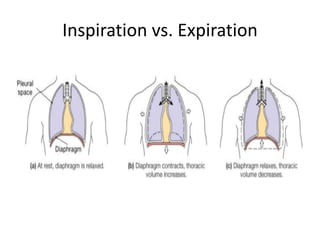
• As these muscles contract, thoracic volume increases which
decreases the pressure within the lung (intra alveolar
pressure) due to the boyle's law.
• When intra alveolar pressure falls below the atmospheric
pressure (758 mmHg versus 760mmHg, respectively), the gas
law dictates that now gases move from the environment into
lungs.
Expiration (exhalation)
• a passive process where elastic tissues of the lungs and
diaphragm recoil to their original position.
• as the diaphragm and external intercostals muscles relax and
recoil, thoracic volume decreases which raises the intra
alveolar pressure (again due to the boyle's law).
• when intra alveolar pressure is risen above the atmospheric
pressure (762 mmHg versus 760mmHg, respectively), gases
move from the lungs into the environment (again due to the
gas law).
Inspiration vs. Expiration
Pulmonary Ventilation - Inspiration
• Pulmonary ventilation is the mechanism by which air is
exchanged between the atmosphere and the alveoli.
• Air is exchanged due to the expansion and contraction of the
lungs.
• Contraction of the diaphragm pulls down, enlarging the intra
pleural cavity.
• Elevation of the ribs also expands the intra pleural cavity.
• These factors decrease the intra pleural cavity pressure: thus,
air flows into the lungs (inspiration).
Pulmonary ventilation - Expiration
• During expiration the diaphragm relaxes, the ribs are pulled down.
• This increases the intra pleural cavity pressure.
• This results in the movement of air out of the lungs.
• Normal quiet breathing is accomplished entirely by the movement of
the diaphragm.
• In the "normal sized" person, about 6 liters of gas per minute move
in and out of the lungs.
• Ventilation can increase up to almost 100 liters per minute during
maximal exercise.
Lung Capacities
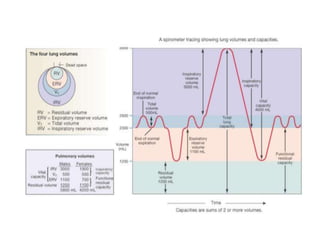
• Lung capacities (air volumes contained in the lungs) can be measured by
a Spirometer, and provide invaluable information regarding the normal
function of the respiratory system.
• Tidal volume (TV) :- Amount of air moving in and out of the lungs during
normal breathing.
• Average value is about 500 ml.
• Inspiratory reserve volume (IRV) :- Amount of air that can be inhaled
after normal inspiration.
• Average value is about 3,000 ml.
• Can be calculated by: IRV = IC – TV where IC represents inspiratory
capacity.
Cont…..
• Expiratory reserve volume (ERV):- Amount of air that can be
exhaled after normal expiration. Average value is about 1,100 ml.
• Inspiratory capacity (IC):- Total amount of air that can be inhaled.
• Average value is about 4,000 ml. can be calculated by: IC = VC– ERV
where VC represents vital capacity.
• Vital capacity (VC):- Total amount of air that can be exhaled.
Average value is about5,000 ml. Can be calculated by: VC = TV + IRV
+ERV.
• Can also be determined by predicted VC values on a chart based on
a person's age and height.
• Residual volume (RV):- Amount of air that is always left in the lungs
after expiration. Average value is about 1,200 ml.
• Total lung capacity (TLC):- Total amount of air that the lungs contain,
including residual volume. Average value is about 6,000 ml. Can be
calculated by: TLC =VC + RV.
• Anatomic dead space refers to the amount of air remain in the
bronchial tree that is not involved in gas exchange, due to
obstruction of air flow or damage in the bronchial tree.
• Alveolar dead space refers to the amount of air in the alveolar ducts
or alveolar sacs that is not involved in gas exchange, due to poor
blood flow or unusually long diffusion distances in gas exchange.
• Physiologic dead space refers to the total amount of air in the lungs
that is not involved in gas exchange (i.e. anatomic dead space +
alveolar dead space).
Control of breathing
1. Four major factors that affect normal breathing: Stretching in
the lungs and thoracic walls O2level in the blood CO2 level in
the blood H+ level in the blood.
2. Normal breathing is inhibited by stretching of the lungs and
thoracic walls, a rise in O2 level, and a decrease in CO2 and H+
levels; while normal breathing is stimulated by relaxing of the
lungs and thoracic walls, a decrease in O2 level, and a rise in
CO2 and H+ levels.
• Chemicals, and emotional state also affect breathing.
• Stretch of tissues: inhibits inspiration by triggering an inflation
reflex which reduces the duration of inspiratory movements.
• This, also prevents over inflation of the lungs during foreceful
breathing. Hyperventilation decreases carbon dioxide concentration
as well.
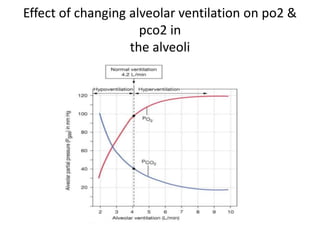
• Low blood PO2: increase alveolar ventilation (peripheral
chemoreceptors in the carotid bodies & aortic bodies detect low
O2concentrations).
• High blood Pco2: increase alveolar ventilation.
• High CSF, H+ ion concentration: increase breathing rate and alveolar
ventilation. CO2combines with water to form carbonic acid, which
in turn, releases H+ ions in CSF.
Effect of changing alveolar ventilation on po2 &
pco2 in
the alveoli
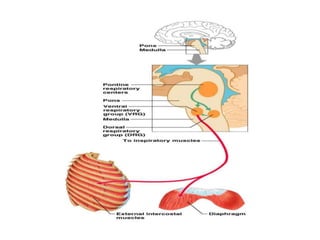
Respiratory Centers
3. Normal breathing is a rhythmic, involuntary action regulated
by the respiratory centers in the pons and medulla oblongata
of the brain stem.
• Rhythmicity area in the medulla oblongata sets the basic
rhythm of inspiration and expiration, and is subdivided into
the dorsal respiratory group (which controls normal
breathing) and the ventral respiratory group (which controls
forceful, voluntary breathing).
• Pneumontaxic area in the pons sets the depth, duration, and
rate of breathing by influencing the dorsal respiratory group.
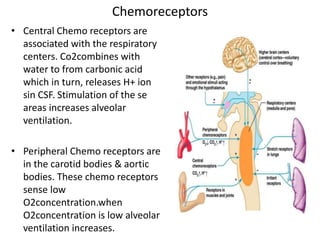
Chemoreceptors
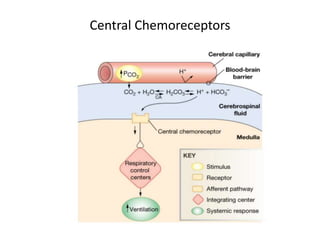
• Central Chemo receptors are
associated with the respiratory
centers. Co2combines with
water to from carbonic acid
which in turn, releases H+ ion
sin CSF. Stimulation of the se
areas increases alveolar
ventilation.
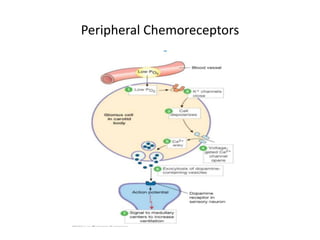
• Peripheral Chemo receptors are
in the carotid bodies & aortic
bodies. These chemo receptors
sense low
O2concentration.when
O2concentration is low alveolar
ventilation increases.
Peripheral Chemoreceptors
Central Chemoreceptors
• Pco2: Medullary chemo receptors are sensitive to the PH of CSF.
Diffusion of Co2from the blood into CSF lowers the PH of CSF by
forming carbonic acid. Similarly, the aortic and carotid bodies are
stimulated by a fall in blood PH, induced by increases in blood Co2.
• PH: peripheral chemo receptors are stimulated by decreased blood
PH independent of the effect of blood Co2. Chemo receptors in the
medulla are not affected by changes in blood PH because H+ cannot
cross the blood brain barrier.
• Po2: Low blood Po2augments the chemoreceptor response to
increases in blood Pco2and can stimulate ventilation directly when
the Po2fallsbelow 50 mmHg.
• Ventilation: the amount of air moved in and out of the lungs during
each minute is called pulmonary ventilation. Increase in metabolism
is accompanied by increases in ventilation (due to increase in
plasmaCo2).
Gas Exchange
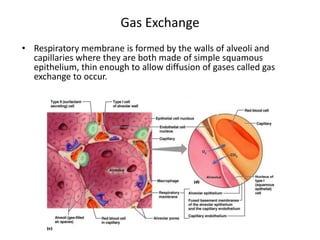
• Respiratory membrane is formed by the walls of alveoli and
capillaries where they are both made of simple squamous
epithelium, thin enough to allow diffusion of gases called gas
exchange to occur.
• Dalton’s Law :
Gases (particularly O2and CO2for this discussion)always
diffuse from high pressure to low pressure. Each gas in a
mixture of gases produces its own pressure called partial
pressure (pp or p), and the sum of all partial pressure is
the total pressure of that gas mixture – a physical law
called the Dalton's law.
• Therefore, the directions of diffusion during gas
exchange in the lungs and in body tissues are based on
the differences in partial pressure of these gases.
External & Internal Respiration
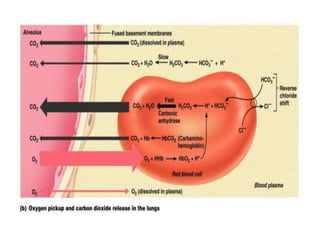
• External Respiration: occurs in the lungs to oxygenate the blood and
remove CO2from the deoxygenated blood. O2diffuses from the
alveoli into capillaries, while CO2 diffuses from the capillaries into
alveoli.
• Internal respiration : (tissue respiration) occurs in the body tissues
to provide O2to tissue cells and remove CO2from the cells.
• O is critical in the release of energy molecules (i.e. ATP) is critical in
the release of energy molecules (i.e. ATP), a process called cellular
respiration, while CO2is a by product of metabolism which can
become harmful to tissue cells in large quantities.
• O2 diffuses from the capillaries into tissue cells, while CO2diffuses
from tissue cells into capillaries.
Alveolar Gas exchange
• Gas exchanges between the air and the blood occur within the
alveoli.
• 1. The alveoli are tiny sacs clustered at the distal ends of alveolar
ducts.
• 2. The respiratory membrane consists of the alveolar and capillary
walls. Gas exchange takes place through these walls.
• 3. Diffusion through the respiratory membrane.
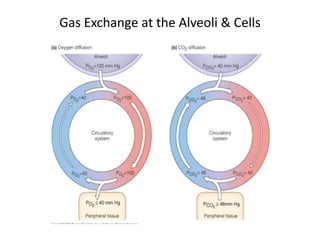
• O2 diffuses from the alveolar air into the blood; Co2 diffuses from
the blood into the alveolar air.
• Note: the differences in partial pressure determines the diffusion
through the respiratory membrane.
Gas Exchange at the Alveoli & Cells
Pulmonary vs. Systemic Capillaries
• Pulmonary Capillaries: Alveolar Po2 = 104 mmHg
• Pulmonary capillaries Po2 = 40 mmHg Result: O2enters capillaries
• Alveolar Pco2 = 40 mmHg
• Pulmonary capillaries Pco2 = 45 mmHg Result: Co2enters alveoli
•
• Systemic capillaries:
• Systemic capillaries Po2 = 104 mmHg
• Tissues Po2 = >40 mmHg Result: O2enters tissues
• Systemic capillaries Pco2 = 40 mmHg
• Tissues Pco2 = < 45 mmHg Result: Co2enters capillary
Gas Transport - Oxygen
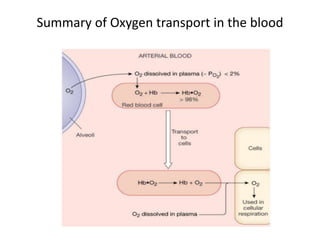
• 98% of O2
• is transported by binding to hemoglobin in
• erythrocytes [when O2 binds with hemoglobin (Hb)
• oxyhemoglobin (oxy-Hb) is formed which shows are a red
• pigment].
• 2% of O2
• is dissolved in the blood plasma.
• The resulting oxyhemoglobin is relatively unstable and releases
• © 2009 Ebneshahidi
• its O2
• in regions where Po2
• is low.
• More O2
• is released as the blood conc. of Co2
• increases, as the
• blood becomes more acidic, and as the blood Temp. increases.
• The efficiency of oxy-Hb releasing O2
• to tissue cells during
• internal respiration is shown on the O2
• -Hb dissociation curve
• which shows a distinctive sigmoid shape.
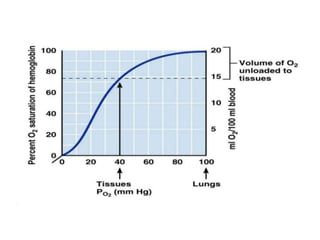
• On this curve, as O2 partial pressure increases, the level of Hb
• saturation increases (each Hb molecule can bind up to four O2
• molecules).
• At about 40 mmHg of O2
• , roughly 75% of Hb is saturated.
• At about 80 mmHg of O2
• , close to 98% of Hb is saturated, and the
• curve becomes flattened beyound this point where only about 98 -
• 99% of Hb can be saturated no matter how high the O2 pressure is.
4 main factors that can shift the O2 -Hb
dissociation curve:
• O2 pressure – a decrease shifts the curve to the
right.
• CO2 pressure – an increase shifts the curve to the
right.
• PH of blood – more acidic shifts the curve to the
right.
• Body temperature – an increase shifts the curve to
the right.
• When this dissociation curve shifts to the right, it is a
phenomenon called the Bohr effect, where less Hb saturation
occurs and more O2 is being released from oxy hemoglobin.
When the dissociation curve shifts to the left (which is less
common), it is called the Haldane effect, where more Hb
saturation occurs and less O2 release.
Oxygen-Hemoglobin dissociation curve
Summary of Oxygen transport in the blood
Gas Transport – carbon dioxide
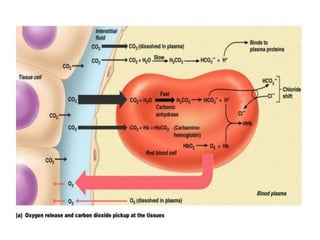
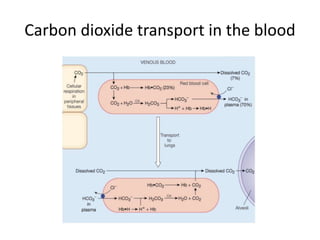
• 7% of CO2is dissolved in the blood plasma.
• 23% of CO2 binds with hemoglobin in erythrocytes. [when
CO2binds to Hb, carb-amino hemoglobin is formed which shows a
bluish pigment].
• 70% of CO2reacts with water and forms carbonic acid in
erythrocytes CO2+ H2O → H2CO3 erythrocytes CO2+ H2O →
H2CO3
• Carbonic acid is immediately broken down by the enzyme carbonic
anhydrase (CA), to become hydrogen ion and bicarbonate ion.
• H2CO3→H+ + HCO3– Where H+ quickly binds with Hb to prevent it
from affecting blood pH too drastically, and HCO3- diffuses into
blood plasma and maintains an ionic balance with chloride anion
(Cl-).
Carbon dioxide transport in the blood
Gas Transport – carbon monoxide
• Co forms as a result of incomplete combustion of
fuels.
• It combines with hemoglobin more readily than O2
and forms a stable compound.
• Co is toxic because the hemoglobin with which it
combines is no longer available for O2 transport.
Clinical Terms
• Anoxia: absence or a deficiency of O2 within tissues.
• Asphyxia: deficiency of O2and excess of Co2in the blood and
tissues.
• Atelectasis: collapse of a lung or some portion of it.
• Bronchitis: inflammation of the bronchial lining.
• Cheyne – strokes – respiration: irregular breathing pattern of a
series ofCheyne – strokes – respiration: irregular breathing
pattern of a series ofshallow breaths that increases in depth
and rate, followed by breathsthat decrease in depth and rate.
• Dyspnea: difficulty in breathing.
• Hyperoxia: excess oxygenation of the blood.
• Hyperpnea: increase in the depth and rate of breathing.
• Hypoxia: diminished availability of O2in the tissues.
• Pneumothorax: entrance of air into the space between thepleural
membrane, followed by collapse of the lung.
• Tachypnea: rapid, shallow breathing.
• Asthma: the dyspnea, wheezing and other symptoms of asthmaare
produced by obstruction of air flow through the bronchioles that
occur in episodes or "attacks" (obstruction is due toinflammation).
• Lung cancer: 1/3 of cancer death in the U.S. – smoking is the
leading cause.
THANK YOU

The respiratory system

  • 1.
  • 2.
    Functions of TheRespiratory System • To allow gases from the environment to enter the bronchial tree through inspiration by expanding the thoracic volume. • To allow gas exchange to occur at the respiratory membrane, so that oxygen diffuses into the blood while carbon dioxidediffuses into the bronchial tree. • To permit gases in the lungs to be eliminated through expiration by decreasing the thoracic volume.
  • 3.
    General anatomy ofThe respiratory System • Consists of a tube that divides into small branching tubes in the lungs: External nares → nasal cavity → nasao pharynx → laryngo pharynx → larynx → trachea → primary bronchi →lungs (secondary bronchi → tertiary bronchi →bronchioles →alveolar sacs → alveoli).
  • 4.
    Lungs • Cone –shaped organs located in the thoracic cavity. • Thoracic cavity is lined with a body membrane called parietal pleura, while the surface of lungs is covered with visceral pleura. • The thin space between the two pleural membranes is called pleural cavity which is filled with a clear fluid called plural fluid to minimize friction between the tissues and to provide surface tension in the pleural cavity. [water molecules in the pleural fluid allow the two pleural membranes to adhere to one another, to prevent collapsing of the lungs]. • A chemical substance called surfactant secreted by the lungs also facilitate the surface tension.
  • 5.
    The respiratory Tract– Bronchial Tree
  • 6.
  • 7.
    • The histologyalong the respiratory tract changes – from the trachea to the tertiary bronchi, the tract is lined with ciliated pseudo stratified columnar epithelium, smooth muscle and cartilage rings; the bronchioles are lined with cuboidal epithelium; and from the alveolar ducts to the alveoli, the tract is lined with simple squamous epithelium. • Inferior to the lungs is a sheet of skeletal muscle under diaphragm involuntary control, called , to facilitate the control of thoracic volume.
  • 8.
    The Bronchial tree •tree – like branching tubes extended from the trachea. Only the primary bronchi are external to the lungs, while the rest of the bronchial tree is embedded in lung tissues. • diameters of the tubes from primary bronchi to tertiary bronchi are large, so that support with cartilage rings is necessary. • diameter at the bronchioles is down to 1 mm where the tubes do not need cartilage rings for support. This structure is composed of cuboidal cells where diffusion is also not possible. • from the alveolar duct to the alveoli, the lining tissue becomes simple squamous epithelium where gas exchange is possible. Since there is a much larger surface area at the alveoli, almost all gas exchange occurs at the alveoli [300 million alveoli provide a total surface area similar to a tennis court!].
  • 9.
    Breathing Mechanisms –physical laws • The Gas law states that gas molecules always diffuse from a higher pressure area to a lower pressure area. • The Boyle's law states that pressure and volume are inversely related (with the temperature remains constant), where pressure will increase in a smaller volume of gases, and pressure decreases in a larger volume of gases
  • 10.
    Inspiration (Inhalation) • Anactive process where nerve impulses from medulla oblongata cause the contraction of diaphragm and external intercostals muscles. • As these muscles contract, thoracic volume increases which decreases the pressure within the lung (intra alveolar pressure) due to the boyle's law. • When intra alveolar pressure falls below the atmospheric pressure (758 mmHg versus 760mmHg, respectively), the gas law dictates that now gases move from the environment into lungs.
  • 11.
    Expiration (exhalation) • apassive process where elastic tissues of the lungs and diaphragm recoil to their original position. • as the diaphragm and external intercostals muscles relax and recoil, thoracic volume decreases which raises the intra alveolar pressure (again due to the boyle's law). • when intra alveolar pressure is risen above the atmospheric pressure (762 mmHg versus 760mmHg, respectively), gases move from the lungs into the environment (again due to the gas law).
  • 12.
  • 13.
    Pulmonary Ventilation -Inspiration • Pulmonary ventilation is the mechanism by which air is exchanged between the atmosphere and the alveoli. • Air is exchanged due to the expansion and contraction of the lungs. • Contraction of the diaphragm pulls down, enlarging the intra pleural cavity. • Elevation of the ribs also expands the intra pleural cavity. • These factors decrease the intra pleural cavity pressure: thus, air flows into the lungs (inspiration).
  • 14.
    Pulmonary ventilation -Expiration • During expiration the diaphragm relaxes, the ribs are pulled down. • This increases the intra pleural cavity pressure. • This results in the movement of air out of the lungs. • Normal quiet breathing is accomplished entirely by the movement of the diaphragm. • In the "normal sized" person, about 6 liters of gas per minute move in and out of the lungs. • Ventilation can increase up to almost 100 liters per minute during maximal exercise.
  • 15.
    Lung Capacities • Lungcapacities (air volumes contained in the lungs) can be measured by a Spirometer, and provide invaluable information regarding the normal function of the respiratory system. • Tidal volume (TV) :- Amount of air moving in and out of the lungs during normal breathing. • Average value is about 500 ml. • Inspiratory reserve volume (IRV) :- Amount of air that can be inhaled after normal inspiration. • Average value is about 3,000 ml. • Can be calculated by: IRV = IC – TV where IC represents inspiratory capacity.
  • 16.
    Cont….. • Expiratory reservevolume (ERV):- Amount of air that can be exhaled after normal expiration. Average value is about 1,100 ml. • Inspiratory capacity (IC):- Total amount of air that can be inhaled. • Average value is about 4,000 ml. can be calculated by: IC = VC– ERV where VC represents vital capacity. • Vital capacity (VC):- Total amount of air that can be exhaled. Average value is about5,000 ml. Can be calculated by: VC = TV + IRV +ERV. • Can also be determined by predicted VC values on a chart based on a person's age and height.
  • 17.
    • Residual volume(RV):- Amount of air that is always left in the lungs after expiration. Average value is about 1,200 ml. • Total lung capacity (TLC):- Total amount of air that the lungs contain, including residual volume. Average value is about 6,000 ml. Can be calculated by: TLC =VC + RV. • Anatomic dead space refers to the amount of air remain in the bronchial tree that is not involved in gas exchange, due to obstruction of air flow or damage in the bronchial tree. • Alveolar dead space refers to the amount of air in the alveolar ducts or alveolar sacs that is not involved in gas exchange, due to poor blood flow or unusually long diffusion distances in gas exchange. • Physiologic dead space refers to the total amount of air in the lungs that is not involved in gas exchange (i.e. anatomic dead space + alveolar dead space).
  • 19.
    Control of breathing 1.Four major factors that affect normal breathing: Stretching in the lungs and thoracic walls O2level in the blood CO2 level in the blood H+ level in the blood. 2. Normal breathing is inhibited by stretching of the lungs and thoracic walls, a rise in O2 level, and a decrease in CO2 and H+ levels; while normal breathing is stimulated by relaxing of the lungs and thoracic walls, a decrease in O2 level, and a rise in CO2 and H+ levels. • Chemicals, and emotional state also affect breathing.
  • 20.
    • Stretch oftissues: inhibits inspiration by triggering an inflation reflex which reduces the duration of inspiratory movements. • This, also prevents over inflation of the lungs during foreceful breathing. Hyperventilation decreases carbon dioxide concentration as well. • Low blood PO2: increase alveolar ventilation (peripheral chemoreceptors in the carotid bodies & aortic bodies detect low O2concentrations). • High blood Pco2: increase alveolar ventilation. • High CSF, H+ ion concentration: increase breathing rate and alveolar ventilation. CO2combines with water to form carbonic acid, which in turn, releases H+ ions in CSF.
  • 21.
    Effect of changingalveolar ventilation on po2 & pco2 in the alveoli
  • 22.
    Respiratory Centers 3. Normalbreathing is a rhythmic, involuntary action regulated by the respiratory centers in the pons and medulla oblongata of the brain stem. • Rhythmicity area in the medulla oblongata sets the basic rhythm of inspiration and expiration, and is subdivided into the dorsal respiratory group (which controls normal breathing) and the ventral respiratory group (which controls forceful, voluntary breathing). • Pneumontaxic area in the pons sets the depth, duration, and rate of breathing by influencing the dorsal respiratory group.
  • 24.
    Chemoreceptors • Central Chemoreceptors are associated with the respiratory centers. Co2combines with water to from carbonic acid which in turn, releases H+ ion sin CSF. Stimulation of the se areas increases alveolar ventilation. • Peripheral Chemo receptors are in the carotid bodies & aortic bodies. These chemo receptors sense low O2concentration.when O2concentration is low alveolar ventilation increases.
  • 25.
  • 26.
  • 27.
    • Pco2: Medullarychemo receptors are sensitive to the PH of CSF. Diffusion of Co2from the blood into CSF lowers the PH of CSF by forming carbonic acid. Similarly, the aortic and carotid bodies are stimulated by a fall in blood PH, induced by increases in blood Co2. • PH: peripheral chemo receptors are stimulated by decreased blood PH independent of the effect of blood Co2. Chemo receptors in the medulla are not affected by changes in blood PH because H+ cannot cross the blood brain barrier. • Po2: Low blood Po2augments the chemoreceptor response to increases in blood Pco2and can stimulate ventilation directly when the Po2fallsbelow 50 mmHg. • Ventilation: the amount of air moved in and out of the lungs during each minute is called pulmonary ventilation. Increase in metabolism is accompanied by increases in ventilation (due to increase in plasmaCo2).
  • 28.
    Gas Exchange • Respiratorymembrane is formed by the walls of alveoli and capillaries where they are both made of simple squamous epithelium, thin enough to allow diffusion of gases called gas exchange to occur.
  • 29.
    • Dalton’s Law: Gases (particularly O2and CO2for this discussion)always diffuse from high pressure to low pressure. Each gas in a mixture of gases produces its own pressure called partial pressure (pp or p), and the sum of all partial pressure is the total pressure of that gas mixture – a physical law called the Dalton's law. • Therefore, the directions of diffusion during gas exchange in the lungs and in body tissues are based on the differences in partial pressure of these gases.
  • 30.
    External & InternalRespiration • External Respiration: occurs in the lungs to oxygenate the blood and remove CO2from the deoxygenated blood. O2diffuses from the alveoli into capillaries, while CO2 diffuses from the capillaries into alveoli. • Internal respiration : (tissue respiration) occurs in the body tissues to provide O2to tissue cells and remove CO2from the cells. • O is critical in the release of energy molecules (i.e. ATP) is critical in the release of energy molecules (i.e. ATP), a process called cellular respiration, while CO2is a by product of metabolism which can become harmful to tissue cells in large quantities. • O2 diffuses from the capillaries into tissue cells, while CO2diffuses from tissue cells into capillaries.
  • 31.
    Alveolar Gas exchange •Gas exchanges between the air and the blood occur within the alveoli. • 1. The alveoli are tiny sacs clustered at the distal ends of alveolar ducts. • 2. The respiratory membrane consists of the alveolar and capillary walls. Gas exchange takes place through these walls. • 3. Diffusion through the respiratory membrane. • O2 diffuses from the alveolar air into the blood; Co2 diffuses from the blood into the alveolar air. • Note: the differences in partial pressure determines the diffusion through the respiratory membrane.
  • 32.
    Gas Exchange atthe Alveoli & Cells
  • 33.
    Pulmonary vs. SystemicCapillaries • Pulmonary Capillaries: Alveolar Po2 = 104 mmHg • Pulmonary capillaries Po2 = 40 mmHg Result: O2enters capillaries • Alveolar Pco2 = 40 mmHg • Pulmonary capillaries Pco2 = 45 mmHg Result: Co2enters alveoli • • Systemic capillaries: • Systemic capillaries Po2 = 104 mmHg • Tissues Po2 = >40 mmHg Result: O2enters tissues • Systemic capillaries Pco2 = 40 mmHg • Tissues Pco2 = < 45 mmHg Result: Co2enters capillary
  • 34.
    Gas Transport -Oxygen • 98% of O2 • is transported by binding to hemoglobin in • erythrocytes [when O2 binds with hemoglobin (Hb) • oxyhemoglobin (oxy-Hb) is formed which shows are a red • pigment]. • 2% of O2 • is dissolved in the blood plasma. • The resulting oxyhemoglobin is relatively unstable and releases • © 2009 Ebneshahidi • its O2 • in regions where Po2 • is low. • More O2 • is released as the blood conc. of Co2 • increases, as the • blood becomes more acidic, and as the blood Temp. increases. • The efficiency of oxy-Hb releasing O2 • to tissue cells during • internal respiration is shown on the O2 • -Hb dissociation curve • which shows a distinctive sigmoid shape. • On this curve, as O2 partial pressure increases, the level of Hb • saturation increases (each Hb molecule can bind up to four O2 • molecules). • At about 40 mmHg of O2 • , roughly 75% of Hb is saturated. • At about 80 mmHg of O2 • , close to 98% of Hb is saturated, and the • curve becomes flattened beyound this point where only about 98 - • 99% of Hb can be saturated no matter how high the O2 pressure is.
  • 36.
    4 main factorsthat can shift the O2 -Hb dissociation curve: • O2 pressure – a decrease shifts the curve to the right. • CO2 pressure – an increase shifts the curve to the right. • PH of blood – more acidic shifts the curve to the right. • Body temperature – an increase shifts the curve to the right.
  • 38.
    • When thisdissociation curve shifts to the right, it is a phenomenon called the Bohr effect, where less Hb saturation occurs and more O2 is being released from oxy hemoglobin. When the dissociation curve shifts to the left (which is less common), it is called the Haldane effect, where more Hb saturation occurs and less O2 release.
  • 39.
  • 40.
    Summary of Oxygentransport in the blood
  • 42.
    Gas Transport –carbon dioxide • 7% of CO2is dissolved in the blood plasma. • 23% of CO2 binds with hemoglobin in erythrocytes. [when CO2binds to Hb, carb-amino hemoglobin is formed which shows a bluish pigment]. • 70% of CO2reacts with water and forms carbonic acid in erythrocytes CO2+ H2O → H2CO3 erythrocytes CO2+ H2O → H2CO3 • Carbonic acid is immediately broken down by the enzyme carbonic anhydrase (CA), to become hydrogen ion and bicarbonate ion. • H2CO3→H+ + HCO3– Where H+ quickly binds with Hb to prevent it from affecting blood pH too drastically, and HCO3- diffuses into blood plasma and maintains an ionic balance with chloride anion (Cl-).
  • 43.
  • 45.
    Gas Transport –carbon monoxide • Co forms as a result of incomplete combustion of fuels. • It combines with hemoglobin more readily than O2 and forms a stable compound. • Co is toxic because the hemoglobin with which it combines is no longer available for O2 transport.
  • 46.
    Clinical Terms • Anoxia:absence or a deficiency of O2 within tissues. • Asphyxia: deficiency of O2and excess of Co2in the blood and tissues. • Atelectasis: collapse of a lung or some portion of it. • Bronchitis: inflammation of the bronchial lining. • Cheyne – strokes – respiration: irregular breathing pattern of a series ofCheyne – strokes – respiration: irregular breathing pattern of a series ofshallow breaths that increases in depth and rate, followed by breathsthat decrease in depth and rate. • Dyspnea: difficulty in breathing.
  • 47.
    • Hyperoxia: excessoxygenation of the blood. • Hyperpnea: increase in the depth and rate of breathing. • Hypoxia: diminished availability of O2in the tissues. • Pneumothorax: entrance of air into the space between thepleural membrane, followed by collapse of the lung. • Tachypnea: rapid, shallow breathing. • Asthma: the dyspnea, wheezing and other symptoms of asthmaare produced by obstruction of air flow through the bronchioles that occur in episodes or "attacks" (obstruction is due toinflammation). • Lung cancer: 1/3 of cancer death in the U.S. – smoking is the leading cause.
  • 48.