2016 CT STATE EMS PROTOCOL
CCR/CPR UPDATE
Change to CPR/CCR
• Emphasis on:
– Starting compressions sooner
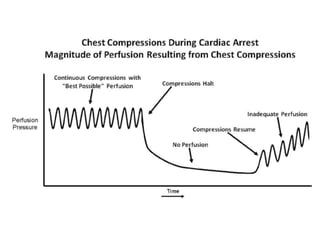
– Minimally interrupted compressions
– High performance CPR
Change to CPR/CCR
• No more 30:2 for Adults
– Pediatric – follow standard AHA CPR
• Instead:
– Cycles of 2 minutes uninterrupted compressions
– Check rhythm every 2 minutes
– Ventilate every 10th compression on the upstroke
• Do not interrupt compressions to ventilate
• Don’t overventilate – will cause gastric distention
• Consider using pediatric BVM
CCR
• CCR still for first 8 minutes in presumed
cardiac etiology
– NOT for respiratory arrest, opiate OD, pediatrics,
or trauma
– Passive ventilation with OPA and NRB will usually
be used at first
– May transition to active ventilations once
sufficient personnel/resources are present
• This could be immediate, at 2 minutes, 8 minutes or
any point in between
No More “20 Minute Then Transport”
• Resuscitation performed on scene until ROSC or termination of
efforts EXCEPT for ‘special circumstances’
– “Special Circumstances” not well defined in protocol but think “can
the hospital do something to fix this that I can’t?” Ex:
• Hypothermia (central rewarming)
• Pulmonary embolism (lytics, ECMO, IR)
• Pregnancy with potentially viable fetus (perimortem c-section)
• Etc.
• Still AT LEAST 20 minutes ALS resuscitation before considering
termination
– Definitively manage airway prior to termination
– Should continue resuscitation if ROSC is likely such as in cases with:
• Witnessed arrest and early CPR
• Reversible cause
• etCO2 >15mmHg
• Persistent vfib/v-tach
• Etc.
Changes to ALS Arrest Management
• Antiarrhythmics now “per AHA ACLS guidelines”
• Medics should use etCO2 with BLS and ALS airway to
assess CPR quality and for signs of ROSC
• Bicarb indications (now 2 mEQ/kg IV)
– Suspected excited delerium
• New indication – that patient you were restraining who isn’t
breathing any more…
– Suspected pre-existing metabolic acidosis
– Known tricyclic OD (tox protocol also includes other Na
channel blockers such as cocaine and Benadryl)
– Should insert an advanced airway before bicarb
• Bicarb works by creating CO2
• May be harmful in a ‘closed system’ (i.e. ineffective ventilations)
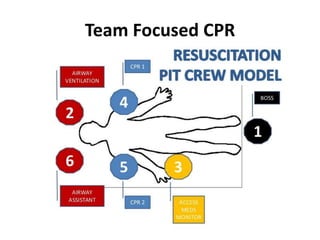
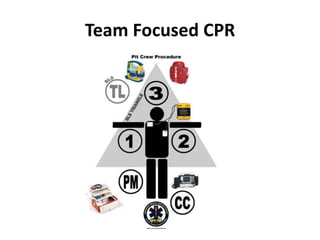
Team Focused CPR
• Send a rescuer in ahead (with just gloves) to start
compressions
• Pre-defined roles and positions
– Different ways to set this up depending on resources
– Goal is efficiency
• The example described in the protocols follows
but may be adapted
– Protocol example assumes at least 4 ALS providers on
scene
– Strive for multiple ALS providers to fill roles
– ALS provider may need to fill multiple roles
Team Focused CPR
Team Focused CPR
Team Focused CPR
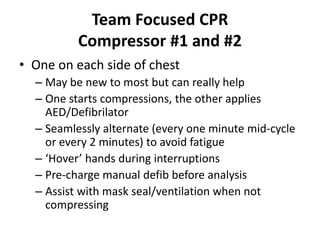
Compressor #1 and #2
• One on each side of chest
– May be new to most but can really help
– One starts compressions, the other applies
AED/Defibrilator
– Seamlessly alternate (every one minute mid-cycle
or every 2 minutes) to avoid fatigue
– ‘Hover’ hands during interruptions
– Pre-charge manual defib before analysis
– Assist with mask seal/ventilation when not
compressing
Team Focused CPR
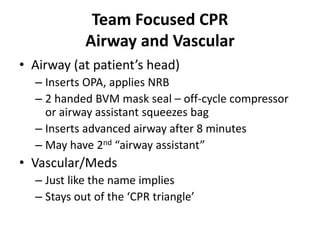
Airway and Vascular
• Airway (at patient’s head)
– Inserts OPA, applies NRB
– 2 handed BVM mask seal – off-cycle compressor
or airway assistant squeezes bag
– Inserts advanced airway after 8 minutes
– May have 2nd “airway assistant”
• Vascular/Meds
– Just like the name implies
– Stays out of the ‘CPR triangle’
Team Focused CPR
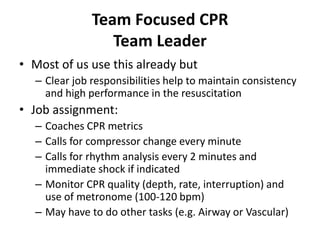
Team Leader
• Most of us use this already but
– Clear job responsibilities help to maintain consistency
and high performance in the resuscitation
• Job assignment:
– Coaches CPR metrics
– Calls for compressor change every minute
– Calls for rhythm analysis every 2 minutes and
immediate shock if indicated
– Monitor CPR quality (depth, rate, interruption) and
use of metronome (100-120 bpm)
– May have to do other tasks (e.g. Airway or Vascular)
Team Focused CPR
Code Commander
• Ideally highest level provider
– May have to do double duty as team leader
• Coordinates patient treatment decisions
– Can interface with OLMC without disruption to
resuscitation
• Communicates with family/loved ones
– Essential, especially if termination will be
considered
• Completes CPR Checklist (new to most)
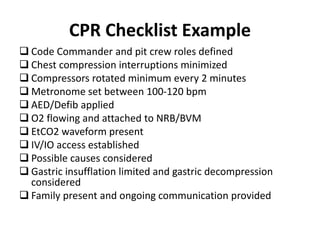
CPR Checklist Example
 Code Commander and pit crew roles defined
 Chest compression interruptions minimized
 Compressors rotated minimum every 2 minutes
 Metronome set between 100-120 bpm
 AED/Defib applied
 O2 flowing and attached to NRB/BVM
 EtCO2 waveform present
 IV/IO access established
 Possible causes considered
 Gastric insufflation limited and gastric decompression
considered
 Family present and ongoing communication provided
Pit Crew CPR
• https://youtu.be/RNiNKluuIqE?t=25s
Mechanical CPR
• 2015 AHA Evidence review:
– 2 large RCTs compared the use of LUCAS against
manual compressions for patients with OHCA
– Together enrolled 7060 patients
– Neither demonstrated a benefit for mechanical CPR
over manual CPR with respect to early (4-hour) and
late (1- and 6-month) survival
– The PARAMEDIC study demonstrated a negative
association between mechanical chest compressions
and survival with good neurologic outcome (Cerebral
Performance Category 1–2) at 3 months as compared
with manual compressions
Mechanical CPR
• 2015 AHA Recommendation:
– “The evidence does not demonstrate a benefit with the use of
mechanical piston devices for chest compressions versus manual
chest compressions in patients with cardiac arrest.”
– “Mechanical piston devices may be considered in specific
settings where the delivery of high-quality manual compressions
may be challenging or dangerous provided that rescuers strictly
limit interruptions in CPR during deployment and removal of the
devices.” Ex:
• Limited rescuers available
• Prolonged CPR
• During hypothermic cardiac arrest
• In a moving ambulance
• In the angiography suite
• During preparation for extracorporeal CPR [ECPR]),
Mechanical CPR
• Hartford Hospital Expectations if using
mechanical CPR:
– Apply only after first 8 minutes manual CPR
– At least yearly training and competency evaluation
– MUST be able to reliably apply with less than 5
second (at most 10 second) interruptions in CPR
• Time this in training; Team leader watch for this in real
life
– Discontinue and revert to manual CPR if device or
application problems occur
Questions?

2016 10 06 cpr ccr update

  • 1.
    2016 CT STATEEMS PROTOCOL CCR/CPR UPDATE
  • 2.
    Change to CPR/CCR •Emphasis on: – Starting compressions sooner – Minimally interrupted compressions – High performance CPR
  • 3.
    Change to CPR/CCR •No more 30:2 for Adults – Pediatric – follow standard AHA CPR • Instead: – Cycles of 2 minutes uninterrupted compressions – Check rhythm every 2 minutes – Ventilate every 10th compression on the upstroke • Do not interrupt compressions to ventilate • Don’t overventilate – will cause gastric distention • Consider using pediatric BVM
  • 5.
    CCR • CCR stillfor first 8 minutes in presumed cardiac etiology – NOT for respiratory arrest, opiate OD, pediatrics, or trauma – Passive ventilation with OPA and NRB will usually be used at first – May transition to active ventilations once sufficient personnel/resources are present • This could be immediate, at 2 minutes, 8 minutes or any point in between
  • 6.
    No More “20Minute Then Transport” • Resuscitation performed on scene until ROSC or termination of efforts EXCEPT for ‘special circumstances’ – “Special Circumstances” not well defined in protocol but think “can the hospital do something to fix this that I can’t?” Ex: • Hypothermia (central rewarming) • Pulmonary embolism (lytics, ECMO, IR) • Pregnancy with potentially viable fetus (perimortem c-section) • Etc. • Still AT LEAST 20 minutes ALS resuscitation before considering termination – Definitively manage airway prior to termination – Should continue resuscitation if ROSC is likely such as in cases with: • Witnessed arrest and early CPR • Reversible cause • etCO2 >15mmHg • Persistent vfib/v-tach • Etc.
  • 7.
    Changes to ALSArrest Management • Antiarrhythmics now “per AHA ACLS guidelines” • Medics should use etCO2 with BLS and ALS airway to assess CPR quality and for signs of ROSC • Bicarb indications (now 2 mEQ/kg IV) – Suspected excited delerium • New indication – that patient you were restraining who isn’t breathing any more… – Suspected pre-existing metabolic acidosis – Known tricyclic OD (tox protocol also includes other Na channel blockers such as cocaine and Benadryl) – Should insert an advanced airway before bicarb • Bicarb works by creating CO2 • May be harmful in a ‘closed system’ (i.e. ineffective ventilations)
  • 8.
    Team Focused CPR •Send a rescuer in ahead (with just gloves) to start compressions • Pre-defined roles and positions – Different ways to set this up depending on resources – Goal is efficiency • The example described in the protocols follows but may be adapted – Protocol example assumes at least 4 ALS providers on scene – Strive for multiple ALS providers to fill roles – ALS provider may need to fill multiple roles
  • 9.
  • 10.
  • 11.
    Team Focused CPR Compressor#1 and #2 • One on each side of chest – May be new to most but can really help – One starts compressions, the other applies AED/Defibrilator – Seamlessly alternate (every one minute mid-cycle or every 2 minutes) to avoid fatigue – ‘Hover’ hands during interruptions – Pre-charge manual defib before analysis – Assist with mask seal/ventilation when not compressing
  • 12.
    Team Focused CPR Airwayand Vascular • Airway (at patient’s head) – Inserts OPA, applies NRB – 2 handed BVM mask seal – off-cycle compressor or airway assistant squeezes bag – Inserts advanced airway after 8 minutes – May have 2nd “airway assistant” • Vascular/Meds – Just like the name implies – Stays out of the ‘CPR triangle’
  • 13.
    Team Focused CPR TeamLeader • Most of us use this already but – Clear job responsibilities help to maintain consistency and high performance in the resuscitation • Job assignment: – Coaches CPR metrics – Calls for compressor change every minute – Calls for rhythm analysis every 2 minutes and immediate shock if indicated – Monitor CPR quality (depth, rate, interruption) and use of metronome (100-120 bpm) – May have to do other tasks (e.g. Airway or Vascular)
  • 14.
    Team Focused CPR CodeCommander • Ideally highest level provider – May have to do double duty as team leader • Coordinates patient treatment decisions – Can interface with OLMC without disruption to resuscitation • Communicates with family/loved ones – Essential, especially if termination will be considered • Completes CPR Checklist (new to most)
  • 15.
    CPR Checklist Example Code Commander and pit crew roles defined  Chest compression interruptions minimized  Compressors rotated minimum every 2 minutes  Metronome set between 100-120 bpm  AED/Defib applied  O2 flowing and attached to NRB/BVM  EtCO2 waveform present  IV/IO access established  Possible causes considered  Gastric insufflation limited and gastric decompression considered  Family present and ongoing communication provided
  • 16.
    Pit Crew CPR •https://youtu.be/RNiNKluuIqE?t=25s
  • 17.
    Mechanical CPR • 2015AHA Evidence review: – 2 large RCTs compared the use of LUCAS against manual compressions for patients with OHCA – Together enrolled 7060 patients – Neither demonstrated a benefit for mechanical CPR over manual CPR with respect to early (4-hour) and late (1- and 6-month) survival – The PARAMEDIC study demonstrated a negative association between mechanical chest compressions and survival with good neurologic outcome (Cerebral Performance Category 1–2) at 3 months as compared with manual compressions
  • 18.
    Mechanical CPR • 2015AHA Recommendation: – “The evidence does not demonstrate a benefit with the use of mechanical piston devices for chest compressions versus manual chest compressions in patients with cardiac arrest.” – “Mechanical piston devices may be considered in specific settings where the delivery of high-quality manual compressions may be challenging or dangerous provided that rescuers strictly limit interruptions in CPR during deployment and removal of the devices.” Ex: • Limited rescuers available • Prolonged CPR • During hypothermic cardiac arrest • In a moving ambulance • In the angiography suite • During preparation for extracorporeal CPR [ECPR]),
  • 19.
    Mechanical CPR • HartfordHospital Expectations if using mechanical CPR: – Apply only after first 8 minutes manual CPR – At least yearly training and competency evaluation – MUST be able to reliably apply with less than 5 second (at most 10 second) interruptions in CPR • Time this in training; Team leader watch for this in real life – Discontinue and revert to manual CPR if device or application problems occur
  • 20.

Editor's Notes

  • #5 Graph of Coronary perfusion relative to chest compressions and importance of not interrupting