KEEPING YOUR EQUIPMENT PERFORMANCE-READY
Our Capabilities
 Qualified In-House Lube Engineers plus ExxonMobil Field Engineer
 ExxonMobil Engineering Global Support available if required
 Field Engineering Service
 Delivering Mobil Serv to you
 Umbrella brand of technical services
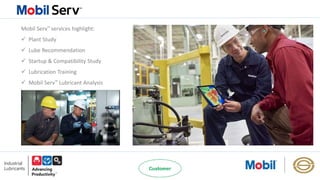
Mobil Serv℠ services highlight:
 Plant Study
 Lube Recommendation
 Startup & Compatibility Study
 Lubrication Training
 Mobil Serv℠ Lubricant Analysis
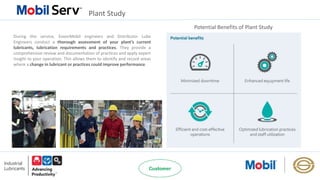
Plant Study
Potential Benefits of Plant Study
During this service, ExxonMobil engineers and Distributor Lube
Engineers conduct a thorough assessment of your plant’s current
lubricants, lubrication requirements and practices. They provide a
comprehensive review and documentation of practices and apply expert
insight to your operation. This allows them to identify and record areas
where a change in lubricant or practices could improve performance.
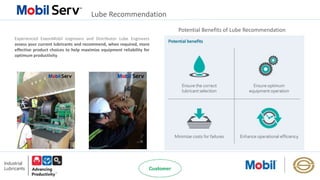
Lube Recommendation
Potential Benefits of Lube Recommendation
Experienced ExxonMobil engineers and Distributor Lube Engineers
assess your current lubricants and recommend, when required, more
effective product choices to help maximize equipment reliability for
optimum productivity.
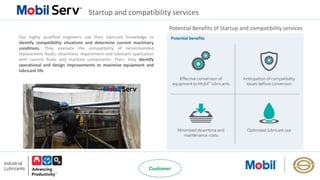
Startup and compatibility services
Potential Benefits of Startup and compatibility services
Our highly qualified engineers use their lubricant knowledge to
identify compatibility situations and determine current machinery
conditions. They evaluate the compatibility of recommended
replacement fluids, cleanliness requirement and lubricant application
with current fluids and machine components. Then, they identify
operational and design improvements to maximize equipment and
lubricant life.
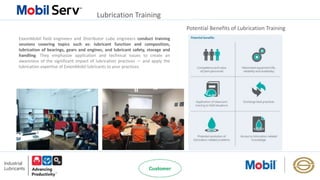
Lubrication Training
Potential Benefits of Lubrication Training
ExxonMobil field engineers and Distributor Lube engineers conduct training
sessions covering topics such as: lubricant function and composition,
lubrication of bearings, gears and engines, and lubricant safety, storage and
handling. They emphasize application and technical issues to create an
awareness of the significant impact of lubrication practices — and apply the
lubrication expertise of ExxonMobil lubricants to your practices.
Lubricant Analysis
Potential Benefits of Lubricant Analysis
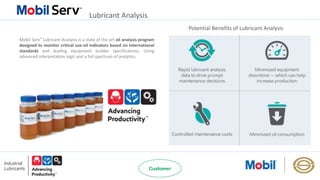
Mobil Serv℠ Lubricant Analysis is a state of the art oil analysis program
designed to monitor critical use-oil indicators based on international
standards and leading equipment builder specifications. Using
advanced interpretation logic and a full spectrum of analytics.
Why test the oil?
 Helps determine if equipment is operating efficiently
 Similar to a blood sample taken during a medical exam
 Identifies contamination, potential wear, and
 Monitors oil condition
Oil is the life blood of the equipment!
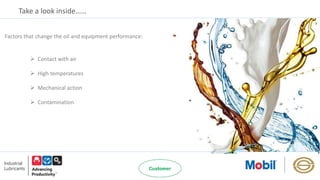
Take a look inside……
 Contact with air
 High temperatures
 Mechanical action
 Contamination
Factors that change the oil and equipment performance:
Goals of oil analysis
 Ensure equipment reliability and prevent equipment failures
 Extend equipment life
 Extend lubricant life
 Reduce unscheduled downtime
 Reduce lubricant consumption and disposal
 Reduce maintenance costs
Maximize performance of the equipment while reducing maintenance costs.
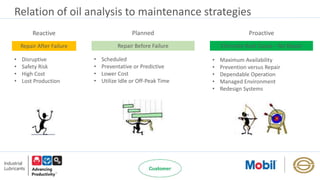
Relation of oil analysis to maintenance strategies
Reactive
Repair After Failure
• Disruptive
• Safety Risk
• High Cost
• Lost Production
Proactive
Eliminate Root Cause – No Repair
• Maximum Availability
• Prevention versus Repair
• Dependable Operation
• Managed Environment
• Redesign Systems
Planned
Repair Before Failure
• Scheduled
• Preventative or Predictive
• Lower Cost
• Utilize Idle or Off-Peak Time
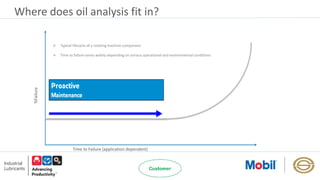
Where does oil analysis fit in?
%Failure
Time to Failure (application dependent)
 Typical lifecycle of a rotating machine component
 Time to failure varies widely depending on various operational and environmental conditions
%Failure
Time to Failure (application dependent)
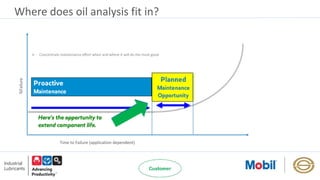
Where does oil analysis fit in?
 Concentrate maintenance effort when and where it will do the most good
%Failure
Time to Failure (application dependent)
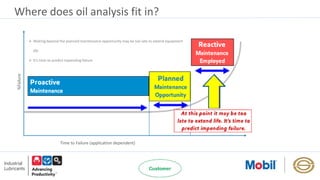
Where does oil analysis fit in?
 Waiting beyond the planned maintenance opportunity may be too late to extend equipment
life
 It’s time to predict impending failure
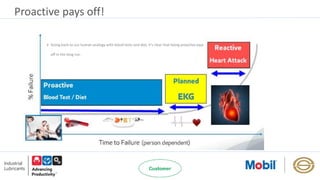
Proactive pays off!
 Going back to our human analogy with blood tests and diet, it’s clear that being proactive pays
off in the long run.
Why Mobil Serv Lubricant Analysis?
 Analysis Options
 Detailed Recommendations
 Local Field Support
Mobil Serv Lubricant Analysis provides value to customers in three key ways:
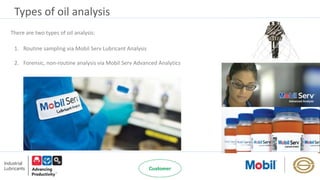
Types of oil analysis
1. Routine sampling via Mobil Serv Lubricant Analysis
2. Forensic, non-routine analysis via Mobil Serv Advanced Analytics
There are two types of oil analysis:
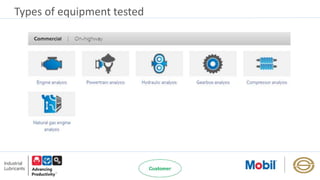
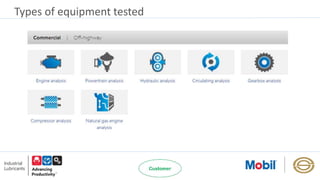
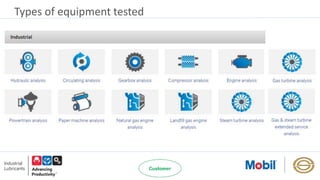
Types of equipment tested
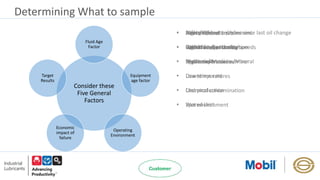
Determining What to sample
Consider these
Five General
Factors
Fluid Age
Factor
Equipment
age factor
Operating
Environment
Economic
impact of
failure
Target
Results
• Hours/Kilometer/miles since last oil change
• Oxidation, Contamination
• Synthetic/Premium/Mineral
• Hours/Kilometer/miles
• Rated life expectancy
• Made and Model number
• High dirt/dust environment
• High loads/pressures/speeds
• High temperatures
• Low temperatures
• Chemical contamination
• Wet environment
• Safety risk
• Operational criticality
• Repair costs
• Downtime cost
• Lost production
• Spared Unit
• Above control limits
• Within control limits
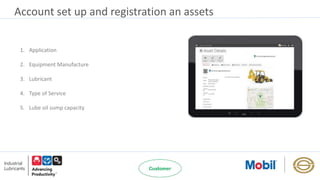
Account set up and registration an assets
1. Application
2. Equipment Manufacture
3. Lubricant
4. Type of Service
5. Lube oil sump capacity
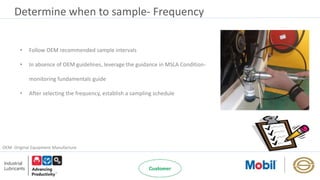
Determine when to sample- Frequency
• Follow OEM recommended sample intervals
• In absence of OEM guidelines, leverage the guidance in MSLA Condition-
monitoring fundamentals guide
• After selecting the frequency, establish a sampling schedule
OEM- Original Equipment Manufacture
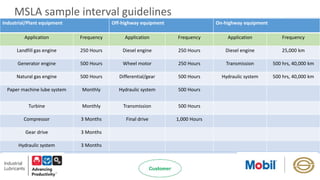
MSLA sample interval guidelines
Industrial/Plant equipment Off-highway equipment On-highway equipment
Application Frequency Application Frequency Application Frequency
Landfill gas engine 250 Hours Diesel engine 250 Hours Diesel engine 25,000 km
Generator engine 500 Hours Wheel motor 250 Hours Transmission 500 hrs, 40,000 km
Natural gas engine 500 Hours Differential/gear 500 Hours Hydraulic system 500 hrs, 40,000 km
Paper machine lube system Monthly Hydraulic system 500 Hours
Turbine Monthly Transmission 500 Hours
Compressor 3 Months Final drive 1,000 Hours
Gear drive 3 Months
Hydraulic system 3 Months
Sampling guide line
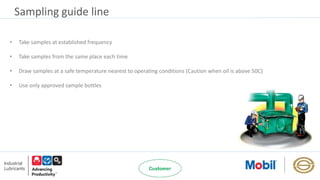
• Take samples at established frequency
• Take samples from the same place each time
• Draw samples at a safe temperature nearest to operating conditions (Caution when oil is above 50C)
• Use only approved sample bottles
Steps for taking the sample
 Inspect the work environment for safe operating conditions and wear proper safety equipment
 Collect data for asset registration if new asset
 Collect operating details
 Record sample details
 Draw a sample from the equipment
 Sample at a safe operating temperature
 Clean the area around the sample point
 Flush the sample bottle with the sampled oil, and fill to shoulder of sample bottle
 Avoid sampling from the drain plug
 Tighten the sample bottle cap to avoid leaks
Record sample details
 Date sampled
 Oil-hours/miles/kilometers
 Make-up oil capacity
 Equipment- hours/miles/kilometers
Record operating and maintenance details, as trend identification is important.
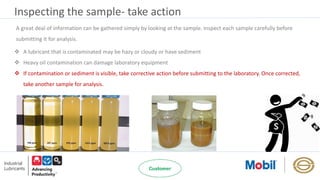
Inspecting the sample- take action
 A lubricant that is contaminated may be hazy or cloudy or have sediment
 Heavy oil contamination can damage laboratory equipment
 If contamination or sediment is visible, take corrective action before submitting to the laboratory. Once corrected,
take another sample for analysis.
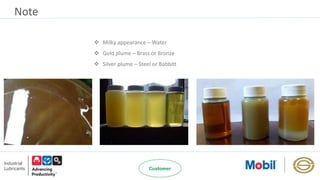
A great deal of information can be gathered simply by looking at the sample. Inspect each sample carefully before
submitting it for analysis.
Note
 Milky appearance – Water
 Gold plume – Brass or Bronze
 Silver plume – Steel or Babbitt
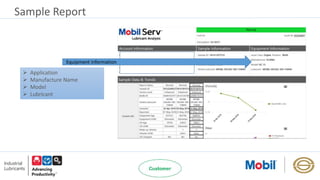
Sample Report
Equipment information
 Application
 Manufacture Name
 Model
 Lubricant
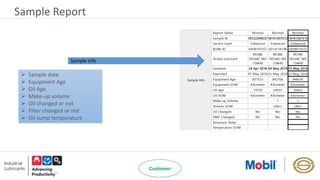
 Sample date
 Equipment Age
 Oil Age
 Make-up volume
 Oil changed or not
 Filter changed or not
 Oil sump temperature
Sample info
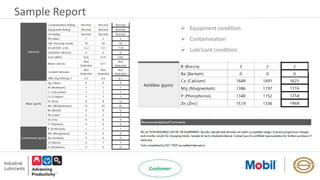
Sample Report
Sample Report
 Equipment condition
 Contamination
 Lubricant condition
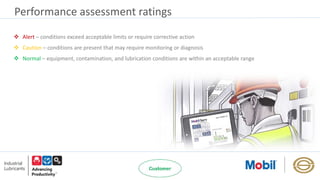
Performance assessment ratings
 Alert – conditions exceed acceptable limits or require corrective action
 Caution – conditions are present that may require monitoring or diagnosis
 Normal – equipment, contamination, and lubrication conditions are within an acceptable range
Limitations of lubricant analysis
 Will not detect sudden component failure
 Identifies trends
 Elemental analysis limited to particles <8 micron
 Must know the lubricant type being analyzed
 Commingled products
 Other monitoring tools may be needed to confirm conditions
 Vibration Analysis
 Thermography
 Ferrography
 Inspections
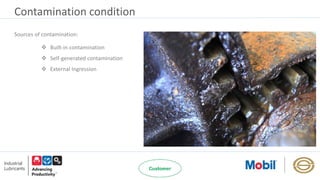
Contamination condition
 Built-in contamination
 Self-generated contamination
 External Ingression
Sources of contamination:
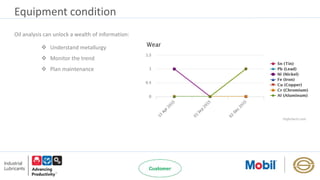
Equipment condition
 Understand metallurgy
 Monitor the trend
 Plan maintenance
Oil analysis can unlock a wealth of information:
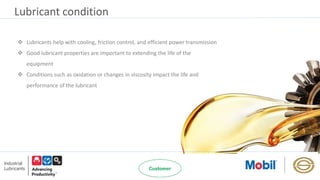
Lubricant condition
 Lubricants help with cooling, friction control, and efficient power transmission
 Good lubricant properties are important to extending the life of the
equipment
 Conditions such as oxidation or changes in viscosity impact the life and
performance of the lubricant
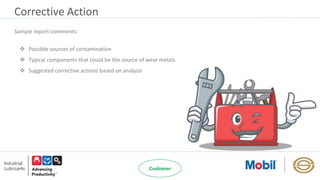
Corrective Action
 Possible sources of contamination
 Typical components that could be the source of wear metals
 Suggested corrective actions based on analysis
Sample report comments:
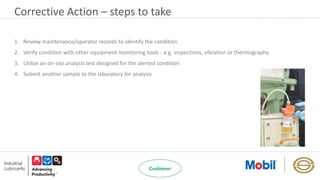
Corrective Action – steps to take
1. Review maintenance/operator records to identify the condition.
2. Verify condition with other equipment monitoring tools - e.g. inspections, vibration or thermography
3. Utilize an on-site analysis test designed for the alerted condition
4. Submit another sample to the laboratory for analysis
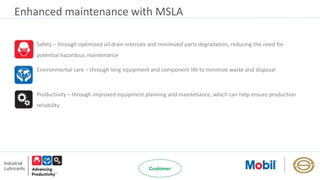
Enhanced maintenance with MSLA
Safety – through optimized oil drain intervals and minimized parts degradation, reducing the need for
potential hazardous maintenance
Environmental care – through long equipment and component life to minimize waste and disposal
Productivity – through improved equipment planning and maintenance, which can help ensure production
reliability
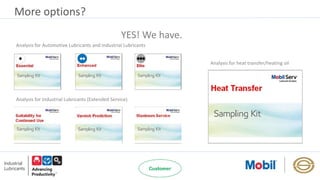
More options?
YES! We have.
Analysis for Automotive Lubricants and Industrial Lubricants
Analysis for Industrial Lubricants (Extended Service)
Analysis for heat transfer/heating oil
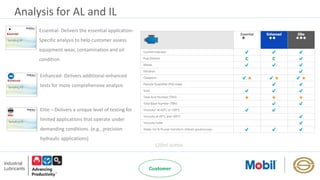
Analysis for AL and IL
Essential- Delivers the essential application-
Specific analysis to help customer assess
equipment wear, contamination and oil
condition
Enhanced- Delivers additional enhanced
tests for more comprehensive analysis
Elite – Delivers a unique level of testing for
limited applications that operate under
demanding conditions. (e.g., precision
hydraulic applications)
120ml bottle.
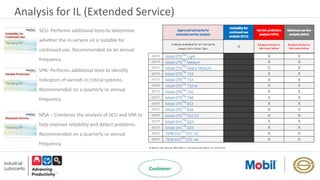
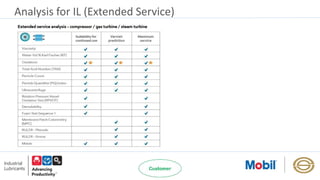
Analysis for IL (Extended Service)
SCU- Performs additional tests to determine
whether the in-service oil is suitable for
continued use. Recommended on an annual
frequency.
VPA- Performs additional tests to identify
indicators of varnish in critical systems.
Recommended on a quarterly or annual
frequency.
MSA – Combines the analysis of SCU and VPA to
help improve reliability and detect problems. .
Recommended on a quarterly or annual
frequency.
Analysis for IL (Extended Service)
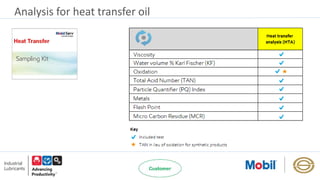
Analysis for heat transfer oil
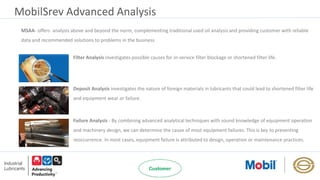
MobilSrev Advanced Analysis
MSAA- offers analysis above and beyond the norm, complementing traditional used oil analysis and providing customer with reliable
data and recommended solutions to problems in the business
Filter Analysis investigates possible causes for in-service filter blockage or shortened filter life.
Deposit Analysis investigates the nature of foreign materials in lubricants that could lead to shortened filter life
and equipment wear or failure.
Failure Analysis - By combining advanced analytical techniques with sound knowledge of equipment operation
and machinery design, we can determine the cause of most equipment failures. This is key to preventing
reoccurrence. In most cases, equipment failure is attributed to design, operation or maintenance practices.
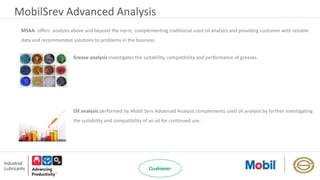
MobilSrev Advanced Analysis
MSAA- offers analysis above and beyond the norm, complementing traditional used oil analysis and providing customer with reliable
data and recommended solutions to problems in the business
Grease analysis investigates the suitability, compatibility and performance of greases.
Oil analysis performed by Mobil Serv Advanced Analysis complements used oil analysis by further investigating
the suitability and compatibility of an oil for continued use.
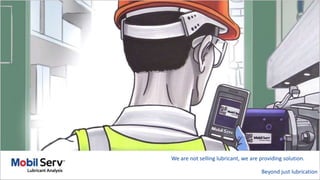
We are not selling lubricant, we are providing solution.
Beyond just lubrication
Aung Khaing Htun
Chloe Wong
Compiled by:
Mobil Lubricant Analysis

Mobil Lubricant Analysis

  • 1.
    KEEPING YOUR EQUIPMENTPERFORMANCE-READY
  • 2.
    Our Capabilities  QualifiedIn-House Lube Engineers plus ExxonMobil Field Engineer  ExxonMobil Engineering Global Support available if required  Field Engineering Service  Delivering Mobil Serv to you
  • 3.
     Umbrella brandof technical services
  • 4.
    Mobil Serv℠ serviceshighlight:  Plant Study  Lube Recommendation  Startup & Compatibility Study  Lubrication Training  Mobil Serv℠ Lubricant Analysis
  • 5.
    Plant Study Potential Benefitsof Plant Study During this service, ExxonMobil engineers and Distributor Lube Engineers conduct a thorough assessment of your plant’s current lubricants, lubrication requirements and practices. They provide a comprehensive review and documentation of practices and apply expert insight to your operation. This allows them to identify and record areas where a change in lubricant or practices could improve performance.
  • 6.
    Lube Recommendation Potential Benefitsof Lube Recommendation Experienced ExxonMobil engineers and Distributor Lube Engineers assess your current lubricants and recommend, when required, more effective product choices to help maximize equipment reliability for optimum productivity.
  • 7.
    Startup and compatibilityservices Potential Benefits of Startup and compatibility services Our highly qualified engineers use their lubricant knowledge to identify compatibility situations and determine current machinery conditions. They evaluate the compatibility of recommended replacement fluids, cleanliness requirement and lubricant application with current fluids and machine components. Then, they identify operational and design improvements to maximize equipment and lubricant life.
  • 8.
    Lubrication Training Potential Benefitsof Lubrication Training ExxonMobil field engineers and Distributor Lube engineers conduct training sessions covering topics such as: lubricant function and composition, lubrication of bearings, gears and engines, and lubricant safety, storage and handling. They emphasize application and technical issues to create an awareness of the significant impact of lubrication practices — and apply the lubrication expertise of ExxonMobil lubricants to your practices.
  • 9.
    Lubricant Analysis Potential Benefitsof Lubricant Analysis Mobil Serv℠ Lubricant Analysis is a state of the art oil analysis program designed to monitor critical use-oil indicators based on international standards and leading equipment builder specifications. Using advanced interpretation logic and a full spectrum of analytics.
  • 11.
    Why test theoil?  Helps determine if equipment is operating efficiently  Similar to a blood sample taken during a medical exam  Identifies contamination, potential wear, and  Monitors oil condition Oil is the life blood of the equipment!
  • 12.
    Take a lookinside……  Contact with air  High temperatures  Mechanical action  Contamination Factors that change the oil and equipment performance:
  • 13.
    Goals of oilanalysis  Ensure equipment reliability and prevent equipment failures  Extend equipment life  Extend lubricant life  Reduce unscheduled downtime  Reduce lubricant consumption and disposal  Reduce maintenance costs Maximize performance of the equipment while reducing maintenance costs.
  • 14.
    Relation of oilanalysis to maintenance strategies Reactive Repair After Failure • Disruptive • Safety Risk • High Cost • Lost Production Proactive Eliminate Root Cause – No Repair • Maximum Availability • Prevention versus Repair • Dependable Operation • Managed Environment • Redesign Systems Planned Repair Before Failure • Scheduled • Preventative or Predictive • Lower Cost • Utilize Idle or Off-Peak Time
  • 15.
    Where does oilanalysis fit in? %Failure Time to Failure (application dependent)  Typical lifecycle of a rotating machine component  Time to failure varies widely depending on various operational and environmental conditions
  • 16.
    %Failure Time to Failure(application dependent) Where does oil analysis fit in?  Concentrate maintenance effort when and where it will do the most good
  • 17.
    %Failure Time to Failure(application dependent) Where does oil analysis fit in?  Waiting beyond the planned maintenance opportunity may be too late to extend equipment life  It’s time to predict impending failure
  • 18.
    Proactive pays off! Going back to our human analogy with blood tests and diet, it’s clear that being proactive pays off in the long run.
  • 19.
    Why Mobil ServLubricant Analysis?  Analysis Options  Detailed Recommendations  Local Field Support Mobil Serv Lubricant Analysis provides value to customers in three key ways:
  • 20.
    Types of oilanalysis 1. Routine sampling via Mobil Serv Lubricant Analysis 2. Forensic, non-routine analysis via Mobil Serv Advanced Analytics There are two types of oil analysis:
  • 21.
  • 22.
  • 23.
  • 24.
    Determining What tosample Consider these Five General Factors Fluid Age Factor Equipment age factor Operating Environment Economic impact of failure Target Results • Hours/Kilometer/miles since last oil change • Oxidation, Contamination • Synthetic/Premium/Mineral • Hours/Kilometer/miles • Rated life expectancy • Made and Model number • High dirt/dust environment • High loads/pressures/speeds • High temperatures • Low temperatures • Chemical contamination • Wet environment • Safety risk • Operational criticality • Repair costs • Downtime cost • Lost production • Spared Unit • Above control limits • Within control limits
  • 25.
    Account set upand registration an assets 1. Application 2. Equipment Manufacture 3. Lubricant 4. Type of Service 5. Lube oil sump capacity
  • 26.
    Determine when tosample- Frequency • Follow OEM recommended sample intervals • In absence of OEM guidelines, leverage the guidance in MSLA Condition- monitoring fundamentals guide • After selecting the frequency, establish a sampling schedule OEM- Original Equipment Manufacture
  • 27.
    MSLA sample intervalguidelines Industrial/Plant equipment Off-highway equipment On-highway equipment Application Frequency Application Frequency Application Frequency Landfill gas engine 250 Hours Diesel engine 250 Hours Diesel engine 25,000 km Generator engine 500 Hours Wheel motor 250 Hours Transmission 500 hrs, 40,000 km Natural gas engine 500 Hours Differential/gear 500 Hours Hydraulic system 500 hrs, 40,000 km Paper machine lube system Monthly Hydraulic system 500 Hours Turbine Monthly Transmission 500 Hours Compressor 3 Months Final drive 1,000 Hours Gear drive 3 Months Hydraulic system 3 Months
  • 28.
    Sampling guide line •Take samples at established frequency • Take samples from the same place each time • Draw samples at a safe temperature nearest to operating conditions (Caution when oil is above 50C) • Use only approved sample bottles
  • 29.
    Steps for takingthe sample  Inspect the work environment for safe operating conditions and wear proper safety equipment  Collect data for asset registration if new asset  Collect operating details  Record sample details  Draw a sample from the equipment  Sample at a safe operating temperature  Clean the area around the sample point  Flush the sample bottle with the sampled oil, and fill to shoulder of sample bottle  Avoid sampling from the drain plug  Tighten the sample bottle cap to avoid leaks
  • 30.
    Record sample details Date sampled  Oil-hours/miles/kilometers  Make-up oil capacity  Equipment- hours/miles/kilometers Record operating and maintenance details, as trend identification is important.
  • 31.
    Inspecting the sample-take action  A lubricant that is contaminated may be hazy or cloudy or have sediment  Heavy oil contamination can damage laboratory equipment  If contamination or sediment is visible, take corrective action before submitting to the laboratory. Once corrected, take another sample for analysis. A great deal of information can be gathered simply by looking at the sample. Inspect each sample carefully before submitting it for analysis.
  • 32.
    Note  Milky appearance– Water  Gold plume – Brass or Bronze  Silver plume – Steel or Babbitt
  • 33.
    Sample Report Equipment information Application  Manufacture Name  Model  Lubricant
  • 34.
     Sample date Equipment Age  Oil Age  Make-up volume  Oil changed or not  Filter changed or not  Oil sump temperature Sample info Sample Report
  • 35.
    Sample Report  Equipmentcondition  Contamination  Lubricant condition
  • 36.
    Performance assessment ratings Alert – conditions exceed acceptable limits or require corrective action  Caution – conditions are present that may require monitoring or diagnosis  Normal – equipment, contamination, and lubrication conditions are within an acceptable range
  • 37.
    Limitations of lubricantanalysis  Will not detect sudden component failure  Identifies trends  Elemental analysis limited to particles <8 micron  Must know the lubricant type being analyzed  Commingled products  Other monitoring tools may be needed to confirm conditions  Vibration Analysis  Thermography  Ferrography  Inspections
  • 38.
    Contamination condition  Built-incontamination  Self-generated contamination  External Ingression Sources of contamination:
  • 39.
    Equipment condition  Understandmetallurgy  Monitor the trend  Plan maintenance Oil analysis can unlock a wealth of information:
  • 40.
    Lubricant condition  Lubricantshelp with cooling, friction control, and efficient power transmission  Good lubricant properties are important to extending the life of the equipment  Conditions such as oxidation or changes in viscosity impact the life and performance of the lubricant
  • 41.
    Corrective Action  Possiblesources of contamination  Typical components that could be the source of wear metals  Suggested corrective actions based on analysis Sample report comments:
  • 42.
    Corrective Action –steps to take 1. Review maintenance/operator records to identify the condition. 2. Verify condition with other equipment monitoring tools - e.g. inspections, vibration or thermography 3. Utilize an on-site analysis test designed for the alerted condition 4. Submit another sample to the laboratory for analysis
  • 43.
    Enhanced maintenance withMSLA Safety – through optimized oil drain intervals and minimized parts degradation, reducing the need for potential hazardous maintenance Environmental care – through long equipment and component life to minimize waste and disposal Productivity – through improved equipment planning and maintenance, which can help ensure production reliability
  • 44.
    More options? YES! Wehave. Analysis for Automotive Lubricants and Industrial Lubricants Analysis for Industrial Lubricants (Extended Service) Analysis for heat transfer/heating oil
  • 45.
    Analysis for ALand IL Essential- Delivers the essential application- Specific analysis to help customer assess equipment wear, contamination and oil condition Enhanced- Delivers additional enhanced tests for more comprehensive analysis Elite – Delivers a unique level of testing for limited applications that operate under demanding conditions. (e.g., precision hydraulic applications) 120ml bottle.
  • 46.
    Analysis for IL(Extended Service) SCU- Performs additional tests to determine whether the in-service oil is suitable for continued use. Recommended on an annual frequency. VPA- Performs additional tests to identify indicators of varnish in critical systems. Recommended on a quarterly or annual frequency. MSA – Combines the analysis of SCU and VPA to help improve reliability and detect problems. . Recommended on a quarterly or annual frequency.
  • 47.
    Analysis for IL(Extended Service)
  • 48.
    Analysis for heattransfer oil
  • 49.
    MobilSrev Advanced Analysis MSAA-offers analysis above and beyond the norm, complementing traditional used oil analysis and providing customer with reliable data and recommended solutions to problems in the business Filter Analysis investigates possible causes for in-service filter blockage or shortened filter life. Deposit Analysis investigates the nature of foreign materials in lubricants that could lead to shortened filter life and equipment wear or failure. Failure Analysis - By combining advanced analytical techniques with sound knowledge of equipment operation and machinery design, we can determine the cause of most equipment failures. This is key to preventing reoccurrence. In most cases, equipment failure is attributed to design, operation or maintenance practices.
  • 50.
    MobilSrev Advanced Analysis MSAA-offers analysis above and beyond the norm, complementing traditional used oil analysis and providing customer with reliable data and recommended solutions to problems in the business Grease analysis investigates the suitability, compatibility and performance of greases. Oil analysis performed by Mobil Serv Advanced Analysis complements used oil analysis by further investigating the suitability and compatibility of an oil for continued use.
  • 51.
    We are notselling lubricant, we are providing solution. Beyond just lubrication
  • 53.
    Aung Khaing Htun ChloeWong Compiled by: