The Internet of  ThingsThe Next Evolution Of        The InternetDave EvansCisco Chief FuturistChief Technologist, Internet Business Solutions Group (IBSG)
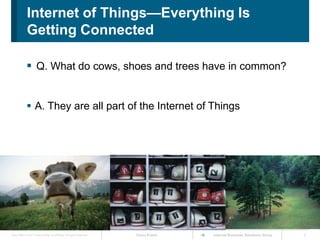
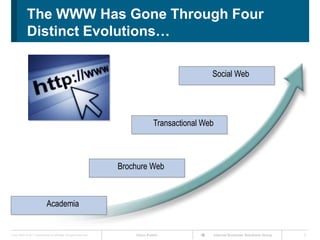
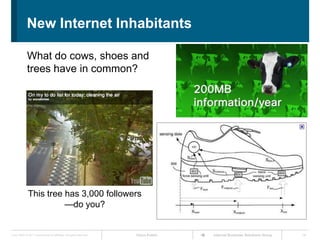
Internet of Things—Everything Is Getting ConnectedQ. What do cows, shoes and trees have in common?A. They are all part of the Internet of ThingsThe WWW Has Gone Through Four Distinct Evolutions…Social WebTransactional WebBrochure WebAcademia
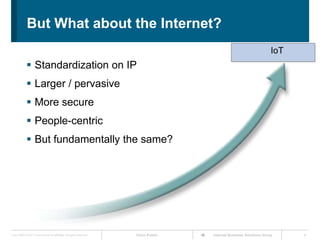
But What about the Internet?IoTStandardization on IP
Larger / pervasive
More secure
People-centric
But fundamentally the same?  The Internet of ThingsRepresents the first true evolution of the Internet
Why?
More mobile than fixed
New architecture models
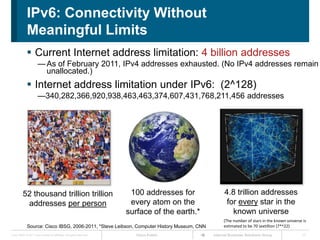
New protocol (IPv6)
Sensor-laden
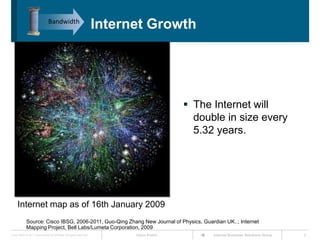
More machines than peopleBandwidthInternet GrowthThe Internet will double in size every 5.32 years.Internet map as of 16th January 2009Source: Cisco IBSG, 2006-2011, Guo-Qing Zhang New Journal of Physics, Guardian UK..; Internet Mapping Project, Bell Labs/Lumeta Corporation, 2009
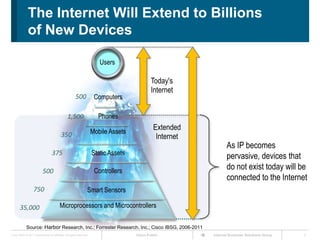
The Internet Will Extend to Billions of New DevicesUsersToday'sInternet500ComputersPhones1,500Extended InternetMobile Assets350As IP becomes pervasive, devices that do not exist today will be connected to the InternetStatic Assets375Controllers500750Smart SensorsMicroprocessors and Microcontrollers35,000Source: Harbor Research, Inc.; Forrester Research, Inc.; Cisco IBSG, 2006-2011
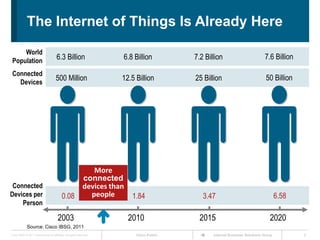
The Internet of Things Is Already HereWorld Population7.6 Billion6.3 Billion6.8 Billion7.2 BillionConnectedDevices50 Billion500 Million12.5 Billion25 BillionMore connected devices than peopleConnected Devices per Person6.580.081.843.472003201020152020Source: Cisco IBSG, 2011

Internet of Things

  • 1.
    The Internet of ThingsThe Next Evolution Of The InternetDave EvansCisco Chief FuturistChief Technologist, Internet Business Solutions Group (IBSG)
  • 2.
    Internet of Things—EverythingIs Getting ConnectedQ. What do cows, shoes and trees have in common?A. They are all part of the Internet of ThingsThe WWW Has Gone Through Four Distinct Evolutions…Social WebTransactional WebBrochure WebAcademia
  • 3.
    But What aboutthe Internet?IoTStandardization on IP
  • 4.
  • 5.
  • 6.
  • 7.
    But fundamentally thesame? The Internet of ThingsRepresents the first true evolution of the Internet
  • 8.
  • 9.
  • 10.
  • 11.
  • 12.
  • 13.
    More machines thanpeopleBandwidthInternet GrowthThe Internet will double in size every 5.32 years.Internet map as of 16th January 2009Source: Cisco IBSG, 2006-2011, Guo-Qing Zhang New Journal of Physics, Guardian UK..; Internet Mapping Project, Bell Labs/Lumeta Corporation, 2009
  • 14.
    The Internet WillExtend to Billions of New DevicesUsersToday'sInternet500ComputersPhones1,500Extended InternetMobile Assets350As IP becomes pervasive, devices that do not exist today will be connected to the InternetStatic Assets375Controllers500750Smart SensorsMicroprocessors and Microcontrollers35,000Source: Harbor Research, Inc.; Forrester Research, Inc.; Cisco IBSG, 2006-2011
  • 15.
    The Internet ofThings Is Already HereWorld Population7.6 Billion6.3 Billion6.8 Billion7.2 BillionConnectedDevices50 Billion500 Million12.5 Billion25 BillionMore connected devices than peopleConnected Devices per Person6.580.081.843.472003201020152020Source: Cisco IBSG, 2011

Editor's Notes

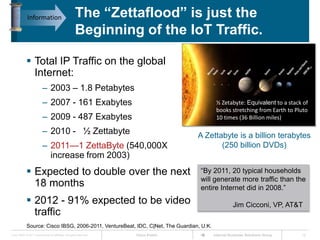
  • #7 2007 – 161bn GB2009 – 487bn GBhttp://www.physorg.com/news151162452.htmlhttp://www.guardian.co.uk/business/2009/may/18/digital-content-expansion
  • #9 Cisco IBSG, defines the Internet of Things (IoT) as the point in time when more “things or objects” were connected to the Internet than people.1In 2003, there were approximately 6.3 billion people living on the planet and 500 million devices connected to the Internet.2 By dividing the number of connected devices by the world population, we find that there was less than one (0.08) device for every person. Based on Cisco IBSG’s definition, IoT didn’t yet exist in 2003 because the number of connected things was relatively small given that ubiquitous devices such as smartphones were just being introduced. For example, Steve Jobs, Apple’s CEO, didn’t unveil the iPhone until January 9, 2007 at the Macworld conference.3Explosive growth of smartphones and tablet PCs brought the number of devices connected to the Internet to 12.5 billion in 2010, while the world’s human population increased to 6.8 billion, making the number of connected devices per person more than 1 (1.84 to be exact) for the first time in history.4Refining these numbers further, Cisco IBSG estimates IoT was “born” sometime between 2008 and 2009. Today, IoT is well under way, as initiatives such as Cisco’s Planetary Skin, smart grid, and intelligent vehicles continue to progress.5Looking to the future, Cisco IBSG predicts there will be 25 billion devices connected to the Internet by 2015 and 50 billion by 2020. It is important to note that these estimates do not take into account rapid advances in Internet or device technology; the numbers presented are based on what is known to be true today.Additionally, the number of connected devices per person may seem low. This is because the calculation is based on the entire world population, much of which is not yet connected to the Internet. By reducing the population sample to people actually connected to the Internet, the number of connected devices per person rises dramatically. For example, we know that approximately 2 billion people use the Internet today.6 Using this figure, the number of connected devices per person jumps to 6.25 in 2010, instead of 1.84.Of course, we know nothing remains static, especially when it comes to the Internet. Initiatives and advances, such as Cisco’s Planetary Skin, HP’s central nervous system for the earth (CeNSE), and smart dust, have the potential to add millions—even billions—of sensors to the Internet.7MethodologyIn January 2009, a team of researchers in China studied Internet routing data in six-month intervals, from December 2001 to December 2006. Similar to the properties of Moore’s Law, their findings showed that the Internet doubles in size every 5.32 years. Using this figure in combination with the number of devices connected to the Internet in 2003 (500 million, as determined by Forrester Research), and the world population according to the U.S. Census Bureau, Cisco IBSG estimated the number of connected devices per person.8NoteCalculations are based on number of connected IP devices.SourcesCisco IBSG, 2011. U.S. Census Bureau, 2010; Forrester Research, 2003.Wikipedia, 2010. Cisco IBSG, 2010; U.S. Census Bureau, 2010. “Planetary Skin: A Global Platform for a New Era of Collaboration,” Juan Carlos Castilla-Rubio and Simon Willis, Cisco IBSG, March 2009, http://www.cisco.com/web/about/ac79/docs/pov/Planetary_Skin_POV_vFINAL_spw_jc_2.pdfWorld Internet Stats: Usage and Population Statistics, June 30, 2010.Cisco, 2010; HP, 2010.While no one can predict the exact number of devices connected to the Internet at any given time, the methodology of applying a constant (Internet doubling in size every 5.32 years) to a generally agreed-upon number of connected devices at a point in time (500 million in 2003) provides an estimate that is appropriate for the purposes of this paper. Sources: “Internet Growth Follows Moore's Law Too,” Lisa Zyga, PhysOrg.com, January 14, 2009, http://www.physorg.com/news151162452.html; George Colony, Forrester Research founder and chief executive officer, March 10, 2003, http://www.infoworld.com/t/platforms/forrester-ceo-web-services-next-it-storm-873
  • #15 Fitted with sensors, a computer, a web-cam and a wi-fi centre (just to name a few of the gadgets), the tree, based in Brussels, outputs all manner of content that can be found on YouTube, Soundcloud and Flickr with a feed on Twitter that makes sense of the data from all of the on-tree gizmos for it’s 3000+ followers.http://www.nitro-digital.co.uk/blog/2010/11/02/trees-tweet/#more-882