DESIGN BY:
AKRM ABDULAH RASSAM
AMAL ABDULRAHMAN HAMOUD.
SAMAR ABDULKAWE ALSHARAIE
MOHAMMED ABDULJABBAR QAID
MOHAMMED ABDUL-RAHMAN
NADA YASIN ABDULSALAM
Taiz University
Dep.COM.
Level 5
2015
LTE Network
(Coverage and capacity) Optimization
Introduction of LTE
Network Planning
LTE System Architecture
Network Optimization
INTRODUCTION OF LTE
Requirements and Targets for the LTE
 Reduced delays.
 Increased user data rates.
 Increased cell-edge bit-rate, for uniformity of service provision.
 Greater flexibility of spectrum usage.
 Simplified network architecture.
 Seamless mobility.
 Reasonable power consumption for the mobile terminal.
 Orthogonal Frequency Domain Multiple Access
(OFDMA) in downlink.
 Single-Carrier Frequency Domain Multiple Access (SC-
FDMA) in uplink.
 Multiple Input Multiple Output (MIMO) antennas.
 Packet-Switched Radio Interface.
Technologies for the LTE
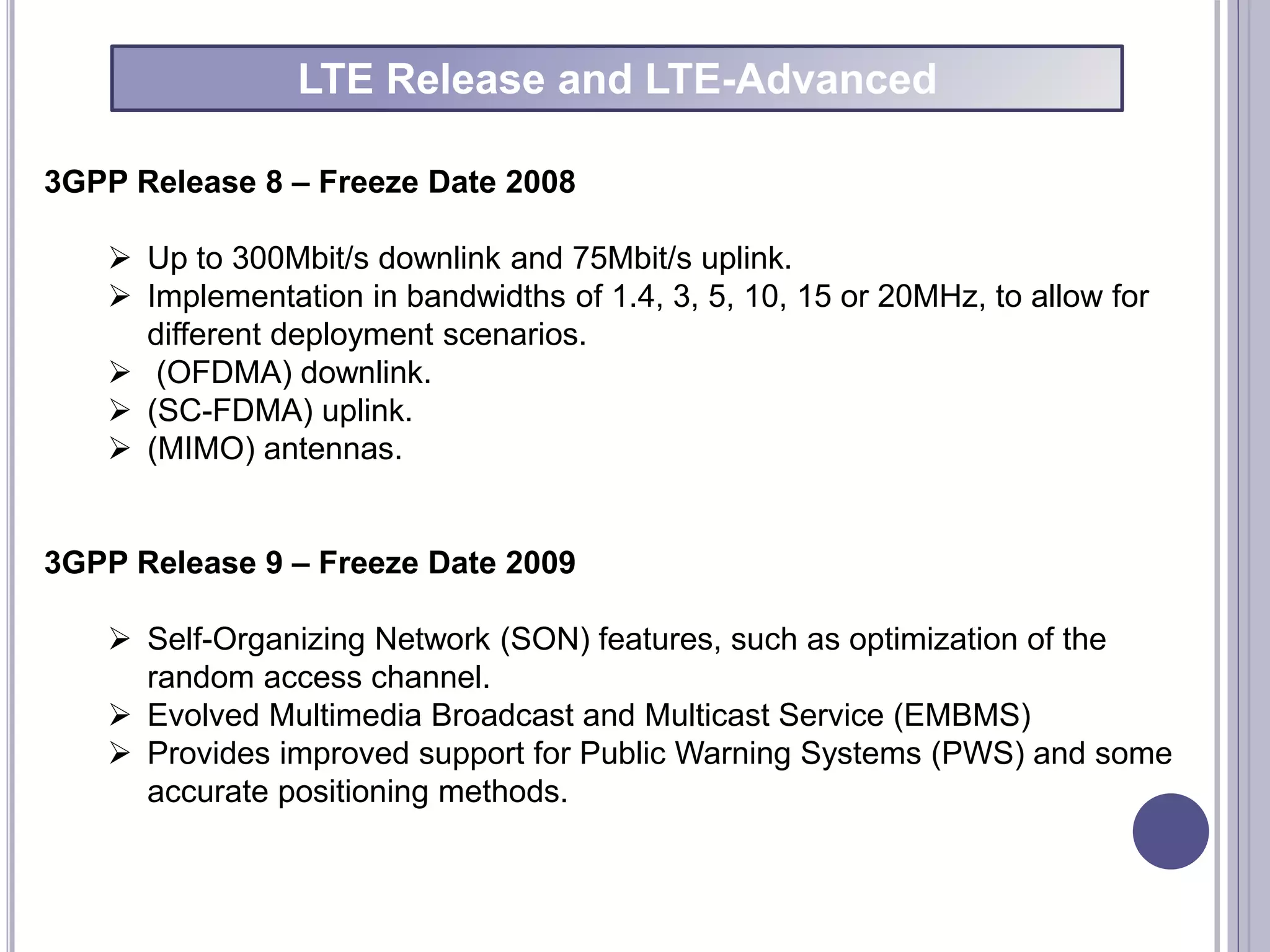
3GPP Release 8 – Freeze Date 2008
 Up to 300Mbit/s downlink and 75Mbit/s uplink.
 Implementation in bandwidths of 1.4, 3, 5, 10, 15 or 20MHz, to allow for
different deployment scenarios.
 (OFDMA) downlink.
 (SC-FDMA) uplink.
 (MIMO) antennas.
3GPP Release 9 – Freeze Date 2009
 Self-Organizing Network (SON) features, such as optimization of the
random access channel.
 Evolved Multimedia Broadcast and Multicast Service (EMBMS)
 Provides improved support for Public Warning Systems (PWS) and some
accurate positioning methods.
LTE Release and LTE-Advanced
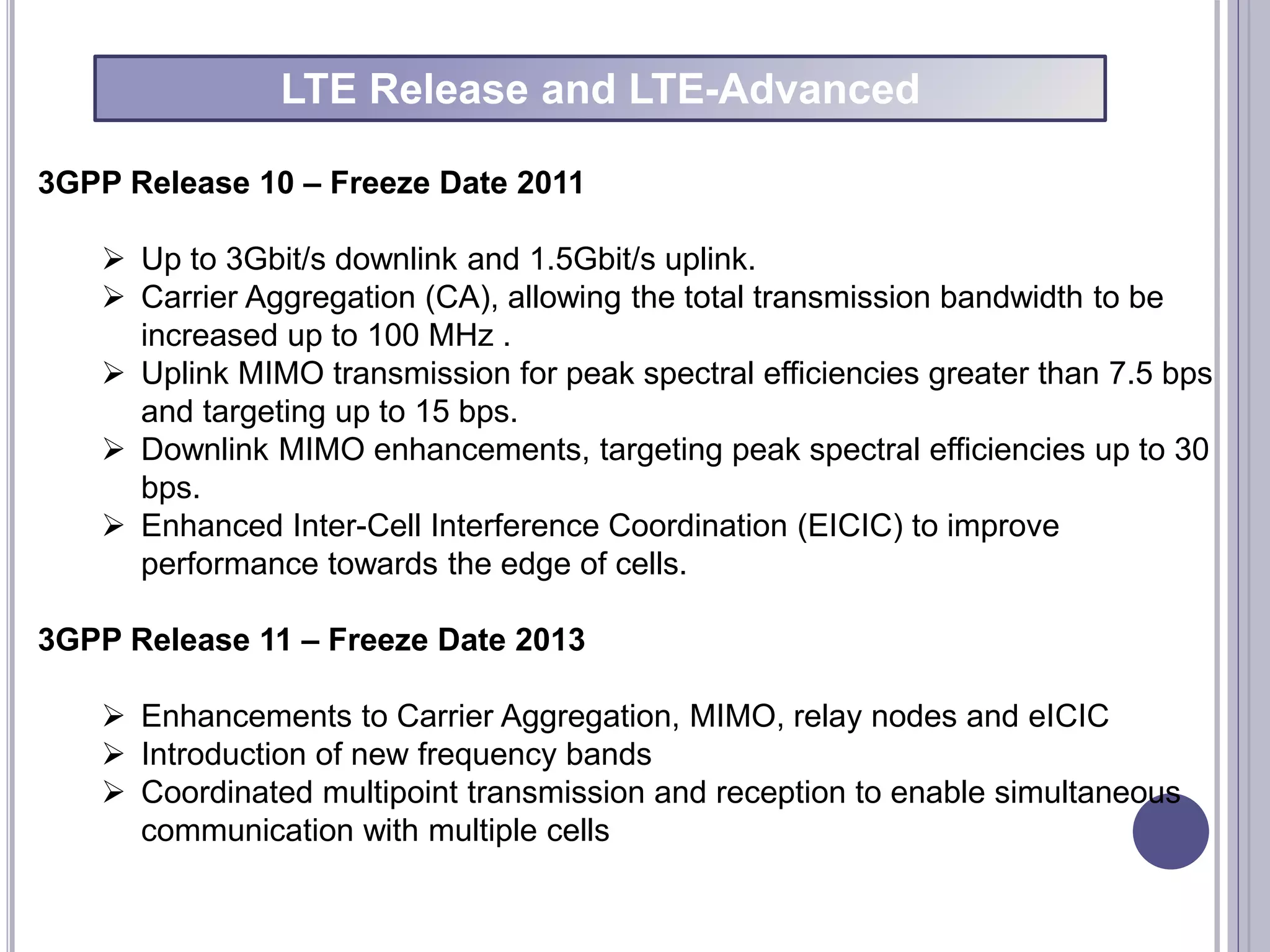
3GPP Release 10 – Freeze Date 2011
 Up to 3Gbit/s downlink and 1.5Gbit/s uplink.
 Carrier Aggregation (CA), allowing the total transmission bandwidth to be
increased up to 100 MHz .
 Uplink MIMO transmission for peak spectral efficiencies greater than 7.5 bps
and targeting up to 15 bps.
 Downlink MIMO enhancements, targeting peak spectral efficiencies up to 30
bps.
 Enhanced Inter-Cell Interference Coordination (EICIC) to improve
performance towards the edge of cells.
3GPP Release 11 – Freeze Date 2013
 Enhancements to Carrier Aggregation, MIMO, relay nodes and eICIC
 Introduction of new frequency bands
 Coordinated multipoint transmission and reception to enable simultaneous
communication with multiple cells
LTE Release and LTE-Advanced
3GPP Release 12 – Freeze Date 2014
 New antenna techniques and advanced receivers to maximize
the potential of large cells.
 Interworking between LTE and Wi-Fi or HSPDA.
 Further developments of previous technologies.
LTE Release and LTE-Advanced
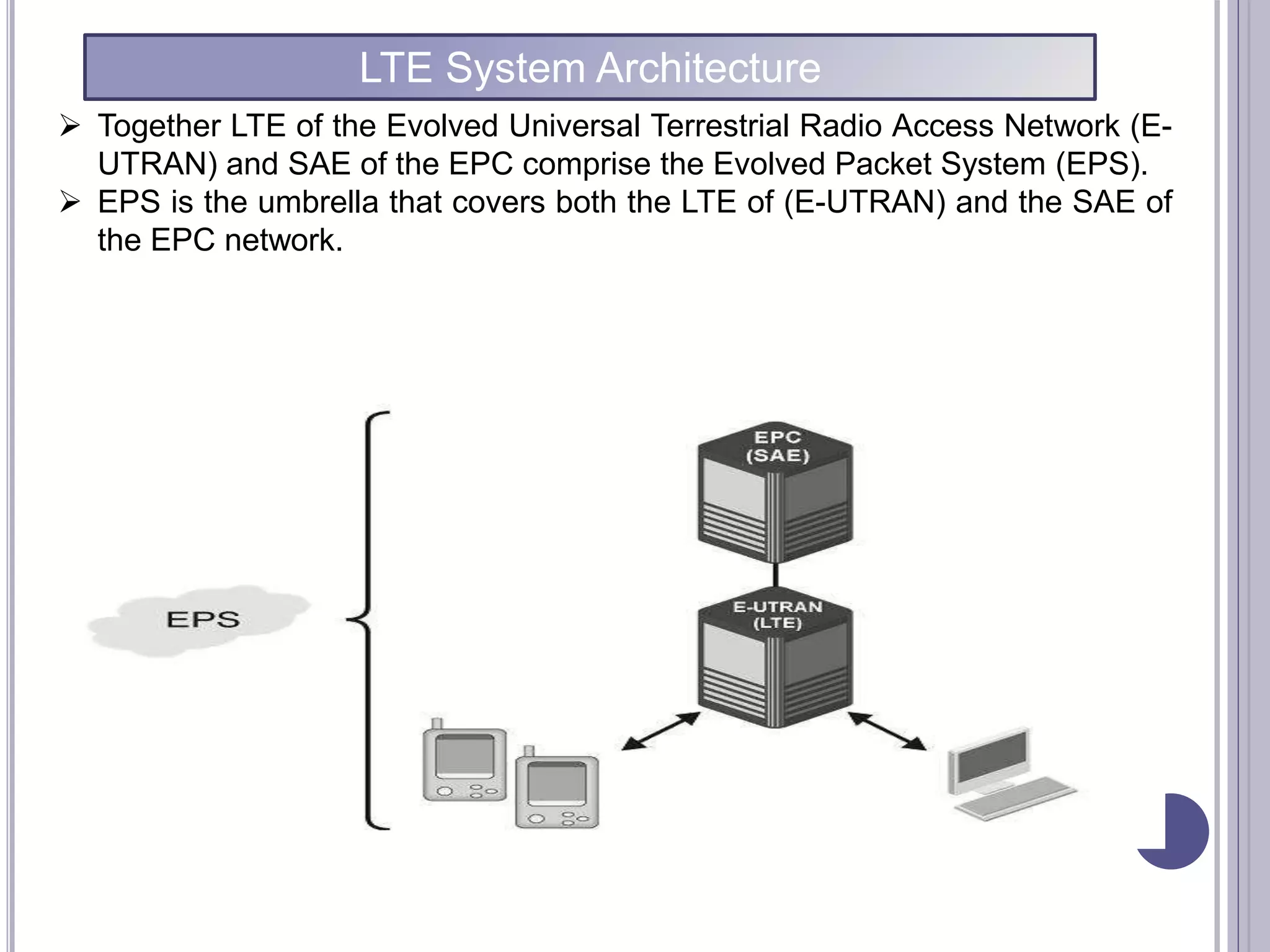
 Together LTE of the Evolved Universal Terrestrial Radio Access Network (E-
UTRAN) and SAE of the EPC comprise the Evolved Packet System (EPS).
 EPS is the umbrella that covers both the LTE of (E-UTRAN) and the SAE of
the EPC network.
EPC and LTE under the umbrella of EPS.
LTE System Architecture
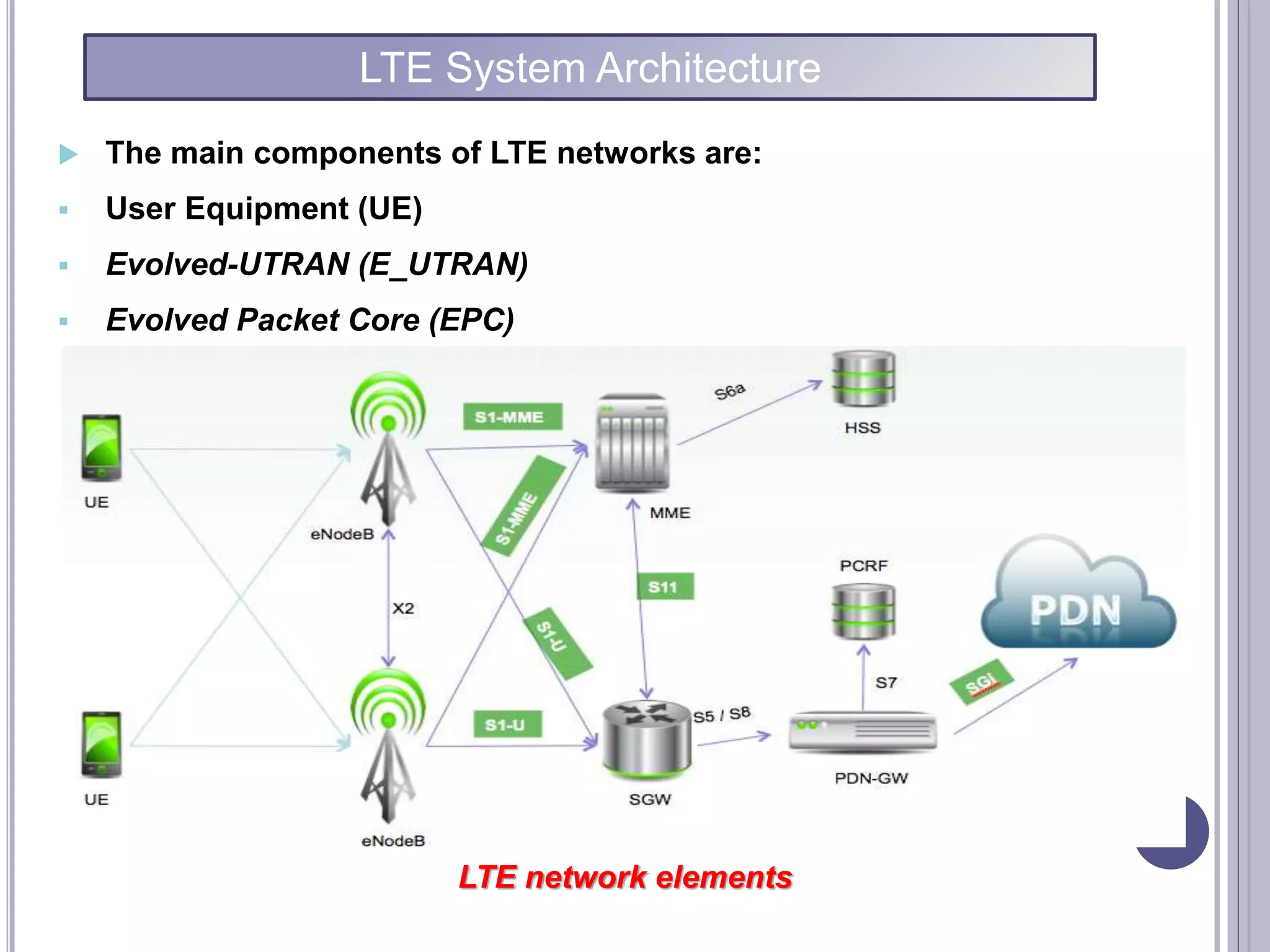
 The main components of LTE networks are:
 User Equipment (UE)
 Evolved-UTRAN (E_UTRAN)
 Evolved Packet Core (EPC)
LTE network elements
LTE System Architecture
 User Equipment (UE)
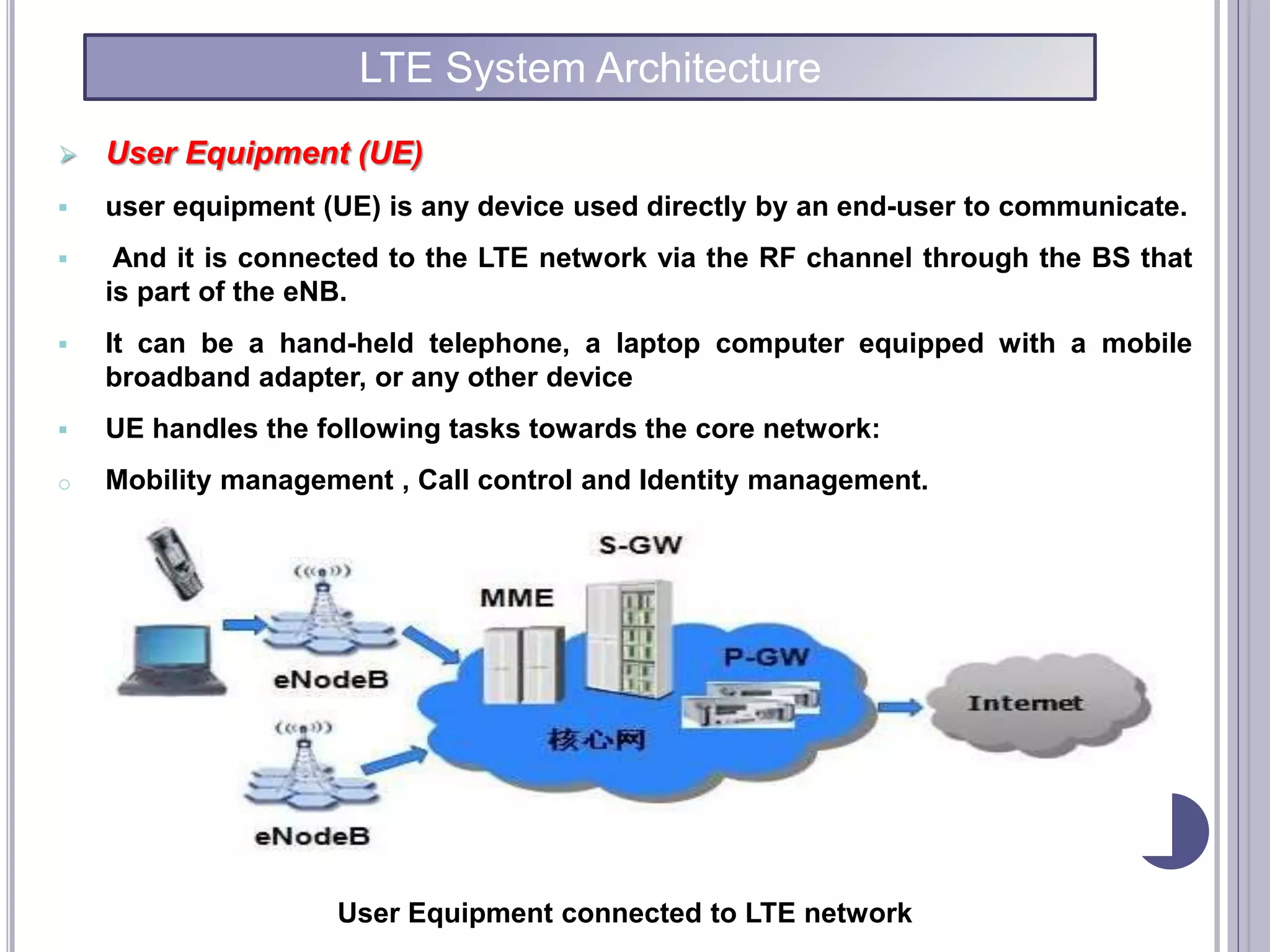
 user equipment (UE) is any device used directly by an end-user to communicate.
 And it is connected to the LTE network via the RF channel through the BS that
is part of the eNB.
 It can be a hand-held telephone, a laptop computer equipped with a mobile
broadband adapter, or any other device
 UE handles the following tasks towards the core network:
o Mobility management , Call control and Identity management.
User Equipment connected to LTE network
LTE System Architecture
 Evolved-UTRAN (E_UTRAN)
 The E-UTRAN is responsible for all radio-related functions, which can be
summarized as:
 Radio Resource Management : This covers all functions related to the radio
bearers, such as radio bearer control, radio admission control, radio mobility
control, scheduling and dynamic allocation of resources to UEs in both uplink
and downlink.
 Header Compression : This helps to ensure efficient use of the radio
interface by compressing the IP packet headers, which could otherwise
represent a significant overhead, especially for small packets such as VoIP.
 Security : All data sent over the radio interface is encrypted.
 Positioning : The E-UTRAN provides the necessary measurements and other
data to the E-SMLC and assists the E-SMLC in finding the UE position
 Connectivity to the EPC : This consists of the signalling towards the MME
and the bearer path towards the S-GW.
LTE System Architecture
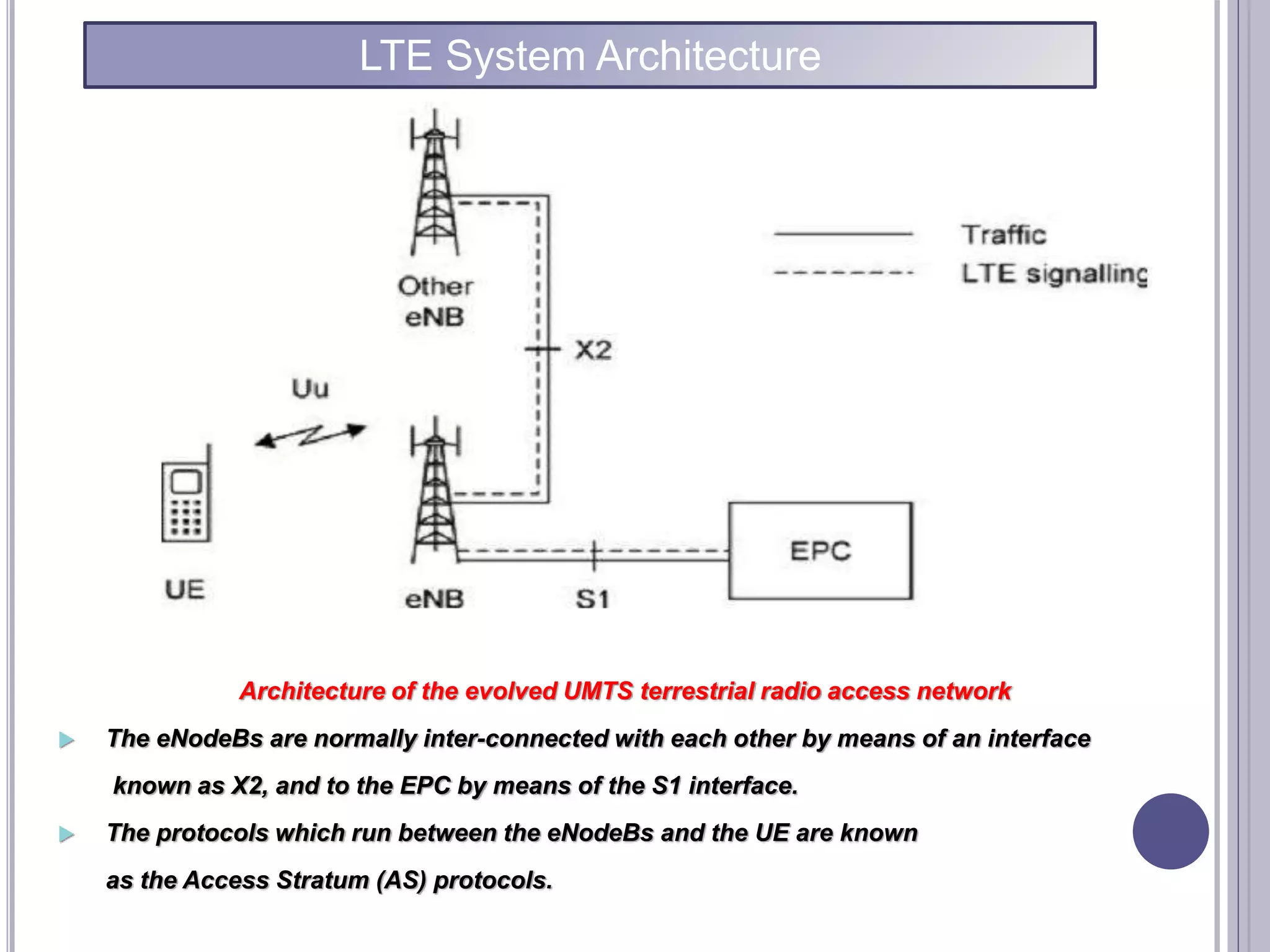
Architecture of the evolved UMTS terrestrial radio access network
 The eNodeBs are normally inter-connected with each other by means of an interface
known as X2, and to the EPC by means of the S1 interface.
 The protocols which run between the eNodeBs and the UE are known
as the Access Stratum (AS) protocols.
LTE System Architecture
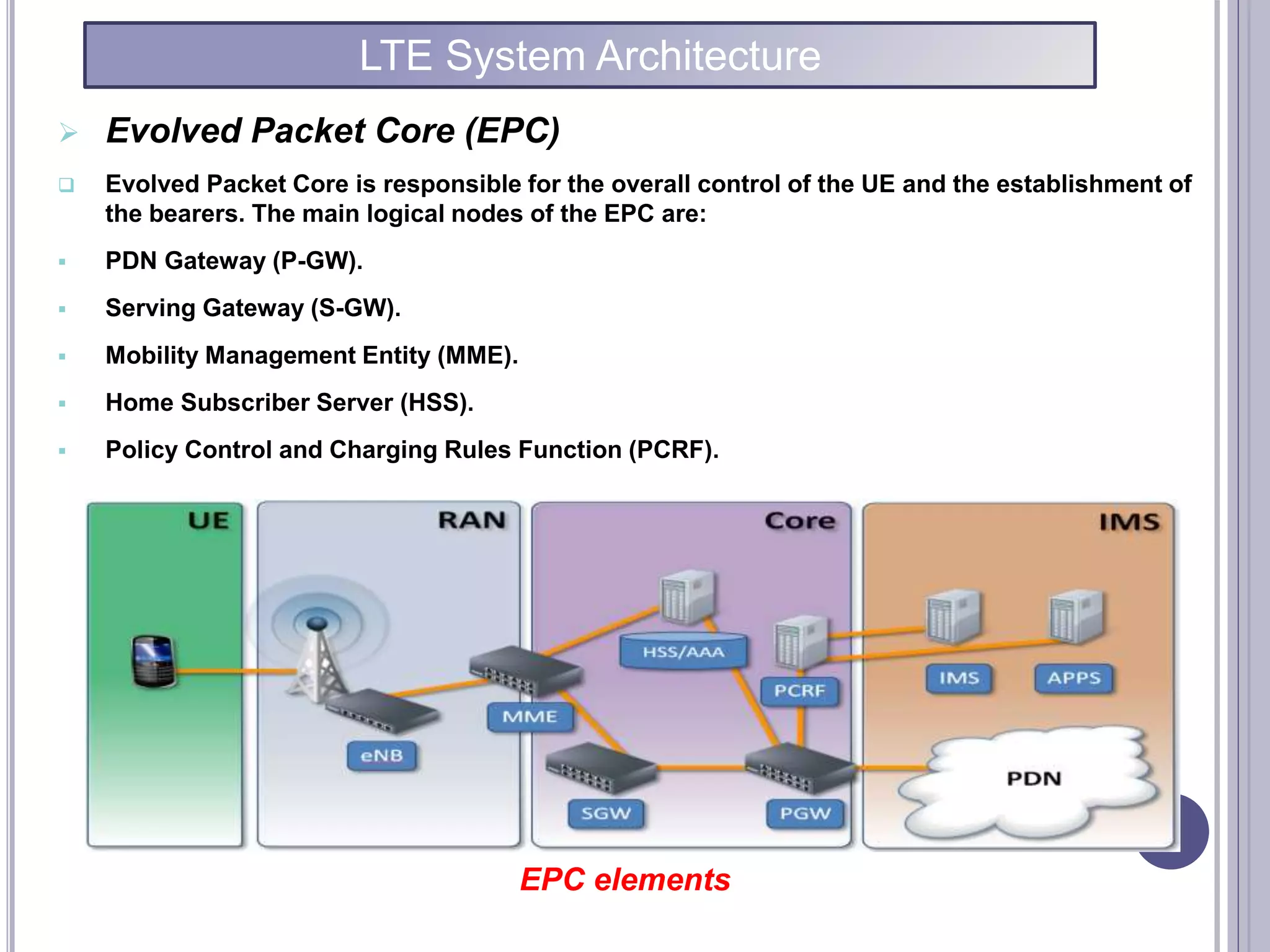
 Evolved Packet Core (EPC)
 Evolved Packet Core is responsible for the overall control of the UE and the establishment of
the bearers. The main logical nodes of the EPC are:
 PDN Gateway (P-GW).
 Serving Gateway (S-GW).
 Mobility Management Entity (MME).
 Home Subscriber Server (HSS).
 Policy Control and Charging Rules Function (PCRF).
EPC elements
LTE System Architecture
 P-GW(Packet Data Network- Gateway)
 The (P-GW)is the EPC’s point of contact with the outside world .
Through the SGi interface,
 The P-GW is responsible for IP address allocation for the UE, QoS
enforcement and flow-based charging according to rules from the
PCRF.
 S-GW (Serving Gateway)
 acts as a router, and forwards data between the base station and the
PDN gateway.
 MME (Mobility Management Entity)
 The MME is the control node, which processes the signaling between
the UE and the EPC.
 The main functions supported by the MME are :
 establishment, maintenance and release of the bearers.
 paging subscribers in the EPS Connection Management.
 the MME performs management of handovers.
LTE System Architecture
 PCRF (Policy Control and Charging Rules Function)
 The PCRF is responsible for controlling the flow based charging
functionalities in the Policy Control Enforcement Function (PCEF), which
resides in the P-GW.
 HSS (Home Subscriber Server)
 The HSS contains user’s subscription data such as the EPS-subscribed QoS
profile and any access restrictions for roaming.
LTE System Architecture
NETWORK PLANNING
1-COVERAGE PLANNING
 LTE Radio access network planning refers to analytical approach which is
based on algorithmic formulation and focuses on the radio engineering
aspect of the planning process, i.e :
• on determining the locations.
• estimated capacity and size of the cell sites (coverage and capacity
planning).
• and assigning frequencies to them by examining the radio-wave
propagation environment and interferences among the cells.
Network Planning
 LTE Access Network Dimensioning:
 The target of the LTE access network dimensioning is to
estimate the required site density and site configurations for the
area of interest.
 Initial LTE access network planning activities include:
 radio link budget .
 a coverage analysis.
 cell capacity estimation.
 estimation of the amount of eNB.
Coverage planning
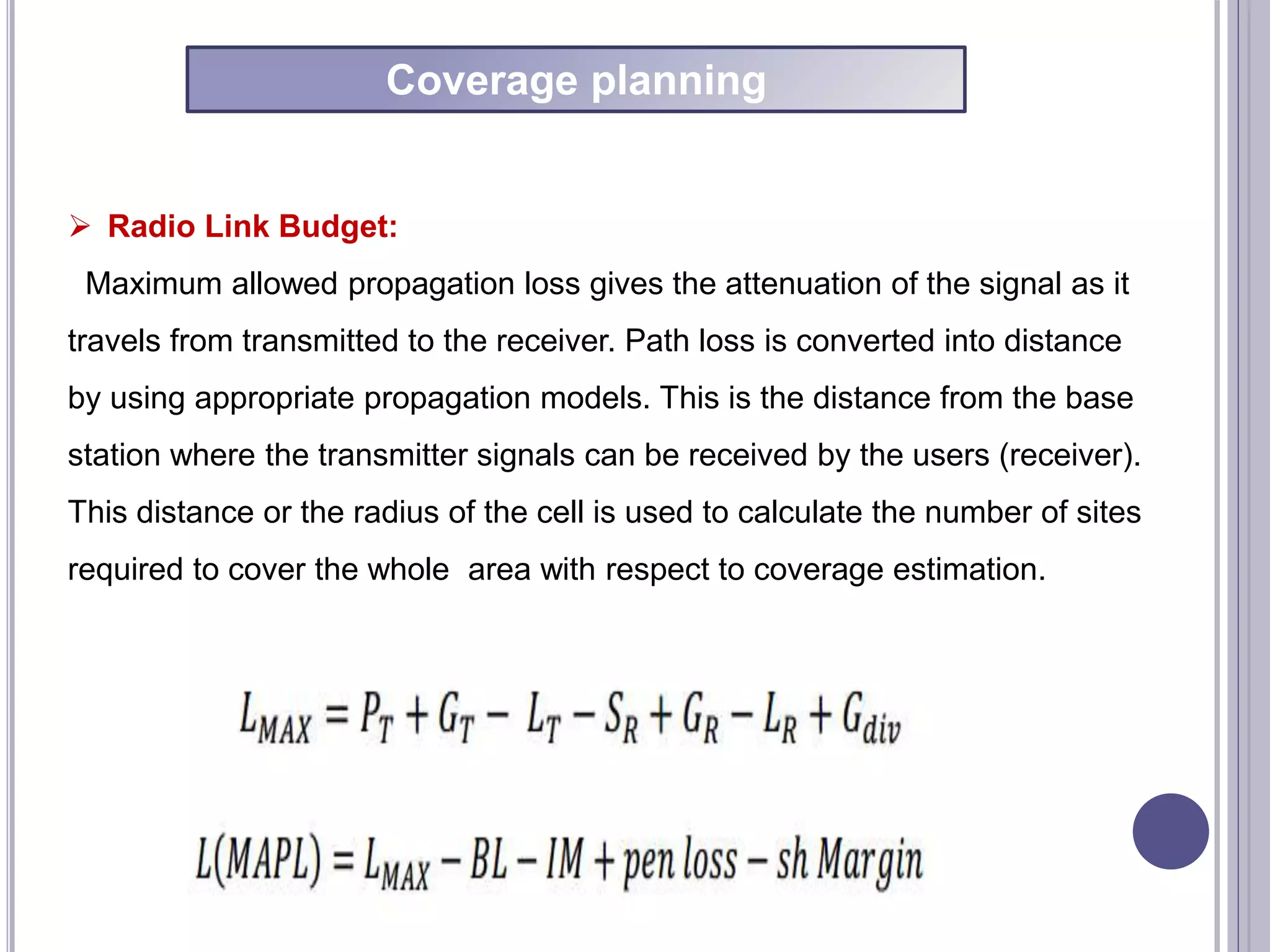
 Radio Link Budget:
Maximum allowed propagation loss gives the attenuation of the signal as it
travels from transmitted to the receiver. Path loss is converted into distance
by using appropriate propagation models. This is the distance from the base
station where the transmitter signals can be received by the users (receiver).
This distance or the radius of the cell is used to calculate the number of sites
required to cover the whole area with respect to coverage estimation.
Coverage planning
Link budget and coverage planning is calculated, for both cases UL and DL
a following the procedure steps are :
Step 1: Calculate the Max Allowed Path Loss (MAPL) for DL and UL.
Step 2: Calculate the DL and UL cell radiuses by the propagation model
equation and the MAPL.
Step 3: Determine the appropriate cell radius by balancing the DL and UL radiuses.
Step 4: Calculate the site coverage area and the required sites number.
Coverage planning
 Radio Link Budget:
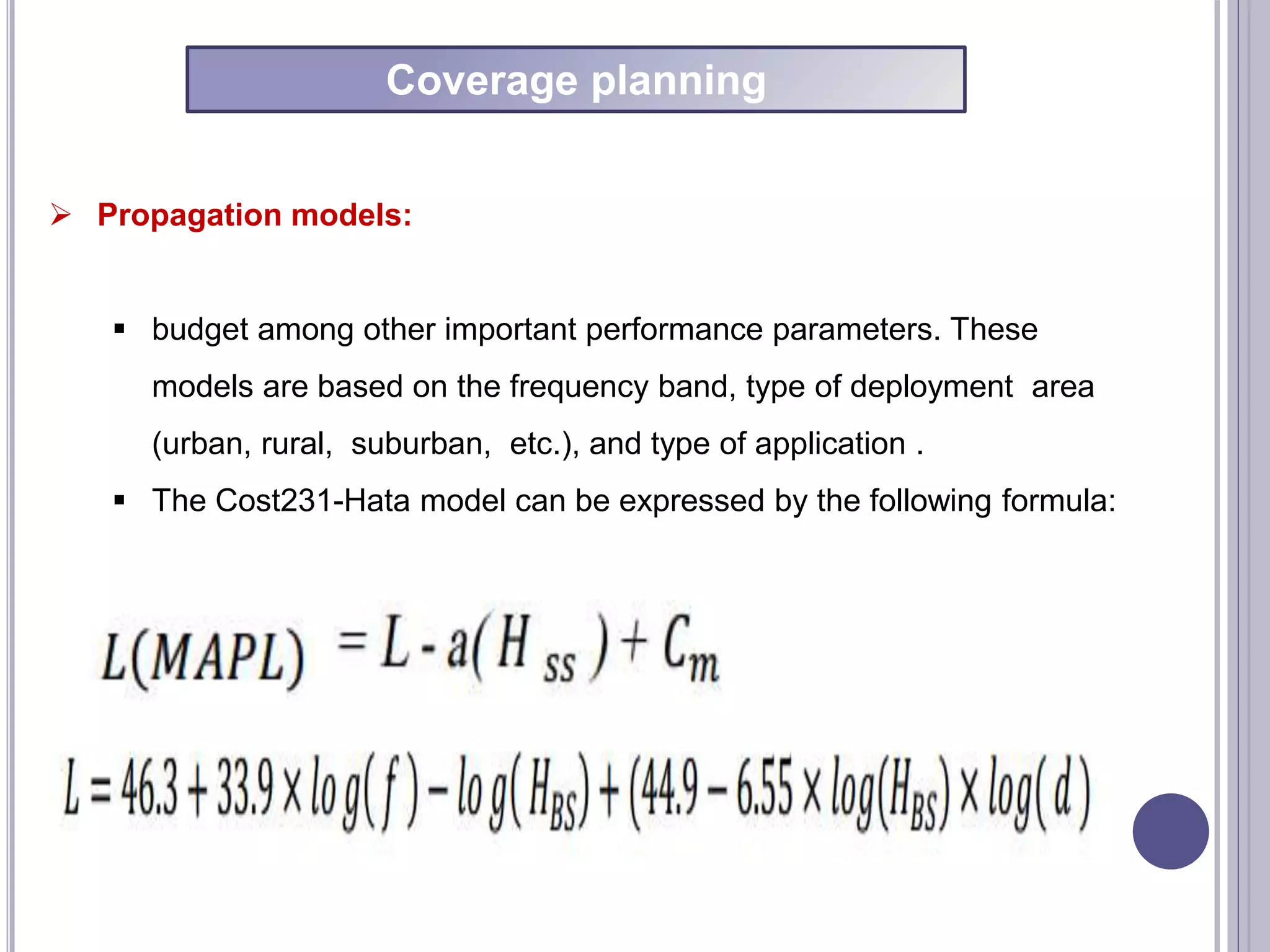
 Propagation models:
 budget among other important performance parameters. These
models are based on the frequency band, type of deployment area
(urban, rural, suburban, etc.), and type of application .
 The Cost231-Hata model can be expressed by the following formula:
Coverage planning
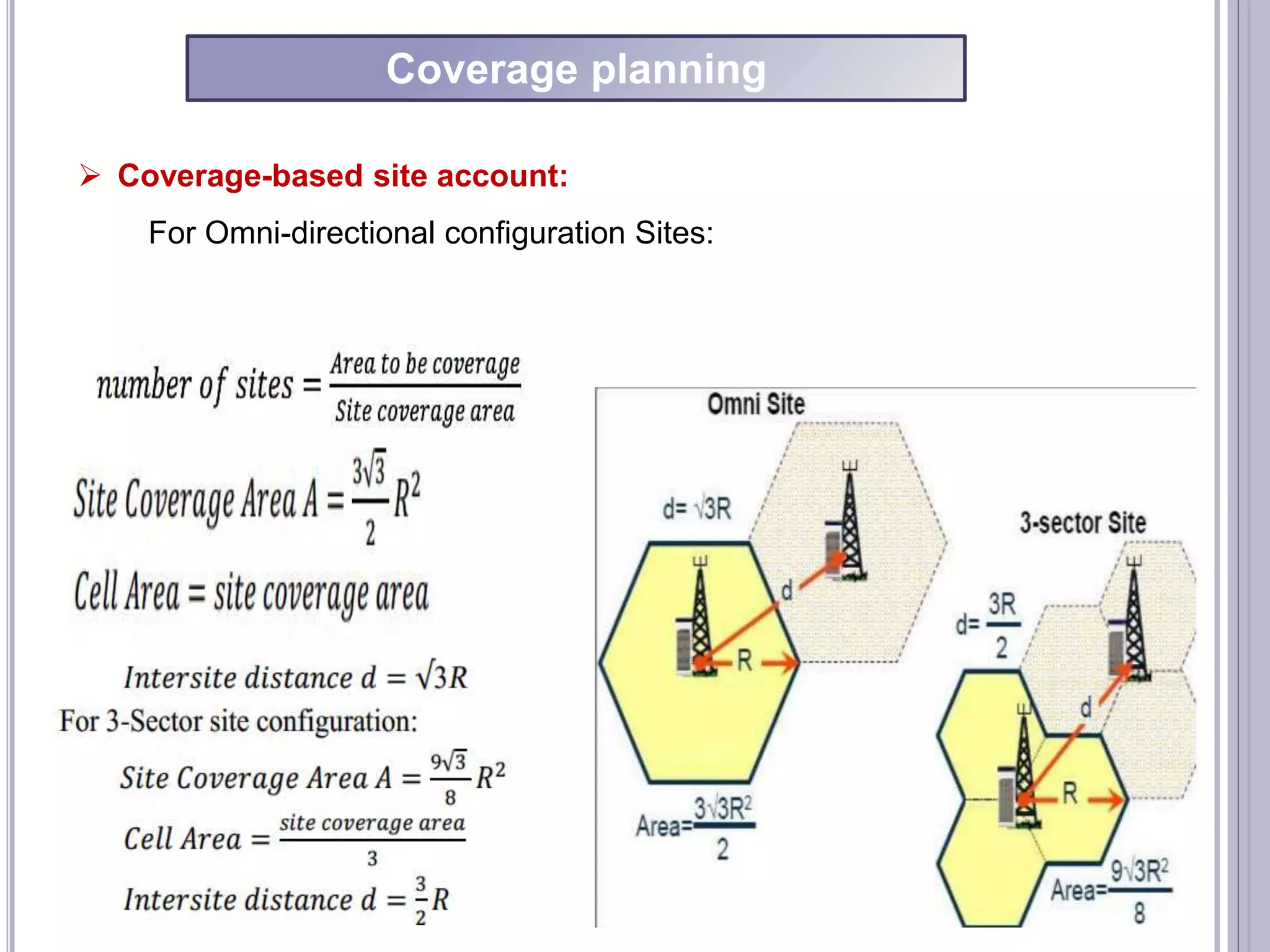
 Coverage-based site account:
For Omni-directional configuration Sites:
Coverage planning
2- CAPACITY PLANNING
 Capacity planning gives an estimate of the resources needed for supporting
a specified offered traffic with a certain level of QoS
 e.g.
 throughput
 blocking probability
 Theoretical capacity of the network is limited by the number of eNodeB’s installed
in the network.
 Cell capacity in LTE is impacted by several factors,
• interference level,
• packet scheduler
• supported modulation
• coding schemes.
Capacity Planning
 § The LTE Cell Capacity (Throughput) depends on:
o Cell Range (Path loss)
 Channel Bandwidth (1.4 MHz... 20 MHz)
 LTE Features
• MIMO :
 Open/Closed Transmit diversity
 it results in coverage improvement therefore, it is more suitable to be used
at the cell edge.
 – Open / Closed Loop Spatial Multiplexing Spatial multiplexing on the other
 hand doubles the subscriber data rate
LTE Capacity Dimensioning Process
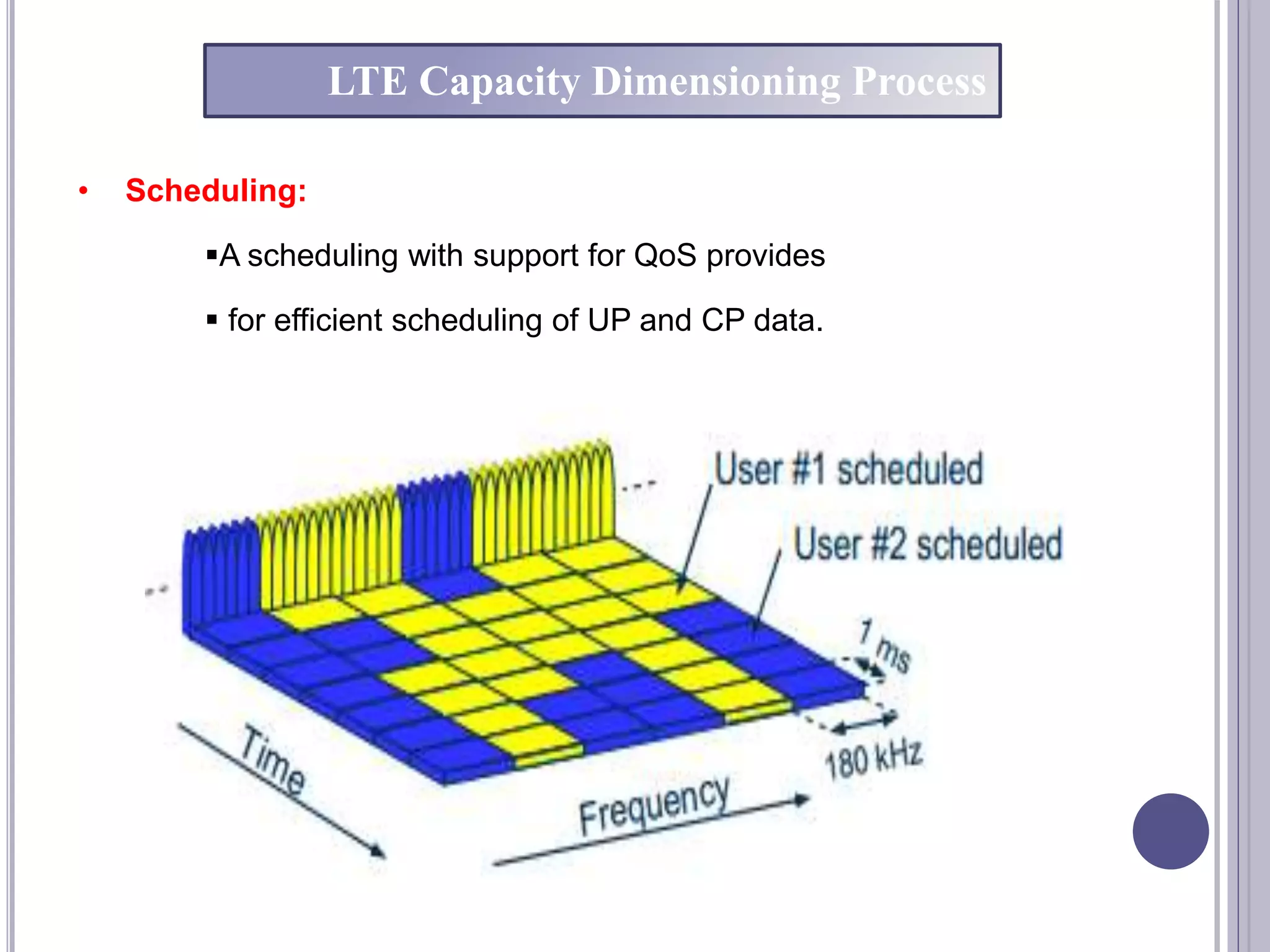
• Scheduling:
A scheduling with support for QoS provides
 for efficient scheduling of UP and CP data.
 4. Cell Load: It has to be noticed that when the neighbour cell load
is decreasing the cell throughput is increasing as expected.
LTE Capacity Dimensioning Process
 Fractional Frequency Reuse (FFR(
The basic idea on which the FFR schemes rely is to divide the
whole available .resources in .to two subsets or group FFR scheme
has two main classes:
 Partial Frequency Reuse (PFR):
in this scheme a common frequency band is used in all sectors
with equal power to create one sub-band with a low inter-cell
interference level in each sector.
LTE Capacity Dimensioning Process
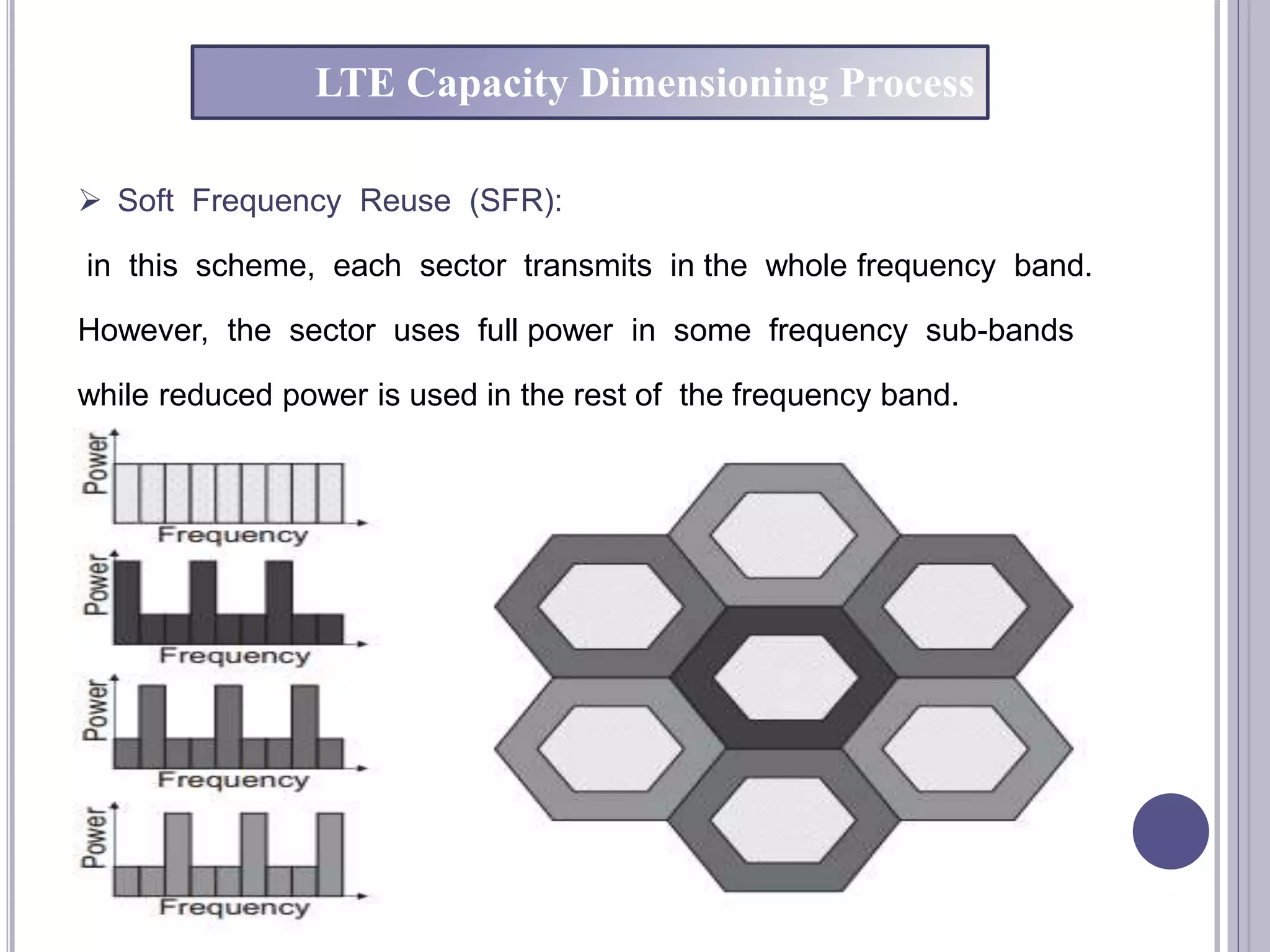
 Soft Frequency Reuse (SFR):
in this scheme, each sector transmits in the whole frequency band.
However, the sector uses full power in some frequency sub-bands
while reduced power is used in the rest of the frequency band.
LTE Capacity Dimensioning Process
 Cell capacity provided from the link level simulation as input to these approach
assumes that
 the target date rate is #Mbps per subscriber. Since only some of the subscribers
are downloading data simultaneously, we can apply an overbooking factor. This
essentially means that the average busy hour data rate is:
 Where:
 Overbooking factor (OBF) is the average number of subscribers that can share a
given unit of channel
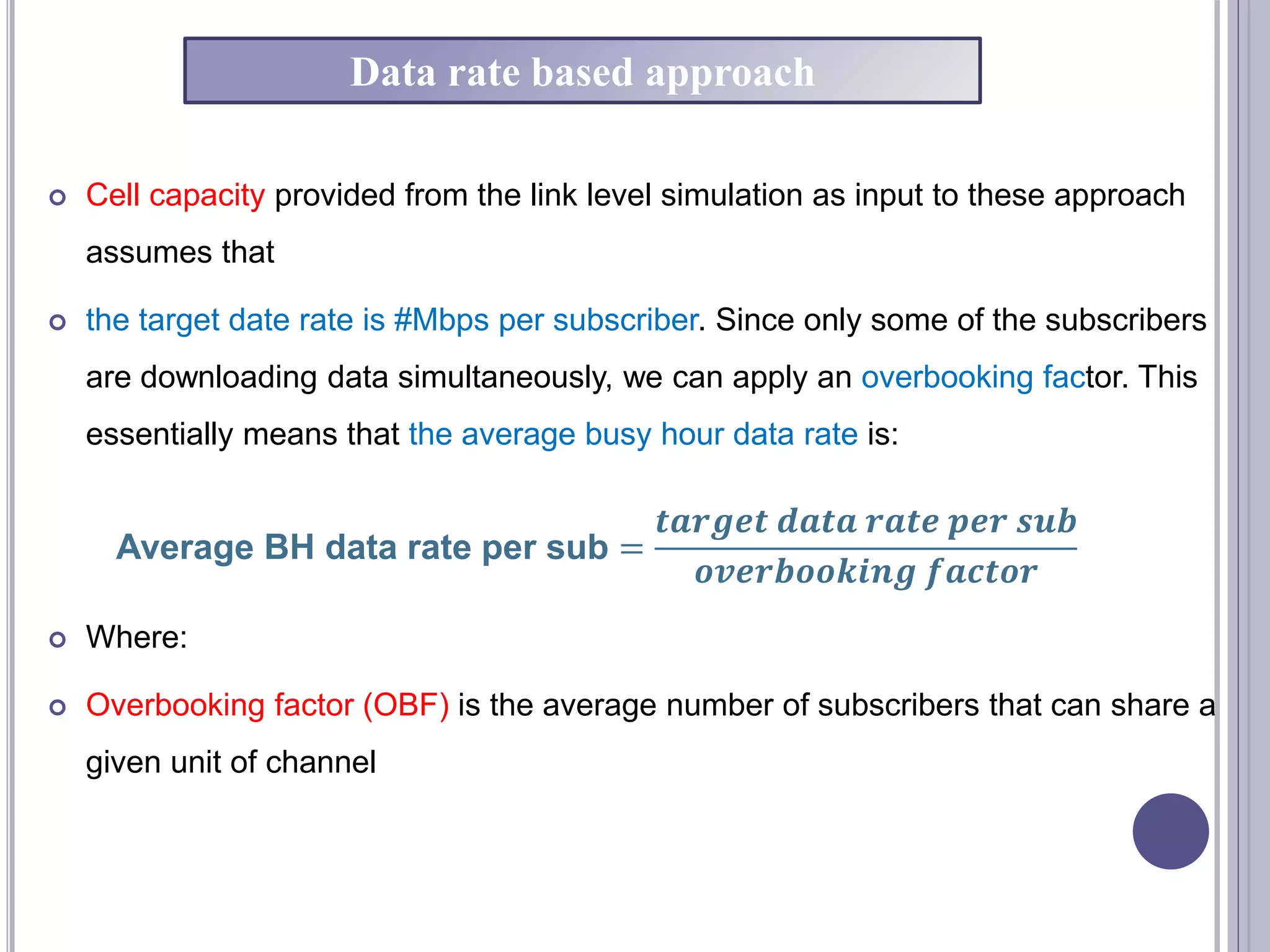
Average BH data rate per sub =
𝒕𝒂𝒓𝒈𝒆𝒕 𝒅𝒂𝒕𝒂 𝒓𝒂𝒕𝒆 𝒑𝒆𝒓 𝒔𝒖𝒃
𝒐𝒗𝒆𝒓𝒃𝒐𝒐𝒌𝒊𝒏𝒈 𝒇𝒂𝒄𝒕𝒐𝒓
Data rate based approach
• The number of subscribers per site using this approach calculated
as:
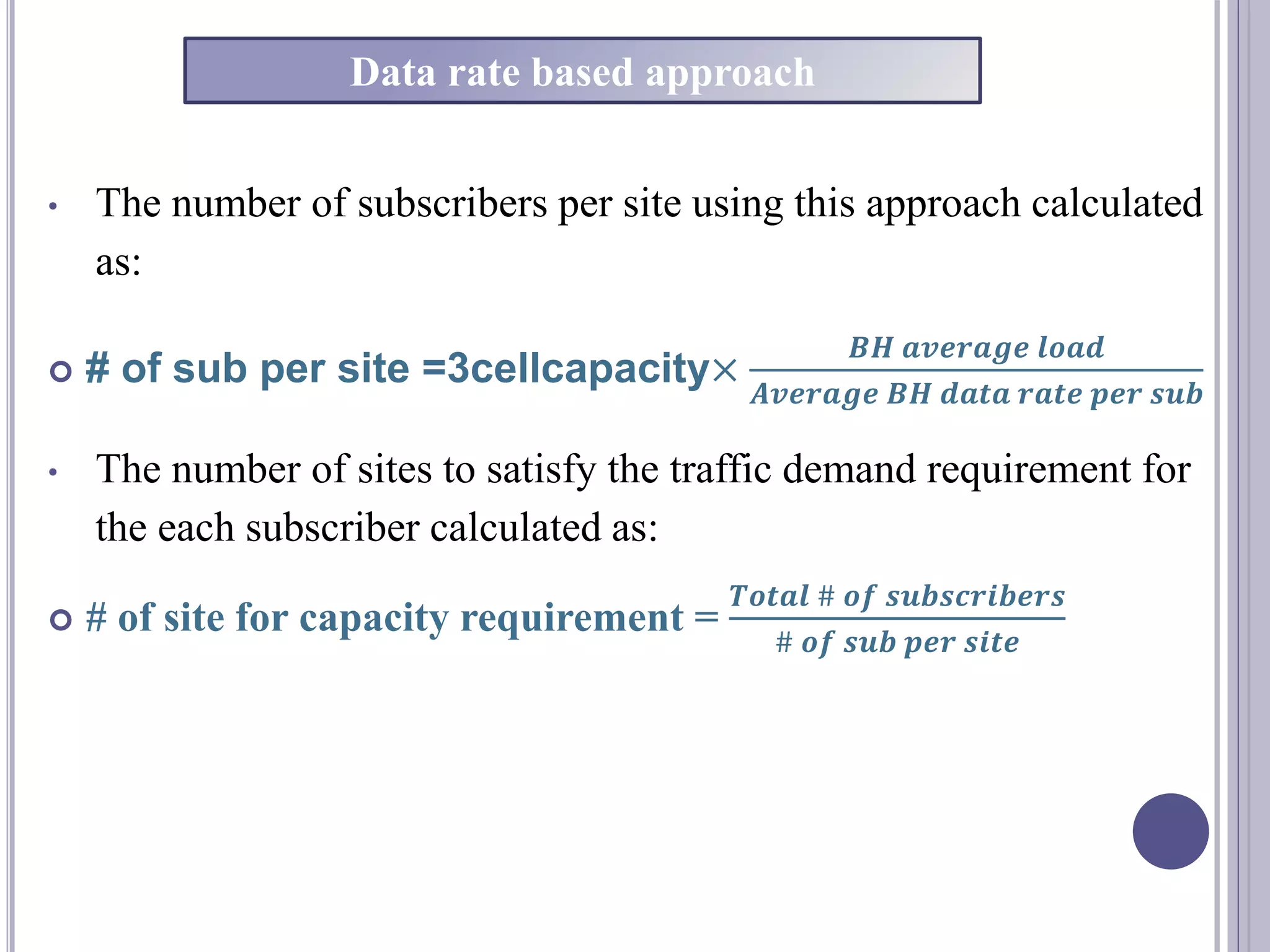
 # of sub per site =3cellcapacity×
𝑩𝑯 𝒂𝒗𝒆𝒓𝒂𝒈𝒆 𝒍𝒐𝒂𝒅
𝑨𝒗𝒆𝒓𝒂𝒈𝒆 𝑩𝑯 𝒅𝒂𝒕𝒂 𝒓𝒂𝒕𝒆 𝒑𝒆𝒓 𝒔𝒖𝒃
• The number of sites to satisfy the traffic demand requirement for
the each subscriber calculated as:
 # of site for capacity requirement =
𝑻𝒐𝒕𝒂𝒍 # 𝒐𝒇 𝒔𝒖𝒃𝒔𝒄𝒓𝒊𝒃𝒆𝒓𝒔
# 𝒐𝒇 𝒔𝒖𝒃 𝒑𝒆𝒓 𝒔𝒊𝒕𝒆
Data rate based approach
LTE(RF) OPTIMIZATION
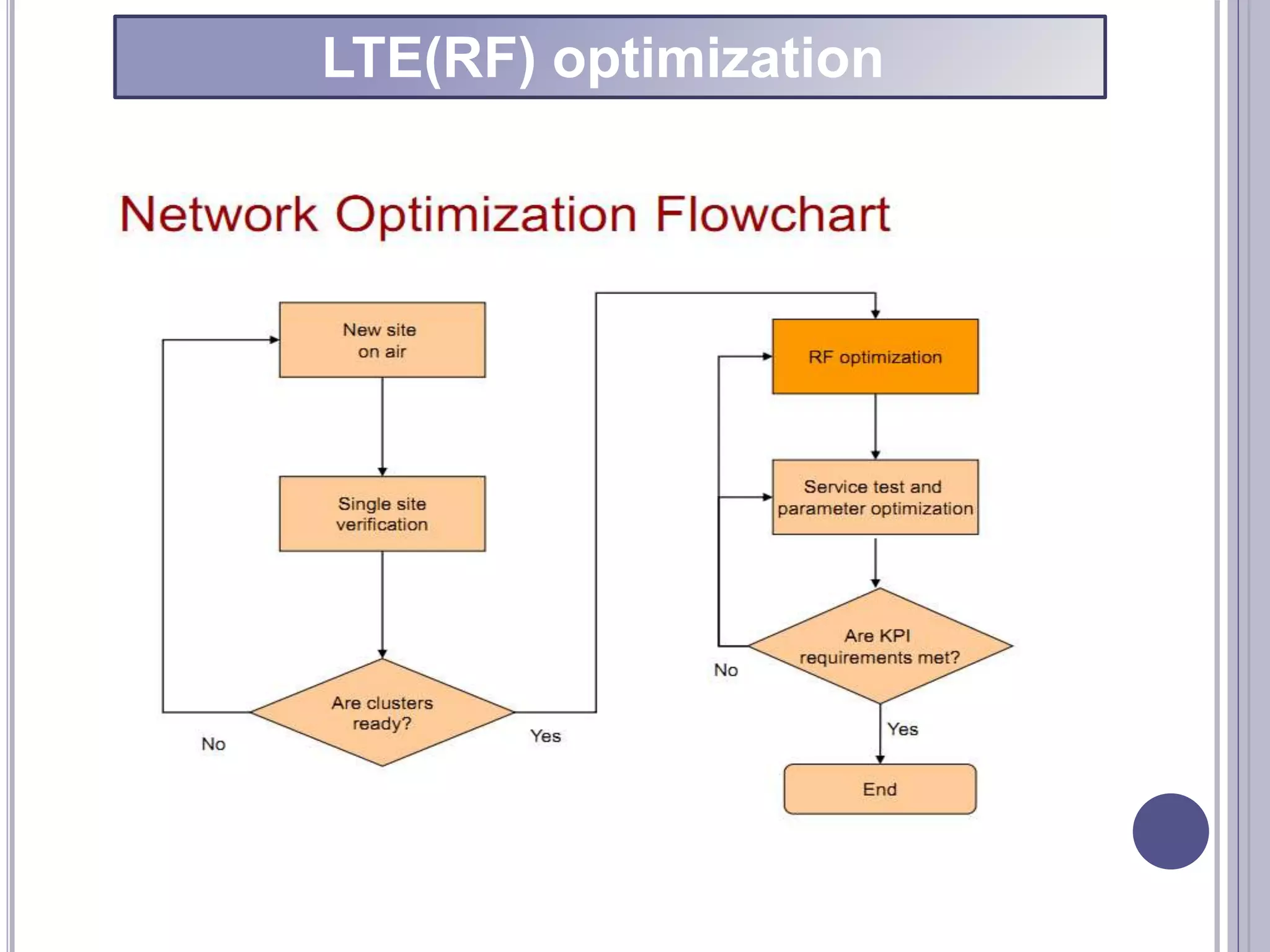
LTE(RF) optimization
• To meet customers' requirements for high-quality
networks, LTE trial networks must be optimized
during and after project implementation.
• Radio frequency (RF) optimization is necessary in
the entire optimization process.
What is optimization:
Optimization is the fine-tuning of a nominal cell plan to a real
environment.
Objective:
• The design criteria in regards to coverage, capacity and quality.
• The standards defined by local government authority.
LTE(RF) optimization
Need for optimization
• Perceived reduction in network quality.
• Indications from network performance monitoring.
• Subscriber's experience of using the network.
• Maximizing the use of existing infrastructure.
.
• Introduction of new services.
LTE(RF) optimization
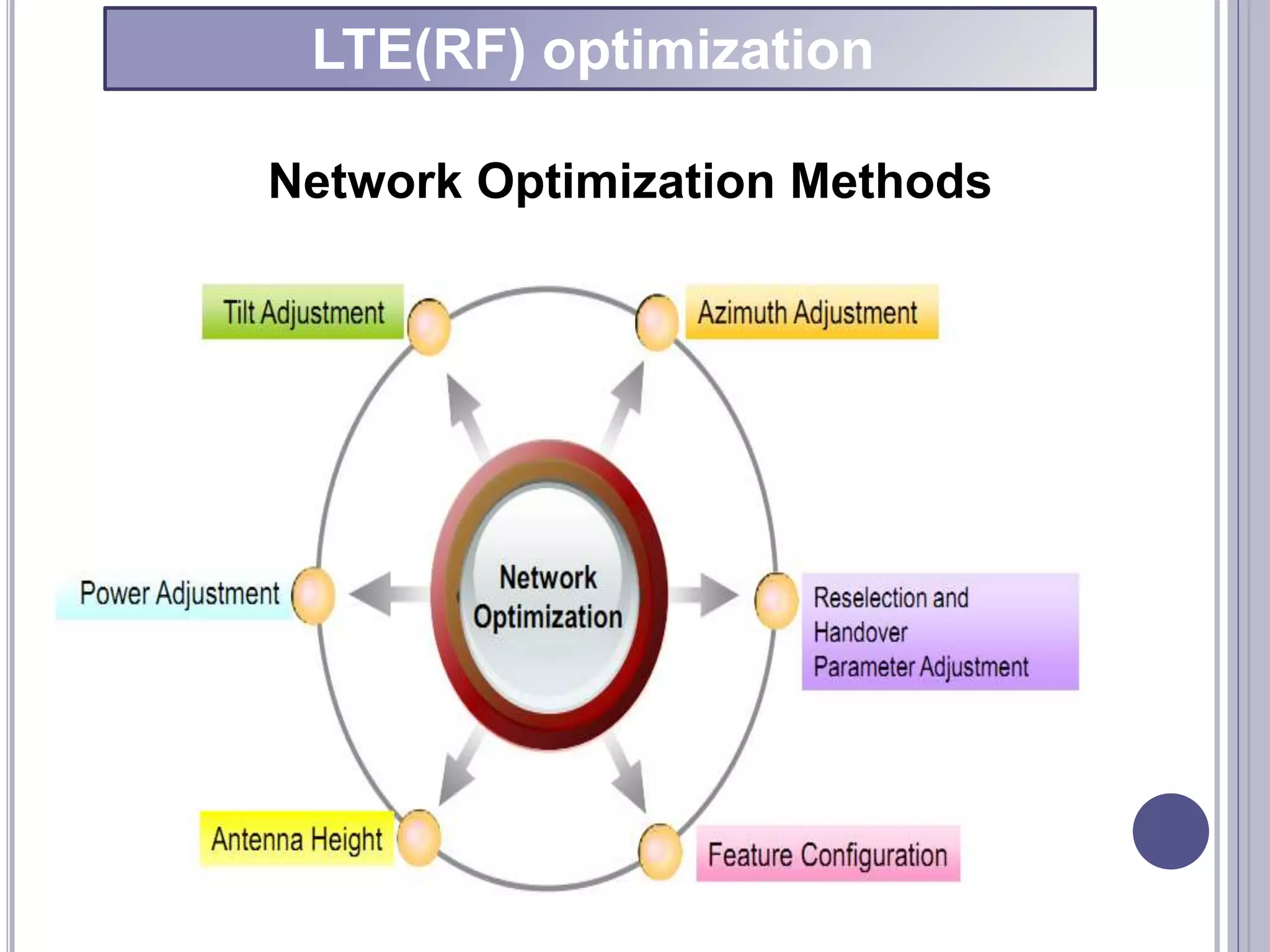
Network Optimization Methods
LTE(RF) optimization
Thank you

LTE optimization

  • 1.
    DESIGN BY: AKRM ABDULAHRASSAM AMAL ABDULRAHMAN HAMOUD. SAMAR ABDULKAWE ALSHARAIE MOHAMMED ABDULJABBAR QAID MOHAMMED ABDUL-RAHMAN NADA YASIN ABDULSALAM Taiz University Dep.COM. Level 5 2015 LTE Network (Coverage and capacity) Optimization
  • 2.
    Introduction of LTE NetworkPlanning LTE System Architecture Network Optimization
  • 3.
  • 4.
    Requirements and Targetsfor the LTE  Reduced delays.  Increased user data rates.  Increased cell-edge bit-rate, for uniformity of service provision.  Greater flexibility of spectrum usage.  Simplified network architecture.  Seamless mobility.  Reasonable power consumption for the mobile terminal.
  • 5.
     Orthogonal FrequencyDomain Multiple Access (OFDMA) in downlink.  Single-Carrier Frequency Domain Multiple Access (SC- FDMA) in uplink.  Multiple Input Multiple Output (MIMO) antennas.  Packet-Switched Radio Interface. Technologies for the LTE
  • 6.
    3GPP Release 8– Freeze Date 2008  Up to 300Mbit/s downlink and 75Mbit/s uplink.  Implementation in bandwidths of 1.4, 3, 5, 10, 15 or 20MHz, to allow for different deployment scenarios.  (OFDMA) downlink.  (SC-FDMA) uplink.  (MIMO) antennas. 3GPP Release 9 – Freeze Date 2009  Self-Organizing Network (SON) features, such as optimization of the random access channel.  Evolved Multimedia Broadcast and Multicast Service (EMBMS)  Provides improved support for Public Warning Systems (PWS) and some accurate positioning methods. LTE Release and LTE-Advanced
  • 7.
    3GPP Release 10– Freeze Date 2011  Up to 3Gbit/s downlink and 1.5Gbit/s uplink.  Carrier Aggregation (CA), allowing the total transmission bandwidth to be increased up to 100 MHz .  Uplink MIMO transmission for peak spectral efficiencies greater than 7.5 bps and targeting up to 15 bps.  Downlink MIMO enhancements, targeting peak spectral efficiencies up to 30 bps.  Enhanced Inter-Cell Interference Coordination (EICIC) to improve performance towards the edge of cells. 3GPP Release 11 – Freeze Date 2013  Enhancements to Carrier Aggregation, MIMO, relay nodes and eICIC  Introduction of new frequency bands  Coordinated multipoint transmission and reception to enable simultaneous communication with multiple cells LTE Release and LTE-Advanced
  • 8.
    3GPP Release 12– Freeze Date 2014  New antenna techniques and advanced receivers to maximize the potential of large cells.  Interworking between LTE and Wi-Fi or HSPDA.  Further developments of previous technologies. LTE Release and LTE-Advanced
  • 9.
     Together LTEof the Evolved Universal Terrestrial Radio Access Network (E- UTRAN) and SAE of the EPC comprise the Evolved Packet System (EPS).  EPS is the umbrella that covers both the LTE of (E-UTRAN) and the SAE of the EPC network. EPC and LTE under the umbrella of EPS. LTE System Architecture
  • 10.
     The maincomponents of LTE networks are:  User Equipment (UE)  Evolved-UTRAN (E_UTRAN)  Evolved Packet Core (EPC) LTE network elements LTE System Architecture
  • 11.
     User Equipment(UE)  user equipment (UE) is any device used directly by an end-user to communicate.  And it is connected to the LTE network via the RF channel through the BS that is part of the eNB.  It can be a hand-held telephone, a laptop computer equipped with a mobile broadband adapter, or any other device  UE handles the following tasks towards the core network: o Mobility management , Call control and Identity management. User Equipment connected to LTE network LTE System Architecture
  • 12.
     Evolved-UTRAN (E_UTRAN) The E-UTRAN is responsible for all radio-related functions, which can be summarized as:  Radio Resource Management : This covers all functions related to the radio bearers, such as radio bearer control, radio admission control, radio mobility control, scheduling and dynamic allocation of resources to UEs in both uplink and downlink.  Header Compression : This helps to ensure efficient use of the radio interface by compressing the IP packet headers, which could otherwise represent a significant overhead, especially for small packets such as VoIP.  Security : All data sent over the radio interface is encrypted.  Positioning : The E-UTRAN provides the necessary measurements and other data to the E-SMLC and assists the E-SMLC in finding the UE position  Connectivity to the EPC : This consists of the signalling towards the MME and the bearer path towards the S-GW. LTE System Architecture
  • 13.
    Architecture of theevolved UMTS terrestrial radio access network  The eNodeBs are normally inter-connected with each other by means of an interface known as X2, and to the EPC by means of the S1 interface.  The protocols which run between the eNodeBs and the UE are known as the Access Stratum (AS) protocols. LTE System Architecture
  • 14.
     Evolved PacketCore (EPC)  Evolved Packet Core is responsible for the overall control of the UE and the establishment of the bearers. The main logical nodes of the EPC are:  PDN Gateway (P-GW).  Serving Gateway (S-GW).  Mobility Management Entity (MME).  Home Subscriber Server (HSS).  Policy Control and Charging Rules Function (PCRF). EPC elements LTE System Architecture
  • 15.
     P-GW(Packet DataNetwork- Gateway)  The (P-GW)is the EPC’s point of contact with the outside world . Through the SGi interface,  The P-GW is responsible for IP address allocation for the UE, QoS enforcement and flow-based charging according to rules from the PCRF.  S-GW (Serving Gateway)  acts as a router, and forwards data between the base station and the PDN gateway.  MME (Mobility Management Entity)  The MME is the control node, which processes the signaling between the UE and the EPC.  The main functions supported by the MME are :  establishment, maintenance and release of the bearers.  paging subscribers in the EPS Connection Management.  the MME performs management of handovers. LTE System Architecture
  • 16.
     PCRF (PolicyControl and Charging Rules Function)  The PCRF is responsible for controlling the flow based charging functionalities in the Policy Control Enforcement Function (PCEF), which resides in the P-GW.  HSS (Home Subscriber Server)  The HSS contains user’s subscription data such as the EPS-subscribed QoS profile and any access restrictions for roaming. LTE System Architecture
  • 17.
  • 18.
  • 19.
     LTE Radioaccess network planning refers to analytical approach which is based on algorithmic formulation and focuses on the radio engineering aspect of the planning process, i.e : • on determining the locations. • estimated capacity and size of the cell sites (coverage and capacity planning). • and assigning frequencies to them by examining the radio-wave propagation environment and interferences among the cells. Network Planning
  • 20.
     LTE AccessNetwork Dimensioning:  The target of the LTE access network dimensioning is to estimate the required site density and site configurations for the area of interest.  Initial LTE access network planning activities include:  radio link budget .  a coverage analysis.  cell capacity estimation.  estimation of the amount of eNB. Coverage planning
  • 21.
     Radio LinkBudget: Maximum allowed propagation loss gives the attenuation of the signal as it travels from transmitted to the receiver. Path loss is converted into distance by using appropriate propagation models. This is the distance from the base station where the transmitter signals can be received by the users (receiver). This distance or the radius of the cell is used to calculate the number of sites required to cover the whole area with respect to coverage estimation. Coverage planning
  • 22.
    Link budget andcoverage planning is calculated, for both cases UL and DL a following the procedure steps are : Step 1: Calculate the Max Allowed Path Loss (MAPL) for DL and UL. Step 2: Calculate the DL and UL cell radiuses by the propagation model equation and the MAPL. Step 3: Determine the appropriate cell radius by balancing the DL and UL radiuses. Step 4: Calculate the site coverage area and the required sites number. Coverage planning  Radio Link Budget:
  • 23.
     Propagation models: budget among other important performance parameters. These models are based on the frequency band, type of deployment area (urban, rural, suburban, etc.), and type of application .  The Cost231-Hata model can be expressed by the following formula: Coverage planning
  • 24.
     Coverage-based siteaccount: For Omni-directional configuration Sites: Coverage planning
  • 25.
  • 26.
     Capacity planninggives an estimate of the resources needed for supporting a specified offered traffic with a certain level of QoS  e.g.  throughput  blocking probability  Theoretical capacity of the network is limited by the number of eNodeB’s installed in the network.  Cell capacity in LTE is impacted by several factors, • interference level, • packet scheduler • supported modulation • coding schemes. Capacity Planning
  • 27.
     § TheLTE Cell Capacity (Throughput) depends on: o Cell Range (Path loss)  Channel Bandwidth (1.4 MHz... 20 MHz)  LTE Features • MIMO :  Open/Closed Transmit diversity  it results in coverage improvement therefore, it is more suitable to be used at the cell edge.  – Open / Closed Loop Spatial Multiplexing Spatial multiplexing on the other  hand doubles the subscriber data rate LTE Capacity Dimensioning Process
  • 28.
    LTE Capacity DimensioningProcess • Scheduling: A scheduling with support for QoS provides  for efficient scheduling of UP and CP data.
  • 29.
     4. CellLoad: It has to be noticed that when the neighbour cell load is decreasing the cell throughput is increasing as expected. LTE Capacity Dimensioning Process
  • 30.
     Fractional FrequencyReuse (FFR( The basic idea on which the FFR schemes rely is to divide the whole available .resources in .to two subsets or group FFR scheme has two main classes:  Partial Frequency Reuse (PFR): in this scheme a common frequency band is used in all sectors with equal power to create one sub-band with a low inter-cell interference level in each sector. LTE Capacity Dimensioning Process
  • 31.
     Soft FrequencyReuse (SFR): in this scheme, each sector transmits in the whole frequency band. However, the sector uses full power in some frequency sub-bands while reduced power is used in the rest of the frequency band. LTE Capacity Dimensioning Process
  • 32.
     Cell capacityprovided from the link level simulation as input to these approach assumes that  the target date rate is #Mbps per subscriber. Since only some of the subscribers are downloading data simultaneously, we can apply an overbooking factor. This essentially means that the average busy hour data rate is:  Where:  Overbooking factor (OBF) is the average number of subscribers that can share a given unit of channel Average BH data rate per sub = 𝒕𝒂𝒓𝒈𝒆𝒕 𝒅𝒂𝒕𝒂 𝒓𝒂𝒕𝒆 𝒑𝒆𝒓 𝒔𝒖𝒃 𝒐𝒗𝒆𝒓𝒃𝒐𝒐𝒌𝒊𝒏𝒈 𝒇𝒂𝒄𝒕𝒐𝒓 Data rate based approach
  • 33.
  • 34.
    • The numberof subscribers per site using this approach calculated as:  # of sub per site =3cellcapacity× 𝑩𝑯 𝒂𝒗𝒆𝒓𝒂𝒈𝒆 𝒍𝒐𝒂𝒅 𝑨𝒗𝒆𝒓𝒂𝒈𝒆 𝑩𝑯 𝒅𝒂𝒕𝒂 𝒓𝒂𝒕𝒆 𝒑𝒆𝒓 𝒔𝒖𝒃 • The number of sites to satisfy the traffic demand requirement for the each subscriber calculated as:  # of site for capacity requirement = 𝑻𝒐𝒕𝒂𝒍 # 𝒐𝒇 𝒔𝒖𝒃𝒔𝒄𝒓𝒊𝒃𝒆𝒓𝒔 # 𝒐𝒇 𝒔𝒖𝒃 𝒑𝒆𝒓 𝒔𝒊𝒕𝒆 Data rate based approach
  • 35.
  • 36.
    LTE(RF) optimization • Tomeet customers' requirements for high-quality networks, LTE trial networks must be optimized during and after project implementation. • Radio frequency (RF) optimization is necessary in the entire optimization process.
  • 37.
    What is optimization: Optimizationis the fine-tuning of a nominal cell plan to a real environment. Objective: • The design criteria in regards to coverage, capacity and quality. • The standards defined by local government authority. LTE(RF) optimization
  • 38.
    Need for optimization •Perceived reduction in network quality. • Indications from network performance monitoring. • Subscriber's experience of using the network. • Maximizing the use of existing infrastructure. . • Introduction of new services. LTE(RF) optimization
  • 39.
  • 40.
  • 41.
  • 42.