Internet of Things
Contents
•
•
•
•
•

Introduction/Overview
The Internet of Things
Applications of IoT
Challenges and Barriers in IoT
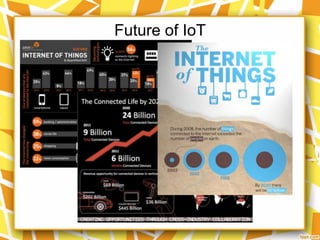
Future of IoT
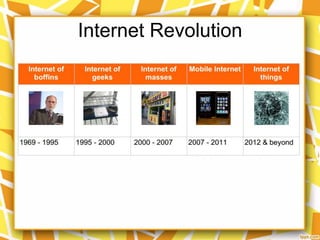
Internet Revolution
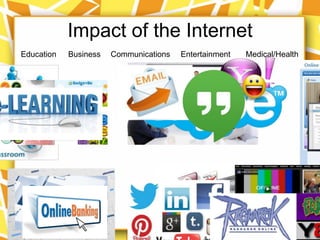
Impact of the Internet
Education

Business

Communications

Entertainment

Medical/Health
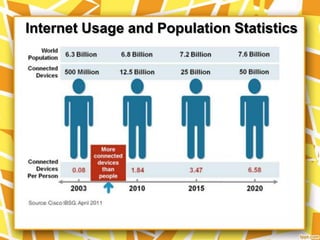
Internet Usage and Population Statistics
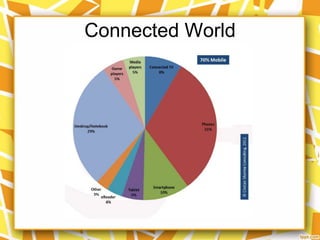
Connected World
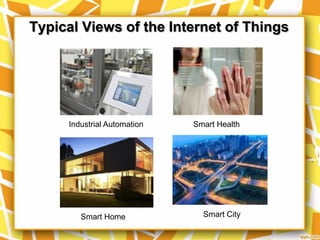
Typical Views of the Internet of Things

Industrial Automation

Smart Home

Smart Health

Smart City
The Internet of Things
“Internet of Objects”

“Machine-to-Machine Era”

“Internet of Everything”

(1) The Internet of Things, also called The Internet of
Objects, refers to a wireless network between objects,
usually the network will be wireless and selfconfiguring, such as household appliances.
------Wikipedia
(2) Internet of Things refers to the concept that the
Internet is no longer just a global network for people to
communicate with one another using computers, but it is
also a platform for devices to communicate electronically
with the world around them.”
--Center for Data and Innovation
The Internet of Things
(3) The term "Internet of Things" has come to describe a
number of technologies and research disciplines that
enable the Internet to reach out into the real world of
physical objects.
------IoT 2008
(4) “Things having identities and virtual personalities
operating in smart spaces using intelligent interfaces to
connect
and
communicate
within
social, environmental, and user contexts”.
-------IoT in 2020
The Internet of Things
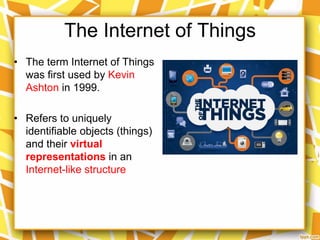
• The term Internet of Things
was first used by Kevin
Ashton in 1999.
• Refers to uniquely
identifiable objects (things)
and their virtual
representations in an
Internet-like structure
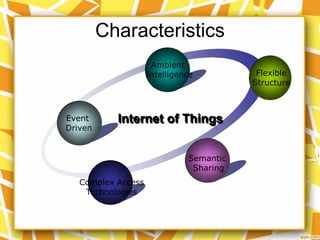
Characteristics
Ambient
Intelligence

Event
Driven

Internet of Things
Semantic
Sharing

Complex Access
Technologies

Flexible
Structure
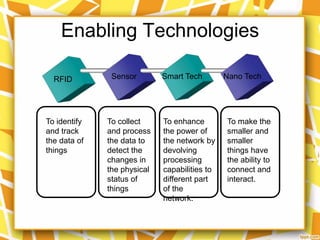
Enabling Technologies
RFID

To identify
and track
the data of
things

Sensor

To collect
and process
the data to
detect the
changes in
the physical
status of
things

Smart Tech

To enhance
the power of
the network by
devolving
processing
capabilities to
different part
of the
network.

Nano Tech

To make the
smaller and
smaller
things have
the ability to
connect and
interact.
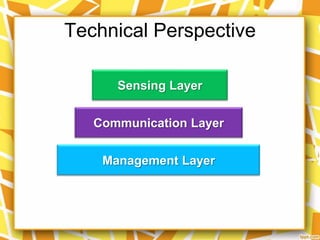
Technical Perspective
Sensing Layer
Communication Layer
Management Layer
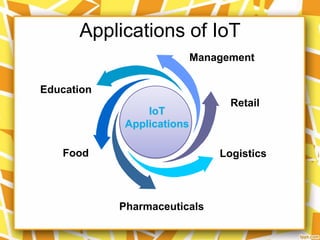
Applications of IoT
Management
Education

IoT
Applications
Food

Retail

Logistics

Pharmaceuticals
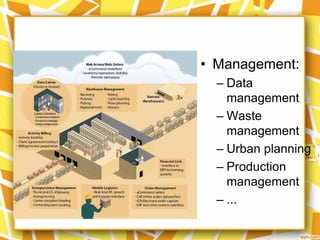
• Management:
– Data
management
– Waste
management
– Urban planning
– Production
management
– ...
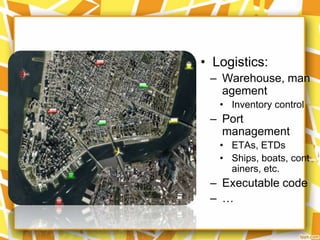
• Logistics:
– Warehouse, man
agement
• Inventory control

– Port
management
• ETAs, ETDs
• Ships, boats, cont
ainers, etc.

– Executable code
– …
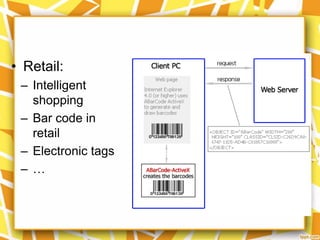
• Retail:
– Intelligent
shopping
– Bar code in
retail
– Electronic tags
– …
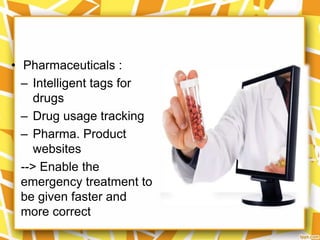
• Pharmaceuticals :
– Intelligent tags for
drugs
– Drug usage tracking
– Pharma. Product
websites
--> Enable the
emergency treatment to
be given faster and
more correct
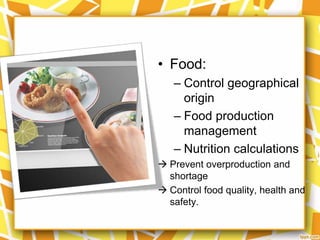
• Food:
– Control geographical
origin
– Food production
management
– Nutrition calculations
 Prevent overproduction and
shortage
 Control food quality, health and
safety.
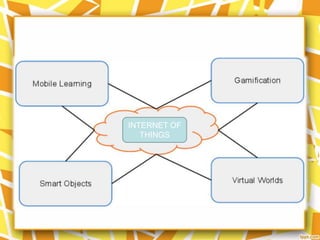
INTERNET OF
THINGS
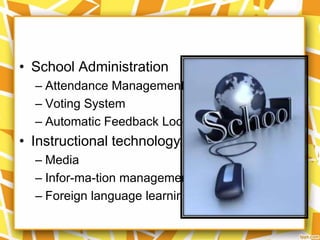
• School Administration
– Attendance Management
– Voting System
– Automatic Feedback Loops

• Instructional technology
– Media
– Infor-ma-tion management
– Foreign language learning
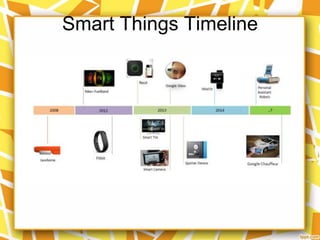
Smart Things Timeline
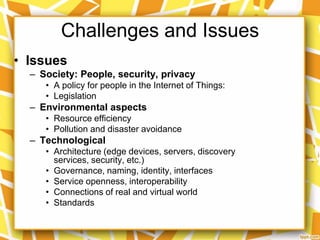
Challenges and Issues
• Issues
– Society: People, security, privacy
• A policy for people in the Internet of Things:
• Legislation

– Environmental aspects
• Resource efficiency
• Pollution and disaster avoidance

– Technological
• Architecture (edge devices, servers, discovery
services, security, etc.)
• Governance, naming, identity, interfaces
• Service openness, interoperability
• Connections of real and virtual world
• Standards
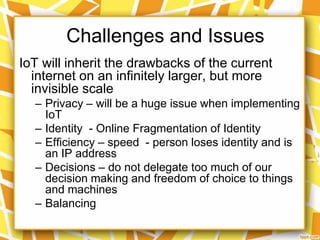
Challenges and Issues
IoT will inherit the drawbacks of the current
internet on an infinitely larger, but more
invisible scale
– Privacy – will be a huge issue when implementing
IoT
– Identity - Online Fragmentation of Identity
– Efficiency – speed - person loses identity and is
an IP address
– Decisions – do not delegate too much of our
decision making and freedom of choice to things
and machines
– Balancing
Challenges and Issues
• Transition to IPv6 – Internet protocol v6
• Estalishing a common set of standards between
companies, educational systems, and nations.
– The same type of cabling,
– The same applications or programming
– The same protocol or set of rules that will apply to all

• Developing energy sources for millions -even
billions - of sensors.
– Wind
– Solar,
– Hydro-electric
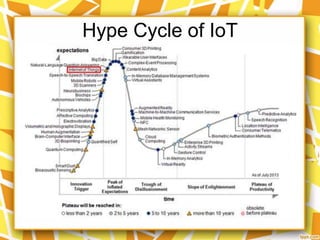
Hype Cycle of IoT
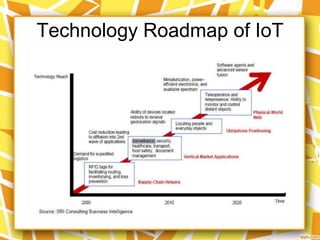
Technology Roadmap of IoT
Future of IoT
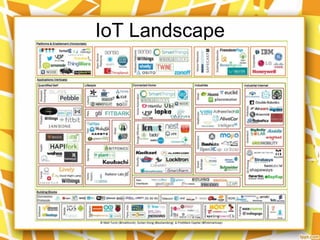
IoT Landscape

IoT - IT 423 ppt

  • 1.
  • 2.
    Contents • • • • • Introduction/Overview The Internet ofThings Applications of IoT Challenges and Barriers in IoT Future of IoT
  • 4.
  • 5.
    Impact of theInternet Education Business Communications Entertainment Medical/Health
  • 6.
    Internet Usage andPopulation Statistics
  • 7.
  • 8.
    Typical Views ofthe Internet of Things Industrial Automation Smart Home Smart Health Smart City
  • 10.
    The Internet ofThings “Internet of Objects” “Machine-to-Machine Era” “Internet of Everything” (1) The Internet of Things, also called The Internet of Objects, refers to a wireless network between objects, usually the network will be wireless and selfconfiguring, such as household appliances. ------Wikipedia (2) Internet of Things refers to the concept that the Internet is no longer just a global network for people to communicate with one another using computers, but it is also a platform for devices to communicate electronically with the world around them.” --Center for Data and Innovation
  • 11.
    The Internet ofThings (3) The term "Internet of Things" has come to describe a number of technologies and research disciplines that enable the Internet to reach out into the real world of physical objects. ------IoT 2008 (4) “Things having identities and virtual personalities operating in smart spaces using intelligent interfaces to connect and communicate within social, environmental, and user contexts”. -------IoT in 2020
  • 12.
    The Internet ofThings • The term Internet of Things was first used by Kevin Ashton in 1999. • Refers to uniquely identifiable objects (things) and their virtual representations in an Internet-like structure
  • 13.
  • 14.
    Enabling Technologies RFID To identify andtrack the data of things Sensor To collect and process the data to detect the changes in the physical status of things Smart Tech To enhance the power of the network by devolving processing capabilities to different part of the network. Nano Tech To make the smaller and smaller things have the ability to connect and interact.
  • 16.
  • 17.
  • 18.
    • Management: – Data management –Waste management – Urban planning – Production management – ...
  • 19.
    • Logistics: – Warehouse,man agement • Inventory control – Port management • ETAs, ETDs • Ships, boats, cont ainers, etc. – Executable code – …
  • 21.
    • Retail: – Intelligent shopping –Bar code in retail – Electronic tags – …
  • 22.
    • Pharmaceuticals : –Intelligent tags for drugs – Drug usage tracking – Pharma. Product websites --> Enable the emergency treatment to be given faster and more correct
  • 23.
    • Food: – Controlgeographical origin – Food production management – Nutrition calculations  Prevent overproduction and shortage  Control food quality, health and safety.
  • 24.
  • 25.
    • School Administration –Attendance Management – Voting System – Automatic Feedback Loops • Instructional technology – Media – Infor-ma-tion management – Foreign language learning
  • 26.
  • 27.
    Challenges and Issues •Issues – Society: People, security, privacy • A policy for people in the Internet of Things: • Legislation – Environmental aspects • Resource efficiency • Pollution and disaster avoidance – Technological • Architecture (edge devices, servers, discovery services, security, etc.) • Governance, naming, identity, interfaces • Service openness, interoperability • Connections of real and virtual world • Standards
  • 28.
    Challenges and Issues IoTwill inherit the drawbacks of the current internet on an infinitely larger, but more invisible scale – Privacy – will be a huge issue when implementing IoT – Identity - Online Fragmentation of Identity – Efficiency – speed - person loses identity and is an IP address – Decisions – do not delegate too much of our decision making and freedom of choice to things and machines – Balancing
  • 29.
    Challenges and Issues •Transition to IPv6 – Internet protocol v6 • Estalishing a common set of standards between companies, educational systems, and nations. – The same type of cabling, – The same applications or programming – The same protocol or set of rules that will apply to all • Developing energy sources for millions -even billions - of sensors. – Wind – Solar, – Hydro-electric
  • 30.
  • 31.
  • 32.
  • 33.

Editor's Notes

  • #6 Impact of the Internet
  • #14 AI: the autonomous and intelligent entities will act in full interoperability & will be able to auto-organize themselves depending on the context, circumstances or environment. ED is to design the scheme depending on the needFS means that hundreds and thousands of nodes will be disable and will be set to run. CAT means that there’s several kinds of media such as vehicle stone that they need different access technologies.SS is the machine can rend and send by themselves. No need to tell humanbeings
  • #15 machine-to-machine interfaces and protocols of electronic communicationmicrocontrollerswireless communicationRFIDEnergy harvesting technologiessensor technologyLocation technologySoftwareIPv6
  • #18 Logistics – Tagging items on a UPS truck (now they use barcodes to be scanned) but not real-time. Using the newer technology all is in realtime.
  • #23 waste management, urban planning, sustainable urban environment, continous care, emergency response, intelligent shopping, smart product management, smart meters, home automation and smart eventsPharma. – Doctors managing patience during the day – realtime - managing heart rate, Temperature, etc.
  • #24 waste management, urban planning, sustainable urban environment, continous care, emergency response, intelligent shopping, smart product management, smart meters, home automation and smart events
  • #25 http://blogs.princeton.edu/etc/2012/02/24/the-internet-of-things/ Education – When researching items and tagging them (Radio Frequency Identification) the data can be collected and monitored over a time period.
  • #26 Infor­ma­tion management: research data
  • #28 Legislation: mandatory that policy keeps up with technology so that citizens gain confidence in the new technology People’s momentarily context and roles can determine their attitudes towards new technology. An employee will resist his boss’ access to his or her mailbox while the same person may demand the same insight into the mailboxes of subordinates.