Mobile communication
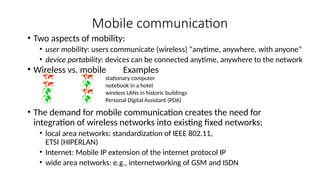
• Twoaspects of mobility:
• user mobility: users communicate (wireless) “anytime, anywhere, with anyone”
• device portability: devices can be connected anytime, anywhere to the network
• Wireless vs. mobile Examples
stationary computer
notebook in a hotel
wireless LANs in historic buildings
Personal Digital Assistant (PDA)
• The demand for mobile communication creates the need for
integration of wireless networks into existing fixed networks:
• local area networks: standardization of IEEE 802.11,
ETSI (HIPERLAN)
• Internet: Mobile IP extension of the internet protocol IP
• wide area networks: e.g., internetworking of GSM and ISDN
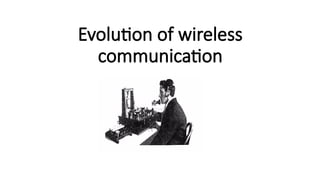
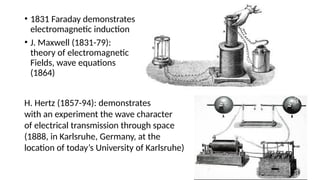
• 1831 Faradaydemonstrates
electromagnetic induction
• J. Maxwell (1831-79):
theory of electromagnetic
Fields, wave equations
(1864)
H. Hertz (1857-94): demonstrates
with an experiment the wave character
of electrical transmission through space
(1888, in Karlsruhe, Germany, at the
location of today’s University of Karlsruhe)
13.
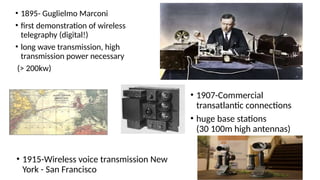
• 1895- GuglielmoMarconi
• first demonstration of wireless
telegraphy (digital!)
• long wave transmission, high
transmission power necessary
(> 200kw)
• 1907-Commercial
transatlantic connections
• huge base stations
(30 100m high antennas)
• 1915-Wireless voice transmission New
York - San Francisco
14.
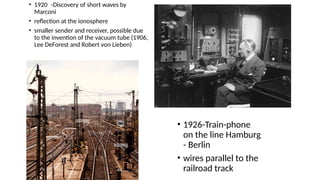
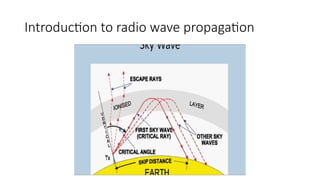
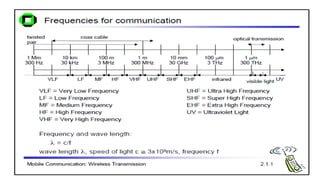
• 1920 -Discoveryof short waves by
Marconi
• reflection at the ionosphere
• smaller sender and receiver, possible due
to the invention of the vacuum tube (1906,
Lee DeForest and Robert von Lieben)
• 1926-Train-phone
on the line Hamburg
- Berlin
• wires parallel to the
railroad track
15.
• 1928 manyTV broadcast trials (across Atlantic, color TV, TV news)
• 1933 Frequency modulation (E. H. Armstrong)
• 1958 A-Netz in Germany
analog, 160MHz, connection setup only from the mobile station, no handover,
80% coverage, 1971 11000 customers
• 1972 B-Netz in Germany
analog, 160MHz, connection setup from the fixed network too
(but location of the mobile station has to be known)
available also in A, NL and LUX, 1979 13000 customer in D
• 1979 NMT at 450MHz (Scandinavian countries)
• 1982 Start of GSM-specification
goal: pan-European digital mobile phone system with roaming
• 1983 Start of the American AMPS (Advanced Mobile Phone
System, analog)
• 1984 CT-1 standard (Europe) for cordless telephones
16.
• 1986 C-Netzin Germany
• analog voice transmission, 450MHz, hand-over possible, digital signaling, automatic
location of mobile device
• Was in use until 2000, services: FAX, modem, X.25, e-mail, 98% coverage
• 1991 Specification of DECT
• Digital European Cordless Telephone (today: Digital Enhanced Cordless
Telecommunications)
• 1880-1900MHz, ~100-500m range, 120 duplex channels, 1.2Mbit/s data
transmission, voice encryption, authentication, up to several 10000 user/km2, used
in more than 50 countries
• 1992 Start of GSM
• in D as D1 and D2, fully digital, 900MHz, 124 channels
• automatic location, hand-over, cellular
• roaming in Europe - now worldwide in more than 170 countries
• services: data with 9.6kbit/s, FAX, voice, ...
17.
• 1999 Standardizationof additional wireless LANs
• IEEE standard 802.11b, 2.4-2.5GHz, 11Mbit/s
• Bluetooth for piconets, 2.4Ghz, <1Mbit/s
• Decision about IMT-2000
• Several “members” of a “family”: UMTS, cdma2000, DECT, …
• Start of WAP (Wireless Application Protocol) and i-mode
• First step towards a unified Internet/mobile communicaiton system
• Access to many services via the mobile phone
• 2000 GSM with higher data rates
• HSCSD offers up to 57,6kbit/s
• First GPRS trials with up to 50 kbit/s (packet oriented!)
• UMTS auctions/beauty contests
• Hype followed by disillusionment (approx. 50 B$ payed in Germany for 6 UMTS licences!)
• 2001 Start of 3G systems
• Cdma2000 in Korea, UMTS in Europe, Foma (almost UMTS) in Japan
Introduction to MobileCommunication
Evolution
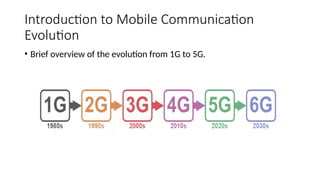
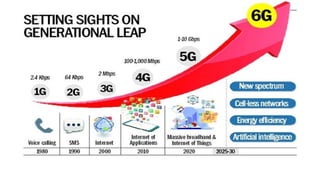
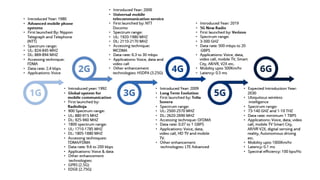
• Brief overview of the evolution from 1G to 5G.
20.
1G: The Birthof Mobile Communication
• Era: 1980s
• Technologies: AMPS (USA), NMT (Europe)
• Key Features: Analog technology, voice-only service, poor call quality,
lack of security.
21.
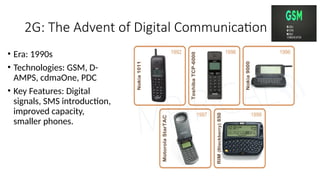
2G: The Adventof Digital Communication
• Era: 1990s
• Technologies: GSM, D-
AMPS, cdmaOne, PDC
• Key Features: Digital
signals, SMS introduction,
improved capacity,
smaller phones.
22.
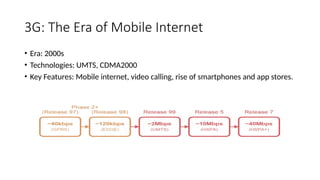
3G: The Eraof Mobile Internet
• Era: 2000s
• Technologies: UMTS, CDMA2000
• Key Features: Mobile internet, video calling, rise of smartphones and app stores.
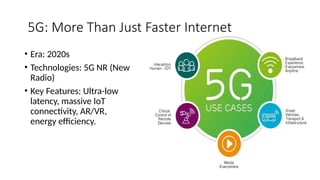
5G: More ThanJust Faster Internet
• Era: 2020s
• Technologies: 5G NR (New
Radio)
• Key Features: Ultra-low
latency, massive IoT
connectivity, AR/VR,
energy efficiency.
25.
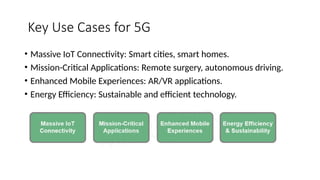
Key Use Casesfor 5G
• Massive IoT Connectivity: Smart cities, smart homes.
• Mission-Critical Applications: Remote surgery, autonomous driving.
• Enhanced Mobile Experiences: AR/VR applications.
• Energy Efficiency: Sustainable and efficient technology.
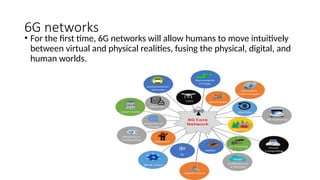
6G networks
• Forthe first time, 6G networks will allow humans to move intuitively
between virtual and physical realities, fusing the physical, digital, and
human worlds.
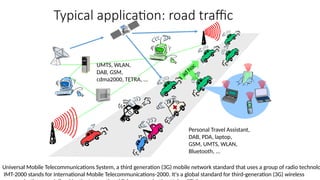
Typical application: roadtraffic
ad
hoc
UMTS, WLAN,
DAB, GSM,
cdma2000, TETRA, ...
Personal Travel Assistant,
DAB, PDA, laptop,
GSM, UMTS, WLAN,
Bluetooth, ...
Universal Mobile Telecommunications System, a third generation (3G) mobile network standard that uses a group of radio technolo
IMT-2000 stands for International Mobile Telecommunications-2000. It's a global standard for third-generation (3G) wireless
Applications I
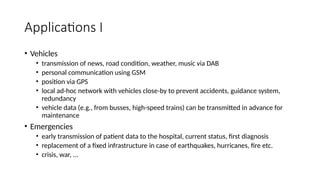
• Vehicles
•transmission of news, road condition, weather, music via DAB
• personal communication using GSM
• position via GPS
• local ad-hoc network with vehicles close-by to prevent accidents, guidance system,
redundancy
• vehicle data (e.g., from busses, high-speed trains) can be transmitted in advance for
maintenance
• Emergencies
• early transmission of patient data to the hospital, current status, first diagnosis
• replacement of a fixed infrastructure in case of earthquakes, hurricanes, fire etc.
• crisis, war, ...
34.
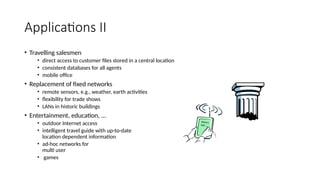
Applications II
• Travellingsalesmen
• direct access to customer files stored in a central location
• consistent databases for all agents
• mobile office
• Replacement of fixed networks
• remote sensors, e.g., weather, earth activities
• flexibility for trade shows
• LANs in historic buildings
• Entertainment, education, ...
• outdoor Internet access
• intelligent travel guide with up-to-date
location dependent information
• ad-hoc networks for
multi user
• games
History
Info
35.
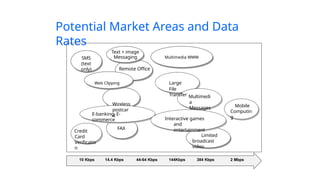
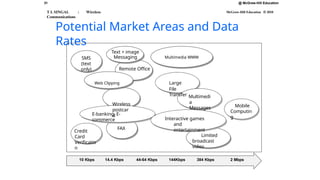
Potential Market Areasand Data
Rates
Limited
broadcast
video
FAX
SMS
(text
only)
Credit
Card
Verificatio
n
E-banking, E-
commerce
Text + image
Messaging Multimedia WWW
Remote Office
Web Clipping Large
File
Transfer
Wireless
postcar
d
Multimedi
a
Messages
Interactive games
and
entertainment
Mobile
Computin
g
10 Kbps 14.4 Kbps 44-64 Kbps 144Kbps 384 Kbps 2 Mbps
36.
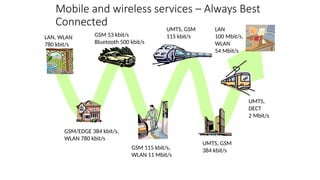
Mobile and wirelessservices – Always Best
Connected
UMTS,
DECT
2 Mbit/s
UMTS, GSM
384 kbit/s
LAN
100 Mbit/s,
WLAN
54 Mbit/s
UMTS, GSM
115 kbit/s
GSM 115 kbit/s,
WLAN 11 Mbit/s
GSM 53 kbit/s
Bluetooth 500 kbit/s
GSM/EDGE 384 kbit/s,
WLAN 780 kbit/s
LAN, WLAN
780 kbit/s
37.
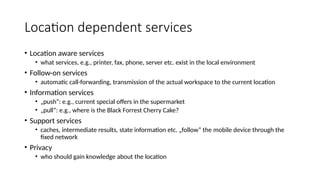
Location dependent services
•Location aware services
• what services, e.g., printer, fax, phone, server etc. exist in the local environment
• Follow-on services
• automatic call-forwarding, transmission of the actual workspace to the current location
• Information services
• „push“: e.g., current special offers in the supermarket
• „pull“: e.g., where is the Black Forrest Cherry Cake?
• Support services
• caches, intermediate results, state information etc. „follow“ the mobile device through the
fixed network
• Privacy
• who should gain knowledge about the location
38.
Target Business
Areas
TheAutomotive Industry
Market
The Fleet Management
Vehicle Positioning Market
The Utilities Market
The Security Systems Market
Vending Machines
39.
Challenges for Research
Wirelesscommunications – a major
technological areas for research as
well as industrial applications.
True wireless multimedia services –
required by highly mobile subscribers
seamlessly on a global arena.
Diverse IP multimedia applications.
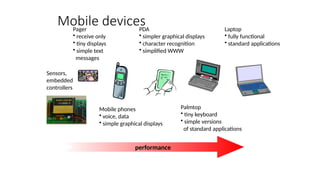
Mobile devices
performance
Pager
• receiveonly
• tiny displays
• simple text
messages
Mobile phones
• voice, data
• simple graphical displays
PDA
• simpler graphical displays
• character recognition
• simplified WWW
Palmtop
• tiny keyboard
• simple versions
of standard applications
Laptop
• fully functional
• standard applications
Sensors,
embedded
controllers
42.
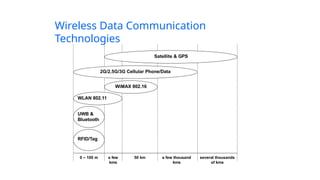
Wireless Data Communication
Technologies
Satellite& GPS
2G/2.5G/3G Cellular Phone/Data
WiMAX 802.16
WLAN 802.11
UWB &
Bluetooth
RFID/Tag
0 – 100 m a few
kms
50 km a few thousand
kms
several thousands
of kms
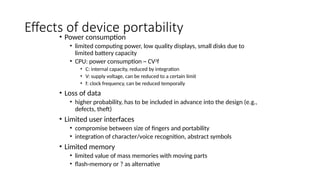
Effects of deviceportability
• Power consumption
• limited computing power, low quality displays, small disks due to
limited battery capacity
• CPU: power consumption ~ CV2
f
• C: internal capacity, reduced by integration
• V: supply voltage, can be reduced to a certain limit
• f: clock frequency, can be reduced temporally
• Loss of data
• higher probability, has to be included in advance into the design (e.g.,
defects, theft)
• Limited user interfaces
• compromise between size of fingers and portability
• integration of character/voice recognition, abstract symbols
• Limited memory
• limited value of mass memories with moving parts
• flash-memory or ? as alternative
45.
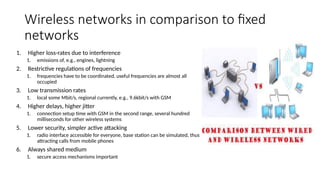
Wireless networks incomparison to fixed
networks
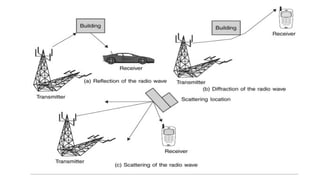
1. Higher loss-rates due to interference
1. emissions of, e.g., engines, lightning
2. Restrictive regulations of frequencies
1. frequencies have to be coordinated, useful frequencies are almost all
occupied
3. Low transmission rates
1. local some Mbit/s, regional currently, e.g., 9.6kbit/s with GSM
4. Higher delays, higher jitter
1. connection setup time with GSM in the second range, several hundred
milliseconds for other wireless systems
5. Lower security, simpler active attacking
1. radio interface accessible for everyone, base station can be simulated, thus
attracting calls from mobile phones
6. Always shared medium
1. secure access mechanisms important


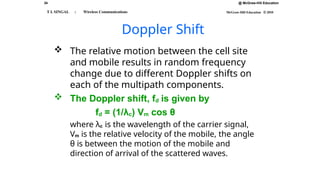
![@ McGraw-Hill Education
35
T L SINGAL : Wireless Communications McGraw-Hill Education © 2010
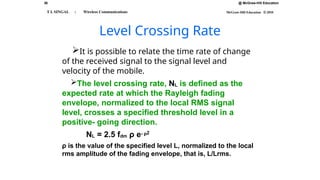
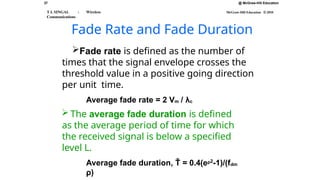
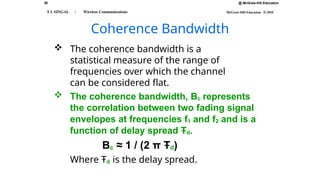
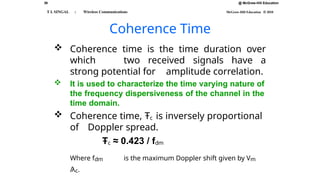
Doppler Spread
Doppler shift will be positive or negative
depending on whether the mobile receiver is
moving towards or away from the cell site.
In mobile radio applications, the Doppler
spectrum or Doppler spread for a Rayleigh
fading channel is usually modeled by
D(λ) = (0.16/fdm) x [1-( λc / fdm)2]-0.5 for - fdm ≤ λc ≤ fdm
where fdm is the maximum Doppler frequency
possible fdm = Vm / λc](https://image.slidesharecdn.com/evolutionofwirelesscommunication-1a-250214022909-6ca489df/85/Evolution-of-wireless-mobile-communication-1a-pptx-82-320.jpg)