Wireless Digital Subscriber Line (WDSL) Presented By: Kashif Akram Student ID: 04910284 MSc Mobile Computer Systems Presented To:   John Byrne (Supervisor) John Cowley (Second Assessor)
Contents Wireless Communication Digital Subscriber Line (DSL). Wireless Fldelity (WiFi) World Interoperability for Microwave Access (WiMAX) Conclusion Further Work
Wireless Communication Introduction Future of Handheld devices. Development in last 15 to 20 years. Cost effectiveness and portability. Easy to install. Evolution of Wireless Networks Wireless Communication in old times.  First Wireless Communication System 1895 by Guglielmo Marconi. (Distance 18 miles) 1902 first bidirectional communication system across the Atlantic Ocean from Cornwall to Newfoundland.
Wireless Communication Early Mobile Telephony: 1946, Mobile Telephone System (MTS). Introduced in 25 cities of USA. Analogue and half duplex System. Manual Call Switching.  Limited channels in some cases there are only 3 channels. 1960, new version of MTS Improved Mobile Telephony System (IMTS) Full duplex. Automatic Call Switching and 23 channels can be used simultaneously.
Wireless Communication Analogue Cellular Telephony or 1 st  Generation (1G) IMTS transmitters producing interference. Not efficient use of spectrum. During  1950’s and  1960’s AT&T Bell Lab introduced new concept of cellular networks. Switching cells without the noticeable degradation of voice call. In 1982, Advance Mobile Phone Systems (AMPS), the first commercial analogue system in USA. Total Access Communication System (TACS) adjacent to AMPS, introduced in UK, Spain, Italy, Austria and Ireland.
Wireless Communication Digital Cellular Telephony or 2 nd  Generation (2G) In this the data was represented digitally. Short Messaging Service Support.  10kbps Caller ID. Global System for Mobile Communication (GSM) Works on 900, 1800, 1900 MHz frequency band. The system uses 1800 MHz frequency band is known as DCS 1800. 1982 2G activities started in Europe. A Study Group named Group Special Mobile was created for specify a common European Standards later on named as Global Systems for Mobile Communication (GSM). First deployment 1992.
Wireless Communication High Speed Circuit Switch Data (HSCSD) and General Packet Radio Service (GPRS) GSM is compatible with both the technologies. HSCSD  More time slots per frame result better data rate. Date rates 57.6, 43.2 and 28.8Kbps. Support asymmetric communication.  GPRS Works on HSCSD principle more time slots per frame. Bandwidth on demand.  Supports data rate from 14.4Kbps to 115.2Kbps  Supports Symmetric and Asymmetric communication
Wireless Communication IS95 1993 new standard of 2G IS95 or CDMAOne. Works on Code Division Multiple Access (CDMA) Data rate 4.8 to 14.4Kbps Newer version IS95b or CDMATwo Data rate 115.2Kbps  D-AMPS 1996 advance version of IS95, the IS136 or D-AMPS introduced. Data rate 3Kbps. Enhancement of D-AMPS is D-AMPS+ D-AMPS+ offers date rate 9.6 to 19.2Kbps. Compatible with IS95.
Wireless Communication Third Generation (3G) Increasing user demands. EDGE Enhancement Data Rates for Global Evolution Time Division Multiple Access (TDMA) based modulation Theoretical data rate up to 473.6Kbps but practically it is around 68kbps. Backward compatibility GSM. CDMA-2000 Enhancement to Code Division Multiple Access. Data rate 2Mbps Backward compatibility IS95.
Wireless Communication W-CDMA Wideband Code Division Multiple Access. Uses 5MHz wideband and offers 2Mbps. Fourth Generation (4G) Aim is high data rate up to 100Mbps Quality of Service (QoS) Improved Security Uninterrupted operation across networks.
Digital Subscriber Line Introduction Developed in 1989. Main purpose was video streaming. Data rate up to 6Mbps. Asymmetric communication. Types of DSL ADSL Asymmetric Digital Subscriber Line. Designed for home users. Download speed from 1.5 to 9Mbps. Upload speed is around 1.5Mbps.
Digital Subscriber Line ADSL Lite Low speed version of ADSL. Download speed 1Mbps. Upload speed 512Kbps. Within the range of 18000 feet from service provider. R-ADSL Rate Adaptive Digital Subscriber Line. Same data rates as ADSL but in this the modem can be adjusted variably according to the length of line and quality.
Digital Subscriber Line HDSL High bit rate Digital Subscriber Line. Symmetric connectivity.  Data rate 1.544 to 2.048Mbps Distance from service provider 12000 to 15000 feet. Designed for video conferencing. SDSL Symmetric Digital Subscriber Line. Designed for business applications. Speed from 192Kbps to 1.1Mbps.
Digital Subscriber Line IDSL ISDN Digital Subscriber Line Data rate 144Kbps which is slightly higher than ISDN 128Kbps VDSL Very High Bit Rate Digital Subscriber Line Fastest in all DSL types. Data rates 13-52Mbps downstream and 1.5 to 2.3Mbps upstream. Distance 1000 to 4500 feet from service provider end.
Digital Subscriber Line DSL Equipment DSLAM Digital Subscriber Line Access Multiplexer. DSL Multiplexer connects DSL lines with ATM, frame relay or internet protocols. Supports Quality of Service features like contention, diffserv and priority queues. The common upstream link in the DSLAM use Giga bit Ethernet or multi Giga bit fibre optic links. However not a full stateful firewall, some DSLAM’s offers packet filtering.  DSLAM acts like a massive network switch.
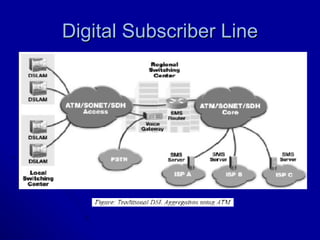
Digital Subscriber Line ATM Asynchronous Transfer Mode. Designed for voice networks. Still used for voice and TDM services but majorly used for data networks. Guaranteed bandwidth at customer end. Installed with network backbone router to assure QoS with high reliability. There is a virtual connection between ATM and Customer Premises Equipment (CPE) using DSLAM.
Digital Subscriber Line
Digital Subscriber Line BRAS Broadband Remote Access Server. Aggregates traffic from big number of users to reduce  cost per user. Perform number of functions: Accounting, Authentication and Authorization (AAA) VPN Tunnelling Full IP routing Multi Protocol Label Switching (MPLS)
Wireless Fidelity (WiFi) Introduction Introduced in 1994 by WiFi Alliance. 1997 IEEE defined WiFi as standard 802.11. 1999 802.11b was introduced. 2002 802.11g was introduced. Works on 2.4GHz and 5GHz Implementation There are three methods to implement  LAN Extension Nomadic Access Ad-Hoc Networking
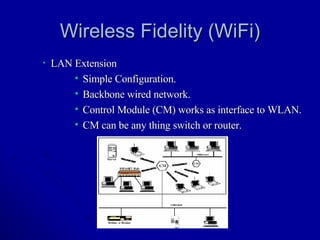
Wireless Fidelity (WiFi) LAN Extension Simple Configuration. Backbone wired network. Control Module (CM) works as interface to WLAN. CM can be any thing switch or router.
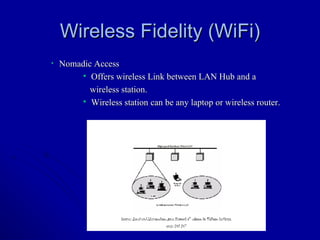
Wireless Fidelity (WiFi) Nomadic Access Offers wireless Link between LAN Hub and a  wireless station. Wireless station can be any laptop or wireless router.
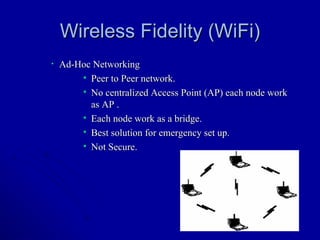
Wireless Fidelity (WiFi) Ad-Hoc Networking Peer to Peer network. No centralized Access Point (AP) each node work as AP . Each node work as a bridge. Best solution for emergency set up. Not Secure.
Wireless Fidelity (WiFi) Types of WiFi There are many standards I will discuss the most common: 802.11b Introduced in 1999. Works on 2.40 and 2.4835GHz band. Theoretical data rate up to 11Mbps on average its 4 to 6Mbps.  Coverage area 75 to 100 meters. Interference can be caused by microwave ovens, cordless phones and bluetooth devices.
Wireless Fidelity (WiFi) 802.11a Introduced in 2003. Works on 5.725 to 5.850 GHz. Data rate up to 54Mbps. Average data rate is 6,12 and 24Mbps, practical throughput is 20 to 25Mbps. Range up to 25 meters. No interference with microwave or phones.
Wireless Fidelity (WiFi) 802.11g Introduced in 2003. Data rate 54Mbps. Works on 2.40 to 2.4835GHz. Compatible with 802.11b. Coverage area 75 to 100meters.
Worldwide Interoperability Microwave Access (WiMAX)  Introduction Created a revolution in the communication world. Non Line of Sight (LOS) communication. Alternative to wired DSL, T1/E1 variants. IEEE standard 802.16. Works on Orthogonal Frequency Division Multiplexing (OFDM). Bandwidth 70Mbps or 2 to 10Mbps/user in 6miles. Frequency band 10 to 66GHz
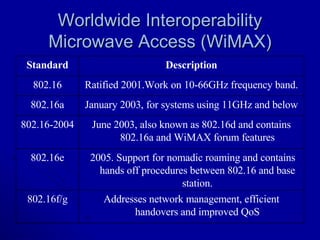
Worldwide Interoperability Microwave Access (WiMAX) Addresses network management, efficient handovers and improved QoS 802.16f/g 2005. Support for nomadic roaming and contains hands off procedures between 802.16 and base station. 802.16e June 2003, also known as 802.16d and contains 802.16a and WiMAX forum features 802.16-2004 January 2003, for systems using 11GHz and below 802.16a Ratified 2001.Work on 10-66GHz frequency band. 802.16 Description Standard
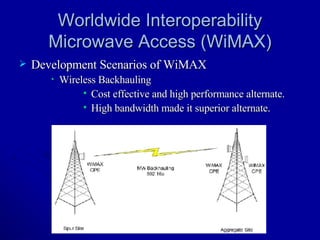
Worldwide Interoperability Microwave Access (WiMAX) Development Scenarios of WiMAX Wireless Backhauling Cost effective and high performance alternate. High bandwidth made it superior alternate.
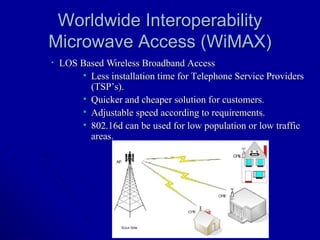
Worldwide Interoperability Microwave Access (WiMAX) LOS Based Wireless Broadband Access Less installation time for Telephone Service Providers (TSP’s). Quicker and cheaper solution for customers. Adjustable speed according to requirements. 802.16d can be used for low population or low traffic areas.
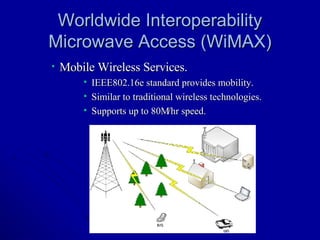
Worldwide Interoperability Microwave Access (WiMAX) Mobile Wireless Services. IEEE802.16e standard provides mobility. Similar to traditional wireless technologies. Supports up to 80M/hr speed.
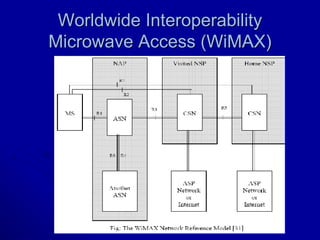
Worldwide Interoperability Microwave Access (WiMAX) WiMAX Architecture: In 802.16 IEEE limited itself to MAC and PHY layer. WiMAX forum is working on End to End architecture. Major components of the architecture are: ASN CSN
Worldwide Interoperability Microwave Access (WiMAX) ASN Access Service Network Network may have one or more than one ASN Gateways. ASN manages MAC access functions like, Paging, Radio Resource Management (RRM) and mobility between stations. Radio level management is done by ASN.
Worldwide Interoperability Microwave Access (WiMAX) CSN Connectivity Service Network. Manages gateways for Internet Access, routers, proxies for AAA, IP allocation, Servers, Internetworking devices, admission and policy control and user database. Topology Support Point to Point Point to Multipoint Mesh Network
Worldwide Interoperability Microwave Access (WiMAX)
Conclusion Future of Wireless Handheld devices. Providing flexibility and portability to different enviourment since different regions have different regulations. Reducing interference between different technologies. New high speed data networks. Improving security.
Further Work In my research paper I will be working on: Mobility in WiMAX.
Wireless Digital Subscriber Line

  • 1.
    Wireless Digital SubscriberLine (WDSL) Presented By: Kashif Akram Student ID: 04910284 MSc Mobile Computer Systems Presented To: John Byrne (Supervisor) John Cowley (Second Assessor)
  • 2.
    Contents Wireless CommunicationDigital Subscriber Line (DSL). Wireless Fldelity (WiFi) World Interoperability for Microwave Access (WiMAX) Conclusion Further Work
  • 3.
    Wireless Communication IntroductionFuture of Handheld devices. Development in last 15 to 20 years. Cost effectiveness and portability. Easy to install. Evolution of Wireless Networks Wireless Communication in old times. First Wireless Communication System 1895 by Guglielmo Marconi. (Distance 18 miles) 1902 first bidirectional communication system across the Atlantic Ocean from Cornwall to Newfoundland.
  • 4.
    Wireless Communication EarlyMobile Telephony: 1946, Mobile Telephone System (MTS). Introduced in 25 cities of USA. Analogue and half duplex System. Manual Call Switching. Limited channels in some cases there are only 3 channels. 1960, new version of MTS Improved Mobile Telephony System (IMTS) Full duplex. Automatic Call Switching and 23 channels can be used simultaneously.
  • 5.
    Wireless Communication AnalogueCellular Telephony or 1 st Generation (1G) IMTS transmitters producing interference. Not efficient use of spectrum. During 1950’s and 1960’s AT&T Bell Lab introduced new concept of cellular networks. Switching cells without the noticeable degradation of voice call. In 1982, Advance Mobile Phone Systems (AMPS), the first commercial analogue system in USA. Total Access Communication System (TACS) adjacent to AMPS, introduced in UK, Spain, Italy, Austria and Ireland.
  • 6.
    Wireless Communication DigitalCellular Telephony or 2 nd Generation (2G) In this the data was represented digitally. Short Messaging Service Support. 10kbps Caller ID. Global System for Mobile Communication (GSM) Works on 900, 1800, 1900 MHz frequency band. The system uses 1800 MHz frequency band is known as DCS 1800. 1982 2G activities started in Europe. A Study Group named Group Special Mobile was created for specify a common European Standards later on named as Global Systems for Mobile Communication (GSM). First deployment 1992.
  • 7.
    Wireless Communication HighSpeed Circuit Switch Data (HSCSD) and General Packet Radio Service (GPRS) GSM is compatible with both the technologies. HSCSD More time slots per frame result better data rate. Date rates 57.6, 43.2 and 28.8Kbps. Support asymmetric communication. GPRS Works on HSCSD principle more time slots per frame. Bandwidth on demand. Supports data rate from 14.4Kbps to 115.2Kbps Supports Symmetric and Asymmetric communication
  • 8.
    Wireless Communication IS951993 new standard of 2G IS95 or CDMAOne. Works on Code Division Multiple Access (CDMA) Data rate 4.8 to 14.4Kbps Newer version IS95b or CDMATwo Data rate 115.2Kbps D-AMPS 1996 advance version of IS95, the IS136 or D-AMPS introduced. Data rate 3Kbps. Enhancement of D-AMPS is D-AMPS+ D-AMPS+ offers date rate 9.6 to 19.2Kbps. Compatible with IS95.
  • 9.
    Wireless Communication ThirdGeneration (3G) Increasing user demands. EDGE Enhancement Data Rates for Global Evolution Time Division Multiple Access (TDMA) based modulation Theoretical data rate up to 473.6Kbps but practically it is around 68kbps. Backward compatibility GSM. CDMA-2000 Enhancement to Code Division Multiple Access. Data rate 2Mbps Backward compatibility IS95.
  • 10.
    Wireless Communication W-CDMAWideband Code Division Multiple Access. Uses 5MHz wideband and offers 2Mbps. Fourth Generation (4G) Aim is high data rate up to 100Mbps Quality of Service (QoS) Improved Security Uninterrupted operation across networks.
  • 11.
    Digital Subscriber LineIntroduction Developed in 1989. Main purpose was video streaming. Data rate up to 6Mbps. Asymmetric communication. Types of DSL ADSL Asymmetric Digital Subscriber Line. Designed for home users. Download speed from 1.5 to 9Mbps. Upload speed is around 1.5Mbps.
  • 12.
    Digital Subscriber LineADSL Lite Low speed version of ADSL. Download speed 1Mbps. Upload speed 512Kbps. Within the range of 18000 feet from service provider. R-ADSL Rate Adaptive Digital Subscriber Line. Same data rates as ADSL but in this the modem can be adjusted variably according to the length of line and quality.
  • 13.
    Digital Subscriber LineHDSL High bit rate Digital Subscriber Line. Symmetric connectivity. Data rate 1.544 to 2.048Mbps Distance from service provider 12000 to 15000 feet. Designed for video conferencing. SDSL Symmetric Digital Subscriber Line. Designed for business applications. Speed from 192Kbps to 1.1Mbps.
  • 14.
    Digital Subscriber LineIDSL ISDN Digital Subscriber Line Data rate 144Kbps which is slightly higher than ISDN 128Kbps VDSL Very High Bit Rate Digital Subscriber Line Fastest in all DSL types. Data rates 13-52Mbps downstream and 1.5 to 2.3Mbps upstream. Distance 1000 to 4500 feet from service provider end.
  • 15.
    Digital Subscriber LineDSL Equipment DSLAM Digital Subscriber Line Access Multiplexer. DSL Multiplexer connects DSL lines with ATM, frame relay or internet protocols. Supports Quality of Service features like contention, diffserv and priority queues. The common upstream link in the DSLAM use Giga bit Ethernet or multi Giga bit fibre optic links. However not a full stateful firewall, some DSLAM’s offers packet filtering. DSLAM acts like a massive network switch.
  • 16.
    Digital Subscriber LineATM Asynchronous Transfer Mode. Designed for voice networks. Still used for voice and TDM services but majorly used for data networks. Guaranteed bandwidth at customer end. Installed with network backbone router to assure QoS with high reliability. There is a virtual connection between ATM and Customer Premises Equipment (CPE) using DSLAM.
  • 17.
  • 18.
    Digital Subscriber LineBRAS Broadband Remote Access Server. Aggregates traffic from big number of users to reduce cost per user. Perform number of functions: Accounting, Authentication and Authorization (AAA) VPN Tunnelling Full IP routing Multi Protocol Label Switching (MPLS)
  • 19.
    Wireless Fidelity (WiFi)Introduction Introduced in 1994 by WiFi Alliance. 1997 IEEE defined WiFi as standard 802.11. 1999 802.11b was introduced. 2002 802.11g was introduced. Works on 2.4GHz and 5GHz Implementation There are three methods to implement LAN Extension Nomadic Access Ad-Hoc Networking
  • 20.
    Wireless Fidelity (WiFi)LAN Extension Simple Configuration. Backbone wired network. Control Module (CM) works as interface to WLAN. CM can be any thing switch or router.
  • 21.
    Wireless Fidelity (WiFi)Nomadic Access Offers wireless Link between LAN Hub and a wireless station. Wireless station can be any laptop or wireless router.
  • 22.
    Wireless Fidelity (WiFi)Ad-Hoc Networking Peer to Peer network. No centralized Access Point (AP) each node work as AP . Each node work as a bridge. Best solution for emergency set up. Not Secure.
  • 23.
    Wireless Fidelity (WiFi)Types of WiFi There are many standards I will discuss the most common: 802.11b Introduced in 1999. Works on 2.40 and 2.4835GHz band. Theoretical data rate up to 11Mbps on average its 4 to 6Mbps. Coverage area 75 to 100 meters. Interference can be caused by microwave ovens, cordless phones and bluetooth devices.
  • 24.
    Wireless Fidelity (WiFi)802.11a Introduced in 2003. Works on 5.725 to 5.850 GHz. Data rate up to 54Mbps. Average data rate is 6,12 and 24Mbps, practical throughput is 20 to 25Mbps. Range up to 25 meters. No interference with microwave or phones.
  • 25.
    Wireless Fidelity (WiFi)802.11g Introduced in 2003. Data rate 54Mbps. Works on 2.40 to 2.4835GHz. Compatible with 802.11b. Coverage area 75 to 100meters.
  • 26.
    Worldwide Interoperability MicrowaveAccess (WiMAX) Introduction Created a revolution in the communication world. Non Line of Sight (LOS) communication. Alternative to wired DSL, T1/E1 variants. IEEE standard 802.16. Works on Orthogonal Frequency Division Multiplexing (OFDM). Bandwidth 70Mbps or 2 to 10Mbps/user in 6miles. Frequency band 10 to 66GHz
  • 27.
    Worldwide Interoperability MicrowaveAccess (WiMAX) Addresses network management, efficient handovers and improved QoS 802.16f/g 2005. Support for nomadic roaming and contains hands off procedures between 802.16 and base station. 802.16e June 2003, also known as 802.16d and contains 802.16a and WiMAX forum features 802.16-2004 January 2003, for systems using 11GHz and below 802.16a Ratified 2001.Work on 10-66GHz frequency band. 802.16 Description Standard
  • 28.
    Worldwide Interoperability MicrowaveAccess (WiMAX) Development Scenarios of WiMAX Wireless Backhauling Cost effective and high performance alternate. High bandwidth made it superior alternate.
  • 29.
    Worldwide Interoperability MicrowaveAccess (WiMAX) LOS Based Wireless Broadband Access Less installation time for Telephone Service Providers (TSP’s). Quicker and cheaper solution for customers. Adjustable speed according to requirements. 802.16d can be used for low population or low traffic areas.
  • 30.
    Worldwide Interoperability MicrowaveAccess (WiMAX) Mobile Wireless Services. IEEE802.16e standard provides mobility. Similar to traditional wireless technologies. Supports up to 80M/hr speed.
  • 31.
    Worldwide Interoperability MicrowaveAccess (WiMAX) WiMAX Architecture: In 802.16 IEEE limited itself to MAC and PHY layer. WiMAX forum is working on End to End architecture. Major components of the architecture are: ASN CSN
  • 32.
    Worldwide Interoperability MicrowaveAccess (WiMAX) ASN Access Service Network Network may have one or more than one ASN Gateways. ASN manages MAC access functions like, Paging, Radio Resource Management (RRM) and mobility between stations. Radio level management is done by ASN.
  • 33.
    Worldwide Interoperability MicrowaveAccess (WiMAX) CSN Connectivity Service Network. Manages gateways for Internet Access, routers, proxies for AAA, IP allocation, Servers, Internetworking devices, admission and policy control and user database. Topology Support Point to Point Point to Multipoint Mesh Network
  • 34.
  • 35.
    Conclusion Future ofWireless Handheld devices. Providing flexibility and portability to different enviourment since different regions have different regulations. Reducing interference between different technologies. New high speed data networks. Improving security.
  • 36.
    Further Work Inmy research paper I will be working on: Mobility in WiMAX.