

Branch and Bound Algorithm:

  Its Application to Binary Integer
            Programming
             A.Tannouri
Concept
The idea behind the branch and bound
  algorithm is to “Divide and Conquer”. This is
  achieved by:
                   • Branching
                    • Bounding
                   • Fathoming
Branching
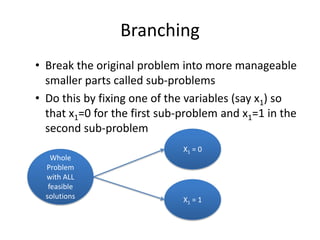
• Break the original problem into more manageable
  smaller parts called sub-problems
• Do this by fixing one of the variables (say x1) so
  that x1=0 for the first sub-problem and x1=1 in the
  second sub-problem
                              X1 = 0
    Whole
  Problem
  with ALL
   feasible
  solutions                   X1 = 1
Bounding
• The goal is to find a bound on how good the best
  feasible solution can be for each sub-problem.
• This is done by relaxing a constraint (typically the
  binary constraint). This type of relaxation is called
  LP relaxation.
• Using the simplex method solve the problem and
  get the value of Z
• Any Z value that is found as a can be rounded
  down to make it an integer if it isn’t one already
Fathoming
• The goal is to determine what sub-problems
  we can dismiss from consideration. If it is
  “fathomed” then it is dismissed
• A sub-problem is fathomed if it passes one of
  the following tests:
     • Test 1: Its bound ≤ Z*
     • Test 2: Its LP relaxation has no feasible solutions
     • Test 3: If an integer is obtained as the optimal solution
       for the LP relaxation
Summary
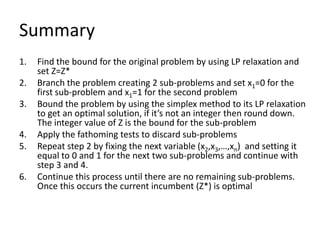
1.   Find the bound for the original problem by using LP relaxation and
     set Z=Z*
2.   Branch the problem creating 2 sub-problems and set x1=0 for the
     first sub-problem and x1=1 for the second problem
3.   Bound the problem by using the simplex method to its LP relaxation
     to get an optimal solution, if it’s not an integer then round down.
     The integer value of Z is the bound for the sub-problem
4.   Apply the fathoming tests to discard sub-problems
5.   Repeat step 2 by fixing the next variable (x2,x3,…,xn) and setting it
     equal to 0 and 1 for the next two sub-problems and continue with
     step 3 and 4.
6.   Continue this process until there are no remaining sub-problems.
     Once this occurs the current incumbent (Z*) is optimal
Initial Problem
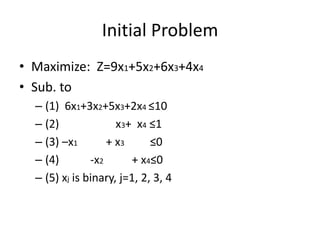
• Maximize: Z=9x1+5x2+6x3+4x4
• Sub. to
  – (1) 6x1+3x2+5x3+2x4 ≤10
  – (2)              x3+ x4 ≤1
  – (3) –x1        + x3      ≤0
  – (4)        -x2       + x4≤0
  – (5) xj is binary, j=1, 2, 3, 4
Sub-problem 1
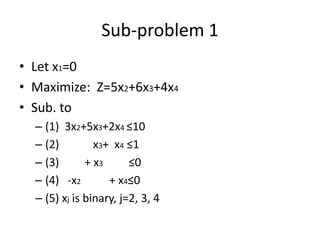
• Let x1=0
• Maximize: Z=5x2+6x3+4x4
• Sub. to
  – (1) 3x2+5x3+2x4 ≤10
  – (2)         x3+ x4 ≤1
  – (3)       + x3      ≤0
  – (4) -x2        + x4≤0
  – (5) xj is binary, j=2, 3, 4
Sub-problem 2
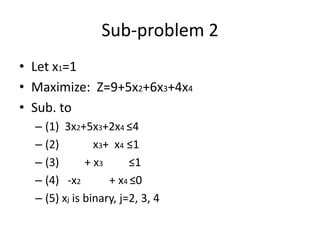
• Let x1=1
• Maximize: Z=9+5x2+6x3+4x4
• Sub. to
  – (1) 3x2+5x3+2x4 ≤4
  – (2)         x3+ x4 ≤1
  – (3)       + x3      ≤1
  – (4) -x2        + x4 ≤0
  – (5) xj is binary, j=2, 3, 4
Relaxation
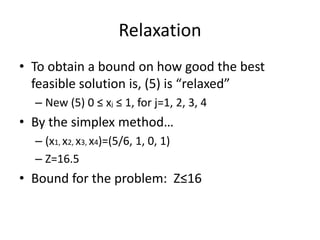
• To obtain a bound on how good the best
  feasible solution is, (5) is “relaxed”
  – New (5) 0 ≤ xj ≤ 1, for j=1, 2, 3, 4
• By the simplex method…
  – (x1, x2, x3, x4)=(5/6, 1, 0, 1)
  – Z=16.5
• Bound for the problem: Z≤16
Relaxation of Sub-problems
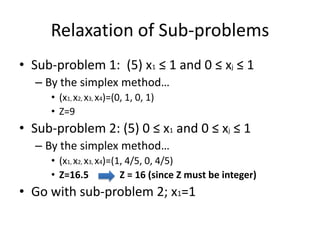
• Sub-problem 1: (5) x1 ≤ 1 and 0 ≤ xj ≤ 1
  – By the simplex method…
     • (x1, x2, x3, x4)=(0, 1, 0, 1)
     • Z=9
• Sub-problem 2: (5) 0 ≤ x1 and 0 ≤ xj ≤ 1
  – By the simplex method…
     • (x1, x2, x3, x4)=(1, 4/5, 0, 4/5)
     • Z=16.5             Z = 16 (since Z must be integer)
• Go with sub-problem 2; x1=1
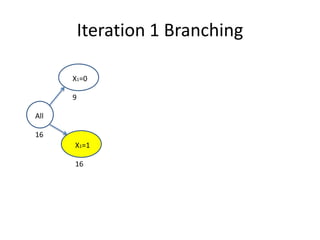
Iteration 1 Branching

      X1=0

      9

All

16
      X1=1

      16
Iteration 2;
                  Sub-problem 3
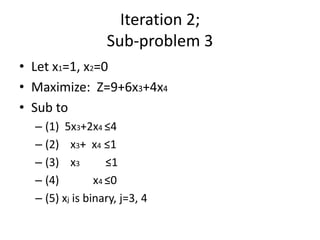
• Let x1=1, x2=0
• Maximize: Z=9+6x3+4x4
• Sub to
  – (1) 5x3+2x4 ≤4
  – (2) x3+ x4 ≤1
  – (3) x3         ≤1
  – (4)         x4 ≤0
  – (5) xj is binary, j=3, 4
Iteration 2;
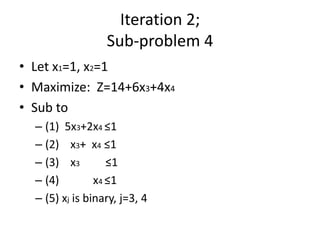
                  Sub-problem 4
• Let x1=1, x2=1
• Maximize: Z=14+6x3+4x4
• Sub to
  – (1) 5x3+2x4 ≤1
  – (2) x3+ x4 ≤1
  – (3) x3         ≤1
  – (4)         x4 ≤1
  – (5) xj is binary, j=3, 4
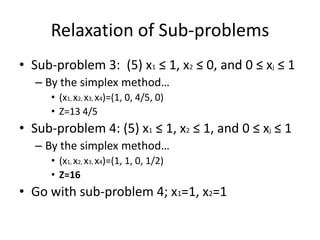
Relaxation of Sub-problems
• Sub-problem 3: (5) x1 ≤ 1, x2 ≤ 0, and 0 ≤ xj ≤ 1
  – By the simplex method…
     • (x1, x2, x3, x4)=(1, 0, 4/5, 0)
     • Z=13 4/5
• Sub-problem 4: (5) x1 ≤ 1, x2 ≤ 1, and 0 ≤ xj ≤ 1
  – By the simplex method…
     • (x1, x2, x3, x4)=(1, 1, 0, 1/2)
     • Z=16
• Go with sub-problem 4; x1=1, x2=1
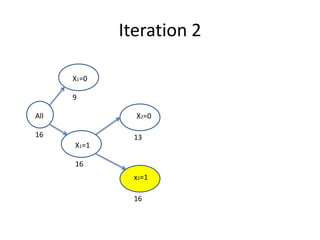
Iteration 2

      X1=0

      9

All            X2=0

16             13
      X1=1

      16
               x2=1

               16
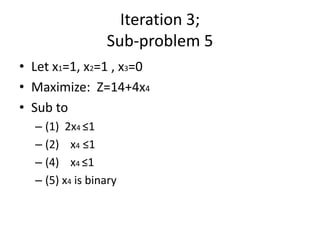
Iteration 3;
                 Sub-problem 5
• Let x1=1, x2=1 , x3=0
• Maximize: Z=14+4x4
• Sub to
  – (1) 2x4 ≤1
  – (2) x4 ≤1
  – (4) x4 ≤1
  – (5) x4 is binary
Iteration 3;
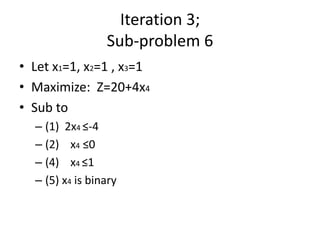
                 Sub-problem 6
• Let x1=1, x2=1 , x3=1
• Maximize: Z=20+4x4
• Sub to
  – (1) 2x4 ≤-4
  – (2) x4 ≤0
  – (4) x4 ≤1
  – (5) x4 is binary
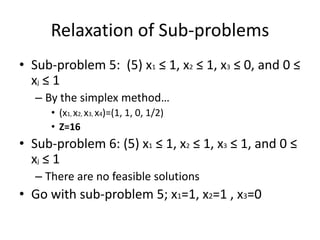
Relaxation of Sub-problems
• Sub-problem 5: (5) x1 ≤ 1, x2 ≤ 1, x3 ≤ 0, and 0 ≤
  xj ≤ 1
  – By the simplex method…
     • (x1, x2, x3, x4)=(1, 1, 0, 1/2)
     • Z=16
• Sub-problem 6: (5) x1 ≤ 1, x2 ≤ 1, x3 ≤ 1, and 0 ≤
  xj ≤ 1
  – There are no feasible solutions
• Go with sub-problem 5; x1=1, x2=1 , x3=0
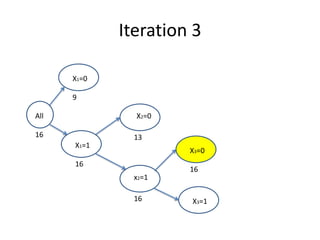
Iteration 3

      X1=0

      9

All            X2=0

16             13
      X1=1
                      X3=0
      16
                      16
               x2=1

               16     X3=1
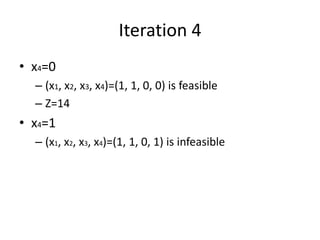
Iteration 4
• x4=0
  – (x1, x2, x3, x4)=(1, 1, 0, 0) is feasible
  – Z=14
• x4=1
  – (x1, x2, x3, x4)=(1, 1, 0, 1) is infeasible
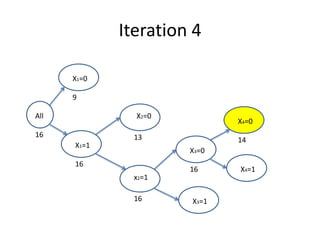
Iteration 4

      X1=0

      9

All            X2=0
                             X4=0
16             13            14
      X1=1
                      X3=0
      16
                      16     X4=1
               x2=1

               16     X3=1
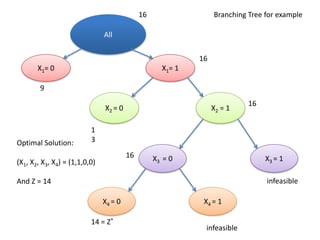
16                   Branching Tree for example

                               All

                                                             16
       X1 = 0                                       X1 = 1

        9
                                                                            16
                               X2 = 0                             X2 = 1

                          1
Optimal Solution:         3
                                        16        X3 = 0                         X3 = 1
(X1, X2, X3, X4) = (1,1,0,0)

And Z = 14                                                                       infeasible

                               X4 = 0                         X4 = 1

                          14 = Z*
                                                              infeasible

Branch&bound at

  • 1.
    Branch and BoundAlgorithm: Its Application to Binary Integer Programming A.Tannouri
  • 2.
    Concept The idea behindthe branch and bound algorithm is to “Divide and Conquer”. This is achieved by: • Branching • Bounding • Fathoming
  • 3.
    Branching • Break theoriginal problem into more manageable smaller parts called sub-problems • Do this by fixing one of the variables (say x1) so that x1=0 for the first sub-problem and x1=1 in the second sub-problem X1 = 0 Whole Problem with ALL feasible solutions X1 = 1
  • 4.
    Bounding • The goalis to find a bound on how good the best feasible solution can be for each sub-problem. • This is done by relaxing a constraint (typically the binary constraint). This type of relaxation is called LP relaxation. • Using the simplex method solve the problem and get the value of Z • Any Z value that is found as a can be rounded down to make it an integer if it isn’t one already
  • 5.
    Fathoming • The goalis to determine what sub-problems we can dismiss from consideration. If it is “fathomed” then it is dismissed • A sub-problem is fathomed if it passes one of the following tests: • Test 1: Its bound ≤ Z* • Test 2: Its LP relaxation has no feasible solutions • Test 3: If an integer is obtained as the optimal solution for the LP relaxation
  • 6.
    Summary 1. Find the bound for the original problem by using LP relaxation and set Z=Z* 2. Branch the problem creating 2 sub-problems and set x1=0 for the first sub-problem and x1=1 for the second problem 3. Bound the problem by using the simplex method to its LP relaxation to get an optimal solution, if it’s not an integer then round down. The integer value of Z is the bound for the sub-problem 4. Apply the fathoming tests to discard sub-problems 5. Repeat step 2 by fixing the next variable (x2,x3,…,xn) and setting it equal to 0 and 1 for the next two sub-problems and continue with step 3 and 4. 6. Continue this process until there are no remaining sub-problems. Once this occurs the current incumbent (Z*) is optimal
  • 7.
    Initial Problem • Maximize:Z=9x1+5x2+6x3+4x4 • Sub. to – (1) 6x1+3x2+5x3+2x4 ≤10 – (2) x3+ x4 ≤1 – (3) –x1 + x3 ≤0 – (4) -x2 + x4≤0 – (5) xj is binary, j=1, 2, 3, 4
  • 8.
    Sub-problem 1 • Letx1=0 • Maximize: Z=5x2+6x3+4x4 • Sub. to – (1) 3x2+5x3+2x4 ≤10 – (2) x3+ x4 ≤1 – (3) + x3 ≤0 – (4) -x2 + x4≤0 – (5) xj is binary, j=2, 3, 4
  • 9.
    Sub-problem 2 • Letx1=1 • Maximize: Z=9+5x2+6x3+4x4 • Sub. to – (1) 3x2+5x3+2x4 ≤4 – (2) x3+ x4 ≤1 – (3) + x3 ≤1 – (4) -x2 + x4 ≤0 – (5) xj is binary, j=2, 3, 4
  • 10.
    Relaxation • To obtaina bound on how good the best feasible solution is, (5) is “relaxed” – New (5) 0 ≤ xj ≤ 1, for j=1, 2, 3, 4 • By the simplex method… – (x1, x2, x3, x4)=(5/6, 1, 0, 1) – Z=16.5 • Bound for the problem: Z≤16
  • 11.
    Relaxation of Sub-problems •Sub-problem 1: (5) x1 ≤ 1 and 0 ≤ xj ≤ 1 – By the simplex method… • (x1, x2, x3, x4)=(0, 1, 0, 1) • Z=9 • Sub-problem 2: (5) 0 ≤ x1 and 0 ≤ xj ≤ 1 – By the simplex method… • (x1, x2, x3, x4)=(1, 4/5, 0, 4/5) • Z=16.5 Z = 16 (since Z must be integer) • Go with sub-problem 2; x1=1
  • 12.
    Iteration 1 Branching X1=0 9 All 16 X1=1 16
  • 13.
    Iteration 2; Sub-problem 3 • Let x1=1, x2=0 • Maximize: Z=9+6x3+4x4 • Sub to – (1) 5x3+2x4 ≤4 – (2) x3+ x4 ≤1 – (3) x3 ≤1 – (4) x4 ≤0 – (5) xj is binary, j=3, 4
  • 14.
    Iteration 2; Sub-problem 4 • Let x1=1, x2=1 • Maximize: Z=14+6x3+4x4 • Sub to – (1) 5x3+2x4 ≤1 – (2) x3+ x4 ≤1 – (3) x3 ≤1 – (4) x4 ≤1 – (5) xj is binary, j=3, 4
  • 15.
    Relaxation of Sub-problems •Sub-problem 3: (5) x1 ≤ 1, x2 ≤ 0, and 0 ≤ xj ≤ 1 – By the simplex method… • (x1, x2, x3, x4)=(1, 0, 4/5, 0) • Z=13 4/5 • Sub-problem 4: (5) x1 ≤ 1, x2 ≤ 1, and 0 ≤ xj ≤ 1 – By the simplex method… • (x1, x2, x3, x4)=(1, 1, 0, 1/2) • Z=16 • Go with sub-problem 4; x1=1, x2=1
  • 16.
    Iteration 2 X1=0 9 All X2=0 16 13 X1=1 16 x2=1 16
  • 17.
    Iteration 3; Sub-problem 5 • Let x1=1, x2=1 , x3=0 • Maximize: Z=14+4x4 • Sub to – (1) 2x4 ≤1 – (2) x4 ≤1 – (4) x4 ≤1 – (5) x4 is binary
  • 18.
    Iteration 3; Sub-problem 6 • Let x1=1, x2=1 , x3=1 • Maximize: Z=20+4x4 • Sub to – (1) 2x4 ≤-4 – (2) x4 ≤0 – (4) x4 ≤1 – (5) x4 is binary
  • 19.
    Relaxation of Sub-problems •Sub-problem 5: (5) x1 ≤ 1, x2 ≤ 1, x3 ≤ 0, and 0 ≤ xj ≤ 1 – By the simplex method… • (x1, x2, x3, x4)=(1, 1, 0, 1/2) • Z=16 • Sub-problem 6: (5) x1 ≤ 1, x2 ≤ 1, x3 ≤ 1, and 0 ≤ xj ≤ 1 – There are no feasible solutions • Go with sub-problem 5; x1=1, x2=1 , x3=0
  • 20.
    Iteration 3 X1=0 9 All X2=0 16 13 X1=1 X3=0 16 16 x2=1 16 X3=1
  • 21.
    Iteration 4 • x4=0 – (x1, x2, x3, x4)=(1, 1, 0, 0) is feasible – Z=14 • x4=1 – (x1, x2, x3, x4)=(1, 1, 0, 1) is infeasible
  • 22.
    Iteration 4 X1=0 9 All X2=0 X4=0 16 13 14 X1=1 X3=0 16 16 X4=1 x2=1 16 X3=1
  • 23.
    16 Branching Tree for example All 16 X1 = 0 X1 = 1 9 16 X2 = 0 X2 = 1 1 Optimal Solution: 3 16 X3 = 0 X3 = 1 (X1, X2, X3, X4) = (1,1,0,0) And Z = 14 infeasible X4 = 0 X4 = 1 14 = Z* infeasible

Editor's Notes

  • #8 Because the problem is binary, set x1 to 0 and to 1 to create two sub-problems.
  • #11 Instead of solving the problem, we solve a more simple “relaxed” version of the problem. This is done by removing the most troublesome constraint; i.e. that xj is binary. Use the original problem to find the bound. Fathoming: Z*=16=incumbent
  • #12 Sub-problem 1 no longer needs to be considered, as 9 is not a better solution than 16 (the bound of the initial problem). Sub-problem 1 is fathomed/dismissed. We continue forward with sub-problem 2, x1=1
  • #16 Both of these are larger than 9 (x1=0), but sub-problem 4 (16) results in a larger value than sub-problem 3 (13 4/5). Neither sub-problems are fathomed at this point (they are larger than 9, have feasible solutions and include variables with non-interger values).
  • #20 Sub-problem 6 is infeasible and therefore fathomed/dismissed. Continue on with sub-problem 5
  • #22 X4=0 is the only feasible solution here, it is also the optimal solution for the problem. X4=0 passes test 3 (14 > 9), x4=1 passes test 2.Sub-problem 3: 13 <= 14; therefore sub-problem 3 is fathomed proving sub-problem 4 was the correct way to go.
  • #23 (x1, x2, x3, x4)=(1, 1, 0, 0) Z=14