


Department of Plastic
And Reconstructive
Surgery
Sher i Kashmir Institute of
Medical Sciences Srinagar
Seminar Topic : SKIN FLAPS
Skin FLAPS
Presentor : Dr Junaid khiurshid
Moderator : Dr Altaf Rasool
Definition
A flap is a unit of tissue that is transferred from
donor site to recipient site while maintaining its
own blood supply.
Term “Flap”
Originated from the 16th century Dutch word
“FLAPPE” which means “anything that hung broad
and loose, fastened only by one side
Timeline
• 600 BC Sushruta Samhita Pedicle flaps in the face
and forehead for nasal reconstruction
• 1597 Tagliacozzi Nasal reconstruction by tubed
pedicle flap from arm; described “delay” of pedicle
flap
• 1896 Tansini Latissimus dorsi musculocutaneous
flap for breast reconstruction (post- mastectomy)
• 1920 Gillies Tubed pedicle flap
• 1946 Stark Muscle flaps for osteomyelitis
• 1955 Owens Compound neck flap
• 1963 McGregor Temporalis flap
• 1965 Bakamjian Deltopectoral flap
• 1971 Ger Lower extremity musculocutaneous flap
• 1972 McGregor and Jackson Groin flap
• 1972 Orticochea Musculocutaneous flaps
• 1977 Mc Craw et al Musculocutaneous territories
• 1981 Mathes and Nahai Classification of muscle
flaps based on vascular anatomy
• 1981 Ponten described fasciocutaneous flap
HISTORY : CUTANEOUS
CIRCULATION
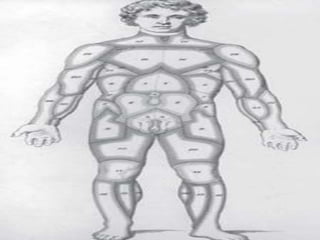
Carl Manchot (1889 )
• Performed the first examination of the vascular
supply of the human integument.
• 40 cutaneous territories
• His work “Die Hautarterien des menschlichen
Körpers “ [The Cutaneous Arteries of the Human
Body] was initially published in German and later
translated to English by Milton.
Spalteholz (1893)
• Published paper on the origin, course and
distribution of the cutaneous perforators in adult
and neonatal cadavers.
• He performed arterial injections of gelatin and
various pigments. The soft tissues were fixed in
alcohol and subtracted in xylol and the resulting
vascular network was embedded in Canada
Balsam.
Salmon (1930)
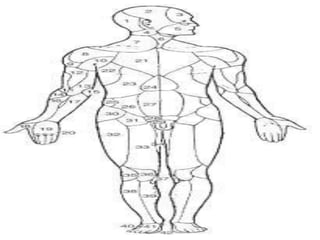
• French anatomist and surgeon charted more than
80 cutaneous territories encompassing the entire
body.
• Salmon dissected 15 human cadavers and took
radiographs of integument which enabled him to
demonstrate much smaller vessel than Manchot
• The blood reaching the skin originates from deep
vessels.
• DANIEL AND WILLIAMS(1973) defined that the deep
vessels supplying skin are fundamentally two type
of arteries i.e. either musculocutaneous or direct
cutaneous arteries
• Originally described as Direct cutaneous arteries ,
are now called as septocutaneous arteries.
Musculo cutaneous
• Origin: Major vessel
supplying muscle
• Travel perpendicularly
through underlying muscle
into the overlying
cutaneous circulation
• Prevalent supply of skin
covering the broad, flat
muscles of the torso.
• Example: latissimus dorsi
flap, rectus abdominis flap
Septo cutaneous
• Origin: segmental or
muscular artery
• Arise originally from either
segmental or
musculocutaneous vessels,
pass directly within
intermuscular fascial
septae
• common between the
longer, thinner muscles of
the extremitie
• Example :Radial forearm
flap, Dorsalis pedis flap
CLASSIFICATION OF FLAPS
BASED ON LOCATION OF DONOR SITE
LOCAL FLAP
Flap transferred from an area adjacent to the defect.
This is the least complex type of flap and includes
advancement flaps, rotation flaps, and transposition
flaps.
REGIONAL FLAP
Regional flaps are not immediately adjacent to the
defect
Instead, the freed tissue "island" is moved over or
underneath normal tissue to reach the defect to be
filled, with the blood supply still connected to the
donor site via a pedicle
Examples PMMC, DP flaps for head and neck defects,
TRAM for breast reconstruction
DISTANT FLAP
Flap transferred from an noncontiguous anatomic
site.
The distant flap can be used as a distant pedicled or
free flap
Flapfailure is a severe complication.
Based on blood supply
Random .blood supply is not derived from a
recognized artery ,rather, from many little unnamed
vessels.eg local cutaneous flaps
Axial flap, blood supply derived from a recognized
artery or group of arteries eg most muscle flaps
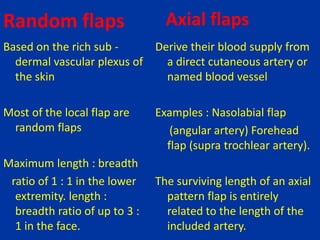
Random flaps
Based on the rich sub -
dermal vascular plexus of
the skin
Most of the local flap are
random flaps
Maximum length : breadth
ratio of 1 : 1 in the lower
extremity. length :
breadth ratio of up to 3 :
1 in the face.
Axial flaps
Derive their blood supply from
a direct cutaneous artery or
named blood vessel
Examples : Nasolabial flap
(angular artery) Forehead
flap (supra trochlear artery).
The surviving length of an axial
pattern flap is entirely
related to the length of the
included artery.
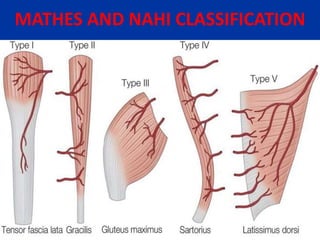
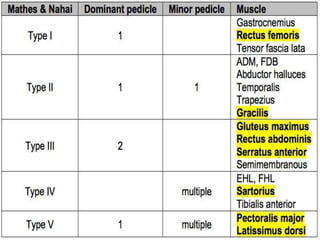
MATHES AND NAHI CLASSIFICATION
CLASSIFICATION OF LOCAL FLAPS
• The composition of the defect to be reconstructed
should dictate the correct composition of the flap
used for reconstruction.
It includes :
• 1.Cutaneous
• 2.Fasciocutaneous
• 3.Musculocutaneous
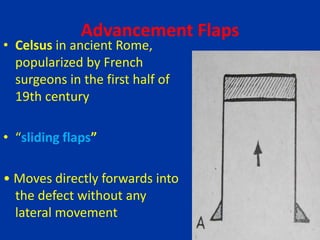
Advancement Flaps
• Celsus in ancient Rome,
popularized by French
surgeons in the first half of
19th century
• “sliding flaps”
• Moves directly forwards into
the defect without any
lateral movement
Advancement Flaps
• Execution is facilitated by presence of excess
Skin
• More feasible in elderly or when skin elasticity is
more like in very young
• Usually rectangular, perpendicular to the lines of
minimal tension
• Uses – forehead , brow
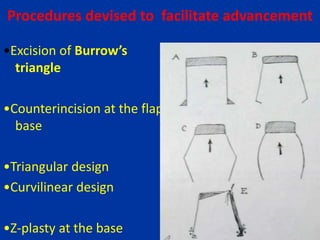
Procedures devised to facilitate advancement
•Excision of Burrow’s
triangle
•Counterincision at the flap
base
•Triangular design
•Curvilinear design
•Z-plasty at the base
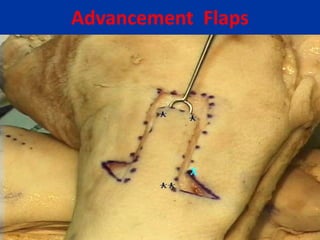
Advancement Flaps
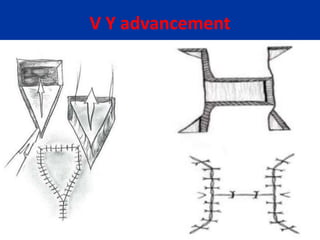
V Y advancement
V-Y Advancement Flap
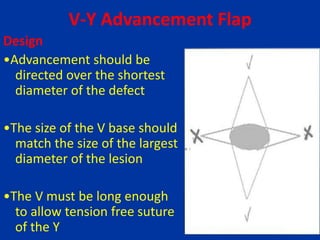
Design
•Advancement should be
directed over the shortest
diameter of the defect
•The size of the V base should
match the size of the largest
diameter of the lesion
•The V must be long enough
to allow tension free suture
of the Y
V-Y Advancement Flap
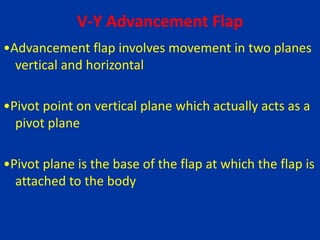
•Advancement flap involves movement in two planes
vertical and horizontal
•Pivot point on vertical plane which actually acts as a
pivot plane
•Pivot plane is the base of the flap at which the flap is
attached to the body
V-Y Advancement Flap
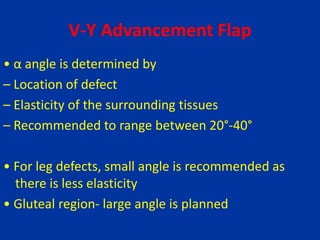
• α angle is determined by
– Location of defect
– Elasticity of the surrounding tissues
– Recommended to range between 20°-40°
• For leg defects, small angle is recommended as
there is less elasticity
• Gluteal region- large angle is planned
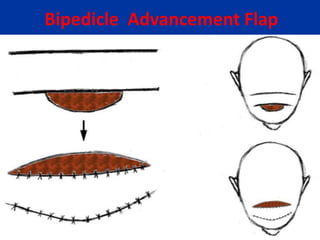
Bipedicle Advancement Flap
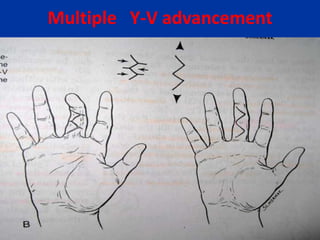
Multiple Y-V advancement
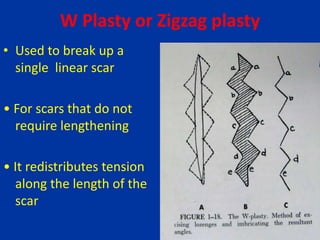
W Plasty or Zigzag plasty
• Used to break up a
single linear scar
• For scars that do not
require lengthening
• It redistributes tension
along the length of the
scar
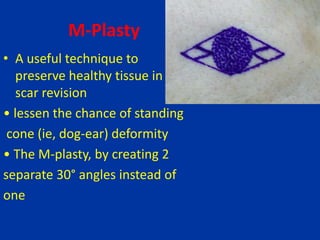
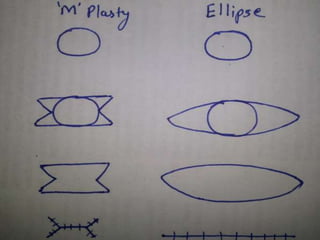
M-Plasty
• A useful technique to
preserve healthy tissue in
scar revision
• lessen the chance of standing
cone (ie, dog-ear) deformity
• The M-plasty, by creating 2
separate 30° angles instead of
one
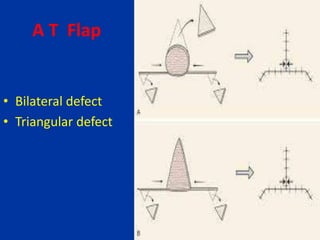
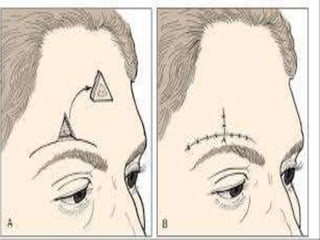
A T Flap
• Bilateral defect
• Triangular defect
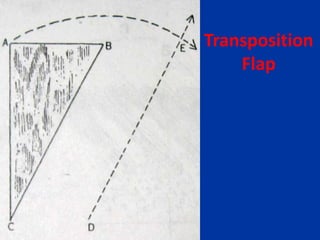
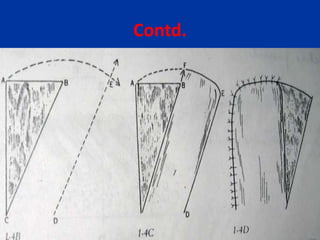
Transposition Flap
• Usually rectangular or square flap.
• Transferred in a direction at right angles to that of
the blood supply.
• Additional length- Back Cut.
Donor site.
– Skin graft
– Another flap
Transposition Flap- DESIGN
Recipient defect is triangulated
– Right angle triangle
– Hypotenuse- near border of the flap
– The right angle assumes a position opposite the flap
– In scalp defects, apex should direct towards the
periphery of the scalp
Transposition
Flap
Contd.
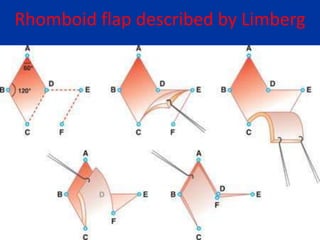
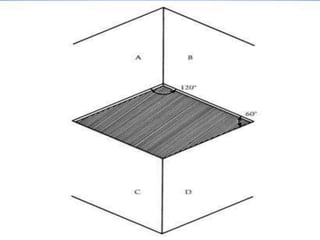
Rhomboid flap described by Limberg
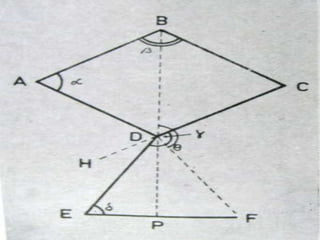
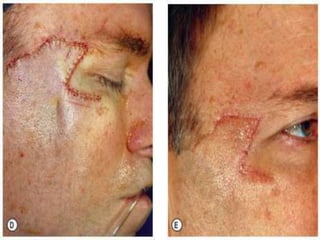
Dufourmentel Flap
• Designed by a French Surgeon, Claude
Dufourmental in 1962
• The defect is tailored in the shape of a rhombus
• The short diagonal (BD) and one of the adjacent
side (CD) are extended
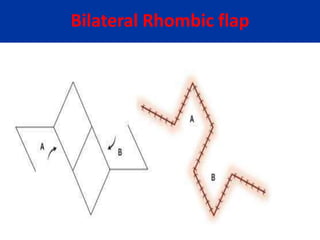
Bilateral Rhombic flap
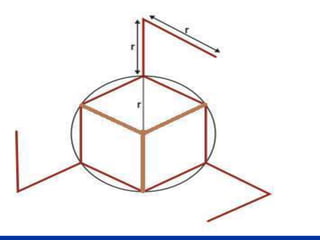
Triple Rhombic flap
• Circular defect conceptualized as hexagon.
• Sides of hexagon are equal to radius (r) of circle.
• First side of flap created by direct extension equal
in length to radius at alternative corners.
• Second side of flap designed parallel to adjacent
side of hexagon.
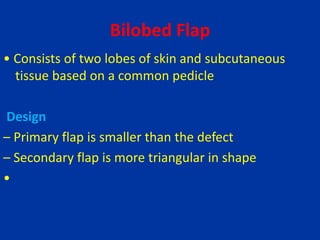
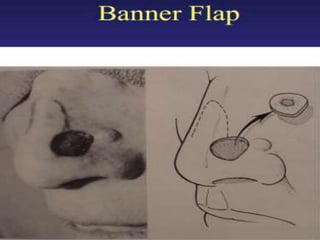
Bilobed Flap
• Consists of two lobes of skin and subcutaneous
tissue based on a common pedicle
Design
– Primary flap is smaller than the defect
– Secondary flap is more triangular in shape
•
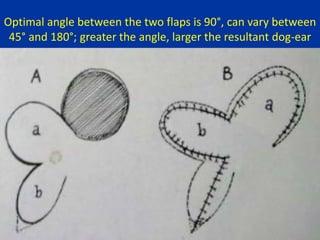
Optimal angle between the two flaps is 90°, can vary between
45° and 180°; greater the angle, larger the resultant dog-ear
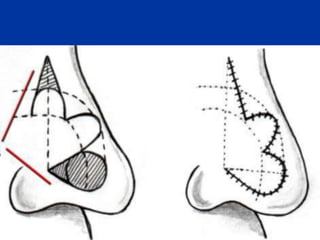
Zitelli's modification (1989)
• Primary flap oriented 45°
• And the secondary 90°
• Convert the defect to a "tear drop" shape
• Use a caliper with one tip placed at the apex of the
wound, to mark out two semicircles
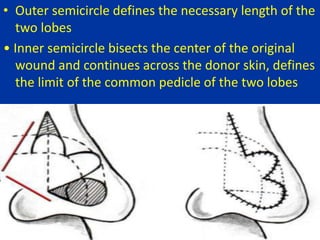
• Outer semicircle defines the necessary length of the
two lobes
• Inner semicircle bisects the center of the original
wound and continues across the donor skin, defines
the limit of the common pedicle of the two lobes
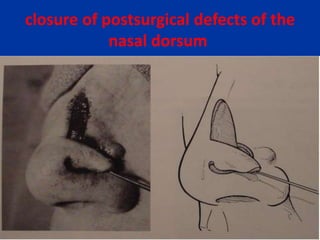
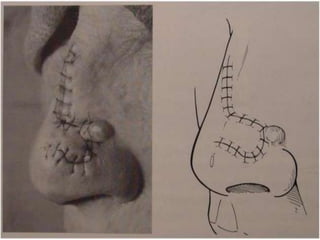
closure of postsurgical defects of the
nasal dorsum
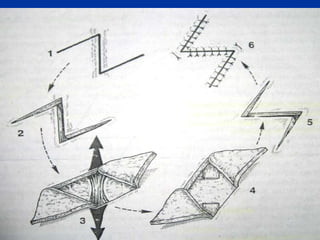
Z Plasty
• Involves transposition of two interdigitating
triangular flaps
• Effects
– Gain in length along the direction of the common
limb of the Z
– Direction of the common limb is changed
• Uses
– Prevention and treatment of contracted scars
– Scar revision
•
In 1856, Denonvilliers first described the Z-plasty
technique as a surgical treatment for lower lid
ectropion.
• The first reference to this technique in American
literature was in 1913, by McCurdy, as treatment for
contracture at the oral commissure.
• Limberg, in 1929, provided a more detailed
geometric description.
• Numerical data showing optimal angles and length
relationships of Z-plasty limbs are credited to Davis
(1946).
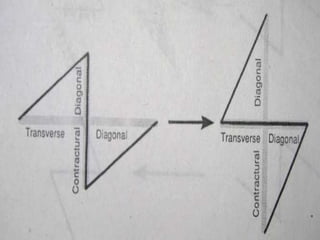
• Release of contracture
– The central limb is placed along the line of
contracture- contractural diagonal
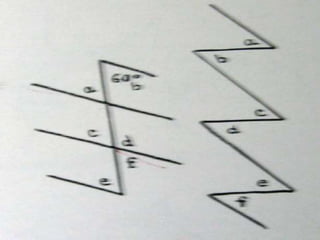
– 60° angle taken on each side and limbs of Z drawn,
all equal in size
– Longer diagonal is the transverse diagonal
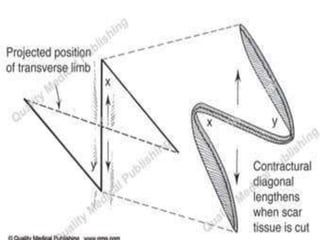
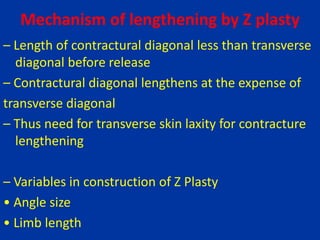
Mechanism of lengthening by Z plasty
– Length of contractural diagonal less than transverse
diagonal before release
– Contractural diagonal lengthens at the expense of
transverse diagonal
– Thus need for transverse skin laxity for contracture
lengthening
– Variables in construction of Z Plasty
• Angle size
• Limb length
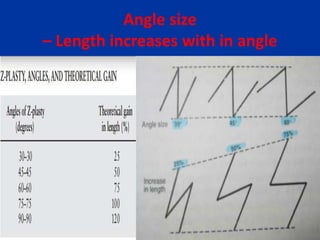
Angle size
– Length increases with in angle
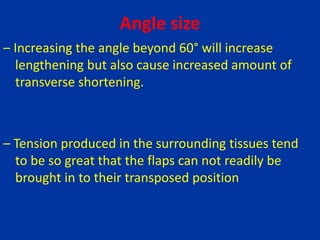
Angle size
– Increasing the angle beyond 60° will increase
lengthening but also cause increased amount of
transverse shortening.
– Tension produced in the surrounding tissues tend
to be so great that the flaps can not readily be
brought in to their transposed position
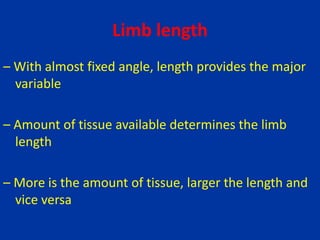
Limb length
– With almost fixed angle, length provides the major
variable
– Amount of tissue available determines the limb
length
– More is the amount of tissue, larger the length and
vice versa
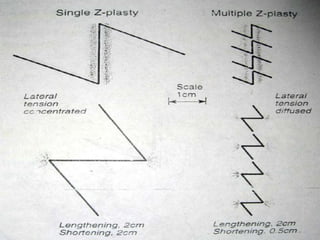
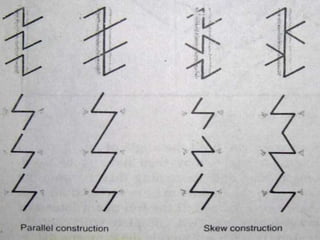
Multiple Z Plasty
• Way of reducing the amount of transverse
shortening without significantly reducing the
amount of lengthening
• Also distributes the lateral tension over various
limbs of multiple Z s
• In place of one large Z plasty, a series of multiple
small Z-plasties are constructed
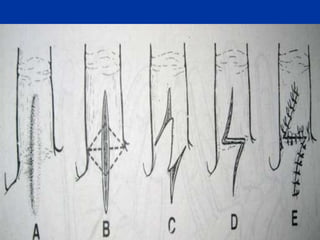
Planning of Z-plasty for contracture
release
• Narrow contractures with lax surrounding skin eg.
Bowstring contracture
• Draw an equilateral triangle on each side of the
contracture and select the more suitable of the two
sets of limbs
– Better blood supply; avoid a flap with scar at base
– Resultant scar falling into a cosmetically favorable
line
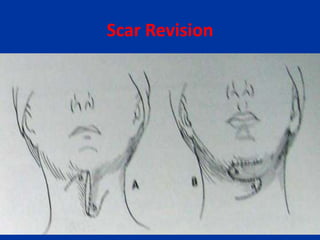
Use in scar revision
Straight line scar
– Break the continuity of a straight line scar, thus
rendering them more conspicuous
• Bridle scar- scar crossing a hollow
• Curving scar
Scar Revision
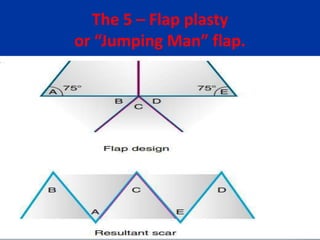
The 5 – Flap plasty
or “Jumping Man” flap.
• management of long-standing flexion
contractures of the proximal interphalangeal
joint ...
•
Rotation –advancement Flap
• Semicircular flap which rotates around a pivot point
• Located along tension lines
• Flap designed quite large than the defect to ensure
primary closure of the donor site
• skin graft or another flap are alternatives for the
donor site
• Tissue can move into anadjacent defect in 2
directions.
• It can advance in a straight line (ie, advancement
flap), or the tissue can rotate into the defect (ie,
rotation flap).
• The distinction between the two is not always clear,
and one type of motion blends into the other .
• Furthermore, a single flap can have both straight
(advancement) movement and rotational (rotation)
movement
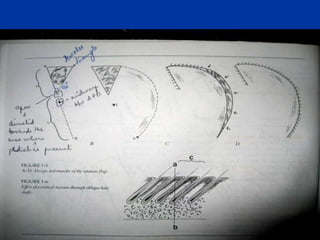
•Triangulation of the defect, Isoceles triangle made
•Apex towards flap pedicle angle <30° to avoid
buckling of the skin
•PIVOT POINT D- on a projection of line AC, atleast
CD>2AC
•E is located midway between A ,An arc is drawn from
B to D
•CBD constitutes the flap
• Conventional rotation flap are successful only in
places where lax skin is present or a back cut is
needed.
• Flap template employs tissue just adjacent to the
triangulated defect thus ensures coverage of the
defect and closure of the donor site
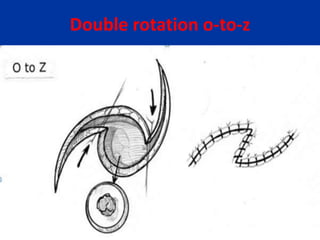
Double rotation o-to-z
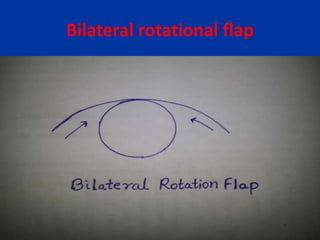
Bilateral rotational flap
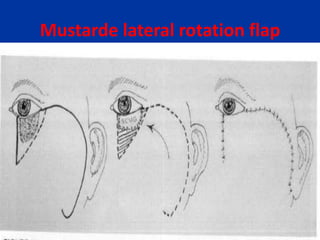
Mustarde lateral rotation flap
• A Mustarde; cheek flap is a large
rotation flap with its leading edge at the
lateral canthus extending laterally and arching
like a Tenzel flap
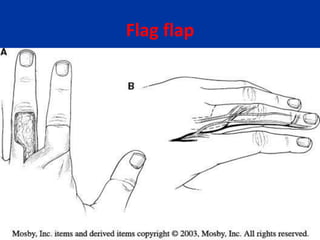
Flag Flap
"Flag flap." Skin moved over distance to palmar
surface or to neighboring digit.
"Flagstaff" contains the pedicle consisting of dorsal
vein, dorsal branch of digital artery, and dorsal
branch of digital nerve
Flag flap
Indication
• Soft-tissue defects on the dorsal aspect of fingers
between the metacarpophalangeal and the distal
interphalangeal joint as well as on the tip of the
thumb.
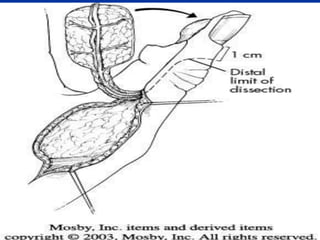
Dorsoulnar thumb flap
• Pedicled flap based on the dorsoulnar artery, a
branch off the princeps pollicis artery after it
branches fr Dorsoulnar flap
• Harvested from inner side of thumb
metacarpophalangeal area reaches distal area of
thumb on the radial artery.
• Artery with a distal pedicle.
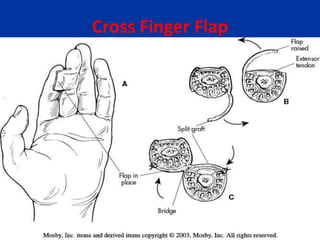
CROSS-FINGER FLAPS
• CROSS-FINGER FLAPS useful for covering a defect of
the skin and other soft tissues on the volar surface
of the finger when tendons and neurovascular
structures are exposed and a small amount of
subcutaneous fat is needed.
• They also are useful for some amputations of the
thumb.
• Best avoided in patients over 50 years of age, in
hands with arthritic changes or a tendency to
finger stiffness for some other reason, or if local
infection is present
Cross Finger Flap
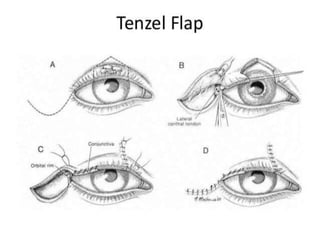
Tenzel Flaps
• A tenzel flap is a semicircular local advancement
flap, which is often utilized in the reconstruction of
full thickness eyelid defects. It allows recruitment of
tissues lateral to the lateral canthus to allow medial
mobilization of the eyelid and direct wound closure.
• indicated in the reconstruction of moderate upper
or lower full thickness eyelid defects involving
approximately 1/3 to 1/2 of the eyelid
• most commonly employed in eyelid reconstruction
following resection of a neoplasm at the eyelid
margin or in cases of trauma with full thickness
tissue loss.
FLAP MODIFICATION
• Modifications and refinements in both technique
and design of flaps have been used for the optimal
results in reconstructive surgery. Important
modifications are :
• 1. Flap delay.
• 2. Tissue expansion.
DELAY PHENOMENON
It can be defined as “ preliminary surgical intervention
wherein a portion of the vascular supply to a flap is
divided before definitive elevation and transfer of
the flap
Delay procedure has been used for
several hundred years.
• 16th century : Tagliacozzi delayed his upper arm
flaps
• It was not until the early 1900s that the concept
was recognized.
• 1921 :Blair introduced the term “DELAYED
TRANSFER “
• 1965 : Milton using the pig model, investigated the
effectiveness of four different methods of delaying
a flap .
MECHANISM
• Increased axiality of blood flow: Removal of blood
flow from periphery of a random flap promotes
development of axial flow.
• Opening of choke vessels.
• Tolerance to ischemia :adaptive metabolic changes
• Sympathectomy vasodilation theory : leading to
vasodilation
FLAP DELAY
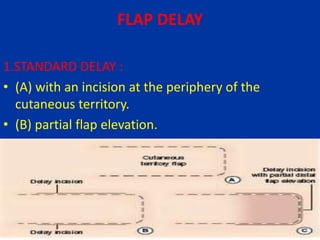
1.STANDARD DELAY :
• (A) with an incision at the periphery of the
cutaneous territory.
• (B) partial flap elevation.
2. STRATEGIC DELAY
• Involves division of selected pedicles to the flap to
enhance perfusion through the remaining pedicle
or pedicles .
TISSUE EXPANSION
• 1957 : Neumann is credited with the first modern
report of this technique.
• 1976 : Radovan further described the use of this
technique for breast reconstruction.
Advantages
1. Reconstruction with tissue of a similar colour and
texture to that of the donor defect.
2. Reconstruction with sensate skin containing skin
appendages.
3. Limited donor-site deformity.
• History
Peripheral vascular disease/Coronary artery disease
Collagen vascular disease
Diabetes mellitis
Prior radiotherapy
• Social habits
cigarettes?
• Medications
ASA, anticoagulants
• Cause of defect
recurrence?
Physical Exam
• Defect size, placement
• Surrounding skin lesions, laxity, color match, scars
• Facial structures functional concerns, lip, lid
• Incision placement Resting skin tension lines
Planning
• Template
• Draw options/Measure
• Planning in reverse
• Incise
• Undermine
• Rotate vs. advance vs. transpose
• Key stitches
• Close
Postoperative Care
• Analgesia
• Wound care
• Antibiotics
• Sutures removal
• Revision if required - 6 months
Complications
• Infection
• Dehiscence
• Vascular insufficiency due to Mechanical tension
Kinking compression
• Hematoma/ seroma
• Failure/ necrosis

Skin flaps

  • 1.
    Department of Plastic AndReconstructive Surgery Sher i Kashmir Institute of Medical Sciences Srinagar Seminar Topic : SKIN FLAPS
  • 2.
    Skin FLAPS Presentor :Dr Junaid khiurshid Moderator : Dr Altaf Rasool
  • 3.
    Definition A flap isa unit of tissue that is transferred from donor site to recipient site while maintaining its own blood supply. Term “Flap” Originated from the 16th century Dutch word “FLAPPE” which means “anything that hung broad and loose, fastened only by one side
  • 4.
    Timeline • 600 BCSushruta Samhita Pedicle flaps in the face and forehead for nasal reconstruction • 1597 Tagliacozzi Nasal reconstruction by tubed pedicle flap from arm; described “delay” of pedicle flap • 1896 Tansini Latissimus dorsi musculocutaneous flap for breast reconstruction (post- mastectomy) • 1920 Gillies Tubed pedicle flap • 1946 Stark Muscle flaps for osteomyelitis
  • 5.
    • 1955 OwensCompound neck flap • 1963 McGregor Temporalis flap • 1965 Bakamjian Deltopectoral flap • 1971 Ger Lower extremity musculocutaneous flap • 1972 McGregor and Jackson Groin flap
  • 6.
    • 1972 OrticocheaMusculocutaneous flaps • 1977 Mc Craw et al Musculocutaneous territories • 1981 Mathes and Nahai Classification of muscle flaps based on vascular anatomy • 1981 Ponten described fasciocutaneous flap
  • 7.
  • 8.
    Carl Manchot (1889) • Performed the first examination of the vascular supply of the human integument. • 40 cutaneous territories • His work “Die Hautarterien des menschlichen Körpers “ [The Cutaneous Arteries of the Human Body] was initially published in German and later translated to English by Milton.
  • 10.
    Spalteholz (1893) • Publishedpaper on the origin, course and distribution of the cutaneous perforators in adult and neonatal cadavers. • He performed arterial injections of gelatin and various pigments. The soft tissues were fixed in alcohol and subtracted in xylol and the resulting vascular network was embedded in Canada Balsam.
  • 11.
    Salmon (1930) • Frenchanatomist and surgeon charted more than 80 cutaneous territories encompassing the entire body. • Salmon dissected 15 human cadavers and took radiographs of integument which enabled him to demonstrate much smaller vessel than Manchot
  • 13.
    • The bloodreaching the skin originates from deep vessels. • DANIEL AND WILLIAMS(1973) defined that the deep vessels supplying skin are fundamentally two type of arteries i.e. either musculocutaneous or direct cutaneous arteries • Originally described as Direct cutaneous arteries , are now called as septocutaneous arteries.
  • 14.
    Musculo cutaneous • Origin:Major vessel supplying muscle • Travel perpendicularly through underlying muscle into the overlying cutaneous circulation • Prevalent supply of skin covering the broad, flat muscles of the torso. • Example: latissimus dorsi flap, rectus abdominis flap Septo cutaneous • Origin: segmental or muscular artery • Arise originally from either segmental or musculocutaneous vessels, pass directly within intermuscular fascial septae • common between the longer, thinner muscles of the extremitie • Example :Radial forearm flap, Dorsalis pedis flap
  • 15.
  • 16.
    BASED ON LOCATIONOF DONOR SITE LOCAL FLAP Flap transferred from an area adjacent to the defect. This is the least complex type of flap and includes advancement flaps, rotation flaps, and transposition flaps.
  • 17.
    REGIONAL FLAP Regional flapsare not immediately adjacent to the defect Instead, the freed tissue "island" is moved over or underneath normal tissue to reach the defect to be filled, with the blood supply still connected to the donor site via a pedicle Examples PMMC, DP flaps for head and neck defects, TRAM for breast reconstruction
  • 18.
    DISTANT FLAP Flap transferredfrom an noncontiguous anatomic site. The distant flap can be used as a distant pedicled or free flap Flapfailure is a severe complication.
  • 19.
    Based on bloodsupply Random .blood supply is not derived from a recognized artery ,rather, from many little unnamed vessels.eg local cutaneous flaps Axial flap, blood supply derived from a recognized artery or group of arteries eg most muscle flaps
  • 20.
    Random flaps Based onthe rich sub - dermal vascular plexus of the skin Most of the local flap are random flaps Maximum length : breadth ratio of 1 : 1 in the lower extremity. length : breadth ratio of up to 3 : 1 in the face. Axial flaps Derive their blood supply from a direct cutaneous artery or named blood vessel Examples : Nasolabial flap (angular artery) Forehead flap (supra trochlear artery). The surviving length of an axial pattern flap is entirely related to the length of the included artery.
  • 21.
    MATHES AND NAHICLASSIFICATION
  • 23.
    CLASSIFICATION OF LOCALFLAPS • The composition of the defect to be reconstructed should dictate the correct composition of the flap used for reconstruction. It includes : • 1.Cutaneous • 2.Fasciocutaneous • 3.Musculocutaneous
  • 24.
    Advancement Flaps • Celsusin ancient Rome, popularized by French surgeons in the first half of 19th century • “sliding flaps” • Moves directly forwards into the defect without any lateral movement
  • 25.
    Advancement Flaps • Executionis facilitated by presence of excess Skin • More feasible in elderly or when skin elasticity is more like in very young • Usually rectangular, perpendicular to the lines of minimal tension • Uses – forehead , brow
  • 26.
    Procedures devised tofacilitate advancement •Excision of Burrow’s triangle •Counterincision at the flap base •Triangular design •Curvilinear design •Z-plasty at the base
  • 27.
  • 28.
  • 29.
    V-Y Advancement Flap Design •Advancementshould be directed over the shortest diameter of the defect •The size of the V base should match the size of the largest diameter of the lesion •The V must be long enough to allow tension free suture of the Y
  • 30.
    V-Y Advancement Flap •Advancementflap involves movement in two planes vertical and horizontal •Pivot point on vertical plane which actually acts as a pivot plane •Pivot plane is the base of the flap at which the flap is attached to the body
  • 31.
    V-Y Advancement Flap •α angle is determined by – Location of defect – Elasticity of the surrounding tissues – Recommended to range between 20°-40° • For leg defects, small angle is recommended as there is less elasticity • Gluteal region- large angle is planned
  • 32.
  • 33.
  • 34.
    W Plasty orZigzag plasty • Used to break up a single linear scar • For scars that do not require lengthening • It redistributes tension along the length of the scar
  • 35.
    M-Plasty • A usefultechnique to preserve healthy tissue in scar revision • lessen the chance of standing cone (ie, dog-ear) deformity • The M-plasty, by creating 2 separate 30° angles instead of one
  • 37.
    A T Flap •Bilateral defect • Triangular defect
  • 39.
    Transposition Flap • Usuallyrectangular or square flap. • Transferred in a direction at right angles to that of the blood supply. • Additional length- Back Cut. Donor site. – Skin graft – Another flap
  • 40.
    Transposition Flap- DESIGN Recipientdefect is triangulated – Right angle triangle – Hypotenuse- near border of the flap – The right angle assumes a position opposite the flap – In scalp defects, apex should direct towards the periphery of the scalp
  • 41.
  • 42.
  • 43.
  • 45.
    Dufourmentel Flap • Designedby a French Surgeon, Claude Dufourmental in 1962 • The defect is tailored in the shape of a rhombus • The short diagonal (BD) and one of the adjacent side (CD) are extended
  • 49.
  • 50.
    Triple Rhombic flap •Circular defect conceptualized as hexagon. • Sides of hexagon are equal to radius (r) of circle. • First side of flap created by direct extension equal in length to radius at alternative corners. • Second side of flap designed parallel to adjacent side of hexagon.
  • 52.
    Bilobed Flap • Consistsof two lobes of skin and subcutaneous tissue based on a common pedicle Design – Primary flap is smaller than the defect – Secondary flap is more triangular in shape •
  • 53.
    Optimal angle betweenthe two flaps is 90°, can vary between 45° and 180°; greater the angle, larger the resultant dog-ear
  • 54.
    Zitelli's modification (1989) •Primary flap oriented 45° • And the secondary 90° • Convert the defect to a "tear drop" shape • Use a caliper with one tip placed at the apex of the wound, to mark out two semicircles
  • 56.
    • Outer semicircledefines the necessary length of the two lobes • Inner semicircle bisects the center of the original wound and continues across the donor skin, defines the limit of the common pedicle of the two lobes
  • 58.
    closure of postsurgicaldefects of the nasal dorsum
  • 60.
    Z Plasty • Involvestransposition of two interdigitating triangular flaps • Effects – Gain in length along the direction of the common limb of the Z – Direction of the common limb is changed • Uses – Prevention and treatment of contracted scars – Scar revision
  • 61.
    • In 1856, Denonvilliersfirst described the Z-plasty technique as a surgical treatment for lower lid ectropion. • The first reference to this technique in American literature was in 1913, by McCurdy, as treatment for contracture at the oral commissure.
  • 62.
    • Limberg, in1929, provided a more detailed geometric description. • Numerical data showing optimal angles and length relationships of Z-plasty limbs are credited to Davis (1946).
  • 63.
    • Release ofcontracture – The central limb is placed along the line of contracture- contractural diagonal – 60° angle taken on each side and limbs of Z drawn, all equal in size – Longer diagonal is the transverse diagonal
  • 67.
    Mechanism of lengtheningby Z plasty – Length of contractural diagonal less than transverse diagonal before release – Contractural diagonal lengthens at the expense of transverse diagonal – Thus need for transverse skin laxity for contracture lengthening – Variables in construction of Z Plasty • Angle size • Limb length
  • 68.
    Angle size – Lengthincreases with in angle
  • 69.
    Angle size – Increasingthe angle beyond 60° will increase lengthening but also cause increased amount of transverse shortening. – Tension produced in the surrounding tissues tend to be so great that the flaps can not readily be brought in to their transposed position
  • 70.
    Limb length – Withalmost fixed angle, length provides the major variable – Amount of tissue available determines the limb length – More is the amount of tissue, larger the length and vice versa
  • 71.
    Multiple Z Plasty •Way of reducing the amount of transverse shortening without significantly reducing the amount of lengthening • Also distributes the lateral tension over various limbs of multiple Z s • In place of one large Z plasty, a series of multiple small Z-plasties are constructed
  • 75.
    Planning of Z-plastyfor contracture release • Narrow contractures with lax surrounding skin eg. Bowstring contracture • Draw an equilateral triangle on each side of the contracture and select the more suitable of the two sets of limbs – Better blood supply; avoid a flap with scar at base – Resultant scar falling into a cosmetically favorable line
  • 77.
    Use in scarrevision Straight line scar – Break the continuity of a straight line scar, thus rendering them more conspicuous • Bridle scar- scar crossing a hollow • Curving scar
  • 78.
  • 79.
    The 5 –Flap plasty or “Jumping Man” flap.
  • 80.
    • management oflong-standing flexion contractures of the proximal interphalangeal joint ... •
  • 81.
    Rotation –advancement Flap •Semicircular flap which rotates around a pivot point • Located along tension lines • Flap designed quite large than the defect to ensure primary closure of the donor site • skin graft or another flap are alternatives for the donor site
  • 82.
    • Tissue canmove into anadjacent defect in 2 directions. • It can advance in a straight line (ie, advancement flap), or the tissue can rotate into the defect (ie, rotation flap). • The distinction between the two is not always clear, and one type of motion blends into the other . • Furthermore, a single flap can have both straight (advancement) movement and rotational (rotation) movement
  • 83.
    •Triangulation of thedefect, Isoceles triangle made •Apex towards flap pedicle angle <30° to avoid buckling of the skin •PIVOT POINT D- on a projection of line AC, atleast CD>2AC •E is located midway between A ,An arc is drawn from B to D •CBD constitutes the flap
  • 85.
    • Conventional rotationflap are successful only in places where lax skin is present or a back cut is needed. • Flap template employs tissue just adjacent to the triangulated defect thus ensures coverage of the defect and closure of the donor site
  • 86.
  • 87.
  • 88.
  • 89.
    • A Mustarde;cheek flap is a large rotation flap with its leading edge at the lateral canthus extending laterally and arching like a Tenzel flap
  • 90.
    Flag Flap "Flag flap."Skin moved over distance to palmar surface or to neighboring digit. "Flagstaff" contains the pedicle consisting of dorsal vein, dorsal branch of digital artery, and dorsal branch of digital nerve
  • 91.
  • 92.
    Indication • Soft-tissue defectson the dorsal aspect of fingers between the metacarpophalangeal and the distal interphalangeal joint as well as on the tip of the thumb.
  • 93.
    Dorsoulnar thumb flap •Pedicled flap based on the dorsoulnar artery, a branch off the princeps pollicis artery after it branches fr Dorsoulnar flap • Harvested from inner side of thumb metacarpophalangeal area reaches distal area of thumb on the radial artery. • Artery with a distal pedicle.
  • 95.
    CROSS-FINGER FLAPS • CROSS-FINGERFLAPS useful for covering a defect of the skin and other soft tissues on the volar surface of the finger when tendons and neurovascular structures are exposed and a small amount of subcutaneous fat is needed.
  • 96.
    • They alsoare useful for some amputations of the thumb. • Best avoided in patients over 50 years of age, in hands with arthritic changes or a tendency to finger stiffness for some other reason, or if local infection is present
  • 97.
  • 98.
    Tenzel Flaps • Atenzel flap is a semicircular local advancement flap, which is often utilized in the reconstruction of full thickness eyelid defects. It allows recruitment of tissues lateral to the lateral canthus to allow medial mobilization of the eyelid and direct wound closure.
  • 99.
    • indicated inthe reconstruction of moderate upper or lower full thickness eyelid defects involving approximately 1/3 to 1/2 of the eyelid • most commonly employed in eyelid reconstruction following resection of a neoplasm at the eyelid margin or in cases of trauma with full thickness tissue loss.
  • 101.
    FLAP MODIFICATION • Modificationsand refinements in both technique and design of flaps have been used for the optimal results in reconstructive surgery. Important modifications are : • 1. Flap delay. • 2. Tissue expansion.
  • 102.
    DELAY PHENOMENON It canbe defined as “ preliminary surgical intervention wherein a portion of the vascular supply to a flap is divided before definitive elevation and transfer of the flap
  • 103.
    Delay procedure hasbeen used for several hundred years. • 16th century : Tagliacozzi delayed his upper arm flaps • It was not until the early 1900s that the concept was recognized. • 1921 :Blair introduced the term “DELAYED TRANSFER “ • 1965 : Milton using the pig model, investigated the effectiveness of four different methods of delaying a flap .
  • 104.
    MECHANISM • Increased axialityof blood flow: Removal of blood flow from periphery of a random flap promotes development of axial flow. • Opening of choke vessels. • Tolerance to ischemia :adaptive metabolic changes • Sympathectomy vasodilation theory : leading to vasodilation
  • 105.
    FLAP DELAY 1.STANDARD DELAY: • (A) with an incision at the periphery of the cutaneous territory. • (B) partial flap elevation.
  • 106.
    2. STRATEGIC DELAY •Involves division of selected pedicles to the flap to enhance perfusion through the remaining pedicle or pedicles .
  • 107.
    TISSUE EXPANSION • 1957: Neumann is credited with the first modern report of this technique. • 1976 : Radovan further described the use of this technique for breast reconstruction.
  • 108.
    Advantages 1. Reconstruction withtissue of a similar colour and texture to that of the donor defect. 2. Reconstruction with sensate skin containing skin appendages. 3. Limited donor-site deformity.
  • 109.
    • History Peripheral vasculardisease/Coronary artery disease Collagen vascular disease Diabetes mellitis Prior radiotherapy • Social habits cigarettes? • Medications ASA, anticoagulants • Cause of defect recurrence?
  • 110.
    Physical Exam • Defectsize, placement • Surrounding skin lesions, laxity, color match, scars • Facial structures functional concerns, lip, lid • Incision placement Resting skin tension lines
  • 111.
    Planning • Template • Drawoptions/Measure • Planning in reverse • Incise • Undermine • Rotate vs. advance vs. transpose • Key stitches • Close
  • 112.
    Postoperative Care • Analgesia •Wound care • Antibiotics • Sutures removal • Revision if required - 6 months
  • 113.
    Complications • Infection • Dehiscence •Vascular insufficiency due to Mechanical tension Kinking compression • Hematoma/ seroma • Failure/ necrosis