Mandibular Reconstruction
Dr Jameel kifayatullah
Senior lecturer Khyber college of
dentistry ,Peshawar ,Pakistan
Goals of mandible reconstruction
1)Restore mandibular continuity
2) Restore alveolar bone height
3) Restore osseous bulk
4) Reconstruct the lower facial contours
5) Preserve the TMJ and its relationship within
glenoid fossa
6)Create a neomandible that is suitable for dental
prosthetic rehabilitation
7) Anatomically and functionally restore adjacent
soft tissue defects(i.e tongue,cheek.lips)
Rationale for reconstruction
• Large complex defects can be created during
resection
• Without reconstruction, patients may have
functional and cosmetic impairments.
• The surgeon redefine the preoperative functions
and facial aesthetic units to allow the patient to
return to a normal family and social life
• The approach includes the placement of dentures
or osseointegrated implants to help shape the
face and to assist with mastication and
verbalization.
Criteria for a successful mandibular
bone reconstruction
• Restoration of mandibular continuity
• Restoration of alveolar bone height
• Restoration of osseous bulk
• Maintenance of osseous content for atleast 18
months
• Restoration of acceptable facial form
• Acceptability of endosseous implants
• Recoverable ,non debilitating donor site surgery
How To achieve optimal functional and
aesthetic results
• replace the skeletal buttresses
• restore the external/internal soft tissue
envelope
• eliminate fistulas
• provide a foundation for dental rehabilitation.
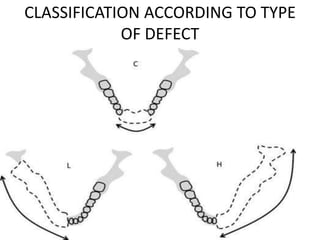
JEWER etal Classification
• Central defects including both canines are
designated “C”
• Lateral segments that exclude the condyle are
designated “L”
• When the condyle is resected together with the
lateral mandible, the defect is designated “H”, or
hemi mandibular
.
Jewer Etal classification
• Eight permutations of these capital letters—C,
L, H, LC, HC, LCL, HCL, and HH—are
encountered for mandibular defects. The
significance of this is that a lateral defect can
be reconstructed with a straight segment of
bone, whereas a central defect would require
osteotomies
CLASSIFICATION ACCORDING TO TYPE
OF DEFECT
Jason k potter classification
• Classification of mandibular defects
Alveolar defects:Loss of alveolar segment without
loss of mandibular continuity
Anterior defects: Segmental defect incorporating the
region of mandibular symphysis or extending from
cuspid to cuspid
Lateral defects:segmental defects involving the
mandibular body region or extending from
mandibular cuspid to the retromolar region
Posterior defects: segmental defects involving the
ramus and mandibular angle with or without loss
of condylar process
Timing of reconstruction
• Primary/Immediate :Reconstruction may be primary
(performed at the time of resection of the tumor)
• Secondary (performed as a separate procedure
after resection
ARGUMENTS AGAINST DELAYED
RECONSTRUCTION
unique challenge for the surgeons due to the
presence of soft tissue scarring and the
contracture of the resected end of the
mandibular tissue. This often hinders the
surgeon’s ability to predict the length and the
amount of mucosa required intraorally.
ARGUMENTS IN FAVOR OF DELAYED
RECONSTRUCTION
• immediate reconstruction covers the primary site,
decreasing the ability to detect recurrence.
• extended length of surgery required for primary
reconstruction
• possibility of seeding cancer cells in newly dissected
tissue planes
• presumed increased risk of infection from salivary
contamination.
• Oncologic margins, especially the bony margins, are
cleared by means of permanent sectioning before safe
restoration can be achieved. Frozen sections are fairly
reliable for soft tissues, but they are less suitable for
mandibular margins.
IMMEDIATE RECONSTRUCTION
• reduction in the number of surgical procedures and hospital
stays
• A shorter time during which the patient has deformity and
morbidity from lack of function
• the protection and preservation of vital structures
• a reduced cost of treatment,
• the rapid oral rehabilitation with a timely return to a normal
social lifestyle
• offers significant advantage over secondary repair by
preventing the wound from scarring while obtaining optimal
functional and aesthetic results for the patient.
• Immediate reconstruction significantly improves QOL and
that most patients prefer immediate reconstruction
Reconstructive options
• Alloplastics(Alloplastic implants)
• Nonvascularized Bone Grafts (Free Bone)
• Revascularized Bone (Free tissue transfer)
• Distraction Osteogenesis
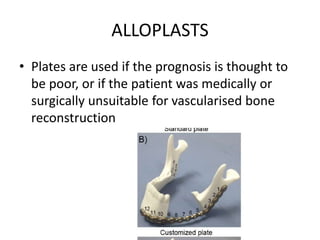
ALLOPLASTS
• Plates are used if the prognosis is thought to
be poor, or if the patient was medically or
surgically unsuitable for vascularised bone
reconstruction
Reconstruction plates
• Reconstruction plates are rigid plates that are
applied along the lower border of mandible
• Made with the intention of bridging a defect
• Stabilizing remaining segments
• Maintaining occlusion and facial contour
• Frequently used to fix corticocancellous blocks
or vascualrised bone grafts to remaining
mandible
Reconstruction Plates
• titanium plates more popular because of
biocompatibility
• overriding principle is to have one single plate of
sufficient thickness and width to hold the
fragments in place. This implies plates
approximately 3 mm thick and 5 mm wide
• A special feature of the modern types is the locking
screw which minimize compression between the
plate and the underlying bone, thereby optimizing
the vascularity surrounding the graft
• Locking plates are associated with significantly
fewer complications than non-locking plates when
used in the symphyseal region.
Reconstruction plates
Complications associated with plates:
• wound dehiscence with plate exposure, infection from
loosening and breakage of screws, plate fracture and
unsatisfactory facial contour.
• Radiography and computed tomography scans in
particular show backscattering which causes diagnostic
problems.
• Irradiation therapy is equally hampered by the plates.
• It has been shown that titanium causes the least
amount of artefacts in magnetic resonance imaging
compared to stainless steel and vitallium
Reconstruction plates
Indications for plate:
• a patient whose medical condition precludes a
prolonged operation time
• to carry out a microsurgically anastomosed flap,
or in whom the vascular system does not allow
for a microvascularanastomosis.
• reconstruction plates should be used only in
those selected patients with a small (<6 cm)
lateral mandibular defect.
• Some surgeons prefer plate fixation as a first
means to stabilize the mandible and will carry out
a secondary reconstruction a year later.
Non-vascularised bone grafts
• Used to reconstruct defects that are less than 6 cm in length
provided that the soft tissues are in good condition(not
irradiated) and in medically compromised patients who
cannot tolerate free tissue transfer
• Non vascular bone grafts should be reserved for lateral or
posterior lateral defects smaller than 6 cm without extensive
soft tissue loss in patients who have not or will not receive
radiotherapy
• Donor sites: intraoral and extraoral
• Extraoral donor sites: cranium,ilium,tibia or femur
• Intraoral donor sites: symphysis,ramus,body or zygomatic
bone
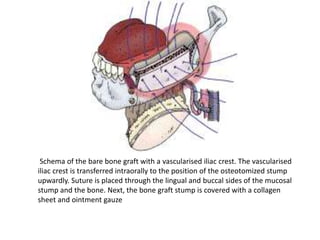
Schema of the bare bone graft with a vascularised iliac crest. The vascularised
iliac crest is transferred intraorally to the position of the osteotomized stump
upwardly. Suture is placed through the lingual and buccal sides of the mucosal
stump and the bone. Next, the bone graft stump is covered with a collagen
sheet and ointment gauze
Microvascular free flaps/free tissue
transfer
• Vascularised bone flaps are treatment of choice
for defects greater than 6 cm and in presence of
irradiated tissues
• Vascularised bone flaps achieve a higer incidence
of primary bone union and implant success rate
• Vascularised bone flaps have shorter healing time
and complications like resorption and infection
are greatly reduced
• The donor sites used most commonly for
mandibular reconstruction are radial
forearm,scapula ,iliac crest and fibula.
FACTORS AFFECTING THE OUTCOME OF
MANDIBULAR RECONSTRUCTION (august)
• Length of mandibular defect
• Timing of reconstruction
• Radiotherapy
• Postoperative recipient site complications
• Malignant diagnosis
• Intraoral communication
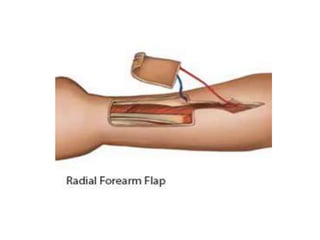
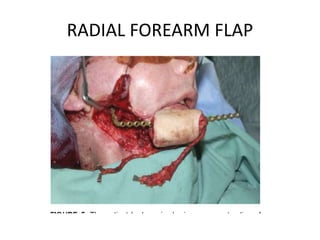
Radial forearm flap
ARTERY: based on radal forearm artery
VEINS;vena comitanta or subcutaneous forearm veins
LENGTH OF BONE HARVESTED:10-12 cm
Advantages:
1)excellent pedicle length and diameter
2)reliable skin paddle which large,thin and pliable ideal
for intraoral lining
Complication: Fracture of radius at donor site
Disadvantages:
the transplanted bone is thin not allowing multiple
osteotomies to adapt to the shape the mandible
the height doesnot favor the placement of implants
RADIAL FOREARM FLAP
Anterior mandibular defects
• Anterior mandibular (C) defects will typically
constitute an absolute indication for
reconstruction using vascularized bone. Due
to multiple osteotomies required to contour
the bone, fibula should be considered the first
choice for reconstruction of anterior or large
defects.
Lateral Defects
• Lateral defects smaller than 6 cm and
associated with benign disease—non vascular
bone grafting in patients not desiring
immediate reconstruction
• Lateral defects 6cm and larger associated with
larger soft tissue loss and having a History or
need for RT ---reconstruct with vascularised
bone graft
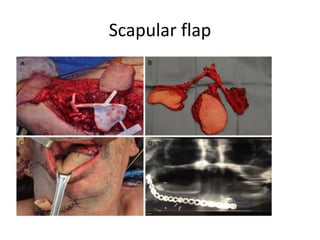
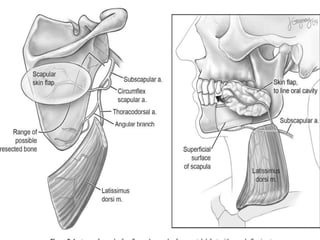
Scapular flap
• Osseous defects of mandible upto 14 cm in
conjunction with large cutaneous or intraoral
mucosal defects reconstructed with this flap
• Through and through oromandibular defects of
cheek combined with sagittal mandibular defects
reconstructed with this flap
• Disadvantages: need for repositioning the patient
• Lack of sensation in the flap
• Limited bone stock for osseointegration esp in
females
Scapular flap
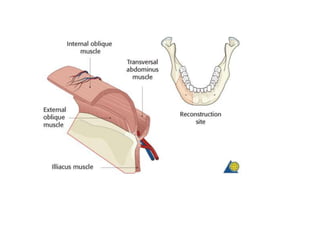
Deep Circumflex Iliac Artery Flap
• Ideal flap to restore the width and vertical dimension of the
mandible
• Provide an appropriate bed for placement of dental implants
• The internal oblique muscle is harvested along with ileac crest
and is allowed to epithelialize to serve as soft tissue coverage
for the graft intraorally
• Skin paddle can be taken with this flap
Disadvantages: Relatively short 4-5 cm vascular pedicle,higher
potential donor site morbidity and bulk
the lack of segmental perforating vessels which limits its use
for osteotomies.
Patients may be slow to ambulate after surgery and
permanent gait disturbance may occasionally occur
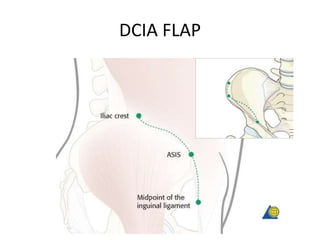
DCIA FLAP
• SURGICAL LANDMARKS: ASIS,Pubic tubercle
and ileac crest
• Skin paddle:12×6 cm
• Bone segment 8×18 cm may be harvested
DCIA FLAP
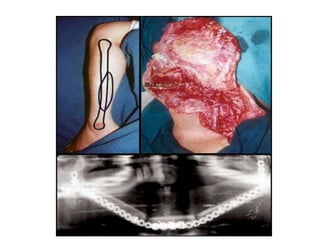
Fibula free flap
ARTERY: peroneal artery
VEINS;peroneal vein
LENGTH OF BONE HARVESTED: upto 25 cm
Standard landmarks: fibula head,lateral malloelus, posterolateral intermuscular
septum
Advantages:
1)The width and height of the flap are well suited for mandibular reconstruction
2)better suited for placement of dental implants
3) The fibula free flap remains the first choice for the edentulous mandible or for
extensive mandibular resections
Disadvantages: Donor site morbidity is relatively mild but pre-existing peripheral
vascular disease will preclude use of this flap
The height of bone is inadequate relative to a dentate mandible which
can be a problem when dental implants are planned for occlusal rehabilitation
Distraction osteogenesis
• Distraction osteogenesis is a process
in which new bone formation is gradually
induced by an opening (distraction) device
between two bony surfaces.
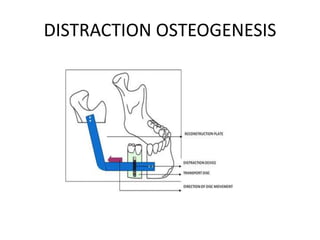
• For mandibular reconstruction, a technique known as
transport disc distractionosteogenesis (TDDO) used.
• A segment of bone is cut adjacent to the defect and
moved gradually across the defect by a mechanical
device. New bone fills in between the two bone
segments. The pieceof bone being moved or
transported is referred to as the transport disc
DISTRACTION OSTEOGENESIS
Distraction Osteogenesis
• External devices were employed in early cases but these
caused problems of facial scarring along the pintracks. To
overcome this problem, an internal plate-guided distraction
device was described by Herford in 2004
• ADVANTAGES:
Obviates the need for harvesting bone from a donor site
It offers the potential of growing bone and
soft tissue from the native site and placement of dental
implants is possible
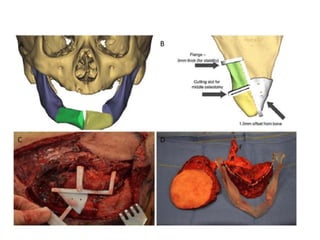
DEFECT WISE RECONSTRUCTION
Anterior Defects
• Anterior defects(symphysis) reconstructed
with reconstruction plates and soft tissue flaps
are at high risk of failure
• Vascularised bone flaps procedure of choice
for anterior region
• The one drawback is that they are difficult to
contour
Lateral Defects
• Lateral defects smaller than 6 cm and
associated with benign disease—non vascular
bone grafting in patients not desiring
immediate reconstruction
• Lateral defects 6cm and larger associated with
larger soft tissue loss and having a History or
need for RT ---reconstruct with vascularised
bone graft
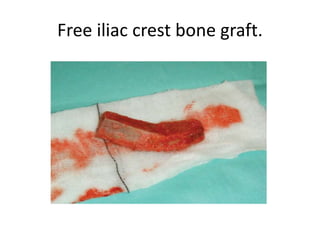
Free iliac crest bone graft.
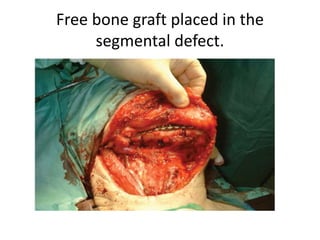
Free bone graft placed in the
segmental defect.
Posterior defects
• Less complicated to reconstruct unless
involving condylar process
• Posterior defects can impact facial
form,including posterior vertical height of the
mandible
• Create a more significant impact on
mandibular range of motion because of
relationship with TMJ and muscles of
mastication
Posterior defects
• Can allow Collapse of defect without reconstruction
dictated by patients clinical condition
• The local and patient factors which determine the
type of graft for reconstruction of posterior defects
are: volume of tissue loss,disease process,status of
temporomandibular joint and RT
• The type of graft used dependent on above factors
are costochondral/corticocancellous
grafts,alloplastic prosthesis,or vascular bone flaps
Posterior defects
• Preservation of condylar process when
oncologically feasible may be stabilised to
graft with plates when adequate condylar
structure is present or with wire fixation for
smaller segments
Tissue-engineered transplants
• The engineered graft allowed to heal in the
trapezius muscle and subsequently
transplanted to the recipient side using
microvascular anastomosis.
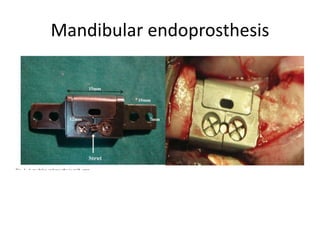
MODULAR ENDOPROSTHESIS
• An endoprosthesis is a metallic device that
replaces diseased bone in long bones
and is fixed internally with bone cement
within the medullary space of the remaining
healthy bone.
• There is no need for screw fixation. The variable length
of the bone gap can be bridged by using modules
that allow for accurate three-dimensional
reconstructions. The modules are connected by a
locking system.
Mandibular endoprosthesis
Mandibular reconstruction

Mandibular reconstruction

  • 1.
    Mandibular Reconstruction Dr Jameelkifayatullah Senior lecturer Khyber college of dentistry ,Peshawar ,Pakistan
  • 2.
    Goals of mandiblereconstruction 1)Restore mandibular continuity 2) Restore alveolar bone height 3) Restore osseous bulk 4) Reconstruct the lower facial contours 5) Preserve the TMJ and its relationship within glenoid fossa 6)Create a neomandible that is suitable for dental prosthetic rehabilitation 7) Anatomically and functionally restore adjacent soft tissue defects(i.e tongue,cheek.lips)
  • 3.
    Rationale for reconstruction •Large complex defects can be created during resection • Without reconstruction, patients may have functional and cosmetic impairments. • The surgeon redefine the preoperative functions and facial aesthetic units to allow the patient to return to a normal family and social life • The approach includes the placement of dentures or osseointegrated implants to help shape the face and to assist with mastication and verbalization.
  • 4.
    Criteria for asuccessful mandibular bone reconstruction • Restoration of mandibular continuity • Restoration of alveolar bone height • Restoration of osseous bulk • Maintenance of osseous content for atleast 18 months • Restoration of acceptable facial form • Acceptability of endosseous implants • Recoverable ,non debilitating donor site surgery
  • 5.
    How To achieveoptimal functional and aesthetic results • replace the skeletal buttresses • restore the external/internal soft tissue envelope • eliminate fistulas • provide a foundation for dental rehabilitation.
  • 6.
    JEWER etal Classification •Central defects including both canines are designated “C” • Lateral segments that exclude the condyle are designated “L” • When the condyle is resected together with the lateral mandible, the defect is designated “H”, or hemi mandibular .
  • 7.
    Jewer Etal classification •Eight permutations of these capital letters—C, L, H, LC, HC, LCL, HCL, and HH—are encountered for mandibular defects. The significance of this is that a lateral defect can be reconstructed with a straight segment of bone, whereas a central defect would require osteotomies
  • 8.
  • 9.
    Jason k potterclassification • Classification of mandibular defects Alveolar defects:Loss of alveolar segment without loss of mandibular continuity Anterior defects: Segmental defect incorporating the region of mandibular symphysis or extending from cuspid to cuspid Lateral defects:segmental defects involving the mandibular body region or extending from mandibular cuspid to the retromolar region Posterior defects: segmental defects involving the ramus and mandibular angle with or without loss of condylar process
  • 10.
    Timing of reconstruction •Primary/Immediate :Reconstruction may be primary (performed at the time of resection of the tumor) • Secondary (performed as a separate procedure after resection
  • 11.
    ARGUMENTS AGAINST DELAYED RECONSTRUCTION uniquechallenge for the surgeons due to the presence of soft tissue scarring and the contracture of the resected end of the mandibular tissue. This often hinders the surgeon’s ability to predict the length and the amount of mucosa required intraorally.
  • 12.
    ARGUMENTS IN FAVOROF DELAYED RECONSTRUCTION • immediate reconstruction covers the primary site, decreasing the ability to detect recurrence. • extended length of surgery required for primary reconstruction • possibility of seeding cancer cells in newly dissected tissue planes • presumed increased risk of infection from salivary contamination. • Oncologic margins, especially the bony margins, are cleared by means of permanent sectioning before safe restoration can be achieved. Frozen sections are fairly reliable for soft tissues, but they are less suitable for mandibular margins.
  • 13.
    IMMEDIATE RECONSTRUCTION • reductionin the number of surgical procedures and hospital stays • A shorter time during which the patient has deformity and morbidity from lack of function • the protection and preservation of vital structures • a reduced cost of treatment, • the rapid oral rehabilitation with a timely return to a normal social lifestyle • offers significant advantage over secondary repair by preventing the wound from scarring while obtaining optimal functional and aesthetic results for the patient. • Immediate reconstruction significantly improves QOL and that most patients prefer immediate reconstruction
  • 14.
    Reconstructive options • Alloplastics(Alloplasticimplants) • Nonvascularized Bone Grafts (Free Bone) • Revascularized Bone (Free tissue transfer) • Distraction Osteogenesis
  • 15.
    ALLOPLASTS • Plates areused if the prognosis is thought to be poor, or if the patient was medically or surgically unsuitable for vascularised bone reconstruction
  • 16.
    Reconstruction plates • Reconstructionplates are rigid plates that are applied along the lower border of mandible • Made with the intention of bridging a defect • Stabilizing remaining segments • Maintaining occlusion and facial contour • Frequently used to fix corticocancellous blocks or vascualrised bone grafts to remaining mandible
  • 17.
    Reconstruction Plates • titaniumplates more popular because of biocompatibility • overriding principle is to have one single plate of sufficient thickness and width to hold the fragments in place. This implies plates approximately 3 mm thick and 5 mm wide • A special feature of the modern types is the locking screw which minimize compression between the plate and the underlying bone, thereby optimizing the vascularity surrounding the graft • Locking plates are associated with significantly fewer complications than non-locking plates when used in the symphyseal region.
  • 18.
    Reconstruction plates Complications associatedwith plates: • wound dehiscence with plate exposure, infection from loosening and breakage of screws, plate fracture and unsatisfactory facial contour. • Radiography and computed tomography scans in particular show backscattering which causes diagnostic problems. • Irradiation therapy is equally hampered by the plates. • It has been shown that titanium causes the least amount of artefacts in magnetic resonance imaging compared to stainless steel and vitallium
  • 19.
    Reconstruction plates Indications forplate: • a patient whose medical condition precludes a prolonged operation time • to carry out a microsurgically anastomosed flap, or in whom the vascular system does not allow for a microvascularanastomosis. • reconstruction plates should be used only in those selected patients with a small (<6 cm) lateral mandibular defect. • Some surgeons prefer plate fixation as a first means to stabilize the mandible and will carry out a secondary reconstruction a year later.
  • 20.
    Non-vascularised bone grafts •Used to reconstruct defects that are less than 6 cm in length provided that the soft tissues are in good condition(not irradiated) and in medically compromised patients who cannot tolerate free tissue transfer • Non vascular bone grafts should be reserved for lateral or posterior lateral defects smaller than 6 cm without extensive soft tissue loss in patients who have not or will not receive radiotherapy • Donor sites: intraoral and extraoral • Extraoral donor sites: cranium,ilium,tibia or femur • Intraoral donor sites: symphysis,ramus,body or zygomatic bone
  • 21.
    Schema of thebare bone graft with a vascularised iliac crest. The vascularised iliac crest is transferred intraorally to the position of the osteotomized stump upwardly. Suture is placed through the lingual and buccal sides of the mucosal stump and the bone. Next, the bone graft stump is covered with a collagen sheet and ointment gauze
  • 22.
    Microvascular free flaps/freetissue transfer • Vascularised bone flaps are treatment of choice for defects greater than 6 cm and in presence of irradiated tissues • Vascularised bone flaps achieve a higer incidence of primary bone union and implant success rate • Vascularised bone flaps have shorter healing time and complications like resorption and infection are greatly reduced • The donor sites used most commonly for mandibular reconstruction are radial forearm,scapula ,iliac crest and fibula.
  • 23.
    FACTORS AFFECTING THEOUTCOME OF MANDIBULAR RECONSTRUCTION (august) • Length of mandibular defect • Timing of reconstruction • Radiotherapy • Postoperative recipient site complications • Malignant diagnosis • Intraoral communication
  • 24.
    Radial forearm flap ARTERY:based on radal forearm artery VEINS;vena comitanta or subcutaneous forearm veins LENGTH OF BONE HARVESTED:10-12 cm Advantages: 1)excellent pedicle length and diameter 2)reliable skin paddle which large,thin and pliable ideal for intraoral lining Complication: Fracture of radius at donor site Disadvantages: the transplanted bone is thin not allowing multiple osteotomies to adapt to the shape the mandible the height doesnot favor the placement of implants
  • 26.
  • 27.
    Anterior mandibular defects •Anterior mandibular (C) defects will typically constitute an absolute indication for reconstruction using vascularized bone. Due to multiple osteotomies required to contour the bone, fibula should be considered the first choice for reconstruction of anterior or large defects.
  • 28.
    Lateral Defects • Lateraldefects smaller than 6 cm and associated with benign disease—non vascular bone grafting in patients not desiring immediate reconstruction • Lateral defects 6cm and larger associated with larger soft tissue loss and having a History or need for RT ---reconstruct with vascularised bone graft
  • 29.
    Scapular flap • Osseousdefects of mandible upto 14 cm in conjunction with large cutaneous or intraoral mucosal defects reconstructed with this flap • Through and through oromandibular defects of cheek combined with sagittal mandibular defects reconstructed with this flap • Disadvantages: need for repositioning the patient • Lack of sensation in the flap • Limited bone stock for osseointegration esp in females
  • 30.
  • 32.
    Deep Circumflex IliacArtery Flap • Ideal flap to restore the width and vertical dimension of the mandible • Provide an appropriate bed for placement of dental implants • The internal oblique muscle is harvested along with ileac crest and is allowed to epithelialize to serve as soft tissue coverage for the graft intraorally • Skin paddle can be taken with this flap Disadvantages: Relatively short 4-5 cm vascular pedicle,higher potential donor site morbidity and bulk the lack of segmental perforating vessels which limits its use for osteotomies. Patients may be slow to ambulate after surgery and permanent gait disturbance may occasionally occur
  • 33.
    DCIA FLAP • SURGICALLANDMARKS: ASIS,Pubic tubercle and ileac crest • Skin paddle:12×6 cm • Bone segment 8×18 cm may be harvested
  • 34.
  • 36.
    Fibula free flap ARTERY:peroneal artery VEINS;peroneal vein LENGTH OF BONE HARVESTED: upto 25 cm Standard landmarks: fibula head,lateral malloelus, posterolateral intermuscular septum Advantages: 1)The width and height of the flap are well suited for mandibular reconstruction 2)better suited for placement of dental implants 3) The fibula free flap remains the first choice for the edentulous mandible or for extensive mandibular resections Disadvantages: Donor site morbidity is relatively mild but pre-existing peripheral vascular disease will preclude use of this flap The height of bone is inadequate relative to a dentate mandible which can be a problem when dental implants are planned for occlusal rehabilitation
  • 38.
    Distraction osteogenesis • Distractionosteogenesis is a process in which new bone formation is gradually induced by an opening (distraction) device between two bony surfaces. • For mandibular reconstruction, a technique known as transport disc distractionosteogenesis (TDDO) used. • A segment of bone is cut adjacent to the defect and moved gradually across the defect by a mechanical device. New bone fills in between the two bone segments. The pieceof bone being moved or transported is referred to as the transport disc
  • 39.
  • 40.
    Distraction Osteogenesis • Externaldevices were employed in early cases but these caused problems of facial scarring along the pintracks. To overcome this problem, an internal plate-guided distraction device was described by Herford in 2004 • ADVANTAGES: Obviates the need for harvesting bone from a donor site It offers the potential of growing bone and soft tissue from the native site and placement of dental implants is possible
  • 41.
    DEFECT WISE RECONSTRUCTION AnteriorDefects • Anterior defects(symphysis) reconstructed with reconstruction plates and soft tissue flaps are at high risk of failure • Vascularised bone flaps procedure of choice for anterior region • The one drawback is that they are difficult to contour
  • 43.
    Lateral Defects • Lateraldefects smaller than 6 cm and associated with benign disease—non vascular bone grafting in patients not desiring immediate reconstruction • Lateral defects 6cm and larger associated with larger soft tissue loss and having a History or need for RT ---reconstruct with vascularised bone graft
  • 44.
    Free iliac crestbone graft.
  • 45.
    Free bone graftplaced in the segmental defect.
  • 46.
    Posterior defects • Lesscomplicated to reconstruct unless involving condylar process • Posterior defects can impact facial form,including posterior vertical height of the mandible • Create a more significant impact on mandibular range of motion because of relationship with TMJ and muscles of mastication
  • 47.
    Posterior defects • Canallow Collapse of defect without reconstruction dictated by patients clinical condition • The local and patient factors which determine the type of graft for reconstruction of posterior defects are: volume of tissue loss,disease process,status of temporomandibular joint and RT • The type of graft used dependent on above factors are costochondral/corticocancellous grafts,alloplastic prosthesis,or vascular bone flaps
  • 48.
    Posterior defects • Preservationof condylar process when oncologically feasible may be stabilised to graft with plates when adequate condylar structure is present or with wire fixation for smaller segments
  • 49.
    Tissue-engineered transplants • Theengineered graft allowed to heal in the trapezius muscle and subsequently transplanted to the recipient side using microvascular anastomosis.
  • 50.
    MODULAR ENDOPROSTHESIS • Anendoprosthesis is a metallic device that replaces diseased bone in long bones and is fixed internally with bone cement within the medullary space of the remaining healthy bone. • There is no need for screw fixation. The variable length of the bone gap can be bridged by using modules that allow for accurate three-dimensional reconstructions. The modules are connected by a locking system.
  • 51.