

PROF.S.SUBBIAH et.al
Maxillectomy
Department of Surgical Oncology
Centre for Oncology
GRH,Royapettah
PROF.S.SUBBIAH et.al
Maxilla
• Facial appearance
• Mastication, speech and deglutition
• Irregular paired pneumatic bones
• Maxillary sinus (Antrum of Highmore)
• 6 walls/ surfaces
PROF.S.SUBBIAH et.al
Maxillectomy - History
• Lazars in 1827 – concept of maxillectomy
Procedure aborted – due to excess blood loss
• Joseph Gonsol – first successful maxillectomy in 1827
• Syme – first maxillectomy with orbital exenteration
• High mortality, morbidity and disfigurement
• Advancement in anaesthesia  reduced blood loss
• Portmann and Rotrouvey – transoral approach in 1927
• Weber Ferguson in 1950
PROF.S.SUBBIAH et.al
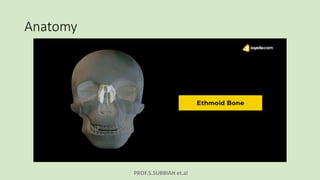
Anatomy
PROF.S.SUBBIAH et.al
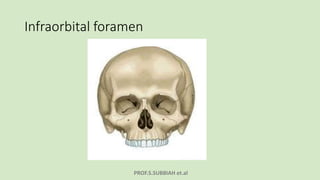
Infraorbital foramen
PROF.S.SUBBIAH et.al
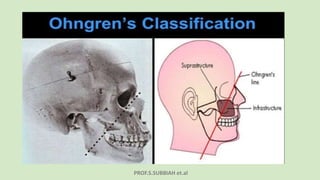
Ohngren's classification
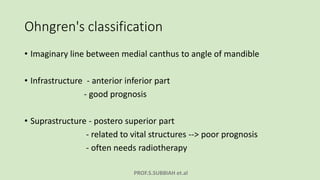
• Imaginary line between medial canthus to angle of mandible
• Infrastructure - anterior inferior part
- good prognosis
• Suprastructure - postero superior part
- related to vital structures --> poor prognosis
- often needs radiotherapy
PROF.S.SUBBIAH et.al
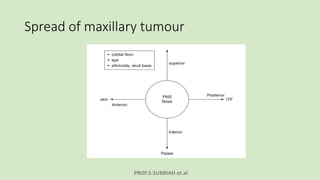
Spread of maxillary tumour
PROF.S.SUBBIAH et.al
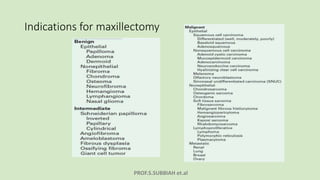
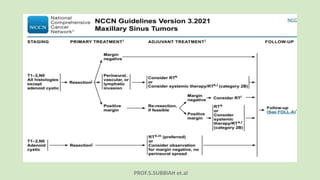
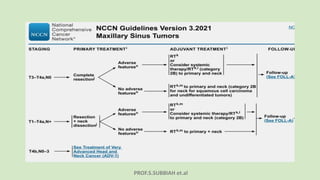
Indications for maxillectomy
PROF.S.SUBBIAH et.al
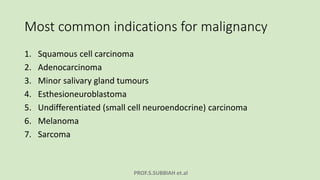
Most common indications for malignancy
1. Squamous cell carcinoma
2. Adenocarcinoma
3. Minor salivary gland tumours
4. Esthesioneuroblastoma
5. Undifferentiated (small cell neuroendocrine) carcinoma
6. Melanoma
7. Sarcoma
PROF.S.SUBBIAH et.al
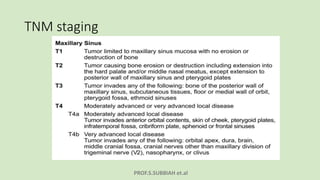
TNM staging
PROF.S.SUBBIAH et.al
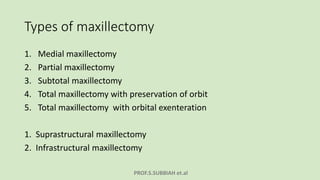
Types of maxillectomy
1. Medial maxillectomy
2. Partial maxillectomy
3. Subtotal maxillectomy
4. Total maxillectomy with preservation of orbit
5. Total maxillectomy with orbital exenteration
1. Suprastructural maxillectomy
2. Infrastructural maxillectomy
PROF.S.SUBBIAH et.al
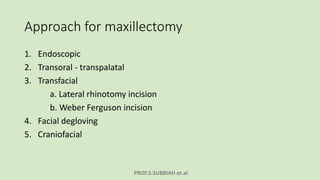
Approach for maxillectomy
1. Endoscopic
2. Transoral - transpalatal
3. Transfacial
a. Lateral rhinotomy incision
b. Weber Ferguson incision
4. Facial degloving
5. Craniofacial
PROF.S.SUBBIAH et.al
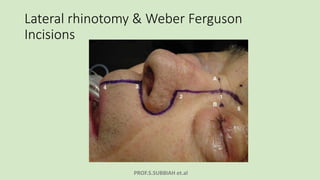
Lateral rhinotomy & Weber Ferguson
Incisions
PROF.S.SUBBIAH et.al
• Lateral rhinotomy approach
- for medial maxillectomy
- for tumours of medial wall of maxilla
- also for tumours of lateral wall of nasal cavity
PROF.S.SUBBIAH et.al
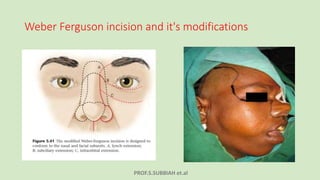
Weber Ferguson incision and it's modifications
PROF.S.SUBBIAH et.al
Weber Ferguson incision
• For subtotal or total maxillectomy
• Modifications:
1. Dieffenbach - direct visualization of posterior maxilla
2. Lynch - avoids ectropion, better cosmesis, better flap vitality
3. Borle extension (question mark)- for temporalis flap
PROF.S.SUBBIAH et.al
Transoral-transpalatal approach
• Combination of sublabial gingivobuccal sulcus incision and palatal
incision
• For inferior (infrastructure) maxillectomy
• Also for tumors of upper alveolar ridge and hard palate
PROF.S.SUBBIAH et.al
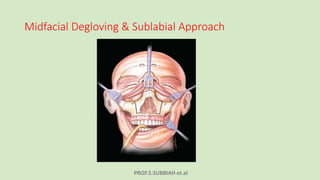
Midfacial Degloving & Sublabial Approach
PROF.S.SUBBIAH et.al
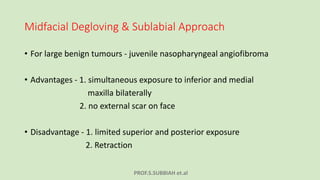
Midfacial Degloving & Sublabial Approach
• For large benign tumours - juvenile nasopharyngeal angiofibroma
• Advantages - 1. simultaneous exposure to inferior and medial
maxilla bilaterally
2. no external scar on face
• Disadvantage - 1. limited superior and posterior exposure
2. Retraction
PROF.S.SUBBIAH et.al
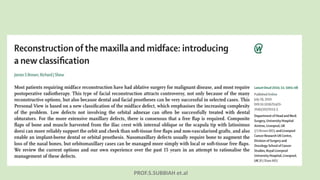
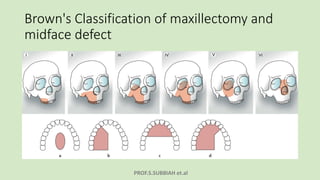
Brown's Classification of maxillectomy and
midface defect
PROF.S.SUBBIAH et.al
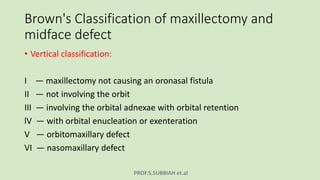
Brown's Classification of maxillectomy and
midface defect
• Vertical classification:
I — maxillectomy not causing an oronasal fistula
II — not involving the orbit
III — involving the orbital adnexae with orbital retention
lV — with orbital enucleation or exenteration
V — orbitomaxillary defect
VI — nasomaxillary defect
PROF.S.SUBBIAH et.al
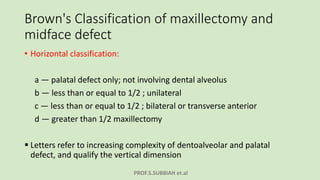
Brown's Classification of maxillectomy and
midface defect
• Horizontal classification:
a — palatal defect only; not involving dental alveolus
b — less than or equal to 1/2 ; unilateral
c — less than or equal to 1/2 ; bilateral or transverse anterior
d — greater than 1/2 maxillectomy
 Letters refer to increasing complexity of dentoalveolar and palatal
defect, and qualify the vertical dimension
PROF.S.SUBBIAH et.al
Santamaria and Cordeiro or MSKCC
classification
PROF.S.SUBBIAH et.al
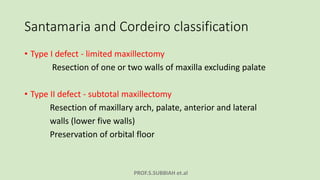
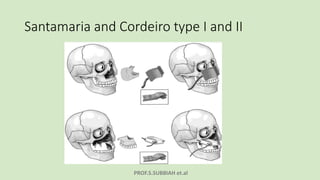
Santamaria and Cordeiro classification
• Type I defect - limited maxillectomy
Resection of one or two walls of maxilla excluding palate
• Type II defect - subtotal maxillectomy
Resection of maxillary arch, palate, anterior and lateral
walls (lower five walls)
Preservation of orbital floor
PROF.S.SUBBIAH et.al
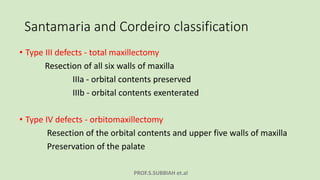
Santamaria and Cordeiro classification
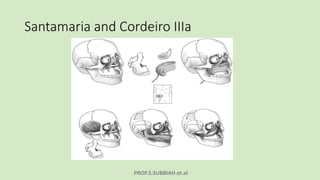
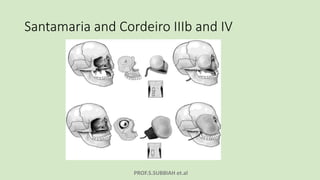
• Type III defects - total maxillectomy
Resection of all six walls of maxilla
IIIa - orbital contents preserved
IIIb - orbital contents exenterated
• Type IV defects - orbitomaxillectomy
Resection of the orbital contents and upper five walls of maxilla
Preservation of the palate
PROF.S.SUBBIAH et.al
Santamaria and Cordeiro type I and II
PROF.S.SUBBIAH et.al
Santamaria and Cordeiro IIIa
PROF.S.SUBBIAH et.al
Santamaria and Cordeiro IIIb and IV
PROF.S.SUBBIAH et.al
Prosthesis
• Dental prosthesis
• Maxillofacial prosthesis
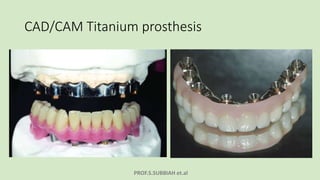
• Titanium prosthesis - CAD/ CAM ( computer aided design or
Computer assisted manufactured
PROF.S.SUBBIAH et.al
CAD/CAM Titanium prosthesis
PROF.S.SUBBIAH et.al
• Orbit support - Temporal fascia/flap
- vascularised or avascular bone graft
- Titanium mesh
PROF.S.SUBBIAH et.al
Take home message
• Medial maxillectomy - lateral rhinotomy approach
• Inferior maxillectomy – transoral/transpalatal approach
• Subtotal and total maxillectomy - Weber Ferguson incision
• Large benign nasopharyngeal tumour - Midfacial Degloving &
Sublabial Approach
PROF.S.SUBBIAH et.al
Take home message
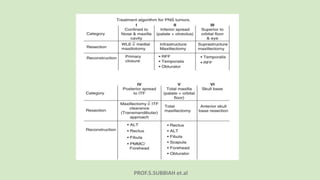
• Algorithm for reconstruction - based on type of defect
• Large surface area with small to medium volume defects - Radial
forearm fasciocutaneous or osteocutaneous flap
• Large volume with medium to large surface area defects - rectus
abdominis free flap
• Orbital floor reconstruction - bone graft combined with soft tissue
flaps
PROF.S.SUBBIAH et.al
Thank you

MAXILLECTOMY