Local Anesthesia in Surgery
Dr Saujanya Jung Pandey
General Surgery
Moderator- Dr Bashanta Baral
Introduction
• Local anaesthetics (LAs) are drugs which upon topical application or
local injection cause reversible loss of sensory perception, especially
of pain, in a localized area of the body.
Historical aspects
• South American natives chewed coca leaves for stimulant and
euphoric action
• Albert Niemann- Isolated cocaine in 1860
• He tasted it causing numbness of tongue
• Sigmund Freud- tried it for psychic energizing activity unsuccessfully
• Carl Koller- Used cocaine for ocular surgery in 1884
• Halstead- infiltration anesthesia
Desirable properties
• Non-Irritating
• Do not cause permanent damage to nerve structure
• Systemic toxicity should be low
• Effective-
• Injected
• Applied locally
• Onset Of action as short as possible
• DOA long enough to allow time for surgery
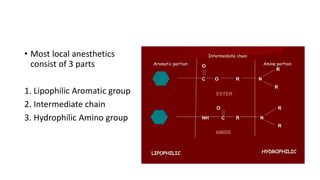
• Most local anesthetics
consist of 3 parts
1. Lipophilic Aromatic group
2. Intermediate chain
3. Hydrophilic Amino group
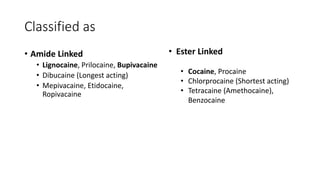
Classified as
• Amide Linked
• Lignocaine, Prilocaine, Bupivacaine
• Dibucaine (Longest acting)
• Mepivacaine, Etidocaine,
Ropivacaine
• Ester Linked
• Cocaine, Procaine
• Chlorprocaine (Shortest acting)
• Tetracaine (Amethocaine),
Benzocaine
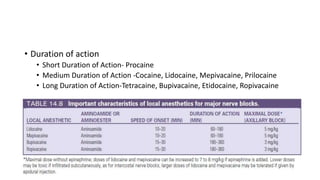
• Duration of action
• Short Duration of Action- Procaine
• Medium Duration of Action -Cocaine, Lidocaine, Mepivacaine, Prilocaine
• Long Duration of Action-Tetracaine, Bupivacaine, Etidocaine, Ropivacaine
Mechanism of action
• All LAs are weak bases.
• penetrate the axonal membrane (in unionized form) and block the
voltage gated Na+ channels from within (in ionized from).
• consequently block the nerve conduction by reducing the
permeability of Na+ ions during depolarization.
• Stabilize inactivated state of sodium channels.
• Degree of blockade is frequency dependent
• Greater blockade at higher frequency of Stimulation
• Higher concentration of Ca++ reduces inactivation of Na+ channel
• Blockade is not due to hyperpolarization
• RMP is unaltered as K+ channels are not blocked
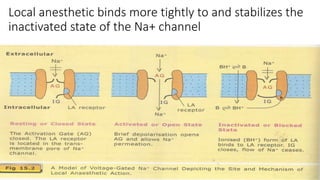
Local anesthetic binds more tightly to and stabilizes the
inactivated state of the Na+ channel
Factors influencing action of LA
• Lipid Solubility
• Lipid solubility helps in nerve penetration, faster action
• Non ionized form can easily cross nerve membrane
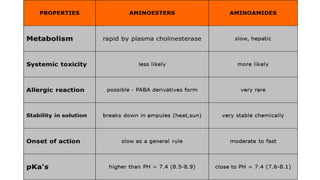
• pKa
• Lower pKa (7.6 — 7.8) — faster acting (lidocaine, mepivacaine)
• Higher pKa (8.1 — 8.9) — slower acting (procaine, tetracaine, bupivacaine)
• Vasoconstrictors (Adrenaline, Phenylephrine)
• Felypressin (Vasopressin Analogue)
• Used as vasoconstrictor in patients with CV Diseases
• increased protein binding correlates with a longer duration of action
• Inflammation
• Acidic environment
• ionized LA, Penetration decreased
• Alkalization
• Hasten onset of nerve block
• Limited increase in unionized form
• precipitation of LA
Actions of LA- local
 Small diameter axons are more susceptible to block than large
diameter fibres.
 Small unmyelinated C fibers, and small myelinated Aλ fibers are
blocked before the larger myelinated Aϒ, Aβ, and Aα fibers In
 functional terms: Autonomic > Sensory > Motor.
 Among sensory fibres sequence of block is temperature( cold before
heat) > pain > touch > deep pressure > proprioception.
Effects
• CNS Stimulation (More sensitive than cardiac)
• Dose-related spectrum Of effects and All effects are due to
depression of neurons
• First apparent CNS stimulation (convulsions most serious)
• Followed by CNS depression (death due to respiratory depression)
• Premonitory signs include: ringing in ears, metallic taste ,numbness around
lips
• Cocaine- euphoria
• Lidocaine - sedation even at non-toxic doses
• CVS-
• ↓ Automaticity, Conductivity, Excitability, Contractility
• ↑ Effective refractory period
• Prolonged QTc interval
• Ventricular Tachycardia, Ventricular Fibrillation
• ↓ in Blood Pressure by Sympathetic blockade
• Cocaine ↑ Blood pressure
• Methemoglobinemia
• Some LA metabolites have significant oxidizing properties
• This may cause a significant conversion of hemoglobin to methemoglobin and
compromise ability to carry oxygen
• prilocaine benzocaine lidocaine have been implicated
• Hypersensitivity
• Esters> Amides (Methyl Paraben)
• Asthmatic attack or Allergic dermatitis
Lignocaine
 Readily absorbed from mucous membranes and damaged skin.
 Rapidly absorbed from injection site .
 After IV, rapidly and widely distributed into highly perfused tissues
followed by redistribution into skeletal muscle and adipose tissue.
 Onset of action- fast
 Duration of nerve block- 1-2 hrs.
 Used for infiltration anaesthesia, regional nerve block, surface,
epidural, spinal anaesthesia.
BUPIVACAINE
• Potent
• Slow onset : 4-10 min.
• Long duration of action: 1.5 - 8.5 hours.
• Produces anaesthesia without significant motor blockade (mother can
actively cooperate in vaginal delivery).
• Has high lipid solubility, distribute more in tissues than in blood.
• Indicated mainly for infiltration anaesthesia and epidural block.
Techniques
• Surface anaesthesia
• Infiltration Anaesthesia
• Nerve Blocks
• Intravenous Regional Block (Bier’s Block)
• Spinal Anaesthesia
• Epidural Anaesthesia
Surface anesthesia
Topical application of LA to mucous membranes and abraded skin
Superficial area is anaesthetised
Lignocaine commonly used for ear, nose, eye, mouth and pharynx.
It is also used for proctoscopy, catheterization and per rectal
examination.
 Lignocaine is ineffective on intact skin.
 However a mixture of 2.5% prilocaine and 2.5% lignocaine in ratio of
1:1 can anaesthetize even unbroken skin.
 Combination of these 2 local anaesthetics lower the melting point of
individual drugs and help to form a semi- solid ointment.
 This mixture is known as Eutectic mixture.
 Oxethazaine (mucaine) can be used to provide symptomatic relief in
gastritis (it remains unionised in the acidic pH of stomach)
INFILTRATION ANESTHESIA
• Direct injection into tissues to reach nerve branches and terminals.
• Can be superficial as well as deep.
• Used in minor surgery.
• Immediate onset with variable duration.
• This type involve skin region as deep as intraabdominal tissue.
NERVE BLOCK or FIELD BLOCK
• Interruption of nerve conduction upon injection into the region of
nerve plexus or trunk.
• Used for surgery, dentistry, analgesia.
• Less anesthetic needed than for infiltration
• Given within specific nerve area such as brachial plexus, within
intercostal nerves, abdominal nerves are targeted, cervical plexus
when neck region is targeted.
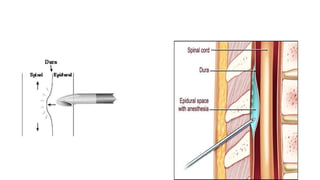
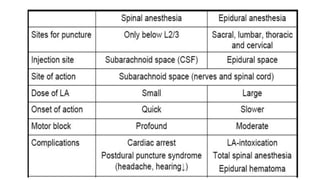
Spinal Anesthesia
• Site of injection — Subarachnoid space between L2-3 or L3-4
• Site of action — nerve root in the cauda equina
• Level of anaesthesia — vol. & speed of injection; baricity of drug soln.
with CSF and posture of patient
• Order of anaesthesia — sympathetic > motor
• Uses — lower limbs, pelvis, lower abdomen, prostatectomy, fracture
setting and obstetric procedures
• Problems- Spinal Headache ,hypotension, bradycardia and respiratory
depression, cauda equina syndrome and nausea-vomiting
• Drugs - Lidocaine, tetracaine
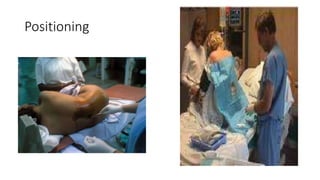
Positioning
Procedure
Epidural and Caudal Anaesthesia:
• Site of injection — sacral hiatus (caudal) or lumbar, thoracic or
cervical region
• Catheters are used for continuous infusion
• Unwanted effects similar to that of spinal except less likely because
longitudinal spread is reduced -
• Drugs - Lidocaine, bupivacaine, ropivacaine
Regional anaesthesia (Intravenous)
• Mostly limited to upper limb
• Orthopaedic procedures
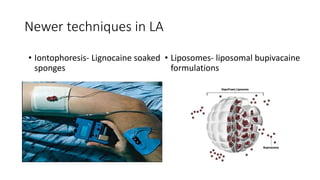
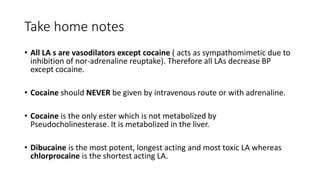
Newer techniques in LA
• Liposomes- liposomal bupivacaine
formulations
• Iontophoresis- Lignocaine soaked
sponges
Take home notes
• All LA s are vasodilators except cocaine ( acts as sympathomimetic due to
inhibition of nor-adrenaline reuptake). Therefore all LAs decrease BP
except cocaine.
• Cocaine should NEVER be given by intravenous route or with adrenaline.
• Cocaine is the only ester which is not metabolized by
Pseudocholinesterase. It is metabolized in the liver.
• Dibucaine is the most potent, longest acting and most toxic LA whereas
chlorprocaine is the shortest acting LA.
• Bupivacaine is the best drug for regional block but it is also the most
cardiotoxic LA.
• Lignocaine is the most commonly used LA and is the drug of choice
for ventricular tachycardia.
• Chlorprocaine is the shortest acting LA and is contraindicated in spinal
anaesthesia (It may cause paraplegia due to the presence of sodium
metasulphite as preservative, which is neurotoxic).
References
• Essentials of Medical Pharmacology -7th edition by KD Tripathi
• Sabiston textbook of surgery 21st edition
• Basic and Clinical pharmacology 11th edition by Bertram G Katzung

Local Anesthesia in Surgical practice.pptx

  • 1.
    Local Anesthesia inSurgery Dr Saujanya Jung Pandey General Surgery Moderator- Dr Bashanta Baral
  • 2.
    Introduction • Local anaesthetics(LAs) are drugs which upon topical application or local injection cause reversible loss of sensory perception, especially of pain, in a localized area of the body.
  • 3.
    Historical aspects • SouthAmerican natives chewed coca leaves for stimulant and euphoric action • Albert Niemann- Isolated cocaine in 1860 • He tasted it causing numbness of tongue • Sigmund Freud- tried it for psychic energizing activity unsuccessfully • Carl Koller- Used cocaine for ocular surgery in 1884 • Halstead- infiltration anesthesia
  • 4.
    Desirable properties • Non-Irritating •Do not cause permanent damage to nerve structure • Systemic toxicity should be low • Effective- • Injected • Applied locally • Onset Of action as short as possible • DOA long enough to allow time for surgery
  • 5.
    • Most localanesthetics consist of 3 parts 1. Lipophilic Aromatic group 2. Intermediate chain 3. Hydrophilic Amino group
  • 6.
    Classified as • AmideLinked • Lignocaine, Prilocaine, Bupivacaine • Dibucaine (Longest acting) • Mepivacaine, Etidocaine, Ropivacaine • Ester Linked • Cocaine, Procaine • Chlorprocaine (Shortest acting) • Tetracaine (Amethocaine), Benzocaine
  • 8.
    • Duration ofaction • Short Duration of Action- Procaine • Medium Duration of Action -Cocaine, Lidocaine, Mepivacaine, Prilocaine • Long Duration of Action-Tetracaine, Bupivacaine, Etidocaine, Ropivacaine
  • 9.
    Mechanism of action •All LAs are weak bases. • penetrate the axonal membrane (in unionized form) and block the voltage gated Na+ channels from within (in ionized from). • consequently block the nerve conduction by reducing the permeability of Na+ ions during depolarization. • Stabilize inactivated state of sodium channels.
  • 10.
    • Degree ofblockade is frequency dependent • Greater blockade at higher frequency of Stimulation • Higher concentration of Ca++ reduces inactivation of Na+ channel • Blockade is not due to hyperpolarization • RMP is unaltered as K+ channels are not blocked
  • 11.
    Local anesthetic bindsmore tightly to and stabilizes the inactivated state of the Na+ channel
  • 12.
    Factors influencing actionof LA • Lipid Solubility • Lipid solubility helps in nerve penetration, faster action • Non ionized form can easily cross nerve membrane • pKa • Lower pKa (7.6 — 7.8) — faster acting (lidocaine, mepivacaine) • Higher pKa (8.1 — 8.9) — slower acting (procaine, tetracaine, bupivacaine)
  • 13.
    • Vasoconstrictors (Adrenaline,Phenylephrine) • Felypressin (Vasopressin Analogue) • Used as vasoconstrictor in patients with CV Diseases • increased protein binding correlates with a longer duration of action
  • 14.
    • Inflammation • Acidicenvironment • ionized LA, Penetration decreased • Alkalization • Hasten onset of nerve block • Limited increase in unionized form • precipitation of LA
  • 15.
    Actions of LA-local  Small diameter axons are more susceptible to block than large diameter fibres.  Small unmyelinated C fibers, and small myelinated Aλ fibers are blocked before the larger myelinated Aϒ, Aβ, and Aα fibers In  functional terms: Autonomic > Sensory > Motor.  Among sensory fibres sequence of block is temperature( cold before heat) > pain > touch > deep pressure > proprioception.
  • 16.
    Effects • CNS Stimulation(More sensitive than cardiac) • Dose-related spectrum Of effects and All effects are due to depression of neurons • First apparent CNS stimulation (convulsions most serious) • Followed by CNS depression (death due to respiratory depression) • Premonitory signs include: ringing in ears, metallic taste ,numbness around lips • Cocaine- euphoria • Lidocaine - sedation even at non-toxic doses
  • 17.
    • CVS- • ↓Automaticity, Conductivity, Excitability, Contractility • ↑ Effective refractory period • Prolonged QTc interval • Ventricular Tachycardia, Ventricular Fibrillation • ↓ in Blood Pressure by Sympathetic blockade • Cocaine ↑ Blood pressure
  • 18.
    • Methemoglobinemia • SomeLA metabolites have significant oxidizing properties • This may cause a significant conversion of hemoglobin to methemoglobin and compromise ability to carry oxygen • prilocaine benzocaine lidocaine have been implicated
  • 19.
    • Hypersensitivity • Esters>Amides (Methyl Paraben) • Asthmatic attack or Allergic dermatitis
  • 20.
    Lignocaine  Readily absorbedfrom mucous membranes and damaged skin.  Rapidly absorbed from injection site .  After IV, rapidly and widely distributed into highly perfused tissues followed by redistribution into skeletal muscle and adipose tissue.  Onset of action- fast  Duration of nerve block- 1-2 hrs.  Used for infiltration anaesthesia, regional nerve block, surface, epidural, spinal anaesthesia.
  • 21.
    BUPIVACAINE • Potent • Slowonset : 4-10 min. • Long duration of action: 1.5 - 8.5 hours. • Produces anaesthesia without significant motor blockade (mother can actively cooperate in vaginal delivery). • Has high lipid solubility, distribute more in tissues than in blood. • Indicated mainly for infiltration anaesthesia and epidural block.
  • 22.
    Techniques • Surface anaesthesia •Infiltration Anaesthesia • Nerve Blocks • Intravenous Regional Block (Bier’s Block) • Spinal Anaesthesia • Epidural Anaesthesia
  • 23.
    Surface anesthesia Topical applicationof LA to mucous membranes and abraded skin Superficial area is anaesthetised Lignocaine commonly used for ear, nose, eye, mouth and pharynx. It is also used for proctoscopy, catheterization and per rectal examination.
  • 24.
     Lignocaine isineffective on intact skin.  However a mixture of 2.5% prilocaine and 2.5% lignocaine in ratio of 1:1 can anaesthetize even unbroken skin.  Combination of these 2 local anaesthetics lower the melting point of individual drugs and help to form a semi- solid ointment.  This mixture is known as Eutectic mixture.  Oxethazaine (mucaine) can be used to provide symptomatic relief in gastritis (it remains unionised in the acidic pH of stomach)
  • 25.
    INFILTRATION ANESTHESIA • Directinjection into tissues to reach nerve branches and terminals. • Can be superficial as well as deep. • Used in minor surgery. • Immediate onset with variable duration. • This type involve skin region as deep as intraabdominal tissue.
  • 26.
    NERVE BLOCK orFIELD BLOCK • Interruption of nerve conduction upon injection into the region of nerve plexus or trunk. • Used for surgery, dentistry, analgesia. • Less anesthetic needed than for infiltration • Given within specific nerve area such as brachial plexus, within intercostal nerves, abdominal nerves are targeted, cervical plexus when neck region is targeted.
  • 27.
    Spinal Anesthesia • Siteof injection — Subarachnoid space between L2-3 or L3-4 • Site of action — nerve root in the cauda equina • Level of anaesthesia — vol. & speed of injection; baricity of drug soln. with CSF and posture of patient
  • 28.
    • Order ofanaesthesia — sympathetic > motor • Uses — lower limbs, pelvis, lower abdomen, prostatectomy, fracture setting and obstetric procedures • Problems- Spinal Headache ,hypotension, bradycardia and respiratory depression, cauda equina syndrome and nausea-vomiting • Drugs - Lidocaine, tetracaine
  • 29.
  • 30.
  • 32.
    Epidural and CaudalAnaesthesia: • Site of injection — sacral hiatus (caudal) or lumbar, thoracic or cervical region • Catheters are used for continuous infusion • Unwanted effects similar to that of spinal except less likely because longitudinal spread is reduced - • Drugs - Lidocaine, bupivacaine, ropivacaine
  • 34.
    Regional anaesthesia (Intravenous) •Mostly limited to upper limb • Orthopaedic procedures
  • 35.
    Newer techniques inLA • Liposomes- liposomal bupivacaine formulations • Iontophoresis- Lignocaine soaked sponges
  • 36.
    Take home notes •All LA s are vasodilators except cocaine ( acts as sympathomimetic due to inhibition of nor-adrenaline reuptake). Therefore all LAs decrease BP except cocaine. • Cocaine should NEVER be given by intravenous route or with adrenaline. • Cocaine is the only ester which is not metabolized by Pseudocholinesterase. It is metabolized in the liver. • Dibucaine is the most potent, longest acting and most toxic LA whereas chlorprocaine is the shortest acting LA.
  • 37.
    • Bupivacaine isthe best drug for regional block but it is also the most cardiotoxic LA. • Lignocaine is the most commonly used LA and is the drug of choice for ventricular tachycardia. • Chlorprocaine is the shortest acting LA and is contraindicated in spinal anaesthesia (It may cause paraplegia due to the presence of sodium metasulphite as preservative, which is neurotoxic).
  • 38.
    References • Essentials ofMedical Pharmacology -7th edition by KD Tripathi • Sabiston textbook of surgery 21st edition • Basic and Clinical pharmacology 11th edition by Bertram G Katzung

Editor's Notes

  • #3 When it is used on specific nerve pathways (nerve block), effects such as analgesia (loss of pain sensation) and paralysis (loss of muscle power) can be achieved
  • #14 Tissue Necrosis, Systemic Side effects Cl in areas with terminal arteries (Fingers, Toe, Nose, Penis) Hypoxic injury Tissue Necrosis and May Produce gangrene
  • #16 C fibres (mediating pain sensations) A delta (mediating pain and temperature sensations) A delta beta and alpha (mediating postural, touch, pressure, and motor information)
  • #19 May be a problem if cardiopulmonary reserve is limited treat with oxygen and methylene blue (converts methemoglobin to hemoglobin)