



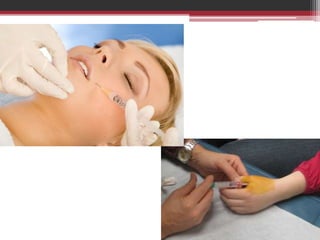
LOCAL ANESTHETICS

Dr Akasha Ambar Awan
PGR Plastic Surgery
(1st YEAR)
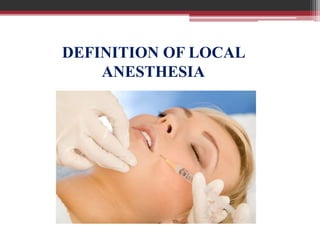
DEFINITION OF LOCAL
ANESTHESIA
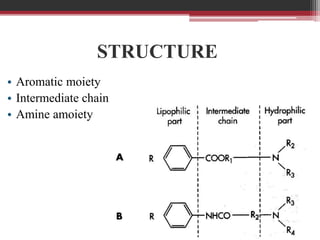
STRUCTURE
• Aromatic moiety
• Intermediate chain
• Amine amoiety
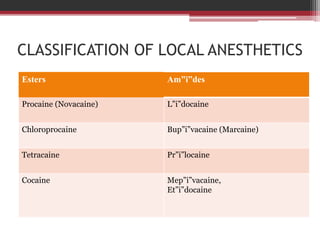
CLASSIFICATION OF LOCAL ANESTHETICS
Esters

Am”i”des

Procaine (Novacaine)

L”i”docaine

Chloroprocaine

Bup”i”vacaine (Marcaine)

Tetracaine

Pr”i”locaine

Cocaine

Mep”i”vacaine,
Et”i”docaine
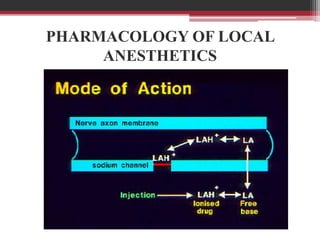
PHARMACOLOGY OF LOCAL
ANESTHETICS
PHARMACOLOGY OF LOCAL
ANESTHETICS
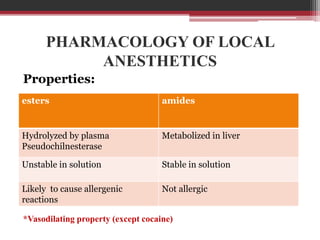
Properties:
esters

amides

Hydrolyzed by plasma
Pseudochilnesterase

Metabolized in liver

Unstable in solution

Stable in solution

Likely to cause allergenic
reactions

Not allergic

*Vasodilating property (except cocaine)
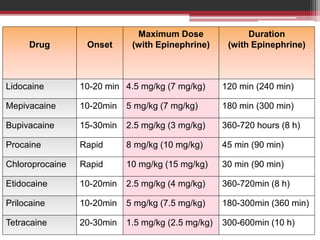
Drug

Onset

Maximum Dose
(with Epinephrine)

Duration
(with Epinephrine)

Lidocaine

10-20 min 4.5 mg/kg (7 mg/kg)

120 min (240 min)

Mepivacaine

10-20min

5 mg/kg (7 mg/kg)

180 min (300 min)

Bupivacaine

15-30min

2.5 mg/kg (3 mg/kg)

360-720 hours (8 h)

Procaine

Rapid

8 mg/kg (10 mg/kg)

45 min (90 min)

Chloroprocaine

Rapid

10 mg/kg (15 mg/kg)

30 min (90 min)

Etidocaine

10-20min

2.5 mg/kg (4 mg/kg)

360-720min (8 h)

Prilocaine

10-20min

5 mg/kg (7.5 mg/kg)

180-300min (360 min)

Tetracaine

20-30min

1.5 mg/kg (2.5 mg/kg)

300-600min (10 h)
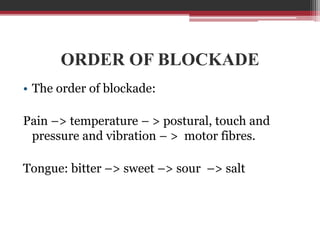
ORDER OF BLOCKADE
• The order of blockade:

Pain –> temperature – > postural, touch and
pressure and vibration – > motor fibres.
Tongue: bitter –> sweet –> sour –> salt
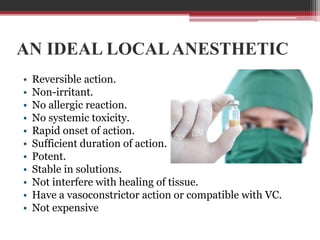
AN IDEAL LOCAL ANESTHETIC
•
•
•
•
•
•
•
•
•
•
•

Reversible action.
Non-irritant.
No allergic reaction.
No systemic toxicity.
Rapid onset of action.
Sufficient duration of action.
Potent.
Stable in solutions.
Not interfere with healing of tissue.
Have a vasoconstrictor action or compatible with VC.
Not expensive
ADDITION OF VASOCONSTRICTOR
(EPINEPHRINE)
• Why do we need to add???
â–« Clear field & hemostasis
â–« Prolonged action by limiting systemic drug
absorption
â–« Lower risk of toxicity/ and intravascular injection
EPINEPHRINE WITH LOCAL
ANESTHETIC
• The dilution of vasoconstrictors referred to as a ratio i.e., 1:50,000;
1:100,000; 1:200,000 etc,…
• A concentration of 1:1,000 means :
â–« 1 gram(1000 mg) of solute (drug) contained in 1000 ml (1 L) of
solution, therefore, 1:1,000 dilution contains 1000 mg in 1000 ml or 1.0
mg/ml of solution (1000 ug/ml)
• 1:1,000 is very concentrated (strong)
• much more dilute forms: for example, 1:50,000 > 1:100,000 > 1:200,000
• (1:100,000 = 0.01 mg/1 ml of solution)
• The maximum amount of 2% Lidocaine 1:100,000 epinephrine that
can be used is 300 mg which is 8.3 cartridges regardless of the
patient’s weight.
CONTRAINDICATIONS OF LOCAL
ANESTHETICS WITH
VASOCONSTRICTOR
•
•
•
•

Hypertension
Coronary heart disease
Arrythmias
Already using MOA

• Epinephrne+local anesthetic solution should not used in
proximity to end arteries
â–« (fingers,toes,penis,nose tip,ear lobules)
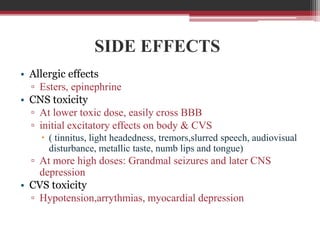
SIDE EFFECTS
• Allergic effects
â–« Esters, epinephrine
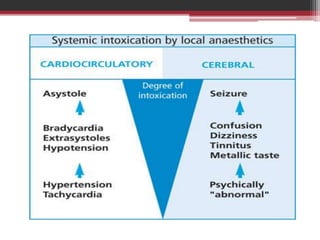
• CNS toxicity
â–« At lower toxic dose, easily cross BBB
â–« initial excitatory effects on body & CVS
ď‚– ( tinnitus, light headedness, tremors,slurred speech, audiovisual
disturbance, metallic taste, numb lips and tongue)

â–« At more high doses: Grandmal seizures and later CNS
depression
• CVS toxicity
â–« Hypotension,arrythmias, myocardial depression
TYPES OF LOCAL ANESTHESIA
•
•
•
•

Topical anesthesia
Local infilteration
Peripheral nerve blocks
Tumescent technique
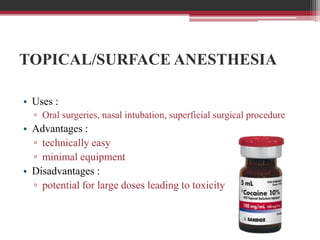
TOPICAL/SURFACE ANESTHESIA
• Uses :
â–« Oral surgeries, nasal intubation, superficial surgical procedure

• Advantages :
â–« technically easy
â–« minimal equipment
• Disadvantages :
â–« potential for large doses leading to toxicity
COCAINE SUBSTITUTIONS
• lidocaine (Xylocaine) -oxymetazoline (Afrin)
combinations.
• tetracaine (pontocaine)-oxymetazoline (Afrin)
combinations.
• Tetracaine (pontocaine) (1%-2%).
• Lidocaine (Xylocaine) (2%-4%).
• benzocaine
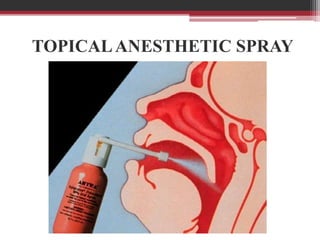
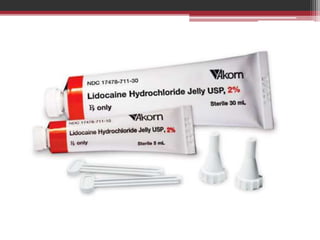
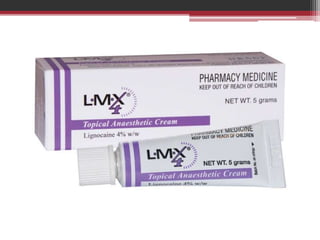
TOPICAL ANESTHETIC SPRAY
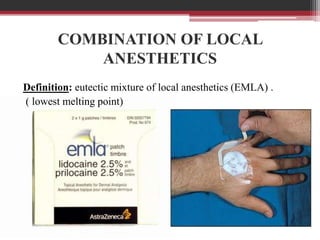
COMBINATION OF LOCAL
ANESTHETICS
Definition: eutectic mixture of local anesthetics (EMLA) .
( lowest melting point)
LOCAL INFILTERATION/FIELD
ANESTHESIA
• Uses:
â–« Suturing, minor superficial surgery, line placement, more
extensive surgery with sedation

• Advantages:
â–« minimal equipment, technically easy, rapid onset

• Disadvantages:
â–« potential for toxicity if large field
PERIPHERAL NERVE BLOCK
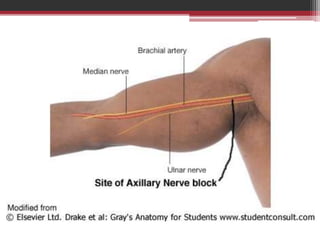
• Minor nerve block
• Major nerve block
â–« Plexus block
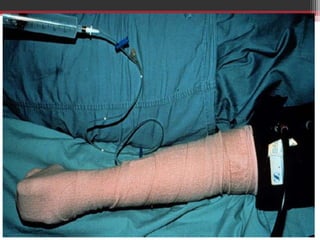
â–« i.v.block e.g. beir block
I.V BLOCK/BIER BLOCK
• Uses
â–« any surgical procedure on an extremity
• Advantages:
â–« technically simple, minimal equipment, rapid onset

• Disadvantages:
â–« duration limited by tolerance of tourniquet pain, toxicity
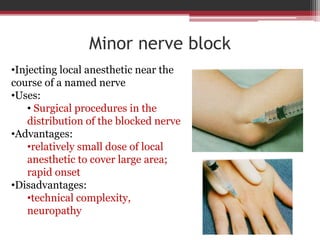
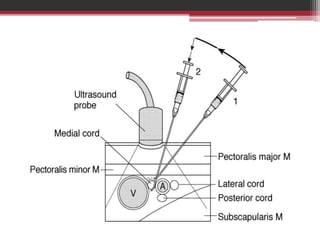
Minor nerve block
•Injecting local anesthetic near the
course of a named nerve
•Uses:
• Surgical procedures in the
distribution of the blocked nerve
•Advantages:
•relatively small dose of local
anesthetic to cover large area;
rapid onset
•Disadvantages:
•technical complexity,
neuropathy
PLEXUS BLOCKAGE
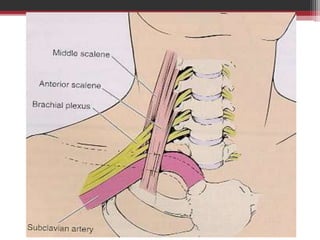
• Injection of local anesthetic adjacent to a plexus,
e.g cervical, brachial or lumbar plexus
• Uses :
â–« surgical anesthesia or post-operative analgesia in the
distribution of the plexus

• Advantages:
â–« large area of anesthesia with relatively large dose of
agent

• Disadvantages:
â–« technically complex, potential for toxicity and
neuropathy.
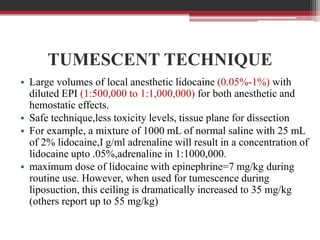
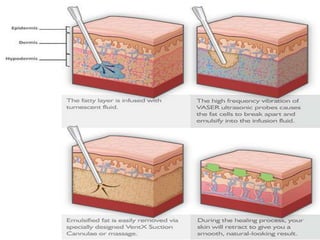
TUMESCENT TECHNIQUE
• Large volumes of local anesthetic lidocaine (0.05%-1%) with
diluted EPI (1:500,000 to 1:1,000,000) for both anesthetic and
hemostatic effects.
• Safe technique,less toxicity levels, tissue plane for dissection
• For example, a mixture of 1000 mL of normal saline with 25 mL
of 2% lidocaine,I g/ml adrenaline will result in a concentration of
lidocaine upto .05%,adrenaline in 1:1000,000.
• maximum dose of lidocaine with epinephrine=7 mg/kg during
routine use. However, when used for tumescence during
liposuction, this ceiling is dramatically increased to 35 mg/kg
(others report up to 55 mg/kg)
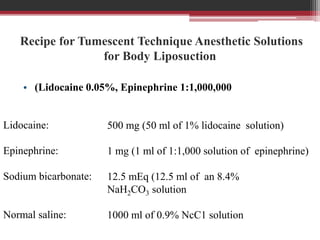
Recipe for Tumescent Technique Anesthetic Solutions
for Body Liposuction
• (Lidocaine 0.05%, Epinephrine 1:1,000,000

Lidocaine:

500 mg (50 ml of 1% lidocaine solution)

Epinephrine:

1 mg (1 ml of 1:1,000 solution of epinephrine)

Sodium bicarbonate:

12.5 mEq (12.5 ml of an 8.4%
NaH2CO3 solution

Normal saline:

1000 ml of 0.9% NcC1 solution
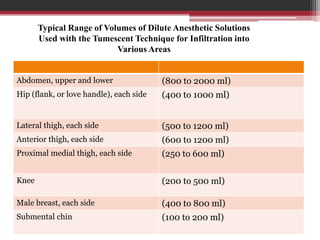
Typical Range of Volumes of Dilute Anesthetic Solutions
Used with the Tumescent Technique for Infiltration into
Various Areas
Abdomen, upper and lower

(800 to 2000 ml)

Hip (flank, or love handle), each side

(400 to 1000 ml)

Lateral thigh, each side

(500 to 1200 ml)

Anterior thigh, each side

(600 to 1200 ml)

Proximal medial thigh, each side

(250 to 600 ml)

Knee

(200 to 500 ml)

Male breast, each side

(400 to 800 ml)

Submental chin

(100 to 200 ml)
THANK YOU

Local anesthetics

  • 1.
    LOCAL ANESTHETICS Dr AkashaAmbar Awan PGR Plastic Surgery (1st YEAR)
  • 2.
  • 3.
    STRUCTURE • Aromatic moiety •Intermediate chain • Amine amoiety
  • 4.
    CLASSIFICATION OF LOCALANESTHETICS Esters Am”i”des Procaine (Novacaine) L”i”docaine Chloroprocaine Bup”i”vacaine (Marcaine) Tetracaine Pr”i”locaine Cocaine Mep”i”vacaine, Et”i”docaine
  • 5.
  • 6.
    PHARMACOLOGY OF LOCAL ANESTHETICS Properties: esters amides Hydrolyzedby plasma Pseudochilnesterase Metabolized in liver Unstable in solution Stable in solution Likely to cause allergenic reactions Not allergic *Vasodilating property (except cocaine)
  • 7.
    Drug Onset Maximum Dose (with Epinephrine) Duration (withEpinephrine) Lidocaine 10-20 min 4.5 mg/kg (7 mg/kg) 120 min (240 min) Mepivacaine 10-20min 5 mg/kg (7 mg/kg) 180 min (300 min) Bupivacaine 15-30min 2.5 mg/kg (3 mg/kg) 360-720 hours (8 h) Procaine Rapid 8 mg/kg (10 mg/kg) 45 min (90 min) Chloroprocaine Rapid 10 mg/kg (15 mg/kg) 30 min (90 min) Etidocaine 10-20min 2.5 mg/kg (4 mg/kg) 360-720min (8 h) Prilocaine 10-20min 5 mg/kg (7.5 mg/kg) 180-300min (360 min) Tetracaine 20-30min 1.5 mg/kg (2.5 mg/kg) 300-600min (10 h)
  • 8.
    ORDER OF BLOCKADE •The order of blockade: Pain –> temperature – > postural, touch and pressure and vibration – > motor fibres. Tongue: bitter –> sweet –> sour –> salt
  • 9.
    AN IDEAL LOCALANESTHETIC • • • • • • • • • • • Reversible action. Non-irritant. No allergic reaction. No systemic toxicity. Rapid onset of action. Sufficient duration of action. Potent. Stable in solutions. Not interfere with healing of tissue. Have a vasoconstrictor action or compatible with VC. Not expensive
  • 10.
    ADDITION OF VASOCONSTRICTOR (EPINEPHRINE) •Why do we need to add??? ▫ Clear field & hemostasis ▫ Prolonged action by limiting systemic drug absorption ▫ Lower risk of toxicity/ and intravascular injection
  • 11.
    EPINEPHRINE WITH LOCAL ANESTHETIC •The dilution of vasoconstrictors referred to as a ratio i.e., 1:50,000; 1:100,000; 1:200,000 etc,… • A concentration of 1:1,000 means : ▫ 1 gram(1000 mg) of solute (drug) contained in 1000 ml (1 L) of solution, therefore, 1:1,000 dilution contains 1000 mg in 1000 ml or 1.0 mg/ml of solution (1000 ug/ml) • 1:1,000 is very concentrated (strong) • much more dilute forms: for example, 1:50,000 > 1:100,000 > 1:200,000 • (1:100,000 = 0.01 mg/1 ml of solution) • The maximum amount of 2% Lidocaine 1:100,000 epinephrine that can be used is 300 mg which is 8.3 cartridges regardless of the patient’s weight.
  • 12.
    CONTRAINDICATIONS OF LOCAL ANESTHETICSWITH VASOCONSTRICTOR • • • • Hypertension Coronary heart disease Arrythmias Already using MOA • Epinephrne+local anesthetic solution should not used in proximity to end arteries ▫ (fingers,toes,penis,nose tip,ear lobules)
  • 14.
    SIDE EFFECTS • Allergiceffects ▫ Esters, epinephrine • CNS toxicity ▫ At lower toxic dose, easily cross BBB ▫ initial excitatory effects on body & CVS  ( tinnitus, light headedness, tremors,slurred speech, audiovisual disturbance, metallic taste, numb lips and tongue) ▫ At more high doses: Grandmal seizures and later CNS depression • CVS toxicity ▫ Hypotension,arrythmias, myocardial depression
  • 20.
    TYPES OF LOCALANESTHESIA • • • • Topical anesthesia Local infilteration Peripheral nerve blocks Tumescent technique
  • 21.
    TOPICAL/SURFACE ANESTHESIA • Uses: ▫ Oral surgeries, nasal intubation, superficial surgical procedure • Advantages : ▫ technically easy ▫ minimal equipment • Disadvantages : ▫ potential for large doses leading to toxicity
  • 22.
    COCAINE SUBSTITUTIONS • lidocaine(Xylocaine) -oxymetazoline (Afrin) combinations. • tetracaine (pontocaine)-oxymetazoline (Afrin) combinations. • Tetracaine (pontocaine) (1%-2%). • Lidocaine (Xylocaine) (2%-4%). • benzocaine
  • 23.
  • 25.
    COMBINATION OF LOCAL ANESTHETICS Definition:eutectic mixture of local anesthetics (EMLA) . ( lowest melting point)
  • 27.
    LOCAL INFILTERATION/FIELD ANESTHESIA • Uses: ▫Suturing, minor superficial surgery, line placement, more extensive surgery with sedation • Advantages: ▫ minimal equipment, technically easy, rapid onset • Disadvantages: ▫ potential for toxicity if large field
  • 29.
    PERIPHERAL NERVE BLOCK •Minor nerve block • Major nerve block ▫ Plexus block ▫ i.v.block e.g. beir block
  • 30.
    I.V BLOCK/BIER BLOCK •Uses ▫ any surgical procedure on an extremity • Advantages: ▫ technically simple, minimal equipment, rapid onset • Disadvantages: ▫ duration limited by tolerance of tourniquet pain, toxicity
  • 31.
    Minor nerve block •Injectinglocal anesthetic near the course of a named nerve •Uses: • Surgical procedures in the distribution of the blocked nerve •Advantages: •relatively small dose of local anesthetic to cover large area; rapid onset •Disadvantages: •technical complexity, neuropathy
  • 33.
    PLEXUS BLOCKAGE • Injectionof local anesthetic adjacent to a plexus, e.g cervical, brachial or lumbar plexus • Uses : ▫ surgical anesthesia or post-operative analgesia in the distribution of the plexus • Advantages: ▫ large area of anesthesia with relatively large dose of agent • Disadvantages: ▫ technically complex, potential for toxicity and neuropathy.
  • 37.
    TUMESCENT TECHNIQUE • Largevolumes of local anesthetic lidocaine (0.05%-1%) with diluted EPI (1:500,000 to 1:1,000,000) for both anesthetic and hemostatic effects. • Safe technique,less toxicity levels, tissue plane for dissection • For example, a mixture of 1000 mL of normal saline with 25 mL of 2% lidocaine,I g/ml adrenaline will result in a concentration of lidocaine upto .05%,adrenaline in 1:1000,000. • maximum dose of lidocaine with epinephrine=7 mg/kg during routine use. However, when used for tumescence during liposuction, this ceiling is dramatically increased to 35 mg/kg (others report up to 55 mg/kg)
  • 38.
    Recipe for TumescentTechnique Anesthetic Solutions for Body Liposuction • (Lidocaine 0.05%, Epinephrine 1:1,000,000 Lidocaine: 500 mg (50 ml of 1% lidocaine solution) Epinephrine: 1 mg (1 ml of 1:1,000 solution of epinephrine) Sodium bicarbonate: 12.5 mEq (12.5 ml of an 8.4% NaH2CO3 solution Normal saline: 1000 ml of 0.9% NcC1 solution
  • 39.
    Typical Range ofVolumes of Dilute Anesthetic Solutions Used with the Tumescent Technique for Infiltration into Various Areas Abdomen, upper and lower (800 to 2000 ml) Hip (flank, or love handle), each side (400 to 1000 ml) Lateral thigh, each side (500 to 1200 ml) Anterior thigh, each side (600 to 1200 ml) Proximal medial thigh, each side (250 to 600 ml) Knee (200 to 500 ml) Male breast, each side (400 to 800 ml) Submental chin (100 to 200 ml)
  • 41.