


Local Anesthetics Pharmacology


Iyad M.Abou Rabii
  February , 2010
What are local anesthetics?


   Local anesthetic: produce loss of sensation to pain in a specific area of
    the body without the loss of consciousness


Page  2
History


   Genus Erythroxylum discovered in South
    America, Venezuela, Bolivia, and Peru since pre-
    Columbian periods
   Coca leaves from the genus Erythroxylum contain high
    concentration of alkaloid up to 0.7-1.8%
   In 1571, Pedro Pizarro, a conquistador of Inca, observed
    nobles and high rank officials of the Inca empire consumed
    the coca plant.
   After the fall of the Inca empire, coca consumption spread
    widely to the population

Page  3
Development of general and local
  anesthesia

   Took place in Western Europe from 1750 to 1850
   Chemists and physicians collected sample of coca leaves
    for experiments
   Isolated active principle of coca leaf, synthesized to a drug
    for patients to feel more relief of pain when taking surgeries
   In 1860, German chemist Albert Niemann successfully
    isolate the active principle of coca leaf; he named it cocaine


Page  4
Development of general and local anesthesia
  (cont.)


    Niemann discovered the effect of numbness of the tongues caused by
     alkaloid in 1860
    Based on Niemann’s discovery, Russian physician Basil Von Anrep
     did experiments on animals, such as rats, dogs, and cats.
    He injected small quantity of 1% solution to his tongue; tongue
     became insensitive
    He concluded cocaine is a good drug for surgical anesthetic
    William Steward Halsted and Richard John Hall developed the inferior
     dental nerve block techniques for dentistry


Page  5
Cocaine Addiction


   An ophthalmologist Carl Koller realized the importance of
    the alkaloid’s anesthetic effect on mucous membranes
   In 1884, he used the first local anesthetic on a patient with
    glaucoma
   In 1898, Professor Heinrich Braun introduced procaine as
    the first derivative of cocaine, also known as the first
    synthetic local anesthetic drug
   Trade name is Novocaine®


Page  6
Procaine replaced cocaine
  (Problems)
 Took too long to set (i.e. to produce the desired anesthetic
  result)
 Wore off too quickly, not nearly as potent as cocaine
 Classified as an ester; esters have high potential to cause
  allergic reactions
 Caused high conc. of adrenaline resulted in increasing heart
  rate, make people feel nervous
 Most dentists preferred not to used any local anesthetic at all
  that time; they used nitrous oxide gas.

Page  7
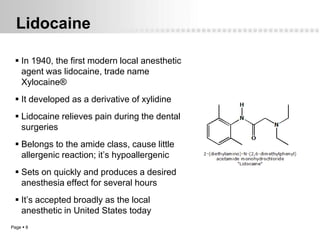
Lidocaine

  In 1940, the first modern local anesthetic
   agent was lidocaine, trade name
   Xylocaine®
  It developed as a derivative of xylidine
  Lidocaine relieves pain during the dental
   surgeries
  Belongs to the amide class, cause little
   allergenic reaction; it’s hypoallergenic
  Sets on quickly and produces a desired
   anesthesia effect for several hours
  It’s accepted broadly as the local
   anesthetic in United States today
Page  8
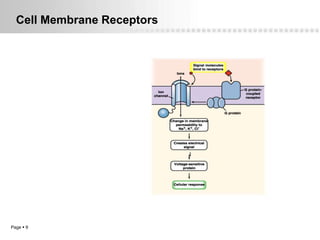
Cell Membrane Receptors


Page  9
Membrane potential and neurotransmission:


 Neuron transmits information mainly by two mechanisms:
  – chemical
  – and electrical signals.
 Information within a neuron is mainly transmitted by electrical signals.
 Electrical signals are propagated by the mechanism called action
  potential.


Page  10
neurotransmission: Resting Potential


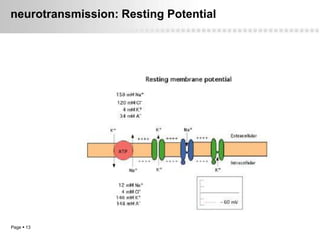
   Resting neurons maintain an intracellular negative membrane
    potential.
   Na+/K+ ATPase (sodium pump) transports intracellular Na+ to
    extracellular in exchange of entry of K+ into cells. This creates a
    concentration gradients of Na+ and K+


Page  11
neurotransmission: Resting Potential


   The resting neuron cell membrane contains much more open K+
    channels than open Na+ and Cl-
   channels or channels for other ions. K+ flows to the outside down the
    concentration gradient, resulting in a negative potential inside the cell.


Page  12
neurotransmission: Resting Potential


Page  13
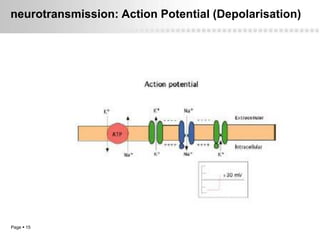
neurotransmission: Action Potential (Depolarisation)


   When stimulated (electrically or chemically), a depolarization of the
    membrane potential in the neuron (axon) membrane opens voltage-
    gated Na+ channels.
   This leads to a burst of flow of Na+ into the cell down the
    concentration gradient, causing a reverse of the membrane potential
    (from negative inside to positive inside).


Page  14
neurotransmission: Action Potential (Depolarisation)


Page  15
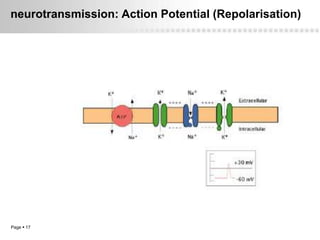
neurotransmission: Action Potential (Repolarisation)


   Eventually, the influx of Na+ is stopped when Na+ concentration
    gradient is balanced by the reversed potential gradient.
   Na+ channels are closed by the voltage-sensitive regulatory domain
   Subsequently, voltage-gated K+ channels open, allowing accelerated
    outflow of K+. The membrane potential returns to resting state


Page  16
neurotransmission: Action Potential (Repolarisation)


Page  17
Membrane potential and neurotransmission:


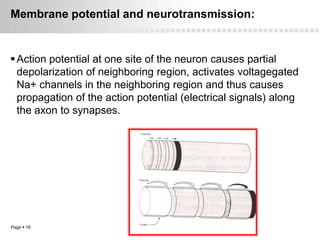
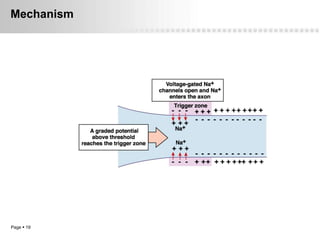
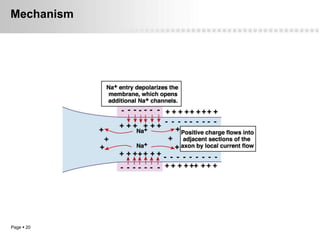
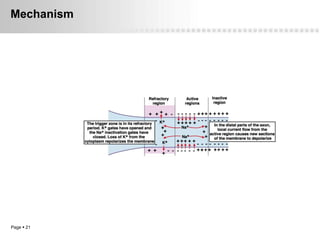
 Action potential at one site of the neuron causes partial
  depolarization of neighboring region, activates voltagegated
  Na+ channels in the neighboring region and thus causes
  propagation of the action potential (electrical signals) along
  the axon to synapses.


Page  18
Mechanism


Page  19
Mechanism


Page  20
Mechanism


Page  21
How Local Anesthetics Work


            Altering the basic potential of the nerve
             membrane
            Altering the threshold or firing level
            Decrasing the rate of depolarization
            Prolonging the rate of repolarization


Page  22
LOCAL ANESTHETICS CALSIFICATION


  – Esters Cocaine,          Procaine   Chlore   procaine
    ,Tetracaine .
  – Amids : Lidocaine Mepivacaine, Prilocaine Articaine
    Popivacaine, Etidocaine.
  – Ketons :Dyclon.
  – Quinoline: Centbucridine .


Page  23
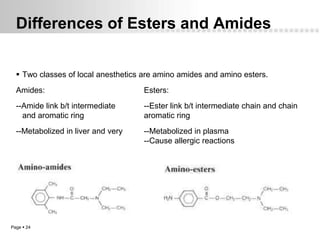
Differences of Esters and Amides


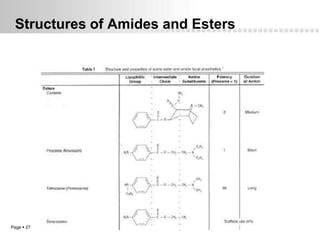
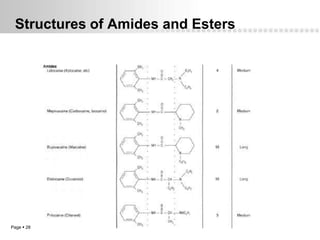
   Two classes of local anesthetics are amino amides and amino esters.
  Amides:                            Esters:
  --Amide link b/t intermediate      --Ester link b/t intermediate chain and chain
    and aromatic ring                aromatic ring
  --Metabolized in liver and very    --Metabolized in plasma
                                     --Cause allergic reactions


Page  24
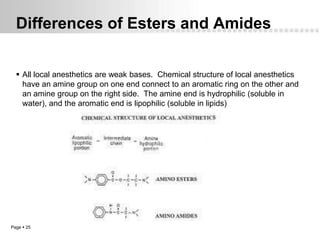
Differences of Esters and Amides


   All local anesthetics are weak bases. Chemical structure of local anesthetics
    have an amine group on one end connect to an aromatic ring on the other and
    an amine group on the right side. The amine end is hydrophilic (soluble in
    water), and the aromatic end is lipophilic (soluble in lipids)


Page  25
Structures of Amides and Esters
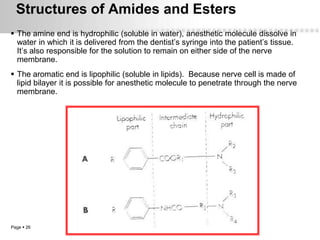
 The amine end is hydrophilic (soluble in water), anesthetic molecule dissolve in
  water in which it is delivered from the dentist’s syringe into the patient’s tissue.
  It’s also responsible for the solution to remain on either side of the nerve
  membrane.
 The aromatic end is lipophilic (soluble in lipids). Because nerve cell is made of
  lipid bilayer it is possible for anesthetic molecule to penetrate through the nerve
  membrane.


Page  26
Structures of Amides and Esters


Page  27
Structures of Amides and Esters


Page  28
Pharmacokinetics


 Following injection into the area of nerve fibers to be blocked, local
  anesthetics are absorbed into blood.
  – Ester-linked local anesthetics are quickly hydrolyzed by butyrylcholinesterase in
    blood.
  – Amide-linked local anesthetics can be widely distributed via circulation. Amide-
    linked local anesthetics are hydrolyzed by liver microsomal enzymes.
    Thus, half lifes of these drugs are significantly longer and toxicity is more likely
    to occur in patients with impaired liver function.


Page  29
Pharmacokinetics


 Absorption of local anesthetics is affected by following factors:
  – dosage,
  – site of injection,
  – drug-tissue-binding and
  – Presence of vaso-constricting drugs


Page  30
Factors Affect the Reaction of Local
  Anesthetics

Lipid solubility
 All local anesthetics have weak bases. Increasing the lipid solubility
  leads to faster nerve penetration, block sodium channels, and speed up
  the onset of action.
 The more tightly local anesthetics bind to the protein, the longer the
  duration of onset action.
 Local anesthetics have two forms, ionized and nonionized. The
  nonionized form can cross the nerve membranes and block the sodium
  channels.
 So, the more nonionized presented, the faster the onset action.


Page  31
Factors Affect the Reaction of Local
  Anesthetics


 pH influence
  Usually at range 7.6 – 8.9
  Decrease in pH shifts equilibrium toward the ionized form, delaying the
   onset action.
  Lower pH, solution more acidic, gives slower onset of action


Page  32
Factors Affect the Reaction of Local
  Anesthetics (cont.)
  Vasodilation
   Vasoconstrictor is a substance used to keep the anesthetic solution in
    place at a longer period and prolongs the action of the drug
   vasoconstrictor delays the absorption which slows down the absorption
    into the bloodstream
   Lower vasodilator activity of a local anesthetic leads to a slower
    absorption and longer duration of action
   Vasoconstrictor used the naturally hormone called epinephrine
    (adrenaline). Epinephrine decreases vasodilator.


  Side effects of epinephrine
   Epinephrine circulates the heart, causes the heart beat stronger and
    faster, and makes people feel nervous.
Page  33
Toxicity
   Toxicity is the peak circulation levels of local anesthetics
   Levels of local anesthetic concentration administered to patients are varied
    according to age, weight, and health.
   Maximum dose for an individual is usually between 70mg to 500mg
   The amount of dose also varied based on the type of solution used and the
    presence of vasoconstrictor
  Example:
  ---For adult whose weight is 150lbs and up, maximum dose Articaine and
    lidocaine is about 500mg
  ---For children, the dosage reduced to about 1/3 to ½ depending on their
    weight.
  The doses are not considered lethal.
  Some common toxic effects:
   --light headedness        ---shivering or twitching             --seizures
  --hypotension (low blood pressure)
Page  34                                      --numbness
Drugs used in dental anesthesia


 The most common local anesthetic used is called lidocaine.
 Others might include mepivacaine, bupivacaine and prilocaine.
 All of the drugs will most likely end with a caine. Procaine, which is
  commonly known as novacaine is no longer used as the other drugs
  mentioned here are more effective as numbing agent.


Page  35
Drugs used in dental anesthesia


 Bupivicaine (Marcaine®
--Produce very long acting anesthetic effect to delay the post operative pain from the surgery
  for as long as possible
--0.5% solution with vasoconstrictor
--toxicity showed by the pKa is very basic
--Onset time is longer than other drugs b/c most of the radicals (about 80%) bind to sodium
  channel proteins effectively
--most toxic local anesthetic drug


Page  36
Drugs used in dental anesthesia


 Prilocaine (Citanest®)
--Identical pKa and same conc. with lidocaine
--Almost same duration as lidocaine
--Less toxic in higher doses than lidocaine b/c small vasodilatory activity


 Articaine (Septocaine®)
--newest local anesthetic drug approved by FDA in 2000
--Same pKa and toxicity as lidocaine, but its half life is less than about ¼ of lidocaine
--Used with vasoconstrictor.
--Enters blood barrier smoothly
--The drug is widely used in most nations today


Page  37
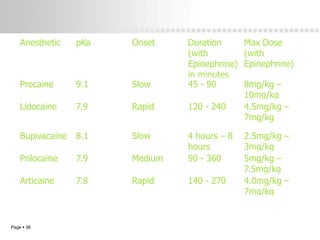
Anesthetic    pKa   Onset    Duration       Max Dose
                                 (with          (with
                                 Epinephrine)   Epinephrine)
                                 in minutes
    Procaine      9.1   Slow     45 - 90        8mg/kg –
                                                10mg/kg
    Lidocaine     7.9   Rapid    120 - 240      4.5mg/kg –
                                                7mg/kg

    Bupivacaine   8.1   Slow     4 hours – 8    2.5mg/kg –
                                 hours          3mg/kg
    Prilocaine    7.9   Medium   90 - 360       5mg/kg –
                                                7.5mg/kg
    Articaine     7.8   Rapid    140 - 270      4.0mg/kg –
                                                7mg/kg


Page  38
The Other Drugs in a Local Anesthesia Carpule


   The dentist will make a solution for the local anesthesia to be
   administered prior to the surgery. Some of the other drugs in the
   solution may contain an antioxidant to prevent a breakdown of the
   vasoconstrictor, sodium hydroxide to adjust the acidity of the anesthetic
   so it works more effectively, sodium chloride, to help the solution enter
   the bloodstream more effectively and sometimes epinephrine which
   also works to narrow blood vessels to help the anesthetic last longer.


Page  39
Vasoconstrictors


 Vasoconstrictors, such as epinephrine and norepinephrine, are commonly
 contained in local anesthetics to decrease systemic toxicity and prolong
 the duration of action by retarding anesthetic absorption.


Page  40
Clinical Consideration


These catecholamines have varying degrees of α and β adrenergic
effects, resulting in cardiac and hemodynamic changes

In cardiac patients, the administration of low concentration of epinephrine
might be necessary according to the degree of severity of the disease.

These doesn`t mean the use of epinephrine free local anesthetics but to
make sure that it is not directly administrated in the blood.


Page  41
How is it administered?


   There are two local anesthesia injections a dentist will use. There is
   something called an infiltration injection which numbs a small area and
   there is a block injection which numbs a larger region. All of the
   injections are done in the interior of the mouth.


Page  42
Side Effects:


    One possible side effect is hematoma, which is a blood filled swelling
    that can form when the needle accidentally punctures a blood vessel.
    You may also feel numbness outside the targeted area and this may
    cause drooping in your eyelid or lips. The effects of drooping will
    disappear when the anesthesia wears off. Allergic reactions are also
    rare; however it is important to tell your doctor about any medication
    you are taking.


Page  43
Side Effects:


   Some of the side effects include a numb mouth, which is of course
   the point of the anesthetic in the first place but other effects include
   dizziness and the feeling that you have a fat or swollen lip. Other
   than that, side effects are very rare, which is part of the reason the
   local anesthetic is so popular in dental procedures.


Page  44
References
   Calatayud Jesús and González Ángel. History of the Development and Evolution of
    Local Anesthesia Since the Coca Leaf. © 2003 American Society of Anesthesiologists
    Volume 98(6) June 2003 pp 1503-1508.
   Peter C. Meltzer, Shanghao Liu, Heather S. Blanchette, Paul Blundell, Bertha K.
    Madras. Design and Synthesis of an Irreversible Dopamine-Sparing Cocaine
    Antagonist. @ Bioorganic & Medicinal Chemistry Volume 10, Issue 11 , November
    2002, Pages 3583-3591
   Shigeki Isomura, Timothy Z. Hoffman, Peter Wirsching, and Kim D. Janda.
    Synthesis, Properties, and Reactivity of Cocaine Benzoylthio Ester Possessing the
    Cocaine Absolute Configuration. J. AM. CHEM. SOC. 2002, Issue 124, p.3661-3668
   Mazoit, Jean-Xavier; Dalens, Bernard J. Pharmacokinetics of local anesthetics in
    infants and children. Clinical Pharmacokinetics (2004), 43(1), 17-32.


   Alejandro A. Nava-Ocampo and Angelica M. Bello-Ramirez. Lipophilicity Affects the
    Pharmacokinetics and Toxicity of Local Anaesthetic Agents Administered by Caudal
    Block. Clinical and Experimental Pharmacology and Physiology (2004) 31, 116-118.
   Don R Revis, Jr. Local Anesthetics. October 14,2004: (Medline)
     http://www.emedicine.com/ent/topic20.htm


Page  45
Copyright notice
   Feel free to use this PowerPoint presentation for your personal,
   educational and business.

   Do

   • Make a copy for backups on your harddrive or local network.
   • Use the presentation for your presentations and projects.
   • Print hand outs or other promotional items.


   Don‘t

   • Make it available on a website, portal or social network website for download.
     (Incl. groups, file sharing networks, Slideshare etc.)
   • Edit or modify the downloaded presentation and claim / pass off as your own work.

   All copyright and intellectual property rights, without limitation, are retained by Dr. Iyad Abou Rabii. By
     downloading and using this presentatione, you agree to this statement.


   Please feel free to contact me, if you do have any questions about usage.
   Dr Iyad Abou Rabii
   Iyad.abou.rabii@qudent.edu.sa


Page  46

Local anesthetics

  • 1.
    Local Anesthetics Pharmacology IyadM.Abou Rabii February , 2010
  • 2.
    What are localanesthetics?  Local anesthetic: produce loss of sensation to pain in a specific area of the body without the loss of consciousness Page  2
  • 3.
    History Genus Erythroxylum discovered in South America, Venezuela, Bolivia, and Peru since pre- Columbian periods  Coca leaves from the genus Erythroxylum contain high concentration of alkaloid up to 0.7-1.8%  In 1571, Pedro Pizarro, a conquistador of Inca, observed nobles and high rank officials of the Inca empire consumed the coca plant.  After the fall of the Inca empire, coca consumption spread widely to the population Page  3
  • 4.
    Development of generaland local anesthesia  Took place in Western Europe from 1750 to 1850  Chemists and physicians collected sample of coca leaves for experiments  Isolated active principle of coca leaf, synthesized to a drug for patients to feel more relief of pain when taking surgeries  In 1860, German chemist Albert Niemann successfully isolate the active principle of coca leaf; he named it cocaine Page  4
  • 5.
    Development of generaland local anesthesia (cont.)  Niemann discovered the effect of numbness of the tongues caused by alkaloid in 1860  Based on Niemann’s discovery, Russian physician Basil Von Anrep did experiments on animals, such as rats, dogs, and cats.  He injected small quantity of 1% solution to his tongue; tongue became insensitive  He concluded cocaine is a good drug for surgical anesthetic  William Steward Halsted and Richard John Hall developed the inferior dental nerve block techniques for dentistry Page  5
  • 6.
    Cocaine Addiction  An ophthalmologist Carl Koller realized the importance of the alkaloid’s anesthetic effect on mucous membranes  In 1884, he used the first local anesthetic on a patient with glaucoma  In 1898, Professor Heinrich Braun introduced procaine as the first derivative of cocaine, also known as the first synthetic local anesthetic drug  Trade name is Novocaine® Page  6
  • 7.
    Procaine replaced cocaine (Problems)  Took too long to set (i.e. to produce the desired anesthetic result)  Wore off too quickly, not nearly as potent as cocaine  Classified as an ester; esters have high potential to cause allergic reactions  Caused high conc. of adrenaline resulted in increasing heart rate, make people feel nervous  Most dentists preferred not to used any local anesthetic at all that time; they used nitrous oxide gas. Page  7
  • 8.
    Lidocaine  In1940, the first modern local anesthetic agent was lidocaine, trade name Xylocaine®  It developed as a derivative of xylidine  Lidocaine relieves pain during the dental surgeries  Belongs to the amide class, cause little allergenic reaction; it’s hypoallergenic  Sets on quickly and produces a desired anesthesia effect for several hours  It’s accepted broadly as the local anesthetic in United States today Page  8
  • 9.
  • 10.
    Membrane potential andneurotransmission:  Neuron transmits information mainly by two mechanisms: – chemical – and electrical signals.  Information within a neuron is mainly transmitted by electrical signals.  Electrical signals are propagated by the mechanism called action potential. Page  10
  • 11.
    neurotransmission: Resting Potential  Resting neurons maintain an intracellular negative membrane potential.  Na+/K+ ATPase (sodium pump) transports intracellular Na+ to extracellular in exchange of entry of K+ into cells. This creates a concentration gradients of Na+ and K+ Page  11
  • 12.
    neurotransmission: Resting Potential  The resting neuron cell membrane contains much more open K+ channels than open Na+ and Cl-  channels or channels for other ions. K+ flows to the outside down the concentration gradient, resulting in a negative potential inside the cell. Page  12
  • 13.
  • 14.
    neurotransmission: Action Potential(Depolarisation)  When stimulated (electrically or chemically), a depolarization of the membrane potential in the neuron (axon) membrane opens voltage- gated Na+ channels.  This leads to a burst of flow of Na+ into the cell down the concentration gradient, causing a reverse of the membrane potential (from negative inside to positive inside). Page  14
  • 15.
    neurotransmission: Action Potential(Depolarisation) Page  15
  • 16.
    neurotransmission: Action Potential(Repolarisation)  Eventually, the influx of Na+ is stopped when Na+ concentration gradient is balanced by the reversed potential gradient.  Na+ channels are closed by the voltage-sensitive regulatory domain  Subsequently, voltage-gated K+ channels open, allowing accelerated outflow of K+. The membrane potential returns to resting state Page  16
  • 17.
    neurotransmission: Action Potential(Repolarisation) Page  17
  • 18.
    Membrane potential andneurotransmission:  Action potential at one site of the neuron causes partial depolarization of neighboring region, activates voltagegated Na+ channels in the neighboring region and thus causes propagation of the action potential (electrical signals) along the axon to synapses. Page  18
  • 19.
  • 20.
  • 21.
  • 22.
    How Local AnestheticsWork Altering the basic potential of the nerve membrane Altering the threshold or firing level Decrasing the rate of depolarization Prolonging the rate of repolarization Page  22
  • 23.
    LOCAL ANESTHETICS CALSIFICATION – Esters Cocaine, Procaine Chlore procaine ,Tetracaine . – Amids : Lidocaine Mepivacaine, Prilocaine Articaine Popivacaine, Etidocaine. – Ketons :Dyclon. – Quinoline: Centbucridine . Page  23
  • 24.
    Differences of Estersand Amides  Two classes of local anesthetics are amino amides and amino esters. Amides: Esters: --Amide link b/t intermediate --Ester link b/t intermediate chain and chain and aromatic ring aromatic ring --Metabolized in liver and very --Metabolized in plasma --Cause allergic reactions Page  24
  • 25.
    Differences of Estersand Amides  All local anesthetics are weak bases. Chemical structure of local anesthetics have an amine group on one end connect to an aromatic ring on the other and an amine group on the right side. The amine end is hydrophilic (soluble in water), and the aromatic end is lipophilic (soluble in lipids) Page  25
  • 26.
    Structures of Amidesand Esters  The amine end is hydrophilic (soluble in water), anesthetic molecule dissolve in water in which it is delivered from the dentist’s syringe into the patient’s tissue. It’s also responsible for the solution to remain on either side of the nerve membrane.  The aromatic end is lipophilic (soluble in lipids). Because nerve cell is made of lipid bilayer it is possible for anesthetic molecule to penetrate through the nerve membrane. Page  26
  • 27.
    Structures of Amidesand Esters Page  27
  • 28.
    Structures of Amidesand Esters Page  28
  • 29.
    Pharmacokinetics  Following injectioninto the area of nerve fibers to be blocked, local anesthetics are absorbed into blood. – Ester-linked local anesthetics are quickly hydrolyzed by butyrylcholinesterase in blood. – Amide-linked local anesthetics can be widely distributed via circulation. Amide- linked local anesthetics are hydrolyzed by liver microsomal enzymes. Thus, half lifes of these drugs are significantly longer and toxicity is more likely to occur in patients with impaired liver function. Page  29
  • 30.
    Pharmacokinetics  Absorption oflocal anesthetics is affected by following factors: – dosage, – site of injection, – drug-tissue-binding and – Presence of vaso-constricting drugs Page  30
  • 31.
    Factors Affect theReaction of Local Anesthetics Lipid solubility  All local anesthetics have weak bases. Increasing the lipid solubility leads to faster nerve penetration, block sodium channels, and speed up the onset of action.  The more tightly local anesthetics bind to the protein, the longer the duration of onset action.  Local anesthetics have two forms, ionized and nonionized. The nonionized form can cross the nerve membranes and block the sodium channels.  So, the more nonionized presented, the faster the onset action. Page  31
  • 32.
    Factors Affect theReaction of Local Anesthetics pH influence  Usually at range 7.6 – 8.9  Decrease in pH shifts equilibrium toward the ionized form, delaying the onset action.  Lower pH, solution more acidic, gives slower onset of action Page  32
  • 33.
    Factors Affect theReaction of Local Anesthetics (cont.) Vasodilation  Vasoconstrictor is a substance used to keep the anesthetic solution in place at a longer period and prolongs the action of the drug  vasoconstrictor delays the absorption which slows down the absorption into the bloodstream  Lower vasodilator activity of a local anesthetic leads to a slower absorption and longer duration of action  Vasoconstrictor used the naturally hormone called epinephrine (adrenaline). Epinephrine decreases vasodilator. Side effects of epinephrine  Epinephrine circulates the heart, causes the heart beat stronger and faster, and makes people feel nervous. Page  33
  • 34.
    Toxicity Toxicity is the peak circulation levels of local anesthetics  Levels of local anesthetic concentration administered to patients are varied according to age, weight, and health.  Maximum dose for an individual is usually between 70mg to 500mg  The amount of dose also varied based on the type of solution used and the presence of vasoconstrictor Example: ---For adult whose weight is 150lbs and up, maximum dose Articaine and lidocaine is about 500mg ---For children, the dosage reduced to about 1/3 to ½ depending on their weight. The doses are not considered lethal. Some common toxic effects: --light headedness ---shivering or twitching --seizures --hypotension (low blood pressure) Page  34 --numbness
  • 35.
    Drugs used indental anesthesia  The most common local anesthetic used is called lidocaine.  Others might include mepivacaine, bupivacaine and prilocaine.  All of the drugs will most likely end with a caine. Procaine, which is commonly known as novacaine is no longer used as the other drugs mentioned here are more effective as numbing agent. Page  35
  • 36.
    Drugs used indental anesthesia  Bupivicaine (Marcaine® --Produce very long acting anesthetic effect to delay the post operative pain from the surgery for as long as possible --0.5% solution with vasoconstrictor --toxicity showed by the pKa is very basic --Onset time is longer than other drugs b/c most of the radicals (about 80%) bind to sodium channel proteins effectively --most toxic local anesthetic drug Page  36
  • 37.
    Drugs used indental anesthesia  Prilocaine (Citanest®) --Identical pKa and same conc. with lidocaine --Almost same duration as lidocaine --Less toxic in higher doses than lidocaine b/c small vasodilatory activity  Articaine (Septocaine®) --newest local anesthetic drug approved by FDA in 2000 --Same pKa and toxicity as lidocaine, but its half life is less than about ¼ of lidocaine --Used with vasoconstrictor. --Enters blood barrier smoothly --The drug is widely used in most nations today Page  37
  • 38.
    Anesthetic pKa Onset Duration Max Dose (with (with Epinephrine) Epinephrine) in minutes Procaine 9.1 Slow 45 - 90 8mg/kg – 10mg/kg Lidocaine 7.9 Rapid 120 - 240 4.5mg/kg – 7mg/kg Bupivacaine 8.1 Slow 4 hours – 8 2.5mg/kg – hours 3mg/kg Prilocaine 7.9 Medium 90 - 360 5mg/kg – 7.5mg/kg Articaine 7.8 Rapid 140 - 270 4.0mg/kg – 7mg/kg Page  38
  • 39.
    The Other Drugsin a Local Anesthesia Carpule The dentist will make a solution for the local anesthesia to be administered prior to the surgery. Some of the other drugs in the solution may contain an antioxidant to prevent a breakdown of the vasoconstrictor, sodium hydroxide to adjust the acidity of the anesthetic so it works more effectively, sodium chloride, to help the solution enter the bloodstream more effectively and sometimes epinephrine which also works to narrow blood vessels to help the anesthetic last longer. Page  39
  • 40.
    Vasoconstrictors Vasoconstrictors, suchas epinephrine and norepinephrine, are commonly contained in local anesthetics to decrease systemic toxicity and prolong the duration of action by retarding anesthetic absorption. Page  40
  • 41.
    Clinical Consideration These catecholamineshave varying degrees of α and β adrenergic effects, resulting in cardiac and hemodynamic changes In cardiac patients, the administration of low concentration of epinephrine might be necessary according to the degree of severity of the disease. These doesn`t mean the use of epinephrine free local anesthetics but to make sure that it is not directly administrated in the blood. Page  41
  • 42.
    How is itadministered? There are two local anesthesia injections a dentist will use. There is something called an infiltration injection which numbs a small area and there is a block injection which numbs a larger region. All of the injections are done in the interior of the mouth. Page  42
  • 43.
    Side Effects: One possible side effect is hematoma, which is a blood filled swelling that can form when the needle accidentally punctures a blood vessel. You may also feel numbness outside the targeted area and this may cause drooping in your eyelid or lips. The effects of drooping will disappear when the anesthesia wears off. Allergic reactions are also rare; however it is important to tell your doctor about any medication you are taking. Page  43
  • 44.
    Side Effects: Some of the side effects include a numb mouth, which is of course the point of the anesthetic in the first place but other effects include dizziness and the feeling that you have a fat or swollen lip. Other than that, side effects are very rare, which is part of the reason the local anesthetic is so popular in dental procedures. Page  44
  • 45.
    References Calatayud Jesús and González Ángel. History of the Development and Evolution of Local Anesthesia Since the Coca Leaf. © 2003 American Society of Anesthesiologists Volume 98(6) June 2003 pp 1503-1508.  Peter C. Meltzer, Shanghao Liu, Heather S. Blanchette, Paul Blundell, Bertha K. Madras. Design and Synthesis of an Irreversible Dopamine-Sparing Cocaine Antagonist. @ Bioorganic & Medicinal Chemistry Volume 10, Issue 11 , November 2002, Pages 3583-3591  Shigeki Isomura, Timothy Z. Hoffman, Peter Wirsching, and Kim D. Janda. Synthesis, Properties, and Reactivity of Cocaine Benzoylthio Ester Possessing the Cocaine Absolute Configuration. J. AM. CHEM. SOC. 2002, Issue 124, p.3661-3668  Mazoit, Jean-Xavier; Dalens, Bernard J. Pharmacokinetics of local anesthetics in infants and children. Clinical Pharmacokinetics (2004), 43(1), 17-32.  Alejandro A. Nava-Ocampo and Angelica M. Bello-Ramirez. Lipophilicity Affects the Pharmacokinetics and Toxicity of Local Anaesthetic Agents Administered by Caudal Block. Clinical and Experimental Pharmacology and Physiology (2004) 31, 116-118.  Don R Revis, Jr. Local Anesthetics. October 14,2004: (Medline) http://www.emedicine.com/ent/topic20.htm Page  45
  • 46.
    Copyright notice Feel free to use this PowerPoint presentation for your personal, educational and business. Do • Make a copy for backups on your harddrive or local network. • Use the presentation for your presentations and projects. • Print hand outs or other promotional items. Don‘t • Make it available on a website, portal or social network website for download. (Incl. groups, file sharing networks, Slideshare etc.) • Edit or modify the downloaded presentation and claim / pass off as your own work. All copyright and intellectual property rights, without limitation, are retained by Dr. Iyad Abou Rabii. By downloading and using this presentatione, you agree to this statement. Please feel free to contact me, if you do have any questions about usage. Dr Iyad Abou Rabii Iyad.abou.rabii@qudent.edu.sa Page  46