AnesthesiaAnesthesia
HistoryHistory
HistoryHistory
 Part 1Part 1
The 16 of October 1846 marked the start
of a silent revolution in medicine.
 William T. G. Morton provided anesthesia to
a patient named Edward Gilbert Abbott,
administering diethyl ether prior to the
surgical removal of a vascular lesion from the
side of Mr. Abbott's neck.
““Prehistory”Prehistory”
 The Roman writer Celsius encouraged
“pitilessness” as an essential characteristic
of the surgeon
 Authors of leading surgical texts often
ignored surgical pain as a topic of
discussion
 In Liston's time, as in the countless ages
before, pain was considered primarily a
symptom of importance
Despite this sentiment, many differentDespite this sentiment, many different
agents were used to achieve anesthesia.agents were used to achieve anesthesia.
 A physician from the first century A.D.,
commented upon mandragora.
 He stated that the plant substance could be
boiled in wine and strained, and used “in the
case of persons . . . about to be cut or
cauterized, when they wish to produce
anesthesia.”
 Mandragora was still being used to anesthetize
patients as late as the 17th century.
From the 9th to the 13th centuriesFrom the 9th to the 13th centuries
 The soporific sponge was a dominant mode of
providing pain relief during surgery.
 Mandrake leaves, along with black
nightshade, poppies, and other herbs, were
boiled together and cooked onto a sponge.
 The sponge was then reconstituted in hot water,
and placed under the patient's nose prior to
surgery. Prepared as indicated by published reports
of the time, the sponge generally contained
morphine and scopolamine in varying amounts—
drugs used in modern anesthesia.
 In addition to using the “sleeping sponge,”
europeans attempted to relieve pain by hypnosis,
by the ingestion of alcohol, herbs, and extracts of
botanical preparations, and by the topical
application of pressure or ice.
From the 9th to the 13th centuriesFrom the 9th to the 13th centuries
Diethyl etherDiethyl ether
 Paracelsus (1493–1541) observed that diethyl ether
caused chickens to fall asleep and awaken
unharmed. He must have been aware of its analgesic
qualities, because he reported that it could be
recommended for use in painful illnesses. There is,
however, no record that his suggestion was followed.
 An inexpensive recreational drug among the poor of
Britain and Ireland, who sometimes drank an ounce or
two of ether when taxes made gin prohibitively
expensive. An American variation of this practice was
conducted by groups of students who held ether-
soaked towels to their faces at nocturnal “ether
frolics.”
Nitrous oxideNitrous oxide
 Nitrous oxide was first prepared in 1773 by
Joseph Priestley, an English clergyman and
scientist, who ranks among the great pioneers
of chemistry.
 Like ether, nitrous oxide was known for its
ability to induce lightheadedness and was
often inhaled by those seeking a thrill.
 It was not used as frequently as was ether
because it was more complex to prepare and
awkward to store.
 A dedicated interest in the potential use of gases
as remedies for scurvy, tuberculosis, and other
diseases led Thomas Beddoes to open his
Pneumatic Institute close to the small spa of
Hotwells, in the city of Bristol, where he hired
Humphry Davy in 1798 to conduct research
projects.
 Humphry Davy (1778–1829) was a young man of
ability and drive. He performed a brilliant series of
investigations of several gases but focused much
of his attention on nitrous oxide, which he and his
associates inhaled through face masks designed
for the Institute by James Watt, the distinguished
inventor of the steam engine.
Nitrous oxideNitrous oxide
 “As nitrous oxide in its extensive
operation appears capable of
destroying physical pain, it may
probably be used with advantage during
surgical operations in which no great
effusion of blood takes place.”
 Although Davy did not pursue this
prophecy, perhaps because he was set
on a career in basic research, he did
coin the persisting sobriquet for nitrous
oxide, “laughing gas.”
Nitrous oxideNitrous oxide
 William E. Clarke may have given the first ether
anesthetic in Rochester, New York, in January
1842.
 On March 30, 1842, Crawford Williamson Long
(1815–1878) administered ether with a towel for
surgical anesthesia in Jefferson, Georgia.
 Horace Wells' great moment of discovery came
on December 10, 1844, when he attended a
lecture-exhibition by an itinerant “scientist,”
Gardner Quincy Colton, who prepared nitrous
oxide and encouraged members of the audience
to inhale the gas.
William T. MortonWilliam T. Morton
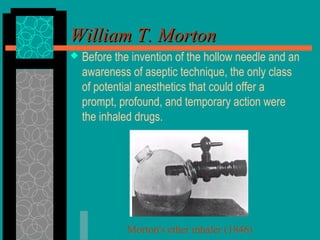
 Before the invention of the hollow needle and an
awareness of aseptic technique, the only class
of potential anesthetics that could offer a
prompt, profound, and temporary action were
the inhaled drugs.
Morton's ether inhaler (1846)
OBG ANESTHESIAOBG ANESTHESIA
 James Young Simpson, a successful obstetrician of
Edinburgh, Scotland, had been among the first to use
ether for the relief of the pain of labor.
 Less than a year after administering the first
anesthesia during childbirth, Simpson addressed
these concerns in a pamphlet entitled “Answers to
the Religious Objections Advanced Against the
Employment of Anaesthetic Agents in Midwifery and
Surgery and Obstetrics.”
 But it was John Snow (1813–1858), an English
contemporary of the Scottish Simpson, who achieved
fame as an obstetric anesthetist by treating Queen
Victoria - chloroform à la reine.
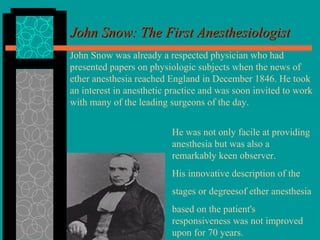
John Snow: The First AnesthesiologistJohn Snow: The First Anesthesiologist
John Snow was already a respected physician who had
presented papers on physiologic subjects when the news of
ether anesthesia reached England in December 1846. He took
an interest in anesthetic practice and was soon invited to work
with many of the leading surgeons of the day.
He was not only facile at providing
anesthesia but was also a
remarkably keen observer.
His innovative description of the
stages or degreesof ether anesthesia
based on the patient's
responsiveness was not improved
upon for 70 years.
John Snow's face mask
(1847).
The expiratory valve can be
tilted to the side to allow the
patient to breathe air.
John Snow's ether inhaler (1847).
The ether chamber (B) contained a
spiral coil so that the air entering
through the brass tube (D) was saturated
by ether before ascending the flexible
tube (F) to the face mask (G).
The ether chamber rested in a bath
of warm water (A).
John Snow: The First AnesthesiologistJohn Snow: The First Anesthesiologist
Ethyl chlorideEthyl chloride
 Ethyl chloride and ethylene were first formulated in the
18th century, and had been examined as anesthetics in
Germany soon after the discovery of ether's action; but
they were ignored for decades.
 Ethyl chloride retained some use as a topical anesthetic
and counterirritant. It was so volatile that the skin
transiently “froze” after ethyl chloride was sprayed upon it.
 Its rediscovery as an anesthetic came in 1894, when a
Swedish dentist sprayed ethyl chloride into a patient's
mouth to “freeze” a dental abscess. Carlson was
surprised to discover that his patient suddenly lost
consciousness.
 Ethyl chloride became a commonly employed inhaled
anesthetic in several countries.
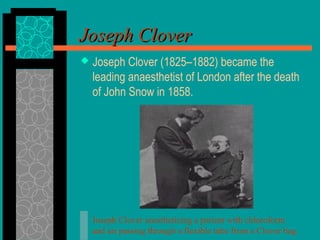
Joseph CloverJoseph Clover
 Joseph Clover (1825–1882) became the
leading anaesthetist of London after the death
of John Snow in 1858.
Joseph Clover anesthetizing a patient with chloroform
and air passing through a flexible tube from a Clover bag.
 Clinicians now accept Clover's monitoring of
the pulse as a simple routine of prudent
practice, but in Clover's time this was a
contentious issue.
 Clover was the first anaesthetist to administer
chloroform in known concentrations through
the Clover bag.
 After 1870, Clover favored a nitrous oxide–
ether sequence. The portable anesthesia
machines that he designed were in popular
use for decades after his death.
 He was the first Englishman to urge the now
universal practice of thrusting the patient's jaw
forward to overcome obstruction of the upper
airway by the tongue.
Joseph CloverJoseph Clover
The first English anaesthetist to beThe first English anaesthetist to be
knighted, Sir Frederick Hewitt.knighted, Sir Frederick Hewitt.
 Frederick Hewitt (1857–1916) gained the first of
his London hospital anesthesia appointments in
1884.
 He earned a reputation as a superb and
inventive clinician and came to be considered
the leading British practitioner of the next 30
years.
 Hewitt engineered modifications of portable
ether and nitrous oxide inhalers and,
recognizing that nitrous oxide and air formed a
hypoxic mixture, designed the first anesthetic
apparatus to deliver oxygen and nitrous oxide in
variable proportions.
 He also was influential in ensuring that
anesthesia was taught in all British medical
schools.
 His book, Anaesthetics and Their Administration,
which first appeared in 1893 and continued
through five editions, is considered the first true
textbook of anesthesia.
 In 1908, Hewitt developed an important appliance
that would assist all anesthesiologists in
managing an obstructed upper airway. He called
his oral device an “air-way restorer,” thus
beginning the practice of inserting an airway to
The first English anaesthetist to beThe first English anaesthetist to be
knighted, Sir Frederick Hewitt.knighted, Sir Frederick Hewitt.
Nitrous oxideNitrous oxide
 During this period, however, Americans led
the revival of nitrous oxide.
 Gardner Q. Colton, the “professor” who had
first demonstrated the use of nitrous oxide to
Horace Wells, developed the Colton Dental
Association after he returned from the
California gold rush.
 In several eastern cities he opened offices equipped
with nitrous oxide generators and, larger breathing
bags of 30-L capacity. By 1869, his advertisements
carried the intriguing slogan “31½ Miles Long.”
 Colton had asked each patient to sign his name to a
scroll, which then contained the names of 55,000
patients who had experienced painless extractions of
teeth without hazard. He proposed that if this great
number of patients were to march past in single file,
the line would be extended for 31½ miles.
Nitrous oxideNitrous oxide
Oxygen–nitrous oxideOxygen–nitrous oxide
 The following year a Chicago surgeon, Edmund
Andrews, experimented with an oxygen–nitrous
oxide mixture and proved that nitrous oxide does
not cause anesthesia by depriving the brain of
oxygen.
 Although the oxygen–nitrous oxide mixture was
safer, he identified a handicap to its use that was
unique to that time when patients were attended
in their homes.
 The large bag was conspicuous and awkward to carry
whenever Andrews walked along busy streets. He
observed that, “In city practice, among the higher
classes, however, this is no obstacle as the bag can
always be taken in a carriage, without attracting
attention.”
 23 Four years later, Andrews was delighted to report the
availability of liquefied nitrous oxide compressed under
750 lb of pressure, which allowed a supply sufficient for
three patients to be carried in a single cylinder.
 Despite Andrews' early enthusiasm, few American
surgeons relied on nitrous oxide until it was used in
combination with regional anesthesia, the last great
contribution to anesthetic practice achieved in the late
Oxygen–nitrous oxideOxygen–nitrous oxide
The Discovery of RegionalThe Discovery of Regional
Anesthesia in the 19 CenturyAnesthesia in the 19 Century
 Cocaine, an extract of the coca leaf, was the
first effective local anesthetic.
 In 1884, Koller's friend, Sigmund Freud,
became interested in the cerebral-stimulating
effects of cocaine and gave him a small
sample in an envelope, which he placed in his
pocket.
 When the envelope leaked, a few grains of
cocaine stuck to Koller's finger, which he
casually licked with his tongue.
It became numb.
 At that moment, Koller realized that he had
found the object of his search. He dashed to
the laboratory and made a suspension of
cocaine crystals. He and Gustav Gartner, a
laboratory associate, observed its anesthetic
effect on the eyes of a frog, a rabbit, and a
dog before they dropped the solution onto
their own corneas. To their amazement, their
eyes were insensitive to the touch of a pin.
The Discovery of RegionalThe Discovery of Regional
Anesthesia in the 19 CenturyAnesthesia in the 19 Century
Spinal anesthesiaSpinal anesthesia
 The term spinal anesthesia was coined in
1885 by Leonard Corning, a neurologist who
had observed Hall and Halsted.
 Corning wanted to assess the action of
cocaine as a specific therapy for neurologic
problems. After first assessing its action in a
dog, producing a blockade of rapid onset that
was confined to the animal's rear legs, he
administered cocaine to a man “addicted to
masturbation.” Corning administered one dose
without effect, then after a second dose, the
patient's legs “felt sleepy.”
 The man had impaired sensibility in his lower
extremity after about twenty minutes. He left
Corning's office “none the worse for the
experience.”25 Although Corning does not refer
to the escape of cerebrospinal fluid (CSF) in
either case, it is likely that the dog had a spinal
anesthetic and that the man had an epidural
anesthetic.
 No therapeutic benefit was described, but
Corning closed his account and his attention to
the subject by suggesting that cocainization
might in time be “a substitute for etherization in
genito-urinary or other branches of surgery.”
Spinal anesthesiaSpinal anesthesia
Before 1907, several anesthesiologists
were disappointed to observe that their
spinal anesthetics were incomplete.
Most believed that the drug spread solely
by local diffusion before this phenomenon
was investigated by Arthur Barker, a
London surgeon. Barker constructed a
glass tube shaped to follow the curves of
the human spine and used it to
demonstrate the limited spread of colored
solutions that he had injected through a T-
piece in the lumbar region.
Spinal anesthesiaSpinal anesthesia
 Barker applied this observation to use solutions of
stovaine made hyperbaric by the addition of 5%
glucose, which worked in a more predictable fashion.
After the injection was complete, Barker placed his
patient's head on pillows to contain the anesthetic
below the nipple line.
 Lincoln Sise acknowledged Barker's work in 1935 when
he introduced the use of hyperbaric solutions of
pontocaine.
 John Adriani advanced the concept further in 1946
when he used a hyperbaric solution to produce “saddle
block,” or perineal anesthesia. Adriani's patients
remained seated after injection as the drug descended
to the sacral nerves.
Spinal anesthesiaSpinal anesthesia
Epidural AnesthesiaEpidural Anesthesia
 In 1949, Martinez Curbelo of Havana,
Cuba, used Tuohy's needle and a ureteral
catheter to perform the first continuous
epidural anesthetic. Silk and gum elastic
catheters were difficult to sterilize and
sometimes caused dural infections before
being superseded by disposable plastics.
 The neurologist Jean Athanase Sicard
applied the technique for a nonsurgical
purpose, the relief of back pain.
 Fernand Cathelin used caudal anesthesia as a less
dangerous alternative to spinal anesthesia for
hernia repairs. He also demonstrated that the
epidural space terminated in the neck by injecting
a solution of India ink into the caudal canal of a
dog. The lumbar approach was first used solely for
multiple paravertebral nerve blocks before the
Pagés–Dogliotti single-injection technique became
accepted.
 Ten years later, Achille M. Dogliotti of Turin, Italy,
wrote a classic study that made the epidural
technique well known.
Epidural AnesthesiaEpidural Anesthesia
Regional AnesthesiaRegional Anesthesia
 In 1902, Harvey Cushing coined the phrase
“regional anesthesia” for his technique of blocking
either the brachial or sciatic plexus under direct
vision during general anesthesia to reduce
anesthesia requirements and provide postoperative
pain relief.
 Fifteen years before his publication, a similar
approach had been energetically advanced to
reduce the stress and shock of surgery by George
Crile, another dedicated advocate of regional and
infiltration techniques during general anesthesia.
 An intravenous regional technique with procaine
was reported in 1908 by August Bier, the surgeon
who had pioneered spinal anesthesia.
 Bier injected procaine into a vein of the upper limb
between two tourniquets.
 Even though the technique is termed the Bier block,
it was not used for many decades until it was
reintroduced 55 years later by Mackinnon Holmes,
who modified the technique by exsanguination
before applying a single proximal cuff.
 Holmes used lidocaine, the very successful amide
local anesthetic synthesized in 1943 by Lofgren and
Lundquist of Sweden.
Regional AnesthesiaRegional Anesthesia
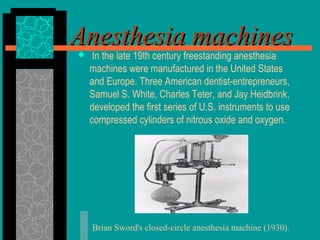
Anesthesia machinesAnesthesia machines In the late 19th century freestanding anesthesia
machines were manufactured in the United States
and Europe. Three American dentist-entrepreneurs,
Samuel S. White, Charles Teter, and Jay Heidbrink,
developed the first series of U.S. instruments to use
compressed cylinders of nitrous oxide and oxygen.
Brian Sword's closed-circle anesthesia machine (1930).
Flow MetersFlow Meters
 In 1910, M. Neu had been the first to apply
rotameters in anesthesia for the
administration of nitrous oxide and oxygen,
but his machine was not a commercial
success, perhaps because of the great cost
of nitrous oxide in Germany at that time.
 Rotameters designed for use in German
industry were first employed in Britain in
1937 by Richard Salt; but as World War II
approached, the English were denied access
to these sophisticated flow meters.
 After World War II rotameters became
regularly employed in British anesthesia
machines, although most American
equipment still featured nonrotating floats.
 The now universal practice of displaying gas
flow in liters per minute was not a uniform
part of all American machines until more than
a decade after World War II.
Flow MetersFlow Meters
VaporizersVaporizers
 The Copper Kettle was the first temperature-
compensated, accurate vaporizer. It had
been developed by Lucien Morris at the
University of Wisconsin in response to Ralph
Waters' plan to test chloroform by giving it in
controlled concentrations.
Tracheal Intubation in AnesthesiaTracheal Intubation in Anesthesia
 The first tracheal tubes were developed for the resuscitation
of drowning victims, but were not used in anesthesia until
1878. Although John Snow and others had already
anesthetized patients by means of a tracheostomy, the first
use of elective oral intubation for an anesthetic was
undertaken by a Scottish surgeon, William Macewan. He
had practiced passing flexible metal tubes through the larynx
of a cadaver before attempting the maneuver on an awake
patient with an oral tumor at the Glasgow Royal Infirmary,
on July 5, 1878.
Kuhn's endotracheal tube.
The tube and introducer were
guided to the trachea by the fingers
of the operator's left hand.
Anesthesiologist Inspired LaryngoscopesAnesthesiologist Inspired Laryngoscopes
 Early practitioners of intubation of the
trachea were frustrated by laryngoscopes
that were cumbersome, ill designed for the
prevention of dental injury, and offered only
a very limited view of the larynx.
 Before the introduction of muscle relaxants,
intubation of the trachea was often a severe
challenge. It was in that period, however,
that two blades were invented that became
the classic models of the straight and
curved laryngoscope.
 Robert Miller of San Antonio, Texas, and
Robert Macintosh of Oxford University
created two blades that have maintained
lasting popularity. Both laryngoscopes
appeared within an interval of 2 years.
 In 1941, Miller brought forward a slender,
straight blade with a slight curve near the tip
to ease the passage of the tube through the
larynx. Although Miller's blade was a
refinement, the technique of its use was
identical to that of earlier models as the
epiglottis was lifted to expose the larynx.
Anesthesiologist Inspired LaryngoscopesAnesthesiologist Inspired Laryngoscopes
Endobronchial TubesEndobronchial Tubes
 Talented observers may recognize a therapeutic
opportunity when presented with what at first appears
to be a frustrating complication.
 After a patient experienced an accidental
endobronchial intubation, Ralph Waters reasoned
that a very long cuffed tube could be used to ventilate
the dependent lung while the upper lung was being
resected.
 On learning of his friend's success with intentional
one-lung anesthesia, Arthur Guedel proposed an
important modification for chest surgery, the double-
cuffed single-lumen tube, which was introduced by
Emery Rovenstine. These tubes were easily
positioned, an advantage over bronchial blockers that
had to be inserted by a skilled bronchoscopist.
Intravenous AnestheticsIntravenous Anesthetics
 A firm understanding of the circulation, along
with adequate intravenous (iv) access, was
necessary before drugs could be
administered directly into a patient's
bloodstream. Both of these aspects were
firmly in place well before an appropriate iv
anesthetic was devised.
 In 1909, a German, Ludwig Burkhardt,
produced surgical anesthesia by intravenous
injections of chloroform and ether.
 Seven years later, Elisabeth Bredenfeld of
Switzerland reported the use of intravenous
morphine and scopolamine. Those trials failed
to show an improvement over inhaled
techniques. None of the drugs had an action
that was both prompt and sufficiently
abbreviated.
 The first barbiturate, barbital, was synthesized
in 1903 by Fischer and von Mering.
Intravenous AnestheticsIntravenous Anesthetics
TO BE CONTINUED…TO BE CONTINUED…
QUEsTIONs???QUEsTIONs???
THANK YOU!!!THANK YOU!!!

anesthesia history

  • 1.
  • 2.
  • 3.
    The 16 ofOctober 1846 marked the start of a silent revolution in medicine.  William T. G. Morton provided anesthesia to a patient named Edward Gilbert Abbott, administering diethyl ether prior to the surgical removal of a vascular lesion from the side of Mr. Abbott's neck.
  • 4.
    ““Prehistory”Prehistory”  The Romanwriter Celsius encouraged “pitilessness” as an essential characteristic of the surgeon  Authors of leading surgical texts often ignored surgical pain as a topic of discussion  In Liston's time, as in the countless ages before, pain was considered primarily a symptom of importance
  • 5.
    Despite this sentiment,many differentDespite this sentiment, many different agents were used to achieve anesthesia.agents were used to achieve anesthesia.  A physician from the first century A.D., commented upon mandragora.  He stated that the plant substance could be boiled in wine and strained, and used “in the case of persons . . . about to be cut or cauterized, when they wish to produce anesthesia.”  Mandragora was still being used to anesthetize patients as late as the 17th century.
  • 6.
    From the 9thto the 13th centuriesFrom the 9th to the 13th centuries  The soporific sponge was a dominant mode of providing pain relief during surgery.  Mandrake leaves, along with black nightshade, poppies, and other herbs, were boiled together and cooked onto a sponge.
  • 7.
     The spongewas then reconstituted in hot water, and placed under the patient's nose prior to surgery. Prepared as indicated by published reports of the time, the sponge generally contained morphine and scopolamine in varying amounts— drugs used in modern anesthesia.  In addition to using the “sleeping sponge,” europeans attempted to relieve pain by hypnosis, by the ingestion of alcohol, herbs, and extracts of botanical preparations, and by the topical application of pressure or ice. From the 9th to the 13th centuriesFrom the 9th to the 13th centuries
  • 8.
    Diethyl etherDiethyl ether Paracelsus (1493–1541) observed that diethyl ether caused chickens to fall asleep and awaken unharmed. He must have been aware of its analgesic qualities, because he reported that it could be recommended for use in painful illnesses. There is, however, no record that his suggestion was followed.  An inexpensive recreational drug among the poor of Britain and Ireland, who sometimes drank an ounce or two of ether when taxes made gin prohibitively expensive. An American variation of this practice was conducted by groups of students who held ether- soaked towels to their faces at nocturnal “ether frolics.”
  • 9.
    Nitrous oxideNitrous oxide Nitrous oxide was first prepared in 1773 by Joseph Priestley, an English clergyman and scientist, who ranks among the great pioneers of chemistry.  Like ether, nitrous oxide was known for its ability to induce lightheadedness and was often inhaled by those seeking a thrill.  It was not used as frequently as was ether because it was more complex to prepare and awkward to store.
  • 10.
     A dedicatedinterest in the potential use of gases as remedies for scurvy, tuberculosis, and other diseases led Thomas Beddoes to open his Pneumatic Institute close to the small spa of Hotwells, in the city of Bristol, where he hired Humphry Davy in 1798 to conduct research projects.  Humphry Davy (1778–1829) was a young man of ability and drive. He performed a brilliant series of investigations of several gases but focused much of his attention on nitrous oxide, which he and his associates inhaled through face masks designed for the Institute by James Watt, the distinguished inventor of the steam engine. Nitrous oxideNitrous oxide
  • 11.
     “As nitrousoxide in its extensive operation appears capable of destroying physical pain, it may probably be used with advantage during surgical operations in which no great effusion of blood takes place.”  Although Davy did not pursue this prophecy, perhaps because he was set on a career in basic research, he did coin the persisting sobriquet for nitrous oxide, “laughing gas.” Nitrous oxideNitrous oxide
  • 12.
     William E.Clarke may have given the first ether anesthetic in Rochester, New York, in January 1842.  On March 30, 1842, Crawford Williamson Long (1815–1878) administered ether with a towel for surgical anesthesia in Jefferson, Georgia.  Horace Wells' great moment of discovery came on December 10, 1844, when he attended a lecture-exhibition by an itinerant “scientist,” Gardner Quincy Colton, who prepared nitrous oxide and encouraged members of the audience to inhale the gas.
  • 13.
    William T. MortonWilliamT. Morton  Before the invention of the hollow needle and an awareness of aseptic technique, the only class of potential anesthetics that could offer a prompt, profound, and temporary action were the inhaled drugs. Morton's ether inhaler (1846)
  • 14.
    OBG ANESTHESIAOBG ANESTHESIA James Young Simpson, a successful obstetrician of Edinburgh, Scotland, had been among the first to use ether for the relief of the pain of labor.  Less than a year after administering the first anesthesia during childbirth, Simpson addressed these concerns in a pamphlet entitled “Answers to the Religious Objections Advanced Against the Employment of Anaesthetic Agents in Midwifery and Surgery and Obstetrics.”  But it was John Snow (1813–1858), an English contemporary of the Scottish Simpson, who achieved fame as an obstetric anesthetist by treating Queen Victoria - chloroform à la reine.
  • 15.
    John Snow: TheFirst AnesthesiologistJohn Snow: The First Anesthesiologist John Snow was already a respected physician who had presented papers on physiologic subjects when the news of ether anesthesia reached England in December 1846. He took an interest in anesthetic practice and was soon invited to work with many of the leading surgeons of the day. He was not only facile at providing anesthesia but was also a remarkably keen observer. His innovative description of the stages or degreesof ether anesthesia based on the patient's responsiveness was not improved upon for 70 years.
  • 16.
    John Snow's facemask (1847). The expiratory valve can be tilted to the side to allow the patient to breathe air. John Snow's ether inhaler (1847). The ether chamber (B) contained a spiral coil so that the air entering through the brass tube (D) was saturated by ether before ascending the flexible tube (F) to the face mask (G). The ether chamber rested in a bath of warm water (A). John Snow: The First AnesthesiologistJohn Snow: The First Anesthesiologist
  • 17.
    Ethyl chlorideEthyl chloride Ethyl chloride and ethylene were first formulated in the 18th century, and had been examined as anesthetics in Germany soon after the discovery of ether's action; but they were ignored for decades.  Ethyl chloride retained some use as a topical anesthetic and counterirritant. It was so volatile that the skin transiently “froze” after ethyl chloride was sprayed upon it.  Its rediscovery as an anesthetic came in 1894, when a Swedish dentist sprayed ethyl chloride into a patient's mouth to “freeze” a dental abscess. Carlson was surprised to discover that his patient suddenly lost consciousness.  Ethyl chloride became a commonly employed inhaled anesthetic in several countries.
  • 18.
    Joseph CloverJoseph Clover Joseph Clover (1825–1882) became the leading anaesthetist of London after the death of John Snow in 1858. Joseph Clover anesthetizing a patient with chloroform and air passing through a flexible tube from a Clover bag.
  • 19.
     Clinicians nowaccept Clover's monitoring of the pulse as a simple routine of prudent practice, but in Clover's time this was a contentious issue.  Clover was the first anaesthetist to administer chloroform in known concentrations through the Clover bag.  After 1870, Clover favored a nitrous oxide– ether sequence. The portable anesthesia machines that he designed were in popular use for decades after his death.  He was the first Englishman to urge the now universal practice of thrusting the patient's jaw forward to overcome obstruction of the upper airway by the tongue. Joseph CloverJoseph Clover
  • 20.
    The first Englishanaesthetist to beThe first English anaesthetist to be knighted, Sir Frederick Hewitt.knighted, Sir Frederick Hewitt.  Frederick Hewitt (1857–1916) gained the first of his London hospital anesthesia appointments in 1884.  He earned a reputation as a superb and inventive clinician and came to be considered the leading British practitioner of the next 30 years.  Hewitt engineered modifications of portable ether and nitrous oxide inhalers and, recognizing that nitrous oxide and air formed a hypoxic mixture, designed the first anesthetic apparatus to deliver oxygen and nitrous oxide in variable proportions.
  • 21.
     He alsowas influential in ensuring that anesthesia was taught in all British medical schools.  His book, Anaesthetics and Their Administration, which first appeared in 1893 and continued through five editions, is considered the first true textbook of anesthesia.  In 1908, Hewitt developed an important appliance that would assist all anesthesiologists in managing an obstructed upper airway. He called his oral device an “air-way restorer,” thus beginning the practice of inserting an airway to The first English anaesthetist to beThe first English anaesthetist to be knighted, Sir Frederick Hewitt.knighted, Sir Frederick Hewitt.
  • 22.
    Nitrous oxideNitrous oxide During this period, however, Americans led the revival of nitrous oxide.  Gardner Q. Colton, the “professor” who had first demonstrated the use of nitrous oxide to Horace Wells, developed the Colton Dental Association after he returned from the California gold rush.
  • 23.
     In severaleastern cities he opened offices equipped with nitrous oxide generators and, larger breathing bags of 30-L capacity. By 1869, his advertisements carried the intriguing slogan “31½ Miles Long.”  Colton had asked each patient to sign his name to a scroll, which then contained the names of 55,000 patients who had experienced painless extractions of teeth without hazard. He proposed that if this great number of patients were to march past in single file, the line would be extended for 31½ miles. Nitrous oxideNitrous oxide
  • 24.
    Oxygen–nitrous oxideOxygen–nitrous oxide The following year a Chicago surgeon, Edmund Andrews, experimented with an oxygen–nitrous oxide mixture and proved that nitrous oxide does not cause anesthesia by depriving the brain of oxygen.  Although the oxygen–nitrous oxide mixture was safer, he identified a handicap to its use that was unique to that time when patients were attended in their homes.
  • 25.
     The largebag was conspicuous and awkward to carry whenever Andrews walked along busy streets. He observed that, “In city practice, among the higher classes, however, this is no obstacle as the bag can always be taken in a carriage, without attracting attention.”  23 Four years later, Andrews was delighted to report the availability of liquefied nitrous oxide compressed under 750 lb of pressure, which allowed a supply sufficient for three patients to be carried in a single cylinder.  Despite Andrews' early enthusiasm, few American surgeons relied on nitrous oxide until it was used in combination with regional anesthesia, the last great contribution to anesthetic practice achieved in the late Oxygen–nitrous oxideOxygen–nitrous oxide
  • 26.
    The Discovery ofRegionalThe Discovery of Regional Anesthesia in the 19 CenturyAnesthesia in the 19 Century  Cocaine, an extract of the coca leaf, was the first effective local anesthetic.  In 1884, Koller's friend, Sigmund Freud, became interested in the cerebral-stimulating effects of cocaine and gave him a small sample in an envelope, which he placed in his pocket.  When the envelope leaked, a few grains of cocaine stuck to Koller's finger, which he casually licked with his tongue. It became numb.
  • 27.
     At thatmoment, Koller realized that he had found the object of his search. He dashed to the laboratory and made a suspension of cocaine crystals. He and Gustav Gartner, a laboratory associate, observed its anesthetic effect on the eyes of a frog, a rabbit, and a dog before they dropped the solution onto their own corneas. To their amazement, their eyes were insensitive to the touch of a pin. The Discovery of RegionalThe Discovery of Regional Anesthesia in the 19 CenturyAnesthesia in the 19 Century
  • 28.
    Spinal anesthesiaSpinal anesthesia The term spinal anesthesia was coined in 1885 by Leonard Corning, a neurologist who had observed Hall and Halsted.  Corning wanted to assess the action of cocaine as a specific therapy for neurologic problems. After first assessing its action in a dog, producing a blockade of rapid onset that was confined to the animal's rear legs, he administered cocaine to a man “addicted to masturbation.” Corning administered one dose without effect, then after a second dose, the patient's legs “felt sleepy.”
  • 29.
     The manhad impaired sensibility in his lower extremity after about twenty minutes. He left Corning's office “none the worse for the experience.”25 Although Corning does not refer to the escape of cerebrospinal fluid (CSF) in either case, it is likely that the dog had a spinal anesthetic and that the man had an epidural anesthetic.  No therapeutic benefit was described, but Corning closed his account and his attention to the subject by suggesting that cocainization might in time be “a substitute for etherization in genito-urinary or other branches of surgery.” Spinal anesthesiaSpinal anesthesia
  • 30.
    Before 1907, severalanesthesiologists were disappointed to observe that their spinal anesthetics were incomplete. Most believed that the drug spread solely by local diffusion before this phenomenon was investigated by Arthur Barker, a London surgeon. Barker constructed a glass tube shaped to follow the curves of the human spine and used it to demonstrate the limited spread of colored solutions that he had injected through a T- piece in the lumbar region. Spinal anesthesiaSpinal anesthesia
  • 31.
     Barker appliedthis observation to use solutions of stovaine made hyperbaric by the addition of 5% glucose, which worked in a more predictable fashion. After the injection was complete, Barker placed his patient's head on pillows to contain the anesthetic below the nipple line.  Lincoln Sise acknowledged Barker's work in 1935 when he introduced the use of hyperbaric solutions of pontocaine.  John Adriani advanced the concept further in 1946 when he used a hyperbaric solution to produce “saddle block,” or perineal anesthesia. Adriani's patients remained seated after injection as the drug descended to the sacral nerves. Spinal anesthesiaSpinal anesthesia
  • 32.
    Epidural AnesthesiaEpidural Anesthesia In 1949, Martinez Curbelo of Havana, Cuba, used Tuohy's needle and a ureteral catheter to perform the first continuous epidural anesthetic. Silk and gum elastic catheters were difficult to sterilize and sometimes caused dural infections before being superseded by disposable plastics.  The neurologist Jean Athanase Sicard applied the technique for a nonsurgical purpose, the relief of back pain.
  • 33.
     Fernand Cathelinused caudal anesthesia as a less dangerous alternative to spinal anesthesia for hernia repairs. He also demonstrated that the epidural space terminated in the neck by injecting a solution of India ink into the caudal canal of a dog. The lumbar approach was first used solely for multiple paravertebral nerve blocks before the Pagés–Dogliotti single-injection technique became accepted.  Ten years later, Achille M. Dogliotti of Turin, Italy, wrote a classic study that made the epidural technique well known. Epidural AnesthesiaEpidural Anesthesia
  • 34.
    Regional AnesthesiaRegional Anesthesia In 1902, Harvey Cushing coined the phrase “regional anesthesia” for his technique of blocking either the brachial or sciatic plexus under direct vision during general anesthesia to reduce anesthesia requirements and provide postoperative pain relief.  Fifteen years before his publication, a similar approach had been energetically advanced to reduce the stress and shock of surgery by George Crile, another dedicated advocate of regional and infiltration techniques during general anesthesia.
  • 35.
     An intravenousregional technique with procaine was reported in 1908 by August Bier, the surgeon who had pioneered spinal anesthesia.  Bier injected procaine into a vein of the upper limb between two tourniquets.  Even though the technique is termed the Bier block, it was not used for many decades until it was reintroduced 55 years later by Mackinnon Holmes, who modified the technique by exsanguination before applying a single proximal cuff.  Holmes used lidocaine, the very successful amide local anesthetic synthesized in 1943 by Lofgren and Lundquist of Sweden. Regional AnesthesiaRegional Anesthesia
  • 36.
    Anesthesia machinesAnesthesia machinesIn the late 19th century freestanding anesthesia machines were manufactured in the United States and Europe. Three American dentist-entrepreneurs, Samuel S. White, Charles Teter, and Jay Heidbrink, developed the first series of U.S. instruments to use compressed cylinders of nitrous oxide and oxygen. Brian Sword's closed-circle anesthesia machine (1930).
  • 37.
    Flow MetersFlow Meters In 1910, M. Neu had been the first to apply rotameters in anesthesia for the administration of nitrous oxide and oxygen, but his machine was not a commercial success, perhaps because of the great cost of nitrous oxide in Germany at that time.  Rotameters designed for use in German industry were first employed in Britain in 1937 by Richard Salt; but as World War II approached, the English were denied access to these sophisticated flow meters.
  • 38.
     After WorldWar II rotameters became regularly employed in British anesthesia machines, although most American equipment still featured nonrotating floats.  The now universal practice of displaying gas flow in liters per minute was not a uniform part of all American machines until more than a decade after World War II. Flow MetersFlow Meters
  • 39.
    VaporizersVaporizers  The CopperKettle was the first temperature- compensated, accurate vaporizer. It had been developed by Lucien Morris at the University of Wisconsin in response to Ralph Waters' plan to test chloroform by giving it in controlled concentrations.
  • 40.
    Tracheal Intubation inAnesthesiaTracheal Intubation in Anesthesia  The first tracheal tubes were developed for the resuscitation of drowning victims, but were not used in anesthesia until 1878. Although John Snow and others had already anesthetized patients by means of a tracheostomy, the first use of elective oral intubation for an anesthetic was undertaken by a Scottish surgeon, William Macewan. He had practiced passing flexible metal tubes through the larynx of a cadaver before attempting the maneuver on an awake patient with an oral tumor at the Glasgow Royal Infirmary, on July 5, 1878. Kuhn's endotracheal tube. The tube and introducer were guided to the trachea by the fingers of the operator's left hand.
  • 41.
    Anesthesiologist Inspired LaryngoscopesAnesthesiologistInspired Laryngoscopes  Early practitioners of intubation of the trachea were frustrated by laryngoscopes that were cumbersome, ill designed for the prevention of dental injury, and offered only a very limited view of the larynx.  Before the introduction of muscle relaxants, intubation of the trachea was often a severe challenge. It was in that period, however, that two blades were invented that became the classic models of the straight and curved laryngoscope.
  • 42.
     Robert Millerof San Antonio, Texas, and Robert Macintosh of Oxford University created two blades that have maintained lasting popularity. Both laryngoscopes appeared within an interval of 2 years.  In 1941, Miller brought forward a slender, straight blade with a slight curve near the tip to ease the passage of the tube through the larynx. Although Miller's blade was a refinement, the technique of its use was identical to that of earlier models as the epiglottis was lifted to expose the larynx. Anesthesiologist Inspired LaryngoscopesAnesthesiologist Inspired Laryngoscopes
  • 43.
    Endobronchial TubesEndobronchial Tubes Talented observers may recognize a therapeutic opportunity when presented with what at first appears to be a frustrating complication.  After a patient experienced an accidental endobronchial intubation, Ralph Waters reasoned that a very long cuffed tube could be used to ventilate the dependent lung while the upper lung was being resected.  On learning of his friend's success with intentional one-lung anesthesia, Arthur Guedel proposed an important modification for chest surgery, the double- cuffed single-lumen tube, which was introduced by Emery Rovenstine. These tubes were easily positioned, an advantage over bronchial blockers that had to be inserted by a skilled bronchoscopist.
  • 44.
    Intravenous AnestheticsIntravenous Anesthetics A firm understanding of the circulation, along with adequate intravenous (iv) access, was necessary before drugs could be administered directly into a patient's bloodstream. Both of these aspects were firmly in place well before an appropriate iv anesthetic was devised.  In 1909, a German, Ludwig Burkhardt, produced surgical anesthesia by intravenous injections of chloroform and ether.
  • 45.
     Seven yearslater, Elisabeth Bredenfeld of Switzerland reported the use of intravenous morphine and scopolamine. Those trials failed to show an improvement over inhaled techniques. None of the drugs had an action that was both prompt and sufficiently abbreviated.  The first barbiturate, barbital, was synthesized in 1903 by Fischer and von Mering. Intravenous AnestheticsIntravenous Anesthetics
  • 46.
    TO BE CONTINUED…TOBE CONTINUED…
  • 47.
  • 48.